As our time was so limited and the other stations in the Wasakuma country were only being started, we did not go farther into that land, for it would have taken us at least another week. We met our Kidzu porters, and after great difficulty secured sufficient porters among the Wasakuma people to take us to Nassa, on the southeast corner of the lake. This is a trip of not less than eighteen hours. Our caravan had grown considerably, so that we were no less than ten white missionaries, and over forty boys and porters. To save ourselves the hard trip in the hot sun, we left on the evening after the Sabbath. As there is quite a stretch of sparsely settled country and desert, we marched the twelve hours, all the night through. After we had gone a few hours we found about a thousand of the Wasakuma people gathered on a hilltop having one of their great heathen feasts, which generally last the entire night. Young and old were hastening to the feast, bearing great pots of beer. As we were several porters short, two of the boys were secured as porters, but one of them had already swallowed so much that he had a rather hard time carrying his load.
Toward morning we passed the Kasema Mountain, where is a gold-mine, and we could clearly hear the noise of the machine crushing the gold ore. From five hundred to one thousand natives are employed there. Had it not been for the lack of time, we surely would have called. When we went into camp on December 22, we were all quite tired out and enjoyed our rest that day. As heavy showers came up, we appreciated the advantage of having that much of our journey behind us.
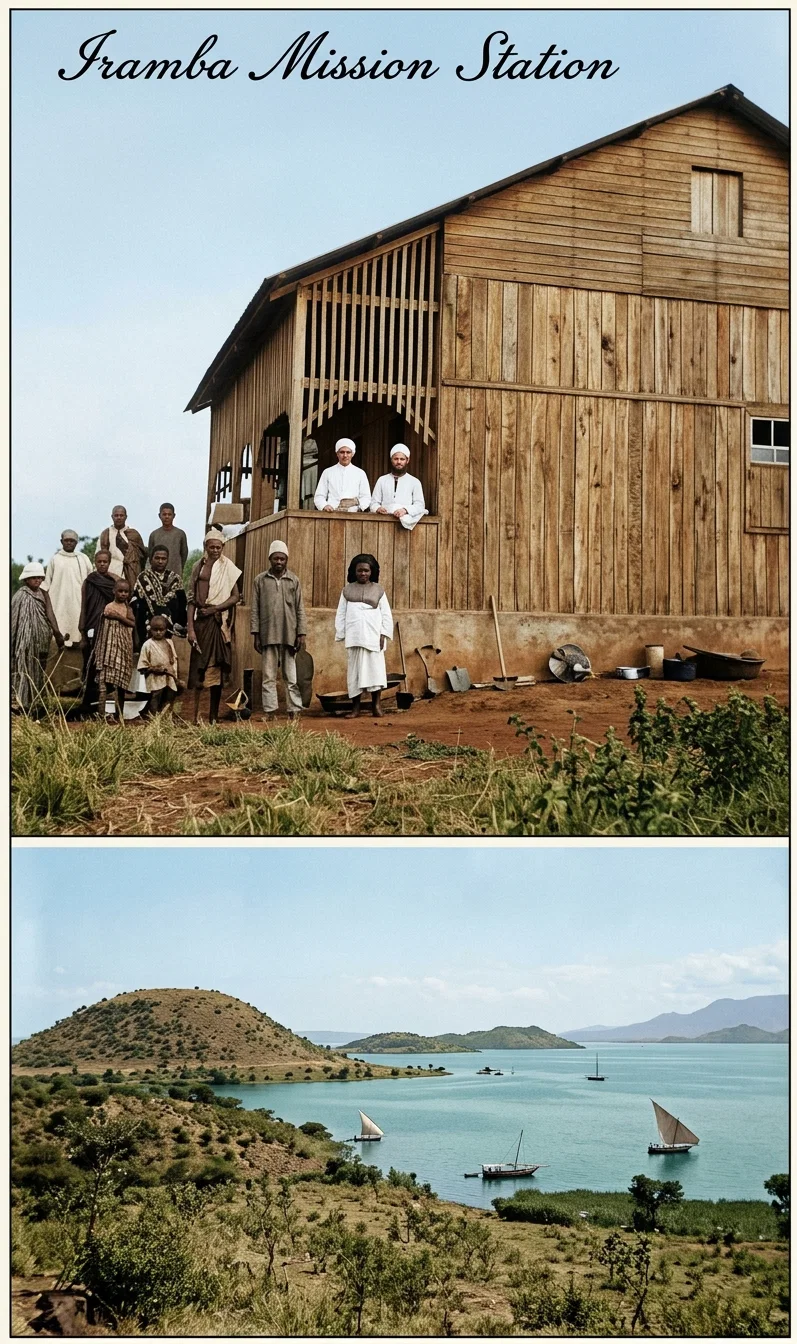
IRAMBA MISSION STATION
LAKE NYANZA FROM SAME MISSION
At 1 P. M. of the twenty-third we reached Nassa, on the Speke Gulf. From early in the morning we had been seeing the cheery waters of the lake, and as we neared it we saw the mast of our mission boat “Herold” awaiting us.
Nassa is an old station of the English Church Mission. Nine years ago when we started in German East Africa we carefully studied its history and thought some of purchasing it, as we knew the society would be willing to dispose of it. Two years ago the African Inland Mission took charge of this station, which is two miles up from the lake. Several of us walked up there to call on the missionaries. Mr. Suwalki, an American Pole, with his wife, is in charge. He is assisted by two other lady workers. They have an out-station besides this, which is at Nera, farther inland. The main mission building had burned down, the large school and church was also in ruins, there was some cultivated land, and another dwelling and school building had been put up. But the buildings and ground were in a condition forming quite a striking contrast to ours.
The Church Mission has four graves here. The African Inland Mission also has lost one man, and his bride, who had come from America, is one of the lady workers still there. When we wanted to visit the school, we found it had just been dismissed. The highest enrolment they report is thirty, but they had at the time scarcely more than half a dozen, and but very few boys living at the station. They had had baptism, but this American society has no real church organization; they pay no fixed salary, giving only an uncertain allowance. Mr. Suwalki would have been glad to attend our general meeting, but he was awaiting orders to be present at a meeting of their society. They have a small hand-press, and expect to get out some hymns in the Wasakuma.
At 10 P. M. we all gladly embarked on our mission boat, rather enjoying its close quarters after so long an overland trip. During the night we crossed the Speke Gulf, and by morning neared Ukerewe, a large island which is separated from the mainland by the narrow Busegwe Channel. The Catholics have old mission stations on the island, but already several of their people have come over to our stations to be taught. This naturally has enraged the missionaries of that body.
The channel, deepened by a German navy official with the help of the natives, was just deep enough in several places to allow our sailboat to pass through. We then entered the Baumann Gulf. Right before us was the high Majita Table-mountain, a leading way-mark on the lake, near which our main station, Majita, is located. But we passed up the gulf, and by noon our Iramba station came in sight. At 3 P. M. we were able to land, and a ten-minute walk brought us to the top of the hill, where the station is located.
A substantial dwelling-house has been erected, together with a good school building, workshops, native huts, etc. Brother Stein and his wife, who went out after the last large Friedensau council, are in charge of the station. We were well entertained in their cozy home. Their grounds are well laid out, and they have a fine view of the lake and bays and islands about them. They have also16about one hundred fifty students, and seem to be doing a good work.
Next morning at seven a fair wind took us across the gulf to Majita Peninsula in two hours. Here we found a well-settled and well-cultivated country. After ascending the hill we saw in the midst of the peninsula on a lofty elevation our main station. A number of the natives had come down to act as porters, and as we passed, the people tilling the land gave us a hearty greeting. At Iramba the sad news reached us that Sister Mertke, our faithful nurse, took ill of the blackwater fever December 21, and was in a dangerous condition.
On reaching the station, we found a splendidly laid-out mission, with good, substantial buildings. Last year Brethren Ohme and Winter erected a good three-room dwelling, where Brother Ohme lives and has his office. We have also a large iron-roofed chapel, which seats fully six hundred persons. Then there are the workshops, girls’ school, some native huts, and the old mission dwelling. But as this old building was put too much into the ground and not cemented, as the other buildings, the white ants had already attacked one end. Dr. Vasenius and Brethren Persson and Wallath arrived soon after we did. We found Sister Mertke in a rather low condition, but were pleased that Sister Ohme and the children and the other missionaries seemed to enjoy good health. Ample preparations had been made for the comfort of all the missionaries, and the natives soon came with baskets of food, etc., from all directions. We had scarcely arrived before the native sultan and his sons called on us. When we reached the station several hundred native boys were lined up, with Brother Winter, and they gave us a hearty reception.
Our main station, which commands a view of the lake from three sides, is surely well located, and is an honor to our work. Several of the German officials have taken extra trouble to come this way and take photographs of the station, but best of all we have been able to get an excellent hold upon the thrifty Majita people. Several hundred of their boys and girls attend the main school, and we have at the foot of the hill near the lake another excellent out-school with about one hundred thirty pupils, who came up on Friday to greet us, and were with us over Sabbath. While the Victoria Nyanza has no lighthouses as yet, and her steamers must anchor overnight, we are indeed thankful to the Lord that Seventh-day Adventist mission stations are planted all along the east coast, and even far inland, as bright beacon-lights. Let us remember them in our prayers.
Malamulo Mission, Nyasaland
By A. E. Ellingworth
A. E. ELLINGWORTH
The vernacular school building is finished and limewashed, and it is well lighted and clean. It needs only the seats finished now, and we shall be ready to start in on another session. In future I expect to spend most of my time in the vernacular school to see that the beginners get a thorough grounding. When thoroughness is neglected here, the weakness is certain to show up when they are put out to teach in the villages. My wife will attend to the Anglo-vernacular school.
I have made two trips to the out-schools recently, the first to those among the hills and the other to the Elephant Marshes, Chiromo District. Those on the plains are finding it difficult to get food; the children leave the villages in the morning to hunt for palm-trees, from which they get a sap to drink, and for roots, or anything they can find to satisfy hunger. The palm sap, if left to work, makes a very powerful intoxicant. Our teachers find it hard to get food; they have to go or send to the hills to buy it. Under these circumstances it is not surprising that some schools have a poor attendance; other schools are well attended and have well-organized Bible classes. On the last trip I took Simon into the schools, and pointing out the weaknesses, gave him hints as to how to strengthen and encourage the resident teacher. While at the villages we held meetings for the people and visited with them. Before leaving Simon I had a long talk with him about the plan of labor and the best line of instruction to give the people. Judging from his letters and the fact that he has not yet returned, he must be putting his heart into the work. I am anxious to get out and see what has been done and its effect upon the people. I think a great deal of Elder Hyatt's methods of evangelical work, and as opportunity offers, intend to put into practise the “little wagon” methods.
We have had Mr. Moore, a Seventh-day Baptist, staying with us for a few days. His colleague, Mr. Wilcox, was also here two days. While over to meet Mr. Wilcox, I called on Mr. Cox, who has an estate near here. He is a brick and tile manufacturer at home, and is now experimenting with tiles here, and he was good enough to let me see the results of his experiments. I have made a start to see if we can not produce tiles also; I am not sure of it yet, but if we can, it will end the continual thatching which has to be done. We have nearly twenty acres of land ready for plowing when the rain comes.
Brother Robinson is away visiting the schools around Blantyre; he also intends taking a run up to Mantandane.
The mission house is now quite a comfortable place with its cement floors. I have to-day finished off the last room in our house also, so we are very comfortably situated. Miss Edie goes out to the villages every day except Sabbath. She is working hard; nothing daunts her.
Traveling Over Bible Lands
THE following post-card from Elder E. E. Frauchiger, superintendent of the Turkish Mission, will be read with interest. The places named may be picked out on a good atlas. The post-card is written from Konia, the old Iconium:—
“It is nearly five months since I left my home to visit places and churches in Asiatic Turkey. My journey has carried me to Samsun, Amasia, Tikat, Sivas, Malatia, Mesereh, Kharput, Diarbekir, Urfa (Mesopotamia), Aintab, Halep, Beirut, Lebanon, Tarsus, Adana, over to Antitaurus (in ice and snow), to Kaisarieh, and now to Konia (Iconium).
“In most of these places we had large meetings, larger than ever before held among our people. I baptized ten persons on the journey. One sees great depression among the people; nevertheless the outlook for the future is good. It was not at all easy to visit some of these places during the war time. I was the only foreigner on the road, so far as I observed. We met hundreds of soldiers who were being gathered from all parts to go to the front. We live constantly in uncertainty as to what we may expect next. Since I left my home in Constantinople, the terrible war has begun. Events go forward rapidly in fulfilment of the prophecy. May the Lord soon finish the work. The church in Konia send their hearty greetings, in which I join.”
One Verse Each Day
REV. ARTHUR TAYLOR, one of the secretaries of the British and Foreign Bible Society, in a report given at the annual meeting in Queen’s Hall, London, recently, told of how a Bible colporteur caught a man out in Tasmania in the gospel net. The story follows:—
“There was another colporteur whom I met in Tasmania. I never met a man of greater humility of spirit joined with a greater courage. He told me how he went to one man and said to him, ‘Do you read your Bible?’ And the man replied, ‘You are a queer one to ask a question like that!’ The colporteur said, ‘Do not take offense at what I am saying.’ The man admitted frankly that he did not read the Bible as he ought to do. ‘Well, now,’ said the colporteur, ‘I want you to do something for me. It is not much. I want you to promise me that you will read one verse every night, only one verse. I am not asking much; and I want you to say one little prayer when you read it. I want you to pray, “Lord, teach me.” Now it is not much, is it?’ And the man agreed to do this. Some time afterward he met our Bible seller again and said, ‘You are a cunning one, you are! Mind you, I have done it; but I do not say that I have not read more than one verse. Do you know, I am beginning to see things as my old mother saw them? She was not so far wrong after all.’”
Pray for Patience
PRAY for patience toward men and patience toward God. Pray for bright eyes to find out the light even in the darkness; pray ever to lean wholly upon God and stay yourself upon him.—C. H. Spurgeon.
The Noon-Hour Prayer
"Evening, and morning, and at noon, will I pray, and cry aloud: and he shall hear my voice." "And the Lord turned the captivity of Job, when he prayed for his friends."
OUR Saviour says: "Ask, and ye shall receive, that your joy may be full." There are many kinds of joy pictured in God's Word, but wondrous indeed is the gladness which fills the heart when a direct answer to prayer is experienced. To pray amid darkness and have God send great light; to pray in the face of a mighty barrier, and see God tear it down before our very eyes; to cry when in dire need and have God swiftly and bounteously supply it—what joy floods the heart at the moment our Father sends such answers! It is the joy of heaven itself, born of God, and its fulness may be ours for the asking. A Texas sister who several months ago asked us to pray for her healing, writes: "God has wonderfully answered your prayers, and has raised me up."
Requests for Prayer
181. A sister in New Hampshire, who is passing through severe trials, begs us to unite in prayer that God will sustain her and keep her faithful to him.
182. A California brother desires prayer for healing.
183. A sister, writing from Iowa, desires prayer for the healing of her aged mother.
184. An afflicted sister in Colorado requests that prayer be offered in her behalf. She suffers from heart and lung trouble.
185. "Please pray for the healing of a dear friend who has tuberculosis," is the request which comes from a Texas sister.
186. Writing from Louisiana, an afflicted sister makes known her desire for prayer that she may be healed from a complication of diseases.
187. An anxious brother in Oregon asks prayer that his wife may be healed of cancer.
188. An Alabama sister writes: "Please pray that I may be healed and avoid an impending operation."
189. An aged colporteur, who is laboring in Missouri, begs us to unite with him in asking the Lord to restore his hearing.
190. Two Indiana sisters request prayer that their health may be restored.
Do Not Murmur
By J. R. WILBUR
J. R. WILBUR
Do not murmur, dear soul, at the sorrow
That God in his wisdom has sent.
Do not think that your life is a failure,
But, trusting in him, be content.
You say that your troubles are many,
And more than you feel you can bear;
This is part of the plan of the Master.
He has promised your troubles to share.
Each sorrow he sends and each burden
But leads to the mansions above.
So murmur no more at his leading,
But trust in his infinite love.
Ranger, N. C.
More Upon the Dress Question
By Carrie R. Moon
MRS. CARRIE R. MOON
THE moral effect of present-day fashions among women is a subject that is being discussed very extensively. The minds of both women and men of the better class are becoming deeply exercised concerning it. There certainly is need of a reform in this matter.
A bill to regulate women’s garb has recently been introduced in the Ohio Legislature, and members are urging its passage. This is loudly denounced by some of the leading women of Chicago.
“Ridiculous!” exclaimed Mrs. Catherine Waugh McCulloch, the suffrage leader. “The idea of a man even suggesting that the men lawmakers of a State should dictate to the women what they should wear!”
Yes, it certainly is ridiculous that women should so far depart from womanly modesty that it would be necessary for men to cry out against their pernicious example.
Mrs. McCulloch continues: “Do you think women would dictate what a man should wear?”
Most assuredly, if a man appeared in public insufficiently or immodestly dressed, women would immediately protest, and the man would most likely be lodged in jail. The laws of the land prohibit men from appearing in public improperly dressed. Why should not women be subject to just such laws if their womanly sense of propriety is not sufficient to make civil law unnecessary?
This is not a matter of little importance. It is tremendous in its influence in molding the characters of the young people of to-day.
The wife of Dr. John C. Hessler, of the James Millikin University, Decatur, Ill., in a recent lecture before the Chicago Woman’s Club, declared that “women attired in the extremes of modern fashion are unconscious contributors to the growth of vice.” She showed that the wrong-doing, or the degradation, of the individual woman affects all womankind, and added: “All womankind is suffering definite moral degradation from prevalent fashions.”
Mrs. Hessler places the blame for this condition, not alone upon the young women, but upon those who are older. They have set the example of wearing in public garments that are fit only to be worn in the privacy of their own rooms. Then she says: “Women have not realized that they have been taking part in the breaking down of barriers between virtue and licentiousness.” This is entirely in harmony with the following:—
“The love of dress endangers the morals, and makes woman the opposite of the Christian lady, characterized by modesty and sobriety. Showy, extravagant dress too often encourages lust in the heart of the wearer, and awakens base passions in the heart of the beholder. God sees that the ruin of the character is frequently preceded by the indulgence of pride and vanity in dress.”
—“Testimonies for the Church,” Vol. IV, page 645. “Vice, disguised in fashion’s garb, intrudes itself among the children.”—Id., page 643.
Seventh-day Adventists have had great light upon the subject of conformity to the fashions of the world. We have been instructed that our dress should be neat and in good taste, but without any attempt to follow the extreme fashions.
“As we see our sisters departing from simplicity in dress and cultivating a love for the fashions of the world, we feel troubled. By taking steps in this direction, they are separating themselves from God. . . .
“It is a shame to our sisters to so forget their holy character and their duty to God as to imitate the fashions of the world. . . . It is so inconsistent with our profession of faith that it makes us ridiculous in the eyes of worldlings. Many a soul who was convinced of the truth has been led to decide against it by the pride and love of the world displayed by our sisters. . . .
“Simplicity of dress will make a sensible woman appear to the best advantage. We judge of a person’s character by the style of dress worn. . . . A modest, godly woman will dress modestly. A refined taste, a cultivated mind, will be revealed in the choice of simple and appropriate attire.”—“Testimonies for the Church,” Vol. IV, pages 628, 641, 643.
Dear sisters, let us be examples in modesty, simplicity, and neatness; and let our dress, as well as our actions, be in harmony with the faith that we profess.
South Bend, Ind.
The Father’s Will
By M. D. Babcock
Back of the loaf is the snowy flour,
And back of the flour the mill;
And back of the mill is the wheat and the shower,
And the sun and the Father’s will.
— M. D. Babcock.
Gathering Sheaves
By Verna Cowan
VERNA COWAN
Gathering sheaves for the Master,
Gathering the ripening grain;
Working in sunshine or shadows,
Working in falling rain.
Gathering sheaves for the Master,
In far-off heathen lands;
Though perils thick surround us,
We gather with willing hands.
Gathering sheaves for the Master,
To all now comes the call.
The daylight fast is fading,
Soon darkness will cover all.
The Message for the Blind
By S. N. Haskell
Thinking the readers of the Review and Herald might be interested in the work we have been doing the past few months in supplying books for the libraries for the blind, we will give some particulars in regard to the work. There is no work more important at the present time than the distribution of message-filled literature. Wars and rumors of wars and storms by sea and land unite with many other tokens in proclaiming that the Lord is coming soon. We can not conceive how it is possible for any one who truly believes these things not to do all in his power to help prepare the people for the coming of the Lord.
There are many thousands of blind people scattered over the country who are not reached by the large quantity of literature that is distributed year by year for the seeing people. Thousands of dollars’ worth of our books have been placed in public libraries for the seeing people, but in the past we have not had one large bound book for the libraries for the blind. The number of blind people is increasing so rapidly that the work of educating them is not all left with the fifty-three State educational institutions for the blind. Many of the public schools in our large cities have a department for the blind. All are taught to read, and a large amount of literature is being printed for the use of the blind.
Some time ago, our attention was especially called to the libraries for the blind, and upon investigation we found that in the most of the States there were circulating libraries for the blind; some of the States have three or four of these libraries. The government carries the books to blind readers and returns them free of postage. There are very few religious books in any of these libraries. There are histories, books on science, educational books of all kinds, and many novels, but little reading-matter that would lead the blind into the kingdom of heaven. The Catholics seem to be the only denomination that has given much attention to the needs of the blind. They are placing many of their books in these libraries.
I just received the late catalogue from one of the largest circulating libraries for the blind in the country, and there are in that library alone twenty-four volumes that the titles reveal to be Catholic books, and others that might be taken for Catholic works.
The Christian Record has for years been doing a good work, and I understand our printing-office at College View has printed fifteen or more tracts for the blind, which are doing much good; but they have not had the facilities with which to print large bound books.
Several agents selling the special number of the Bible Training School have for some time been donating a portion of the profits on each paper sold to create a fund with which to print books for the blind. When sufficient funds had accumulated through the efforts of these faithful agents, we began printing, and now have “Steps to Christ,” “Our Paradise Home,” and the chapter from “Desire of Ages” entitled “The Lord Is Risen” printed in the New York point. Before we did any printing, we communicated with the leading institutions for the blind to ascertain which style of print was most widely used, and found the New York point was read more generally than any other.
As many read the American braille who can not read the New York point, we are having “Steps to Christ” printed in the American braille, and will have it ready for distribution in about two months. All our printing has been done by the American Printing House for the Blind in Kentucky, which is subsidized by the United States government.
We have received requests for the books from libraries in over thirty States, and several of these States already have three or four different libraries where the books are placed. We shall quote a few of the many words of appreciation we have received from the librarians. The following is from one of the large Eastern cities:—
“We were very glad to learn of the three books which have recently been put into embossed type for the blind, and which you so kindly offer to give to this library for the use of the blind readers. We shall be glad indeed to receive them, and feel sure that they will receive good use and be greatly appreciated. Thank you very kindly for extending this offer to us.”
The following was received from one of the States of the Middle West:—
“Your letter concerning the three books of religious literature donated to the blind has been received and contents duly noted. The need of books of this character has long been felt, and I know that many hearts will be gladdened and cheered by them. Perhaps those who donate these books can never conceive of the pleasure and happiness they will bring into many lives. Books mean much more to blind people than the average seeing person can estimate.”
“Anxiously awaiting the new books in behalf of the readers of this library, which number about five hundred, I am, “Very sincerely yours.”
We wish to print “Patriarchs and Prophets” in an abbreviated form for the blind. This will cost about two thousand five hundred dollars. If any one has a stray dollar or two that he does not know what to do with, send it to us and we will use it to help print these books. S. N. Haskell.
South Lancaster, Mass.
Progress of the Work Among the Jews
By F. C. GILBERT
We are glad to report to our brethren and sisters through the REVIEW that the Lord seems to be opening doors and hearts among the Jews for them to hear and to receive the gospel as it is in Jesus. We can see a great change coming over many of them with reference to the gospel of Christ, and we certainly believe that it is the Lord who is opening the way for the message to go among these people.
Thousands of Jews are becoming acquainted with Seventh-day Adventists, and we know that this is having its effect upon them. Many of them are expressing themselves with regard to us and to our work; and we feel certain that this influence will have its effect upon these people.
In correspondence with Jews about the matter of religious legislation, the writer received the following:—
“The somewhat oppressive Sunday laws are certainly a remnant of oppression; and as the Sabbath has been made for man, it is wrong to make it a means of oppression. The Founder of the Christian religion never said that majorities are right, because they happen to be majorities. And it seems to me that the Seventh-day Adventists are doing a good work.
“Thanking you in advance for any information you may send me, I am,
“Yours truly.”
Here is part of a letter from another business man:—
“I am very much pleased to know that a noble body of Christians, better known as Seventh-day Adventists, have come to the front with fundamental principles, and are interpreting the true teaching of the Bible whereby the great principle of Love thy neighbor as thyself could easily be carried out. May God bless them, and open the eyes of others that can not see.
“Thanking you for the kind information,
“Yours truly.”
Here is an extract from a letter from a Jewish rabbi:—
“Of course, as the people who still cling to the Biblical Sabbath day, your denomination is of especial interest to us, and we can not but believe that it lives up to the original Christian doctrines more than does any other Christian sect.
“Very faithfully yours.”
Many letters might be quoted from Jews who are taking an interest in the work being done by our people. For centuries the Christian religion has been such a terrible thing to the Jews that it19takes them a long time to get over the feeling engendered among them. But the Lord Jesus is able to break down all this barrier when the time comes for the work to be done for this people.
In the latest volume from the spirit of prophecy, “The Acts of the Apostles,” are found these words:—
“When this gospel shall be presented in its fulness to the Jews, many will accept Christ as the Messiah. Among Christian ministers there are only a few who feel called upon to labor for the Jewish people; but to those who have been often passed by, as well as to all others, the message of mercy and hope in Christ is to come.
“In the closing proclamation of the gospel, when special work is to be done for classes of people hitherto neglected, God expects his messengers to take particular interest in the Jewish people whom they find in all parts of the earth. As the Old Testament Scriptures are blended with the New in an explanation of Jehovah’s eternal purpose, this will be to many of the Jews as the dawn of a new creation, the resurrection of the soul. As they see the Christ of the gospel dispensation portrayed in the pages of the Old Testament Scriptures, and perceive how clearly the New Testament explains the Old, their slumbering faculties will be aroused, and they will recognize Christ as the Saviour of the world. Many will by faith receive Christ as their Redeemer. To them will be fulfilled the words, ‘As many as received him, to them gave he power to become the sons of God, even to them that believe on his name.’”
“Among the Jews are some who, like Saul of Tarsus, are mighty in the Scriptures, and these will proclaim with wonderful power the immutability of the law of God. The God of Israel will bring this to pass in our day. His arm is not shortened that it can not save. As his servants labor in faith for those who have long been neglected and despised, his salvation will be revealed.”—Pages 380, 381.
These are precious words, and they certainly ought to be a great comfort and to bring much cheer to the hearts of the people of God. For years many have felt that to work for the Jews seemed an impossibility; the prejudice was so strong and the bitterness so intense that the Jews would not listen. But God has said that many will listen, and a great many will accept Christ as their Messiah and Saviour. The reader will notice that the message to the people of God is that they must put forth special efforts for the Jews. And the Lord expects his people to do this. The Saviour would never expect to have his people do a work that could not be done. There is nothing impossible with God. We need to have faith in the promises of God.
There are influences at work to-day even among the Jews which make clear to the student of the Word of God how easily all this can be done. For instance, a short time ago a very prominent Jew, Prof. Israel Abrahams, of Cambridge University, England, teacher of Rabbinics, came to this country on a lecture tour. He traveled from New York to California, addressing tens of thousands of Jews, as well as many thousands of Gentiles. One of his principal addresses among his Jewish brethren was that they should study the New Testament. He urged this in many places in the land, and it is having its effect. The Jewish papers in this country are taking the matter up, and comments and criticisms, favorable and otherwise, are being heard on every side. Thousands of Jews who did not hear Mr. Abrahams are hearing and reading of the views now held by those discussing this suggestion of this Jewish professor, and it can not help making an impression upon the minds of many of the Jews.
It is admitted by many of the Jews that this idea of Mr. Abrahams is original, and many Jewish writers are asking what will be the effect upon the Jews if they accept this suggestion. A few years ago such a suggestion from a Jewish scholar would be unthinkable. The writer well remembers how he used to distribute the New Testament among the Jews, and how many of them felt toward its reception. Many of them still feel the same way. But when the Jewish leaders advocate the reading of this blessed Book, it will mean much in behalf of the gospel work among these people. Then as we, as a people, come in contact with them, and make plain to them that we live out the teachings of the New Testament by keeping the Sabbath and recognizing the obligation of the law of God, it will indeed be a revelation to them; it will be a resurrection to them; it will be as the dawn of a new creation. The principles of present truth should be kept before the Jewish people, that they may see there is a consistency in the teaching of the New Testament, and among the people who profess to follow it.
This testimony of the servant of the Lord also indicates that there are many Jews, like Paul, who will accept the truth. But Saul of Tarsus was a bitter persecutor. God opened his eyes to see, and his heart to believe. We must not get discouraged, then, if some of the Jews are bitter and feel disinclined to receive the truth. Let us do all we can to give it to them, and the Lord will do the rest.
F. C. GILBERT.
Florida
By Carlyle B. Haynes
JACKSONVILLE.—The city effort for Jacksonville, which has been held in Morocco Temple for the last nine weeks, came to an end last night, with a large and attentive audience. When beginning this effort, the writer and the workers associated with him earnestly prayed that it might be a city effort indeed, one which would reach the entire city and bring to the attention of all the inhabitants the truths of the final message. The writer also prayed that we might find at least fifty souls who would accept this message. God has wonderfully answered our prayers in both respects, as well as in many other things.
Through the medium of the newspaper this effort has been made a city effort. Every sermon delivered has received no less than a column and a half report in the paper, and many sermons have received more. Last night’s sermon took up more than two solid columns. There have been sixty consecutive reports in the paper, day after day. This paper covers not only the city, but also the State of Florida, and we have received letters of inquiry from many widely separated places in Florida from persons who have been reading the sermons. We feel that the remarkable work which we have seen accomplished through the newspaper is due alone to the blessing of God.
Among those who have accepted the message are four preachers, three of them colored. The colored people have had the privilege of occupying the gallery at these meetings, and as a result there are nine colored persons who have accepted the Sabbath, including the three preachers just mentioned.
The white clergyman is an ordained minister of another denomination. He and his wife are rejoicing in the truth. He is at the head of an orphans’ home in Denton, Ga. He is planning to attend the General Conference session.
Several visitors in Jacksonville accepted the truth, some of whom have already returned to their homes in other States, and others will do so soon,—one going to Canada, two to North Carolina, two to Missouri, two to Pennsylvania, and four to Georgia. The other converts, we trust, will unite with the church here. We are planning for a baptismal service in about two weeks.
Fifty meetings, in all, have been held in Morocco Temple, which is one of the most magnificent assembly-halls in the South. We have paid for the rent of this hall $1,500, or $30 for each meeting. In addition to this the expenses have been $284.08, making our total expenses for the effort $1,284.08.
The total contributions received amount to $1,369.82. Thus these meetings have cost the conference, exclusive of laborers’ salaries, the sum of $414.26. This will be made up in a few months by the tithe, which many of the new members have already begun to pay.
The effort has resulted not only in the converts we can now count, but also in awakening an interest in the truth on the part of thousands in every part of this great State. In answer to earnest prayer he has poured out upon us his bountiful blessings. All honor and praise belong to him alone.
CARLYLE B. HAYNES.
Field Notes
TWELVE persons in St. Cloud, Fla., have decided to obey the truth.
A CHURCH of thirteen members was organized Sabbath, March 15, at Greeneville, Tenn.
FOUR persons in Lowell, Mass., have recently begun to observe the Sabbath.
ELDER H. J. DIRKSEN reports the baptism of four new Sabbath-keepers in Manitoba, Canada.
AT the close of a series of meetings recently held at Pleasant Hill, Ohio, ten signed the covenant. Others are seriously considering the Sabbath question.
ELDER and Mrs. C. J. Cole have been holding meetings on Haynes Inlet, Coos Bay, southern Oregon. As a result of their efforts twenty-five persons have surrendered their lives to the Lord and decided to keep the Sabbath.