The Youth’s Instructor, Vol. 32, No. 41.

SKETCH OF THE LIFE OF JOHN WESLEY

The Youth’s Instructor

Oct 8, 1884

S. D. A. Publishing Association · Battle Creek, Mich. · Oct 8, 1884

SKETCH OF THE LIFE OF JOHN WESLEY.
John Wesley.
John Wesley.
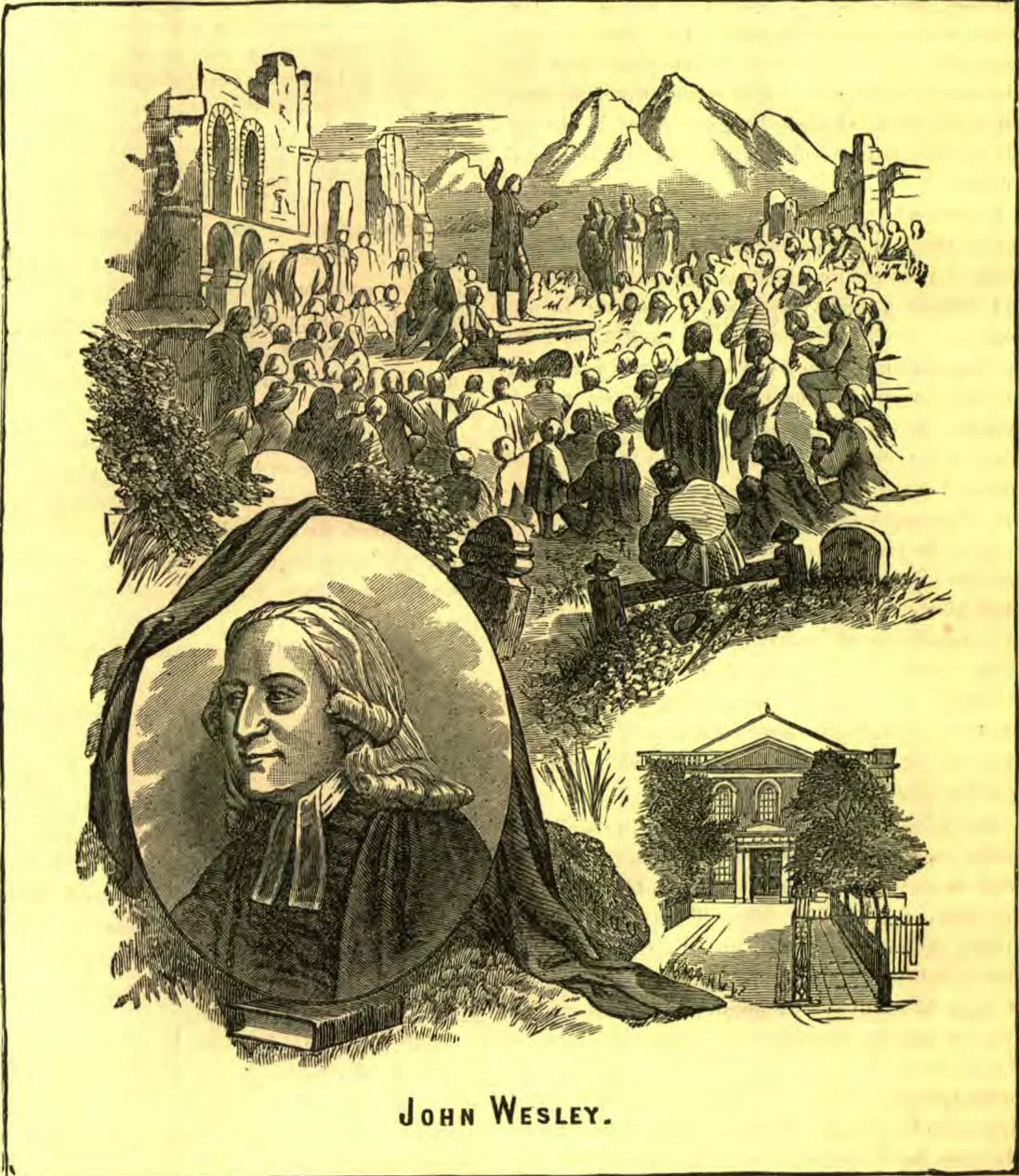
This eminent man was born at Epworth, England, June 17, 1703, and died in London, March 2, 1791, in the eighty-eighth year of his age. It is generally well known that this excellent divine was the founder of the people called Methodists. As might be inferred from the picture, Mr. Wesley was a person of genial disposition, though from his earliest youth he was of a serious turn of mind, and felt that Providence had some important work for him to do.
In early life he had the advantages of a liberal education. At the age of twenty-three he was Greek lecturer in Lincoln College; and shortly after, he graduated as master of arts. He had previously been ordained as a deacon. Not far from this time, he began to assist his father as curate; and a little later, he was regularly ordained as priest in the Church of England. Some two years after, he went to Oxford College, where he entered with great ardor into a religious association of students, his brother, Charles Wesley, and George Whitefield, being prominent members, and to whom, for their zeal and order in religious duties, the term “Methodists” began to be applied.
In 1735 Mr. Wesley came to America with General Oglethorpe, to found a mission among the Indians, and to preach to the colonists. Here he established large and flourishing congregations. While in America, he was often in straightened circumstances as to means, but not, as he says, “without peace, health, and contentment.” In going about his mission work, he had often to wade through swamps, and swim across rivers, to get to his appointments, letting his clothes dry as he traveled. After a brief stay in this country, he recrossed the Atlantic to England, which became the scene of his lifelong labors.
In the year 1739, Mr. Wesley, imitating the example of George Whitefield, began the practice of open-air preaching. It was near the same time also that he felt the Lord had revealed himself with new power to his soul, while listening to the reading of Luther’s “Preface to the Epistle to the Romans.” About this period, lay preaching was established among the people called Methodists, and the labors of Wesley and his associates began to assume the form of a schism in the church. As he was now excluded from the pulpits of the Church of England, he held divine worship in a large building at Moorsfields, among the colliers and others, which, from the fact of its having once been used as a foundery, was afterward known as “the Foundery Church.” This building was subsequently made over into a chapel, and became the center of later operations. In the cut, Wesley is seen preaching from his father’s grave in Epworth, after being refused the privilege of speaking in the state church. His text was, “The kingdom of God is not meat and drink; but righteousness, and peace, and joy in the Holy Ghost.” He says, “At six in the evening I came, and found such a congregation as I believe Epworth never saw before.”
Mr. Wesley now made long journeys to various parts of Great Britain, warning people of all classes to flee from “the wrath to come.” He usually preached twice a day on week days, and often as many as four times a day on Sundays. At Kennington Common he once spoke to an assembly of twenty thousand persons.
This faithful servant of God devoted himself to the work of the gospel with a zeal which is almost unparalleled. It is said by his historian, Doctor Whitehead, that for fifty consecutive years not an instance can be found in which the severest weather kept him from his labors for a single day! He usually journeyed on horseback, seldom traveling less than forty miles a day. He spent sixty-five years in the ministry, going from place to place, convincing gainsayers, warning sinners, comforting the mourning ones, and building up those that believed. It is estimated that in his lifetime he traveled two hundred and seventy thousand miles, and preached over forty thousand sermons, besides his numerous addresses, exhortations, and prayers. As one has observed, “If we consider his abundant labors, we may well say that Mr. Wesley lived two or three lives.”
His industry also was unequaled, except by the apostles themselves. He usually rose at four in the morning, and worked with a will till eight at night, in preaching, reading, writing, meeting the people, traveling, and administering to the spiritual and temporal wants of the sick. His benevolence was unbounded. He literally gave away all that he had, and to the last kept his resolution to die poor. His income was not large, but it is estimated that he gave away in charity during his lifetime one hundred and fifty thousand dollars.
In his social life, Wesley was lively and agreeable. He had great talent for making himself pleasant in company. He was polite and attentive, and talked a great deal where he saw it was expected. Frequently he received invitations from the best families, who wished to show him respect, and who expected to hear him converse on various subjects, religious and otherwise. He had seen much of the world in his travels, and being a great reader, his mind was stored with an infinite number of anecdotes, which, with his agreeable manners, made his conversation very entertaining. In private life, among his friends, his manners were particularly sprightly and pleasant. And this was as conspicuous at nearly ninety years of age, as when a young man of twenty. His temperance principles he carried to great length. But while he never urged these views upon others, he insisted upon the right of being judge of what he deemed best for himself.
Mr. Wesley was a great scholar, being well read in the classics, and thoroughly conversant with the dead languages. When he was unable to quote a text from the English New Testament, he was seldom at loss to repeat it in the Greek. He was also a proficient in many modern tongues. The art of logic he studied with great care. This enabled him to reason correctly, to comprehend things clearly, and to judge truly. In reading, he made accurate notes of men and things, and transcribed them into his journal, which has often been printed. He also held frequent correspondence with the great men of his day,—with bishops, and critics, and lords.
In preaching the doctrine of free grace, Wesley was often persecuted and mobbed, but a kind providence spared his life, sometimes when in the very jaws of death itself. This persecution and injury he bore not only without anger, but without any apparent notice. Though looked upon as a schismatic by the English State Church, this holy man died in her connection, beloved by his own people, and respected by his enemies. The last four days of his earthly existence were spent in praising the Lord.
G. W. A.

AUTUMN

Charming is the dewy spring-time, With its myriad blooms and bird-songs; All its buds are buds of promise, All its breezes rich with perfume.
Summer, too, has joys unnumbered, Roses bloom, and berries ripen; Yet ’tis Autumn brings perfection, Crowning glory of the year.
First we hail the mild September, With its peaches, grapes, and melons; Then in gorgeous robes October, Pensive, patient, quiet, sad.
Bleak November last approaches, Month of rains and wailing winds; Yet her smiles of all are sweetest, In the Indian Summer days.
Spring gives hope; and summer, gladness; Autumn, truly, brings decay; Yet this sober, brown-haired season Dearest is of all to me.
E’en when fruit and leaves have fallen, Warmest colors still she bears; In her heart she carries treasures To glorify the coming year.
So may we, when life declineth, Leave behind us precious fruit, Others to support and strengthen While we slumber ’neath the sod.
W. S.

POLITENESS

A GROUP of boys stood on a street-corner discussing their chances of success in answering an advertisement for an errand-boy in a wholesale dry-goods house near by. Their names and addresses had already been registered, and they were sent off with the remark that the “best boy would be sent for when wanted.”
While they stood talking, an old man, with hair white as snow, bowed back, and trembling hands, came slowly and unsteadily down the street, the only support to his feeble limbs being his stout cane. When a short distance from the boys, the cane dropped from his hand and rolled into the gutter.
“Look there, Billy,” said one of the boys, “the old man’s swamped.”
At this, all the boys but one broke out into a loud laugh.
“He’s shivering as if the winter wind was blowing,” joked another.
But Harry Walton looked serious, and rushing to the gutter, picked up the cane, wiped the mud and water from it, and handed it back to the old man, touching his cap respectfully as he said:—
“Can I assist you, sir?”
“Thank you; you may help me across the street,” replied the old man.
And Harry, taking him by the hand, assisted him over the crossing, and even opened the door of the store for him to enter.
Once inside, he was led to an easy chair in the private office.
“Well, father, I have a large list of names to select from,” said the son in answer to his father’s question. “They all seem sprightly and intelligent, but the one who suits me seems to be slow—yet very polite; in fact, this characteristic pressed itself forcibly upon me.”
“Suppose you summon them all here, and see if I cannot help you out of your difficulty.”
So a postal card was sent to each boy to appear the next day; and at the appointed time, they were on hand.
When they were all gathered together, the old gentleman adjusted his glasses, and said that before the selection would be made, he would tell them a story. And he told of the incident of the day before, and closed by saying that he wished he knew who the lad was.
“Please, sir,” said one of the boys, “that was Harry Walton, and he’s here with us.”
“With you, is he?” spoke up the old man. “Then, James,” turning to his son, “that’s the boy for us.”
“Why, that’s the very boy I thought so slow,” returned the son. “But I guess a boy who is considerate for the aged and infirm must necessarily be fitted for the position.”
The rest of the boys looked confused and uneasy; and as the old gentleman concluded his lecture on politeness, they departed with the determination to follow his advice.
It costs nothing to cultivate good manners, but it pays to have them. The boy or girl who is polite and civil to every one, no matter of what creed or nationality; who practices civility on the street as well as at home, or who has a kind word, or is ready to assist those who cannot help themselves, is always sure to succeed, not only in winning the respect and confidence of the public, but also in getting along in the world. Try it and see!— Philadelphia Call.

EDITOR'S CORNER.

LETTER received for the INSTRUCTOR from a member of the INSTRUCTOR family, a little girl in the West, says her mother was struck by lightning in April, and in consequence had suffered the loss of a foot. She also says that in July, their crops were all swept away by a storm. We have all read or heard of the fearful storms and floods which have been of such frequent occurrence during the last few years, particularly since the early springtime of the present year, and of the hundreds of people who have been left homeless, to say nothing of the great loss of life. Perhaps others of our readers have suffered losses from the same cause.
So long as we are exposed to the angry elements, we do well sometimes to consider the desolation which has thus been made in the earth, in order that we may learn the lessons designed for us, one of which is the uncertainty of riches.
The prophet Jeremiah says, “Let not the rich man glory in his riches.” David says, “If riches increase, set not your heart upon them.” Paul explained to Timothy that “the rich fall into temptations, and a snare, and into many foolish and hurtful lusts, which drown men in destruction; for the love of money is the root of all evil;” and then he says, “Charge them that are rich in this world that they be not highminded, nor trust in uncertain riches.” And why are we thus instructed unless it be as Solomon says, and as has been proved over and over the past summer, that “riches certainly take wings and fly away,” instead of being a sure foundation?
“If the foundations be removed, what can the righteous do?”—“The eyes of the Lord are upon the righteous, and his ears are open unto their cry.” “The righteous cry, and the Lord heareth, and delivereth them out of all their fears.”
But they “that trust in their wealth, and boast themselves in the multitude of their riches,” upon them “he shall rain snares, fire and brimstone, and an horrible tempest; this shall be the portion of their cup.”
The sin of riches consists in setting the heart upon them, upon using them to glorify ourselves, the effect upon us being as Paul stated to Timothy, as previously quoted. Money is needed to carry forward the Lord's work in the earth; and as he has appointed men to do this work, some one must be in the possession of means. If wealth is intrusted to us, it is that we may lay it upon the altar, using it to the glory of God in the advancement of his cause, which is quite another thing from consuming it upon our lusts.
It is the best evidence that God loves us, when he afflicts us. When he strips us of our earthly treasures, it is that we may transfer our affections to him. Does he take wealth, friends, or does he even suffer us to be afflicted in person, it is that he may give us something better in return.
Let us learn the lesson God is now giving the inhabitants of the world,—that “he that layeth up treasure for himself, and is not rich toward God,” will not be prepared to endure earth's final judgments; and should he intrust any means with us, may they be put to that use which will secure to us a good foundation against the time to come; “a treasure in the heavens, which faileth not.” M. J. C.

LIGHT AT EVENTIDE.

The day has been dark and doleful— A day of wind and rain, With the sound of ghostly fingers Upon the window-pane, And never a gleam of sunshine; The cold gray sky has closed In this day for sad remembrance For what our lives have lost.
Weary with vain regretting For things that could not be, Weary with counting over The graves in memory I opened the Book of comfort And in its pages read What one of the grand old prophets, In time of trouble said.
I heard like a voice from heaven The royal singer’s song Of faith in Eternal Goodness To triumph over wrong; The day may be wild with tempest, But in patient trust abide, And remember the sweet old promise Of light at the eventide.
And lo! as I read the chapter So dear to the weary heart, I saw the clouds at sunset, Like curtains swing apart. And it seemed like a glimpse of heaven, That touched my eyes like balm, As I sat in the sunset glory, Repeating the sweet old psalm.
—(Christian Union.)

IMPORTANT BIBLE SUBJECTS.

LESSON 15.—STATE OF THE DEAD.

[NOTE TO THE STUDENT.—Do not consider the lesson learned until you can give at least the substance of every text, with the correct reference for each. The references in black letters indicate those texts that should be committed to memory. A little diligent application each day will enable you to do this.]
“THE writing of Hezekiah, king of Judah, when he had been sick, and was recovered of his sickness: I said in the cutting off of my days, I shall go to the gates of the grave: I am deprived of the residue of my years. I said, I shall not see the Lord, even the Lord, in the land of the living; I shall behold man no more with the inhabitants of the world.” Isa. 38 : 9-11.
“For the grave cannot praise thee, death cannot celebrate thee: they that go down into the pit cannot hope for thy truth. The living, the living, he shall praise thee, as I do this day: the father to the children shall make known thy truth.” Verses 18, 19.
“The dead praise not the Lord, neither any that go down into silence.” Ps. 115 : 17.
“For in death there is no remembrance of thee; in the grave, who shall give thee thanks?” Ps. 6 : 5.
“Put not your trust in princes, nor in the son of man, in whom there is no help. His breath goeth forth, he returneth to his earth; in that very day his thoughts perish.” Ps. 146 : 3, 4.

QUESTIONS.

  1. When King Hezekiah was sick, what message came to him from the Lord? Isa. 38 : 1.
  2. When he received this message, what did he do? Verse 2.
  3. How did he feel at the prospect of death? Verse 3.
  4. In answer to his prayer, what did the Lord promise? Verse 5.
  5. When he had recovered, what reason did he give for the sorrow he had manifested? Verses 9, 10.
  6. Of what did he say he was about to be deprived?
  7. What do you conclude from that statement?
  8. What further reason did Hezekiah give for his sorrow at the prospect of death? Verse 11.
  9. Where does the Lord dwell? Ps. 11 : 4; 33 : 13, 14.
  10. Then if Hezekiah had gone to heaven, would he not have seen the Lord?
  11. What had been the character of Hezekiah? Isa. 38 : 3; 2 Kings 18 : 1-6.
  12. Then what must we conclude from his statement that if he died, he should not see the Lord?
  13. To what place had Hezekiah expected to go if his life was cut short? Isa. 38 : 10.
  14. Was it simply his body that was about to go into the grave? Verse 17.
  15. What did he give as the final reason for not desiring to die? Verse 18.
  16. Who alone can praise the Lord? Verse 19.
  17. How positively does David speak on this point? Ps. 115 : 17.
  18. Why is it that men who have praised God all their lives cease to do so at death? Ps. 6 : 5.
  19. Why do they so soon forget God? Ps. 146 : 3, 4.
  20. If their thoughts perish, how much do the dead know? Eccl. 9 : 5.

NOTES.

WHEN Hezekiah expected to die, he said: “I said in the cutting off of my days, I shall go to the gates of the grave; I am deprived of the residue of my years.” Such language is utterly inconsistent with the idea that he was about to enter upon an eternity of bliss. We conclude, therefore, that Hezekiah had no knowledge of such a thing as continued existence after death.
AMONG the good kings of Judah there was none equal to Hezekiah. We are told that “he did that which was right in the sight of the Lord;” that “he trusted in the Lord God of Israel;” and that he “departed not from following him, but kept his commandments.” Yet when this good man was about to die, he said, “I shall not see the Lord.” Now when we remember that “the Lord’s throne is in heaven,” and that heaven is “the place of his habitation,” what can we conclude but that even so good a man as Hezekiah could not go to heaven at death? And if one righteous man could not go to heaven at death, we have no warrant for supposing that any one can; for it is not intimated that Hezekiah’s case was an exceptional one.

Bertha’s Oxalis.

“Can you give me a bit of your oxalis root, Bertha?” asked Bessie Clair, a pale, sweet-faced, deformed girl, of her pretty cousin, who, with Mary Downing, a school friend, had called upon her. Bessie loved flowers, and being debarred, by her delicate health, from many of the pleasures in which her young associates joined, her friends were glad to indulge her in such as she could enjoy, and many a rare plant found its way to her window. She admired the pink oxalis hanging in her uncle’s window, and belonging to her cousin Bertha. Her mother had said, “Ask Bertha for a root; her basket is already too full, and she will not miss it.”
Bertha’s pretty face clouded perceptibly. She was very proud of her oxalis, and perhaps a little selfishly glad that she had one plant of which Bessie, who had so many rare kinds, had none. She had said, “I’ll not disturb this for any one until it is the largest and prettiest oxalis basket in town.” So she shrugged her shoulders a little, looked down at her dainty foot with which she tapped the carpet, coughed, and said at length, rather awkwardly, “I don’t like to disturb it yet; it might kill it, or, at least, put it back about blooming this winter, and I care most for the blossoms in winter. Perhaps in the spring I can give you one; and a little root would not do much this winter, if you had one.”
Bessie bit her lip and looked grieved. She was not used to being refused, even by Bertha, who was often the kindest of cousins, but whose selfishness would sometimes show itself, even to frail, gentle Bessie. Usually she had so much to enjoy, which Bessie had not, that there was no occasion for envy on her part; but of late she had coveted her cousin’s much admired flowers, and was trying to get up a collection herself.
“Oh, well, Bertha, I don’t want to mar the beauty of your basket, I am sure. Perhaps I can get one somewhere else,” said Bessie.
“Yes, Bessie,” said Mary Downing, “I have one I’ll be glad to share with you, if mamma’s willing, and I almost know she will be.”
“Thank you, Mary;” and Bessie’s face brightened quickly, while Bertha’s grew a deeper crimson. She felt ashamed, though she reasoned to herself: “I have few pretty plants, Bessie has many; why should I spoil my basket for her? Mary doesn’t care so much for hers. Anyway, I have a right to do as I like with my own. If Mary disturbs hers, mine will be prettiest all winter.” A little later, after looking nervously at pictures and plants, she took her leave, inwardly vexed that all thought they must humor Bessie so much.
“Mamma,” said gentle Mary Downing, when at home again, “may I divide my oxalis with Bessie Clair? She needs that among her pretty lot of plants to hang in the window between the ivies.”
“Yes, dear; yours will do better to divide and re-pot it. We will do it to-day.”
That afternoon, Mary carried half her plant to Bessie, who had expected only a small root; and she was repaid by the delight and gratitude the little invalid expressed.
A few weeks later, and the flower windows of both Mary’s and Bessie’s homes were brightened by a profusion of the gay, pink blossoms that opened in the sun and closed in the shade. But Bertha was disappointed. Passing their windows daily, to and from school, the little pink fairies nodded provokingly at her through the windows, while her own was a mass of dwarfed leaves, with scarcely a blossom. She said nothing, being far too proud to have the girls know her feelings; but she learned by an aunt who had taken care of flowers, that her basket was crowded with roots, which had drained the earth of its richness, and being matted together, needed separating. We hope she learned, too, from her bloomless basket, a lesson of life,—that selfish lives may have abundance of barren roots and leaves, but will lack the bloom and beauty they most covet; and that generous self-sacrifice will always find added joys for all it gives away.—The Household.

Christian Heart Like New England Lilies

LIKE those fair New England lakes, greened around with meadows, of translucent depth and silver sand, on whose surface armies of white lilies, golden-crowned, unfold to the sun, so the Christian’s heart should be. All its feelings and affections should open into life like those white lilies, and deep amid the blossom-petals should be seen the golden crown of love.

Obedience.

Very much of the sorrow in the world has been brought about by disobedience. Adam and Eve were the first to disobey. We find, by reading the history of the past, that very many others have followed in this same bad way.
It is said that while the army of Frederick the Great, king of Prussia, was encamped on a certain occasion, he ordered every light throughout the camp to be put out at a certain hour.
This king expected obedience, and it was known that he was very exacting; but one officer kept his light burning after the hour appointed. The king, walking through the camp to see if his order was obeyed, came to this tent. He walked in as the officer was about to seal a letter. The king demanded why he had disobeyed his order. The officer replied that he had been writing to his wife.
“Stop,” said the king; “before you seal that letter, take your pen and add these words to it: ‘By the time you receive this letter, I shall be hanged for disobeying the orders of the king.’”
Bonaparte, in disguise, once attempted to pass a sentry, but the sentinel refused to let him go on. Bonaparte told him he was an officer, and must go on.
“My orders,” said the sentinel, “are to let no one pass, and you should not go on if you were Bonaparte himself.”
The king was very well pleased with his obedience.
The Bible tells us that to obey is better than sacrifice, and only the obedient will eat the good of the land. JOHN R. CALKINS.

A CURIOUS PLANT.

IN some warm countries the rain does not fall for six months at a time. Then the grass all dries up, the leaves curl up on the trees, and the flowers die. But when the rainy season begins, the seeds that have lain asleep in the dry ground spring into life, and clothe the earth with beauty.
There are some plants that are especially fitted to live in such a dry climate. One of these is the cactus. This has large, fleshy leaves, that can hold food enough for the plant to live on all through the dry time, just as onions and such plants store up food in their leaves to make seeds with the next year.
Another plant especially fitted for a dry country is the curious little Resurrection Moss. You can see by the picture on this page how this plant looks. It grows in the cracks of rocks, so that it can get very little moisture by its roots.
One of our neighbors has one that a friend sent to her. It came from California. One day I asked her to let me see it. She took it down from a dark shelf, and brought it to me in a saucer. You would hardly think a plant could live in such a place as that.
This plant was as dry as a chip. It was curled up in a little ball, the outside leaves rolled in toward the center; and it looked like old, dry hay. On the underside of this ball was a bunch of fine, thread-like roots.
She told me to come over in the afternoon, and see it again. Then she filled the saucer with water, and set it on the table.
The next time I saw it, I could hardly have told that it was the same plant. The little, dry bunch had spread out into a mat of beautiful, dark green moss, like this one in the picture, except that there were ever so many more leaves.
These plants must make the bare rocks look very pretty when, in the rainy season, they wake up from their long sleep, and dot the rocks with beautiful green rosettes. W. E. L.

Letter Budget.

JESSIE R. HUNTER writes from Navarro Co., Texas. She says: “I have long thought I would like to write for the Budget. I am twelve years old. I like to read the INSTRUCTOR. I go to Sabbath-school, and use Book No. 3. We were at the Dallas Camp-meeting, about sixty miles from here. I have read my Bible through once, and I am as far as Jeremiah the second time. I have read the first three volumes of Spirit of Prophecy. It is cotton-picking time here now. Sometimes I pick two hundred pounds in a day. I hope you will make allowance for mistakes, as I have only attended day school two weeks, five years ago. I want to shun every evil way.”
No doubt it would be a pleasant treat for our little friends who have never seen a cotton field to try their hands at picking a little while. We think Jessie must have been taught at home, to be able to read and write so well.
We here give you a letter from IDA H. BOWEN, teacher of a “Sunday”-school in Will Co., Ill. She says: “I will write you a few words and tell you of our own little ‘Sunday’-school. The little children wished me to send in their thanks for the INSTRUCTORS. They like them very much. They cannot get away from their work on the Sabbath, so we meet on Sunday, in the school-house. We have met four times, and have recited one hundred and thirty-seven Bible verses. We desire an interest in the prayers of all the INSTRUCTOR family, that these precious souls may be gathered into the fold of Christ.”
The above letter was written the first of August, but, like others, was delayed, waiting its turn. Let us all remember the request of this dear teacher for her class.
NELSON D. WAGOR writes from Madison Co., Iowa: “I have never seen a letter from any one in this Sabbath-school, so I thought I would write one. I am seven years old. I go to Sabbath-school, and study in Lesson Book No. 2. I want to be a good boy, and meet the INSTRUCTOR family in the new earth.”
Do you ever think, Nelson, that the INSTRUCTOR family will not all reach the new earth? Who will be missing?

ANIMAL TRADES AND PROFESSIONS.

Did you ever read about the different kinds of trades the many outside dwellers are plying? They get about their work by daybreak, when most of the children are sleeping sweetly and soundly on their snowy pillows. Wilson Flagg, in his book of birds, speaks of them as musicians. He calls the robin the clarionet player, the blue-bird the flageolet, the hair-bird the octave-flute, and the golden-robin the bugle. He says the serious part of the music begins very early—as if the musicians began the morning with “Praise God, from whom all blessings flow.” At sunrise the bobolink begins his comic melody. He is the merriest of the birds, and there is never a plaintive strain in his music. He is a very jolly sort of a musician. Wilson Flagg also tells us if a discordant sound occurs in the musical performance, it disturbs the equanimity of the singers, and they all suddenly stop, and some minutes elapse before they start again. You might listen to their morning concerts, and find out for yourselves about this statement he has made.
The birds are the musical characters. What are the wasps? They are paper-makers. They make paper out of the materials the paper mills could not use at all. Their nests are made of paper. If you examine one you will see how they are made; but look out for the wasp inside. The caterpillar is a silk-spinner. The mole is an engineer; he can form a tunnel quite as well as if he had taken an engineering course in one of our colleges. The bee, we are told, is a professor of geometry. He constructs his cells scientifically; all the great mathematicians in the world could not make them as the bee does. The nautilus is a navigator, hoisting and taking in his sails as he floats along the water, and casting anchor at pleasure. The kingfisher and heron are fishermen. When you go to the ocean beach, watch them, and see how skillfully they fish. They don’t often go away without any fish, as I have many times seen the boys and girls do, with disappointed faces. One secret of success may be that they keep very still, and do not chatter to each other.
The beetle is a grave digger. He goes about his work very solemnly, and it would be well worth while for you to watch him at his work. In the evening the lamp lighters come out, and light up the woods and gardens. They are the fire-flies and glow-worms. The beavers are carpenters and masons. We might keep on enumerating the different trades of these busy little workers, but every boy and girl who has an opportunity of watching the busy life in the outside world of nature will be surprised to find how much there is of importance going on, how much these little creatures God has made, are capable of doing. —Evangelist.

SLATE PENCILS.

HERE is a curious fact about slate pencils; it may interest our readers, who no doubt have often wondered where all the slate pencils came from. Years ago the most of them came from Germany, and were hard and black; but for some years we have had a full supply from our own country. At the quarry near Castleton, Vt., about thirty-five workmen produce 50,000 pencils daily. The blocks, when quarried, are sawed into pieces seven by twelve inches, split to a thickness of a half inch, and smoothed by a planer. The block is placed under a semi-circular knife, and after having been turned over, the process is repeated. The result is fifty seven-inch pencils. A particle of quartz in the block would break all the pencils. They are pointed by a grindstone, turned, assorted, and sent to market in boxes of a hundred.

WHAT THE FAIRY TOLD BESS.

The trees, the grass, the flowers were rich In sparkling drops of rain, The heavy clouds had fled away, The sky was clear again; And in the east a rainbow hung, With every color bright As ever shone on land or sea, By light of day or night.
And as it faded, little Bess (The sun ne’er looked upon A dearer child) said, soft and low, “I wonder where its gone!” Then suddenly, with laughing eyes, She gaily cried, “I know— A fairy whispered it to me— Where all the rainbows go.”
“They break in many shining bits, And fall upon the ground; But soon again, as beautiful As ever they are found; For when they hear the tap, tap, tap, Of dancing summer showers, Up from the earth they quickly spring, A million pretty flowers.”
—Margaret Eytinge.
Written for the INSTRUCTOR.

You have reached the end of this edition.

The Youth’s Instructor · Oct 8, 1884