Review and Herald Publishing Company · Battle Creek, Mich. · Aug 10, 1899
MARRIAGES, WISE AND UNWISE.
By Ellen G. White
THE Eden home of our first parents was prepared for them by God himself. When he had furnished it with everything that man could desire, he said: “Let us make man in our image, after our likeness: and let them have dominion over the fish of the sea, and over the fowl of the air, and over the cattle, and over all the earth, and over every creeping thing that creepeth upon the earth. So God created man in his own image, in the image of God created he him, male and female created he them.”
We have here revealed to us the truth concerning the origin of man. These words prove how false is the invention of Satan, which has been reiterated by man, that the human race has been developed, stage by stage, from the lowest order of animals. This is one of the deceptions by which Satan seeks to lower in the eyes of man God’s great work of creation.
God said, “Let us make man in our image.” He gave to the work of his hands not only a form resembling his own, but a mind capable of comprehending divine things. His understanding, his memory, his imagination,—every faculty of man’s mind,—reflected the image of God. In disposition and heart he was qualified to receive heavenly instruction. He possessed a right understanding, a true knowledge of his Creator, of himself, his duty, his obligations in respect to the law of God. His judgment was uncorrupted, unbiased, and disposed to obedience and affection, regulated according to reason and truth. He was capable of enjoying to the utmost capacity the good gifts of God. Everything upon which he looked was transporting to his senses; every sound was as music in his ears. Yet he was not placed beyond the reach of temptation. He stood as the representative of the human race,—a free moral agent.
The Lord was pleased with this last and noblest of all his creatures, and designed that he should be the perfect inhabitant of a perfect world.
But it was not his purpose that man should live in solitude. He said: “It is not good that the man should be alone; I will make him a help meet for him.” So God created Eve, and gave her to Adam as a companion.
Thus marriage was instituted. God himself united the holy pair; and this first marriage is an example of what all marriages should be. God gave the man one wife. Had he deemed it best for man to have more than one wife, he could as easily have given him two; but he sanctioned no such thing. Wherever polygamy is practised, it is against our Heavenly Father’s wise arrangement. Under this practise the race degenerates, and all that makes married life elevated and ennobling is blasted.
Immature marriages are productive of a vast amount of the evils that exist to-day. Neither physical health nor mental vigor is promoted by a marriage that is entered on too early in life. Upon this subject altogether too little reason is exercised. Many youth act from impulse. This step, which affects them seriously for good or ill, to be a lifelong blessing or curse, is too often taken hastily, under the impulse of sentiment. Many will not listen to reason or instruction in the matter. They are unwilling to consider this subject from a Christian point of view.
The marriages formed by students at school are not right nor proper. Young boys and girls, unfitted in every way to bear life’s responsibilities, do not guard their affections; and many who are too young to take care of themselves, too young to know their own minds, who have never been tested as to whether they can make home happy, and support themselves, assume the responsibilities of married life.
Many mothers have gone into the grave because the son or daughter, who heretofore had been respectful and obedient, would not be advised with reference to this important relation. The youth take this step regardless of the counsel of parents and friends, and heedless of the approval of God. His command, “Honor thy father and thy mother,” is disregarded, and so his promise can not be fulfilled. His blessing can not rest upon those who pursue this course of reckless wilfulness. The minister of Christ may seek to warn them of their danger; but a bewitching power draws them away from the very ones who would do them good, and they determine to follow their own inclinations.
The world is full of misery and sin to-day in consequence of ill-assorted marriages. In many cases it takes only a few months for husband and wife to realize that their dispositions can never blend; and the result is that discord prevails in the home, where only the love and harmony of heaven should exist. By contention over trivial matters, a bitter spirit is cultivated. Open disagreements and bickering bring inexpressible misery into the home, and drive asunder those who should be united in the bonds of love. Thus thousands have sacrificed themselves, soul and body, by unwise marriages, and have gone down in the path of perdition.
It is a dangerous thing to form a worldly alliance. Satan well knows that the hour which witnesses the marriage of many young men and women closes the history of their religious experience and usefulness. For a time they may make an effort to live a Christian life, but all their strivings are made against a steady influence in the opposite direction. Once they felt it a privilege to speak of their joy and hope; but soon they become unwilling to make this a subject of conversation, knowing that the one with whom they have linked their destiny takes no interest in these things. Thus Satan insidiously weaves about them a web of skepticism, and faith in the precious truth dies out of the heart.
It is Satan’s studied effort to secure the youth in sin; for then he is sure of the man. The enemy of souls is filled with intense hatred against every endeavor to influence the youth in the right direction. He hates everything that will give correct views of God and of Christ. His efforts are especially directed against those who are placed in a position favorable for receiving light from heaven; for he knows that any movement on their part to come into connection with God will give them power to resist his temptations. As an angel of light he comes to the youth with his specious devices, and too often succeeds in winning them, step by step, from the path of duty.438
Young persons who are thrown into one another’s society may make their association a blessing or a curse. They may edify, strengthen, and bless one another, improving in deportment, in disposition, in knowledge; or, by permitting themselves to become careless and unfaithful, they may exert only a demoralizing influence. The youth who finds joy and happiness in reading the word of God and in the hour of prayer, will be constantly refreshed by drafts from the fountain of life. He will attain a height of moral excellence and a breadth of thought that others can not conceive of. Communion with God encourages good thoughts, noble aspirations, clear perception of truth, and lofty purposes of action. Those who connect with God will be acknowledged by him as his sons and daughters. They will reach higher and still higher, obtaining clearer views of God and of eternity, until the Lord can make them channels of light and wisdom to the world.
Jesus will be the helper of all who will put their trust in him. Those who are connected with Christ have happiness at their command. They follow in the path where their Saviour leads, for his sake crucifying the flesh, with the affections and lusts. These persons build their hope upon Christ, and the storms of life are powerless to sweep them from the sure foundation.
MRS. E. G. WHITE.
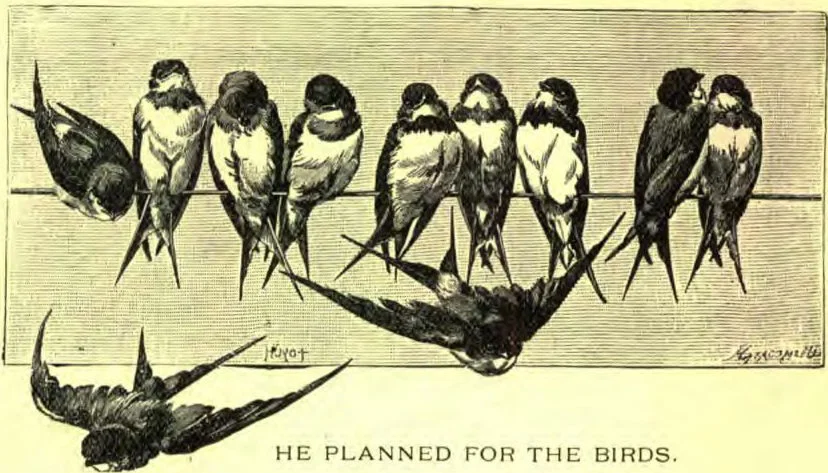
HE PLANNED FOR THE BIRDS.
HE PLANNED FOR THE BIRDS.
By Mrs. A. D. T. Whitney
THE little birds sit on the telegraph-wires,
And chitter, and flitter, and fold their wings;
Maybe they think that for them and their sires
Stretched always, on purpose, those wonderful strings;
And perhaps the thought that the world inspires
Did plan for the birds, among other things.
Little birds sit on the slender lines,
And the news of the world runs under their feet;
How value rises, and how declines,
How kings with their armies in battle meet;
And all the while, ’mid the soundless signs,
They chirp their small gossipings, foolish-sweet.
Little things light on the lines of our lives,—
Hopes, and joys, and acts of to-day;
And we think that for these the Lord contrives,
Nor catch what the hidden lightnings say;
Yet from end to end his meaning arrives,
And his word runs underneath all the way.
— Mrs. A. D. T. Whitney.
DIVING FOR PEARLS.
By B. J. Cady
MANGAREVA is the principal island of the Gambier group, and is governed by the French. It is about three hundred miles northwest of Pitcairn Island, and eight hundred miles southeast from Tahiti. It is a pleasant island, and with the other islands of the group, has a population of about two hundred and twenty-five. Of these, about a dozen are Americans and Europeans.
It is only during six months of the year that the natives are allowed to dive for the shells,—from the first of November to the first of May. During this time they earn plenty of money, enough to support them well during the whole year; but they spend it for strong drink and other hurtful things as fast as they get it, and then live poorly during the rest of the year. None but the natives are allowed to dive.
Without eating breakfast, the natives start out in the morning about seven o’clock, with their sail-boats, to go to the place of diving. When the place is reached, the sails are taken in, and an anchor, or stone with a rope attached to it, is cast into the sea to keep the boat from drifting away. Each man has his diving-box, made out of inch timber, about twelve inches wide and twenty in length, with a pane of glass in one end. This he takes, and then jumps into the sea. The glass in the end of the box is a sort of window through which the shells can be seen on the bottom. A small net is attached to the box, in which to deposit the shells as the diver secures them.
Before diving, the diver places his head in the upper end of the box, and looks through the glass till he sees a shell. He then swims along till he is exactly over it, and leaving the box to take care of itself, dives directly down to the shell. If he is fortunate, perhaps he will bring up three or four shells at one time.
As soon as they reach the surface of the water, the divers begin a sort of whistling, which is constantly kept up by them as long as they are in the water. This is said to be done to keep away the sharks, which occasionally attack them.
Those who use the diving-boxes are not the most skilful divers, but usually dive in water from twenty to forty-five feet deep, as the boxes are not of much account in water over fifty feet deep.
There are a few natives who look down upon those who use the boxes, and dive in much deeper water. We visited one of their boats, and were very much interested in it. In dropping a line into the sea, we found the water to be seventy feet deep where they were diving. Before going down, they prepare themselves by deep breathing. They inhale and exhale very slowly for about three minutes, and then plunge head foremost into the sea. They use no weights to take them down, but swim down very rapidly, and come up in the same way. In this deep water the shells can not be seen till they get near the bottom, and sometimes they have to swim along several yards to find one before coming up.
When the shore is reached, each shell-owner is anxious to see if he has made his fortune by finding a valuable pearl. The pearls are found inside the oyster, which is in the shell; so a knife is thrust into it, and it immediately opens of itself. Then the fleshy part is examined, to see if it contains any pearls.
Sometimes valuable ones are found, their worth varying from one hundred to eight thousand dollars. The money secured in this way is usually all spent in a short time for intoxicating liquor. B. J. CADY.
Chapter IX
By S. M. I. Henry
From Sinai to Olivet
Chapter IX.
When Shirley Goss stepped up to the ticket-window at the station to buy a ticket, for the first time in her life opening out a note on the government for which she had the right to collect face value in anything she might desire,—for the first time actually alone, and on her own responsibility going somewhere,—she experienced a delight as delicious as it was new. Her heart beat so fast and hard as to shorten her breath to little gasps, as if she had been running. An unusual brilliancy of color was in her cheeks, and a new sparkle in her eyes. She was conscious of a grace and ease of movement of which she had dreamed, but which she had never before realized.
Aunt Nell’s beautiful, though plain, dress, hat, gloves, and shoes were very becoming. Shirley was well dressed, and looked and felt like the lady she knew she ought always to be. If she was sinning now, she liked it, and would not think of repenting. Consequences could not be very bitter, when responsibility was so sweet.
“You are off for an outing, I take it, Miss Shirley,” said the smiling agent. “Fine time in the day for a start.”
“Yes, indeed,” with her dimples all in play, “I shall enjoy the ride hugely.”
“I hope you will be coming back this evening. Better take a return.”
“A return?”
“Why, yes, a return ticket saves you a nickel for peanuts.”
Shirley laughed gaily, and hesitated a second. “I do not know just when I shall return,” she said; “I haven’t thought of that part of it.”
“I see;” and the agent smiled again at this recognition of farming thrift. “She wants to hold on to her money as long as possible,” he thought. “They never think of the few cents that may be saved.”
“Well,” he said, aloud, “that’s what you will think of before night. Ladies always start off to the city bright and chicken, but come back wilted.”
“Then I think I’ll not come back,” and Shirley laughed again, as she took her ticket and counted her change with ostentatious care, her fingers thrilling; “I don’t intend to wilt.”
“Oh, you are not one of the wilting sort, Miss Shirley.”
“Thank you; that encourages me.”
“Does Miss Shirley need encouragement on that point?”
It was a new voice: Shirley turned quickly, and confronted Martin McCarty.
He lifted his hat, bowed, and held out his hand with the freedom of a neighborhood acquaintance; but Shirley gave him only one glance, and with a proud scorn on her face, turned and walked out to the platform.
Agent Foreman gave a low whistle.
“That’s all right,” said Martin McCarty, in a hard, angry tone. “If that’s her style, I know how to match it.”
“If a girl did that to me,” said Agent Foreman, “I’d know why.”
“Oh, I know, all right enough,” said McCarty; “it’s the business. She has been high and mighty enough since we went into the saloon; we were good enough chums until then. I don’t see what business it is to a woman what a man goes into to make a living. She’s acted just about that way ever since we began, and I’ve took it; but now,—see here, do you know she’s running away from home?”
“You don’t say!”
“But I do, though; she and her father had a dandy row yesterday, and Shirley jumps from the window and runs, and now she is off for Chicago. What can she do when she gets there? She does n’t know as much as a spring chicken. Anybody can see, with half an eye,439to tell her fortune. She need n’t be so get up and agoin’ with me, I can tell her. I’ve stood it for two years; but I won’t two years longer,—won’t have to. I can wait.”
Agent Foreman made no reply. He stood and heard McCarty, who kept wrathfully talking until the train signaled, and he put it all away for future use. He was not a man to stand still and see a robin worried by a cat.
Shirley had forgotten McCarty as soon as she turned her back on him. She had strong ideas of her own about most things that had come into the range of her eighteen-year-old vision, and the saloon was one of them.
She had no need of, nor use for, friends who were on that level. She had as many friends as she knew what to do with; but even if she had not had one, she would never choose from that grade. She was a single-hearted, strong-brained, practical girl, who had had the disadvantage of a most unpractical training, and so was apparently exposed to many dangers; but she was honest and frank almost to bluntness, and had latent qualities of which neither Martin McCarty nor even her father had ever dreamed.
So while McCarty was gossiping about her, she was walking back and forth on the platform, thrilling with delight at the beauty of the morning and her sense of freedom. She was excited as she never had been in her life. She had not slept all night, and her whole being was keyed up to the highest pitch of sensibility.
The coming of the train produced a shock that sent the blood rolling in upon her heart. She reeled, and her face grew white. All the currents of her being seemed thrilled and changed. She could not have analyzed the feeling that surged through her as the train came to a stand: it was a shock of pain, with a wild joy that almost overpowered her. She could not have anticipated it; she could never forget it.
It was all she could do to reach the steps. She was observed by the agent with sympathy, by McCarty with curiosity, and by the conductor officially. He sprang, and taking her arm, almost lifted her to the platform of the coach.
When she was seated, she was for a moment limp and almost unconscious. The strange tumult in her breast was soon quieted, however; for she was a strong girl, and soon every other feeling was lost in her consciousness of independent action.
As the train moved, the bustle and whir, the rush and chime, all blended in the most entrancing harmony of sound and atmosphere that had ever delighted her senses. To her it was almost as intoxicating as wine.
The rapid passing of the landscape panorama before her dilating eyes had for her a charm surpassing magic. It was a perfect morning. Any living human clod would have rejoiced in it; but to her its beauty was bewildering. The world had never seemed so wonderful, or life so rich.
To the ordinary passenger the ride in the slow milk-train, with its frequent, jerky stops, was commonplace and tiresome to a degree; but to Shirley Goss it was full of incident from first to last.
She was too full of her own inward experience to take note of the sarcastic, curious face of Martin McCarty, who was watching her every change of expression. She had utterly forgotten to care whether she looked well or not; but the fact was that she had never been so nearly beautiful as on this memorable morning. It was a beauty almost childlike in its sweetness, while possessing more than ordinary womanly strength; and now her utter unconsciousness of her external self permitted the free play of thought and sentiment over her expressive face, and both thought and sentiment were inspiring to her, in spite of the questionableness of her course, and the cloud that she knew she was under.
She was so conscious of the new, untrammeled conditions into which her life had sprung, and was so satisfied with them, that she could not remember clouds.
MRS. S. M. I. HENRY.
(To be continued.)
Fireworks in the Ocean.
The ocean has its lanterns, or phosphorescent animals, and among these the jellyfish and sea-anemone are very numerous. Sometimes they look like pillars of fire, sometimes like stars, and sometimes like fiery serpents, flashing out red, green, yellow, and lilac rays.
Many luminous sea-creatures are very small, not larger than a spark; but these gather in such masses that in the Indian Ocean the water often looks like a sea of molten metal; and a naturalist who bathed among them in the Pacific said that he was illuminated for hours afterward, while the sands on which the insects were stranded at low tide gleamed like grains of gold.
The bottom of the ocean is magnificent with its star-fish and sea-pods, some in rich purple, shedding a soft, golden, green light, while others send out silver flashes. Even crabs in hot climates seem to set themselves on fire; and when captured and teased, they blaze all over with indignation.
A species of shark, too, is intensely brilliant at night, and one that was drawn up shone like a splendid lamp for some hours after it was dead. Naturalists have long been at work on this curious subject, and the source of the illuminating power is supposed to be contained in the little sacs, or cells, in the body of the animal.—Christian Observer.
How Sunfish and Bream Build Nests
Among fishes which build nests in which to deposit their eggs are the sunfish, perch, bream, and black bass. The sunfish and bream select a shallow spot near the shore of a stream or pond, where the summer sun keeps the water at a tropical heat. With vigorous fanning of ventral fins and the tail, they soon sweep away from a small circle all mud, sediment, sunken twigs, and all sorts of trash, and leave bare and bright a bed of pebbles. Even these they continue to brush and rub until they have scooped out quite a hollow, and the nest is then ready—a basin some twelve or fourteen inches in diameter, about four inches deep, and paved with small, many-colored stones. If the muddy bottom does not offer any such floor, they will bring pebbles from some near-by gravel bar, and with them build an artificial basin. When this home, built by the united efforts of both parent fish, is completed, the female lays her eggs upon the gravel. Now the period of hatching begins, and it lasts four or five weeks. Meanwhile hundreds of hungry egg-hunting fish have to be kept away. Shoals of gleaming shiners will attack the pebbly home, only to be badly routed by Mr. and Mrs. Sunfish; and bream and big catfish, eels, dace, suckers, chub, and perch meet with similar repulses. After the long watch is over, and the sentinels are relieved, they take no further interest in their numerous young, but swim away, leaving them to fight the world's many battles for themselves.—Selected.
JOSEPH AND THE PYRAMIDS OF EGYPT.
By H. L. Carlisle
Ye silent witnesses of ages past,
The evidence of Pharaoh's mighty hand;
Ye sentinels upon the desert vast,
Watch on! for Joseph's God will soon demand
The sleepers from thy lonely desert sand.
Recent explorations in Egypt, the country of God's oppressed Israel, are constantly giving new testimony in confirmation of the Scriptural narrative of ancient events. The storms, earthquakes, and ravages of time have failed to remove the Pyramids of Egypt and their silent testimony.
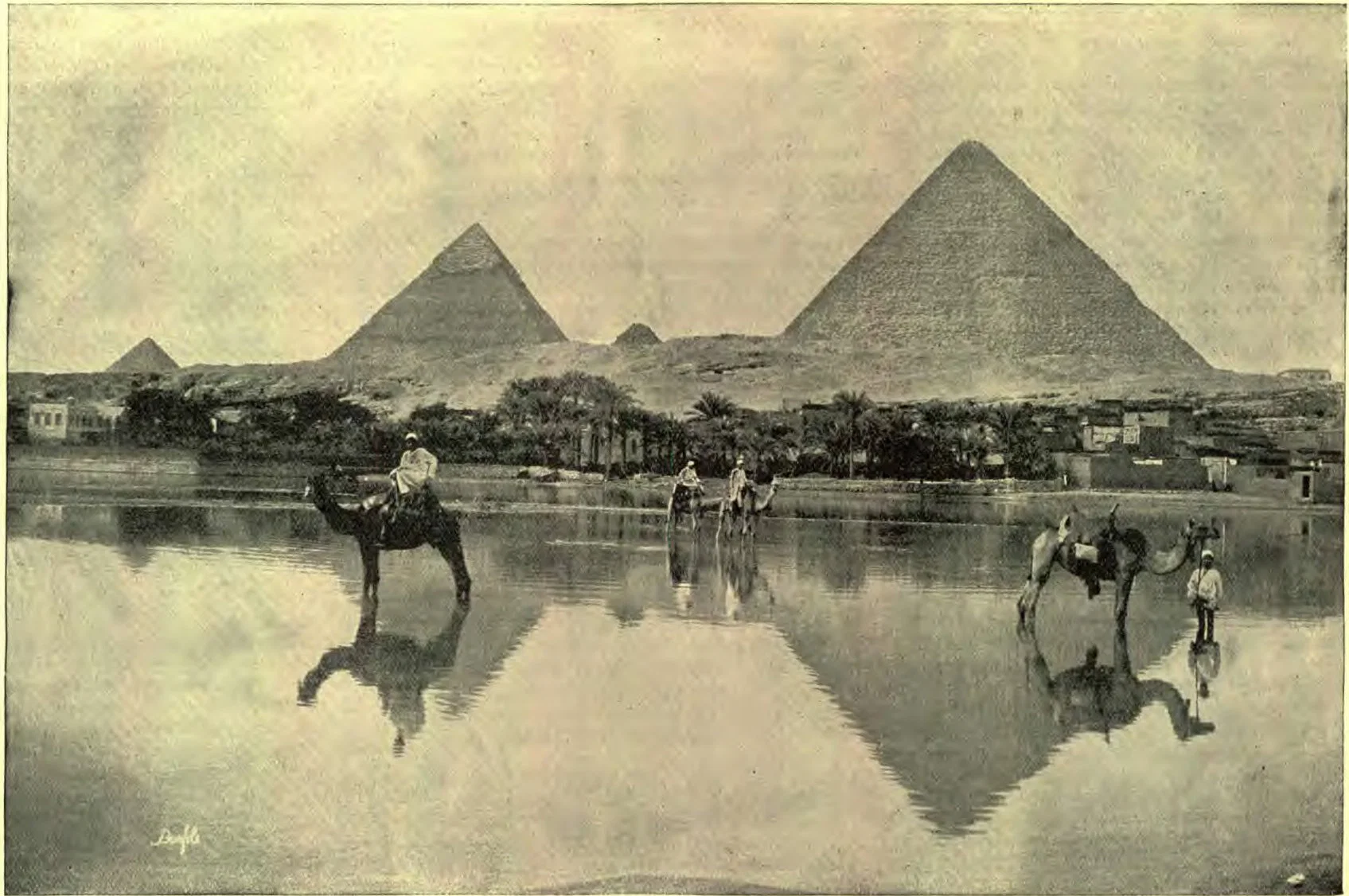
THE PYRAMIDS OF GHIZEH, EGYPT.
Of the seventy pyramids standing in the valley of the Nile, one, Cheops by name, is said to have been built by Joseph. It rises at an angle of fifty-two degrees to a height of four hundred and eighty feet,—originally it was twenty feet higher,—and contains ninety million cubic feet of space. It covers an area of thirteen acres. Some of the stones are thirty feet long and five feet thick; they are evenly dressed, and laid with mortar. Four hundred thousand men were twenty years in building this colossal monument, and it is said that it contains enough material to build a city the size of Washington, D. C., including all the public buildings.
That Joseph constructed this pyramid during the time he was “ruler in Egypt” can not be doubted; for archeologists have found upon some of the stones hieroglyphics that answer to the name of Joseph: it is also a singular coincidence that the description of Cheops given by Herodotus exactly describes the character of Joseph.
The pyramids were erected for mausoleums, or tombs, for the rulers of the people. In the “death chamber” of all but one, mummies have been found. In many instances the linen used in embalming was as white and clean as when first wrapped on the remains. The first explorers of Cheops found that the entrance to the death chamber had been opened, and carefully closed up again; and on entering, the chamber was found empty. This shows that the promise that Joseph had exacted of his brethren,—“God will surely visit you, and ye shall carry up my bones from hence,”—had been fulfilled.440H. L. CARLISLE.
Failure Is Endeavor Temporarily Off the Track
“FAILURE is only endeavor temporarily off the track. How foolish it would be to abandon it in the ditch.”
BUILDING A COTTAGE.
By W. K. Loughborough
The Pitch of the Roof.
BEFORE we build, we must decide what pitch we will give the roof of the house. As I said regarding the window-sill, by pitch we mean the slant of the roof. The pitch varies, in different houses, according to the fancy of the builder. The most common style of roof at present is one-half pitch. A few years ago it was one fourth. I have seen roofs of one fifth, and even of one sixth, pitch; but that makes too flat a roof, as in time of an ice-storm, when the ice freezes at the butt of the shingle, it will back water and leak. One third pitch is good where a person does not care for a steeper one.
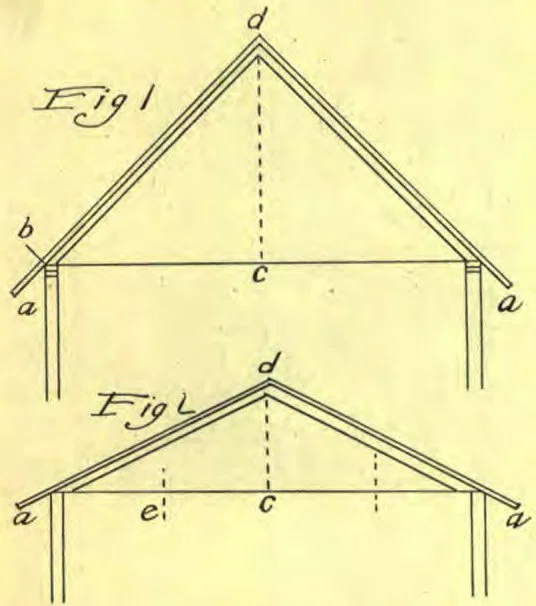
To find the pitch of a roof, we will take Fig. 1 for the building. Draw a line from a to b, calling it sixteen feet. Find the center at c, which is eight feet. Draw a perpendicular line to d, which will be eight feet, then draw a line, as seen in the center, from d to a to the outer corner of the plate. These directions, if followed, will give you one-half pitch.
In Fig. 2 we have a roof that is one-fourth pitch. Find the width of the building, which we will say is sixteen feet. One half of it, to the center, would be eight feet. Divide this again, which would be four feet, which should be the length of your perpendicular line from the center. This gives you one-fourth pitch. To find any pitch desired, take the fractional part of the width you wish to make the pitch, and proceed as directed above.
To get your measure, take a smooth board or paper, and draft out your roof, using, say, a scale of three-fourths inch to the foot. This will give you one sixteenth for an inch. By adding the other, or upper, line, the rafter is a little longer, as the bevel increases at the top. Square up on your rafter at the corner of the plate, as seen at b, Fig. 5. Measure to the top whatever you may add above the center line, and get your exact length. When you have made your draft, you can lay on your square or bevel, and get just the slant to cut your rafters.