There are at present two quite distinct forms of the Latin alphabet in use,—the Roman and the German. During the Middle Ages there were many such styles, most of which have been copied by designers of fancy, or display, type. The art of printing from type arose in Germany, and the first types were made just like the black, up-and-down book-hand then in use. But by the time the newly discovered art had spread to the south of Europe, an earlier and simpler style, copied from old Italian manuscripts, had come into use; and so we find the southern nations using the round and open Roman type at this day, while the Germans still cling to a black-letter. The earliest printed books in England were in a sort of black-letter; but this was soon discarded in favor of the Italian, or “Roman,” style.
The confusion resulting from a much earlier conflict between the English and the French hand, at the same time that the English and the French languages were struggling for supremacy on the soil of Britain, left its trace in our language on the letter Y.
Y, like G, has a history of its own. The sixth letter in the Phenician alphabet was waw, an upright straight line, with a curve resting on it—what might pass for a picture of a fork. It was a corruption of the Egyptian hieroglyph for F or V, which represented a horned asp. The handle of the fork stood for the body of the serpent, and the tines for its two horns. This forked-shaped letter appeared in Greek in two forms,—the letter F, which had a sound like our consonant W, and the letter Y, which was like our vowel U. In the Latin alphabet the stem of their Y was lost, and the two tines took the form V. After a while the Latins borrowed the Greek Y for the purpose of spelling Greek words; for the Greek u-sound was not exactly like the sound of the Latin V. The letter Y never, in either language, stood for a consonant.
When Christian missionaries from Ireland came among our English forefathers, they found them writing with a sort of letters of Greek origin, called “runes.” These runes were regarded with superstitious awe by our unlearned barbarian ancestors. They were supposed to have magic powers, and he who could carve them was looked upon with great respect. The Christian priests thought it best to teach their converts Latin letters, which had no such pagan meaning. They wrote for the old English sounds the letters which had similar sounds in Latin. The sound of Y, which was very rare in Latin, they found to be common enough in English; consequently, Y became a much-used letter with the Anglo-Saxons. Later on, this sound went out of use, and the letter itself was less used than at first.
The letter g, as written by the Irish, and so by the Saxons, was very different from ours. It looked more like a y, and still more like a z, as most persons write it, than like the g we know. The g of Old English had several sounds, of which the most common were the sound of g in “get,” and the sound of y in “yet.”
When the Saxons were well started toward civilization, the Normans conquered England, and brought in French customs. The French hand took the place of the Old English. But one of these sounds of G was so different from the sound of the letter in French, that it was still written with the old character, a character easily mistaken for a Y, and soon written so. Thus for the first time since it parted company with F, Y represented a consonant.
The old vowel Y was almost unused; but it was kept up in some foreign names, so that its use was not forgotten. At the same time, through the Latin months Ianuarii, Februarii, etc.,—which were written Januarij, Februarij,—and the many other Latin words ending in ii, the ending ij became familiar to English eyes. In the black-letter this looked like y, and before long it came to be customary to write January and July. People in general soon began to understand that y was the proper spelling for a final i-sound; so they wrote sky and skies, baby and babies, lady and ladies, and so on with nearly all words that once ended in i or ie.
This change of y from a consonant u (w) in Phenician and a vowel u in Greek to an i-sound, both consonant and vowel, in English, is a good example of the way languages shift and change and grow more and more unlike one another from century to century. Unnoticed except by those who take great trouble to observe, our own and all other languages are now changing, and will always continue to change. The sounds represented by our letters become different, while we go on with the old spelling, till sound and spelling grow so far apart that the connection between them is no longer seen, and we say our spelling is very inconsistent.
In a few words y formerly stood for the sound usually spelled by th. The missionaries who introduced Latin letters into England found a sound in such words as “this” and “that,” which was unlike any sound in Latin; and for this sound they kept the old runic letter. This letter, called thorn, is very common in Anglo-Saxon manuscripts. The Norman scribes used th instead of thorn, except in the words “the,” “that,” and some others. In these they used the Saxon forms, which were shorter; but they mistook the thorn for a y, which it had come to resemble, and wrote yᵉ, yᵗ, etc. This spelling, however, never caused any change in the sound of the word. Those persons who read the expression, “yᵉ olden time,” differently from “the olden time” make a rather absurd mistake.
C. B. MORRILL.
HOW SOAP CLEANSES.
ONE of the explanations of the cleansing action of soap is due to a suggestion made by a no less famous man of science than Prof. W. Stanley Jevons.
It is generally considered that the efficacy of soap depends mainly upon its decomposition, when it is mixed with water, into an alkali and a fatty acid.
The alkali thus set free dissolves the grease by which the dirt is attached to the surface to be cleansed, and the water then carries the dirt off. But this is not all; the fatty acid from the soap neutralizes any free alkali remaining after the loosening of the dirt, and thus prevents the alkali from attacking the cleansed surface itself. This is very important when soap is applied to the skin, and the painful effects produced by some varieties of soap are due to the fact that they possess an excess of free alkali, more than the fatty acids can neutralize.
But there are other factors concerned in the action of soap. Its cohesive power, upon which the formation of soap-bubbles and lather depends, enables it to gather up the dirt as it is loosened by the alkali. Then, too, the process is assisted by the curious property, which soap possesses, of producing a great agitation among solid particles suspended in water.
This, of course, tends to the ready removal of the dirt after it has been detached from the surface; and it is this action that Professor Jevons has pointed out as being one of the elements of the cleansing power of soap.—Selected.
Who Is My Neighbor?
“Who is my neighbor?—It is he whose need
Lifts on my vision, though he ask not gold.
O, though I may not succor, may not heed,
He is my neighbor, be he young or old!”
“Where is my neighbor?—Where I hear the cry
Of sorrow, where is suffering or woe,
Although the spot I pass regardless by,
There is my neighbor, be he high or low.
“Who is my neighbor?—It is surely one
Who feels of cheer or comfort any lack
I could supply. Ah, though his path I shun,
He is my neighbor, be he white or black!”
MINDING A WONDERFUL BABY.
I wonder if any of my little readers ever pouted when mama bade them mind the baby? There are some little mothers who love to mind the baby; but there are many more who, though they are ready to fuss over their dolls hour after hour, dislike very much to care for a “real baby.”
Do you know the story of the little girl who risked her life to mind her baby brother,—not only risked her own life, but stood between death and her father and mother; for if she had betrayed that the baby she minded was her brother, they as well as she would have been killed by order of the king in whose land they lived? Perhaps you think you know nothing of the story; but you do, though you have had your eyes almost all the time upon the baby who was tended, and have overlooked the sweet and wise-headed little girl to whom, under his Heavenly Father, that brother owed his life and fortune.
Have you guessed whom I mean? Let me tell you the little girl's name. It was Miriam. Now do you know? Well, think again. The baby brother had a whole river to rock his cradle, which was made of bulrushes. Ah! now you know—it was Moses. Yes, that was the name given to the baby boy.
You remember that in the days when Moses was born, Pharaoh had ordered that all the baby boys born in Jewish homes should be killed; for he didn’t want an army of them to grow up to fight the soldiers of his people. Many little boys were killed as soon as God gave them to the world, but some parents dared risk the king’s displeasure by attempting to save their boys. Amram and Jochebed were among this number; and when the little Moses came to their home, they hid him away, and for three months kept him safe from all the spies the king sent out. But you know how hard it is to keep a baby boy so quiet that no one will know what he is about; and the parents of Moses, when he was three months old, feared to attempt to hide him any longer. Finally they decided to put him in a cradle on the great river of Egypt, praying God to take care of him, and float him close to some one who would save his life.
So one morning they wept and prayed over the little baby in its bulrush cradle, and gave it to the Nile. Father and mother could not bear the thought of leaving the cradle unwatched; but they dared not watch it themselves, lest the sharp-eyed spies of Pharaoh should discover and suspect them, and lead them away to their death. Then came the opportunity of Miriam. She was only a child, but she loved that baby with all her heart; and she was wise enough to know that even if she watched him, she must be careful not to show her love in any way that would make people think he was her brother. For many anxious hours she followed the cradle as it floated down the Nile, her heart trembling all the while, lest the long jaws of a crocodile should stretch442themselves above the water, and snap down over basket and baby. Slowly the cradle floated down near Pharaoh’s palace. Miriam, following, noticed that a lady, with many young maidens to attend her, was bathing in the Nile; As she looked again, her heart began to throb; for she recognized the face of Pharaoh’s daughter. Suddenly the boy, who had been asleep, awoke, and sent just such a cry as baby boys know how to make, sounding forth over Egypt’s river. The princess heard it, and looking around, saw the floating cradle. Her maids heard it, too, and soon brought the cradle and its occupant to her.
“Oh, what a dear boy it is! Surely the Nile has given him to me. He shall be mine. I will make my father preserve his life.”
The little baby was no longer in the bulrush cradle, but was folded close to the bosom of the princess. It was a glad moment for Miriam, and she longed to run home to tell her mother what had happened. But she must stay as long as the baby was in sight. While waiting, she heard the excited talk of the women, and her quick ears caught words that told her they were questioning where a nurse for the baby might be found. Then a great desire entered Miriam’s heart. Oh, that she might tell them of her mother! But dare she trust herself among those women? Could she hide her joy and excitement, and approach and speak with them? Her eyes ran to her hand, and she rejoiced to see there her water-jar. It would serve her well; and placing it upon her head, she made a great effort to calm her heart, and drive the excitement from her face, and walked slowly toward the place where the women talked, as if she would fill the jar at the Nile. God wanted Miriam as a connecting link; yet that link he must have, or his great chain would not be complete. Walking into the group, she linked her life with the destiny of her people. Seeing her, one of the maidens cried, kindly, “Why, this is one of the Hebrews’ children!”
Then came a hard test for little Miriam. Don’t you know how you feel like jumping, fairly dancing, with delight when a great joy takes hold upon your heart? Well, that was just the way Miriam must have felt; but she dared not dance. She scarcely dared let a smile light up her face; and though her heart was jumping within her breast, she must hold that jar upon her head as steady as if nothing wonderful was happening, and she did. The brave girl was now the girl of steady nerve, and in a quiet voice I can almost hear her ask the princess: “Shall I go and call to thee a nurse of the Hebrew women, that she may nurse the child for thee?”
Those who live in kings’ houses are often lazy, and they like to have others serve them; so every maid who waited on the princess was glad they had this Hebrew girl to perform the task that otherwise would have fallen to them, and Miriam was soon commissioned by the princess to find a nurse for the baby she had taken from the Nile.
Did you ever run fast? Well, I hardly believe your feet ever skipped over the ground as swiftly as the feet of Miriam did when once she was fairly out of sight of the princess; and it was not long before the anxious father and mother were praising God for the deliverance of their child.
Now you know the story of Miriam, the nurse. Think of her, my lads and lasses, when you rock the cradle of the baby in your home. Pray to God to make that baby as good and true to him as the baby that Miriam tended became; and pray that God will lead you to be as wise, patient, and self-possessed as Miriam was; and then every day watch for the opportunities he gives you to find answers to the prayers you raise.—S. S. Advocate.
THE CHILD PROPHET.
By Mrs. L. D. Avery-Stuttle
Hast heard the beauteous story
Of the wondrous prophet child,
With eyes so true and tender
And voice so soft and mild?
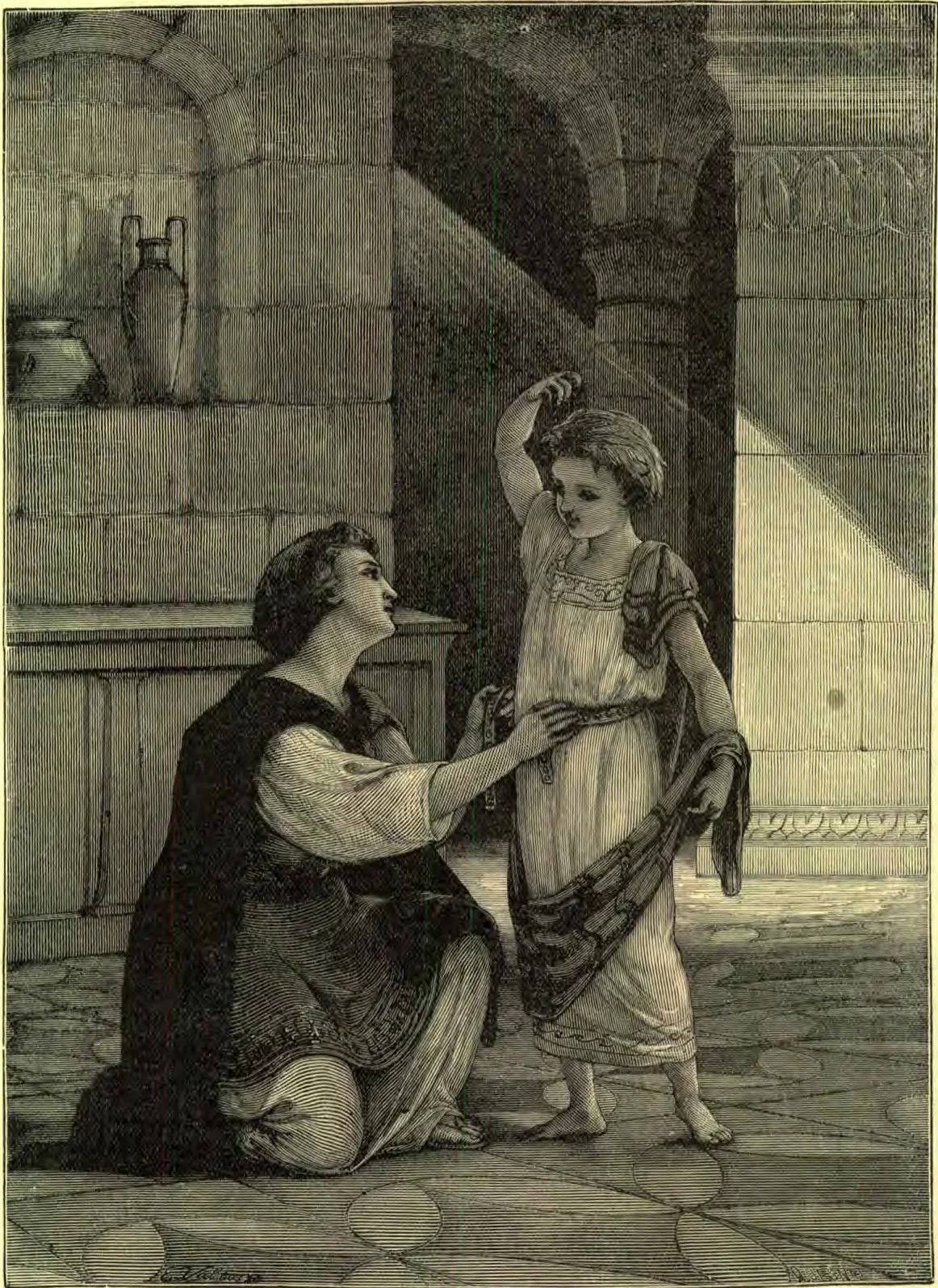
THE CHILD SAMUEL AND HIS MOTHER.
Have you heard of little
Samuel?
Then come and sit by
me;
I will tell the beautiful
story
Of the prophet child to
thee.
Long years ago, in Shiloh,
Where Ephraim's
mountains grand
Arose like sturdy giants
To guard the sacred
land,
The ark of God was 'biding,
There good old Eli
dwelt,
And there the sons of
Israel
In solemn service knelt.
Now Hannah dwelt in
Ramah,
And thus she vowed one
day:
"I'll give my little
Samuel,
I'll give my child,
away;
I'll lend him to the
blessed Lord,
To walk in paths of
right,
To dwell within his
temple,
And serve him day and
night."
And so before old Eli
The little child was
brought,
And in the temple service
Continually was taught:
And every year good
Hannah
A pretty garment made,
And brought it down to
Shiloh,
Where little Samuel
stayed.
One night when o'er fair
Shiloh
The stars their vigils
kept,
And in his quiet chamber
The little Samuel slept,
He heard a voice like
music,—
A voice so sweet and
mild,—
In tones so low and tender
Calling the prophet
child.
Then quickly from its pillow
The little head was raised;
And through the shadowy gloaming
Two wondering, dark eyes gazed;
Two little bare feet pattered
Soft as the raindrops fall,
To seek the good priest Eli,
Obedient to his call.
“Lo, here am I,” he answered,
“I heard thee call my name,
And soon as thou didst bid me,
Behold, I quickly came.”
“What sayest thou, child?” said Eli.
“I called thee not, my son;
Go to thy couch, and slumber
In safety, little one.”
Three times that voice like music
Spoke to the youthful seer;
Three times he sought good Eli,
And whispered, “I am here!”
Then spoke the aged Eli:
“Ah! surely 'tis the Lord;
And thou shalt say, ‘Speak, Master;
Thy servant hears thy word.’”
Once more the gentle summons
Falls softly on his ear,
And well he knows an angel
From Beulah land is near.
Then quick from downy pillow
Raises the little head.
“Speak, Lord, thy servant heareth,”
The gentle Samuel said.
E'en thus, in youth's fair morning,
Turn from the paths of sin;
And when thy Saviour calleth,
Oh, haste to let him in!
And answer thou his pleading,
So gentle, sweet, and mild.
“Speak, Lord, thy servant heareth!”
As did the prophet child.
When and where was the vision of the lesson probably seen? In what year of the captivity of the prophet? What did the prophet see in his vision? Whence did the stream issue? Who talked with the prophet? What did he have in his hand? What distances did he measure? What is said of the increasing depth of the stream? What did the stream symbolize? Where did the angel next take the prophet? To what did he call his attention? What influence did the stream have in the desert? Into what did it flow? What influence did it have on the waters of the sea? What did the healing, life-giving properties of the stream represent?
NOTES.
1. The prophet was still in captivity in Chaldea; but the scene of the vision is Jerusalem. The vision probably was given about B. C. 574, in the twenty-fifth year of Ezekiel’s captivity.
2. Last week’s lesson, representing the resurrection, presented the outcome of the gospel. To-day’s lesson, under the beautiful symbol of a healing river, shows the process, progress, and infinitude of the gospel, and its marvelous power to heal and comfort.
3. The seven chapters preceding the lesson are given to a description of the temple, its measurement, ordinances, and use. “Afterward he brought me again unto the door of the house; and, behold, waters issued out from under the threshold.” “There was a fountain under the temple, and this suggests the figure here used.” This fact gives vividness to the prophet’s words: “In that day there shall be a fountain opened to the house of David and to the inhabitants of Jerusalem for sin and for uncleanness.” Zech. 13: 1.
4. The waters were to the ankles, then the knees, then the loins, then waters to swim in,—a river that could not be passed over. Every figure used in the word of God to represent salvation, presents the possibility of an ever-deepening experience. Thirst, barrenness, and dearth of soul are not accompaniments of a living connection with the river. In the experience of Israel in the wilderness, from the smiting of the rock the second time, there were waters in the desert. Even before the rock was smitten, they had but to make known their thirst, and water was supplied. The bitter water was healed, and they came to Elim, where there were twelve wells. Under the figure of the lighted path, the Christian experience is one that grows brighter and brighter unto the perfect day. Salvation’s river is to flow on in an ever-widening, deepening tide, till all that will be healed are healed.
5. “Hast thou seen this?” This is a personal matter. If we have seen the barrenness, the dearth, the waste and thorny places of our souls, then how glad are we to answer to this question, “Yes.” “There is a river, the streams whereof shall make glad.” Ps. 46: 4.
6. After taking the prophet out to see the on-sweeping river, the angel brought him back to note the effect of the water. On either side of its banks were very many trees. They had sprung up out of the dearth, and had flourished by the healing waters. Speaking of the righteous, or those who are healed by the living waters, David says, “He shall be like a tree planted by the rivers of water, that bringeth forth his fruit in his season; his leaf also shall not wither; and whatsoever he doeth shall prosper.” Ps. 1: 3. “Blessed is the man that trusteth in the Lord, and whose hope the Lord is. For he shall be as a tree planted by the waters, and that spreadeth out her roots by the river, and shall not see when heat cometh, but her leaf shall be green; and shall not be careful in the year of drouth, neither shall cease from yielding fruit.” Jer. 17: 8.
7. “Whithersoever the rivers shall come,” the things that lived and moved were to be healed. God has dealt to every man the measure of faith, and the coming of the message of truth gives opportunity for a larger measure by the exercise of what has been given. Christ, the river, came that we might have life. Those who will not believe are those who neither live nor move.
8. “They shall . . . spread forth nets.” Jesus said to his disciples, “Follow me, and I will make you fishers.” Wherever the river of salvation flows, there are found the fishers with their gospel nets. “Their fish shall be according to their kinds, as the fish of the Great Sea, exceeding many.” In these last days, God says he will call for “many fishers.” This indicates how wide is the stream of salvation. “The glory of the last message is to fill the whole earth. Each fisher gathers fish according to his kind. Each individuality has its place in the plan of God. How precious to know that though our peculiar personality is counted of little value by men, God has a place for it somewhere; and through it, will fish for some soul that maybe could not be saved by some larger, more richly endowed personality.”
9. “Their waters they issued out of the sanctuary.” It is the river of the water of life that issues out of the throne. Rev. 22: 1. The trees on its banks all along its flow through the desert of earth, are after the nature of the tree of life, whose leaf does not fade, whose fruit does not consume, which yields twelve manner of fruit every month for food, and whose leaves are for the healing of the nations. He who receives the water of life becomes a living fountain and a tree of life. The vitalizer is the Holy Spirit,—the life of Christ,—and the lost human life becomes thereby a channel of consolation, an agent of healing.
The Pansies Are Laughing at Me
“AS HE walked in the garden this morning,
Our baby, not yet two years old,
He paused by the border of pansies,
And laughed at their velvet and gold.
‘Why, darling! what is it?’ I questioned.
His laugh rippled over with glee:
‘See! how can I help it, dear grandma,
The pansies are laughing at me!’”
TIME: A. D. 30. PLACE: Bethany. PERSONS: Seventy disciples, Martha and Mary, Lawyer, Jesus, and disciples.
QUESTIONS.
1. Not long after the Feast of Tabernacles, what did Jesus do to enlarge the work of the gospel? What plan did he follow in sending out these laborers? Luke 10: 1. What did he say concerning the need of the field? V. 2. What would be their position as they went out? V. 3.
2. What general instruction governing their conduct did he give? Vs. 4-8. What was to be their work? V. 9. What were they to say and do when their message was rejected? Vs. 10, 11. What comparisons did he then draw, and what woes pronounce? Vs. 12-15. Why? V. 16.
3. What report did the seventy bring back? V. 17. What was Jesus’ reply? Vs. 18, 19. What did he say was their greatest cause for rejoicing? V. 20. What work of grace had been accomplished for the disciples? Vs. 23, 24. What words of praise did Jesus therefore offer? Vs. 21, 22.
4. Who now came to Jesus, and what did he say? V. 25. What reply did he receive from Jesus? V. 26. How did he answer? V. 27. What did Jesus say in return? V. 28.
5. Not willing to acknowledge the truth, what did the lawyer further add? V. 29. To what circumstance did Jesus call his attention? V. 30.
6. Who first saw the wounded man? and what did he do? V. 31. In imitation of the priest, who next came upon him? V. 32. Who came last? What course did he take? Vs. 33-35. Having thus answered, what question did Jesus ask the lawyer? V. 36. What did he say? What admonition did Jesus then leave with him? V. 37; note 1.
7. Coming to Bethany, whose hospitality did Jesus enjoy? V. 38. What contrast is noted in the conduct and disposition of Mary and Martha? Vs. 39, 40. What gentle reproof did Martha receive? V. 41. What word of commendation was spoken concerning Mary? V. 42; note 2.
NOTES.
1. The case of the good Samaritan shows that all men are our neighbors. Just as surely as the Samaritan was neighbor to the one in need of his help, so surely he saw a neighbor in the wounded man. The neighbor to the Samaritan was he whose condition demanded a neighbor’s help. Our neighbors are the fallen and destitute everywhere; and to love the Lord with all our heart and our neighbor as ourselves, according to the law of God, we must serve them in every needed way.
2. The one thing needful, the good part chosen by Mary, is to sit at His feet and learn. In this thought is the key that unlocks to us the treasure of success in all life’s experiences. Keep the eye upon Jesus. Our work is not to be giving attention to our multitude of imperfections and cares, for while we seek victory in one thing, we are sure to lose it in another. But keeping the mind fixed on the Word, on Christ, we are always guarded. Isa. 59:19, last part. Let Christ care for us, and all our burdens: let us care only that we do not lose him from our sight. Isa. 26:3.
THE LIFE-BOAT MISSION SUNDAY-SCHOOL.
By Anna B. Kellogg
When Jesus was here among men, he blessed the children; and though he has returned to heaven, he is still calling the little ones. A few weeks ago, he put it into the heart of Sister Carry to invite them to a Sunday-school, and he is certainly blessing them. Sister Carry wished to work especially for the children who could not attend Christian schools, Sunday-schools, etc.; so she went to the mothers in their poor homes, up one, two, and three flights of stairs, and down in basements and sub-basements. Some were glad to send their children, while others were not.
One little child, dirty, ragged, and only partially clothed, led Mrs. Carry to his “home,” around several corners; down a dirty alley; through the rubbish of a small back-yard, where no grass nor flowers ever grew, and where no birds ever came to sing; and up the winding stairs to their one room. The mother was washing, and the father smoking. Sitting on the bed—for they had no chairs—were five other children. There they were,—eating, sleeping, and living in one small room! On visiting the next home, a child between five and six years old was seen carrying a pail of beer to his father. These are but two of many such “homes” in Chicago.
Fifty of these little ones were present at the opening of our Sunday-school at three o’clock in the afternoon. It was a motley company. Some little feet were clad only with filth from Chicago’s streets. One little fellow had but half a suspender to hold up his ragged trousers; but every one, standing and beating time, learned to sing “’Tis Love That Makes Us Happy.”
Each teacher took four or five of the children, and, forming a little circle, told them the beautiful story of the garden of Eden. At the same time the children placed flowers and leaves in a little box of soil, to represent a garden. They were surprised to learn about the growth of plants, etc. The lessons are practical, and all from nature. Each child went away with a beautiful flower, a Sabbath-school paper, and a picture of the Good Shepherd.
The following is a report given by Sister Carry at the general missionary committee meeting:—
“I have been doing considerable work in the interest of the Sunday-school at the Life Boat Mission, and I find this an excellent way to reach the hearts of the parents. During my calls I met sick persons, whom I sent to the dispensary. At our first Sunday-school, fifty children were present, thirty of whom were Italians. During the week some one went around, and told them not to come again; but, notwithstanding, forty children came last Sunday. This school was also more satisfactory and systematic than that held the previous Sunday. There is a class of children whom we can depend upon to attend almost every time,—those who do not go to any other Sunday-school. We may not see any results from our work at present, but the seed sown will return after many days. This I consider by far the most encouraging school I have ever had the privilege of starting.
ANNA B. KELLOGG.
A HOME FOR CONSUMPTIVES.
By Francis M. Wilcox
Consumption, or tuberculosis, has come to be one of the most dreaded of diseases. Formerly the medical profession was largely in the dark in regard to its true nature, and more or less carelessness was manifested in the care of consumptive patients, resulting, no doubt, in the rapid increase of the malady. In 1882 Professor Koch, a German scientist, discovered the specific germ of tuberculosis, and since that time great progress has been made in the true diagnosis and treatment of the disease. A microscopical examination of the sputum will reveal with almost positive certainty whether the patient has tuberculosis.
With the knowledge that consumption is caused by a specific germ came also the knowledge of its communicability, and every year has served to increase the efforts of the medical profession in educating the general public against the danger of contracting the disease by infection from the germs. This agitation seems greatly in place when we reflect on the fact that the disease is largely on the increase, and that in this country alone one hundred and fifty thousand persons die every year from its effects. Nor is the disease confined alone to the human family, but it affects the brute creation as well. It seems especially contagious among cattle, and thousands of valuable herds have been slaughtered in order to prevent the spread of the disease. Its great increase among the cattle of the country has doubtless served still further to threaten the life of the human family through the medium of their milk and flesh.
During the last two or three years the question of isolating tubercular patients, and providing special facilities for their treatment, has been agitated. Some months ago the New York Legislature made a special appropriation for the founding of a home for this purpose. The large medical convention upon the subject of tuberculosis recently held in Berlin, earnestly urged that this plan be generally adopted. In sanitarium and hospital work, particularly, the necessity of a division between tubercular and non-tubercular patients has been many times demonstrated: first, as has been intimated, on account of the danger of infection from free commingling of the two classes; and secondly, on account of the rapidly growing prejudice on the part of those who are free from the disease, against those who have become infected.
We are satisfied that many patients have been kept away from the Colorado Sanitarium from fear of associating with those having tuberculosis. In view of this, it has been decided to erect a building in Boulder for the special use of consumptives. This building will be a three-story structure, conveniently arranged, plainly but comfortably furnished, and capable of accommodating twenty-five or more patients. In order that all may have a part in this good work, it has been decided to ask our people for contributions, to average one dollar apiece. Some have already responded to the appeal published several weeks ago in the Review, and doubtless many of the INSTRUCTOR family have read the facts, as therein set forth. We now place the matter before our young people, through the columns of their own journal, asking them to unite with us in this worthy enterprise. We believe the work is in God’s order, and that his blessing will attend it.
The work is in no sense local, but is designed generally for those suffering with this disease. Will you not contribute of your youth, vigor, and strength to this worthy cause? Who of our young men and women would not be able to give a dollar, or even more, to this hospital fund? The Lord has entrusted most of you with the priceless capital of health. You may not possess a bank account, as does some older brother; but you have what is far better,—physical strength,—and God holds you responsible for the dedication of this to his service. We earnestly ask our young people to assist in this work.
All drafts and money-orders should be made payable to the Colorado Sanitarium. All gifts should be sent to the undersigned, care of the Colorado Sanitarium, Boulder, Colo.
FRANCIS M. WILCOX.
AGENTS WANTED!
Either sex, to sell the Matchless Dust-pans. Write at once, Exclusive territory given. Send two-cent stamp for circulars and terms. Address Marsh & Haynes, Frankfort, N. Y.
To Reach BATTLE CREEK FROM CHICAGO, BUFFALO, DETROIT, OR TOLEDO,
Purchase Tickets
Reading over the MICHIGAN CENTRAL
“The Niagara Falls Route.”
A First-class Line for First-class Travel between Chicago and New York and Boston. Elegantly equipped through trains pass Battle Creek in each direction daily.
R. N. R. WHEELER, O. W. RUGGLES,
Ticket Agent, Battle Creek. Gen'l P. and T. Agt., Chicago, Ill.
TAKE THE Canadian Pacific Railway
for . . . CHATHAM, OTTAWA, MONTREAL, LONDON, GALT, QUEBEC, WOODSTOCK, TORONTO, BOSTON, PORTLAND, and
All points in New England, the Maritime Provinces, Great Britain, and the Continent.
Illustrated literature, time-tables, and full particulars, upon application to—
J. FRANCIS LEE, GEN. AGENT,
Passenger Dept. 228 SOUTH CLARK ST., CHICAGO.
Branch Offices: 76 Ottawa St., Grand Rapids, Mich. Room D, Chamber of Commerce, Cincinnati, Ohio. 315 Chestnut St., St. Louis, Mo.
Grand Trunk Railway System
By E. H. Hughes; A. S. Parker
Time Card in Effect February 5, 1899.
C. & G. T. DIVISION.
WEST-BOUND FROM BATTLE CREEK.
No. 11, Mail and Express, to Chicago ............ 12.00 M.
No. 1, Chicago Express, to Chicago ............ 9.00 A. M.
No. 3, Lehigh Valley Express, to Chicago ............ 3.40 P. M.
No. 5, Pacific Express, to Chicago, with sleeper ............ 12.55 A. M.
No. 75, Mixed, to South Bend ............ 7.30 A. M.
Nos. 11 and 75, daily, except Sunday. Nos. 1, 3, and 5, daily.
EAST-BOUND FROM BATTLE CREEK.
No. 10, Mail and Express, to Pt. Huron, East, and Detroit ............ 3.45 P. M.
No. 4, Lehigh Express, to Pt. Huron and East ............ 8.27 P. M.
No. 6, Atlantic Express, to Pt. Huron, East, and Detroit ............ 2.25 A. M.
No. 8, Lehigh Exp. to Saginaw, Bay City, Pt. Huron, and East ............ 6.50 A. M.
No. 74, Mixed, to Durand (Starts at Nichols) ............ 7.35 A. M.
Nos. 10 and 74, daily, except Sunday. Nos. 4, 6, and 8, daily.
E. H. HUGHES,
A. G. P. & T. Agt. Chicago, Ill.
A. S. PARKER,
Ticket Agent, Battle Creek.
Like A Magnet
The Remington Standard Typewriter’s New Models
draw old friends closer and attract new ones, by the power of inherent merit and unfailing service.
WYCKOFF, SEAMANS & BENEDICT, 327 Broadway, New York.
THE REMINGTON STANDARD TYPEWRITER CO., 24 Lafayette Ave., Detroit, Mich.
Represented by H. E. Rogers, 57 Manchester St., Battle Creek, Mich.
OPPORTUNITY
By James Buckham
As I pursue my pilgrim way,
One thought abideth, day by day,
As 't were some winning song's refrain,—
“I shall not pass this way again.”
It bids me to be as one whose trust
Discerns the pearl amid the dust;
For hidden good so watchful, fain,—
“I shall not pass this way again.”
While thus reminded, I divine
My brother's need, and make it mine.
Blest be the chance to sooth his pain!—
“I shall not pass this way again.”
To do what gracious thing I may
Belongeth only to this day.
Here at my feet it once hath lain,—
“I shall not pass this way again.”
—James Buckham.