The Youth’s Instructor, Vol. 27, No. 31.

SOMETHING TO DO

The Youth’s Instructor

Jul 30, 1879

S. D. A. Publishing Association · Battle Creek, Mich. · Jul 30, 1879

SOMETHING TO DO.

IN our last article we pointed out to the youth some of the advantages of occupying their leisure time in reading. The aim at that time was to warn the young against the dangers of novel-reading. It is so sad to waste time in reading that which is not only entirely useless, but often very corrupting, while there is ever within reach an inexhaustible store of valuable history and other interesting and healthful literature.
History, especially, should claim the first attention of the young, not only because it presents a wide field for thought and study, and forms an important part of a good education, but because it gives information required to fit one for the duties of life,—especially the duties devolving upon every true citizen. By reading the histories of countries and peoples, carefully noting the causes that have, in the past, contributed to their rise and fall, the youth may gain that knowledge of the principles of government which is necessary to prepare for duty in helping to guide the future destinies of a nation.
There are various departments of history, and the young learner should have counsel, that he may select proper books to secure the desired course of reading. We should choose those authors who write truthfully, and without prejudice. Then a systematic course of reading will be much more interesting, as well as more profitable, than a careless, hap-hazard mode of taking up simply what comes in our way.
The history of our own country requires our first attention. We can never love our country and its institutions as we ought, till we know something of the struggles and sacrifices that have purchased for us these priceless blessings. And this knowledge will also be necessary to enable the true citizen to guard against the gathering dangers that even now threaten the future safety of our world-renowned government.
Then should follow histories of other countries,—not always, nor generally, perhaps, such histories as dwell upon details, but those that give general information in regard to leading nations, and their relations to each other. In selecting a course, you should also include a proper amount of ancient and middle as well as modern history, and such as will present the religious as well as the political condition of the world at different times.
Other classes of interesting and useful reading include travels and biographies; but these also must be selected with great care, allowing only truthful narratives, and the lives of such men and women as are worthy of imitation. The character and course of life of many a youth have been determined by the reading of a single book. We cannot over-estimate the living inspiration that comes from studying the lives of devoted missionaries, of truth-loving martyrs, and of all the noble statesmen and philosophers who, as philanthropists, have labored in various ways to relieve suffering humanity, and to elevate and bless the race. With equal care, select such books of travel as are calculated to impart truthful ideas of the various countries of the globe and the diversified conditions of its many peoples.
S. M. SPICER.

COUNTRY CHILDREN.

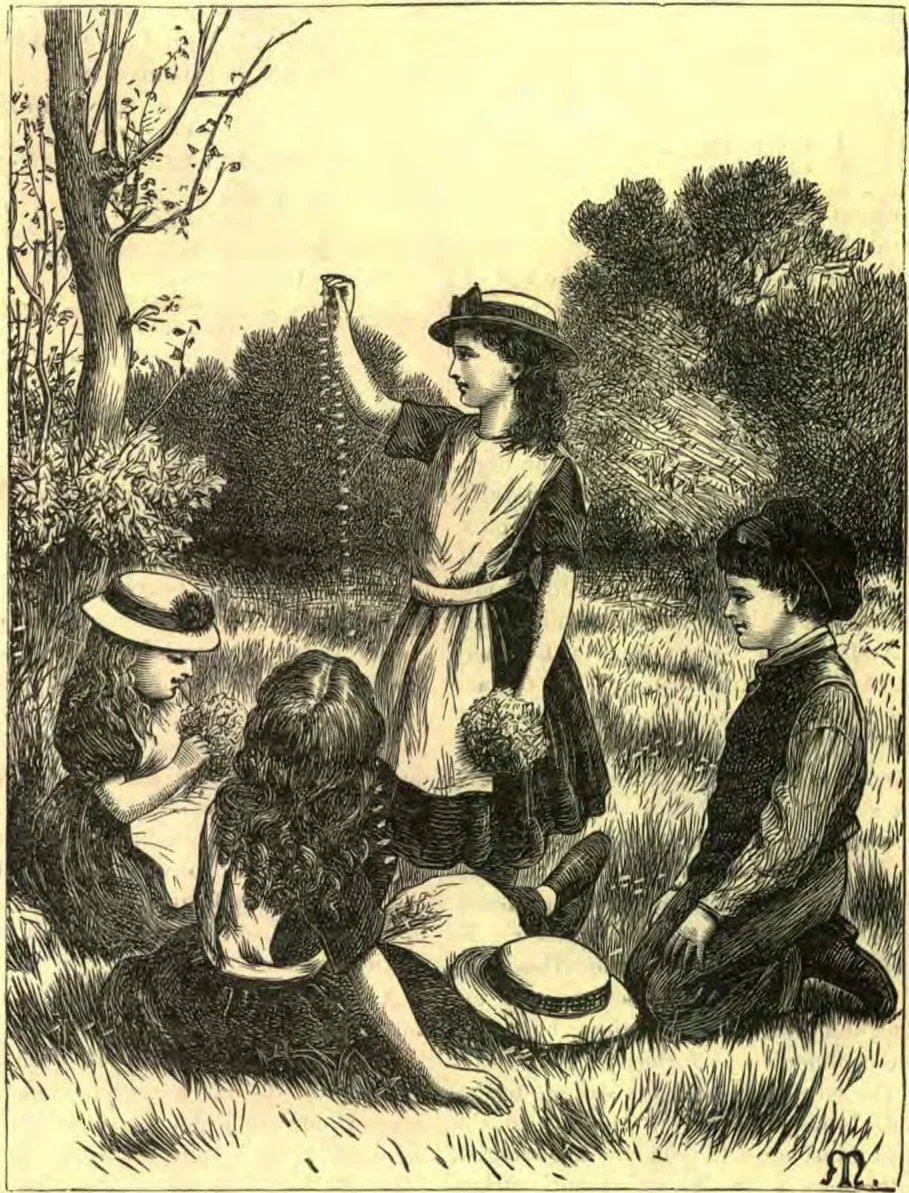
LITTLE fresh violets, Born in the wildwood, Sweetly illustrating Innocent childhood! Shy as an antelope, Brown as a berry, Free as the mountain air, Romping and merry.
Out in the hilly patch, Seeking for berries; Under the orchard tree, Feasting on cherries; Trampling the clover blooms Down ’mong the grasses; No voice to hinder them, Dear lads and lasses!
Dear little innocents, Born in the wildwood; Oh that all little ones Had such a childhood! God’s blue spread o’er them, God’s green beneath them; No sweeter heritage Could we bequeath them.

A VISIT TO LONDON.

(Concluded.)
THE next day, which was the Sabbath, we spent at Mill Yard, where three services were held in the chapel. This is the last of the old Seventh-day Baptist churches in England, and is supported by property left for the purpose many years ago. The chapel and adjoining parsonage stand on a miserable street, but you seem to be in another world as soon as you pass through the high gate; for the house is very neat and tidy, and before it is a lovely green grass-plot. This is really an old grave-yard, but it contains only a few tombs. Eld. Jones preached at the chapel in the morning, and Eld. Andrews for a short time in the afternoon, to about forty persons. Then the audience were invited out into the pleasant green yard, where a lunch had been kindly prepared by Mrs. Jones, that all might stay to the service at six o’clock.
On Sunday we went in the morning to hear Mr. Spurgeon. I liked his sermon very much. He is a large, fleshy, pleasant-looking man, and is a good speaker. In the afternoon we went to the Abbey, to hear Canon Farrar. The sermon was excellent, and they had fine singing; but many of the ceremonies performed in connection with the service looked very strange to me.
Eld. Jones took us on Monday to the British Museum. If you are a geologist, a botanist, a naturalist, or an antiquarian, you may here learn all that you desire to know in any of these departments of study. The library connected with the institution is one of the largest in the world. We saw so many interesting things here that it is impossible for me to describe them.
In the afternoon we went to Smithfield, where John Rogers and other eminent martyrs were burned at the stake in the reign of Queen Mary. Afterward we visited John Wesley’s church. I stood in his pulpit, sat in his chair, and saw his tombstone. We also saw the stone which marks the grave of John Bunyan.
On Tuesday we visited St. Paul’s Cathedral. I can give you no idea of the grandeur of this vast edifice. Over the entrance is sculptured in solid marble a representation of the conversion of the apostle Paul. On entering the Cathedral, as on entering the Abbey, immensity is the first idea that suggests itself to the visitor. Like the Abbey, it is crowded with monuments. After seeing the body of the church, and attending service, we paid a sixpence to be admitted to the library, the whispering gallery, and the clock. The whispering gallery extends entirely around the base of the cupola, and is 140 feet in circumference. It is so constructed that the faintest whisper is heard on the opposite wall, at a distance of 140 feet, as distinctly as if it were uttered close to the ear.
This visit ended our sight-seeing in London. I enjoyed it all very much. But oh, the horrible sights one sees here! They made me sick at heart. I am thankful that my home is not in this great city.
EDITH ANDREWS.

THE FRESH HOUR.

EVERY day should be commenced with God. The busiest and the best man in Jerusalem was wont to say, “In the morning will I direct my prayer unto thee, and will look up;” “I will sing aloud of thy mercy in the morning.” Daniel, too, saluted his God with prayer and praise at early dawn. We begin the day unwisely and at a great risk to ourselves if we leave our chamber without a secret conference with our Almighty Friend. Every Christian, when he puts on his clothes, should also put on his spiritual armor. Before the day’s march begins, he should gather up a portion of heavenly manna to feed the inner man.
As the Oriental traveler sets out for the sultry journey over burning sands by loading up his camel under the palm-tree’s shade, and fills his water flagons from the crystal fountain which sparkles at its roots, so does Christ’s pilgrim draw his morning supplies from the exhaustless spring. Morning is the golden hour for prayer and praise. The mind is fresh; the mercies of the night and the resurrection of the dawn both prompt a devout soul to thankfulness. The buoyant heart takes its earliest flight, like the lark, toward the gates of Heaven. One of the finest touches in Bunyan’s immortal allegory is his description of Christian in the chamber of Peace, who “awoke and sang,” while his window looked out to the sun-rising. If even the stony statue of old heathen Memnon made music when the first rays of the dawn kindled on its flinty brow, surely no Christian heart should be dumb when God causes the outgoings of the morning to rejoice.—T. L. Cuyler.

GLASS GARMENTS.

THE spinning stuffs most generally in use are but few,—wool, cotton, flax, hemp, and silk; yet there are numerous other spinning materials which have been used with more or less success;—straw, leaves, bark, and it is said that even blossoms and fruit, have been spun, and afterward woven into stuffs for garments. Most of these are from the vegetable kingdom.
The animal kingdom, also, furnishes excellent spinning material, as is afforded by the goat of Thibet, Persia, and South America, the llama and camel, the horse and cow, the dog, seal, and rabbit, besides the silk-worm.
Even the mineral kingdom is not far behind the others. “Next to asbestos, have gold and silver been drawn into threads of extra fineness and woven into costly stuffs. But few could be found to wear them; the asbestos has too little to recommend it, and the gold and silver too much.”
But the most beautiful spinning material is glass, which, when woven, “eclipses the finest web of silk, and even throws gold and silver tissue into the shade.” In Paris, Venice, and some other places in Europe, manufactories sprung up for the spinning and weaving of glass; and “more than thirty years ago, in Paris, glass bonnets, hoods, mantles, etc., were worn; glass carpets, too, were woven, more beautiful than any cloth of gold, and also variously colored materials for garments.” But owing to the brittleness of these fabrics, the manufacturers were not successful.
Recently, a process of toughening glass threads has been discovered, so that the weaving of glass has again begun. The San Francisco Chronicle says that Prof. Theodore Greiner, the celebrated artist in glass work, is now manufacturing in that city the glass fabric for a lady’s dress. The threads are finer than the finest floss silk, and the process of weaving very slow, only about ten inches being done in a day.
This, when completed, will no doubt be the most wonderful garment ever manufactured by man; but, shining and beautiful as it may be, it will appear worthless when compared with the white robes waiting for those who get the victory over sin. Probably none of us could afford glass garments if we desired them, but all who will may come and have their robes washed in the blood of the Lamb. Do “white robes wait for you,” dear reader? M. J. C.

ON, FARTHER ON!

Each night is a prison-bar Broken and gone; Each morning a golden gate, On, farther on! On, on toward the city So shining and fair; And He who hath loved me, Died for me, is there! —Alice Cary.

LESSONS FOR CHILDREN.

LESSON XXXI.—SAUL OFFERS SACRIFICE.

When Saul had reigned two years over Israel, he chose three thousand men to be constantly with him. He kept two thousand with himself in camp at Michmash, and one thousand encamped with Jonathan at Gibeah.
Jonathan and his men smote a garrison of the Philistines. This made the Philistines so angry that they gathered a great army, and came up to make war with the Israelites. They had “thirty thousand chariots, and six thousand horsemen, and people as the sand which is on the sea-shore in multitude.” At this, the men of Israel were so frightened that they hid themselves in caves, in thickets, in rocks, and in pits; and some of them fled across the Jordan into the land of Gad and Gilead. Saul was in Gilgal, and the few that were with him trembled for fear of the Philistines. Saul waited at Gilgal seven days for Samuel to come down to make an offering unto the Lord; but Samuel did not come, and the people were continually scattering, so Saul, fearing that he would soon be left alone, took the place of a priest, and offered up sacrifices to the Lord. As soon as Saul had finished making the offering, Samuel came; and when Saul went out to meet him, Samuel said, “What hast thou done?” and when Saul told him, he said, “Thou hast done foolishly; thou hast not kept the commandment of the Lord thy God, which he commanded thee; for now would the Lord have established thy kingdom upon Israel forever. But now thy kingdom shall not continue; the Lord hath sought him a man after his own heart, and the Lord hath commanded him to be captain over his people, because thou hast not kept that which the Lord commanded thee.” Then Samuel left Saul, and went up to Gibeah.
And Jonathan said to his armor-bearer, “Let us go over to the Philistines’ garrison; it may be that the Lord will work for us; for there is no restraint to the Lord to save by many or by few.” So these two men went over to the Philistines, and when they had slain about twenty men, great fear came upon their enemies. “And there was trembling in the host, in the field, and among all the people; the garrison, and the spoilers, they also trembled, and the earth quaked.” The Philistines, by this time, were so terrified that they could not tell who were their enemies, and fell to fighting one another. When Saul and his men heard the confusion among the Philistines, they came on to battle; and when the men that had hid themselves saw that their enemies fled, they joined in the pursuit, and many of the Philistines were slain that day.

QUESTIONS.

  1. After Saul had reigned two years, what did he do? 1 Sam. 13:2.
  2. How many of these men did he keep in camp with himself?
  3. How many encamped with Jonathan?
  4. How did Jonathan provoke the anger of the Philistines?
  5. What did they do? Verse 5.
  6. Describe the army of the Philistines.
  7. How did the men of Israel feel when they found that the Philistines had come up against them with such an army as this?
  8. How did they try to escape from the wrath of their enemies?
  9. Where was Saul at this time?
  10. Describe the feelings of the men that were with him.
  11. In what way did Saul greatly displease the Lord?
  12. Why did he do such a thing?
  13. How did Samuel reprove Saul?
  14. What did he tell him would be the consequence of such rashness?
  15. Where did Samuel then go?
  16. What did Jonathan say to his armor-bearer? 1 Sam. 14:6.
  17. Describe the attack of these two men upon the camp of the Philistines.
  18. Describe the feelings of the Philistines after Jonathan and his armor-bearer had killed about twenty of them.
  19. What did the Lord do to make their terror complete? Verse 15.
  20. What did they finally do, in their fright and confusion?
  21. What did Saul and his men do, when they saw what was going on in the camp of the Philistines?
  22. When the Philistines fled, who joined in the pursuit?
G. H. BELL.

BIBLE LESSONS FOR YOUTH.

LESSON LVII.—ENTERING THE PROMISED LAND.

1. Who took command of the armies of Israel after the death of Moses? Josh. 1:1, 2.
2. What did the Lord do to encourage Joshua? Verses 5–9.
3. How did Joshua obtain wisdom to lead the people?
4. Describe the crossing of the Jordan. Chapter 3.
5. How was this great miracle kept in memory? Josh. 4:2–7.
6. Who appeared to Joshua on the plain of Jericho? Josh. 5:13, 14.
7. What city was first attacked by the Israelites after they crossed the Jordan? Josh. 6:2.
8. Describe the attack. Chapter 6.
9. Describe the first attack upon Ai. Josh. 7:4, 5.
10. How did Joshua manifest the grief and humiliation which he felt on account of this defeat?
11. What did the Lord say to him?
12. Upon inquiry, what facts were ascertained? Josh. 7:20, 21.
13. How was Achan punished? Verse 25.
14. Who ordered this punishment?
15. Describe the second attack upon Ai. Josh. 8:1–29.
16. Where did the people next journey? Verse 30.
17. What was built on Mount Ebal?
18. What was written upon the altar?
19. Describe the ceremony that was then performed.
20. Where did the Israelites next go? Josh. 9:6.
21. What deception was practiced upon Joshua and the elders? Josh. 9:3–15.
22. What course was pursued toward the Gibeonites when it was found that they dwelt in the land? Josh. 9:27.

SYNOPSIS.

After the death of Moses, Joshua took command of the armies of Israel. The Lord encouraged him by many promises and wonderful miracles. As he had before instructed Moses, so he now instructed Joshua. He told him to give command to the people to cross the Jordan; and when the feet of the priests who bore the ark touched the waters of the river, the waters parted, as did the waters of the Red Sea forty years before, and let the people pass through on dry land. As a memorial of this great miracle, twelve stones were taken out of the bed of the river, and set up at Gilgal, and twelve other stones were set up in the bed of the river.
Soon after this, Joshua saw a man before him on the plains of Jericho, who styled himself Captain of the Lord’s host. This man must have been Christ, for he allowed Joshua to worship him, and Christ is commander of the armies in Heaven.
The first city which they attacked after crossing the Jordan was Jericho, a walled town about seven miles west of that river. The Lord told Joshua to march around the city every day for seven days. On the seventh day they made the circuit seven times, and when the priests blew a blast upon their horns, the walls of the city fell down flat.
The next place attacked by the Israelites was Ai, a small town to the northward of Jericho. From this they were repulsed, and driven back with considerable slaughter. Then Joshua was greatly distressed, and fell upon his face; for he knew that the Lord was not with them. “And the Lord said unto Joshua, Get thee up; wherefore liest thou thus upon thy face? Israel hath sinned.” Upon inquiry it was found that Achan, although the Lord had strictly forbidden them to take any of the spoil to themselves, had taken, at the siege of Jericho, two hundred shekels of silver, a costly garment, and a wedge of gold; and had buried them in his tent. Then Achan was stoned; and he, and all that he had, were burned with fire in the valley of Achor, according to the commandment of the Lord. After this, the Lord gave them a plan by which Ai was easily taken.
Then the people journeyed to mounts Ebal and Gerizim. On Mount Ebal they built an altar, and wrote on it a copy of the law of Moses, which he wrote in the presence of the children of Israel. Then half of the tribes stood on Mount Ebal, and the other half on Mount Gerizim, the priests, with the ark, standing in the valley between, while the blessings found in Deut. 28 were pronounced from Mount Gerizim, and the curses from Mount Ebal.
Then the people returned to Gilgal; and about this time the Gibeonites came to the camp, and wanted to make a covenant with Joshua, and the elders of Israel. They claimed to have come from a very far country, and as evidence of the fact, called attention to their worn clothing, which they said was new when they started, and to their moldy food, which they said was taken hot from the oven when they set out on their journey. Joshua thought the case so clear that he neglected to seek counsel from the Lord, and so went on, and made a covenant with these people. In a few days it was found that these men were from Gibeon, which is less than twenty miles from Gilgal. Notwithstanding the deception practiced by these men, Joshua and the elders of Israel would not break their oath; so the Gibeonites were allowed to live, but were made hewers of wood, and drawers of water, for all the congregation of Israel.
G. H. BELL.

FOLLOW UP YOUR WORK.

I often think that Christian work is like much of our secular work in its laws and methods. If you send a woodman into the forest to fell trees, you do not expect him to strike his ax into one trunk, and then into another, till he has gone through the whole wood, delivering but one stroke upon a tree. That would do if he were “blazing a trail” through the forest; but if his work be to fell trees, it doesn’t do at all. He may chop till he is gray, and never produce a log for the mill. He must take his stand by one trunk, and smite away, and make the chips fly, and walk around it, still swinging his ax and working toward the heart, till it comes crashing to the ground. That is the type of successful Christian work.—Rev. A. L. Stone, D. D.

Making the Sabbath School Interesting to All

“Mr. Salisbury, how is it that your Sabbath-school keeps up so nicely? How is it that such a great interest is manifested by all concerned? We can’t have it that way in our school.”
“It is just like this, my friend: we make it so interesting that people would rather be there than anywhere else. We do this in many ways, but the papers we have to distribute are among our greatest helps.”

A LESSON FROM THE SNAIL.

HERE are very many different kinds of snails, and they are found in almost every part of the world. Some of them do great harm by eating the tender plants in gardens; some are useful to man, being used for food in Italy and other countries.
As you see in the picture, the snail carries his house, or shell, on his back when traveling. When at rest he can draw his whole body into his tiny dwelling. The eyes of this little creature are in the two long horns, or “feelers,” one at the end of each. He has no feet, or, rather, the under-side of his body may be called one foot, on which he drags himself along on the ground or wall.
The saying, “As slow as a snail,” has come to be almost a proverb; yet a useful lesson may be learned from even this plodding little creature. Here is a story, showing what a little boy in England was taught by a snail:—
“What can be the trouble, Ned?” said Mrs. Blair to her little son, who, with a book in his hand, and tears in his eyes, sat near a wall at the back of the house.
“We all have a poem to learn,” answered the boy; “and the one who says it best is to get a prize from the Squire. But I don’t think I can learn it.”
“Why not?” inquired his mother.
“The boys say I can’t, and that I need not try,” said Ned in a sad tone.
“Don’t mind what the boys say; let them see that you can learn it,” replied Mrs. Blair.
“But I don’t think I can,” said Ned; “it is so long, and some of the words are so hard! I know that I need not try for the prize; but I would like to learn the poem, for the boys laugh at me, and call me ‘Slow Ned!’”
“Well, dear,” said the lady, “if you are slow, and can’t help it, try to be ‘slow and sure.’ Look at that snail on the wall; how slow it is! And yet, if you watch it, you will see that it will get to the top in time. So just try to learn a few lines each day, and you may gain the prize in the end.”
When Mrs. Blair had said this, she went into the house. And Ned thought that though he could not keep up with the boys, he might run a race with the snail; so he made up his mind to try to learn the first verse of the poem by the time the snail had reached the top of the wall.
When the day came, on which the prize was to be given, Squire Bruce went to the school to hear the boys repeat the poem; and when five or six had recited, it came Ned’s turn. There was a slight laugh when he got up; for most of the boys thought he would fail. But he did not miss a word; and his heart was full of joy when he heard the Squire say, “Well done, Ned Blair!” When the rest of the class had tried, the Squire said Ned had done best; and he gave him the prize.
“And now tell me,” said the Squire, who had heard that Ned was slow to learn, “how did you learn the poem and recite it so much better than the others?”
“Please, sir, it was the snail on the wall that taught me how to do it,” said Ned.
There was a loud laugh at this; but the Squire said, “You need not laugh, boys; for we may learn much, even from a snail. How did the snail teach you, Ned?”
“I saw it crawl up the wall bit by bit. It did not stop, nor turn back, but went straight on and on. And I thought I would do the same with my task. So I learned it bit by bit, and did not give up; by the time the snail had got to the top of the wall, I had learned the first verse, and then I kept at work, day after day, till I had learned it all.”
“Well done, Ned!” said the Squire. “Now, boys, let us give a good cheer for Ned Blair and the snail on the wall.” And the old house rang with a loud, long cheer; for all were glad that “Slow Ned” had won a prize at last.—Sel.

HEALDSBURGH, CAL

Dear Editors: I am keeping the Sabbath with papa and mamma. I go to Sabbath-school every Sabbath. I love to read the INSTRUCTOR. I am ten years old. I have three brothers and one sister. Papa is away most of the time preaching. Once when he came home he brought me a nice little Bible. I have begun to read the New Testament through.
WILMUTH MORTON.

Letter from a Young Orphan Girl

Mt. Morris, Mich.
Dear Editors: I am a little orphan. I am keeping the Sabbath with my ma. My pa has been dead about seven months. I go to Sabbath-school, and am trying to be a good girl, that when Jesus comes I may be his little dove.
Yours truly, Mary L. Lacy.

“YOUR WORD IS SUFFICIENT.”

Petrarch, a famous Italian poet, was held in high esteem for his candor and truth. On one occasion a violent quarrel occurred in the house of a rich nobleman where he was living, and they had recourse to arms. The nobleman, wishing to know who was to blame, assembled all his people, and bound them by a solemn oath to declare the whole truth.
Petrarch, in his turn, presented himself; the nobleman closed the book, and said, “As to you, Petrarch, your word is sufficient.”

CURIOUS DERIVATIONS.

Can you imagine how the person sitting at your table happens to be called a boarder? In primitive times, the Anglo-Saxon table was simply a board placed upon trestles at the time of eating; so those that sat around were called boarders.
Before the addition and multiplication tables were invented, to puzzle and assist the brains of children, the early Greek scholars were obliged, in their arithmetical computations, to depend upon the use of pebbles in reckoning numbers. The word for pebble was calculus, and we are reminded of their poverty and expedients every time we use the word calculate.

THE LITTLE WATCHMAN.

Watching for a golden chance To do a kindly deed; Watching, with a loving glance, To help a brother’s need. Watching for the paths of right, That we may walk therein; Watching still, with all our might, That we may conquer sin.

OAKLAND, ILL

Dear Editors: I send many thanks for the INSTRUCTOR. I like it very much. We get it every Sabbath, at Sabbath-school. We have a little box into which we put our pennies, and then we send for the papers. I am fourteen years old. I was baptized March 2, 1879, by our superintendent, H. P. Ritchey. I keep the Sabbath with my ma and sister, and am trying to overcome and gain a home in Heaven. I hope I may meet the INSTRUCTOR family there. Pray for me.
Susie A. Smith.

LETTER BUDGET.

Rio, Ky.
DEAR EDITORS: I take the YOUTH’S INSTRUCTOR and read the “Children’s Corner” with much interest. I like also to read Bro. Loughborough’s travels “From Sea to Sea.” I attend Sabbath-school, five miles distant, every Sabbath, and get the Youth’s Lessons and the Lessons on Prophecy. We have a good interest in our school, which numbers thirty-five members. We take seventeen copies of the INSTRUCTOR. I want to love and follow the Saviour, and meet all the INSTRUCTOR family in Heaven. MARY E. GARRETT.

You have reached the end of this edition.

The Youth’s Instructor · Jul 30, 1879