The Youth’s Instructor, Vol. 38, No. 39.

THE LITTLE CLOAK

The Youth’s Instructor

Sep 24, 1890

S. D. A. Publishing Association · Battle Creek, Mich. · Sep 24, 1890

THE LITTLE CLOAK.

I SING no splendid deed of fame: My theme, two children nine years old, Crossing the Melton Moor one day When winter winds were keen and cold, When all below was white and still, And all above was dull and gray; And anxious robins could not sing, And streams were frozen on their way.
Brother and sister; on they went. Their childish hearts of kindness full, Yet scantily clothed, and scantily fed, They, like the birds and streams, were dull. And yet the little shivering lad Tried hard his own sore need to hide; Tried hard to give the smile and word That cheered the sister at his side.
She had a little woolen wrap, And suddenly with tears she spoke: "Why, it is big enough for both! Come closer, dear, and share my cloak." "It will not shield us both, Marie." "Come closer to me, do not fear; And if it is not big enough, We'll stretch it just a little, dear!"
They crept together, hand in hand, They found that comfort shared is best; They laughed, and ran, and were as warm As crowding birds within a nest. And oh, how beautiful those souls That always find it wise and fit To stretch their blessings and their love Beyond themselves a little bit! —Lillie E. Barr.

ROUND THE WORLD.—28.

AGRA.

Prior to arriving at Agra, we had become rather disappointed in Indian architecture, which had not come up to our expectations concerning the land of the Orient. Of mosques and temples we had seen a few, but they lacked gracefulness and refined taste in construction. And we could not think that the noble sentiments contained in the hymns of the Vedas were properly crystallized in such work as stuccoed brick, covered with whitewash, and what appeared in the distance as gilded domes of perfect shape and apparently massive construction, but which on close examination proved to be mere shells of wood, considerably damaged by weather.
At Agra, however, the scene changed, and the brightest pictures ever seen in the most vivid day-dreams of an imaginative and beauty-loving mind were more than realized.
The town is situated on the Jumna River. It was built chiefly by the famous Mohammedan conqueror, Akbar, commonly called “the Great.” Formerly the city was surrounded by walls pierced by eleven gates, ruins of which are still seen. There are many lovely buildings, fabrics of the purest white marble lace-work, but space will admit of describing only the most prominent. The first is the fort,—a vast structure, irregular in shape, a mile and a half in circumference, and surrounded by a wall of red sandstone, sixty feet high, with crenelated battlements and numerous turrets. The outer ditch and rampart have disappeared; but the river moat, thirty feet wide, still exists. We entered by the Delhi gateway, an imposing structure flanked by two enormous towers, then up a stone ascent, and into a noble court-yard, 500 by 370 feet, surrounded by arcades. This was formerly the carousal or tilt yard. On one side is the judgment-seat of Akbar, a splendid hall, one hundred and eighty feet long and sixty feet broad. In an alcove in the center is a throne from which judgment, if not justice, was administered. It is a pavilion of white marble, with charming recesses, and containing three exquisitely sculptured marble chairs inlaid with mosaics. At the foot is an immense slab of marble, on which Akbar was accustomed to seat himself on public occasions.
Next we passed to the private hall of audience. It consists of an oblong room of white marble, beautifully sculptured, communicating with an open marble loggia of elegant Saracenic arches, exquisitely carved and inlaid. Adjoining this is an immense court, formerly the harem, three sides of which are occupied by the residences of the ladies.
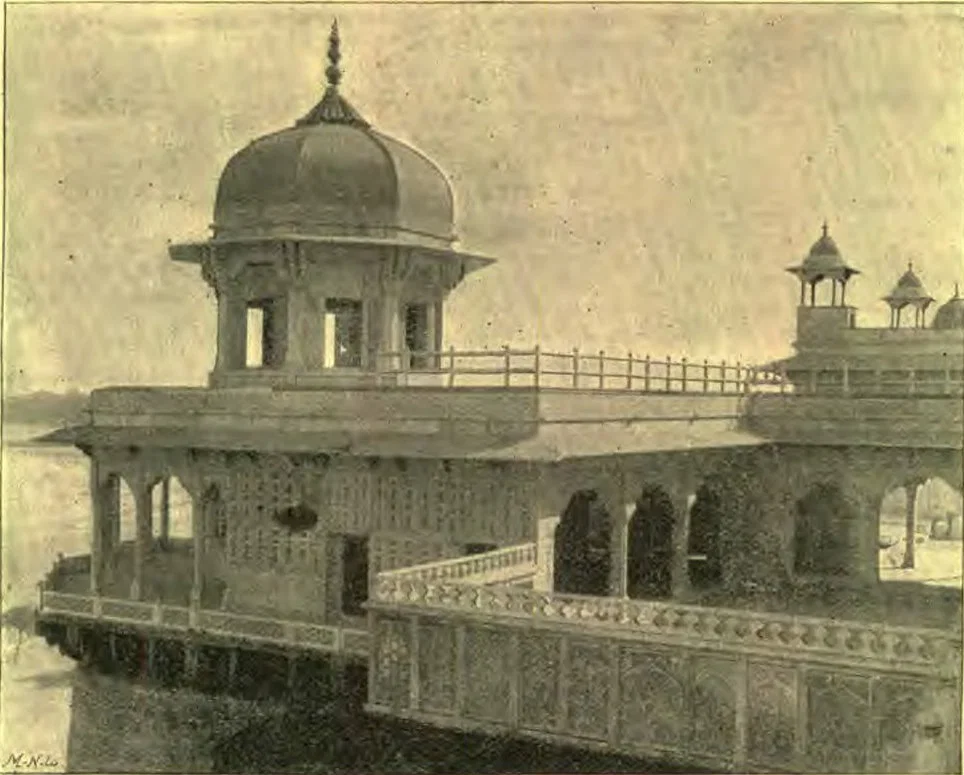
MARBLE PALACE IN AGRA FORT.
The monarch’s palace is still in a tolerable state of preservation. Cannon balls have torn huge gaps in the Sultan’s pavilion, and here and there an inlaid blossom of carnelian, with leaves of blood-stone, has been wantonly excavated from its marble bed; the fountains are dry, but this is all. The chambers, windows, and staircases are complete. One cannot stand there long, before in vision the former inhabitants of the palace of the great emperor are back again, following out such courtly games and sports as would be befitting those of royal state.
The pavilion overhanging the river, as shown in the cut, is inlaid within and without with a rich style of Florentine mosaic. There are precious caskets of marble, glittering all over with jasper, agate, carnelian, blood-stone, and other precious stones, and there are balustrades of marble, wrought in open patterns of rich design, till they appear like fabrics of finest lace. The Jumna washes the wall seventy feet below, and from the balconies attached to the zenana, or women’s apartments, there are lovely views of the palm groves and fairy-like gardens on the opposite bank.
The most curious part of the palace is the Shish Mahal, or palace of glass, which is an Oriental bath; its chambers and passages are adorned with thousands of small mirrors, disposed in the most intricate designs. The water fell over brilliant lamps in a broad sheet into a marble pool, and the fountains are so constructed as to be lighted from within. Mimic cascades tumbled from the walls over slabs of veined marble, into basins so curiously carved that the motion of the water is said to have produced the appearance of fish. This bath must have realized all the fable splendors of Arabian story. The chambers of the sultanas and the open court connecting them are filled with fountains.
Though the building is an incrustation of gold, marble, and precious stones, water was its most beautiful ornament. There are superb little fountains which once gave forth sprays of rose-water, richly perfuming those royal dwellings. On the inner side of these fairy-like precincts is the garden, where sweetest roses rival their odors with that of the jasmine vine, the upturned petals of both receiving the silver sprays from many an artificial font. There is also a court-yard paved with squares of black and white marble, so as to form a chess-board. The game played was called pachisi, and was similar to chess. Pieces of ivory were not used, but little girls ran from square to square as the moves were made. On an open terrace in front of the diwani-khas, where Akbar sat on great occasions, is a large slab of black marble, which was his throne. It is cracked from end to end, and this, the guide said, was caused by the Mahrattas when they took the city,—the Rajah seated himself on it, whereupon it instantly cracked, and blood gushed out of it in several places. There are two red stains on its surface, which is sufficient proof of the reliability of this legend to all good Mohammedans. Opposite is a throne of white marble, where it is supposed that the clown, or jester, sat to amuse the king, the master of this magnificent abode.
Among other wonders are many underground passages, where the wives of the king, it is said, played at the game of hide and seek, clothed only in the garb of Eve, dashing through the fountains of water, and making the halls resound with merriment, which caused the boatmen on the Jumna to look up to the lofty walls and wonder what it all meant. At the end of one of the passages is a deep well, where it is said that those who were unfaithful were put when sentenced to death. Two soldiers some time ago fell down this well, and were either killed by the fall or starved to death, as their bodies were not found till some days afterward. The authorities have now had the end of the passage bricked up.
In the fort is also the Pearl Mosque, which surpasses in loveliness all other buildings of its kind. We ascended a flight of steps, a huge door was flung open before us, and there rose the long-wished-for sight, in all its glory and magnificence. There is a large white marble court-yard, and at the farther end rise in stately grandeur three domes of sublime proportions, terminating in gilded spires. An inscription records the mosque to have been built by Shah Jehan in 1656. P. T. M.

WOODEN SHOES.

One of the most interesting places in a Holland village is the “klompen” maker’s shop, where klompen, or wooden shoes, are made.
Not far from Rotterdam, surrounded by high dikes, lies the little village of Rijsoord; in that village, beside the Skalkydijk River, is a shop in which an old man and his son work early and late, supplying the peasants (who never go barefoot) with shoes. These are first roughly shaped from blocks of willow wood, as a statue is first rudely outlined by chipping the marble block, and afterwards the shoes are finished smoothly with sand-paper and pumice-stone.
The willow trees are grown for this purpose, and when they attain the required size, they are cut down, the branches are trimmed off, and only the trunk is used, being divided into blocks, each one of which is the length of the longest shoe.
The work goes on without interruption through the morning, unless some friendly neighbor looks in over the half-open Dutch door; and this is the occasion seized upon by the two men for refilling and lighting their pipes, and drawing a few long whiffs, while they listen to a little village gossip.
At eleven o’clock the good vrouw appears at the door with “koffij, jongens” (coffee, boys), and they follow her into the adjoining room. It has a low, thatched roof of deep yellow reeds, and contains the great fire-place, where in damp weather the newly-made shoes are placed before the fire to dry.
All their food is cooked in the same fire-place, excepting the bread, which in every peasant’s home is supplied by the baker.
The shoes are piled round the smoldering embers, often with the tea-kettle simmering among them; and while the sap dries out, they give little groans and signs, as if they knew the hard fate awaiting them when the time shall come for them to cover the feet of some sturdy Dutch peasant or workman, and to clatter over the pavements of the town.
After this morning’s refreshment, which all of the peasants enjoy, they return to work.
Sometimes, among the piles of white shavings, there are customers waiting to be fitted with new shoes; and from the rows of shoes suspended from the ceiling and across the side walls, for kinderen and grown folks, the right size is always to be found.
The Hollanders make so many uses of wooden shoes, one is persuaded to believe the “old woman who lived in a shoe, and had so many children she didn’t know what to do,” was a Dutch vrouw. The children turn shoes into boats, and paint them a rich, deep brown, in imitation of the large boats which sail on the river Maas. As they trim the tiny sails of their ships, and launch them upon the waters of a sloot to some imaginary Van Diemen’s land, not to be found in a geography, they seem possessed with the same spirit which inspired the Dutch navigators of earlier days.
There are very many sloots (which are deep ditches full of water), used both to fence and to fertilize the land; so the voyage of the shoe may be a long one, and the owner of the little vessel will have abundant opportunity to indulge in dreams of future wealth, to be realized “when his ship comes in.”
The boats that one may see on the rivers and the coasts of Holland are not unlike the wooden shoes in shape, and the same model may originally have served for both.
The school-boy, heated by play, stops beside the nearest stream, pulls off his shoe, and fills it with water, which he drinks with as much satisfaction as if it were a delicious draught from a silver cup.
Wooden shoes are ornamental as flower-pots, and many a bright flower whose roots are firmly imbedded in a shoe has graced the window of some peasant’s cottage—a joy to the owner, and a pleasure to the passing traveler.
They are useful as hammers, and it is not uncommon to see a koopman (merchant) by the wayside, with a few taps of his shoe mending his cart, piled high with yellow carrots or little round Dutch cheeses, while his dogs rest in the traces.
These shoes also take the place of the obsolete birch rod of our grandmother’s days. The good vrouw, in her quaint cap of spotless white, with gold spiral pins called krullen placed above the ears, does not look very much like such grandmothers as we have known, but her discipline resembles theirs in severity if not in kind.
During the week, after school hours, the little girls walk along the dikes in rows, knitting; and the clatter of their shoes, to an ear unfamiliar with it, is, except that it is without the military regularity, like the sound of an advancing regiment.
Saturday is the great cleaning day in Rijsoord, when everything is made ready for Sunday, the day of rest. The houses are scrubbed inside and out, and among the pots and kettles are seen the wooden shoes; these, scoured snowy white, hang upon forked sticks near the doorway to dry in wind and sun.
The morning brings the sound of klompen along the dikes, and rows of people are seen walking toward the kirk. At the door they leave their shoes, like faithful servants, to await their return later after a three hours’ sermon by the dominie.
In the afternoon the young men and women stroll up and down the Promendijk, which is the “Fifth Avenue” of the village—its general promenade and meeting place. They exchange nods and friendly greetings until sundown, when the busy week begins again, and the wooden shoes soon take on their weekday coat of tan.—Anna Page Scott, in St. Nicholas.

A LITTLE HERO.

The wicked reign of Queen Mary was drawing to a close, but still the persecution of the Protestants went on. On a small farm in a lonely part of Cumberland there once lived a pious farmer, his wife, and little boy and girl, who, when he heard how the persecutors were gradually coming that way, dismissed his servants, and prepared to fly with his wife and children to the mountains which surrounded their home. At last the dreaded day came; the persecutors were in the next town, cruelly murdering the inhabitants, and soon they would be on the way to the village where the farmer lived.
Quickly, and in great haste, they packed up some food and warm clothes, and ran unnoticed till they came to the cave in the mountain side where they had before gone for pleasure, but now to save their lives. Two days passed, and each morning the farmer went to the top of the mountain, where he could see the old home and the little village, but no sign of the dreaded soldiers could he discover. On the third morning they found that they had not enough food to last them, so the parents determined to send Frank, a boy of eleven, to their home to replenish their stock. Frank arrived safely, and after filling his pockets and basket with fruit, bread, and biscuit, set off once more to the hiding-place.
He had already gained the foot of the hill, and was leaving the road to ascend it, when, looking round, he saw, to his horror, a troop of cavalry men galloping along the road after him.
What could he do? But before he had time to decide whether to run and hide in the fields which were on both sides of the road, or to stand still and let them pass, he found himself roughly taken by the collar, and pulled before the general who had charge of the soldiers.
“What is it you have in your basket?” said the general.
“Food, sir,” said Frank.
“And who is it for? Tell me!” sternly said the man.
“My father and mother, sir,” answered he.
“Where are they hiding?”
“I cannot tell, sir.”
“Tell me this minute, or I will punish you,” thundered the general.
“No, I cannot tell.”
The cruel man then turned to a soldier, and said, “Draw your sword.”
In the meantime the farmer had become very anxious at Frank’s long absence, and determined to set out in search of him. He quickly arrived at the foot of the hill, and was turning round toward his old home, when he heard a low cry of pain. He hastened in the direction of the sound, and found his son lying bleeding and almost unconscious. He lifted him carefully, and with great difficulty managed to carry him to the cave, where, by his mother’s careful nursing, Frank recovered before long, and was able to tell his story of the cruel general.
In less than a month the wicked queen died, and the farmer, his wife, and children were free to come home, for the reigning sovereign was a Protestant, the “Good Queen Bess.”—Selected.

THE VALUE OF SMILES.

A SUNBEAM from the morning skies Kissed gentle Kathleen's sleepy eyes— It kissed her eyes and mouth and nose, Until the little maid arose. "I'm going to try," it heard her say, "To be good-natured all the day."
When softly by her brother's bed She stood and soothed his aching head, Her weary mother whispered, "Dear, Your smile is medicine and cheer."
In school she bent a happy look Upon the lesson in her book, And heard at night her teacher say, "You've made me happy, too, all day."
With patient, kindly words she smiled Upon a fretful little child, Who straight forgot to cry a space, And gave her back a pleasant face.
And thus the little maiden wrought A blessing far beyond her thought, Unconscious that a gentle grace Was beaming in her happy face; She felt the world was kind, nor knew Her own sweet nature made it true.
—S. S. Advocate.

The Rainy Sabbath.

“My dear child, you are not going out in this rain?” exclaimed Mrs. Hill, as her daughter entered the room dressed for the street one disagreeable Sabbath morning.
“Yes, mamma, I am going to church,” she answered pleasantly; “the rain did not keep me from that concert last week, nor from going to the stores yesterday. Tom, what did you do with my umbrella?”
“I’m sure I don’t know,” said the young man, who had just sauntered in. “But what nonsense, your going to church this morning! You would better stay at home; you can read a sermon that will do you just as much good.”
“‘Forsake not the assembling of yourselves together,’ quoted his sister. “Ah, here’s my umbrella. Good-by.”
As Mary approached the church, walking carefully through the rain and mud, Harry Hampton, a bright-faced boy of fourteen, came rapidly down the church steps, and ran against her as she started up.
“I beg your pardon,” said the boy, raising his hat. “Why, Miss Mary! is it possible you are out such a day as this? Let me help you up these slippery steps.”
“You are going the wrong way, Harry,” said Mary, pausing a moment as he turned again toward the street.
“Well, yes,” replied Harry, with a slight blush; “I looked into the church, and it looked so empty and desolate that I thought I would go to see some fellows who had invited me to their rooms to-day. I know that is not the way to spend the Sabbath, but you do not know how lonely a boy gets in a town like this by himself all day on Sabbath.”
Harry Hampton was the son of a farmer with whom Mrs. Hill and her family usually spent the heated summer months. Mary had heard that Harry had come to town and entered a store. She had intended to ask Tom to look him up; as she now spoke, she reproached herself for not doing so.
“I know you must be lonely,” replied Mary; “will you not come and sit with me in our pew? I too am alone to-day.”
“Certainly, if you wish it,” and the boy’s face brightened as he followed the pretty and well-dressed young lady into church.
The minister gave as his text, “Choose you this day whom ye will serve,” and followed it with an earnest appeal to those who had not chosen the Lord’s side. When the services were over, and Mary turned to Harry, she was startled at the earnest, thoughtful expression on his face; he refused her invitation to dinner, and walked off to his own room.
Several weeks had passed, and Mary had seen nothing more of Harry, when one bright communion Sabbath she was made happy by seeing him come forward to be received into the church.
“I want to thank you for keeping me at church that rainy Sabbath,” said Harry afterward. “I was on the road to ruin that day, and the sermon I heard stopped me.”
Harry Hampton is an active member of the church, and Mary Hill often thanks God that he used her faithfully-spent “rainy Sabbath” in the salvation of a soul.—Christian Observer.

THE KIND OF GENIUS NEEDED.

“THERE,” said a neighbor, pointing to a village carpenter, “there is a man that has done more good in this community than any other that ever lived in it. A new family never moves into the village that he does not find it out, and give them a neighborly welcome, and offer them some service. He is on the lookout to give strangers a seat in his pew at church. He is always ready to watch with a sick neighbor. He finds time for a pleasant word to all children he meets, and you will always see them climbing into his wagon when he has no other load. He has a genius for helping people, and it does me good to meet him in the streets.”—Selected.

SWINGING, SINGING.

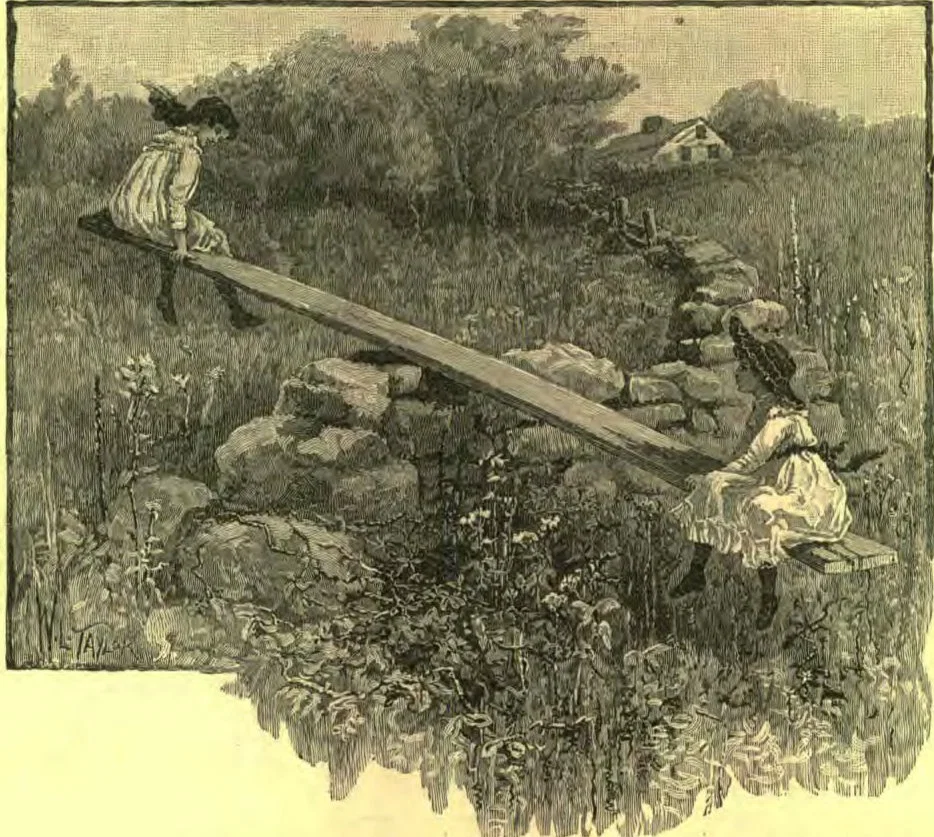
A BLUE sky full of white ships, A meadow full of bright slips, A field of wheat and grasses, All dimpling when wind passes, A farm-house in the billows Of green, beside the willows, An old stone wall between fields, As barrier to the green shields Of golden-rod and aster, That threaten swift disaster, All waving in the meadows And casting direful shadows, And bridged on board above them, Two little maids—God love them!— With fresh young voices singing. How gaily they go swinging! Now up, now down, now low, now high, Like two young birds that learn to fly.
No shade upon their faces; For care has left no traces. No sadness in their singing, As they go swinging, swinging; The world may have its sorrow, They know not of to-morrow; To-day is full of singing, They've naught to do but swinging. A blue sky bends above them, They doubt not that God loves them; The paths of paradise still spread For little children's feet to tread: For everything is love and joy To guileless heart of girl and boy, While thus they sit a-swinging, With naught to do but singing.
O happy maids, that over The sky bends like a lover! Store up the sunshine while you may, And keep it with you all the way; Let memory be a warden To a beauteous pleasure garden. On many a day in years that come It will be sweet to go back home, To see the farm and willows, The house amid the billows Of green, to sit a-swinging, With naught to do but singing. Forgetting for awhile that you Have passed away from all you know, Such memory days are given To make us long for heaven; But now while you are swinging, Do nothing but your singing.
FANNIE BOLTON.

MRS. PAYNE'S RED ANTS.

“Dear me! Dear me!” said Mrs. Payne, as she went into her pantry, “I wonder if I am going to be plagued all summer with red ants? Here they are now on this currant pie I was going to have for dinner. I brushed away a dozen or more yesterday, and to-day there are ten times as many!”
“When they once get into a house this time of year, it is next to impossible to get rid of them.”
“Well, now, I can tell ye how to get rid on ’em,” said old Mrs. Sagett, who had stopped to rest awhile on her way to town, and was sitting in the little calico rocking-chair, sorting the herbs she had to sell.
“Catch them, and give them catnip tea?” asked Mrs. Payne, laughing.
“No, indeedy! Easier than that. Catch a few, and tie ’em up alive in a bit of paper, and carry ’em off to some other body’s house, and drop ’em there unbeknownst. They’ll stay and draw the rest arter ’em. I’ve done it time and time again, and it’s sure cure!”
And with a shakey laugh that had no mirth in it, she gathered up her bundles and bags, and began again her weary way to town.
“Poor thing! Now I suppose she really believes that nonsense,” said Mrs. Payne.
“Is it nonsense?” asked little Hetty Payne, who had been listening intently, while busy with her patchwork.
“Why, of course,” replied her mother, “just like seeing the moon over your right shoulder, and nailing a horseshoe over the door, and all such things.”
Hetty was silent. In her own heart she was always very anxious to see the moon over her right shoulder, and she believed in wish-bones, and she had noticed herself, after Aunt Prissy told her, that whenever the dish-cloth fell on the floor, there was sure to be company directly after.
“Besides,” continued Mrs. Payne, “if it were true, it would be a very mean trick to play on a neighbor.”
As days passed, the red ants increased, until they seemed to be everywhere. They were found in the bread-jar, they got to the cake. There was no security about pies, and it really was too provoking when, on opening the sugar-box, the little red pests were found running about there too.
“I was so ashamed to-day, mother,” said Hetty one afternoon. “When I opened my dinner-pail at noon, and took out my turnover, I broke it to give one of the school-girls a piece, and there were red ants running on the edge!”
“Well, I tried to be careful,” sighed her mother. “I wrapped that turnover in a napkin last night, to keep it safe. I do all I can. I put all the eatables in crocks now, and keep them standing in pans of water.”
“You have red ants, haven’t you?” asked Aunt Prissy, as she came over from her house a few minutes, and sat long enough to eat a slice of gingerbread.
“O dear!” thought Hetty, “I can’t bear it any longer. And there’s the schoolma’am coming here to board next week, and what will she say if she sees red ants! I wish I could run away.”
But every little while she would say softly to herself,—
“I’ve a great mind to try it! I’ve a great mind to try it!”
For you see she could not get it out of her mind that old Mrs. Sagett had told how to get rid of the ants. She was almost sure it was so; those queer old women knew things that other folks didn’t. But if she should catch some of the ants, and do them up in a paper, where should she carry them? Not to Aunt Prissy’s, that would never do; she must go the other way, down the road.
“There’s Mrs. Stebbins,” she thought. “She hasn’t any children, and she’s real strong to work, and a great housekeeper. I guess she can stand them better than we can.”
So, step by step, Hetty drew nearer the resolution. At last she made it,—she would go that very day, after school, toward dark, and carry a paper of red ants to Mrs. Stebbins’s house.
But her mother must not know it, or she would forbid the whole thing.
“It’s too bad she should feel so about it,” said Hetty to herself, “when it will be such a comfort to her when the ants are gone.”
Mrs. Payne was very busy that afternoon, and did not notice especially what Hetty was doing, since her lessons were learned, and her sewing stint done. Hetty went quietly into the pantry, and laid a bit of bread on a shelf.
Then she looked for a piece of paper, and finally tore off a corner from an old newspaper. By this time some ants had gathered on the bread, and Hetty, laying it in the paper, wrapped it up quickly, and for want of a string, pinned the ends together.
“You don’t care if I take a little walk, do you, mother?” she asked.
“Not if you come back by dark,” said her mother.
“It is getting late, and I see ’Kiah driving the cows from the pasture. You might just run down by the road as far as that wild sweet-briar bush, and gather a few for my vase.”
“So I will,” said Hetty, and tying her sunbonnet, she started along the road, with a sweet purpose in her heart and a paper of red ants in her pocket.
It was a lovely summer afternoon, the orchards looked restful and shady, the hay was raked up in the fields, the air was sweet, and the birds were twittering from every bush. But Hetty did not give them a thought; she hurried down the road till she came in sight of Mrs. Stebbins’s big gray house, and then her step slackened.
“Must I go in the house?” she thought. “She’ll ask what I’ve come for, and I’m afraid. She might find the paper as soon as I left, and then what would she do! I don’t see her around anywhere. I shall have to knock. I declare, I’m trembling so I don’t know what to do—if a window was open, I could throw the paper in and run.”
She stood loitering, then she was suddenly afraid Mrs. Stebbins might see her, and wonder why she was hanging about. She thought she heard a wagon coming, and in a quick desperation she plunged her hand in her pocket, threw the paper of ants over the wall in among Mrs. Stebbins’s currant-bushes, and then she ran swiftly toward home.
When half-way there, she met old Mrs. Sagett toiling along the road, and would gladly have passed her, but the old woman stopped to speak.
“How are ye, little gal?” she asked. “I hadn’t time to-day to stop to see yer ma. Been to see Miss Stebbins, hey? Has yer ma got rid o’ her red ants yet?”
Hetty answered as well as she could, and then went on, with a burning face and a strangely heavy heart.
She felt as if Mrs. Sagett was a sort of witch, and knew just what she had been about. Suppose she told Mrs. Stebbins, and all the neighborhood should hear of it! How sorry and ashamed her father and mother would be, to think their little girl had done a mean thing.
And now she remembered that Mrs. Stebbins had been good to her mother, and sat up with her all night once when she was very ill. This seemed to make it all a great deal worse.
“Where’s my sweet-briar?” asked her mother, as she came into the house.
“I forgot all about it,” said Hetty, and that was the truth.
The next day, at school, one of the girls nudged Hetty, and whispered,—
“There’s a red ant running up your sleeve.”
Hetty brushed it off with a look of abhorrence, and at recess some of the girls laughed at her for being afraid of ants.
“Pooh, they’re nothing,” said Jane Downs. “We have ’em every summer, and then mother hangs up pennyroyal to drive them off.”
“Everybody has them now and then,” said Lou Brown, “and say, girls, I’ve heard the funniest thing. If you take some to another person’s house, and leave them, they’ll all go away from your house to stay at that place.”
The girls all laughed but Hetty,—she was overcome with fear and shame. She was sure Lou Brown had somehow found out what she herself had done.
Her spirits sank, she seemed unlike herself, and moped about in a heavy way that disturbed her mother.
“I declare, our red ants are all gone!” Mrs. Payne exclaimed cheerfully, a few days later. “They have gone as suddenly as they came. Aren’t you glad, Hetty?”
But Hetty could only burst into tears and run out of the house. It was true then,—it was true, and no nonsense at all, and now all their red ants had gone to Mrs. Stebbins’s house!
Mrs. Payne was seriously distressed; she followed Hetty, and found her weeping behind the grape arbor. There, taking her little girl in her arms, she soon had the whole story.
“It’s all nonsense, perfect nonsense!” she said. “But don’t you ever do a mean thing to a neighbor again as long as you live, Hetty Payne! You poor child, I tell you it’s all nonsense. Come, dry your eyes, and we will go right over to Mrs. Stebbins’s and find out.”
Thus strengthened, Hetty went forth, holding her mother’s hand, down the road to the old gray house again. Mrs. Stebbins met them at the door with a hearty welcome.
“Come right in,” she said, “come in and sit down. My work’s all done up, and I’m ready for company.”
They talked together in neighborly fashion about the weather, the crops, and the sewing-society, and then Mrs. Payne asked Mrs. Stebbins if she had been troubled any with red ants this summer.
“O yes,” said Mrs. Stebbins, “we had quite a good many last month, they often get into old houses like this, but we haven’t had any now for more than a week. Why, are you troubled?”
Mrs. Payne said she had been troubled with them, but they were all gone now; and shortly after, she and Hetty took their leave.
O, how light Hetty’s heart was now! She fairly danced along the road. It seemed as if she should never know a care again.
“But remember,” said her mother, “remember as long as you live, that mean tricks never pay!”—Selected.

SCHOOL-DAYS OF OUR PRESIDENTS.

The father of President James K. Polk was a farmer and surveyor. James was in the habit of assisting him in the management of the farm, and accompanied him on his surveying expeditions, when they would be away from home for weeks together. It was the duty of James to take care of the horses and camp utensils, and to cook the meals of the surveying party. There was enough of variety and excitement about these expeditions to make them enjoyable, and we may be sure that little James Polk had “a good time.” His father afterward unsuccessfully tried to make a merchant of him, and then allowed him to attend the academy, where he was one of the best scholars in the school. He was noted for his punctuality, and never allowed himself to be absent from a recitation or the morning religious services. One of the wits of the academy, when he wished to prove how sure anything was to happen, was in the habit of saying, “It is as certain as that Polk will get up at the first call.”
The boyhood of Zachary Taylor was spent in Kentucky, about five miles from what is now the thriving city of Louisville. The Indians abounded in that part of the country in those days, and the hardships of border life were familiar to the people of that section. Zachary attended a school kept by a Yankee schoolmaster. It was a common thing in those days for the Kentuckians to spend a good portion of their time fighting the Indians, and the man who shot a “redskin” was not only looked upon as a public benefactor, but among the boys and girls his popularity was assured; he was looked upon as a “great man.”
One day little Zachary was obliged to stay at home from school. Do you suppose it was because he had a headache or a cough?—No; he staid at home with his older brother, and helped make bullets for his father, who was a short distance away from the house, engaged in fighting the Indians. Even the village doctor, when he rode out to see his patients in the surrounding country, carried a brace of pistols attached to his saddle, and he was ready to use them the moment he saw the face of a redskin peep out from behind the trees.
Millard Fillmore, when a small boy, picked up what learning he could from the books that fell in his way, and at an early age was sent to a small town in Livingston County to learn the trade of a clothier. In the meantime he read all the books he could find in the village library on the subjects of history, geography, and travel. A distinguished judge, seeing how studious he was, took a great interest in him, induced the tailor for a certain sum to part with his services, took the boy into his office, and made a lawyer of him.
Franklin Pierce, when a little boy, was noted for his prettiness; he had curly hair, blue eyes, and his manners were so gentle and kindly as to win the favor of all who met him. When he was at school, one of his classmates, much older than the other scholars, found it very difficult to keep up in his studies. Of course he felt very foolish over it. In after years he recalled how little Franklin Pierce had sympathized with him, and how, while the other boys at recess were outside, enjoying their sports, Franklin Pierce remained for several weeks in the school-room, and helped the backward scholar to master his lessons.
At the age of sixteen he attended Bowdoin College, Maine. There he was a bright, good-looking, sunshiny kind of lad, and was very fond of drilling in the college military company, of which he was an officer. He used to say that he wished he could have been a soldier.—Harper’s Young People.
Continue reading: FARMING WITHOUT RAIN