Review and Herald Publishing Assn. · Takoma Park Station, Washington, D. C. · Sep 18, 1917
Brief News Items on War, Science, and Religion
Misplaced switches have wrecked more trains than they have children.
The wings of a big biplane are so strong that they will support one hundred and twenty persons.
A young Kentuckian has lost a big fortune by being twenty minutes late in keeping a business engagement.
The monarchist troops of China have been overcome, and the republic has been reëstablished, with Feng-Kuo-Chang as president.
To further the work of the American Bible Society on the Panama Canal a motor launch has been provided to visit the ships using the canal.
Canada has prohibited the use of wheat in the manufacture of beverage alcohol. Alcohol for commercial and war purposes may be manufactured only under license.
Nearly nine hundred students were graduated from the New York University this year without being present, the money thus saved being applied toward an ambulance service in France.
The 7,000 mechanics and other workers at the Philadelphia navy yard who signed the letter to Secretary Daniels pledging their services to the government during the war have set a splendid example to workingmen throughout the nation.
The new Russia will retain the old flag, which has three horizontal stripes — white, blue, and red. A few years ago the imperial emblem, a black eagle on a yellow field, was placed in the upper left-hand corner of the flag, but the provisional government has ordered that it be removed.
With publishers falling daily farther behind in their orders, the war has created the greatest demand in the history of the nation for Bibles. Publishers say that any one who possesses a set of electrotype plates for the New Testament, pocket size, owns something almost as valuable as a steamship. New York publishers report their presses running from fifteen to eighteen hours a day, but are still several weeks behind orders already received.
Mr. Gerald E. Miles has been canvassing during the summer in Vermont. He has already earned two scholarships for use in the South Lancaster Academy, and has $230 worth of orders toward a third one. Another student of South Lancaster Academy, Miss Deasy, has been canvassing in Connecticut. She pledged the profits of her best week's orders to the academy for needed improvements. So far, her best week's work brought her a profit of $67.
On August 6, the Connecticut blue laws were set aside, and the first open Sunday known in the State for three hundred years was kept. For three centuries only drug stores have been allowed to be open on Sunday. But now bakeries, ice-cream parlors, milk stations, fruit stands, tobacco stores, news stands, and automobile shops were all open and did a thriving business. The motion-picture theaters were stormed in many places by the big crowds who were out for a good time. One section of the new act allows amateur baseball and other sporting events to take place on Sunday, provided no admission fee is asked. Rifle ranges may also be opened.
Lord Dunsany, the Irish Soldier, dramatist, and poet, served without a scratch in the Gallipoli campaign, but, returning home on leave, he was wounded in the Dublin insurrection at Easter, 1916. Lord Dunsany is the author of these beautiful words, which some of our readers will find worth preserving: “What is it to be a poet? It is to see at a glance the glory of the world, to see beauty in all its forms, to feel ugliness like a pain, to resent the wrongs of others as bitterly as one's own, to know mankind as others know single men, to know nature as botanists know a flower, to be thought a fool, to hear at moments the clear voice of God.”
At the American Museum of Natural History in New York City they are making an experiment that may seat King Corn more firmly than ever on his throne. They are cultivating there the Mandan maize, the secret of which has long been known only to the Mandan Indians. The kernels are of different shades of red, black, and blue, but the virtue of the variety lies in its power to adapt itself to cold, dry climates. It can be raised in the Northwest and in the mountain States as easily as common corn is raised in the Middle West.
Twenty-five billions of cigarettes were smoked in the United States during 1916—seven billions more than in 1915. Putting our population at one hundred millions, and omitting women and children, this total means that every boy and man smoked 62½ boxes each of cigarettes during 1916. And yet how many thousands of us never smoke a cigarette. So the actual total for each cigarette smoker must be nearly one hundred boxes a year!
The Panama Canal, which opened in the month in which the war began, has had only a small part of the business that it would have had if the world had been at peace; nevertheless, it has been more useful to merchant shipping than is generally known. Up to the first of the year, 2,781 vessels had passed through it. Nearly half of them were British; a third were American; the others carried no fewer than nineteen different flags.
Dr. A. B. Olsen, superintendent of the Caterham Sanitarium, recently said that two hundred of our young men in England had been called to the colors, but were giving noncombatant service; and that not one of them, so far as he knew, was working on the Sabbath. Their faithfulness in service where they could conscientiously serve had made the officials lenient with them concerning the Sabbath.
The Man Who Makes Character Makes Foes
THE man who makes character makes foes.— Young.
The Bible in the Army
By Caroline Louise Clough
CAROLINE LOUISE CLOUGH
It was Martin Luther, I think, who said that all he did to start the Reformation was to start the Word of God running in the earth. So in all ages the Word of God has been the saving salt of humanity. It is only recently we have learned of the splendid work of the Pocket Testament League among the English and French soldiers at the front since the war began. In twelve months no fewer than forty-eight thousand soldiers have enrolled as members of the league, and of that number twenty-eight thousand have accepted Christ. There are only two stipulations for membership in this league. One is to carry the League Testament always, and the other is the reading of at least one chapter a day.
So with the assistance of the evangelist, the army chaplain, and the private Christian soldier, this work has spread to tremendous proportions.
Quoting from the booklet “Signing On,” by J. Kennedy MacLean, who himself participated in this splendid work, we get some idea of the wonderful results of the distribution of God’s Word in the army.
“Some of these little books have been riddled with bullets, and on some occasions have saved life by intercepting the shot or shell on its way to a vital portion of the body. Frequently while shrapnel has been bursting overhead, the Testament has been read aloud by a member of the league to his anxious comrades, and its words of counsel and comfort have brought peace and strength amid the inferno raging on every side. In not a few places the canteens [drinking places] have been deserted through the influence of the Pocket Testament League.”
Giving the experience of one man of God in the camp, Mr. MacLean says:
“An officer came in who was not a Christian man, nor had he very much sympathy with Christian work. He said, ‘What are you doing here? Extraordinary things are happening in the lines. Men who used to curse and swear are now reading and praying. What is it you have got?’ We showed him the Testament.
“Some of the men who decided have gone straight back to their ungodly companions, and have besought them to turn from their evil ways and come down and get a Testament and start right.
“That the distribution of Testaments has carried with it a far-reaching blessing, and been the means of turning countless lives into new channels, is the glad testimony of all who have come in contact with the work. Everywhere there has been an intense eagerness to listen to the appeal of Christ to the human soul.
“‘But for the Testaments,’ runs the admission of another worker, ‘I should have no legitimate excuse for approaching the men beyond an occasional word. But they are the opening to real heart-to-heart talks and confidences.’”
At one camp, quite a famine broke out for the Word of God among the troops. Quoting further:
“We used to find men reading as they sat about in the fields, and from all accounts it was quite common to see them reading in the huts. Many told us that before the war such a thing as Bible reading would have seemed impossible with many of them.”
Membership Cards and the Messages They Bore
“A packet of membership cards from one of the large military camps in the west of England arrived not long ago. On the backs of these—the cards of men who had professed acceptance of Christ as Lord and Saviour—the worker in charge of the place had briefly sketched biographical notes. Some of these are worth quoting. ‘This fellow,’ ran one of the descriptions, ‘professed to be an infidel, but after I had a long talk with him God opened his eyes to see he was a sinner, and enabled him to accept Christ. His example will result in others’ deciding for Christ, I feel sure.’
“Another: ‘This man was an agnostic, but through God’s Word his doubts were removed, and, after receiving a League Testament, he, with twenty of his comrades, came to my house, and finally decided for the Lord Jesus.’
“A third: ‘This man told me there was nothing like gambling to make one happy, but since accepting Christ he says that it’s Christ who makes one happy.’
“Again: ‘This was a wicked man when he accepted a Testament, but he promised to read it, and was led thereby to Christ. He has since gone to the front.’
A Letter Worth Reading
“All these incidents bear witness to the wonderful work of grace at present in progress among our troops, but it may be doubted whether a more impressive testimony has yet been published than that which is contained in the following letter. The writer has since met his death on the battle field. Written to a friend, the letter reads thus:
“‘When you go over to the young men’s tent, I want you to remember me to the staff there, and to tell the leader how glad I am that I ever had the opportunity of a quiet talk with him. You know, Jim, what my life had been up to that time. You know how I had wasted my life, and brought degradation to my poor wife and family. But that day changed my world.
“‘Oh, the joy of my little wife when I went home and told her I had decided to follow Christ, for whom I had never before had any use! Unless they have told you, or Nell sent you word—my wife’s people had persuaded her to apply for divorce from me; but there will be no divorce now, and if God spares me to return to my darlings, neither wife nor youngsters shall ever have cause to feel ashamed of me again. I am glad to be able to write you like this. We are both fairly well educated, and both of us have room for repentance; but best of all, we both made our decision for Christ under the same influence.
“‘Jim, if ever men felt after God, they are doing it here. There are about twenty-three of us left here4who signed those Testament cards and marked A. C. [accepted Christ] in the corner, and we are sticking to our pledge. In the lonely hours of the night, when one is skimming his eyes for Turks, it is good to feel one is not alone, and to be conscious of an Unseen Presence brooding over one.
“‘Last night poor old Dick died, and as he was dying he handed me his Testament and a letter he had received from the jolly old Y. M. C. A. leader, and asked me to send them to his mother, and tell her to keep them for his sake.
“‘You remember the night he came over to go to bed after he had been with the leader in his tent, and how he knelt down to pray. Yes, and how he continued in prayer although we hurled at him anything we could lay our hands on. We thought it rare fun night after night, didn’t we? But we, too, were soon to be under the same influence ourselves, and pass through a like experience. And we are all the better for it.
“‘I’d give something to see the leader sitting, with his Bible, among us tonight. Poor chap, he used to look worried and wan sometimes, but he always had a smile and a word in season. I may never be able to write him, but you’ll show him my letter, won’t you? It will cheer him up, and I always think of him in my prayers.’”
Impressed by Another Soldier Reading the Testament
“Addressing his letter from the trenches, and inclosing a membership card, a private writes:
“‘It may interest you to know how I came to hear of the Pocket Testament League. We were resting in a wood some weeks ago, a few miles behind the firing line, but well within sound of the guns. One evening I noticed a chap sitting against a tree reading a Testament, and I strolled across to him, and got into conversation. He told me that his sweetheart had sent him the Testament, and he handed it to me, when I saw it was a League Testament.
“‘Soon after, I left him, but this little incident had set me thinking, and I determined to try to lead a better life. Next day we went into action and had a fairly rough time. The chap with the Testament (Summers was his name) and three others were lying together when a shell burst near and killed all three and only slightly wounded Summers. From then I determined to accept Christ as my Saviour. I am glad of the opportunity given me of enrolling men into the league, and I shall spare no effort to get men to read their Testaments.’”
Saved from Death by Kneeling in Prayer
“The following interesting story is contained in a letter received from France a little while ago:
“‘One Sunday evening, I walked to a village six miles off, where a squadron of dragoon guards were resting from the trenches. In this village a large expeditionary force canteen has been placed for their use. These men belong to my division and are mostly all old regulars (the original expeditionary force) and have been through all the fighting from the start, and have not had the same gospel opportunities as the new armies have had. I walked into this canteen, got a cup of coffee, and stood in the center of fifty beer pots, while the owners with much profanity refought their battles. One dear fellow, a leading spirit, was telling how he alone was left out of a party.
“‘“Well, boys,” he said, “it was the first time I had said my prayers since I was a kid, and just as I knelt for the purpose a shell passed right over me and cut off the head of So-and-so at my back. Good thing I knelt down, or I’d have gone under, sure.” In the dramatic pause which followed, I broke in with, “And here’s what we need, boys, if we wish to pray aright,” producing fifteen Testaments; and the man who had told the story, said, “Yes, mate, I believe you’re right,” and as there was a general murmur of assent, I continued for some ten minutes on the value of daily Scripture reading, and on what the Book contained, and the light it gave on the way of salvation, and lastly the special features of the P. T. L. volume, and they went like wildfire.’”
Wanted to Find the Testaments
“‘One man followed me out when I left, and after a short talk, signed a decision card also. I promised to go back, but the opportunity hadn’t come, when just three or four days before the year finished, a man came up to me and said, “Say, mate, can you tell me where to find the mechanic of this lot who gives Testaments?” So I discovered this man belonged to another dragoon squadron of the same regiment in another village; they had all joined up together the day before for return to the trenches, and, hearing of the volumes, wanted them, as they were going into trenches the next morning.’”
Fresh Opportunities for Soul-Winning
“‘The Testaments are eagerly sought after and much valued. They are invaluable in many ways. To get one many come to us who might not have the courage to come and have a talk about these things that matter, so that the Testaments are the greatest help to us in getting these straight talks that almost always lead to a decision for Christ.’”
“So the glad story might go on, if only this little volume could be made large enough to hold it all. It is a story of triumph from whichever part of the world it comes, and tells of lives surrendered to the King. For wherever the Word of Life is scattered, it yields results. God himself promised that it should, and he is ever faithful to his promises.”
Place Your Confidence in God
“PLACE your confidence in God, and it will never be misplaced.”
Backsliders and Overcomers
By S. H. Carnahan
THESE represent two prominent classes of people in the world today. Many persons under certain influences start out on the right course, but later turn aside to the easier way. The experience of King Saul is a notable example of this. Compare I Sam. 10:6, 9, and 16:14.
On the other hand, there are individuals who show a determination to disobey and to oppose the law of God, and then later accept its provisions. Note the experience of Saul of Tarsus, known in the Christian world as the apostle Paul, and Demetrius, the silversmith. Both of these men persecuted the Christians at one time, and then later accepted Christ and became zealous in working for the salvation of others.
Our merciful heavenly Father is not willing that any should perish, but is anxious that all come to repentance. He admonishes us, “Turn ye, turn ye from your evil ways; for why will ye die, O house of Israel?” And the promise is, “He that overcometh . . . I will not blot out his name out of the book of life.” S. H. CARNAHAN.
Trees: Shade, Shelter, and Nourishment
By A. W. Herr
Trees
To the one who loves the out of doors and has learned to harmonize himself with wild and pristine surroundings, nothing is more enjoyable than an early morning stroll in the woods,—the more wild the better,—in paths and bypaths of forest trees. In treading the aisles of these airy cathedrals one has opened to vision the varicolored pages of the book of nature and an open sesame to pleasant surprises and joyous hours.
The trees are the homes of the birds, and morning time is bird time. Then their happiness is at its height, and is expressed in carols and bursting melody that breaks the light of day. Trees stand for grandeur, growth, and time. The boy who plants a chestnut tree may live to enjoy its fruit, but the life of the tree is longer than the life span of that boy. Those ancient olive trees of Greece under which Cicero declaimed are still producing olives, and furnishing us today with olive oil. The giant redwood trees of our western coast may have been shootless and started their course heavenward when the angels proclaimed the birth of Christ.
On a hot August day, how grateful the shade afforded by trees to bird, beast, and man. The fruit they produce is of the highest dietetic and digestive value. While perhaps per pound they do not all contain the amount of nutrition found in other foods, we must except the nuts, for here we have in concentration all elements of nourishment, including salts and vitamins, that are required for man.
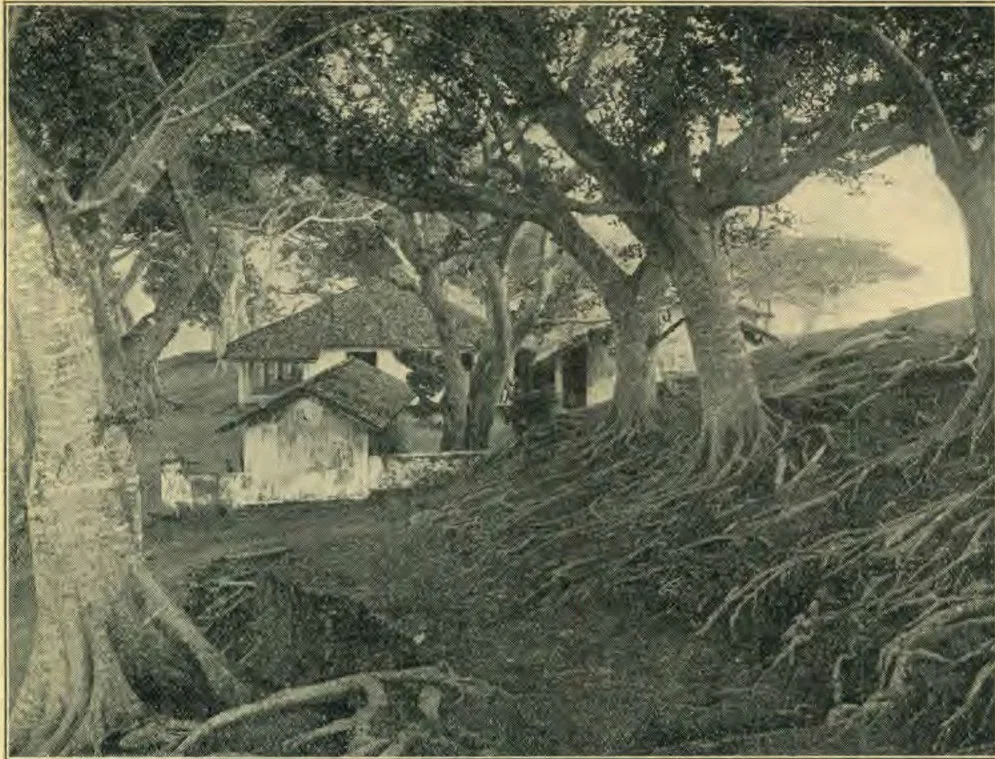
Who Can Identify This Tree by Its Roots?
To the student of forestry, every tree is a friend, and affords an opportunity for study; but all men should become acquainted with the trees. Can you tell a black from a red oak; a chestnut oak from a chestnut tree; a pin oak from a white oak, or on which6the acorns grow? Or can you tell a buckeye from a horse chestnut, or the difference between a yellow and an Ohio buckeye? What is commonly thought to be a horse chestnut, a tree frequently found along our avenues, is not a horse chestnut but a yellow buckeye. You may recognize it by their fan-shaped leaves.
For years I walked through parks and wooded tracts, and simply saw trees. From my boyhood experiences I was able to identify the shagbark hickory, walnut tree, and chestnut; for it was from these that I gathered bushels of nuts. I knew also the oak, willow, and cottonwood; but I could not distinguish the various kinds of oak. In our parks there were many stately trees that I admired, yet to me they were merely trees. But to make friends of the trees one must become acquainted with them; individualize them, and learn to call them by name.
In the month of May one will see along park driveways a tall tree, spotted with tuliplike, greenish-yellow flowers having a splash of orange near the center, forming a golden ring. This is the tulip tree that often reaches the height of two hundred feet or more. Now, any month of the year, this tree, so stately and so tall, may be recognized by its distinctive bark or by the graceful shape of its leaves, which seem to have had their tips cut clean across. If you once get to know the sycamore tree, with its peeling bark, white trunk, and broad leaves, you will never make the mistake of calling it a birch, and think that it was from these that the poor Indian got his bark to form his canoe. Ask the boy, and he will tell you that it is a monkey-ball tree, and throughout the snows of winter its branches are covered with brown balls.
Another tree, a native of China, that is possessed of both grace and beauty, is the ginkgo tree, or maiden-hair tree, with its big waxen leaf that renders it quite distinguishable from any other. Another rare tree that you will see now and then is the redbud or Judas tree. This dainty tree, with broad, flat head of smooth, thornless, angular branches, with its heart-shaped leaves, flowers in the month of April, before the leaves appear. Its purplish rose-pink blossoms of the pea type cover the whole tree with a wealth of bloom that will take long to efface from memory.
In the parks of many cities, usually found grouped in threes, are sassafras trees. The chestnut, like the sassafras, has a tendency to grow in clumps of three or six or more.
Other trees which have become close friends of mine are the spreading magnolia, the umbrella or catalpa, silver maple, ironwood, poplar, and Japanese cherry. Others interest us and claim our admiration, but the fairest, daintiest, loveliest of them all, like sheen on the new-mown hay, like wisps of mist in the morning; the most feathery, the most entrancing of them all, dressed like a fairy in green, is the tamarix. This African tamarix is a rather low-growing tree. It is composed of material that dreams are made of.
The trees are clothed with living green;
Each one to me is a dear friend,
Each branch a thought, each leaf a word,
They move my heart, inspire my pen.
A. W. HERR, M. D.
How Fire Sets Horses Free
By C. L. Edholm
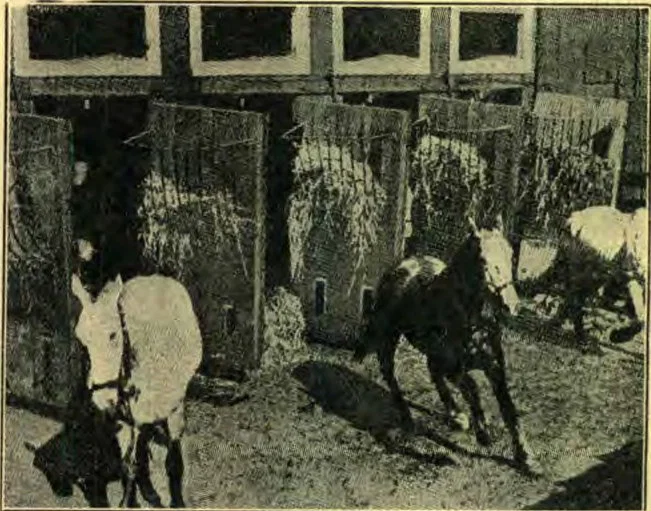
If the stable should burn, don't worry about the horses; the heat of the fire will set them free—that is, if the structure is equipped with the device of a Los Angeles inventor, which has been given a thorough test in his own city. In a large stable there, ten horses were placed in stalls furnished with the automatic equine release, and the heat from a single burning match was applied to the control. The fusible link melted in this trifling rise of temperature with the following results: a gate fell behind each horse, so that it could not back into the stable and get caught in the burning structure (supposing it had been a real conflagration); a door in front of each horse flew open by gravity, allowing a way of escape into the courtyard; the manger, which was built upon the door, collapsed, and in so doing released the rope which held the horse.
Thus the animal was released within five seconds of the time the test began, and the noise made by the moving gates and doors was sufficiently startling to send it scurrying into the open. As ten stalls were thus equipped, and as the opening of each door took place at the same time, there was quite a stampede of horses at this fire-escape test.
“The Horses Were Released Within Five Seconds”
The operation of the entire system is by gravity, and the control may be by a single motion of the watchman's hand, or, if he happens to be away or asleep, the heat of the fire will do his work. A cord is extended throughout the structure with links at frequent intervals. Any of these links will melt rapidly under moderate heat, severing the cord, and when that is parted at any point, the automatic release becomes operative.—C. L. Edholm, in St. Nicholas.
Quinine in Sprays New Anesthetic
The discovery by Dr. Gordon Edwards, a Leland Stanford scientist, of a new way to administer quinine by spray as an anesthetic, has done wonders to relieve the pain of the wounded. The solution is sprayed on the raw surfaces as the patient is brought to the first-aid stations, and is also used subsequently in dressing operations, with a consequent diminution of shock. The result is quick recovery. This is the first time in the history of science that quinine has been used in local anesthesia by spraying.
Dr. Edwards has just returned to Paris from Verdun and Chemin des Dames, where all the French hospitals have been supplied through the generosity of Americans, among them Miss Anne Morgan. Dr. Edwards gave details of the anesthetic.
“The solution,” he said, “is called nikalgin. It is a nontoxicant and induces analgesia in three to five minutes. Its good effect endures three to twenty-four hours. It is good for raw surfaces, small wounds, burns, lacerations, and amputations. One of the chief qualities of the solution consists in allowing painless removal of dressings.”—Washington Post.
Our Nearest Star
By John Brashear
If you could ride from the earth to Alpha Centauri on a train going at the rate of a mile a minute, you would reach your destination in forty-eight million years. At the rate sound travels, if a song were to be sung on Alpha Centauri, it would be 300,800,000 years before we could hear it. This neighbor of ours is thirty-five trillion miles away. A spider’s thread from a cocoon reaching to it would weigh five hundred tons.
Our earth in its revolutions on its own axis and its trip around the sun and outward space makes a journey of 984,000,000 miles a year; but the old clock never varies; there is never a jar or tremor, and we are back again on the hundredth of a second. Do you know it would have cost me $1,500,000,000 if I had had to pay my way so far at the rate of two cents a mile during my journey of seventy-five years?
To ride from the earth to this star would cost seven hundred billion dollars.—John Brashear.
Light in Dark Places
By Ernest Lloyd
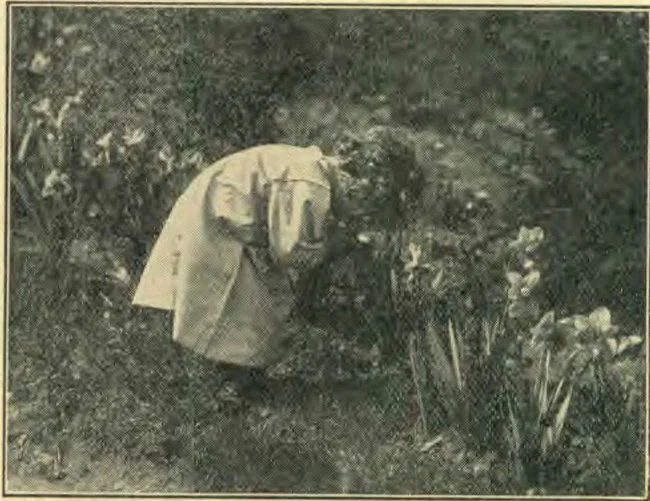
This little girl not yet four years old can identify eight kinds of oak trees from the leaves. Can you do as well?
THERE are many who err, and who feel their shame and their folly. They look upon their mistakes and errors until they are driven almost to desperation. These souls we are not to neglect. When7one has to swim against the stream, there is all the force of the current driving him back. Let a helping hand then be held out to him as was the Elder Brother’s hand to the sinking Peter. Speak to him hopeful words, words that will establish confidence and awaken love.”—“Christ’s Object Lessons,” p. 387.
While reading the foregoing paragraph the other day, I thought of the thousands of unfortunate men in the prison cells throughout the land whose “souls we are not to neglect.” Many of them in every penitentiary “feel their shame and their folly” and need the helpful, “hopeful words”—the words that you and I can speak or send to them. They “sit in darkness,” many of them, and some in that darkness are groping for the light—the Light of life. Letters written in a friendly spirit, and papers carrying helpful messages, are appreciated by more inmates of penitentiaries than we realize.
From an inmate of a penitentiary in an Eastern State comes this message: “I am very thankful to you for sending me copies of the Signs of the Times to distribute among the men in this prison. The paper bears a true gospel message to those who sit in darkness here, and it has been a great benefit to me.”
One day a young man went direct to our Pacific Press office from a United States naval prison. Becoming dissatisfied a year before with some features of naval life, he had deserted, was captured, court-martialed, and sentenced to one year in prison. Credits were given him for good behavior, and he was released after serving ten months of his time.
While in prison he made the acquaintance of another young man to whom the Signs of the Times was being sent. Together they read the paper and studied the Bible. After reading one paper it was difficult to wait patiently for the next. Although formerly a Catholic, this young marine now understood and followed the message, and determined to walk in the light after obtaining his freedom. And so he is with us in the message today. His former prison companion is looking forward to the day when the doors will swing open to him also, so that he may enjoy his twofold liberty—liberty in Jesus and from prison.
The young marine who was released from prison and visited the Pacific Press is now in the Philippine Islands. In a recent letter from him to a brother in California, he told of his experiences in the islands, and then, referring to some money he inclosed, said: “Please send me a copy of ‘Christ’s Object Lessons,’ and be sure to continue sending the Signs of the Times indefinitely, as I need this paper more than anything else.”
An encouraging work with our literature was conducted for several years in the San Quentin (California) Penitentiary, by a young man named Mitchell, who, while in the prison, embraced the faith through the influence of the Signs of the Times and through correspondence with one of our brethren. This young man recently left San Quentin, but the work with the papers is being carried forward by a man whose number is 28041. This man accepted the message, and has taken up Brother Mitchell’s work with real earnestness. He writes under date of June 16:
“It has fallen to me to distribute the Signs of the Times and other Adventist literature sent here, and I take great pleasure in doing it. For a long time we had between thirty and forty on our list of readers, but Mr. Mitchell was very industrious in the good work, and we now have more than one hundred men reading the Signs of the Times regularly. I am told by many that it is the best paper that comes here. “I now believe in the teachings of the Adventist Church, and when I leave the penitentiary I want to be with your people. I now enjoy the peace and rest that faith in the redeeming power of Christ brings to the repentant sinner. . . . I will see that the Signs of the Times are properly handled. . . . God will certainly give us results here.”
Through the kindness of some brethren and sisters who feel deeply concerned about getting the message to the men behind the bars, a new weekly club of sixty Signs of the Times is now going to the men in San Quentin. Information has recently come telling of four or five men in that penitentiary who have definitely joined Brother 28041 in his splendid work of interesting the prisoners in the message carried by the paper.
Somewhere near every church is a jail or a State prison, and there is opportunity for a great work in furnishing the prisoners with our timely literature. Hear a word of caution, please: “Do not think that anything will do,” writes a worker who knows, “for the prisoners will soon resent a course of ancient issues of soiled and tattered papers. Give them the best, for they need it.” ERNEST LLOYD.
Origin of Term
WHEN Oliver Cromwell became protector, after the execution of Charles I, he caused the stamp of the cap of liberty to be placed upon the paper used by the English government. Soon after the restoration of Charles II, having occasion to use some paper for dispatches, some of the government paper was brought to him.
On looking at it and discovering the stamp, he inquired the meaning of it; and, on being told, he said:
“Take it away; I have nothing to do with a fool’s cap!”
The term “foolscap” has since been applied to a certain size of glazed writing paper.—Selected.
Not Painting or Talking, but Doing
A YOUNG artist named Tucker painted the picture of a forlorn woman and child, out in the storm. This picture took such a hold upon him that he laid by palette and brush, saying: “I must go to the lost, instead of painting them.” He prepared for the ministry, and for some time worked in the city’s slums. At length, he said: “I must go to that part of the world where men seem to be most hopelessly lost.” That young artist was none other than Bishop Tucker, of Uganda, Africa. Painting is not enough. Knowing is not enough. Talking is not enough. We must do something.
Items of Interest
Dinner at ten o’clock in the morning! That sounds strange, doesn’t it, and yet that was the dinner hour in early France years ago. As a matter of fact, that is the meaning of the word “dinner;” it is a contraction of dixième heure: tenth hour.
From one fallen giant tree in a California forest, lumbermen recently got three thousand fence posts, enough to fence in 8,000 acres of ground; and 700,000 shingles, enough to shingle 70 houses. No wonder the lumberman would, if he could, cut down all the big trees!
Since the war began more than $200,000,000 of American capital has been invested in the manufacture of dyes. Moreover, the leaders in the new British dyestuff industry say that they will be able not only to supply all British needs after the war, but also to export large quantities of their product.
A young man read that we annually import from Europe 50,000 pounds of dandelions, and a large amount of mullen and catnip to be used in the drug trade. “A hint to the wise is sufficient,” so this young man went to digging wild weeds and drying them. He cleared $72.14 from his adventure during the summer vacation.