When visiting the ancient Hindu temple ruins in central Java a few weeks ago, we saw thousands of gods, telling of a dead past. These ruins represent more than five hundred temples, monasteries, and mausoleums; all in such a small district that by using a motor car one might well visit each group in a single day.
For centuries these chاندis, or temples, were buried beneath ashes from some of the nine neighboring volcanoes, and also further hidden by luxuriant tropical vegetation. Of late, considerable excavating has been done and some efforts made at restoration.
Near a group of ruins an inscription was discovered which tells with perfect exactness the age of the Tara Temple. As deciphered by the Dutch scholar, Dr. J. Brandis, and the Indian, Dr. R. G. Bhandarkar, a part seems to read, “The great king built the Tara Temple in honor of the guru [teacher] when seven hundred years of the Sakai era were past.” That would make it the seven hundred and seventy-ninth year of our era. It is assumed that all of the ruins belong to the same period.
These structures were “built without the aid of line or mortar, the stones being joined by means of tenons and mortises, and dovetails; which bind them solidly together. The material is volcanic lava, whose grayish tint enhances the imposing and melancholy effect, . . . a melancholy hardly enlivened by the most fantastic virtuosity of the chisel.” It is evident that many of the colossal images were placed on their pedestal and the temples built over them.
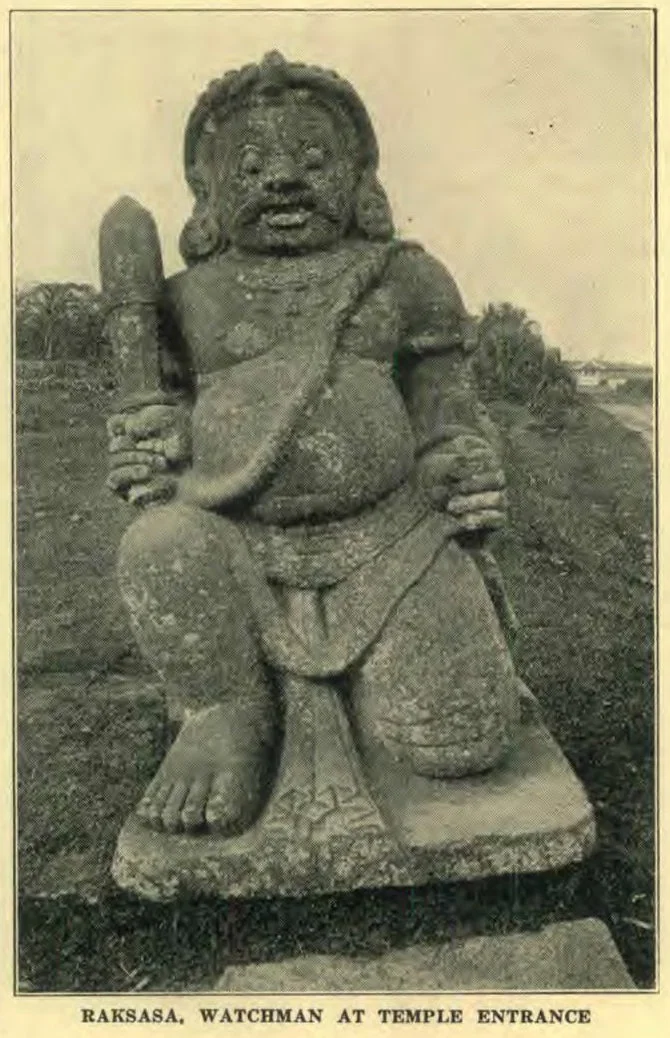
RAKSASA, WATCHMAN AT TEMPLE ENTRANCE
The largest single structure is Boro Budur, being five hundred and thirty-one feet on either of its four sides. Here are a thousand images of Buddha alone, which if placed in a single line would extend for three miles.
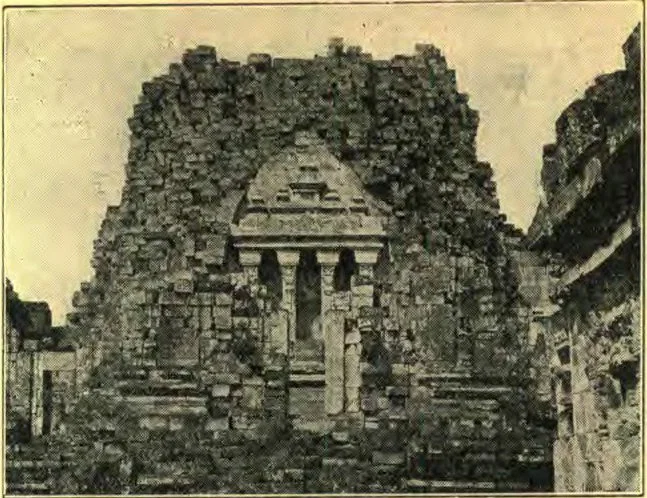
One of the Hindu Temples near Prambanan, Java
Notwithstanding the Buddhistic character of these ruins as a whole, a group near the villages of Prambanan has not one Buddha figure, but many Brahmanic gods. Of these temples the learned Dr. J. Groneman says: “They are the most interesting in the country. . . . In beauty, exquisite workmanship, and imposing majesty the sculpture works of Prambanan are not surpassed by those on any other monument of an extinct civilization.” To this group we will now give our attention.
Leading to the eight large temples were one hundred and fifty-seven smaller ones arranged in terraces. Inscriptions show that at one time a mighty Hindu empire existed in ruins in these parts, so it is thought that the main buildings contained the ashes of the leading rulers, while the lesser ones were mausoleums for monks and minor dignitaries, being built as the need demanded through a long period of time.
In the year 1890 the basements of the greatest temples were laid bare. Some of the wells beneath the images were relieved of their treasures before the archeologists got to them. However, we are told that in one they found a cinerary urn of stone holding imperfectly burned ashes, some flat pieces of gold and silver wrapped in copperplate, disintegrated, yet still showing old Javanese characters; seven oblong gold plates; five figures cut out of gold leaf, symbolizing a dragon, a tortoise, a lotus, a rosette, an altar, and ellipse; thirty-two globular Hindu coins; some garnets, etc. In others they found a gold coin, a gold nail, a tortoise, a cross, a fish from agate, and some rubies. These treasures buried with the ashes represented what loved ones wished the dead might have in a life hereafter.
On these temples epics pertaining to the gods of the Hindu Pantheon have been wrought in bas- and high-relief sculptures; but to the one who has not time to study them they represent merely a lot of rabbits, rams, deer, tigers, parrots, peacocks, geese, trees, bells, melons, and a profusion of demons, dancing musicians, heavenly nymphs, birds with human faces and breasts, etc.
Among the gods that can still be seen here are:
Agni, the god of fire. Here out of a flower arise flames which are pointed and serpentine.
Ravana, which has ten heads and twenty armed hands, riding a winged giant.
Kala, killer, and to the Buddhists this god of death is no enemy, so he is represented with a noble, mild countenance instead of the horrifying tusked-mouthed monster with a collar of skulls seen in other heathen temples.
Siva, god of destruction, has three eyes, wears a crown with a skull over a lunar crescent, a cobra across his shoulder, and a panther skin, the head of which hangs down on his thigh.
Ganesa, god of prudence, is shaped like an elephant, has four hands, also has three eyes and the divine decorations about his head as his father, Siva. One of his hands wields an ax, in another is a rosary, the third holds a little vase from which the trunk takes some food, the fourth lies half open on his knee.
Brahma has four heads9and eight arms; however, another Brahmanistic image has only six arms, and still another of the same deity has but four.
Vishnu, preserver, is a lion-man. It was thought that the demons could not resist the god in whom was both human and brute force.
Nandi is Siva’s sacred humped Indian bull. “It is told that among the Javanese and Mongolians, . . . and even among Europeans, there are some who believe that a man who, mounted on the Nandi’s back, wishes to become rich, stands a fair chance of having his wish fulfilled some day.”
Durga, protectress, consort of Siva, is no doubt the most popular image now. When we entered her chamber we were impressed with the fragrance of the flowers that had been piled in heaps at the foot of this beautiful image. She is standing on a bull she has killed, wielding with some ten hands weapons, among them a bow and arrow. Her lowest hand holds the tail of the bull, and another is fastened in the hair of a demon. From a Dutch work translated by a Mr. A. Dolk, we learn that “from far and near Javanese and Chinese come to offer her incense and flowers and ask favors of her, or fulfil a vow pledged in times of illness or adversity. Even hadjis, pilgrims to Mecca, conform to this heathenish custom. Stranger still, there are Europeans and half-castes who apply to the image for protection, prosperity, a high prize at a lottery, . . . a husband, etc.”
Of these ruins Mr. A. Cabaton, in his book, “Java, Sumatra, and Other Islands of the Dutch East Indies,” says of these temples: “To judge by their numbers, the powers of conception which they reveal, the boldness of execution, and the perfect art of their decorations, all these monuments prove that here at one time existed a great and flourishing empire; extremely populous, to judge by the swarms of artisans and laborers who must have been employed in the construction of these gigantic buildings . . . whose remains compel the admiration of all after centuries have elapsed.”
A Tribute to the Soldiers of the Cross
By M. G. Conger
MILLIONS of men on the battle fields of Europe are obeying the commands of their leaders to go, to charge, to conquer. They are spreading destruction and death, and in the future will reap fearful results individually and nationally. While these soldiers, full of hatred and envy, are busy, the soldiers of the cross, overflowing with love and mercy, are actively ministering to their erring brothers.
All over the world, even in the darkest and most forbidden places, the gospel missionaries are found. They go not only because they have been commanded, but also because the love of Christ impels them. They go, knowing that of those who have gone before them many have returned with broken health, and many have died on the field, unknown and uncared for. They go not in a regiment of a thousand to the sound of bugles and the blare of trumpets, but alone, quietly and unapplauded. They go to spread happiness, blessings, peace, life, and salvation.
Which, then, shall we consider the greater sacrifice, as worthy of the more praise,— the soldier of Europe or the soldier of the cross?
In a Washington (D. C.) newspaper there appeared a notice that under a resolution introduced in Congress the Negro troopers who perished in the fight at Carrizal, Mexico, would have full military honors, with a detail as an escort to bring their bodies to Washington for burial. We rarely hear of the soldiers of the cross being accorded such honor, brought back from distant country to rest at last in the homeland of their birth. But the large majority of Christ’s soldiers lie where they have fallen, in the lonely outposts, on the border of Tibet or Manchuria, among the cannibals of Africa, jungles of India, deserts of Arabia, and the walled cities of China. Concerning their graves, as well as of an English general, a poet might have written:
“Not a drum was heard, not a funeral note,
As his corpse to the rampart we hurried;
Not a soldier discharged his farewell shot
O’er the grave where our hero we buried.”
I have stood beside the broad Potomac, on the gentle slopes of well-kept Arlington, the “City of the Dead,” and have seen the two and three spans of fine horses draw the remains of a soldier boy, draped in the red, white, and blue, to its resting place; heard the “Earth to earth, and dust to dust,” repeated, noticed the uniformed friends bow their heads to their departed comrade, while the sympathetic chaplain eloquently spoke praises of the dead and comfort to the living. The ceremony concluded, the waiting soldiers fired a parting rifle salute, which was answered by the distant cannon’s boom, the bugler sounded his friend’s last “taps,” and the company turned aside to consider the rearing of a monument of marble to show their respect and esteem for their fallen brother.
But what has attended the honorable close of the Christian soldier’s life?
“Slowly and sadly we laid him down,
From the field of his fame and glory;
We carved not a line, we raised not a stone,—
But we left him alone with his glory.”
Where, then, are the hundreds of acres and scores of monuments that are held sacred to the memory of the soldier of the cross? Ah, they never asked for such, neither has the nation which calls itself “Christian” ever deemed it a privilege to grant them such, nor have they thought of setting aside one day in the year when the entire country would join in decking their graves with flowers and spreading over them the flag of the true and the brave. But on the mountain peaks of Switzerland, on the ice fields of Greenland, on the sweltering deserts of Africa, and on the islands of the sea there are monuments in the hearts of men that will last as long as man shall live, which will defy the blasts of winter and the storms of summer, and will endure through the fires of the last days.
(Concluded on page sixteen)10
A Tribute to the Soldiers of the Cross
(Concluded from page nine)
The hardships of the earthly warfare inspire men, true men, to do their utmost. They wait impatiently for the time to push forward, and eagerly look for their marching orders, and willingly fill the gaps made in the battle line by the fierce fire of the enemy’s guns.
The Leader of missions left Christianity’s marching orders nineteen hundred years ago, and still the “Go” may be seen plainly written on the leaves of your dusty Bible. The ranks of the soldiers of the cross are thin. They need recruits,—recruits who, like Europe’s soldiers, are willing to endure all, are ready for anything, and from the hardships are able to gather inspiration for the task. The world is calling, the need is great. This is the time, this is the opportunity — where is the man? M. G. CONGER.
THE JUDGMENT IN SESSION
The Cases of All are Being Decided for Eternity.
THE JUDGMENT IN SESSION
By Carlyle B. Haynes
The Cases of All are Being Decided for Eternity
CARLYLE B. HAYNES
First in his seat on Wednesday evening, Donald Hunter was able, before the meeting began in the big tent, to refresh his mind with the study of the preceding night. The chart of the sanctuary was still in place, and as he looked at it, he found his mind traveling over the points that had been brought out about the cleansing of the sanctuary in heaven. Brother Harris began just where he had left off at the last lecture:
“In order finally and completely to blot out the sins of his people, Christ must first enter into a close examination of their characters, a work which we have seen began in 1844,—that he may determine who are worthy to have their sins blotted out. This means that in 1844 Christ began a work of judgment, not of executive judgment, but of investigative judgment, a work which is clearly necessary before he can finally dispose of sin.
“This is the final work of the gospel; for when it is completed, which will be in the near future, the day of salvation will be ended, the work of the gospel in saving men will be finished, and Jesus will come forth from the heavenly sanctuary to receive his people unto himself, and to establish the kingdom of God upon the earth.
“The Bible clearly teaches that there will be a judgment of both the righteous and the wicked. Eccl. 3:17. In Paul’s day the time for the beginning of the judgment had already been appointed. Acts 17:31. This, without question, points directly to 1844. God’s people, the church, are to be judged first. 1 Peter 4:17. This is necessary because when Christ comes the second time he brings rewards for his people (Rev. 22:12), and as the reward is based upon a man’s work, there must be an investigation into the record which each has made, before the reward can be properly decided. And inasmuch as the reward has already been determined upon previous to the coming of Christ, and is actually brought with him, this investigation must take place before his appearing.
“At the second coming of Christ all the righteous dead are raised from their graves. 1 Thess. 4:16. Before this event it must be decided who is worthy to have a part in this first resurrection. There is no time to decide this momentous question after he comes, for the sleeping saints are raised just as soon as he appears in the clouds of heaven. But in order to make such a decision, the entire record of each professed child of God must be examined. Some are to be accounted worthy; some will be accounted not worthy. This is clearly taught in Luke 20:35.
“From this it is plain that there is to be an ‘accounting’ before Christ comes. This ‘accounting’ is the work of the investigative judgment which began in 1844. This judgment is to decide the eternal destiny of every soul. And that solemn work is going forward in heaven today! Such a truth is calculated to impress upon every serious heart a feeling of solemn responsibility, and to act as a great incentive to walk carefully before God.”
The words spoken turned Donald’s thoughts into a new channel. He was examining his own heart in the light of the great truth he was hearing, and he earnestly longed to be accounted worthy to meet Christ when he should come. Brother Harris continued:
“This investigative judgment will be made from the records in heaven. The names of all candidates for eternal life are written in the book of life. Phil. 4:3. One of the books of heaven which is especially mentioned in the Bible is ‘a book of remembrance.’ Mal. 3:16. In these books is written the record of every life. The judgment which is now taking place in heaven will cover the whole life of each individual. The hidden things will be brought to light, and they will be open before the Judge of all the earth. Also there will be recorded there whether the evil things have been confessed and forgiven, whether the sinful life has been surrendered to Christ, and his grace accepted to cover it.
“This judgment will begin with the names of the dead. Rev. 11:18. When, in 1844, the book of life was opened, there appeared the name of the first man who ever died, Abel. And then the case of Abel was tried at the bar of God. The record of his life was carefully examined; every act and word and thought was investigated. It was noted, too, whether his sins had all been confessed and forgiven. The record of his acceptance of the Saviour was there. And when this had all been gone over, a decision was made regarding the nature of the reward to be brought to Abel when Christ should return to this earth.
“When this case was decided the page was turned, and there came up before God another case, that of the next man who died. It was weighed and examined and decided. Again the page was turned. And thus through the years since 1844 this work has been going on. Before it closes, the cases of the hundreds of millions of people who have had their names written on the pages of the book of life, will be eternally settled and decided.
“Some will have their names blotted out of the book of life. Rev. 3:5; Ex. 32:33. But those who have fully accepted the gospel of Christ, will have their sins blotted out.
“The time must come in this judgment when the case of the last man who is dead is decided, and the judgment will pass to the living. You, my friend, who are sitting in this tent tonight, do not know when your name will come up before God in that work of judgment. But when your name does appear as the page is turned, what will the record be that is written there? If Felix trembled before Paul when he thought11of ‘judgment to come,’ ought not we who live in the very time of the judgment, feel upon our hearts constantly the fearful responsibility of this hour? Very soon, perhaps even tonight, your case and mine will come up before God for decision. We may doubt it, dispute it, deny it; but we must face the fact.”
Donald caught his breath sharply. He was startled at the tremendous thought that even now in heaven every case is being decided, and that his own case might be in review before God. More than ever was he engaged in self-examination, when the preacher said:
“By the investigative judgment the subjects of the coming kingdom of Christ are to be determined. When this is accomplished, and every case has been decided for life or death, Christ will lay aside his priestly garments, and the decree of Rev. 22:11 will go forth from heaven, fixing eternally the destiny of every human soul. Then the plagues of God’s wrath will begin to fall, and Christ will come forth from the heavenly sanctuary to lay the sins of his forgiven and cleansed people upon the antitypical scapegoat. This is Satan, who caused the people of God to commit these sins. He now bears their sins and their punishment himself, while he is led away into ‘a land not inhabited’ (Lev. 16:22), where he remains for the thousand years of the millennium. The land ‘not inhabited’ is the desolate earth.
“At the close of the judgment, when the subjects of his kingdom have been determined, Christ receives his kingdom from the Father. Dan. 7:14. And then Christ will come to take them to himself. The righteous dead will be raised (1 Thess. 4:16), and, with the saints who will be living on the earth (Matt. 24:31), will be changed into the likeness of Christ, and given immortal bodies (1 Cor. 15:51-54). They will then be caught up to meet the Lord in the air (1 Thess. 4:17); and taken to heaven to those mansions which Christ is now preparing for them (John 14:1-3), where they will reign with Christ a thousand years (Rev. 20:4).
“Now, my dear friends,” the speaker said, with intense earnestness, “I hope every one here will be admonished by these truths. The time in which we live is the most solemn of all times of which we have any record. The cases of all are being decided for eternity. Christ is about to come the second time with rewards. Let us be careful how we live. Our every action and thought and word is being recorded in the books of heaven, there to be examined by God himself. Can we meet this record at the judgment with composure? Shall we, like Felix, drive the thought from us? Let us beware. We must stand before the Judge. Are you ready for that day? Are you in Christ? Are you safe? How is it with you? Have you obeyed the word of God? Have you repented of all your sins, and confessed them to Christ? Have you cast yourself on his mercy, and received his pardon and peace? If not, let me entreat you tonight to seek the Lord while he may be found, and call upon him while he is near. Soon the Master will come with rewards. What reward will he bring to you?
“The story is told of a certain martyr who was called before a Roman council to answer the charges brought against him for heresy. The first questions he answered carelessly, but during a moment of silence he detected the scratching of a pen behind a curtain. At once he realized that his answers were being written down to be used against him at his trial. Very carefully, after that, did he choose his words, and answered each question as for his life.
“Behind the curtain which separates this world from the invisible world, there is a pen which writes down in God’s book of remembrance all our acts, our words, and our thoughts. Oh, let this thought ever flash in upon our worldliness, our pleasure, and our sin. For all these things God will bring us into judgment. Let us think of these things; and as we value eternal life and wish to avoid the doom of the ungodly, so let us fear God and keep his commandments; ‘for God shall bring every work into judgment, with every secret thing, whether it be good, or whether it be evil.’ Eccl. 12:14.”
As Donald retired that night he did so with a heart which was all on fire with longing for a new and a better Christian experience. He again definitely reconsecrated his life to the Lord, and promised God to follow him in whatever way he led.
“No Place Like Home”
THE people of Pitcairn, of whom we have heard much of late, are not the only island inhabitants that are subjected to discomfort, loneliness, and privation; for the Atlantic has its Pitcairn, an island about midway between Cape Town and Montevideo, that surpasses the real Pitcairn in bleakness and barrenness. The name of this volcanic peak is Tristan da Cunha, “the vortex of fierce storms, the center of almost incessant rains, always enveloped by cloud and shunned by ships, and yet for the last hundred years inhabited by a strange population made up of English, Dutch, Irish, Italians, Americans, cast ashore from time to time in shipwreck, or driven there by weariness of the busy world, and living on fish and the spoils of the wrecks that strew its coast.”
Mr. Charles Grant Miller, in the Christian Herald, recently gave the following description of the people:
“These people, now about eighty in number, men, women, and children, suffer hardships and deprivations almost inconceivable to residents of more favored lands.
“Having no useful timber, their huts are unmortared piles of rough stones, thatched with grass.
“The isle is so infested with rats from wrecked ships that any grain planted is eaten in the ground; and the only source of flour is passing vessels, which may be intercepted only by rowing many miles to sea.
“There is no government of any sort, no school, no church.
“The island has no future; the people have no prospect but of entombment there.
“One would suppose that these unfortunates, intelligent, industrious, thrifty, and temperate, as they are described to be, would gladly leave their rude huts, their terrible hardships, their barren fields, their pitiable poverty and hopelessness, to rejoin the comfortable world.
“But no!
“The British government has renewed its offers to remove them and their few possessions from the bleak island to any British soil they may choose, and to give them means to start life anew.
“Not one will consent to go.
“There on the bleak island are their homes, and there they will stay.
“Maybe, after all, one lot in life is not much better or worse than another, so far as real happiness goes; but there are some things that seem very necessary to us, and that little corner in God’s creation we call home is one of them.”
The Disillusionment of Prue
By Marian Heywood
MARIAN HEYWOOD
PRUE had not really chosen to spend a whole, precious year of her life teaching a country school out in big, roomy Montana. The necessity for so doing had been thrust upon her by virtue of the fact that her unfinished education demanded the impetus of a bank account. She had accepted fate with an outward manifestation of serenity and an inward sinking of the heart, because she found her eagerness to complete her course without interruption and enter into “the work” hard to reconcile with this change compelled by circumstances. It seemed almost intolerable to think of substituting the mediocre plan of the average rural community for the intellectual environment of the college. There was so much to be lost in a year, and so little—nothing—to be gained. “But few of the alterations requisite in the conversion of a college freshman to a country pedagogue of the feminine gender, would be desirable as permanent characteristics,” Prue laughingly told herself.
Notwithstanding the unpleasantness of the situation, she summoned her energies and prepared for the coming examinations. With some reluctance she had accepted a school out across the barren wind-swept hills that stretched away, gaining prominence with distance, until they emerged in the grand preëminence of the Rockies. Concerning the school itself, Prue had little time for reflection, and less experience to aid her in forming an accurate impression. It had been secured by a personal interview with the clerk and chairman of the board of trustees, at which time also she had encountered the curious gaze of two thirds of her entire enrolment, whose shyness had caused them to seek the friendly seclusion of various articles of household furniture. She had had a glimpse, too, of the schoolhouse, where from within she would watch the white, chill days of winter proceed with slow monotony.
With the strain of examinations over, Prue felt relieved, and somehow the brown hills away toward the scene of future effort, began to look green with promise as she contemplated the liberal commendation of the superintendent concerning various points of merit in her papers. For with all her great antipathy for the work she must do, Prue wanted to be successful, wanted to feel sure that she was capable of adapting herself to disagreeable circumstances.
On that first Monday morning in September, Prue, having been previously installed in one of three small rooms in a sod house on the hillside, assumed charge of her school of twenty-two, with exceeding heaviness of heart. Happily, the situation before her demanded all her time. The days slipped by quite unobserved, and the first week had drawn to a close before any mental analysis of her impressions had shaped itself. Alone with her thoughts at the close of the session on Friday afternoon, Prue faced squarely the interrogation, “Can any good thing come out of Nazareth?” In spite of her resolution to be lenient with their faults, she felt that her pupils were below the average on every conceivable point. Their ignorance was amazing, and, hard to believe, there was not a very hearty response on their part to the pouring-in method adopted by the teacher. Taking all into consideration,—the unseemly number of absences, the smoking stove, the wind that fairly shrieked around the corners of the building, and her failure to arouse the latent energies of her pupils—it was not surprising that Prue in distraction should resign all claim to her circumstantial calling as a teacher of country schools.
Matters were brought to a climax, however, when difficulty arose at her boarding place. Indirectly, the trouble was doubtless due to prejudice caused by conflicting religious views. Prue, while feeling a keen distaste for the “whole affair,” was rejoiced to find a new home pro tempore, wherein was found a host of welcome blessings.
From this time forward, events wore a very commonplace aspect as far as outward appearances were concerned. Prue arose every morning, went to school, met and solved as best she could the problems of the day, and returned home at its close, to spend the evening in doing some bit of needlework for her next year’s wardrobe. But these ordinary days were evolving a reconstruction of standards on the part of the teacher in the little gray schoolhouse, that were by no means lacking in uniqueness. And so it came to pass that each day brought unlooked-for revelations, until the hard little bud of Prue’s judgment began to unfold with sympathetic understanding.
Spring had come again to the Land of the Shining Mountains. Renewed life crept into the hedges and thickets; and even the brown hills were responding to the gentle wooing of sunshine and raindrops. Prue stood at the close of another day watching the sun sinking behind the radiant western peaks, but her thoughts were wandering back along the beaten paths of the year’s experiences. She recalled vividly the impressions of that first week, how unjust they were. Knowledge had come to her as it comes to a child, not with a great preponderance of argument, but with an overwhelming sense of its being so because it is so. She had measured the understanding of her children with that of her own, and when she found deficiency, she was ready to pronounce ignorance a defect common to the whole school. As a remedy, she had plunged into a vigorous campaign for the purpose of bringing them up to the standard. She had met with defeat, but she had also learned the seasonableness of the old adage, “Rome was not built in a day,” when applied to the development of the child mind. Oh, there had been abundance of opportunity right in her own school-room, of learning lessons that would some day make her valuable as a worker.
There had been other experiences, too. Life in these mountains, with its rough, unvarnished exterior, had meant nothing but patient endurance in those first few months, but slowly she had begun to look past the homespun, surface qualities to the stanch underlying principles that were a kind of heritage in the lives of the people. She had watched them at their daily round of monotonous labor, with never an attempt to produce a change, and wondered why they were satisfied. And yet she thought she understood, and it hushed the disquietude of her own heart.
But if there had been victories, there had also been reverses, and Prue thought of the Sunday school she had tried to organize, with the hope of imparting some phase of the truth dear to her, and which had failed to retain interest after the novelty of the affair wore away. But life is like that,—not all sunshine, not all tempest,—so with patient resignation she had left the result with God.13
Only the brief interval of a few months remained now, and then she would swing back into another coveted year of training, with a twelve-month qualification to render it the best of all her thirteen years of school life. Had it paid,—this year of involuntary sacrifice?—Ah, yes! Already there were abundant returns in largeness of heart and soul, in human sympathy and kindness, and in the wealth of knowledge the new life had revealed. To Prue had come a relaxation of the stern, uncompromising standards of her girlhood, because as the days multiplied apace, they brought to her fresh evidence of the power of “the enemy of all righteousness,” against whom no one can hope to win, unaided. This was her first touch with the world, from which teacher and minister alike had exhorted, “Keep thy heart with all diligence.” In some measure, at least, Prue knew that she had been faithful.