The Youth’s Instructor, Vol. L., No. 11

STUDY OF PLANT LIFE

The Youth’s Instructor

March 13, 1902

Review and Herald Publishing Company · Battle Creek, Mich. · March 13, 1902

STUDY OF PLANT LIFE

1. The study of plant life dates back to remote antiquity. This is naturally so from the fact that the intelligent study of plants lies at the foundation of the scientific study of agriculture, and agriculture is the oldest of all known sciences. It was studied by Adam and Eve in the garden of Eden. From that time to the present, agriculture has been the principal means of sustaining the life of the millions of human beings who have lived in every age and clime, with the exception of the few who live in the regions of perpetual snow and ice, and subsist largely upon a flesh diet. The study of plants has thus received some attention from at least a part of the people of all times, yet by many it has been placed in the background, and as a consequence great losses have been sustained. Owing to a lack of knowledge of the nature of plants and the conditions best suited to their growth, the cultivation of the soil has not always been followed with the best results, so that often the earth has failed to bring forth the full measure of her increase.
2. Plants, as well as man and the lower animals, have suffered from the curse, having greatly degenerated in size, beauty, and productiveness. It is only by careful, intelligent labor that vegetation can now be made to do its best, and be brought back to some degree from its degenerated condition.
3. The study of plant life is useful in enabling us more successfully to cope with the conditions of our existence, but there are other benefits which should also be taken into consideration.
4. When our Saviour said, “Consider the lilies of the field, how they grow,” he intended that we should see in the plants about us a manifestation of the divine wisdom and beneficence of the Creator of all things. The numerous species, the varied forms, the elegant structure, the exquisite skill with which they are fashioned and adorned, should teach us something of the infinite resources of him whom we are permitted to call “Father.”
5. Of one person, the poet Wordsworth said,—
“A primrose by a river’s brim, A yellow primrose was to him; And it was nothing more;”
but we should not allow ourselves to be thus blind to God’s teaching. When we look upon the wonders of nature, the beautiful flowers, the green fields, the waving grain, the majestic trees, we should see in all these things a manifestation of the divine idea, the perfect workmanship of the master Artist, though sadly marred by the blight of the curse.
Photo used by courtesy of Fred W. Gage, Battle Creek, Mich.
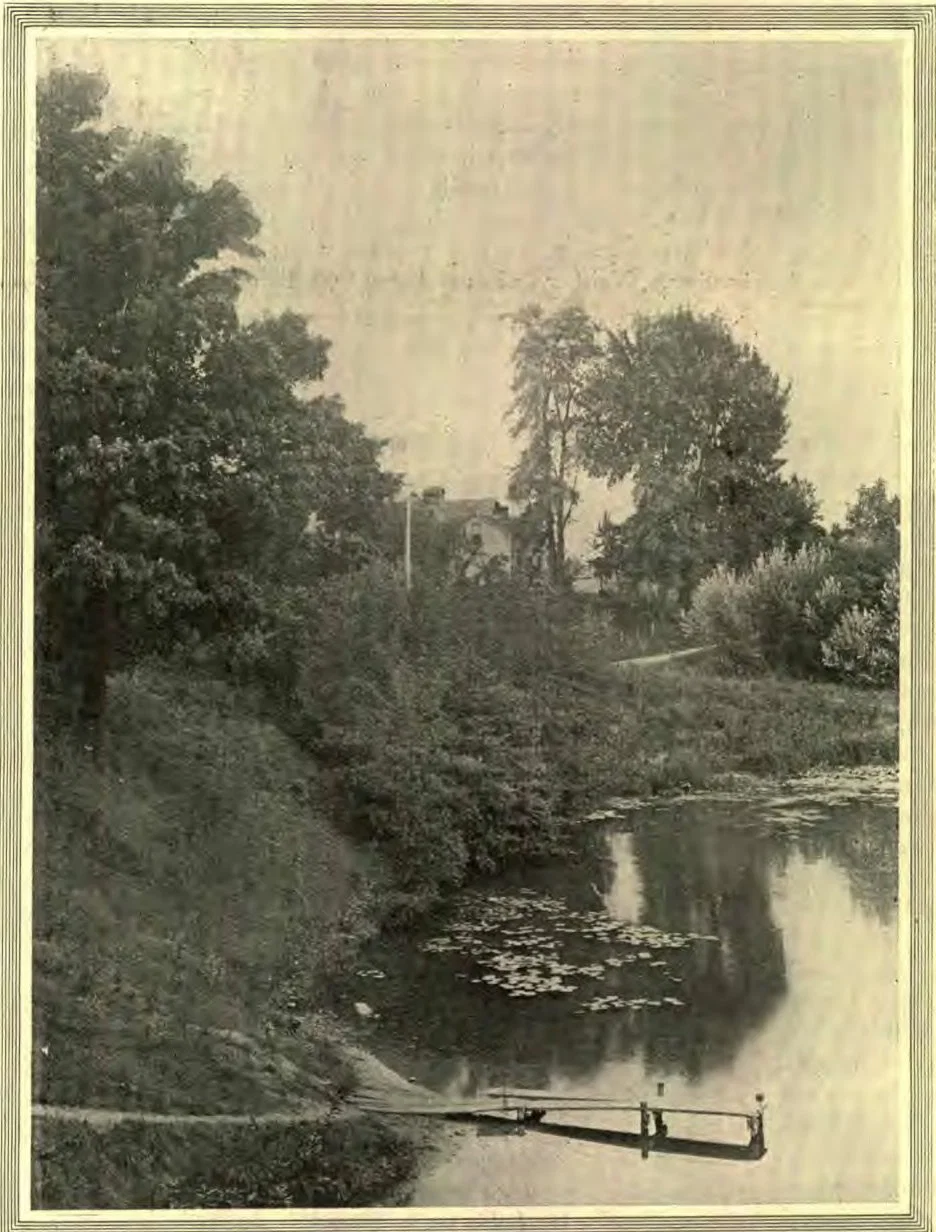
A BIT OF SUNNY LAKE SHORE IN JUNE
Photo used by courtesy of Fred W. Gage, Battle Creek, Mich. A BIT OF SUNNY LAKE SHORE IN JUNE
6. A knowledge of the common plants about us increases many fold the pleasure obtained from a ramble in wood or field, or by the roadside. The monotony of a railway journey, or of a drive through an otherwise uninteresting country, gives place to the pleasure and excitement of a tour of discovery when one has learned the pleasure of observation. The boggy meadow, the rocky woodland, a bit of sunny lake shore, the plain, and the mountain, are alike invested with almost irresistible charms. When we meet with familiar plants, we recognize them as the faces of friends; and if we know something of their habits, their life history, and their struggles for existence, we think of them as living individuals, meeting with fortunes and misfortunes, the same as do other living beings.
7. You have probably all noticed, whether you have ever studied botany or not, that there are two great series of plants,—those that bear flowers, and those that never bloom. It is likely, however, that you have considered many plants as belonging to the flowerless series that properly belong with the flowering plants, such as a large number of the trees, from the fact that their flowers are so inconspicuous that they have escaped your notice.
8. It is quite natural that we should be especially attracted by those plants that produce large, showy flowers; but in passing by all others as unworthy of notice, we often fail to recognize those that are really of greatest value. In our association with those about us there is danger that we may fall into the same error. We naturally feel that persons who are making the greatest show in the world are most worthy of praise; but there are many in the lowly walks of life, who, in their own quiet way, and unnoticed by the world, are doing more to bless their fellow men than many who are highly honored.
9. From an economic point of view, the flowering plants are by far the more important, and for this reason, it is quite fitting that they should be given first place in our study of plant life. As we shall find in our future studies, it is this series of plants that furnishes us with the greater part of our food, clothing, and shelter.
10. Winter is the best of all times to begin the study of plants. Then when the spring days arrive, and the warm rays of the sun waken the earth from her long sleep, you will be prepared to greet the bursting buds and springing flowers with an intelligent enthusiasm. B. E. CRAWFORD.

The Cheerful Face

“NEXT to the sunlight of heaven is the cheerful face. Who has not felt its electrifying influence? One glance at this face lifts us out of the mists and shadows into the beautiful and bright warmth within. A host of evil passions may lurk around the door, but they never enter and abide there; the cheerful face will put them to flight.”

WHEN BABY LEARNED TO WALK

When baby's father visited relatives one day, many were the inquiries concerning the newest member of the family. “Two months ago you wrote that he took his first step, and yet it was only last week that Florence told us in a letter that he was learning to walk alone. How do you explain that?” said one aunt, rather teasingly.
“Easily enough,” rejoined the father, not at all abashed; “long before he was of the age when most babies begin to walk, our laddie took his first steps alone, and did so repeatedly. During those experiments, however, he received a good many falls and bumps which seemed to dampen his enthusiasm, and soon he gave up trying to walk alone.
“Of course, he could walk and run as finely as you please, so long as he had hold of a finger or a string or a switch, or any other support, however trifling. He really didn’t need this, but he thought he did, and persistently refused to strike out independently of such assistance.”
“And now,” continued the father, “how do you suppose the little fellow has finally solved the problem? He holds on to himself! Instead of grasping a hand or a cane or a string or anything of the sort, he takes firm hold of his own dress, and off he goes. It’s amusing to see him trotting all over the house, with his chubby little fists clasping tight his dress at the breast, just as if he were playing locomotive. Unless he can do this, he will not walk; he never attempts to walk with his hands hanging free.
“You see, the young man is learning early to depend on himself for support. And we hope that all through life he may be able to make progress without any other “pull” or “push” than is divinely planted in his own breast.”—Selected.

THE MAN WHO WAS “GOING TO”

He was, in the first place, a boy who was always “going to,” but who rarely did any of the things he was “going to do.” He was for a time a pupil of a school I taught, and I boarded at his father’s house a part of one winter. That was nearly twenty-five years ago, so the boy has been a man for several years. When I was staying at his home, his mother would say: “Robert, have you filled the wood-box yet?”
“No, but I’m going to,” would be the reply.
Or his father would ask: “Robert, have you fed the horse yet?” “No, sir; but I’m going to.”
Sometimes I would say to Robert, in school, “Have you learned your arithmetic lesson yet?” and would receive the same answer; but when the time came for the class to recite, the lesson would still be unlearned. At the last minute Robert would take his arithmetic and slate, and try to solve his problems in less time than was possible for even the brightest boy in the class.
It is many years since I saw Robert, but I heard from him the other day. A friend was good enough to write a long letter telling me about many of the boys and girls who went to school to me. About Robert S—— he said:—
“You no doubt remember Robert S——? He is still ‘going to do’ all sorts of things. I went by his home yesterday. It is a sorry-looking place. The front gate has been separated from its hinges for about five years, yet I have heard Robert say many times that he was ‘going to fix that gate.’ The pump at his well became disabled more than a year ago, and Robert has been ‘going to fix it’ every day during that time, but it is not repaired. In the meantime, his family carry water from the well of a neighbor, a fifth of a mile distant. Two years ago the drainage pipe on Robert’s place became clogged up, and Robert was ‘going to fix it’ for more than a year. When it rained, the water stood a foot deep all over the cellar, and Robert came near losing two of his children because of illness traceable to this cause. The worst of it is that Robert has fallen into the habit of borrowing money that he is ‘going to repay,’ but somehow he does not pay it. They speak of him here as ‘the man who is going to.’”
It is a habit that will make a failure of any life. To be forever intending to do things, and never doing them, is to make one weak and vacillating. It destroys self-confidence, and the confidence of others in us. It was only the other day that I overheard two business men talking. One of the men said:—
“O, B—— is a good fellow and all that, but he can not be depended upon to do anything at any time. His business is going to pieces simply because he dilly-dallies so, and never does anything when it ought to be done. I told him ten days ago about an opportunity which, if taken advantage of at once, would be of great profit to him. He said he would attend to it right away; but when I saw him a week later he had not attended to it, and the opportunity was lost for good and all. If a thing is to be done, now is the time to do it.”—Well Spring.

MOTHER SCREECH-OWL AND HER FAMILY

In a grove about a hundred and fifty yards from our house, stood a hollow tree, which had once been the home of a red-headed woodpecker. Later old Mrs. Fox Squirrel had taken rooms, and reared a family there. One cold winter morning Mrs. Screech-Owl, who had been at the shed looking for mice, was surprised to see day come so soon; and as the light hurt her eyes, she crept into the first place she could find—which happened to be the old hollow tree—to spend the day. It pleased her well; and she made up her mind to set up housekeeping there, on her own account, the next summer. At first Mr. Screech-Owl objected to being so near a house, and declared that their old hollow snag of a stump on the creek bank was quite good enough for him, even if it did show signs of leaking. There, at least, no hateful squirrel would be peeping into their house, and trying to collect her rent just when he was taking his noonday nap. This might have caused a family quarrel, had I not taken a hand in the game.
I had noticed, in passing their old stump, that it was still inhabited; so I climbed to the hole near the top, and caught Mr. Screech-Owl, as I had done several times the previous winter. This time, however, I took him home with me, and carried him into the warm kitchen, where we all admired and played with him for a while. Then I turned him loose, and he went home as straight as he could fly. My brother brought him up a few days later; and so it went till he either decided we were not so bad, after all, or felt that he could not have his sleep broken into so often.
It was a very cold, snowy winter; and I shall always think that one thing that helped him to come to his wife's way of looking at things was the discovery that there were plenty of mice in the barn, and that a screech-owl could go in and out at his own sweet will. This much I am sure of: the owls stayed about the hollow tree and the barn the remainder of the winter. Sometimes one of them would get into the pigeon-boxes, but I never knew of their harming anything. The pigeons were not nesting then; and by the time they had young birds, the owls had forsaken the barn, and were living in the hollow tree, and dining off bugs and worms.
In the spring I forgot all about my Screech-Owl family, and so was surprised one day, on hitting their hollow tree with a club, to hear a squeaking noise inside. I climbed up and reached in, and lo! the tree was full of owls,—Mrs. Screech, who tried to drive me away by scratching and biting, and seven little Screeches almost large enough to fly. I set them on a log in a row, and treated them to a good meal of grasshoppers, much to their delight and their kind mother's alarm. In fact, she entered several vigorous protests in the back of my head with her claws. Even Mr. Screech-Owl aroused himself sufficiently to flit nervously from tree to tree.
The young owls were beautiful little fellows, and seemed much inclined to make friends with any one who would feed them. Finally I placed them all safely in their nest again, and went home. This was repeated frequently till Mr. Screech-Owl would sit stock still against a dead limb, looking so exactly like a knot that a casual observer would never notice him, and watch the whole proceeding without even a blink of his eye. Even Mrs. Screech-Owl made no protest.
Soon all the young Screeches could fly, and I lost track of them, and concluded that they had forsaken me. In the early autumn, however, as the season came for owls to bewail the waning summer, something surprising happened. I slept up-stairs in a west room, with the head of my bed by the open window, which had only a screen in it. The branches of a large cherry-tree reached so near that one could pick the fruit from the window, in cherry season. Here, night after night, came the whole Screech family, perching themselves as near as they could, and spending most of the night. One would say, “Bla-la-la-la-a-a-a!” Then all would squeeze up closer to the window, and utter the most mournful little “Oow-ow-ow-ow-w-w-w!” It made one think of frost, lonesomeness, homesickness, all at once, yet it was the most delightful music that ever sang one to sleep. It made one appreciate a snug, warm bed.
I left home to attend school that fall, and I have never met the family since. Passing the old home a few days ago, I noticed that the hollow tree was gone, and mentioned it to my brother. Neither of us know whether our Screech-Owl family are still alive or not, but I hope they may yet have many prosperous days.
FLOYD BRALLIAR.

HIS PEACE

I was at a young people’s prayer-meeting recently when the subject for the evening was peace. One of the Scripture selections read was that passage in John containing the words, “My peace I give unto you,” and a remark of the pastor’s concerning it impressed me so much that I wish to tell you about it. He said the legacy left by Christ to his followers was his peace: “My peace I give unto you.” This is not a peace like that of David or Paul; it is not the peace of Peter or John, nor of any of the world’s greatest. “Not as the world giveth, give I unto you.” His gift is the perfect peace of heaven itself.
MARY M. CURRIER.

WATCH THEM WELL

There are four T’s too apt to run, ’Tis best to set a watch upon:—

Our Thoughts.

Oft when alone they take them wings, And light upon forbidden things.

Our Temper.

Who in the family guards it best, Soon has control of all the rest.

Our Tongue.

Know when to speak, yet be content When silence is most eloquent.

Our Time.

Once lost, ne’er found; yet who can say He’s overtaken yesterday?
—Selected.

THE BATTLE CREEK YOUNG PEOPLE'S SOCIETY

On Sabbath, February 15, a large company of young people in Battle Creek were favored with a stirring discourse by Elder A. G. Daniells, in which was emphasized the truth that genuine religion consists not in mere profession, but in actual doing. This fact was urged upon our young men and women with great force and clearness. The practical application of this principle to the individual life was made the more direct by particular reference to our personal responsibility in the effort to free our schools from their indebtedness through the sale of “Christ’s Object Lessons.”
The blessings which will result through the realization of this plan were vividly set forth, both by statement of fact and by illustrative example. While the blessing to accrue to our educational work is truly great and glorious, the inestimable good conveyed to those who purchase this precious book, and the renewal of spiritual strength to those who sell it, were given their appropriate place in this grand movement. A few moments were devoted to statements of blessings received and conveyed by those who had already taken part in the work. Inspiring experiences were also related, and helpful suggestions offered, by Elders H. W. Cottrell, R. A. Underwood, and others.
Pledges for about eighty books were taken at this meeting. A goodly number of those present had previously subscribed at the general meeting in the Tabernacle on the preceding Sabbath, or at district meetings during the week. In view of the fact that our people have provided these schools at the cost of patient toil and great sacrifice when our numbers and strength were small, in order that the young people now approaching maturity might be fitted for useful service in the Master’s work, it seems fitting that our strong young men and women should stand in the forefront of this movement, which assures so much blessing alike to those who give and to those who receive.
At the close of the service, Brother Edwin S. Butz was set apart to the work of the gospel ministry, Elder Daniells offering the prayer, and Elder Thurston delivering the charge. The week following (Sabbath, the 22d) Elder Butz occupied the hour of the Young People’s meeting in relating his experiences while engaged in missionary work in the Friendly Islands, South Pacific Ocean. A large company of young people was present, and the occasion was one of unusual interest. We believe that apart from the valuable instruction received, many present were inspired with a greater desire to engage in labor in needy lands afar. At the close of the service, many came forward to ask questions, extend Christian greeting to Brother Butz, and bid him Godspeed on his long journey. We are confident that our young people in Battle Creek will henceforth sense a keener interest in the distant island-field to which our brother returns.
H. E. OSBORNE.

OUR SOUTHERN TRAINING SCHOOL

Among all our schools, perhaps the surroundings of none would more vividly remind one of the fortress of that missionary church of the Dark Ages than the environs of the Southern Training School. “In the heart of their mountains is situated the most interesting, perhaps, of all their valleys. It was here that their college stood, and it was here that their missionaries were trained, and, after ordination, were sent forth to sow the good seed as opportunity offered, in other lands. . . . There opens before us a noble circular valley, its grassy bottom watered by torrents, its sides dotted with dwellings, and clothed with corn-fields and pasturages, with a ring of white peaks encircling it above. This was the inner sanctuary of the Waldensian temple.” Almost it might have been written, “the Adventist temple.” The natural beauties of our hill-girded valley,—the peace of the wide-reaching meadows, the solitude of the forests, the thrill of the rushing mountain torrents, and the protective benignity of the encircling mountains,—can not but inspire the soul of every one who comes under their influence.
About us there lies a missionary field almost as varied as that which stretched at the feet of the Vaudois church. Natives and foreigners, Northerners and Southerners, Indians, mountaineers,—“our contemporary ancestors,”—townsmen, farmers, and miners,—all within a radius of from three to five miles, have presented opportunities for missionary labor. During the week of prayer, students and teachers formed companies to visit the villagers and near-by residents; and in this work a number of openings were found for Christian Help work, Bible readings, etc., which have since been filled by student workers. A Sunday-school is conducted each Sunday afternoon at the coal-mines, two miles from here in the mountains, the results of which have been a great blessing both to the students participating and to the miners’ children who have attended.
The special blessing of God has been with the school during the whole year. The presence of the Holy Spirit has been seen in the conversion of a number of students who had not before acknowledged Christ, or even the inspiration of his word; and now there is scarcely one who has not put his hand into the hand of God. This they have done, not in the fervor of a great revival, but one by one, under the ever-present influence of the Spirit of God, which has often been especially manifest in chapel and class-room. We praise the Lord for his mercy and blessing upon this little band, who are, in so great a degree, the hope of this needy Southern field.
The missionary society of the students deserves special mention, as being unique among school organizations. Believing that their school work could be best re-enforced by a line of literary work upon a missionary basis, and recognizing the duty of the Southern States not merely to themselves but to the more needy foreign field at their lower door, the students and teachers organized the “Spanish Mission Auxiliary Society,” for the study of Spanish- and Portuguese-American fields. Our study includes not only missionary operations, but the history, customs, and resources of the different countries, that all may become to some extent intelligent in regard to their peoples, as a preparation for future missionary work among them. The society is endeavoring to make its members more familiar with these lands, by the preparation of articles from the reading of books and magazines, by correspondence with missionaries in the field, and by the publication of a weekly paper, El Fanal (“published in Lima, Peru”), which contains reports from missionaries, general articles supposed to be suited to the field, and the current history of that effervescent continent.
The reports of local missionary work are also to be included in the programs, that we may, while studying to become foreign missionaries, connect with this work our present Christian activity. Our prayer is that this young home guard, which is training for field service, may soon have large drafts made upon it from the firing line in that part of the field to which it has devoted itself. A. W. Spaulding.

AN INTERESTING MEETING

Such was the meeting held by the Youth’s Missionary Society of Oakland, on December 28. The topic for the day was “China: Its People and Religions.”
Some time was spent in giving a report of labor, which showed that these boys and girls are becoming practical missionaries, and are sharing with others, less favored than themselves, the temporal and spiritual blessings which they have received. It was gratifying to see the ready responses to the call for volunteers to keep the reading-racks filled, to clean the hall for the mission Sunday-school, to carry baskets of food to some poor families, etc., etc.
A missionary Bible reading given by one of the boys showed that God calls all to labor for him wherever they see work needing to be done. This was followed by a very interesting talk upon “Ancestor Worship,” by one of the girls, after which “Buddhism in China” was set forth in an interesting manner.
A sad picture of “Home Life in China” was followed by “China as a Missionary Field,” in which it was shown that something is being done toward bringing the light of the third angel’s message into this dark land; it also showed the crying need of more laborers and more means.
A poem, “Whom Shall I Send?” was recited by four little girls. As each ended, “Here am I. Send me! Send me!” we could not but hope that this would be the consecration prayer of many of these young hearts, and that they would help to swell the ranks of the laborers in the needy places of the earth.
The donation, amounting to $6.62, was to be given to assist in the education of Ah Yung Charm, who is now attending school at Berrien Springs, Michigan, preparatory to becoming a laborer in his native country.
A double quartet of girls rendered the song “Speed Away,” with inspiring zeal, after which the meeting closed with the singing of the “Missionary’s Farewell.”—C. R. K., in Pacific Union Recorder.

THE YOUNG PEOPLE'S WORK IN CALIFORNIA

WE are glad to report through the INSTRUCTOR that an excellent interest is being manifested in the young people's work throughout the State. New societies are being organized, and plans have just been perfected for a State organization, which will include the isolated young people; that is, in the smaller churches, where there are not a sufficient number of youth to form a Young People's Society. We carry on a continuous correspondence with the young people throughout the State, and the letters received are indeed encouraging. Regularly organized Societies are formed in nearly all the larger churches,—San Francisco, Oakland, Healdsburg, St. Helena, Fresno, etc. We are working and praying to the end that the youth will enlist in the young people's organization, and thus beginning to bear the Master's yoke in active service, may continue in the good way they have chosen throughout life, or until the end shall overtake us. We ask the prayers of the INSTRUCTOR family in behalf of the young people's work on the Pacific Coast.
W. S. SADLER.

THE TALENTS—V

The Talent of Time

(March 16-22)
1. TIME is the one talent that is given to all alike. Each day brings exactly the same number of hours and minutes to every one of God’s children. The men and women who have done the greatest and best work in the world had no more time than we have. Eccl. 9: 11.
2. The value of time can not be estimated by any standard that we know. Its worth is measured in loving words and kindly deeds; and who but God knows the value of these?
3. “Of no talent God has given will he require a more strict account than of our time.” We are responsible for all that might be accomplished by a right use of every moment.
4. We must study to economize time, that we may accomplish the most in it. Ps. 90: 12.
5. It is just as wrong to waste time as to waste money. There is an old adage which says, “Time is money;” but time is more than money to the Christian: it is opportunity.
6. If our time is rightly used, if we are systematic and orderly in our work, there will be time enough for everything we shall need to do,—for work, for study, for rest and innocent recreation. Read Eccl. 3: 1-8.
7. The present is the only time we are sure of, the future is always uncertain; therefore the double necessity for making the very best use of to-day. John 9: 4.
In addition to the extracts from “Christ’s Object Lessons” (pages 342-346) and the Scripture references given, careful study should be made of the Testimonies upon this subject. Pages 412 and 451 of Volume IV speak directly of this matter. Others should be added. E. T. R.

THE PASADENA OSTRICH FARM

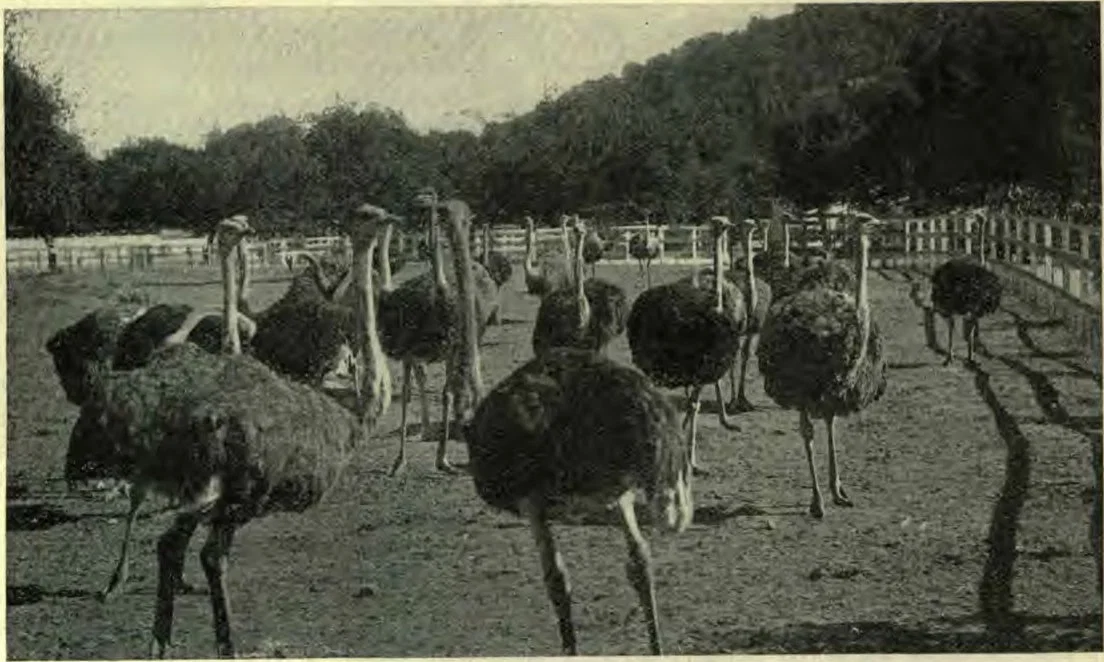
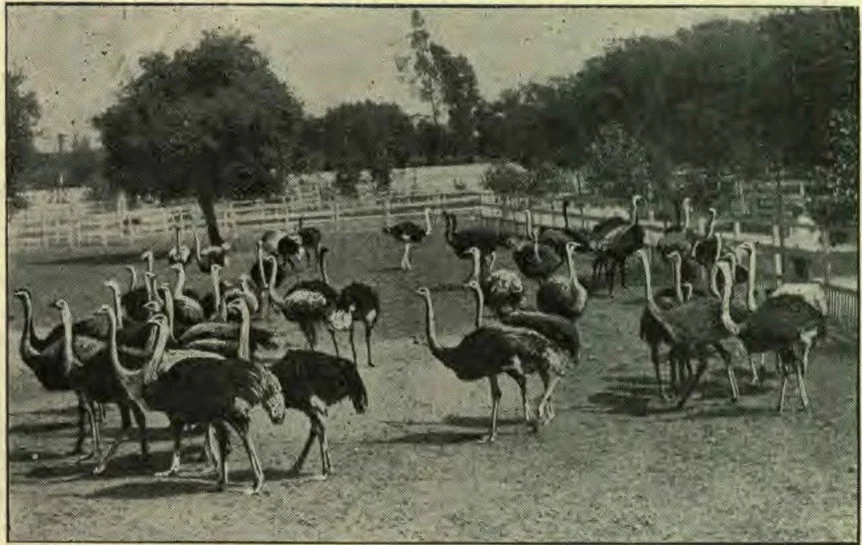
An interesting sight to the traveler in Southern California is the ostrich farm near Pasadena. This is the largest as well as the original ostrich farm in the United States. Here are one hundred of these strange birds, ranging in age from sixteen years down to the cunning-looking “chicks” recently hatched.
AT THE PASADENA OSTRICH FARM
The ostriches of to-day do just as they did in Job’s time,—lay their eggs in the sand, without any effort to build a nest. See Job 39:14. But instead of going away and leaving them, a divine instinct seems to tell them that California sand is not warm enough to hatch their eggs, so the males sit on them at night, and the females during the day. The eggs require forty days to hatch. The newly hatched chicks are about the size of a full-grown quail. The illustration on page 5 shows three ostriches just hatched, and a fourth out of the shell.
These birds sometimes attain the age of fifty or sixty years. They walk with a stately tread. The largest bird on the farm near Pasadena bears the well-known name of J. P. Morgan. He is eight years old, and is eight feet high, weighing three hundred and fifty pounds.
Some of these birds become quite angry at times, and fight in a most vicious and frightful fashion. They throw forward one of their immense legs, a blow from which will as effectually knock a man down as a club. One day Morgan became angry at a young man, and struck at him through the fence; breaking an ordinary-sized fence board by the blow.
One should see an ostrich eat in order fully to appreciate the significance of the common expression, “He has the digestive power of an ostrich.” These birds readily eat chopped hay, bones, cabbage, fruit peelings, etc. The matter of mastication does not seem to concern them very much. I saw one ostrich, “Edward VII,” swallow seven oranges whole. His big neck being free from feathers, the oranges could be easily seen gliding down the esophagus one after the other. One of these ostriches recently swallowed thirty-two whole oranges at one meal. Most fowls swallow small pebbles, sand, etc., to assist in grinding up what they eat. One of these birds one day improved a favorable opportunity to swallow some nails, undoubtedly for this purpose.
The food, if it can properly be called food, that thousands of human beings try to subsist upon demands just such stomachs if it is to be properly digested. The fact that people fail to recognize that they do not possess such digestive powers has resulted in the universal prevalence of dyspepsia.
In order to satisfy the vanity of humanity, these poor birds have to sacrifice their beautiful plumage every nine months. Each such picking will yield about fifty dollars’ worth of feathers. If the average young woman would intelligently cultivate health, and harbor sweet and wholesome thoughts, improving every opportunity to make the lives of others happy, she would be rewarded with a beauty that would need no feathers to add to its attractiveness. If we labored half as hard to develop physical perfection as we do to cover up our defects by artificial means, we should be far more successful. Physical beauty is one revelation of the divine, and therefore it is perfectly right to desire it, that we may thereby the more fully reveal the glory of our Creator; but we can secure it only by co-operating with him.
DAVID PAULSON, M. D.

MENDING RESOLUTIONS

It may be that by this time some of the resolutions that were so fresh and strong and shining on the first of January are, if not broken, cracked or weakened, and in need of mending.
ANOTHER VIEW
ANOTHER VIEW
“A stitch in time saves nine,” and a nail driven in season saves much labor and loss. So with resolutions. One taken in hand when it begins to show the first signs of needing repair will last long, and be of much service. Now is a good time to look our resolutions over, and see if they are in working order, and likely to stand the wear and tear of the rest of the year.
And with what shall we mend the weak places, if we find any? A good cement is made of equal parts of retrospect, aspiration, and determination, with a liberal amount of prayer. There are other formulas, but they are all alike in one respect,—prayer is the principal ingredient.
MARY M. CURRIER.

FARM WORK AND THE BOY

“Tell you what,” said Roger, one day, “this chore and errand business is getting to be a little more than I can stand!”
Roger was lately from town, and life on a large farm seemed a “hard row” to a boy who was not accustomed to it. His brother Dick thought about as Roger did; and together they were not long in making up their minds to see something of the world,—in other words, to run away. A few days ago they came back from a three-weeks’ trip, which had been anything but a pleasant one.
Of course they expected punishment from their father; but when that kind but very busy man saw their torn clothes and sober faces, he decided that their act had been its own sufficient punishment, to which he would add nothing. Calling them to him, he said:—
“Boys, I know exactly how you feel about this farm work, and it is just as a million other boys have felt about it,—just as I myself once felt about it. But there is a future ahead of you, and you will find some day that this work you are doing now has been a priceless training for anything you may do later. The regular round of chores gives you the same training a cadet at the military academy receives; it places regularity and duty before everything else. You can’t afford to miss that. The work you do for us, the errands you are called on to run, will teach you generosity and helpfulness of a kind that will make you loved and respected. Besides these and other advantages, you are getting good constitutions. So, boys, I don’t want to make you feel like servants at all; but when I looked back over my own life, and to the success that had been mine, I saw it was due to the training my father gave me on the farm; and I wanted you to have the same training and the same success.”
“That puts a different color on the whole thing,” said Roger, when he had thought it over; and I was happy to hear him singing at his work the other morning as I drove past. I tell you what it is, boys, you can get an education on the farm that nothing else in the world can give. You may not think so; nevertheless, the boy who tries it faithfully and contentedly, will some day say, “That’s so!”
EDISON DRIVER.
Continue reading: A LITTLE FELLOW AND A BIG FELLOW