The Youth's Instructor, Vol. LI, No. 8

Keeping the Heart

The Youth's Instructor

March 5, 1903

Review and Herald Publishing Company · Battle Creek, Michigan · March 5, 1903

Keeping the Heart

“KEEP thy heart with all diligence; for out of it are the issues of life.” Diligent heart-keeping is essential to a healthy growth in grace. The heart in its natural state is a habitation for unholy thoughts and sinful passions. When brought into subjection to Christ, it must be cleansed by the Spirit from all defilement. This can not be done without the consent of the individual.
When the soul has been cleansed, it is the duty of the Christian to keep it undefiled. Many seem to think that the religion of Christ does not call for the abandonment of daily sins, the breaking loose from habits which have held the soul in bondage. They renounce some things condemned by the conscience, but they fail to represent Christ in the daily life. They do not bring Christlikeness into the home. They do not show a thoughtful care in their choice of words. Too often, fretful, impatient words are spoken, words which stir the worst passions of the human heart. Such ones need the abiding presence of Christ in the soul. Only in his strength can they keep guard over the words and actions.

Pray without Ceasing

In the work of heart-keeping we must be instant in prayer, unwearied in petitioning the throne of grace for assistance. Those who take the name of Christian should come to God in earnestness and humility, pleading for help. The Saviour has told us to pray without ceasing. The Christian can not always be in the position of prayer, but his thoughts and desires can always be upward. Our self-confidence would vanish, did we talk less and pray more.
We give evidence of the sincerity of our prayers by the earnestness of our endeavors to answer them, to overcome the sins which strive for a place in the life. Our prayers will be ineffectual unless we continually strive to correct that which is wrong and unlovely in our lives. If we ask God to work for us, and then make no effort to conquer self, our prayers will rise no higher than our heads. God helps those who co-operate with him. We can obtain forgiveness only through the blood of Christ. His atoning sacrifice is all-powerful. But in the struggle for immortality we have a part to act. Christ will help those who pray and then watch unto prayer. He calls upon us to use every power he has given us in the warfare against sin. We can never be saved in inactivity and idleness. We might as well look for a harvest from seed which we have not sown, and for knowledge where we have not studied, as to expect salvation without making an effort. It is our part to wrestle against the evil tendencies of the natural heart.

The Results of Disobedience Certain

Contrast man’s physical, mental, and moral feebleness with Adam’s perfection before he transgressed God’s law. Among the waving trees of paradise the holy pair stood in their sinless beauty before God, and the privilege of unrestrained intercourse with him was theirs. Adam was a noble being, with a powerful mind, a will in harmony with the will of God, and affections that centered upon heaven. He possessed a body heir to no disease, and a soul bearing the impress of Deity. But all this rich inheritance, the gift of his Maker, did not save him from the result of disobedience.
God did not spare Adam, though his sin may seem to us a small one. Neither will he spare us, if we continue to disregard his requirements. He divorced Israel from him because her people walked not in his ways. Never was a people more beloved. Never had a nation greater evidence of the divine favor. Yet only two of the adults who left Egypt entered the promised land. The rest died in the wilderness, having proved unworthy to enter Canaan. Pride and self-indulgence were their ruin.
Their history has been traced by the pen of inspiration, that by their experience we may take warning. It is written for our admonition, upon whom the ends of the world are come. God will call us to account if we retain wrong traits of character, refusing to call to our aid the power of the word, and in the name of Jesus correct our faults and subdue the passions of the natural heart. Many enthrone Satan in the heart, to triumph over Christ by the indulgence of evil inclinations. Sin reigns where Christ should reign. Those who thus continue to cherish sin can never be saved as they are. Unless they change, they will never enter heaven themselves, and they make very difficult the path of those who are trying to overcome. Their faulty, unconsecrated lives place them on the side of the power of darkness, while they are professedly on the side of Christ. Jesus makes them the objects of his tender solicitude and unwearied labor, until, notwithstanding all his efforts, they become fixed in sin. Then those over whom he has wept and yearned in love and compassion are left to pursue their own course. The Saviour turns from them, saying, sadly, They are joined to their idols; let them alone. God forbid that this should be said of us.

Every Man That Hath This Hope in Him

The sins of fretfulness, impatience, love of the world, are grievous in God’s sight. Some who cherish these defects confess that they are doing wrong; but year after year passes, and finds them still in bondage to these sins. Each year the same acknowledgment is made, but no change appears in the life. They confess, but they do not repent. They do not realize how grievous their sins are in the sight of God. If they were really one with Christ, if his Spirit were dwelling in them, they would see the sinfulness of sin. Not only would they confess; but they would forsake that which God abhors.
Those who remain in transgression, who do not strive for self-control, are ignorant of God. However high their claims of godliness, their spirituality is weak, their faith small, their love imperfect, their hopes and experience are governed by circumstances. But those who resolutely try to obtain the victory over temptation, who promptly and decisively resist the attacks of Satan, will become rooted and grounded in the truth. Their experience will not be dwarfed and sickly, but will bear rich fruit to the glory of God.
“Beloved, now are we the sons of God, and it doth not yet appear what we shall be: but we know that, when he shall appear, we shall be like him; for we shall see him as he is. And every man that hath this hope in him purifieth himself, even as he is pure.”
This is our work. It is not enough to profess to be a child of God. He who has in him this hope will purify himself from all defilement. But this is the work from which every day nine tenths of us excuse ourselves. We seem to think that it does not matter if we get angry now and then, if we cheat now and then, if we are selfish and uncourteous.
Dear young friends, let us not spare ourselves. Let us with self-renunciation lift the cross of Christ, and follow in his footsteps. Let us begin in earnest the work of reformation. Let us crucify the flesh. Unholy habits will clamor fiercely for the victory, but in the name and through the power of Jesus we may conquer them. To him who seeks daily to keep his heart with all diligence, to be a true child of God, the promise is sure, “In all these things we are more than conquerors through him that loved us. For I am persuaded that neither death, nor life, nor angels, nor principalities, nor powers, nor things present, nor things to come, nor height, nor depth, nor any other creature, shall be able to separate us from the love of God, which is in Christ Jesus our Lord.”
Living the life of him who went about doing good, overcoming self-love and every other species of selfishness, fulfilling bravely and cheerfully our duty to God and to those around us,—this makes us more than conquerors. This prepares us to stand before the great white throne, free from spot or wrinkle or any such thing, having washed our robes of character and made them white in the blood of the Lamb.
Mrs. E. G. White.

For an Ensample

The cloud before thy people moved each day; No step ahead their eyes were given to see; They wist not where that sign would lead their way, Nor what of peril on the path might be; Yet in the cloud they knew and followed thee.
Thy veil is drawn before my coming days; I know not what of pain shall be their part, What hungerings I shall bear in desert ways, Or what fierce foes from ambushed brake shall start; Yet lead thou still, between them and my heart.
Toward fairer lands thy people journeyed on. Alas, for all their weary toil in vain! Back from the fields of promise almost won They turned them to the desert leagues again; Yet did thy pity lighten on their pain.
Ah, Lord, if ever, drawing near to good Which thou before my journeying soul hast set, I falter from thy strife in coward mood, Turned back to desert lands and long regret, Pity me also then, and save me yet.
— Mabel Earle.

’Tis All for the Best

“’Tis all for the best,” Paul said when he and Silas were, as a reward of their self-sacrificing toil and labor, thrust into the rude Philippian jail, and their feet made fast in the stocks. Their backs were bleeding from the lash, their bodies were weary, their limbs were cramped and aching. Could this, too, be all for the best? “We glory in tribulations,” were the words of the undaunted hero. God knew whom he could trust with his message in that uninviting dungeon. The sun went down on a family in the darkness of heathenism; it rose the next morning on a family of regenerated, baptized Christians.
Quick work. What did it cost?
“’Tis all for the best,” Joseph said to his brethren, who had cruelly sold him into Egyptian bondage. “God did send me before you to preserve life.” Ten men repentant and forgiven, nations saved from famine. Glorious results, but think of the sacrifice to Joseph.
“’Tis all for the best,” John the Baptist said from behind the bars of his Roman cell, and then, with unclouded faith and fearless heart, he submitted his neck to the executioner’s knife. Fifty millions of martyrs were afterward strengthened and sustained by John’s fortitude.
“’Tis all for the best,” Moses said when they were thirsting and starving in a desolate wilderness; it is “to humble thee, and to prove thee, to know what was in thine heart, whether thou wouldest keep his commandments or no.”
“’Tis all for the best,” James says, when temptations assail you. “Count it all joy when ye fall into divers temptations.”
“’Tis all for the best,” Jesus said, when Lazarus was taken sick. “This sickness is . . . for the glory of God, that the Son of God might be glorified thereby.”
“’Tis all for the best,” Tom Scott the miner was always preaching to his skeptical comrades in the coal pit. One day when they had come up to the mouth of the shaft to eat their dinner, a hungry dog grabbed up Scott’s lunch basket and ran away with it. Scott was derisively asked if this was “all for the best.” Without waiting to notice their jeers, he took hard after the dog to recover his midday meal. But the chase was a long one, and ere it was over, the men had returned to their work. As he was about to descend the shaft, a loud report told him that there had been a terrible explosion. All his unbelieving comrades were found dead.
“’Tis all for the best,” Mrs. Simpson said, as an angry landlord drove her and her invalid husband from the little cottage he owned because of Mrs. Simpson’s refusal to assist him in straightening some accounts on the Sabbath. They begged him to allow them to remain one more night, promising to vacate the next day. But he was unfeeling, angry, and determined. So they hastily gathered their few things, and removed to a near-by hut. “’Tis all for the best,” Mrs. Simpson repeated; but her husband was less cheerful. That very night the vacated cottage was struck by lightning, and burned to the ground.
“’Tis all for the best,” said a poor widow, who, having once lived in affluence, was finally compelled to accept a room in an almshouse.
“Well,” said a friend, who had known her in better days, and who seemed shocked to see her living in an almshouse, “surely you can not say all is for the best now. I am surprised to see you here,—you who used to be so charitable yourself, that you never suffered any distress in the neighborhood that you could prevent. Why, you were born and bred a lady.”
“Ah, dear friend,” the widow said, “I was born and bred a sinner, undeserving of the mercies I have received. Here my cares are at an end, but not my duties. I have here a great deal of leisure; a good part of this I devote to the wants of those who are more distressed than myself. I work a little for the old, and I instruct the young. My eyes are good; this enables me to read the Bible and other good books to those who have lost their eyesight, or who were never taught to read. I have tolerable health; so that I am able occasionally to sit up with the sick, and pray with them. In my younger days I often sat up late for my pleasure; shall I not willingly now and then sit up by a dying bed? My Saviour walked, and watched, and suffered for me in the garden, and shall I not gladly do what I can for his suffering members? It is only by keeping his sufferings in view that we can willingly sacrifice for others or practice self-denial ourselves. Yes, bless God, I know all things work together for good to those that love him.”
O yes, “’Tis all for the best.”
W. C. WALES.

Money and Morals

It seems a strange combination! Is there any connection between money and morals? If there is, it is the connection that exists between the neck of the criminal and the ax of the executioner — a connection that is, as a rule, hopelessly and absolutely fatal. The reckless greed of gain has driven more men away from Jesus Christ than any other passion. “Very sorrowful, . . . for he was very rich.” That is a miniature portrait of a young man who once came to Christ, and it tells the story of many a prosperous but dissatisfied man to-day. Have you ever known any man who received the slightest benefit of a high and noble kind from money? Has it ever made a man good? Has it ever increased his generosity, broadened his sympathies, or aroused in him a longing for righteousness?— Never! It adds to your creature comforts, ministers to your merely sensuous enjoyment. If you possess brains, it enables you to encourage art and science; and if you are a practical Christian, it places in your hand the wherewithal to succor the suffering and relieve the distressed. But in itself money has never made any man happy or healthy or holy. On the contrary, it has dimmed the love, wrecked the peace, and spoiled the characters of countless thousands.
Don’t you think it is a very impressive and significant fact that the most heartless and contemptible act of treachery ever committed — an act which has excited the horror and disgust of all ages — should have been due to the selfish desire of a miserable and covetous man to secure thirty pieces of silver? Judas Iscariot was not a degraded profligate — he was a disciple, with a character, no doubt, of the utmost decency and respectability. He may have been alluded to, for all we know, as a shrewd, practical hard-headed man of business. But it was that little bag of money which led to his sin, his suicide, and his destruction. His love of gain was greater than his love for his Lord.
And this is just where the danger exists. Young men will exclaim, “Surely it is not wrong to wish to make money!” Certainly not, if you are careful that when you have made the money it does not mar you. Riches are like a rose in a man’s hand; if he holds it gently, it will preserve its beauty of shape and fragrance of smell; but if he handles it tightly, he will crush and destroy it. Hold the riches lightly — let them flow out freely in wise benevolence, use them liberally for the highest ends, and you will have done well. But hug your wealth, set your heart on it, let the miserly and covetous spirit paralyze your very soul, and life will become a hideous nightmare, a foul sepulcher, a long spell of hopeless servitude.—Atkins.

A New Day

From out the great eternity, A new day dawns o’er land and sea; Its like again will never be, Nor e’er hath been of old. What opportunities it brings, What rarest blessings on its wings! O, grasp its gift of precious things, Before its hours are told!
For like a ripple on the deep, Or flight of birds as on they sweep, Or swift-winged arrow’s flying leap, So soon it passes by: And though thou shouldst with bitter pain, And tears that fall like summer rain, Entreat it to return again, In vain would be thy cry.
Then fill it up with victories won, With lessons learned and duties done, And thou shalt know at set of sun The peace to victors given. Thus thou shalt seize the hours that fleet, And weave them in a garland sweet, And cast them at the Saviour’s feet, To make perfume in heaven.
VIOLA E. SMITH.

Shortening the Way

THE mother was wheeling the baby carriage and its tiny occupant homeward after an afternoon's visit, while four-year-old Robbie was continually reaching up his hands to push, or running forward to pull, under the impression that he was aiding the progress.
“Why do you let him?” demanded the matter-of-fact aunt. “He only gets in your way.”
“He thinks he is helping, and that makes the way shorter to him, and keeps him from feeling tired,” answered the mother, softly, as the little fellow ran forward to push a branch out of the way. “It is only like us older ones,” she added, with deeper meaning; “we all find the way long when we begin to think we are not needed any more.”
It is a truth that every loving heart should take note of, for it is here that the aged or invalid ones of our household are often wounded unwittingly. Mistaken kindness would take away every task, our thoughtless strength is so sure of ability to do it all better and more easily that weak hands are robbed of their accustomed occupations, and left idle. Love should be keener-sighted; there is nothing that makes the way so long as a feeling that one is done with usefulness.—Selected.

The Tract Campaign in the Battle Creek Young People’s Society

On the tenth of February our Young People’s Society organized for the work of distributing the four recently published tracts throughout the southern portion of the city of Battle Creek. That part of the city lying north of Main Street, in which our Adventist people largely reside, was assigned for the local missionary societies of the church. All south of Main Street was given to the young people, and divided into twenty-four districts. These districts were again divided into six subdivisions, over each of which a person was named to direct the work of distribution.
It is planned that this work shall be continued, not only by distributing the four tracts already mentioned, but by continuing the work indefinitely. It is hoped that opportunities for becoming acquainted with interested people will be found in the work of distributing the tracts, and an effort will accordingly be made to realize definite results from the work undertaken. There has been a sufficient number of volunteers for this line of work to enable us at this writing to cover practically the entire territory with the first tract.
We have repeatedly sought to emphasize in the minds of all our young people the fact that the Young People’s Societies have been formed for service. It would seem as if the tract campaign, organized this winter among our people, offers an exceptional opportunity for the youngest and most inexperienced workers to undertake definite service. We therefore earnestly hope that our young people everywhere will take an active interest in the effort to distribute widely the tracts that have been especially prepared for this purpose. Let us be thankful that in this message there is indeed labor for all. The consistent attitude of every child of God is set forth in the experience of Isaiah, who said, “Also I heard the voice of the Lord, saying, Whom shall I send, and who will go for us? Then said I, Here am I; send me.” Isa. 6:8. By reading the context, it will be noted that this call came to Isaiah at a time when he felt wholly incompetent to perform the service required. Very different from the prophet’s response is that of many who seek to evade the obligation to serve personally. We trust, however, that in view of all that our Master has done for us, many earnest young people will avail themselves of the present opportunity to do service in his name.
It is written that an old legionary once asked his emperor, Augustus, to plead his cause in a pending case. The emperor, however, named a friend to act as his advocate. The soldier declined the offer, saying, “It was not by proxy that I fought for you at Actium.” The aged warrior’s reply so affected the emperor that he pleaded his subject’s cause in person.
Let not our young people seek a substitute in this campaign. It was not by proxy that our Saviour suffered for us in Gethsemane and on Calvary.
H. E. OSBORNE.

MARCH STUDY OF THE FIELD

India as a Mission Field

(March 8-14)

Suggestive Outline

I. OPENING EXERCISES:—
Song—“Hymns and Tunes,” No. 1263.
Scripture Reading—Romans 10:1-15.
Prayer.
2. Field Study:—
(a) India’s Pioneer Missionary.
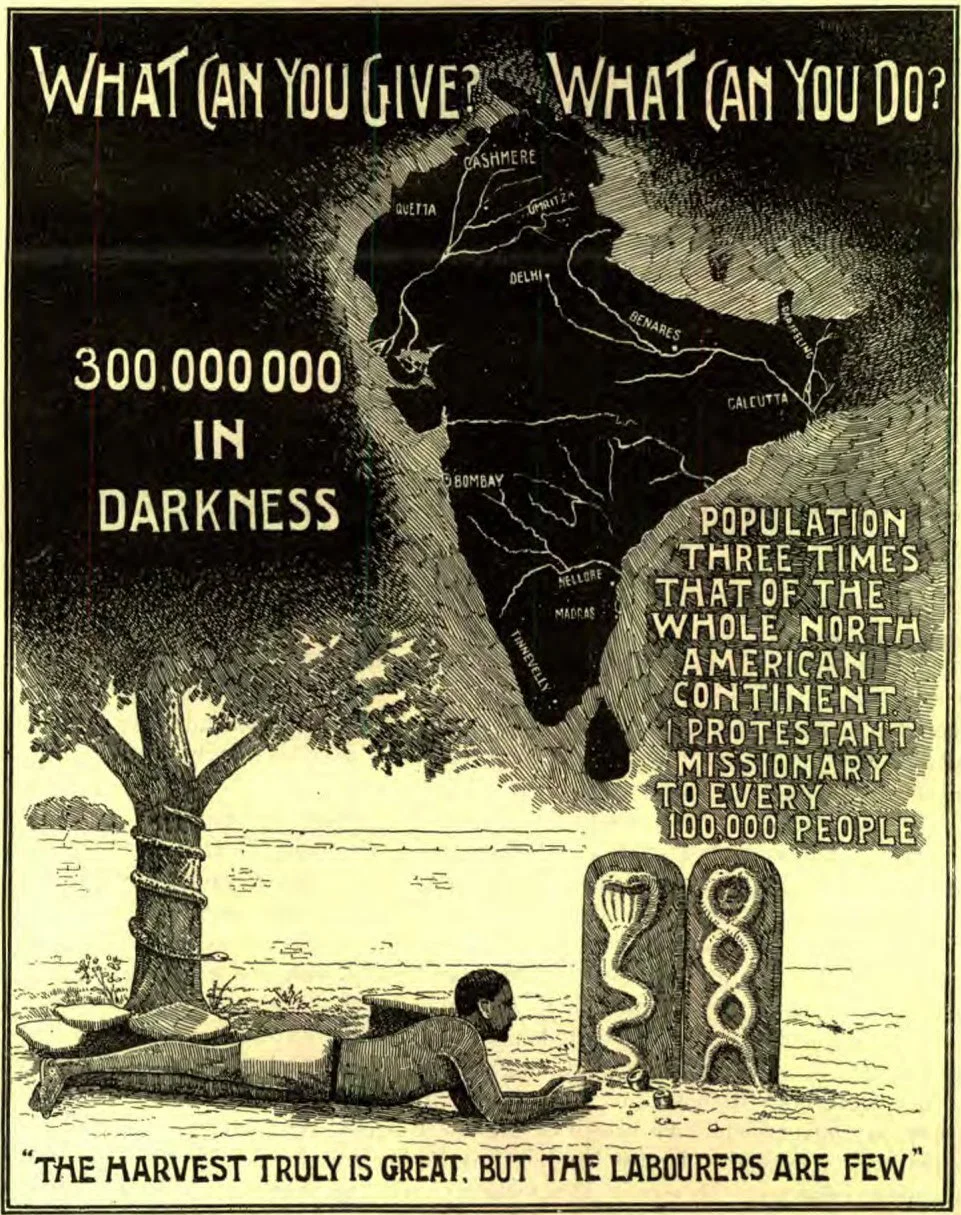
(b) India’s 300,000,000 in Darkness.
(c) Song—“Hymns and Tunes,” No. 1955.
(d) The Third Angel’s Message in India.
(e) Our Mission to the Santals.
3. Closing Address:— What can you give? What can you do?
4. Closing Exercises:—
Song—“Hymns and Tunes,” No. 103.
Benediction.
SUGGESTION.— Abundant material for the different topics suggested may be found in the following Reviews:—
1902—No. 36, p. 15; No. 38, p. 15; No. 39, p. 16; No. 40, p. 13; No. 42, p. 18; No. 47, pp. 14, 17; No. 51, p. 15.
1903—No. 3, p. 11; No. 7, p. 14.
Other matter may also be found in Missionary Magazine files.
The hymn No. 103 of our “Hymns and Tunes” collection will certainly be sung with a deep spirit of consecration, when we remember that it was written by the first convert to Christianity in India—Krishna Pal.
A reproduction of the illustration on this page, either on a blackboard or on a large sheet of paper, will add very much to the interest of the meeting. It gives a glimpse of the real spiritual condition of India far better than words can portray it. The population of India may be illustrated by drawing a large square, measured off into twenty-five small squares. One of the twenty-five should then be marked off into one hundred small squares. Then draw another large square marked off in one hundred and forty-four little squares. Each small space of this second large square now represents one thousand people, and the entire square represents the smallest square in our first figure. If possible, again mark one of these smallest squares into one hundred squares, each representing one hundred people, and one of these will about represent our own people in India, who number a little under one hundred. This fact alone will be a strong argument in answering the two questions in our illustration.
E. H.

William Carey

Early Life

ONE hundred years ago this sign hung over a cottage in a Northamptonshire village: “Second-hand Shoes Bought and Sold. William Carey.” Within sat a cobbler, twenty-eight years of age, careworn, burdened with the support of himself and a sickly, half-crazed wife. On a pile of leather chips, the leaves held open by lasts and awls, were books in Hebrew, Latin, Greek, and French, which languages he was trying to master. On the wall was a map which he had rudely drawn, and scribbled over with the statistics of the world.
Carey was born in 1761, the son of a poor weaver. His early education was such as, with his marvelous powers of observation, he picked up from men and things. When a mere lad, his room was stocked with specimens of bugs and botany. For language he had such a natural gift that he learned to read French in three weeks from a French translation of an English work, and that without grammar or dictionary. But though a genius, he had no natural endowment of piety. He learned to lie, and once he stole. He was converted at eighteen; married at twenty; cobbled, peddled shoes, and studied during the weekdays, opened a school at night for those poorer than himself.

The First Missionary Society

There were no foreign missionary meetings, magazines, nor interest in those days. But, bending over his Bible and his last, the cobbler student felt himself swayed by the conviction that the church must go to the heathen. At a meeting of preachers he brought up the subject. The presiding officer, as wise as his age in these matters, rebuked him: “You are a miserable enthusiast; nothing can be done before another Pentecost, when an effusion of miraculous gifts, including the gift of tongues, will give effect to the commission of Christ as at first.”
But the pentecostal effusion was already in Carey’s soul, and it almost took the form of the gift of tongues, such was his marvelous facility for acquiring languages. He sent out from his cobbler shop a pamphlet, which, as it was the first, is still about the best, missionary prospectus in the English language. Its chief suggestions were united prayer and a penny a week from every communicant. His genius in putting the matter, and his devotion to the idea, soon won him some grand friends, among them the distinguished Andrew Fuller. They at once started the “monthly concert” of prayer for missions, which is still observed so largely in England and America. In 1792 Carey preached a grand sermon, a direct result of which was the founding of the Baptist Missionary Society. As the chief projector of this grand scheme, the devoted man did not hesitate to offer himself as its first missionary.

Carey Volunteers for India

He studied his maps. India, with its hundreds of millions, seemed to be the most needy, and at the same time the most promising field accessible, in that the English flag was already there. Fuller eloquently described the meeting where Carey volunteered. “We saw there was a gold-mine in India, but it was as deep as the center of the earth. ‘Who will venture to explore it?’ ‘I will go down,’ said Carey, ‘but remember that you must hold the ropes.’ We solemnly engaged to him to do so, nor while we live shall we desert him,” was the pledge with which the little band launched the plan of modern English missions.
Taking John Thomas, who had once been in India, as a medical helper, Carey sailed in 1793. That vast land was then divided between Hinduism in its densest superstition, and the equal bigotry of Mohammedanism. British influence being that of the camp, the trading station, or the political office, showed the vices of Christian lands rather than the virtues of Christian life. The East India Company dreaded the attempt to evangelize the land, lest it should awaken the religious prejudices of the people and imperil their gains. Such was the hostility of even English merchants that the missionaries were denied passage to India in an English boat, and sailed in a Danish ship. Arriving at Calcutta, they were not allowed by the East India Company to engage in religious work. For five months they lived in abject poverty. Carey finally went inland, built a bamboo house in a neighborhood infested with tigers, hired out as an assistant in an indigo factory, and while thus engaged studied the Bengali language, talking the gospel in it as fast as he learned the equivalent of the sacred words. He set up in a corner of the factory a rude printing-press, and on this he printed portions of the Bible. Able to earn some money in the factory, the self-sacrificing man declined to receive any salary from the friends in England. He soon fell a victim to the fever. His children sickened; one died. The insanity of his wife developed into actual mania. But he worked on without abatement of zeal. Beside his house he built a chapel, and preached to the natives, though such multitudes came that they congregated outside more frequently than inside. He visited two hundred villages, every one he could reach in his boat, which was his sleeping place and his library; for all the while he was studying Sanskrit, the mother tongue of the Indian languages.
He saw that the Bible must be laid beside the shastras of the Hindus; that it, the divine light, could evangelize India—he could not. In the meantime his letters electrified the home church with his own spirit. To his personal influence we trace the formation of three great missionary societies: the London Missionary Society, representing various denominations of dissenters; the Scottish Missionary Society, representing Presbyterianism; and the Church Missionary Society in the Established Church. Individual Christians, too, caught Carey’s enthusiasm. After reading the account of his project, Robert Haldane sold all his possessions, and gave two hundred thousand dollars to establish a similar work in Benares, which, however, was prevented by the cruel timidity of the secular authorities.

The First Convert

Soon Carey was joined by those grand men, Marshman and Ward. The East India Company not allowing them in their bounds, they settled in Danish territory at Serampore. On Christmas day, 1800, after seven years’ labor, Carey baptized his first native convert, Krishna Pal, whose hymn, translated by Marshman, has become an heirloom of all the modern church:—
“O thou, my soul, forget no more The Friend who all thy sorrows bore. Let every idol be forgot, But, O my soul! forget Him not.”
Krishna was a high-caste Brahman; he became a gifted preacher, and with his own private fortune built the first house of Christian worship for natives in Bengal.

Carey’s Work as a Translator

The same year witnessed the publication of the entire New Testament in Bengali, a work which made Carey’s reputation as the foremost of Oriental scholars. The British government now found it necessary to establish a college at Fort William for the instruction of their own officers in the languages and literature of India. There was only one man in India, or the world, if we except Lord Colebrooke, who could fill its chief chair. Carey became a professor, but really he became the university. One who had seen him at work writes: “Here was for nearly a whole generation a sublime spectacle—the Northamptonshire shoemaker training the governing class of India in Sanskrit, Bengali, and Marathi all day, translating, too, the Ramayana and the Veda; and then, when the sun went down, returning to the society of the maimed, the halt, and the blind, and many with the leprosy; to preach in several tongues the glad tidings of the kingdom to the heathen of England as well as of India, and all with a loving tenderness and patient humility learned in the childlike school of Him who said, ‘Wist ye not that I must be about my Father’s business?’”
It was in 1804, when Carey had thirty years of life still before him, that the governor-general of India declared that he esteemed the commendation of such a man a greater honor than the applause of courts and parliaments. The occasion of this praise was a notable one. In a brilliant assembly of European officers and native scholars, Carey had welcomed Lord Wellesley in a speech in Sanskrit, at the time an almost unknown tongue to Europeans. It was an exploit of a great genius, at which the Sanskrit scholars of to-day marvel, although they have the aid of Carey’s dictionaries and grammar, and more recent works based upon them, with which to acquire that language, while Carey had to make these tools for himself. That the following thirty years of such a man’s life would be of immense influence we could predict, but the full greatness of his work no man can estimate. With the corps of scholars he brought about him, he rendered the gospel into between thirty and forty different tongues, and thus brought it within the reach of over three hundred millions of human beings to whom it had been unknown. It was a beautiful custom of these translators, when a volume was completed, to place it on the communion table, and dedicate it to the service of Christ.
But Carey’s work was wider than this, although this alone would have warranted the praise given him at his death by Robert Hall as “the instrument of diffusing more religious knowledge among his contemporaries than has fallen to the lot of any other individual since the Reformation;” if not that of another, who pronounces him “the most honored and the most successful missionary since the time of the apostles.” We can only indicate the side work of this wonderful man. He was distinguished as a botanist, and edited the journal Flora Indica. He founded the Agricultural Society of India. He made the first dictionary of Oriental languages. He translated parts of the Hindu sacred books. He established the first distinctly Christian college in heathen lands, having won the patronage of the king of Denmark. He started the first newspaper in the East, the Samachar Darpam. His was the first clear and potent voice which the British authorities heeded, in suppressing the cruelties of infanticide, the murder of widow-burning, and the living sacrifice to Juggernaut.

His Death

Carey died at the age of seventy-three. At that time English missions had become established in India, and all sects recognized him as the divinely appointed pioneer. When on his sick bed, the Metropolitan Bishop of India, the highest official of the English Church in the land, visited him, and bowing his head by his pillow, asked the dissenter’s benediction, feeling that no ecclesiastical honor could equal the blessing of one whom God had ordained to be the great apostle of modern missions. The learned world went into mourning when the news floated to the universities of England, Germany, and America that Carey was no more. The secular authorities did well to recognize his departure as if he had been one high in political or military life, by dropping the flag to half-mast; for he had accomplished more for European influence in India than any single man who represented only the state. But Carey himself seemed during his life to be the only one who was ignorant of his greatness. The humility of this sublime soul was beautifully illustrated during his last illness. Dr. Duff, then a young man, visited him. As he was leaving the chamber, the sick man recalled him, and said, “Mr. Duff, you have been speaking about Dr. Carey, Dr. Carey; when I am gone, say nothing about Dr. Carey—speak about Carey’s Saviour.”
Where ninety years ago Carey was the only ordained Protestant missionary, are now about seven thousand. That single convert, Krishna Pal, has a goodly following of two thirds of a million. This is the commentary on Carey’s early sermon that led to the establishment of the society which sent him out as its first missionary. His text was Isa. 54:2, 3: “Enlarge the place of thy tent,” etc. Under this he made the two points—the heart lobes of his own life:—
  1. Expect great things from God.
  2. Attempt great things for God.
— James M. Ludlow, D. D.
Continue reading: Stories in the snow, and how to read them