Winter is the best time in the world to learn interesting stories at first hand. Now that there is snow in most parts of the United States, the children will find it both invigorating and instructive to wrap up warm, put on leggings, and overshoes, and go outdoors, and use their eyes. We will take a little tramp to-day. First we will go into the fields, and see where the mice have been printing their dainty lacework on the snow. If we look sharp, we may be rewarded with a real story. We shall find where there are families of little folk living out in the snow, and learn where they go to get the greens and other relishes that they like to add to their winter fare.
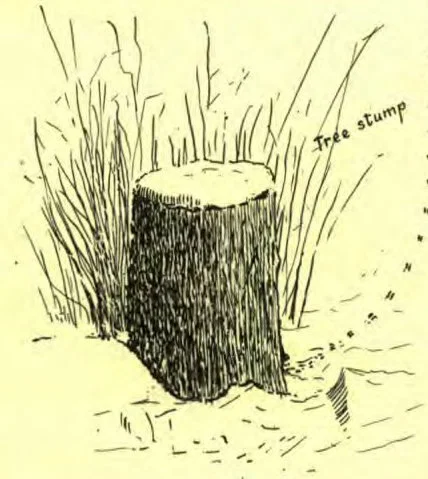
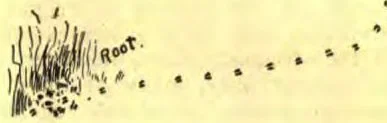
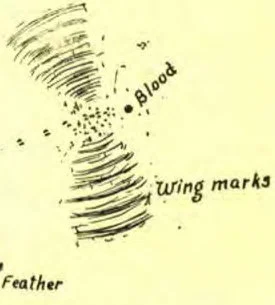
About a shock of corn is one good place to look. And if there is an owl in the neighborhood, or a mink, we shall very likely see some of his work, too. The other day I saw the story that is illustrated on this page. A mouse had come out of the hole in the base of a stump, and had run along on the snow for twenty feet, and stopped to eat an acorn. Then he went a little farther, and found another rare bit, which he devoured. Growing bold with success, he had ventured twenty yards from any shelter, broad daylight though it was. A crow had been coming that way; and now the wing-marks in the snow, and a drop of blood, were all that was left to tell the story. If an owl had carried him away in his talons, that drop of blood would not have been there. A crow would have pecked the mouse with his bill.
Now we will go into the woods. Do you see where a squirrel has come down from a tree, hopped out a few jumps, and, guided either by a wonderful scent or a no less remarkable memory, has digged up a nut? He did not dig here and there till he found one, as you and I would have to do, but went straight down to it the first time. Perhaps if you look sharp, you will see where he has hidden a nut in the lichens that grow on a stump.
Soon we shall see where there were some berries, or perhaps some edible roots, that a blue jay has scratched away the snow to eat. If you have learned the art of going softly and not treading on sticks or leaves, you may be so fortunate as to see him digging. I am sure you will like him better when you see how he can make the snow fly.
Go about some old bridge, and you will see the double row of tracks made by a skunk as he waddled about hunting for mice or other prey. He is an enterprising fellow, as you will learn if you go out on a day following a snow, and follow his tracks made in a single night. You will also be surprised to see how readily he has detected every worm that lay dormant in a stump within reach of his sharp claws, and to notice how he has tracked the birds to their sleeping places in the snow, and perhaps caught one that was sleeping too soundly.
If you can find a place where there are a few bunches of buck brush, you will not have to watch long before you will see the brilliant little cardinal grosbeaks flitting about and eating the berries. No matter how cold it is, they will be chirping as happily as can be, and their merry little song is wonderfully cheering on a cold winter day. As you watch them crack the shells of the seed in the berry, and eat the kernel, and then eat one yourself, you will wonder why they are so happy over their meager fare.
Perhaps you will see a titmouse creeping over the limbs of the tree hunting for worms, or hear the jolly sapsucker as he goes about in the woods, trying to make his living, and dolefully squeaking out, C-a-n-'t! c-a-n-'t! c-a-n-'t! and yet proving by every action that he “can.”
Take a note-book along, and make notes of what you learn. Make sketches of the most interesting things. You may not be able to draw well, but the sketch will help you remember better. If you take a long tramp on a sharp, crisp day, and do not come home satisfied that you have learned more than you would have learned from reading a book on nature study, write me a letter, and tell me about it. Besides, you will find that you are feeling ever so much better than you do after a day in a close room.
As you pass an old hickory tree, pull off some of the loose, shaggy bark, and it will be a miracle if you do not find half a dozen kinds of insect eggs that have been snugly hidden away until the warm days of spring. If you don't find them under one piece, look under another; for they are surely there. If you can't find them, Mr. Titmouse or Mr. Sapsucker certainly will. Then, if you look sharp, you may see something very brilliant and beautiful shining in the snow; for this is the time of year for the beautiful crimson berries of the Jack-in-the-pulpit.
If you climb a few hollow trees, you will be rewarded by finding the screech owl, or perhaps even a barn owl. These birds go very softly these days, and are careful not to leave marks in the snow that would betray their hiding-place.
How It Cleared Off
SUCH a time! And to think it all “came out of a clear sky!” as Aunt Esther would say. A minute before, Meg and Kathie had been cozily chattering, with their arms round each other. Then came the thunder-shower that bade fair to settle down into steady raining.
Aunt Esther happened to be in the other room, and this is what she heard. Meg began: “It’s in Webster Under-the-bridge.”
“Webster On-the-bridge, you mean,” Kathie interposed, briskly.
“Under-the-bridge.”
“On-the-bridge.”
“Kathrine Trundy, I guess I know! My father’s a minister!”
“Meg’ret Merriweather, my father’s a bridge-maker, an’ I guess I know, so there!”
This was too much for Meg for a minute, but she recovered presently.
“I don’t care, it’s Webster Under-the-bridge. My brother’s in college, and I guess he knows!”
“Poh! If I had a brother, I guess he’d know enough to know it’s Webster On-the-bridge!”
“’Tisn’t!”6
“’Tis, too!”
“Kath’rine Trundy, I don’t s’pose my mother’d want me to play with such a nignoramus! Here’s your doll.”
“Here’s yours.”
The exchange was made stiffly. Both little girls held their heads very high, and looked dignifiedly hostile.
“Wait!” Aunt Esther called, just as they were parting “forever.”
She took them each by the hand, and led them into the library, up to the dictionary-stand. Then she pointed to the big title-word.
“U-n-a-b-r-i-d-g-e-d,” she spelled, slowly.
“Oh, my!” breathed Meg, ruefully. “We didn’t both of us know!”
“No, we didn’t,” Kathie admitted.
And when they went out again, the little dollies had gone visiting once more.— Companion.
First Lessons in Geography
By Floyd Bralliar
Lesson XXXVI
PERSIA is one of the oldest countries in the world. As the races scattered from Mt. Ararat after the flood, some of them settled in the mountain region of this country, where they have been nearly ever since. At one time Persia ruled the world. It is spoken of many times in the Bible, and is one of the four great kingdoms of the prophecies of Daniel. At present it is not entirely independent, but the pasha is partly under the influence of the sultan of Turkey, and partly under the influence of the Russians; yet he carries on his own government as he sees fit. Some of the people are not civilized, but live in tents, like roving tribes, and subsist by their flocks and herds. The civilized classes earn their living by raising silkworms, and the manufacture of beautiful shawls, silks, and carpets.
Afghanistan and Beluchistan are mountainous states populated mostly by wandering tribes, who profess the Mohammedan religion. They have no strong central government, and carry on but little commerce with the rest of the world. Many of the people are professional robbers. Missionaries have done but little work in that country, as the language is hard to learn, and the people are not friendly toward Christianity. Women are oppressed, and it is hard to reach them. When a white man goes there as a missionary, his wife must always walk behind him as they pass through the streets together, or she must ride behind him if they are traveling. The native women are kept in the house, very much as the high-caste Indian women are. Little has been done toward carrying the gospel to these nations.
Nearly all the low land in southwestern Asia lies along the Tigris and Euphrates rivers. Much of it is now desert, having been covered with sand that the wind has carried from the desert of Arabia. Years ago this country was very fertile, and supported the most powerful nation in the world, the proud and mighty Babylon. Because of the wickedness of the people this nation was overthrown, and now the country is inhabited only by wandering tribes of half-civilized people, who raise a few herds of camels, goats, and sheep, which form almost the only wealth of this region. As the winds blow over the desert before they reach this country, there is but little rain; and as the people are too indolent to irrigate it with water from the river, little grows except on the banks of the streams. Here, however, figs and dates grow luxuriantly, many of those we buy in the market coming from this region. From the wood grown in this country the natives manufacture costly rugs and carpets.
East of this country is a desert, and west of it stretches the great desert of Arabia. The camel is of great importance here, for it can travel for a long distance over the hot desert sands without either food or drink. Trains of these animals, called caravans, carry loads of merchandise to the various parts of the country, often going thousands of miles.
REVIEW.—Where is Persia? How old is the country? What do the people manufacture? Tell about Afghanistan and Beluchistan. How are the women treated in Persia? Tell about the country along the Euphrates River. What do the people do here? Of what value is the camel to this people? What do we get from these countries? Find Babylon on the map. Mt. Ararat.
Lesson XXXVII
Arabia consists almost entirely of a high, dry plateau; in fact, it is mostly a desert, with here and there a fertile oasis. The Arabs of the plateau of Arabia are closely related to the Jews, some of them being descendants of Ishmael and others of Esau. Palestine lies just north of Arabia, on the coast of the Mediterranean Sea. It was in Palestine that the ancient Jewish people lived, and in the western part of Arabia the children of Israel wandered for forty years.
The Arabs are generally wandering herdsmen, each tribe being governed by a chief called a Sheik. The strongest and most important of the Arabian states is Oman, in the southeastern part of the peninsula. Although the Arabians have herds of goats, sheep, and camels, their favorite property is horses. The Arabian horses are raised in the fertile oases, and are noted throughout the world for their beauty and speed. These horses are wonderfully intelligent, and their masters have trained them to obey at the first command. The Arabian people are warlike, living by plundering the surrounding country, and then fleeing to the desert on their swift horses. No nation has ever succeeded in conquering the Arabians. Most of the people profess the Mohammedan religion, and some of the tribes pay tribute to the sultan of Turkey, but otherwise they govern themselves. They are a very hospitable people. The gospel was preached among the Arabians by Joseph Wolff just before the great advent movement of 1844, and it must go again before the Lord comes.
On the coast of Arabia there are fertile lands where dates and coffee are grown. Dates, cheese, and milk are the principal articles of diet with this people, and the use of coffee is almost universal.
All the nations in southeastern Asia except the Turkish belong to the white race. The Turks are of the yellow race. They constitute the ruling class in all Turkey, and oppress the other people very cruelly. They also belong to the Mohammedan faith, and oppose Christianity. Missionaries are allowed in their country, not from choice, but because of fear of the nations of Europe and America. Although many of the common people have accepted Christianity, few of the Turks will have anything to do with it. They are warlike, and dislike work, so they live by robbing the common people. The Turks also rule a part of Europe. Constantinople is their capital city. The Bible tells us that before Christ comes, the Turkish people will be driven out of Europe, and that Jerusalem will be made their capital city.
It was in this part of the world that Christ lived, and where his disciples did most of their work. Nearly all the places mentioned in the book of Acts are to be found in Turkey. It is important that you learn the geography of this part of the country thoroughly, for it was here that the Jewish people lived, and that the Bible was written.
Abraham came from the region of the west coast of the Persian Gulf, and journeyed up the Euphrates River, and then crossed to the coast of the Mediterranean Sea, living here the remainder of his life. Isaac and Jacob also lived near Jerusalem. Where is the Dead Sea? It is supposed that Sodom and Gomorrah once stood where this sea now lies.
REVIEW.—What kind of country is Arabia? What people wandered in this country for forty years? Why is Mt. Ararat important? From whom did the Arabians descend? What do the Arabians do? Tell about their horses. Where is Turkey? To what race do the Turks belong? What is their religion? What is the capital of Turkey? Where does the Bible say the Turkish capital will be before the Lord comes? Why is it important to become familiar with the geography of this part of the world.
FLOYD BRALLIAR.
Taking Aim
By Mary S. Ladd
THERE were four little boys who started to go
From the very same spot, to make tracks in the snow.
Who made his path straightest, they laid in their plan,
Of all the contestants should be the best man.
Now this little four were Philip and John,
And merry-faced Harry, and sober-eyed Don;
The best friends in the world, and full of invention
In play, but they seldom were found in contention.
Well, they started together, and traveled along;
But John, Don, and Harry in some way went wrong;
But Phil made his path nearly straight, and they wondered,
When all tried alike, why they three had blundered.
Then Philip replied: “The reason you see;
Though not harder I tried to succeed than you three,
I pushed for that oak, going forward quite ready,
While you struggled on without aim, and unsteady.”
Now you see, my dear boys, what such lessons teach:
If there is a point that you wish to reach,
A position in life at all worth the naming,
If you gain it, ’twill greatly depend on your aiming.
— Mary S. Ladd.
Aristocratic Squirrels
NEAR a certain Western city, a family of squirrels found their way into a fine country house, and lived in it during a winter while the owner was traveling in Europe. He thought the house had been securely closed, but the sly long-tailed creatures hit upon some unguarded crevice, and took possession. One day a neighbor saw one of the squirrels gazing out through a window, very much at his ease. A number of people went in to drive out the little intruders, but could not find even the tiniest baby squirrel.
A few days later, Mr. Squirrel was again seen at the window, and the men determined to make another search for the sly fellows. This time they hid themselves, kept quiet, and watched.
Before long, a squirrel came running from the parlor, and started up the stairway. One of the men gave the cry, and a chase began. They saw him enter a front bedroom; they instantly followed, but found no trace of him!
They searched through closets, cupboards, bureau-drawers, yet all in vain. Then some one turned down the edge of a counterpane on the bed, and there, snugly cuddled down, were two gray squirrels. When the cover was raised, they leaped to the floor, and were off like lightning.
Not far away from the nest, too, was a plentiful supply of nuts and other food, showing that the squirrels were satisfied with their new home, and had no idea of moving.—St. Nicholas.
The Jolly Serving-Men
I HAVE neither house nor castle, Nor a single foot of land. But I've ten jolly serving-men Ranged straight on either hand. Sometimes they are such busy lads, Sometimes they are so idle, Sometimes I have to hitch them up With a check-rein and a bridle.
In winter-time they go to school Dressed snugly all together; In summer-time they berrying go Quite free of fur or leather. If through the forests green I ride, Or sail far o'er the sea, All in a row, on either side, My good men follow me.
The captains, they are dwarf men, And two are giants tall. Just four of them are middling, And two are rather small. Now, come, put on your thinking-cap,— I'll give you guesses ten If you will tell me who they are, My jolly serving-men.
MEMORY VERSE: “I will put my laws into their hearts, and in their minds will I write them.” Heb. 10:16.
Our lesson this week is on “the giving of the law.” The law is God’s gift to us. He says, “I will put [give] my laws into their hearts.” And in 2 Cor. 3:3 we learn how this is done: “Not with ink, but with the Spirit of the living God; not in tables of stone, but in fleshy tables of the heart.” So the real giving of the law is God sending his Holy Spirit into our hearts to write it there.
We are often told to keep God’s commandments and his laws. But we must get them before we can keep them; and we do not get them by having them in a book or on tables of stone. The children of Israel had them so, and they promised to keep them, when they had never received the Holy Spirit of God to write them in their hearts.
Do you remember the young man’s answer to the Lord’s question: “What is written in the law? how readest thou?” He said: “Thou shalt love the Lord thy God with all thy heart, and with all thy soul, and with all thy strength, and with all thy mind; and thy neighbor as thyself.” And Jesus said that he had answered well; for all the law is summed up in the one word “love.” And “the love of God is shed abroad in our hearts by the Holy Ghost which is given unto us.” This again shows that “the giving of the law” is the giving to us of God’s Holy Spirit of love and life.
God has a law for everything he has made. We speak of the laws of nature, and the laws of plant and animal life. The plant is keeping the commandments of God for it when it grows into just the form and color that he planned for it. The bee is keeping his commandments when it makes its perfect honeycomb. The bird is keeping his law when it soars in the air or builds its nest. None of these creatures has a law written out for it. God writes its law for it in the thing itself, and this is just what he wants to do for us.
God’s life in all things works out in each one what he wants it to do. So when we give our hearts to him and choose his way, and yield ourselves to let his Holy Spirit guide us, we shall do his will on earth as it is done in heaven.
Notice that God did not say, You are not to do this, or that, but “Thou shalt not.” He is telling us what he will do for us; as he afterward said to his people: “If thou wilt harken unto me, there shall no strange god be in thee, neither shalt thou worship any strange god.”
“His voice then shook the earth,” as he spoke the words of his law; showing the power of his word. We have learned how God’s word is at work in all the earth, how it brought the light out of darkness, divided the waters, and made the earth bring forth grass, trees, and animals. And the words of his law that he speaks to us have just the same power as his word that he spoke in the beginning when he said, “Let there be light;” and there was light. So if we harken and receive that word into our hearts, it will keep us from every evil way.
In the first four commandments God tells us what he will do for us. He says we shall not worship any false god, nor set up any idol, nor take his name in vain, nor break his holy Sabbath,—we shall do no evil, but he will keep us pure and holy. These commandments are some of God’s “exceeding great and precious promises,” and “he is faithful that promised.” Let us trust him, and he will write his laws in our hearts and minds, so that we shall not sin against him in thought, word, or deed.
Questions
1. Repeat the words that God spoke on Mt. Sinai. Ex. 20: 1-17.
2. Where was this law afterward written? Ex. 31: 18.
3. Is it on tables of stone or in a book that God wants to give us his law? Can we keep it if we have it only in this way?
4. What is the real giving of the law? Where is it written by the Spirit? 2 Cor. 3:3.
5. What one thing sums up the whole law? How only can we get the love of God into our hearts? Rom. 5:5.
6. Is man the only being who keeps God’s commandments? Where is his law written? What are all the laws of nature?
7. What are all the commandments of God to us? 2 Peter 1:4.
8. Tell the things that God has promised us in the first four commandments.
9. What took place when God spoke from heaven? Heb. 12:26. Will he ever again speak in the same way?
10. What will then happen to everything that is shaken? Heb. 12:27.
11. What alone can keep us from being shaken in that awful day? Matt. 7:24, 25.
O give thanks unto Jehovah; for he is good;
For his loving-kindness endureth forever.
Let the redeemed of Jehovah say so,
Whom he hath redeemed from the hand of the adversary,
And gathered out of the lands,
From the east and from the west,
From the north and from the south.
They wandered in the wilderness in a desert way;
They found no city of habitation.
Hungry and thirsty,
Their soul fainted in them.
Then they cried unto Jehovah in their trouble,
And he delivered them out of their distresses.
He led them also by a straight way,
That they might go to a city of habitation.
Oh that men would praise Jehovah for his loving-kindness,
And for his wonderful works to the children of men!
For he satisfieth the longing soul,
And the hungry soul he filleth with good.
Such as sat in darkness and in the shadow of death,
Being bound in affliction and iron,
Because they rebelled against the words of God,
And contemned the counsel of the Most High;
Therefore he brought down their heart with labor;
They fell down, and there was none to help.
Then they cried unto Jehovah in their trouble,
And he saved them out of their distresses.
He brought them out of darkness and the shadow of death,
And brake their bonds in sunder.
Oh that men would praise Jehovah for his loving-kindness,
And for his wonderful works to the children of men!
For he hath broken the gates of brass,
And cut the bars of iron in sunder.
Questions
With what exhortation does this psalm open?
Why are we exhorted to give thanks unto Jehovah? How long does his loving-kindness endure?
Who are especially urged to give thanks?
From what have they been redeemed?
From what parts of the earth have they been gathered?
Through what experiences did they pass?
How did they secure deliverance? How many times is this experience repeated in this chapter?
For what purpose did God lead his people forth by the right way? See the experience in Ezra 8:21.
Who is again exhorted to praise the Lord? Why? How many times does this exhortation appear in this chapter?
What does the Lord do for the longing soul?
How does he satisfy the hungry one?
What is the condition of those who sat in darkness and in the shadow of death?
Why has this experience been brought upon them?
By what experience were they brought to realize that there was no help but Jehovah?
What did they then do? How fully were they delivered?
Will this be the experience of every one who realizes that only in Jehovah is deliverance?
What are men again exhorted to do?
What encouragement can each young Christian draw from this lesson?
Notes
We are not merely to think it, but to say it, that the Lord is good. The more the redeemed of the Lord say it, the deeper sense of his goodness will they have. It is wonderful how much help one may receive by the earnest effort to tell others how good the Lord is. Let us open our mouths and say it out. Heb. 13:15.
God led the people forth “by the right way.” The ways of the Lord are right. In Christ, the Way, we have deliverance from sin, from the power of the enemy. See the song of Zacharias. Luke 1:68-75. The record of the deliverances of a whole people is but the history of the work of God in our own hearts, the defeats, the victories, and the leadings in individual experiences.
Rebellion (verse 11) is the cause of our troubles. Jesus, our example, received teaching and discipline, and was not rebellious. Isa. 50:4-10.
When they fell down, and there was none to help, then came deliverance, as they called on God. What assurance of victory in verses 12-14 of this psalm! Not a soul should pass this lesson, surely, without accepting deliverance; for every bond is loosed, and every bar cut asunder.
— Lesson Pamphlet.
Sent on THREE DAYS' TRIAL FREE THE CO-RO-NA MEDICATOR CURES CATARRH
By E. J. Worst
Head-Colds, Pains and Roaring in the Head, Partial Deafness, Sore Throat, HEADACHE, La Grippe and All Diseases of the Air Passages by Inhalation. The Most Perfect Appliance ever offered.
SPECIAL OFFER:
For a short time I will mail to any reader naming this paper one of my new improved CO-RO-NA MEDICATORS, with medicines for a quick home cure, or three days' trial FREE. If it gives perfect satisfaction, send me $1.00 (half price); if not, return it at the expired time, which will cost you only three cents postage. Could any proposition be fairer? Address
E. J. WORST, 16 Elmore Block, ASHLAND, OHIO
AGENTS WANTED
EDITORIAL NOTE—If you have the slightest symptoms of Catarrh, or are easy to take cold, you should send for a CO-RO-NA on the easy terms offered. In writing be sure to name this paper.
Bill to Raise Presidential Salary to $100,000
A BILL providing for increasing the salary of the president of the United States to one hundred thousand dollars a year, instead of fifty thousand dollars, has been introduced into the House of Representatives.
How Do We Know?
By Carolyn A. Hathaway
How do we know that we are living in the last generation? Is the threefold message of Rev. 14:6-12 the last message of salvation from sin to be given to the world? Can we demonstrate beyond a doubt that we have now reached the fifty-eighth year since the seventh angel of Rev. 10:7 began to sound? These and others are questions that are stirring the minds of the young people in the Battle Creek Society.
The real question at issue is, Do the young people who are now coming upon the field of action, and who are thinking of taking responsibilities in the important work of the third angel’s message, so thoroughly understand the foundation principles of the faith that they are “ready always to give an answer to every man that asketh a reason” for their hope? Many we fear do not. And why not?
There are among us pioneers of the advent message, who participated in the thrilling events of 1844. At mention of the former days their hearts kindle anew with the old-time enthusiasm. They long for the message to go again with power as it did then. Did advancing years and failing strength permit, they would gladly go forth now to engage in its proclamation. These true and tried souls studied carefully every point involved in the truth for their time. Shall we do less than they? Have we examined carefully our foundation to know whereon we stand, or do we take some one else’s “say-so” for our belief? These are questions for the candid consideration of every young Seventh-day Adventist.
If we thoroughly understand the situation, can we sit passively and listen to the plaintive calls for laborers coming from different parts of the great harvest field, without responding? If we know these things, we shall be able to tell them to others,—yes, and we shall be telling them. If we can not tell them, it is a sure indication that we do not know them.
May God stir us mightily with a realization of the times in which we live, and put upon us a spirit of consecration for service. Let us arise and finish the work given us to do. What say you? CAROLYN A. HATHAWAY.
Keeping the Heart
READ carefully the article printed on the first page of this number of the INSTRUCTOR,—“Keeping the Heart.” It sets forth plainly some important principles regarding the part the Christian must himself act in the forming of a character that will meet the approval of Heaven.
April Prisoners' Number of The Life Boat
The April number of The Life Boat will be the annual Prisoners’ Number. The publishers are expecting to print a hundred and twenty-five thousand copies, and to place a number in every prison in the United States. Further particulars may be had by addressing The Life Boat, 28 Thirty-third Place, Chicago, Ill.
Overcoming Temptation Through the Word of God
THE battle with temptation is a daily battle. Our adversary is on guard, and none does he watch so closely as those whom he is in danger of losing. We need not expect, then, that because we accept Christ as our Saviour, and enlist in his army, we shall be free from temptation. But it is our privilege to know how to guard against it, and how to resist it when it comes. This we may learn from the example of Jesus. His mind was filled with good thoughts, he was familiar with God’s word; and in the hour of temptation he met the adversary, and overcame him, with the word, It is written.
A mind that is filled with the pure and true and lovely things of God’s word, is in that way safeguarded against evil; for good always crowds out evil. That is the first step; but it will not do to rely on that alone; our confidence is in God. But if we are familiar with his words, we shall find them flashing before our minds as plainly and as brightly as a picture is thrown upon a screen in a darkened room, and in the strength of that promise or warning or admonition we shall gain the victory. The psalmist understood this secret when he said, “Thy word have I hid in mine heart, that I might not sin against thee.”
Help for a Needy Field
OUR readers will be glad to know that two more young people from Battle Creek, Mr. and Mrs. J. H. Watson, have offered themselves for missionary service abroad, and have been accepted by the Board. They are now on the way to Nyassaland, to connect with the work in our mission there.
Mr. and Mrs. Watson bravely say farewell to their friends and loved ones, and start on their long journey full of courage and hope, rejoicing that they are among those who are chosen to let their light shine in one of earth’s “dark places.” Our prayers follow them, that they may be kept in health, may at all times realize the nearness of the presence of their Father and ours, and that through their efforts this gospel of the kingdom may be preached to many of the nations of Central Africa.