The Youth’s Instructor, Vol. 32, No. 23.

THE MONTH OF MAY

The Youth’s Instructor

Jun 4, 1884

S. D. A. Publishing Association · Battle Creek, Mich. · Jun 4, 1884

THE MONTH OF MAY.

I LOVE the flowery May, With its sunshine bright and gay, Its ringing laughter in the woods, and shouting in the vale; I love the hawthorn bloom, With its delicate perfume, That whitens all the hedges ’round, and sweetens every gale.
I love the merry May, And I long to be away In copse and dingle, where the flowers like stars are shining out, To hear the sweet birds sing, And the gurgle of the spring, That gushes from its ferny bed, and freshens all about.
Oh, yes, I love the May, ’T is nature’s holiday, And children hail its coming with an ever new delight; There are blossoms on the bough, There are mirth and gladness now; The youngsters have a pleasant time from morning until night.
— Selected.

ZANZIBAR

Written for the Instructor.

ZANZIBAR

WHERE is it? and what about it? we imagine we hear some one ask. Please take the atlas, and turn to the map of Africa. By following along down its eastern coast, we find there a small territory bearing the name of Zanguebar, or Zinguebar. It comprises the islands of Zanzibar, Pemba, and Mafia, together with other small islands, and the coast opposite to them, from the island of Warsheikh, lat. 2° 30' N., to the village of Kionga, south of Cape Delgado, in lat. 10° 45' S. It received its name from the Portuguese, who sought its shores for trade and traffic with the negroes inhabiting it. Although the name is not now used among the natives, it is still employed by Europeans to designate the entire territory ruled by the seyid, or sultan, of Zanzibar, as well as the island on which is the seat of his government.
The country is watered by several rivers, the principal of which is the Lufiji. It is very fertile, supplying all kinds of tropical productions, including sugar, cotton, coffee, cloves, nutmegs, cinnamon, and many other things, which find their way into the markets in every part of the world, and are found on almost every table.
From its forests are furnished large quantities of valuable timber, caoutchouc, and copal. The elephant, rhinoceros, lion, leopard, hippopotamus, and several species of the antelope, are found among its native wild animals. Fish abound in its streams. The domestic animals of our own country, such as cattle, sheep, goats, and fowls, have also been introduced.
Quite an extensive export and import business is carried on by the banions, or Hindoo traders, who collect the African produce for the European or American export houses, and distribute the imported goods to the natives. In 1872 the exports from the island were estimated at about $2,500,000, and the imports at nearly the same amount. The climate is hot, oppressive, and enervating, and is generally considered unhealthful.
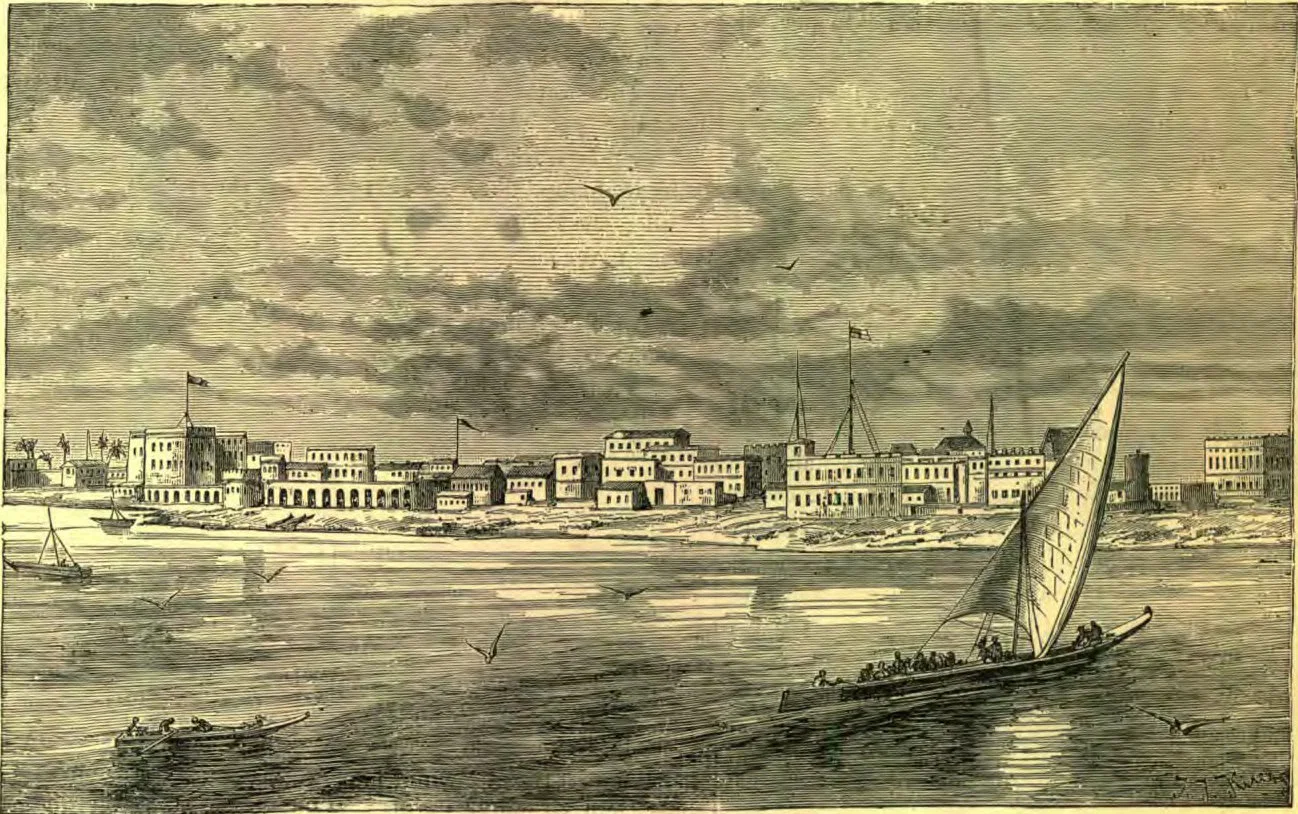
In the accompanying picture is shown the city of Zanzibar and its harbor, situated on the west side of the island. It is built on a sandy peninsula, and is connected with the main-land by a stone bridge. Its streets are narrow and crooked, and their sanitary condition is sadly neglected, being cleaned only by the rains.
As seen in the engraving, there are some large public buildings, principal among which are the custom-house, the mosques, and the bazaars, the latter being well filled with all kinds of merchandise. The palace of the seyid, or sultan, and the houses of the foreign merchants, are near the sea; and this part of the city is much better kept than other parts.
The spacious harbor, which we see is a good one, is generally considered safe at all seasons; but like all others, it has not always escaped misfortune. In 1872 a destructive cyclone visited it, and a large number of ships were destroyed.
This port was formerly a great slave market, where the infamous slave trade was carried on to a great extent, the natives of the interior being captured by those engaged in the business, and shipped to the shores of our own country. But as a business, this was finally abolished by a treaty with Great Britain in 1873, although it is still, to some extent, carried on without proper authority on the main-land. In 1784 Zanzibar was conquered by, and brought under the jurisdiction of Oman, a country of southeastern Arabia; but upon the death of the seyid, in 1856, various internal dissensions arose, when by treaty and the annual payment of 40,000 crowns, she again obtained her independence. J. W. B.

“KEEP THE STAR IN SIGHT, LADS.”

On a wild spot on the coast of Cornwall, I first saw Will Treherne. He was as sound an “old salt” as ever manned a life-boat, or went aloft in a gale of wind. He was getting to be an old man when I used to see him sitting on the beach after his day’s work was done, gazing thoughtfully at the sky, and especially at the evening star. He told us boys such stirring stories of sea-life and adventure that we could not put him down as “sentimental,” yet the steady gaze he kept on the star inspired us with feelings of mystery.
One evening, when the sky was clouded, the wind rising, and the sea hoarsely breaking over the rocks, I ventured to say to him, “Mr. Treherne, you can’t see your old friend to-night.”
“What old friend, my boy?” he asked.
“The evening star; you seem so fond of it, I am sure you must miss it.”
“Well, my lad, it is the truth that I do miss it. You are too young to understand what that star is to me. If I thought—”
“Now, Mr. Treherne,” I broke in, “I know there is a story connected with that star; do tell it to me.”
The sailor was silent for a few minutes; then he said, with great reverence, “I have to thank that star and the God who made it, for saving my life and saving my soul.”
“Do tell me the story, Mr. Treherne,” I said eagerly; “I am sure it will be the best you ever told.”
“I am not so sure of that,” he answered; “for somehow we cannot always do our best with what we feel most. But I will tell you the story.”
“Thirty years ago, in just such a night as this, the wind whistling as it does now, with the sea rising, and with as crazy a craft as seamen ever sailed in, I found myself drifting along a dangerous coast. Our captain was an experienced one, and when he saw what weather we were threatened with, he took his place at the wheel, and did his best to keep our courage up. He was in terribly poor health, but his spirit rose above his bodily weakness, and he gave his orders with a pluck and decision that made men of every one of us.
“‘Will Treherne,’ he cried, ‘stand by me if you can be spared; my strength is going. Do you see that star right ahead?’
“‘Yes, sir.’
“‘If my strength should fail, steer right ahead for that, and you are safe. And oh, remember, Will, that there is another star you must always keep in view if you are to get safe into port at last.’”
“I knew what he meant; he was pointing me to the Lord Jesus Christ; for he was as good a Christian as he was a captain, and he never lost a chance of saying a word that might steady us youngsters, and make us religious. I have heard many a sermon since that night in the storm when he told me to keep the star ahead, but none took more hold on me than that one on that night when I lost my truest and best friend.”
“Did you lose him that night?” I asked.
“Yes, my lad,” the sailor answered sadly. “His hour was come. When he could stand the gale no longer, he shouted as loudly as he could, ‘Keep the star in sight, my lads! keep the star in sight!’ Then he was helped down to the cabin, and I never saw him alive again. I was lashed to the wheel, and though the spray well-nigh blinded me, I yet managed to keep the star in sight, as the first officer gave his orders for the working of the ship.”
“After two hours of steering through a narrow and treacherous channel, we found ourselves in a friendly sea. The star had guided us aright.”
“When the ship was in safety, and my turn of work was over, I went down to the captain’s cabin. A flag was thrown over his body, but his manly, resolute face, which even death had not much altered, was visible. I knelt down there, and prayed God to guide me through the storms of life; and I believe I can say that from that night I have kept the star in sight.”
“Now you will know why I am such a star-gazer; and if I may give you a bit of counsel, my lad, let me advise you to begin and steer your course by the Star of Bethlehem. Keep your eye on the Star, and you will come safely through the dangers of life into the port of peace at last.”
Then, buttoning up his jacket, and turning the collar up around his neck, he clasped his hands over his knees; and, settling himself again comfortably on the bank, he turned his eyes to the evening star, which shone out now and then between the cloud-rifts,—Selected.

A RIDE THROUGH SWITZERLAND

FOREIGN TRAVEL.—NO. 7.

A RIDE THROUGH SWITZERLAND.

A ride from Paris through Switzerland by way of Bâle, Lucerne, and the great St. Gothard tunnel is very interesting. If one has a taste for mountain scenery, probably he could not find a railroad ride in the world which would gratify his desire better.
I have been through the Green Mountains, the White Mountains of New Hampshire, the Alleghanies, the Rockies, and the Sierra Nevadas, but I have never seen anything which would equal in wildness and grandeur the passage of the Alps by the St. Gothard line.
The ride from Paris through France to Bâle, Switzerland, is a very pleasant one. The farming is well managed, the land being cultivated in long, narrow strips, put out to different kinds of crops, very few wide fields being sown. There were plenty of women out working in the fields here as well as in almost every country on the Continent where we have been. It seemed so different in this respect from our own America. The women handle the hoe, fork, and spade as if they were used to it. They were stout and coarse, compared to our delicate American women.
Bâle is a fine town of over 60,000 population. It is the first Swiss town of importance which we reach, and is one of the largest in Switzerland. It dates from the old Roman times. It is pleasantly situated on the Rhine, which is crossed by a very fine new bridge and two old ones. The Rhine is a large, beautiful, clear stream, taking its rise in the Alps. Bâle is a busy place, and contains an industrious, thriving population. It has a beautiful climate, and many fine walks lined with trees, shrubs, and flowers, and is one of the most attractive cities we have seen.
The ride from Bâle to Lucerne is very pleasant indeed. There is great variety of scenery. Here and there an old castle, or the ruins of one, reveals itself from the highest points as we rapidly pass; and clear streams dash merrily along. In all directions beautiful hedges and well-tilled fields greet the eye. Fruit trees abound, and fine houses are constantly passed. As we went through valleys and over ridges, and occasionally through a tunnel, we gradually came in sight of the lofty Alpine peaks, snow-capped at this season of the year, and some of them always.
Lucerne, the capital of the canton, with population about 18,000, is pleasantly situated on the lake of the same name. It is inclosed by well-preserved walls and watch-towers, erected in 1385, which give it a picturesque appearance. The lofty peaks of Pilatus and the Rigi rear their heads above all around, the former being 6965 feet high, the latter, 5906. They both afford a wonderful view of mountain scenery.
Lake Lucerne, or the “Lake of the Four Forest Cantons,” as it is sometimes called, being surrounded by the four cantons of Uri, Schwyz, Unterwalden, and Lucerne, is a most beautiful body of water, unsurpassed in Switzerland, or even in Europe, in magnificence of scenery. Its greatest length is twenty-three miles, lying somewhat in the form of a cross. It is surrounded by lofty peaks, and its beautiful shores are undoubtedly associated with the historical events and traditions connected with the life of William Tell. Its greatest depth is 510 feet. It is fed by mountain streams, and its color is a clear, deep green. The River Reuss issues from it with the swiftness of a torrent.
This city and the mountains around it are visited by many thousands every summer from all parts of the world.
After leaving Lucerne, in less than half an hour we reach Lake Zug (pronounced Zoog) eight and three-fourths miles long, two and one-half wide, and 1320 feet deep. This is a most beautiful lake. It lies directly at the foot of the Rigi, and wooded peaks rise from its surface in all directions. Pretty villages nestle in the valley on its shores, from one of which an elevated railroad runs to the top of the Rigi. It is hard to find a more beautiful and romantic scene on this earth. Soon after leaving Lake Zug, the railroad runs along the shores of Lake Lucerne for quite a distance, affording a fine prospect. On every side, peak rises above peak in countless number, varying in size and form.
We noticed one peculiarly formed peak, terminating in a very sharp point, which looked as if it would be wholly inaccessible to human feet. The front face of it looks as if a large portion of the mountain had slid off clear to the top, while the other sides are quite precipitous, but like other peaks in form. This peak is called the Rossberg, or Ruf, which rises above the village of Goldau, the scene of a famous land slide in 1806. The rock formation is mostly very hard, but interspersed with sandstone and other soft formations. There had been in very wet seasons, minor land slides, but this was one of the most appalling catastrophes of the kind which has ever occurred. The summer had been very rainy. On the second of September, about 5 P. M., a portion of the mountain over a mile in length, 1000 feet in breadth, and 100 feet in thickness, was precipitated from a height of 3000 feet into the valley beneath, burying four villages with 457 of their inhabitants, and filling up one-fourth of a lake at the foot of the mountain. The water rose eighty feet in the lake, inundating islands and the opposite bank.
The railroad passes within a mile of the town of Altorf, the capital of the canton of Uri. This is the traditional scene of the exploits of William Tell, the liberator of Switzerland from the Austrian yoke. A colossal statue of Tell, in plaster, erected in 1861, is said to occupy the spot whence the intrepid archer aimed at the apple placed on the head of his son, by the tyrant Gesler. It is said that the lime-tree where his son stood lived till 1567.
The St. Gothard railroad, passing over the mountains, is perhaps the most remarkable piece of railroad engineering in the world. It was opened in May 1882, its construction having occupied ten years. It was built by the governments of Germany, Italy, and Switzerland, which entered into a treaty concerning its construction, each furnishing a stipulated portion. The total cost was nearly $50,000,000. As it nears the great tunnel which is its highest point, it follows the course of the River Reuss, which here runs through a very narrow valley, inclosed on both sides by precipitous mountains. The river descends very rapidly, tumbling over the boulders and stones, and foaming along at a furious rate. The grade of the road cannot ascend so rapidly as the valley. So, to obviate this difficulty, tunnels are cut in the sides of the mountains, and the road turns a complete circle in the rock something like an immense corkscrew. After running in the dark tunnel, seemingly quite a long time, we come out to the light of day. On looking out of the window, we see, perhaps a hundred feet below us, the track we were traveling over just before we went into the tunnel. This great circle in the solid rock, hundreds of yards in length, was made to raise the grade of the road perhaps one hundred feet, so that it could make the ascent of the valley. In two places on the line of this road there are two such tunnels, one above the other; and when the train curves the last turn, you can see from the car window two other tracks, one below the other, which the train has just passed over, the lower track away down two or three hundred feet below us. Tunnel after tunnel in the solid rock is passed through. There are in all on this line fifty-four of them. Riding in tunnels, however, is not so very pleasant.
Gradually we ascend, following the stream, which grows smaller and smaller, passing here and there little villages where the valley is wide enough to contain them, till a little way ahead the solid mountain face rises before us. We see no valley for the train to pass through, and wonder what next. Then the train stops in a rocky gorge, where with great labor a place has been made for a few houses, a station, and an engine house. We get out, and can then see the entrance of the famous St. Gothard tunnel, the longest in the world, being nine and one-fourth miles long. A little one side of the entrance, the River Reuss, here but a few feet across, seems to burst out of the side of the mountain. The train soon starts, and we enter the tunnel. We were just twenty-two minutes in passing through it by my watch. This tunnel is one and two-thirds miles longer than the Mt. Cenis tunnel. It was about eight years in being bored, and cost about $13,000,000. The boring machines were worked by compressed air. The tunnel is twenty-eight feet broad, and twenty-one feet high, and contains a double track, and is lined with masonry throughout. A current of fresh air constantly passes through it; so it is necessary to close the windows as we pass. The Kastilhorn mountain rises 6076 feet above the center of it, and Sella lake lies 3350 feet above it. We then emerge on the Italian side of the mountains, and rapidly pass downward along the valley of the Ticino River toward the fair plains of Italy, by the same methods and succession of tunnels as we ascended from the Swiss side.
Lofty peaks are visible in all directions, till one gets almost tired of beholding them. We pass lakes and vineyards and cultivated farms and little villages in rapid succession, and soon find ourselves nearing the fields of Lombardy. But we must close this article, already too long. Next week we will speak of Northern Italy.
UNCLE IDE.

ONLY ONE MINUTE MINE.

Just one little minute! What can I do in it?— I can speak a sentence so cross and bad That all who hear, will be angered or sad.
I can step both feet in the devil’s snare, Though angels or men cry out, “Beware!” In one little minute I choice can make, Which course of two offered I wish to take.
The way of them both I know full well, One tendeth to heaven, one endeth in hell. In one I must bear every day a cross, And watch unto prayer, lest I suffer loss.
There’s a guide, I am told, where the path is obscure, And in danger or fright his assistance is sure As the “crown of rejoicing” that ever waits For all who “through patience” reach the gates.
The other way looks enticingly grand, From the point of life on which I now stand; But its end, its end, alas, it is death! Art thou passing, minute? Wait one breath,
’Till I tell what I’ll do in thee, fleeting minute! I’ll choose heaven, and try to win it. For God’s word says if I do my best, Christ my Redeemer will do all the rest.
Mrs. M. S. Beers.

NEW-TESTAMENT HISTORY.

LESSON 190.—PAUL IN ROME.

1. On what island was Paul wrecked? Acts 28:1.
2. How were Paul and the rest of the ship’s company received by the people of the island? Verse 2.
3. What accident happened to Paul? Verse 3.
4. What did the barbarous people of the island say about this?
5. What did Paul do? Verse 5.
6. How were the people of the island astonished? Verse 6.
7. What did they say when they saw that Paul received no harm from the bite?
8. What kindness was shown by the chief man of the island? Verse 7.
9. What miracle was wrought by Paul? Verse 8.
10. How was the same kindness extended to others? Verse 9.
11. How did the people show their gratitude? Verse 10.
12. How long did Paul remain on this island? Verse 11.
13. What was the name of the ship in which he sailed?
14. At what places did he stop on the voyage? Verses 12–14.
15. How long did he tarry at each place?
16. Where was he met by some of the brethren from Rome? Verse 15.
17. What effect did this meeting have upon him?
18. What was done with the prisoners when they arrived at Rome? Verse 16.
19. What disposition was made of Paul?
20. What did Paul do after three days? Verse 17.
21. How did he assure them of his innocence?
22. Why had he been compelled to appeal unto Caesar? Verses 18, 19.
23. Why did he now wish to speak to these Jews of Rome? Verse 20.
24. What was the hope of Israel?
25. How did these Jews reply to Paul? Verses 21, 22.
26. What did he do for them when on a day appointed they came to hear him? Verse 23.
27. What effect did his words have?
28. What scripture did he apply to them before they departed? Verses 26, 27.
29. What did he say about the Gentiles? Verse 28.
30. How long was Paul allowed to hold meetings in his own hired house?
31. How did he improve this opportunity? Verse 31.

NOTES.

Acts 28:1. Melita.—That this was the modern Malta cannot well be doubted. Malta is sixty miles from Cape Passero, the southern point of Sicily, and two hundred miles from the African coast. It is farther from the main-land than any other island in the Mediterranean. It is seventeen miles in length, nine miles in its greatest breadth, and sixty miles in circumference. It is nearly equidistant between the two ends of the Mediterranean. Its highest point is said to be six hundred feet above the level of the sea.—Hackett. It is said that the atmosphere is so clear that Mt. Etna can be distinguished, one hundred and thirty miles away.
Ver. 2. The barbarous people.—The Greeks regarded all as barbarians who did not speak their language, and applied the name to all other nations but their own. It does not denote, as it sometimes does with us, people of savage, uncultivated, and cruel habits.—Barnes.
Ver. 11. Whose sign was Castor and Pollux—i. e., having images of Castor and Pollux painted or carved on the prow, from which images the vessel may have been named. This use of figure-heads on ancient ships was very common. Castor and Pollux were the favorite gods of seamen, the winds and waves being supposed to be specially subject to their control.—Hackett.
Ver. 12. Syracuse.—A celebrated city on the southeast coast of Sicily. The extensive trade of Syracuse, carried on while an independent State under its own kings, rendered it very wealthy and populous. About B. C. 200 it was taken by the Romans. The city still exists under the name of Syracuse. It is a place of some importance, and a few ruins of the ancient city yet remain.—Whitney. Rhegium.—Now Reggio, an Italian seaport opposite to the northeastern point of Sicily. To Puteoli.—Puteoli, now Pozzuoli, was eight miles northwest from Neapolis, the modern Naples. It derived its name from the springs which abound there, or from the odor of the waters. It was the principal port south of Rome. Nearly all the Alexandrian and a great part of the Spanish trade with Italy was brought hither. A mole with twenty-five arches stretched itself into the sea at the entrance of this bay, alongside of which the vessels, as they arrived, cast anchor for the delivery of their freight and passengers. Thirteen of the piers which upheld this immense structure show their forms still above the water, and point out to us, as it were, the very footsteps of the apostle as he passed from the ship to the land.—Hackett.
Ver. 15. Appii Forum.—About forty miles from Rome. This town was named from Appius Claudius Cæcus, who built the Appian Way. It lay on the northern border of the Pontine Marshes.—Ibid. This Appian Way was a celebrated road, which, with its branches, connected Rome with all parts of southern Italy. It was remarkable for its substantial pavement of large and well-fitting blocks, and was the most picturesque of all the approaches to Rome. Numerous magnificent sepulchers lined the road, the most memorable of which were those of Calatinus and the Scipios.—Amer. Cycl. Three Taverns, which was thirty miles from Rome. Three Taverns, as appears from one of Cicero’s letters to Atticus, must have been near where the cross-road from Antium fell into the Appian Way. It is thought to have been not far from the modern Cisterna, the bulk of which lies on the traveler’s left in going from Rome to Naples, under the shadow of the Volscian Hills.—Hackett.
Ver. 20. For the hope of Israel.—The hope which the Jews cherished of the coming of the Messiah, of the resurrection, and of the future state through him.—Barnes.

Sowing and Reaping: The Value of Every Hour

It takes but a very little time to plant, but it takes a long time to gather in the harvest. An hour of sinful seed-sowing may bring a lifetime of wretched sin-reaping. Not what the present hour is to bring forth, but what the present hour is to prepare for, is the measure of value for every hour while it is still with us.—Selected.

THE CAPTIVE AFRICAN BOY.

Fifty years ago there was a boy in Africa who was taken prisoner in one of the fierce wars between the tribes, and was carried away from his home to be sold as a slave. First he was sold for a horse. Then his buyer thought him a bad exchange for the horse, and compelled his master to take him back. Then he was sold for so much rum. This was called another bad bargain by the man who had bought him, and again he was returned, to be sold for tobacco, with the same result.
Nobody wanted the poor, miserable slave boy, who was on the point of committing suicide, when he was bought by a Portuguese trader, and carried away in a slave-ship. Ah, how little the wretched boy, as he lay chained in the hold of that crowded slave-ship, thought what the future had in store for him, or what great things God would yet do for him. One day an English war-ship that was clearing the high seas of the slavers, bore down upon the Portuguese vessel, and rescued the captives. The African boy was placed under Christian influences, baptized, and educated, and to-day he is Bishop Crowther, England’s black Bishop in Africa, where he has founded a successful mission.
It would be a long story to tell all he has done for his poor people in Africa, how he has fought the slave trade, preached to cannibals, been taken prisoner again and again, and how the Lord has kept him safe in every danger. Twenty-five years after he was made a slave, he found his old mother, and she became a Christian, and died under the hospitable roof of her son’s Episcopal residence.—Selected.

Sabbath School Notes in the Review

For additional notes, see the S. S. department in the Review for June 3.

THE ARK.

When God first made the earth, it was very much more beautiful than it is now. The trees were a great deal taller, the flowers prettier, and the people larger and nobler looking. At first the people prayed to God, and tried to do just right; but by and by they grew wicked, and worshiped idols instead of the true God, and did many other things that were very wrong.
This displeased the Lord so much that he was sorry he had made any people at all; and he said he would destroy in a great flood all those who had done so wickedly. But among all these bad people, there were a few who had not forgotten God, but tried to serve him just as he wanted them to.
There was one good man whose name was Noah. He had a wife, and three sons that were married. The Lord told him what he meant to do, and that he would save him from the flood of water, because he had been faithful to him. He told Noah that the flood would not come for one hundred and twenty years; but that while he was waiting, he must build a great boat to ride in when the flood came, and he must also tell the people how the Lord was going to punish them for their wicked deeds.
So Noah set to work to build the great ark, for he believed every word that the Lord had said. The Lord had told him just how to make it; it was to be five hundred and fifty feet long, and three stories high, with a window in the top, and a door in the side.
Noah brought the wood together, and the tools, and everything he needed to use in his work. And while he and the men he had to help him were hammering and pounding away on the great boat, he talked to the people, and tried to get them to turn from their evil ways. No matter how much the people laughed at him, he kept right on building this great boat on the dry ground, thus showing the people that he believed what he preached to them.
By and by the ark was finished; and then the people saw a very strange sight. The animals, seven pairs of every clean kind, and two pairs of every unclean kind, and the birds of the air in pairs, came and entered the ark. It would have taken Noah a long while to collect all these animals. Indeed, he could hardly have done it at all, so the Lord caused them to go to the ark, without any help from man.
Then, after they were all in, and food enough was stored away to last a long time, Noah’s family of just eight persons entered their new home, and the Lord shut the door.
We can imagine how anxiously the people watched for a little time, for fear the rain would come. But when for seven days the sun shone as brightly as it ever did, the sky was as blue, and the grass as green, the people made great sport of the good man, and probably thought him crazy for spending all his time and money in building such a large boat. No doubt Noah could hear the tumult and the shouting and dancing going on all around outside the ark. But he knew that he was right, and so patiently waited for the Lord to fulfill his word.
At the end of the week the flood came. Then how bitterly the people mourned because they had not heeded the message that the Lord had sent them. But it was now too late. Higher and higher rose the waters, till the highest mountains were covered. By and by it stopped raining, though it was nearly a year before Noah could go out from the ark.
How thankful he was that the Lord had kept him safely through the great rain storm, and that he could once more go about on the earth! He built an altar the first thing, and offered up sacrifices, and prayed and praised God.
Then the Lord put a rainbow in the clouds, and told Noah that it was to be a sign that as long as the earth remained, he would never again send such a flood. Is it not comforting to think, every time we see a rainbow in the clouds, that the great Creator remembers the promise he made to Noah so many thousand years ago, and that he will safely protect those who put their trust in him?
W. E. L.

NOT AFRAID.

Two little boys were talking together about a lesson they had been receiving from their grandmother on the subject of Elijah’s going to heaven in a chariot of fire.
“I say, Charlie,” said George, “but would not you be afraid to ride on such a chariot?”
“Why, no,” replied Charlie, “I should not be afraid if I knew the Lord was driving.”
That was what David felt when he said, “What time I am afraid, I will trust in Thee.” He knew that nothing could hurt him if God was present as his protector and friend.

THE DEAR LITTLE HEADS IN THE PEW.

IN the morn of the holy Sabbath, I like in the church to see The dear little children clustered, Worshiping there with me. I am sure that the gentle pastor, Whose words are like summer dew, Is cheered as he gazes over The dear little heads in the pew.
Thoughtful and earnest faces, Innocent, grave and sweet, They look in the congregation, Like lilies among the wheat. And I think that the tender Master, Whose mercies are ever new, Has a special benediction For the dear little heads in the pew.
Clear in the hymns resounding To the organ’s swelling chord, Mingle the fresh young voices, Eager to praise the Lord; And I trust that the rising anthem Has a meaning deep and true, The thought and the music blended For dear little heads in the pew.
When they hear, “The Lord is my Shepherd,” Or, “Suffer the babes to come,” They are glad that the loving Jesus Has given the lambs a home; A place of their own with his people, He cares for me and for you, But close in his arms he gathers The dear little heads in the pew.
So I love, in the great assembly, On the Sabbath morn, to see The dear little children clustered, And worshiping there with me; For I know that my precious Saviour, Whose mercies are ever new, Has a special benediction For the dear little heads in the pew.
—Advance.
Continue reading: Letter Budget