Your ShelfYour Projects

Signs of the Times, Vol. 23, No. 11.

The Necessary Faith
Earlier text: THE TURKISH-ARMENIAN QUESTION

THE HEADSHIP OF THE CHURCH.

Jesus Himself, or a Papal Regent?

In the Scriptures the church of Christ is described under the figure of the human body as God made it. The relationship between Christ and his church is shown and illustrated by the relationship that exists between the human body and its head; and the relationship between Christ and the members of his church is illustrated by the relationship between the members of the human body and the head of that body as God has placed it.
The church is his body. Eph. 1:22. “Now ye are the body of Christ, and members in particular.” 1 Cor. 12:27. The members of his church are “members of his body, of his flesh, and of his bones.” Eph. 5:30. Christ is, the head of this body, which is his church. For “he is the head of the body, the church; who is the beginning, the first-born from the dead.” Col. 1:18. “God raised him from the dead, . . . and gave him to be head over all things to the church, which is his body.” Eph. 1:19-23. And it is Christ himself, too, who is head of this church. Not Christ by a representative; not Christ by a substitute, a vicar, or a regent; but Christ himself, in his own proper person. This is certainly true, because in stating this same thought under the figure of a building, the Word declares that Christ “himself” is the chief corner-stone, “the head-stone of the corner.” And here are the words: “Ye are God’s building.” 1 Cor. 3:9; Eph. 2:21, 22, 19, 20.
Yet the claim of the Papacy is that a man is head of the church of Christ. The claim of the Catholic Church is that the head of that church is the head of the church of Christ. The claim of the Church of Rome is that the Bishop of Rome is head of the church of Christ—in the place of Christ—as the “representative,” the “substitute,” the “vicar,” the “regent,” of Christ. Here is the authoritative statement:—
Says the Council of Florence (1439), at which also were present the bishops of the Greek and the Latin Church: “We define that the Roman pontiff is the successor of blessed Peter, prince of the apostles, and the true vicar of Christ, the head of the whole church, the father and doctor of all Christians; and we declare that to him, in the person of blessed Peter, was given him by Jesus Christ our Saviour, full power to feed, rule, and govern the universal church.”
The pope is here called the true vicar or representative of Christ in this lower kingdom of his church militant; that is, the pope is the organ of our Saviour, and speaks his sentiments in faith and morals.—Cardinal Gibbons, in The Faith of Our Fathers, pp. 154, 155.
It was the Council of Chalcedon, 451, that first addressed the bishop of Rome as “the head, of whom we are the members.”
Let us look at this claim of the Catholic Church in view of the statements made in the Scriptures on this point. As we have seen, the church of Christ is his body in this world, and he is its head. God is the builder of this body, the church of Christ, as he was the builder of the human body in the beginning; for “God hath set the members every one of them in the body as it hath pleased him.” Now, take a human body as God made it, with the head in its place as God set it. In the place of that head, which God gave to that body, you put a “representative” head—a substitute head. In the place of the true head, which God set to that body, you put a “regency” head—another head to occupy the place in the absence of the true head—then what have you? Take away the head from a human body, and you have left only a dead body. This is the very first and only result of taking away the head. And even tho you set another head on this headless body, it is still only a dead body.
Now this is precisely the case of the Church of Rome. It was once the church of Christ; its members were members of the body of Christ; and Christ was its head. It had life from Christ, its living head, the life which is by faith, so that its “faith was spoken of throughout the whole world.” Rom. 1:8. But there came “a falling away.” 2 Thess. 2:3. The bishops and councils of the church put away Christ, the true head whom God had set, and put another, a man, in his place, as head of that church. The putting away of Christ, its living head, left it only a lifeless body; and the putting of another head in his place did not, and could not, give life to that lifeless body. So far as spiritual life is concerned—the real life of the church of Christ—the Church of Rome is as destitute of it as is a human body with its own head cut off and another head put on in its place. Thus the Church of Rome is destitute of the life that vivifies the church of Christ, and partakes only of the elements of death. The only hope for it, or for those who are connected with it, is to recognize that it is indeed spiritually dead, and have Christ, the Life-giver, raise them from the dead, and connect them with himself as their living head, that thus they may live indeed.
Warning was given against this very course of that church in the first days of the church of Christ, and the same warning is yet given. In the second chapter of Colossians it is written: “Beware lest any man spoil you through philosophy and vain deceit, after the tradition of men, after the rudiments of the world, and not after Christ. For in him dwelleth all the fulness of the Godhead bodily. And ye are complete in him, which is the head of all principality and power. . . . Let no man beguile you of your reward in a voluntary humility and worshiping of angels, intruding into those things which he hath not seen, vainly puffed up by his fleshly mind; and not holding the head, from which all the body by joints and bands having nourishment ministered, and knit together, increaseth with the increase of God. Wherefore if ye be dead with Christ from the rudiments of the world, why, as the living in the world, are ye subject to ordinances after the doctrines and commandments of men? Which things have indeed a show of wisdom in will-worship, and humility, and neglecting [punishing, margin] of the body; not in any honor to the satisfying of the flesh.” Verses 7-23.
This is the divine warning against the spirit that made the Papacy, against the Papacy itself, against all its workings, and against its very nature. Men, fleshly-minded men, ambitious men, in the church, not being dead with Christ from the rudiments of the world, holding the rudiments of the world and not holding the head—these were the men who put away from the people Christ, the true and living Head, and put a man, one of their own sort, in his place. And to supply the lack of him and his life they imposed upon the people a host of forms and ordinances, and commandments and doctrines of men, and voluntary humilities, and will-worshiping, and punishings of the body in penances and pilgrimages, and worshiping of angels, and saints, and dead people called saints. And this is the body of which Leo XIII., pope, is the head. This is the Church of Rome, with a man as its head, in the place of Christ. This is the Catholic Church. And this is how the bishop of Rome obtained his “regency of God on earth.” A. T. Jones.

THE FELLOWSHIP OF HIS SUFFERINGS.

“THAT I may know the fellowship of his sufferings.” Was there ever so strange an ambition as that? Was there ever a seeker for knowledge who deliberately put before himself so unusual an object of desire? But this man writes it, talks it, lives it, as if to suffer with one who had only a little before been condemned as a malefactor were the grandest, noblest thing to which a human being might aspire. And he says it, knowing from his own experience what it means to suffer, and from his knowledge of the condemned Jesus what he suffered.
There is nothing strange in the desire of men to share the honors of another. It does not require much persuasion for the eager followers of a successful political leader to accept the rewards he may have it in his power to offer. But the sorrows of defeat, the pains of ungratified desire, are not much coveted. Our songs, even in the Christian pilgrimage, are rather more of the crowns than of the crosses, and there are usually more who are willing to “sit and sing themselves away to everlasting bliss” than to go through the “valley of Baca” with the Saviour in his pain.
And yet we get glimpses enough along our lifeway to show us a little of what the apostle means when he says that he wants to share in the sufferings of Christ. The old patriarch knew something of it when his eldest son threw away his birthright for a mess of pottage. Lot knew something of it when the temptations of Sodom had destroyed his own sons. David knew a great deal of it when the beautiful boy for whom he would have died, became a traitor and died in rebellion against him. All along the track which men have made, you find the monuments which they have erected to perpetuate the memory of those who have suffered for another’s good.
In fact, if Christ loved, he must suffer; for, while sin exists, love and pain are in a plain way indissolubly joined. Love is the impelling motive to painful service. Joy comes in the bearing of pain for another’s sake. In a large sense it is forever true that he who saves another can not save himself. The mother can not save her weary body if she saves her sickchild. The friend can not save himself from distress if he knows the danger of one he loves. Indeed, the man or woman does not know what a glorious thing it is to live, who does not know what is the joy of work, and sorrow, and hurt, and pain, for the sake of love.—H. E. Butler, in N. Y. Observer.

SPOTLESS AS DRIVEN SNOW.

'Twas yestermorn, The sun, on rising, feebly smiled And looked upon this sin-stained earth, Enrobed in purity.
The beauteous snow, With graceful symmetry, had covered As with bridal veil, the scars and blots Erst seen on nature’s face.
Thus forth she stood With beauty unsurpassed, but transient; And thus, my soul, may all your blemishes Be covered with a glorious, eternal garment, Spotless as driven snow.
Christ’s righteousness (How precious is the thought), if we confess; To us is granted, as a cloak, in barter For naught but filthy rags.
Then let us choose Right early to exchange darkness for light, That Christ, the Sun of Righteousness, may see Our character transformed into His likeness, And thus be satisfied.
W. M. HEAD.
Battle Creek, Mich.

THE SABBATH OF THE BIBLE.

Had the Jewish nation been true to their trust, and communicated to the world the light they had, they would have remained the depositary of the truth of God. God had brought his people out of the cruel bondage of Egypt, and had exalted them before the nations around them. They were favored with every temporal and spiritual blessing. God’s presence went with them, enshrouded in the pillar of cloud by day, and the pillar of fire by night. They were under his guardianship, and his love and care were manifested in protection and blessing. But they were unfaithful; they rebelled against God, and transgressed his holy law, spoken from Mount Sinai by his own voice, and written on tables of stone by his own finger; and God sent his Son to make known to the world his character and the laws of his kingdom.
“In the beginning was the Word, and the Word was with God, and the Word was God. The same was in the beginning with God. All things were made by him; and without him was not anything made that was made. In him was life; and the life was the light of men. And the light shineth in darkness; and the darkness comprehended it not. . . . That was the true Light, which lighteth every man that cometh into the world. He was in the world, and the world was made by him, and the world knew him not. He came unto his own, and his own received him not. But as many as received him, to them gave he power to become the sons of God, even to them that believe on his name. . . . And the Word was made flesh, and dwelt among us (and we beheld his glory, the glory as of the only begotten of the Father), full of grace and truth. . . . And of his fulness have all we received, and grace for grace.”
At the time when he was most needed, Jesus, the Son of God, the world’s Redeemer, laid aside his divinity, and came to earth in the garb of humanity. He came to live out in his life God’s holy law that had been misrepresented, and buried beneath human tradition and the commandments of men. Forms and ceremonies had been put in the place of the Word of God, until its pure and holy principles were almost extinct.
Christ came as the representative of God, the Light of the world. His mission to earth was to dispel, with his clear, bright rays, the moral darkness that was enshrouding the world. He gave no heed to the traditions and maxims of men. These human inventions were opposed to the Gospel of the kingdom he had come to establish. He sought to remove from the law the mass of rubbish with which men had covered it. Of priests and rulers he said, “In vain do they worship me, teaching for doctrines the commandments of men.”
In his Sermon on the Mount, Christ declared: “Think not that I am come to destroy the law, or the prophets; I am not come to destroy, but to fulfil. For verily I say unto you, Till heaven and earth pass, one jot or one tittle shall in no-wise pass from the law, till all be fulfilled.”
Many professing Christians of to-day are closing their hearts and minds to the Sun of Righteousness, whose bright beams would chase away the darkness and mist that exist there. They refuse the light, and make God’s requirements and will of secondary importance. In place of the rest day given them by Jehovah, they accept a counterfeit Sabbath; they worship an idol, and transgress God’s holy law in trampling upon the Sabbath which he has instituted and blessed.
The object of the Sabbath was that all mankind might be benefited. After God had made the world in six days, he rested, and blessed and sanctified the day upon which he rested from all his work which he had created and made. He set apart that special day for man to rest from his labor, that as he should look upon the earth beneath, and the heavens above, the tangible proofs of God’s infinite wisdom, his heart might be filled with love and reverence for his Maker. Had man always kept the day which God has blessed and sanctified, there would never have been an infidel in our world; for the Sabbath was given as a memorial of the Creator’s work; it was given, that upon that day in a special sense, man might draw his mind away from the things of earth to the contemplation of God and his mighty power.
“But the Lord is the true God, he is the living God, and an everlasting King; at his wrath the earth shall tremble, and the nations shall not be able to abide his indignation. Thus shall ye say unto them, The gods that have not made the heavens and the earth, even they shall perish from the earth, and from under these heavens. He hath made the earth by his power, he hath established the world by his wisdom, and hath stretched out the heavens by his discretion. When he uttereth his voice, there is a multitude of waters in the heavens, and he causeth the vapors to ascend from the ends of the earth; he maketh lightnings with rain, and bringeth forth the wind out of his treasures.”
The heathen in their blindness bow down to idols of wood and stone. “These be our gods,” they say.
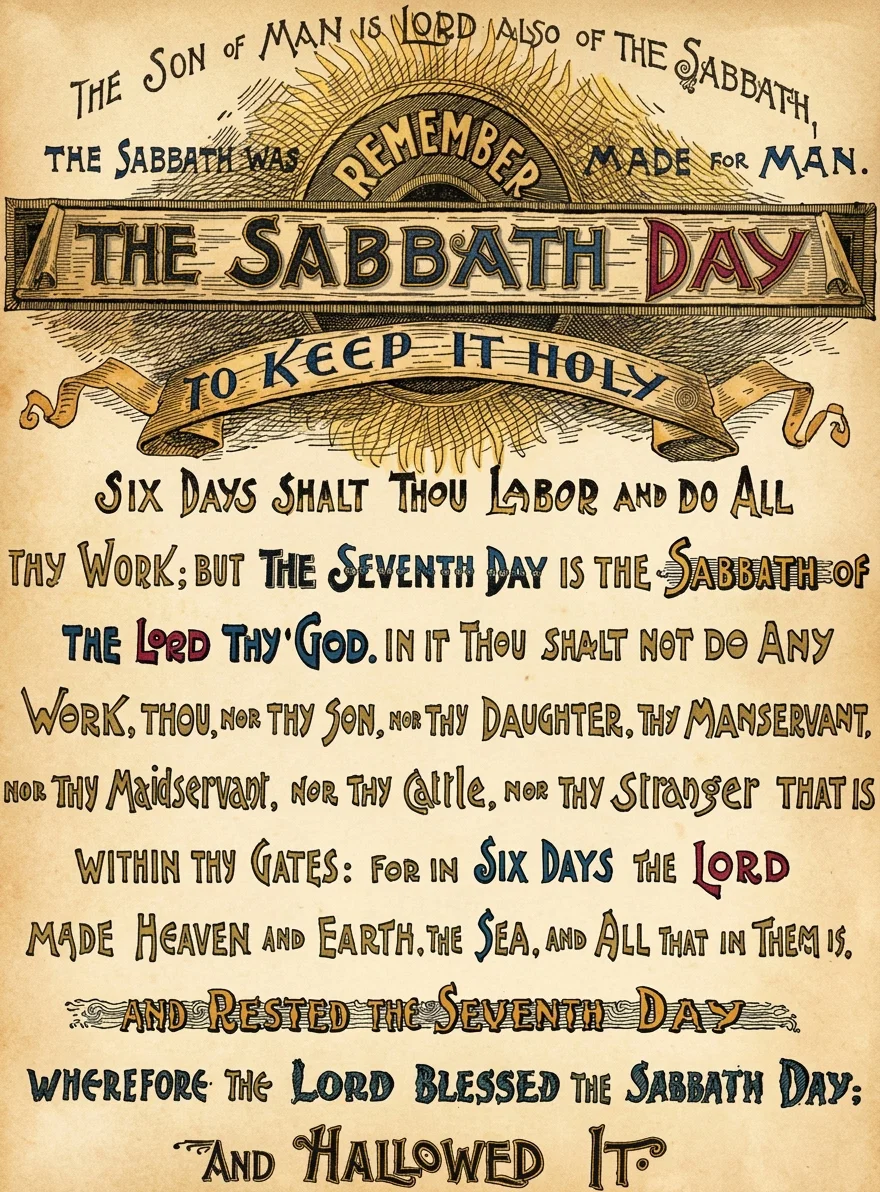
But in the fourth commandment we have the proof that our God is the true and living God. In it is the seal of his authority: “Remember the Sabbath day, to keep it holy. Six days shalt thou labor, and do all thy work; but the seventh day is the Sabbath of the Lord thy God; in it thou shalt not do any work, thou, nor thy son, nor thy daughter, thy manservant, nor thy maidservant, nor thy cattle, nor thy stranger that is within thy gates; for in six days the Lord made heaven and earth, the sea, and all that in them is, and rested the seventh day; wherefore the Lord blessed the Sabbath day, and hallowed it.” In the heavens, that declare the glory of their Maker,—the sun, shining in his strength, giving life and beauty to all created things; the moon, and the stars, the works of his hands,—we see the superiority of the God we worship. He is the God that “made the heavens and the earth.”
Great blessings are promised to those who place a high estimate upon the Sabbath, and realize the obligations resting upon them in regard to its observance: “If thou turn away thy foot from the Sabbath, from doing thy pleasure on my holy day; and call the Sabbath a delight, the holy of the Lord, honorable; and shalt honor him, not doing thine own ways, nor finding thine own pleasure, nor speaking thine own words; then shalt thou delight thyself in the Lord; and I will cause thee to ride upon the high places of the earth, and feed thee with the heritage of Jacob thy father; for the mouth of the Lord hath spoken it.”
Christ commanded his followers, “Search the Scriptures; for in them ye think ye have eternal life; and they are they which testify of me.” Peter exhorts us, “Sanctify the Lord God in your hearts; and be ready always to give an answer to every man that asketh youa reason of the hope that is in you with meekness and fear.” The earth itself is not more interlaced with golden veins and precious things than is the Word of God. It is the field of revelation, the storehouse of the unsearchable riches of Christ. The truths contained therein are as treasure hid in a field; the which when a man hath found, for joy thereof he goeth and selleth all that he hath, and buyeth that field, that he may search every part of it, and make himself master of its treasure.
That field is the Word of God; and it must be searched before its precious things can be brought to light. But by the grace of God, and the enlightenment of his Holy Spirit, we may make ourselves the possessors of its hidden treasure. Then let us search the Scriptures daily, as did the noble Bereans of Paul’s day, to find out if these things be so, and be willing to receive “with all readiness of mind” the pure Word of God.
MRS. E. G. WHITE.

JUSTIFICATION BY FAITH.

“THEREFORE being justified by faith, we have peace with God through our Lord Jesus Christ.” Rom. 5:1. A Biblical definition of faith is, “The substance [ground or confidence] of things hoped for, the evidence of things not seen.” Heb. 11:1. “So then faith cometh by hearing, and hearing by the Word of God.” Rom. 10:17.
The Word of God comes down to us well authenticated as a revelation from our heavenly Father. It is a letter from our very best Friend, containing His will, in which it is clearly demonstrated that He is especially interested in the weal and happiness of every created intelligence, and would have them to comply with all of the conditions stipulated in it, in order that God might be gracious to all mankind in translating them “into the kingdom of his dear Son,” making them “heirs of God, and joint-heirs with Christ.” Rom. 8:17. He would bring them “to an inheritance incorruptible, and undefiled, and that fadeth not away, reserved in heaven for you, who are kept by the power of God through faith unto salvation ready to be revealed in the last time.” 1 Peter 1:4, 5.
Our true standing and character is very prominently portrayed and delineated in this divine revelation, which plainly informs us that “we have all sinned, and come short of the glory of God” (Rom. 3:23), and have thereby subjected ourselves to the penalty of his law, which is death. “For the wages of sin is death.” Rom. 6:23. God, who is rich in infinite love and mercy, hath not left us to grope our way in darkness and misery, and then go down to eternal night. But he has provided a way for our escape through the gift of “his only-begotten Son, that whosoever believeth in him should not perish, but have everlasting life.” John 3:16. God gave his only-begotten Son to suffer and die in our stead, that we by accepting of him as our life and security and as our true, unfallen, spiritual, representative, should not come into condemnation of the law, but have life, joy, peace, and happiness here in this present world, and in the world to come the gift of eternal life, with a beautiful home, where never-withering flowers bloom perennially throughout the years of eternity.
There is but the one way for us to reach this ecstatic life in God, and that is through the righteousness of his dear Son. “Now we know that what things soever the law saith, it saith to them who are under the law; that every mouth may be stopped, and all the world may become guilty before God. Therefore by the deeds of the law there shall no flesh be justified in his sight; for by the law is the knowledge of sin. But now the righteousness of God without the law is manifested, being witnessed by the law and the prophets; even the righteousness of God which is by faith of Jesus Christ unto all and upon all them that believe; for there is no difference; for all have sinned, and come short of the glory of God; being justified freely by his grace through the redemption that is in Christ Jesus; whom God hath set forth to be a propitiation through faith in his blood, to declare his righteousness for the remission of sins that are past, through the forbearance of God; to declare, I say, at this time his righteousness; that he might be just, and the justifier of him which believeth in Jesus. Where is boasting then? It is excluded. By what law? of works? Nay; but by the law of faith. Therefore we conclude that a man is justified by faith without the deeds of the law.” Rom. 3:19-28. The apostle Paul continues by saying in verse 31, “Do we then make void the law through faith? God forbid; yea, we establish the law.” He recognizes the fact that “the law is holy, and the commandment holy, and just, and good.” Rom. 7:12. The law of God is a transcript of his character; it is a plain statement as to what he is and what he would have us to be. The commandments of God are his righteousness. Faith does not make void the righteousness of God, but always works in perfect harmony with it. It has been truthfully said by Elder E. J. Waggoner:—
All unrighteousness is sin, or the transgression of the law. The Gospel is God’s remedy for sin; its work, therefore, must be to bring men into harmony with the law, to cause the working of the righteous law to be manifested in their lives. But this is wholly a work of faith. The righteousness of God is revealed from faith to faith. Faith in the beginning, and faith in the end. As it is written, “The just shall live by faith.” Rom. 1:17. This has been true in all ages since the fall of man, and will be true until the saints of God have his name in their foreheads, and see him as he is.
“Christ is the end of the law for righteousness to every one that believeth.” No one who comes up to the end (or purpose) of the law finds in himself any redeeming qualities or virtues, but only the opposite, condemnation and death. But thanks be to God that Christ is entrenched there as our security. He was made sin for us, who knew no sin, that he might bring us back to God by being made a curse for us, dying in our place the death to which our own disobedience and transgression had subjected us.
When a conscientious, awakened man comes up to the end of the law, and sees nothing but death and eternal separation from God, then it is that he is enabled to look away from the violated law of God to Christ, by faith, as his life, security, and Redeemer, who has met his Father’s broken law and rendered complete satisfaction to it. When man is brought to see and realize this fact by faith he is ready and willing to comply with the conditions of the Gospel, “repentance toward God and faith in the Lord Jesus Christ,” ready to work out his own salvation with fear and trembling, knowing that it is God that worketh in him, both to will and to do of his good pleasure (Phil. 2:12, 13); glad to turn away from his sins and to turn to God with a true purpose of heart, laying down his puny arms of rebellion, surrendering all to his rightful Owner, who has purchased him with His own precious blood upon Calvary’s cross. Then it is that God meets his returning prodigal son out upon the way, accepting him in Christ Jesus, pardons and liberates him from the thraldom and bondage of sin, and brings him out from under the condemnation of the law, making him a new creature in Christ Jesus, perfectly free in the Lord as long as he does by faith the things contained in the law. Peace like the river of life, passing all understanding, flows through his heart, permeating his entire soul with the consciousness that he is at peace with God through our Lord Jesus Christ. Welcomed home to his Father’s house, adopted into the heavenly family, with the blessed assurance that his name is registered upon the fair pages of the Lamb’s book of life, he rejoices with “joy unspeakable and full of glory.” He then enjoys the blessed experience of the apostle Paul: “Who shall separate us from the love of Christ? shall tribulation, or distress, or persecution, or famine, or nakedness, or peril, or sword? . . . Nay, in all these things we are more than conquerors through him that loved us. For I am persuaded, that neither death, nor life, nor angels, nor principalities, nor powers, nor things present, nor things to come, nor height, nor depth, nor any other creature, shall be able to separate us from the love of God, which is in Christ Jesus our Lord.” Rom. 8:35-39.
JOHN E. MOORE.
Holdingford, Minn.

Jewish Customs and Traditions.

(By an Israelite.)

The Sanctuary and Its Services.—Continued.

THE boards of the sanctuary, as is illustrated in the cut below, formed the solid part of the structure. They were all of one length and breadth. There were forty-eight in number, forming the three sides of the building, as the entrance into the sanctuary was closed by a vail. The boards were all covered with gold, and were placed in an erect position. In each board were cut two tenons, that they might fit closely one into the other, and thus there be no friction. Each board rested in two silver sockets, thus giving to each a good foundation. There were also long bars made, part of which went the entire length of the building on each side, and some of them went part way only. The foundation upon which they stood was nothing of artificial make, but the earth which God formed. God himself made the foundation for his tabernacle.
What beautiful Gospel truths we learn from these materials! As we think of the boards all of the same length and all the same breadth, how forcibly it does remind us that God’s people are all to grow into the same height and stature as is He, the pattern. All to grow into Him, the living head. Not that some of them should be larger than others, but all were to be of the same stature in Christ. Not merely the physical height or stature, but to grow up into men and women of Christ Jesus. How beautifully this does represent his blessed church!
And then they were so arranged into each other that they all fitted beautifully. So the apostle, speaking of God’s building being erected, says, “In whom all the building fitly framed together groweth unto an holy temple in the Lord; in whom ye also are builded together for an habitation of God through the Spirit.” Eph. 2:21, 22. Evidently the apostle Paul must have had the placing of the boards together when he makes this statement, for how true it is that, as the boards back yonder were fitted in so closely together, all perfectly smooth, so God wants his church to be framed together, all passing along smoothly, without any friction of any kind, each one doing the work which God gave him to do; not harboring any feelings that some one is doing a given work that I might do, or doing more than I am able to do. Thus growing together, what a beautiful structure the temple of the living God does become!
We are advised by the great Counselor to buy of him “gold tried in the fire,” which is the faith that he gives. So the church is covered with the faith of him, that as he beholds them within, the Lord sees the beautiful faith of himself covering his people; and how gloriously they do appear in his sight thus! Faith is the gift of God; and he is the Author and Finisher of it. So when he imparts to his children his own faith, they then are covered with the gold which he has tried, and thus are all bright and shiny.
The boards resting in the sockets of silver declare unto us upon what our salvation rests. Silver is always referred to in the Bible as the redemptive value. Ex. 30:11–16. “Then was fulfilled that which was spoken by Jeremy the prophet, saying, And they took the thirty pieces of silver, the price of him that was valued, whom they of the children of Israel did value.” Matt. 27:9. The church of Christ rests on his merit, because of his redeeming value which he has secured for us. The foundation for the building was nothing artificial, it was one which the Lord himself provided. What a grand truth it teaches us, No man can lay other foundation than that which is laid, Christ Jesus! And ye are built upon the foundations of the apostles and prophets; Jesus Christ himself being the chief corner-stone. God himself laid the foundation for his church, and well could he say that the gates of hell shall not prevail against it. “Behold, I lay in Zion for a foundation a stone, a tried stone, a precious corner-stone, a sure foundation; he that believeth shall not make haste.” What a beautiful foundation to build upon! and it is not to be wondered that such a beautiful temple will be built, for God is doing the work from the laying of the foundation till the building is complete. The bars were used to bear the boards upon the shoulders of the Levites, and carry them from place to place. And this has ever been the work of the Master, as he declared to Israel, I have carried you about on eagles’ wings, and brought you unto myself. Yea, he bare them and carried them all the days of old.
Every board had its silver sockets, its tenons, and its share of the bar. So every Christian, a member of the church of Christ, depends on the Master for his redemption, is knit together with the members of the church, and is ever carried about by Him, the great Burden-bearer. Blessed privilege for such a life!
“Cast thy burden on the Lord; Lean thou only on His word: Ever will He be thy stay, Tho the heavens shall pass away.” F. C. Gilbert.

ASSURANCE

I am glad that the Saviour has given “The Comforter,” with me to stay Till He comes from the mansions in heaven, With His angels, to bear me away.
I know when I pray for a blessing His Spirit indited the prayer; And I feel, when to Him I am confessing, That angels are witnessing there.
I am sure all I ask He will give, And file my petitions above; If I walk in His ways while I live, I’ll be guided by wisdom and love.
Mrs. J. B. Goldsborough.

GOOD AS FAR AS IT GOES.

Hon. J. G. Elliott, member of the Assembly from Merced County, Cal., was the recipient of a number of letters urging him to vote for a general Sunday law. A letter in reply to one of these gives his position as follows:—
“SACRAMENTO, Feb. 17, 1897.
“MR. ——: Dear Sir: Your favor urging me to vote for a Sunday law is at hand. As there are a great many thoroughly conscientious religious people in this State who observe Saturday as their Sabbath, I don’t see how I can conscientiously vote for a law that would compel them to observe another day also. From a theological point of view those people have as much right to ask the Legislature to enact a law prohibiting all unnecessary secular labor, etc., on Saturday, their Sabbath. In the event that that should be done you and I, who believe in a proper observance of our sabbath, would have to observe our Sunday from a conscientious duty and also Saturday from a civil duty and thereby lose one day’s labor in seven. Do you think that would be just legislation? In my official acts affecting the rights of others, I try to put myself in their place. You remember the words of our Saviour, ‘All things whatsoever ye would that men should do to you, do ye even so to them.’
“Would a Sunday law cause people to be better? Can you be forced to like a person you dislike? These are kindred questions arising in my mind in considering this question, and I submit them to you for an answer. Sincerely yours,
“J. G. ELLIOTT.”
This is good as far as it goes, but it does not quite reach the bottom of the principle involved. The true principle of religious liberty involves the rights of all classes, whether they observe the first day, the seventh day, or no day. The Legislature is a civil body; it has no right to enforce Sunday observance even upon people who want to observe it, any more than upon them who do not so desire. It has no right to enforce the religious observance of any day upon any person, any more than it has a right to enforce baptism or the communion or the confessional. If the Legislature may enact Sabbath observance at all, it may with the same propriety enact all the Sabbath traditions of the scribes and Pharisees, to the minutest detail. One thing that the advocates of Sunday laws, as well as many men who oppose them, never take into consideration is, that men have the right, as far as man is concerned, to ignore all religion and all religious observances. No one can observe the Golden Rule without recognizing this fact. Many legislators have opposed Sunday laws solely because of the hardship imposed upon the observers of the seventh day. This is a good reason, but it does not reach far enough; to be a full recognition of civil rights, it must consider the imposition upon all classes. When a legislative body refrains from enacting a Sunday law only for the reason that it infringes upon the rights of one class, it virtually assumes that it is proper to infringe upon the rights of all other classes. It virtually assumes that people who do not keep any day should be made to do so. The Lord never compelled men to serve him, and never authorized any man or set of men to so compel others. If men do not choose to obey his law, he himself will judge them in the day when the secrets of all hearts shall be made known. He has not authorized man to judge or to punish such offenses. The civil government is set to regulate the civil affairs of men; to judge, and to punish if need be, the infringement of human rights, but not to enact laws authorizing and compelling such infringement. W. N. G.

HIS BAD BREATH HINDERED.

SOMETIMES those who are trying hard to do aggressive work for the Master have that work much hindered by some habit, or possibly by some physical infirmity.
Not long ago we were talking with a boy about his Sunday school and his teacher. His teacher, as we knew, was a very earnest, consecrated, whole-souled Christian worker, and we were surprised to hear the boy say he wanted very much to change teachers.
We questioned him as to his reasons, because we were naturally surprised that the boy should want to leave so excellent and so interesting a teacher, and he said in reply, “I like the teacher first-rate; he is good, he is always on hand, he comes to see me, and I know he is a very good man, but he always has such a bad breath that I can not stand it.”
Some things we can not help; but as Christian workers we certainly ought to try to be very careful in the care of our teeth and stomachs, if for no other reason than that those whom we are striving to lead to Christ will not be driven away by some unpleasantness that we could help, did we but give it proper care and attention.
Very likely there are other things that may be just as disagreeable in some of us as was this objection referred to by the boy, and something, too, that is liable to hinder a great many unless attention is given to the correction of such difficulties. If seeking after souls is our business we should be careful to make ourselves as presentable and agreeable as possible.—Union Gospel News.
Continue reading: NATIONAL DEBTS OF THE WORLD