“What will your mother say when she sees you, Louise?”
“It is not what she will say which troubles me most,” was the frank rejoinder as the girl glanced down at the pretty white dress, so fresh and dainty only an hour ago, but now limp and bedraggled from the shower which had been threatening ever since morning, and had at last caught both the girls half a mile from home.
Marjory Evans looked at her friend with some curiosity. Louise was wont to make queer remarks occasionally, but this struck her as being rather more peculiar than usual.
“My mother never nags,” Louise went on to say. “If I have done anything contrary to her wishes, she never says, ‘I told you so,’ or, ‘It serves you right,’ or any of those hateful reminders that make one feel as if one didn’t care, and often goad one on to saying so.”
“You don’t mean to say, Louise Moore, that your mother will not scold you when she sees that rain-soaked dress? I heard her advise you twice to take an umbrella. Why, my mother would talk about it for a week,” exclaimed Marjory, looking at her friend with astonishment.
“There is a difference in mothers,” was the quiet reply. “Mine believes in making me ‘work out my own salvation,’ as she calls it, from the wholesome lesson I have learned. Do you think I shall be likely to wear a clean white dress again when it looks showery, without taking an umbrella?” Louise turned her face toward Marjory as she spoke, and shook out the limp folds of her skirt, smiling ruefully.
“I think I see what you mean,” replied Marjory, critically. “Your mother prefers to have you do the scolding instead of her—silent scolding, of course. Come to think of it, it is more satisfactory to them. It saves lots of hard feelings, too. I wish my mother was that kind of woman.”
The girls had by this time reached the home of Louise; and Marjory was very willing to stop and dry her wet skirts, after being assured that Louise was in no danger of a reprimand. Besides, she was anxious to see a mother who could so control her desire to bring the full force of her indiscretion home to the mind of her daughter as to view the ruined daintiness of her attire without a word of blame.
As Louise stepped inside the door, her mother’s eyes rested for a moment upon her clinging drapery, and then she quietly suggested that it would be wise for her to change her clothes as soon as possible.
“I have laid out some dry clothing upon your bed,” she said, cheerfully assisting Louise to remove her hat.
Meanwhile Marjory had been given a seat beside the kitchen stove, with instructions to dry her wet feet until the shower should have passed over. Mrs. Moore talked to her pleasantly and cheerfully, without any embarrassing allusions to the unfortunate situation.
When Louise entered the room, a few minutes later, in clean, dry clothing, Marjory was puzzled by the expression upon her usually happy countenance. It was the grieved look of a child who has disobeyed and seeks forgiveness.
“I don’t believe I should like that if my mother were to receive me as cordially as Mrs. Moore has welcomed Louise, after I had got caught in a soaking rain, dressed out in finery which I had been advised not to wear, into the bargain. I guess Louise is right; mothers are not all alike,” her thoughts ran on.
Her surprise was greater, however, when Louise went up to her mother and wound an arm around her neck, saying, “It wasn’t your fault that I got wet, was it, Mumsie, dear?”
“No, daughter, our mistakes are generally our own fault; that is what makes their consequences often so hard to bear,” was the loving response as Mrs. Moore drew the encircling arm closer.
“She didn’t even reprove Louise, mama,” declared Marjory, an hour later, when she was relating the circumstance to her mother, after she had listened to the usual flow of words regarding her own carelessness.
“She must be a very indifferent mother,” was the disapproving answer. “If I were to adopt the same course with you, land knows what you would come to.”
Yet as Mrs. Evans noted the rebellious look which instantly settled upon her daughter’s face, she almost regretted that she had allowed her thoughts thus to express themselves.
“I’ve a mind to try Mrs. Moore’s plan sometime and see how it works. Marjory always was a child of strange ideas, and this strikes me as being about visionary enough to take her fancy,” Mrs. Evans reasoned with herself, as Marjory passed out of the room, the cloud still upon her brow.
Several days went by before Mrs. Evans had a chance to try her experiment. Marjory came home from school one afternoon with a long rent across the front of her dress—her best dress, too. Marjory had been set upon wearing it, as there were to be exercises of a patriotic nature at school that afternoon, and all the girls were going to “dress up,” she said. “I’ll be very careful of it, mama,” Marjory had urged. And her mother, remembering her resolve, had made no further opposition.
The clock upon the mantel ticked loudly, but its strokes could not deaden the steady thump, thump, thump of Marjory’s heart, as she stood waiting, with an expression of stoical indifference upon her face, for the tirade which she had every reason to expect would follow the first glance of her mother’s eye at the unsightly rent.
But as the moments passed, and her mother still continued to sew on, steadily, rapidly, and silently, she began to think that she might not have noticed her dress. Wishing to have the scolding over with as soon as possible, and unable longer to endure the painful silence, Marjory suddenly stepped up in front of her mother, and said, with an air of defiance: “I caught my dress on one of the desks and tore it, mama. What are you going to do to me?”
Mrs. Evans had been bracing herself for the moment which she, too, had been dreading. She had been so used to expressing herself in sharp, reproachful language, that it was with a great effort she forced herself to say quietly, as she viewed the ugly rent: “I don’t see that I can do anything except to mend it; but I am afraid I can not do it very neatly.”
A wave of color surged over Marjory’s expressive face as she impulsively burst forth: “You can’t tell how sorry I am, mama! I expected you would scold me, and I wasn’t going to care, but now—now—mama, I am sorrier than I can tell. I am ever so much sorrier than if you had scolded me.”
Marjory threw her arms around her mother and cried aloud.
“Is it possible that I have been the cause of all Marjory’s petulance and ill temper?” thought Mrs. Evans, as she gathered the sobbing girl into her arms and pressed kiss after kiss upon her tear-stained cheek.
“Mother has been all wrong, dear, but she has learned a lesson, and you have been her teacher,” she said, in an unsteady voice.
“What have I taught you, mama?” asked Marjory, lifting her head from her mother’s shoulder, with a puzzled expression upon her face.
“Patience and self-control, dear—two virtues which it is very difficult to acquire,” was the mother’s humble answer.—Helen M. Richardson, in The Congregationalist.
Eating Without Appetite
Food eaten without an appetite usually does more harm than good. If a child refuses food, he should not be urged; the cause should be found and corrected.
— Selected.
The British Union Conference
By Guy Bail
GUY BAIL
This year’s session of the British Union Conference was held August 2–11, in beautifully located Nottingham, on the Trent, a city of about two hundred and fifty thousand inhabitants. By the five hundred brethren and sisters present, this was declared to be the best meeting of the kind we ever had in the British Isles. The earnest words read to the laborers from God’s messenger, wrought repentance and a new consecration, so that they manifested a spirit of love and union, and their efforts to draw nearer to the Lord were rewarded by a great awakening among the people, scores of whom came forward during the forenoon services of the second Sabbath—some seeking God for the first time, others confessing their backslidings and renewing their covenant with him. In the afternoon, Brethren W. T. Bartlett (of London), R. Mussen (of Ireland), and D. P. Miller and A. E. Bacon (laboring in Scotland), were solemnly set apart to the gospel ministry by prayer and laying on of hands, God witnessing to their ordination by the presence of his Spirit. In the evening, twelve were baptized. The labors of Elders Prescott, Conradi, and Gilbert (who was present the last two days), as well as the help rendered by the workers of the British Union, were appreciated by the people, and proved very beneficial to all.
Special efforts were put forth for the young people and children, and meetings were held also for the parents. The health meetings served to deepen the interest felt in the health reform movement. The business sessions were neither dry nor lacking in interest, for the reports from the field and of our institutions showed that God’s hand is in the work.
As would naturally be expected, one of the leading topics to come up for careful consideration was the building up of our union institutions, now located at Stanborough Park, near Watford, where we secured fifty-five acres of beautiful land the latter part of last year. It was decided that the publishing house and the health food factory be moved here the latter part of August, and that the school also be transferred from London to the buildings that were on the estate when we secured it.
Plans were laid for the collection of much-needed funds to assist in perfecting the arrangements necessary to make Stanborough Park the training center it ought to be for our young people in Great Britain. First, five thousand copies of “Christ’s Object Lessons” are to be sold by the end of 1907, the entire proceeds of which, beyond the cost of manufacture, will be devoted to the erection of a building for the college. Second, it was voted that ten thousand copies of “Ministry of Healing” be issued as soon as possible after the first of next January, and that, in behalf of our institutions, our British brethren undertake to sell the entire edition within a year after its publication. It was recommended that each field supply the average of one pound for each member (which all have undertaken to raise) as soon as it can be collected, to assist in erecting and equipping the institutions at Stanborough Park. Further, as there are many worthy young people who are financially unable to advance the money necessary for their education, it was strongly urged that our brethren contribute liberally to the Stanborough Park Missionary College Educational Fund. Over three hundred and ninety dollars was raised for this purpose on the grounds. A special effort is being made to secure promising young men and women to enter the school, that they may be fitted to become workers together with God; but as only a limited number can support themselves in our institutions and by canvassing and laboring in the districts surrounding Stanborough Park, the creation and maintenance of such a fund is imperative.
Great Britain has always done well in the circulation of literature. Last year they had about one hundred and seventy book and paper agents in the field, and the retail value of their sales was about $74,000. The circulation of their Present Truth averaged 23,000 copies weekly; 150,000 copies of the Our Day series of “Sunday, or Notes on the National Campaign,” were sold; the circulation of their Good Health is 45,000 monthly. An effort is now to be made to secure still more and better-trained canvassers; for there are still many counties in Great Britain that are not being worked by our agents, and it is conceded that the canvassing department is one of the best pioneer agencies we have in this field. It was also voted that immediate steps be taken to provide literature for the more than one million Welsh-speaking people in the British Union; moreover, a young man has been selected who is to master this language, that he may give his whole time to work among the Welsh people.
The Caterham Sanitarium has graduated its first class of nurses, and a new class of fourteen has been accepted on trial. Since the Drs. Richards were called from Leicester, our sanitarium in that city has been operated under the Caterham Sanitarium management. The health institution formerly in Belfast has been transferred to Rostrevor, where it is located on a beautiful estate of one hundred and thirty acres, overlooking Carlingford Loch from an elevation of about four hundred feet above the sea. Suitable young people are being sought out to take the proper training in the sanitariums to enable them to become successful medical missionary nurses. Good Health Leagues are still being conducted for the good of the people; and the suggestion that studies be prepared on health topics for the use of our churches will be carried out to the benefit of all. The circulation of the Good Health published in Great Britain will also doubtless be increased the coming year, for it has a distinct part to act in spreading abroad the principles God has given us upon the subject of healthful living.
The British East African Mission has been reinforced by the addition of Brother and Sister Baker and Sister Thompson, who sailed from London June 8, and are doubtless on the ground now. For the nominal sum of about two hundred and forty-four dollars the mission secured three hundred and twenty acres of good land about twenty-five miles from Kisumu, on Kavarondo Bay. The spirit of the meeting is well expressed in the following preamble and resolution:—
“Whereas, By the good hand of our God upon us, the workers in British East Africa have been guided to a favorable site for the establishment of our mission in that country, and have been preserved in health and strength; therefore,—
“Resolved, That this union conference gratefully acknowledge the divine blessing that has rested upon this our first foreign missionary enterprise, and that we pledge ourselves faithfully to support the workers whom we have sent to that difficult and dangerous field, not only with our regular and liberal offerings, and by doing what we can to sell ‘The Story of Joseph,’ in aid of the mission, but also with our sympathy and prayers.”
It was voted to recommend the organization of Young People’s Societies, wherever this is possible, for study and for Christian effort, and that the Youth’s Instructor be suggested to them as a helpful agency in the development of such Societies. Beginning with Jan. 1, 1908, the funds of the British Union Conference will consist of the tithe of the tithe of the local conferences; whereas the Sabbath-school, weekly, and annual offerings will be forwarded to the European subtreasury of the General Conference, in harmony with the recommendations of the Gland meeting. As Brother W. H. Wakeham is to enter the school, Brother W. H. Meredith, of Wales, will take his place as president of the South England Conference, and Brother H. E. Armstrong, of the North England Conference Committee, will become superintendent of the Welsh Mission.
The president of the British Union stated that at the close of 1906 their membership was 1,727 (309 having been received during the year), and that there were 70 book and 100 paper agents, and 64 conference workers in the field; that14the tithe had been $23,194.60, an increase of $3,420 over 1905; the average tithe per capita for 1905 had been $12.96, while for 1906 it was $13.36; the average amount of offerings per member in 1905 was $1.37½; in 1906, $2.06½.
Credentials were granted to E. E. Andross, H. C. Lacey, A. A. Carscallen; ordination and credentials to W. T. Bartlett, R. Mussen, D. P. Miller, A. E. Bacon; ministerial licenses to M. E. Olsen, S. Joyce, A. B. Olsen; missionary licenses to J. D. Baker, Mrs. J. D. Baker.
The report of the nominating committee, unanimously accepted, read as follows:—
President, E. E. Andross; Vice-President, W. H. Wakeham; Secretary and Treasurer, S. S. Barnard; Sabbath-school and Young People’s Society Secretary, W. H. Wakeham; Auditor, J. Howarth; General Canvassing Agent, S. Joyce. Committee: Presidents of the North and South England Conferences, and of the Scotch, Irish, and Welsh Missions; and W. C. Sisley, H. C. Lacey, Dr. A. B. Olsen, W. T. Bartlett. Auditing Committee (in addition to the members of the British Union Committee): G. Hawkins, E. Armstrong, Sr., S. Joyce, D. E. Piednue.
That God’s blessing may be with all the workers in the field, and with every member in the church, and especially with the institutions we are seeking to erect at Stanborough Park, is the sincere prayer of all who were at the meeting.
Nottingham, England.
The Selamlik
By Claude D. Ac Moody
CLAUDE D. AC MOODY
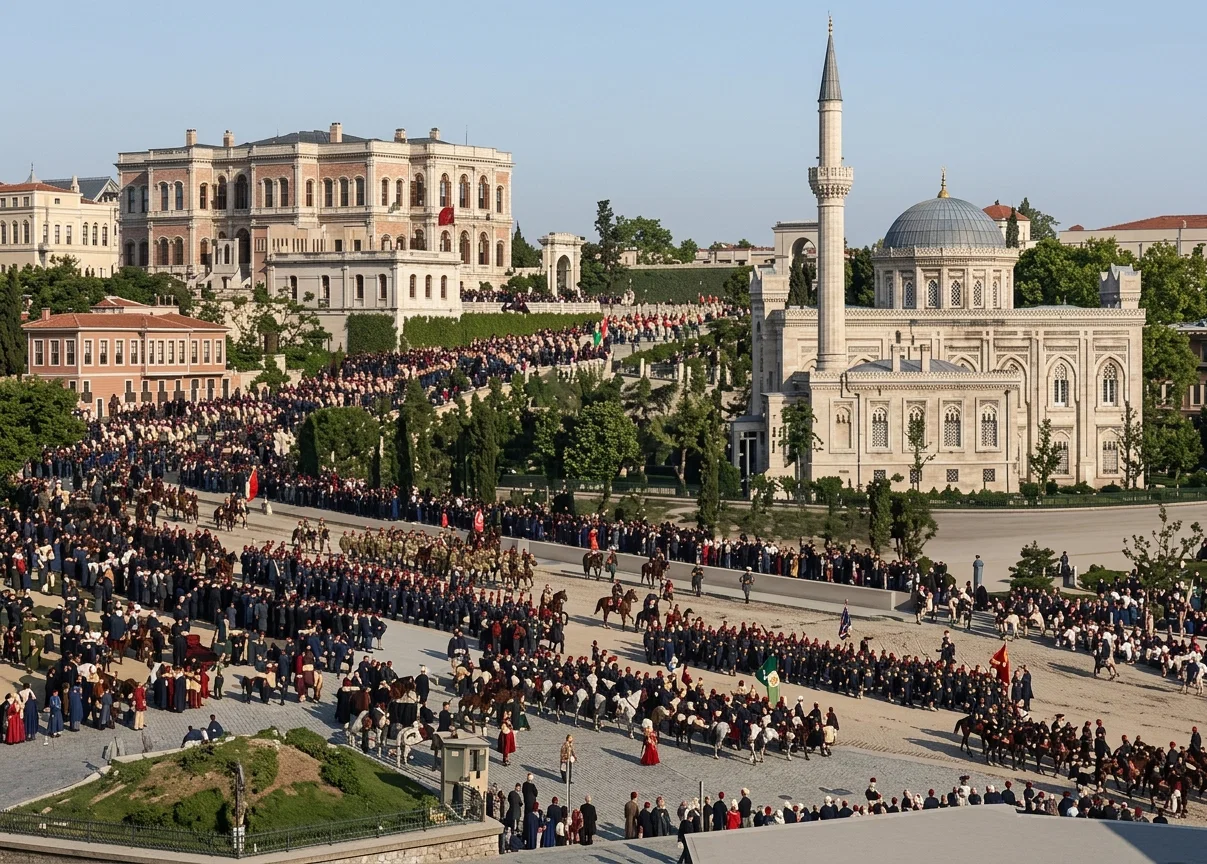
THE term Selamlik is applied to the appearance of the sultan of Turkey in state every Friday, as he attends worship at the Hamidieh Mosque. This is strictly a court ceremony. Accordingly, no one can attend Selamlik except the high officers of the Turkish government, the ambassadors of foreign countries and their families, and such foreigners as are able to secure special permission through their respective embassies. In the early spring, the writer, in company with Dr. A. J. Hoenes, who was at the time spending a few days in Constantinople, on a trip through the Orient, secured permission, through our American embassy, to attend this state function. The impression received upon that occasion, together with the information obtained since, has prompted me to give to the readers of the REVIEW a brief account of some things that have been of great interest to me, and some of the lessons that I have drawn from them.
The ceremony is attended with all the pomp and ostentation characteristic of Oriental custom. The palace and spacious gardens of the sultan, the Hamidieh Mosque, and the drive from the palace to the mosque, are surrounded by a great turnout of the infantry and cavalry of Turkey. Each main division of cavalry and infantry has a band, and a continuous round of music is kept in progress from the time the divisions leave their various quarters in different parts of the city until the ceremony is over.
The foreigners who have secured permission to attend start from the headquarters of their respective embassies, in company with an attendant from the embassy. From the American embassy to the Hamidieh Mosque is a delightful drive of about forty-five minutes.
The names of all the applicants at the various foreign embassies are telegraphed to the sultan’s palace, and then a reply is telegraphed back, notifying whether their applications are accepted.
The palace is very strict about this, since the bomb-throwing about two years ago.
A VIEW OF THE SELAMLIK
The building to the right with the minaret is the Hamidieh Mosque, where the sultan worships every Friday. The large building to the left is the sultan's palace.
The admitted spectators view the procession of the sultan to the mosque from the Imperial Pavilion, which is before the Yildiz Kiosk, or summer palace. A kiosk is a Turkish summer house. Yildiz is the Turkish word for star. But as the emblem of the Moslem empire is “the star and crescent,” this term is sometimes applied to it, also. The full Turkish word, however, for the crescent coat-of-arms is ay-ile-yildiz, meaning literally, “the moon with the star;” hence, the Yildiz Kiosk, or house of the star and crescent.
As the companies from the various legations arrive at the Imperial Pavilion, their cards are passed in to one who has a list of the names that have been accepted. From this pavilion a most excellent view is obtained of the vast military display, of the Hamidieh Mosque, of the arched entrance to the main palace grounds, and of the way over which the sultan passes.
We arrived fully forty-five minutes before the procession to the mosque. During this time additional companies of infantry and cavalry kept putting in appearance, until every rod by which their chief was to pass was heavily guarded. Every few minutes some pasha or high military officer would arrive within the guarded space, with gorgeously liveried coachman and footmen.
Amid all this, one of the first things to attract my attention was many small piles of gravel in the way over which we were expecting the sultan to pass at any moment. Many workmen appeared presently, and scattered this gravel evenly and smoothly over all the “royal way,” and much more was brought by one-horse carts. This took considerable time. It was most thoroughly and carefully done, though the way was already well paved, much like the macadamized streets in America.
Soon a priest, having ascended the high spiral minaret of the mosque, stepped out upon the narrow gallery near its top, and began to call. The hour of prayer had come. This call to prayer, chanted forth in Arabic by the Oriental tongue, conveys a sound to the ear, yea, a feeling to the soul, that tells one he is in the East; that he is among the worshipers of the Arabian prophet.
Preceding the procession of the sultan, and while the workmen were performing the finishing touches of their gravel-spreading, several closed cabs passed, bearing some of his majesty’s wives from the imperial harem. Through the glass in the cab doors a glimpse of the occupants could be obtained. These ladies were richly dressed, their faces covered with white veils. In some cases their children accompanied them. One sultan is said to have had one hundred and fifteen children.
At last the sultan appears, surrounded by a heavy guard of mounted soldiers, before, behind, and on either side. Oriental matting and rugs are laid down from the carriage to the entrance of the mosque. The prayer service lasts only about twenty minutes. Then comes the return procession. The sultan does not return in the same carriage in which he goes to worship, but in a single-seat15vehicle, driving his own horses. This is to indicate that he holds the reins of government in his hands, and that he receives this reigning power from Mohammed.
This over, our carriages soon appeared. The bands were engaged in a vigorous rendering of the Ohmedieh march, the Turkish national air; and the companies of infantry and cavalry began their march to their respective headquarters, and we were off upon our pleasant return drive to the American embassy.
A strong impression was left upon me. How great a contrast, indeed, between the apparent glory and power signified by this great display and the real strength of the “sick man of the East”—the Ottoman empire in its weakened condition!
Selamlik comes from selam and the Turkish terminal lik. Selam means peace, and is the common Turkish salutation; and when thus spoken signifies, “Peace to you.” Lik denotes the abstract essential quality or function of the thing named; hence, selamlik, or peacefulness, the possession of peace, or the foundation of peace. Now selam contains the consonantal radicals in Arabic corresponding to the Hebrew radicals in the Hebrew word salem, the only real difference being in the placing of the vowels in pronunciation. The Hebrew word salem means peace; and Melchisedec is called “King of Salem,” or “King of Peace,” in Heb. 7: 1, 2. Again, Jerusalem, or Yerusalem, means “abode of peace.” Altogether, the comparison of Selamlik and Jerusalem shows a striking similarity in the meaning which each may convey.
Now in view of the prophecy of Daniel 11 and 12, which shows us that we are living in the days when “he [Turkey] shall plant the tabernacles of his palace between the seas in the glorious holy mountain [Jerusalem],” and in view of the fact that the Moslems themselves believe in the early removal of the Ottoman seat of government, the foregoing similarity of terms possesses an interesting degree of significance.
The third angel’s message in the hearts and hands of those who are the ambassadors of Jesus Christ is “preparing the way” of the only King of Peace—the King of kings, and Lord of lords. The angel of Revelation 10 has ascended the great prophetic “minaret,” and since 1844 has been heralding, “Time shall be no longer.” And in these recent years this has been especially emphasized under the construction, “There shall be delay no longer,” expressed in what has come to be our watchword and banner—“The advent message to all the world in this generation.” And Isaiah proclaims: “Prepare ye the way of the Lord, make straight in the desert a highway for our God. Every valley shall be exalted, and every mountain and hill shall be made low: and the crooked shall be made straight, and the rough places plain.” As I witnessed the thorough preparation of the way over which an earthly king passed, I longed to see the way of our heavenly King being prepared more rapidly in these great Eastern lands. His way passes through all nations and climes.
The preparation of the way of our God is the carrying of the third angel’s message to the world, to separate from earth’s millions those who desire not only to witness, but to unite in the great triumphal procession of King Jesus. All who attend must first have their names sent to the sanctuary in heaven, and be accepted there. The condition of acceptance is perfect loyalty to the King and kingdom, that no more outbursts of rebellion shall ever mar the peace of our King’s dominions. And “we are ambassadors for Christ,” who should beseech an entrance into Christ’s kingdom for those now in darkness.
There is time still for names to be sent beforehand to the sanctuary. Soon mercy’s door will be forever closed. Soon the last name of those who with joy shall attend, yea, in this case join, the procession heavenward, will have been accepted. Let us hasten the preparation of the way of our King! The door of mercy is open against time; for the time of our King is at hand.
Words are weak to express my feelings as these truths were reinforced in their meaning to me, through the event herein described. “Young people, to the front” for the fields of the East—fields laden with history, indeed; but how shall we relate ourselves to their future?
Constantinople, Turkey.
H. H. VOTAW
By H. H. VOTAW
Burma
H. H. VOTAW
LAST week I wrote, telling of the good opening here for a lady dentist. Since then I have been talking to some acquaintances, people who have lived here for years, and the opening seems more urgent than ever. One man said, “I would not be afraid to guarantee a good living to the one who comes.”
There are in Rangoon thousands of emigrants from India. Some of these are very wealthy and progressive. Yet their old customs bind them, and the women are not allowed to be looked in the face by any strange man—in fact, by none but the nearest relatives. Among this class of women there is an opportunity for a lady dentist to make a good living with very few hours of work each day. And then she could devote her remaining time to evangelical work. Her profession would open the way for such a work with many.
Our work is most encouraging. Sister Ruoff has been making a good living ever since she came. Within three days after her arrival she had a patient, and has had all the work she cared to do since. Just now she is ill, but is better than she was, and I think will be all right soon.
Dr. Oberholtzer is now located in Moulmein, and the outlook is encouraging. She is getting her house fixed so that she can give some simple treatments, and the patients are beginning to come. It seems that she will soon be able to more than pay her way.
Miss Jewett and Miss King have been canvassing here for about two and one-half months, and have taken about seven hundred orders for the Oriental Watchman and Good Health. This is in addition to the books which they have sold.
Mrs. Votaw and I have sold a number of books, and taken some subscriptions for our papers. Every English-reading family in Burma has the REVIEW.
In the first five months of this year, our tithe from our believers (not including the workers) has exceeded all that we had the last year. We have been able to raise enough monthly to meet all our current expenses in connection with our meeting-hall, rents, lights, etc. Now we are able to turn all our Sabbath-school donations into the treasury. These donations and our tithe are almost sufficient to meet the salary of our two native workers. All this indicates a healthy growth, and we are thankful to God. We fully expect that by the close of this year there will still be a substantial increase.
One of our brethren who was recently baptized is just taking up the canvassing work, resigning a good position to do this. He will finish the territory that the sisters were obliged to leave because of the rains. After he has finished the territory with the papers, he will take up the book work.
Burma and India have both been subjugated by the British, and, in consequence, are one politically. But in religion, race, social institutions, Burma is as distinct from India as is China. In reality, the Burmese are much more like the Chinese than like the Indians. And Burma will be the most fruitful province in the Indian empire for our work, if we may judge at all by present indications.
Rangoon,
Divine Providence and Human Plans
God often directs the movements of his servants in ways to us very mysterious, and known only unto himself. Robert Morrison, the great pioneer missionary to China, planned to go to Africa. David Livingstone wanted to go to China, but God sent him to Africa. Truly, “there is a divinity that shapes our ends.” Solemn, sedate Robert Morrison never could have won the love of the emotional Africans as Livingstone did; and Livingstone, the active worker, who hated book-making, never could have sat cooped up twelve hours a day, translating the Scriptures into that difficult Chinese tongue. Rebekah was anxious that her favorite son should get the coveted blessing, and interfered with the fine touch of the Infinite in shaping the events and destinies of her boys. But in the crossed arms of Jacob himself upon his death-bed, with his hands placed upon the heads of Joseph’s two sons, we have a fitting illustration of how our great God makes no mistakes when human plans and schemes are presumptuously thrust athwart the pathway of his providences.
The First Church Organized in Sierra Leone, West Africa
By L. W. Browne
NEVER before have the workers in this part of the Lord's vineyard realized the significance and importance of organization as we do at the present time. Unity is strength. And as it was in the experience of the children of a dying parent, whose individual efforts proved futile to break a bundle of sticks that had been given to each one for trial, but which was easily broken when separated into single sticks; so it is with the church of God to-day: when firmly and fully united, it is impossible for Satan and his host to make an inroad among the people of God; but when they are divided, his work is readily accomplished.
With such thoughts in mind, the necessity of organizing a church in Sierra Leone was discussed for several weeks, and Sabbath, July 20, was appointed as the day on which it should take place. It was a bright, sunny morning (although this is the rainy season), and quite a favorable day for those who lived at some distance from the place of worship. There was a good attendance, including those who had given their names for organization, as well as other interested persons.
Elder Babcock spoke impressively of the benefits of organization, and of the duties that devolved upon the related members of an organized body. The fundamental principles of our faith were presented, and special mention was made of the use of tobacco and pepper, which are a desideratum with the people here. The same reasons that Brother Anderson has given to show the necessity of instructing the Chinese on these points of healthful living before acceptance into church fellowship apply in West Africa. From the time that a babe is three months old, pepper is given to it. Thus the foundation is laid for narcotics and alcoholic beverages. But great patience must be manifested in their cases, if we would follow the example of our Saviour; for it was said of him: “A bruised reed shall he not break,” and smoking flax shall he not quench.”
As points of interest were touched, “Amen” was heard from different ones, thus signifying their desire to comply with the principles presented.
Object-lessons are helpful in teaching lessons of importance; and as the figure of a building was drawn on the blackboard, and the use of each post, sleeper, and beam pointed out, as they are related to one another in the building, also their failure to stand alone and be useful when separated from one another, all could see the necessity of being at least a sleeper (an active one) in the Lord's great building. The third chapter of First Corinthians was studied in connection with this thought.
At the close of the discourse, organization was duly attended to, and twenty persons entered into the bond of Christian fellowship and concord. Seven of these were accepted subject to baptism, which was arranged to be administered on the following day. The election of officers was also postponed for the next day.
On Sunday morning quite a goodly number assembled at a clear, crystal stream called George's Brook. As we joined in singing, “O now I see the crimson wave,” a spirit of solemnity settled over the company, which remained until we left the brook. No disturbance was made by the onlookers, the very best of behavior being exhibited. Six of the seven baptized are young men who have expressed a desire to work for the Master. We expect great things from them.
Service was held after the necessary changes of clothing were made, and again the subject of organization was presented. Organize to become active missionaries, was the key-note of the meeting. Officers were elected, their duties pointed out, and thus closed the experience of a never-to-be-forgotten occasion. We all felt revived, and resolved to consecrate our lives to the Lord more fully than ever before. Ethiopia is stretching forth her hand to God. Pray that she may find him speedily.
L. W. BROWNE.
New York City
By L. Zecchetto
Since last November, when our little Italian church of eleven members was organized, five others have been added to the church, and quite a number are now keeping the Sabbath, and are getting ready to unite with the little company.
One evening two months ago, while I was giving Bible readings to two young men, the pastor of the church to which they belonged walked in, and told me that he wanted to know the company they were in, and asked if he would be allowed to participate in the meeting. I answered that nothing would give me more pleasure than having him join us. After a season of prayer, I asked what subject they desired to study. The minister answered, “Let us have the Sabbath, by all means, for if you are right, I want to know it; and if you are wrong, I desire these young men to know it.” So, with the help of God, I endeavored to present the Sabbath question in the best way I could. At the close, I asked him if he had any questions to ask. He answered, with tears in his eyes, that he had none; that the only thing left for him to do was, with the help of God, to keep God’s Sabbath day, and he desired to have two studies every week thereafter. After several studies, he confessed that we were right, and said it was his desire to join us. I hope that every reader of this article will especially remember this brother in prayer.
Our hall meetings are much improved since Brother Calderone, an ex-Catholic priest, is helping me in holding open-air meetings outside the hall, one-half hour before the regular meeting begins.
The greatest enemies we have to contend with in New York are the Italian Protestant ministers and missionaries, who have combined their forces to close up our work. They have gone so far as to employ the police authorities to stop us, but I am glad to say that their efforts were without result.
We feel greatly blessed in being able to start an Italian sixteen-page paper published monthly, bearing the third angel’s message. We feel confident that this paper will be a great light-bearer. If all who read this will subscribe for the paper and put it in the hands of some Italian, they will be doing a good work for the advancement of the cause among this people. Order through the Review and Herald Office, 32 Union Square East, New York City, or send to the writer, 590 Fifth Ave., New York City.
Another encouraging feature in God’s work here among the Italians is that Brother C. Giraldi, an ex-minister in the Methodist denomination, has just completed the translation of the book “Bible Readings for the Home Circle,” in the Italian language. I trust that this book will be a great help to the Italian people.
I hope that every reader will remember in his prayers the Italian work in this great metropolis, where there are so many thousands who have never heard the message.