Review and Herald, Vol. 92, No. 45.

The Papacy in Prophecy
Earlier text: The Papacy in Prophecy
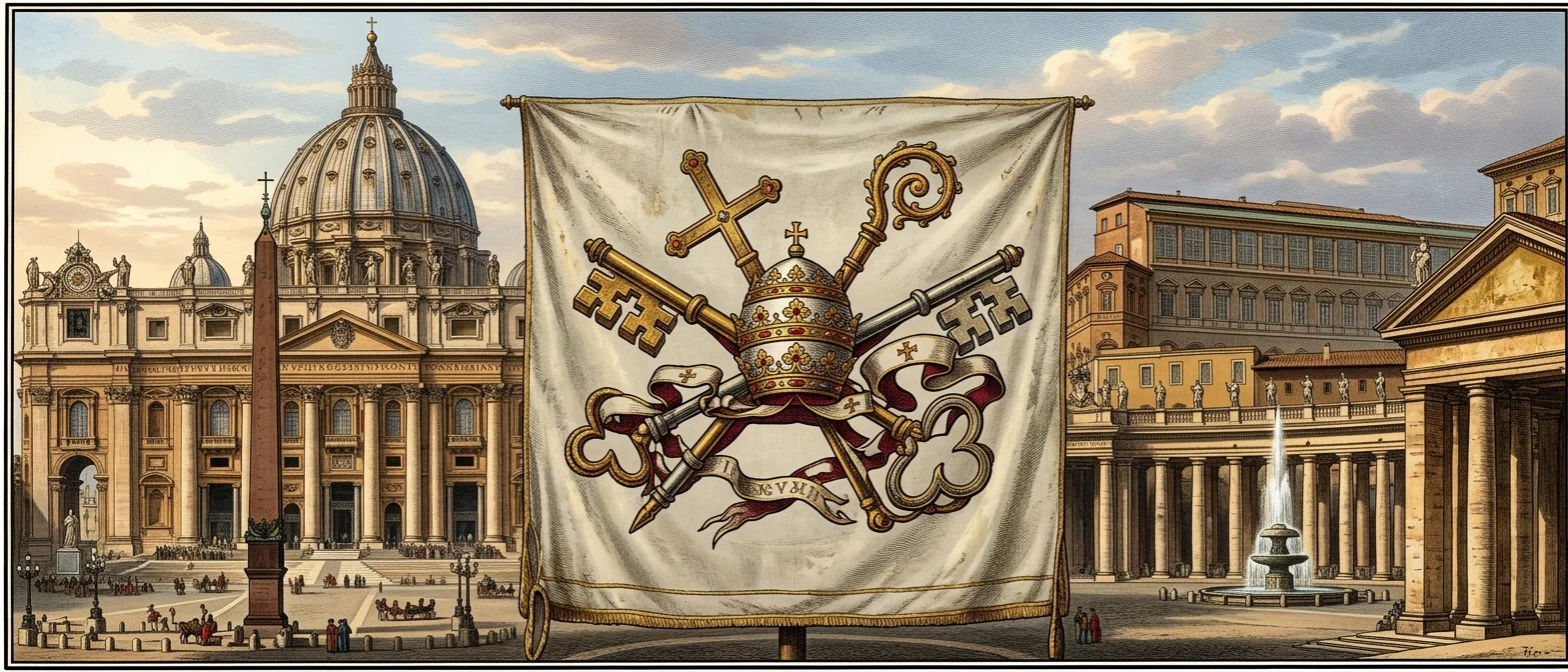
THE PAPAL COAT OF ARMS

The Little Horn of the Eighth Chapter of Daniel

A Bible Study

The Vicar of Christ

1. WHAT appeared to Daniel in 538 B. C., the same year in which Babylon fell? “In the third year of the reign of King Belshazzar a vision appeared unto me, even unto me Daniel, after that which appeared unto me at the first.” Dan. 8:1.
2. Where was Daniel at this time? “And I saw in a vision; and it came to pass, when I saw, that I was at Shushan in the palace, which is in the province of Elam; and I saw in a vision, and I was by the river of Ulai.” Verse 2.
3. What first attracted the prophet’s attention? “Then I lifted up mine eyes, and saw, and, behold, there stood before the river a ram which had two horns: and the two horns were high; but one was higher than the other, and the higher came up last.” Verse 3.
4. What power was represented by the ram having two horns? “The ram which thou sawest having two horns are the kings of Media and Persia.” Verse 20.
5. How are the rise and work of this power described? “I saw the ram pushing westward, and northward, and southward; so that no beasts might stand before him, neither was there any that could deliver out of his hand; but he did according to his will, and became great.” Verse 4.
6. What symbol was next introduced in the vision? “And as I was considering, behold, an he goat came from the west on the face of the whole earth, and touched not the ground: and the goat had a notable horn between his eyes.” Verse 5.
7. What did the goat with the notable horn represent? “And the rough goat is the king of Grecia: and the great horn that is between his eyes is the first king.” Verse 21.
8. How was the conquest of Medo-Persia by Grecia foretold in this symbolic prophecy? “And I saw him come close unto the ram, and he was moved with choler against him, and ran unto the ram, and brake his two horns: and there was no power in the ram to stand before him, but he cast him down to the ground, and stamped upon him: and there was none that could deliver the ram out of his hand.” Verse 7.
9. When the he goat “was strong,” what occurred? “Therefore the he goat waxed very great: and when he was strong, the great horn was broken; and for it came up four notable ones toward the four winds of heaven.” Verse 8.
10. What was represented by “the great horn,” and what followed when it was broken? “And the rough goat is the king [kingdom] of Grecia: and the great horn that is between his eyes is the first king. Now that being broken, whereas four stood up for it, four kingdoms shall stand up out of the nation, but not in his power.” Verses 21, 22.
NOTES.—From the interpretation given, it is plain that the notable “horn” upon the he goat represented Alexander the Great, who led the Grecian forces in their conquest of Medo-Persia. Upon the death of Alexander at Babylon, 323 B. C., there followed a brief period of confusion in the struggle for the kingdom, but the succession was definitely determined by the Battle of Ipsus, —Cassander, Lysimachus, Ptolemy, and Seleucus,—became his successors.
“The vast empire created by Alexander’s unparalleled conquests was distracted by the wranglings and wars of his successors, and before the close of the fourth century before Christ, had become broken up into many fragments. Besides minor states, four well-defined and important monarchies arose out of the ruins. Their rulers were Lysimachus, Cassander, Seleucus Nicator, and Ptolemy, who had each assumed the title of king. The great horn was broken; and instead of it came up four notable ones toward the four winds of heaven.”—Myers’s “History of Greece,” page 457, edition 1902.
11. What came out of one of the four horns of the goat? “And out of one of them came forth a little horn, which waxed exceeding great, toward the south, and toward the east, and toward the pleasant land.” Verse 9.
12. What interpretation is given of this little horn? “And in the latter time of their kingdom, when the transgressors are come to the full, a king of fierce countenance, and understanding dark sentences, shall stand up.” Verse 23.
13. What did this little horn do to the people of God? “And it waxed great, even to the host of heaven; and it cast down some of the host and of the stars to the ground, and stamped upon them.” Verse 10.
14. In what literal language is this persecution of the people of God further described? “And his power shall be mighty, but not by his own power: and he shall destroy wonderfully, and shall prosper, and practice, and shall destroy the mighty and the holy people.” Verse 24.
15. How was this little horn to exalt itself against Christ? “Yea, it magnified itself, even to the Prince of the host; and it took away from him the continual burnt offering, and the place of his sanctuary was cast down.” Verse 11, R. V.
16. In the interpretation of the vision, how is this self-exaltation set forth? “And through his policy also he shall cause craft to prosper in his hand; and he shall magnify himself in his heart, and by peace shall destroy many: he shall also stand up against the Prince of princes; but he shall be broken without hand.” Verse 25.
17. What similar language is used by the apostle Paul in describing the “mystery of iniquity,” or “man of sin”? “That day shall not come, except there come a falling away first, and that man of sin be revealed, the son of perdition; who opposeth and exalteth himself above all that is called God, or that is worshiped; so that he as God sitteth in the temple of God, showing himself that he is God.” 2 Thess. 2:3, 4.
NOTES.—The last two scriptures evidently describe one and the same power,—a power which, while professedly Christian, is anti-christian in spirit, and the very “man of sin” himself. Possessed with the selfish ambition of Lucifer (Isa. 14:12-14; Eze. 28:17), he assumes to occupy the very seat and place of Deity in the temple of God. Professing to be Christ’s vicar or personal representative on earth, he magnifies himself against Christ, and “stands up” (or reigns) in the place of, and “against,” the Prince of princes.
18. What was given into the hands of the power represented by the little horn? “And the host was given over to it together with the continual burnt offering through transgression.” Dan. 8:12, first clause, R. V.
19. What did this power do to the truth? “And it cast down truth to the ground, and it did its pleasure and prospered.” Same verse, last clause, R. V.
NOTES.—The interpretation already given to this vision shows plainly that the power represented by the little horn is the successor of Medo-Persia and Grecia. In the vision of the seventh chapter of Daniel, which is closely related to this vision, the fourth beast represented the fourth kingdom, or Rome, in its entirety, special attention, however, being given to the “little horn,” or papal phase, of its history. As shown by the work attributed to it, this little horn, which arose among the ten kingdoms into which Rome was divided, was to be a religio-political power, which was to change the times and law of God, and persecute the people of God. In the vision of the eighth chapter the ecclesiastical features of this fourth world power are especially noted and emphasized, and hence the only symbol there used to represent it is the “little horn” which waxed “exceeding great.”
The religion of all the four great monarchies mentioned in these prophecies was paganism; but the paganism of ancient Babylon was reproduced in pagan Rome, and then adapted and adopted by papal Rome. The little horn of the eighth chapter represents Rome, both pagan and papal, in its ecclesiastical aspect, with its union of paganism—and later of apostate Christianity—and the secular power, with its anti-christian persecution of the saints of God, with its perversion of the priesthood of Christ, and with its assertion of both temporal and spiritual power over all the world. It is evident that pagan Rome is introduced into this prophecy chiefly as a means of locating the place and work of papal Rome, and the ecclesiastical features of pagan Rome as typical of the same features accentuated in papal Rome, and that the emphasis is to be placed upon the fulfillment of prophecy in the work of papal Rome. A careful comparison of Dan. 7:21, 25, with Dan. 8:10-12, R. V., and 2 Thess. 2:3, 4, will amply justify this conclusion.

“Mystery, Babylon the Great”

Either the claims of the Church of Rome are just, or they are not.
If they are, she is infallible and indefectible. She is the mother and mistress of churches. Her Pontiff is the universal pastor, the center of unity, the father of the faithful, the supreme head and spiritual judge of Christendom, and (as he himself asserts) it is necessary for every one to be in communion with him and to be in subjection to him. Out of his communion there is no salvation.
Now, we hold in our hand the Apocalypse of St. John, the revelation of Jesus Christ, the voice of the Spirit to the churches, the prophetic history of the church from the apostolic age to the day of doom.
In it St. John places us at Rome; he points to its seven hills; he shows us the city enthroned upon them; he detains us there, while he reveals to us Rome’s future history, even to its total extinction, which he describes.
1. If (as Rome affirms) Christ has instituted a spiritual supremacy and an infallible authority which all men are obliged to acknowledge and to which all must bow and with which all must be in communion on pain of everlasting damnation, it may reasonably be supposed that the Holy Spirit, in revealing the future history of the church (as he does in the Apocalypse) and in providing guidance and comfort for Christians under their trials, which he predicts, would not have failed to give some notice of such spiritual supremacy and infallible authority in the church.
2. If Christ has settled that spiritual pre-eminence and supremacy at Rome, it may reasonably be concluded that the Holy Spirit, when speaking specially and copiously of Rome, and tracing her history (as he does in the Apocalypse), and as he does even to the day when she will be burned with fire and her smoke ascend to heaven, would not have omitted to mention that pre-eminence and supremacy supposed to exist at Rome.
3. If the Church of Rome is—as she herself affirms—the true spouse of Christ, the mother and mistress of all churches in Christendom, and if communion with her is necessary to salvation, assuredly the Holy Spirit would have taken great care that no reasonable man should be able to impute to the Christian Church of Rome what he intended for the heathen city of Rome. And since by the union of the supreme civil authority and the spiritual in the person of the bishop, who is also the sovereign of Rome, and by the consequent incorporation of the city of Rome in the Church of Rome, there was great probability of such a confusion,—which the Holy Spirit could foresee,—he would have guarded against it, and have taken care that the character he draws of the harlot, and the awful description which he gives in the Apocalypse of her future doom, could not possibly be applied by any reasonable man to the Church of Rome.
Now, what is the fact?
1. Not a word does the Holy Spirit say in the Apocalypse, of the existence of any supreme visible head or infallible authority in the church.
2. Not a word does he say of the Church of Rome as the center of unity, the arbitress of faith, the mother and mistress of churches. Not a word does he speak in her praise. Indeed, the advocates of the Church of Rome (who all allow that, in the Apocalypse, he speaks largely of the Roman city) say that he does not mention the Church of Rome at all!
How unaccountable is all this if, as they affirm, Christ has instituted such a supremacy, and if he has placed it at Rome!
But now let us take the other alternative. Let the claims of the Church of Rome be unfounded; then it must be admitted that they are nothing short of blasphemy, for they are claims to infallibility, indefectibility, and universal dominion, spiritual and temporal, which are attributes of Almighty God.
And now again let us turn to the Apocalypse. What do we find there?
We see there a certain city portrayed, a great city, the great city, the queen of the earth when St. John wrote, the city on seven hills, the city of Rome.
At Rome, then, we are placed by St. John. We stand there by St. John’s side. This city is represented by him as a woman; it is called the harlot. It is contrasted by him with the woman in the wilderness, crowned with the twelve stars, the future bride in heaven, the New Jerusalem; that is, it is contrasted with the faithful apostolic church, now sojourning on earth, and to be glorified hereafter in heaven.
The harlot persecutes with the power of the dragon; the bride is persecuted by the dragon. The harlot is arrayed in scarlet; the bride is attired in white. The harlot sinks to an abyss; the bride mounts to heaven. The bride is the faithful church; the harlot, contrasted with her, is a faithless church.
The great city, then, which is allowed to be living, is called a harlot, and a harlot is a faithless church; therefore that great city is the Church of Rome.
This harlot city is represented as seated upon many waters, which are peoples, and nations, and tongues. Kings give their power to her and commit fornication with her. She boasts that she is a queen forever. She is displayed as claiming a double supremacy.
Now, look at Rome. She, she alone of all the cities that are or ever have been in the world, asserts universal supremacy, spiritual and temporal. She wields two swords. She wears two diadems. And she has claimed this double power for more than a thousand years. “Ruler of the World,” “Universal Pastor,” “Father of Kings and Princes,”—these are the titles of her Pontiff. She boasts that she is the Catholic Church; that she is “alone, and none beside her,” on the earth; she affirms that her light will never be dim, her candlestick never removed. And yet she teaches strange doctrines. She has broken her plighted troth, and forgotten the love of her espousals. She has been untrue to God. She has put on the scarlet robe and gaudy jewels and bold look of a harlot, and gone after other gods. She canonizes men,—as she did the other day (June 8, 1862),—and then worships them. She would make the apostles untrue to their Lord, and constrain the blessed mother of Christ to be a rival of her divine Son. She salutes angels, and thereby dishonors the triune God, before whose glorious majesty they veil their faces. She deifies the creature, and thus defies the Creator.
St. John, when he calls us to see the harlot city, the seven-hilled city, fixed her name on her forehead—Mystery—to be seen and read by all. And he says, “Blessed is he that readeth, and they that hear the words of this prophecy.”
Her title is Mystery, a secret spell bearing a semblance of sanctity, a solemn rite which promises bliss to those who are initiated in it, a prodigy inspiring wonder and awe in the mind of St. John, an intricate enigma requiring for its solution the aid of the Spirit of God.
Heathen Rome doing the work of heathenism in persecuting the church was no mystery. But a Christian church, calling herself the mother of Christendom, and yet drunken with the blood of saints,—this is a mystery. A Christian church boasting herself to be the bride, and yet being the harlot; styling herself Zion, and being Babylon,—this is a mystery. A mystery indeed it is that when she says to all, “Come unto me,” the voice from heaven should cry, “Come out of her, my people.” A mystery indeed it is that she who boasts herself the city of saints should become the habitation of devils; that she who claims to be infallible should be said to corrupt the earth; that a self-named “mother of churches” should be called by the Holy Spirit the “mother of abominations”; that she who boasts to be indefectible should in one day be destroyed, and that apostles should rejoice at her fall; that she who holds, as she says, in her hands the keys of heaven, should be cast into the lake of fire by Him who has the keys of hell. All this, in truth, is a great mystery.
Nearly eighteen centuries have passed away since the Holy Spirit prophesied, by the mouth of St. John, that this mystery would be revealed in that city which was then the queen of the earth, the city on seven hills, the city of Rome.
The mystery was then dark, dark as midnight. Man’s eye could not pierce the gloom.
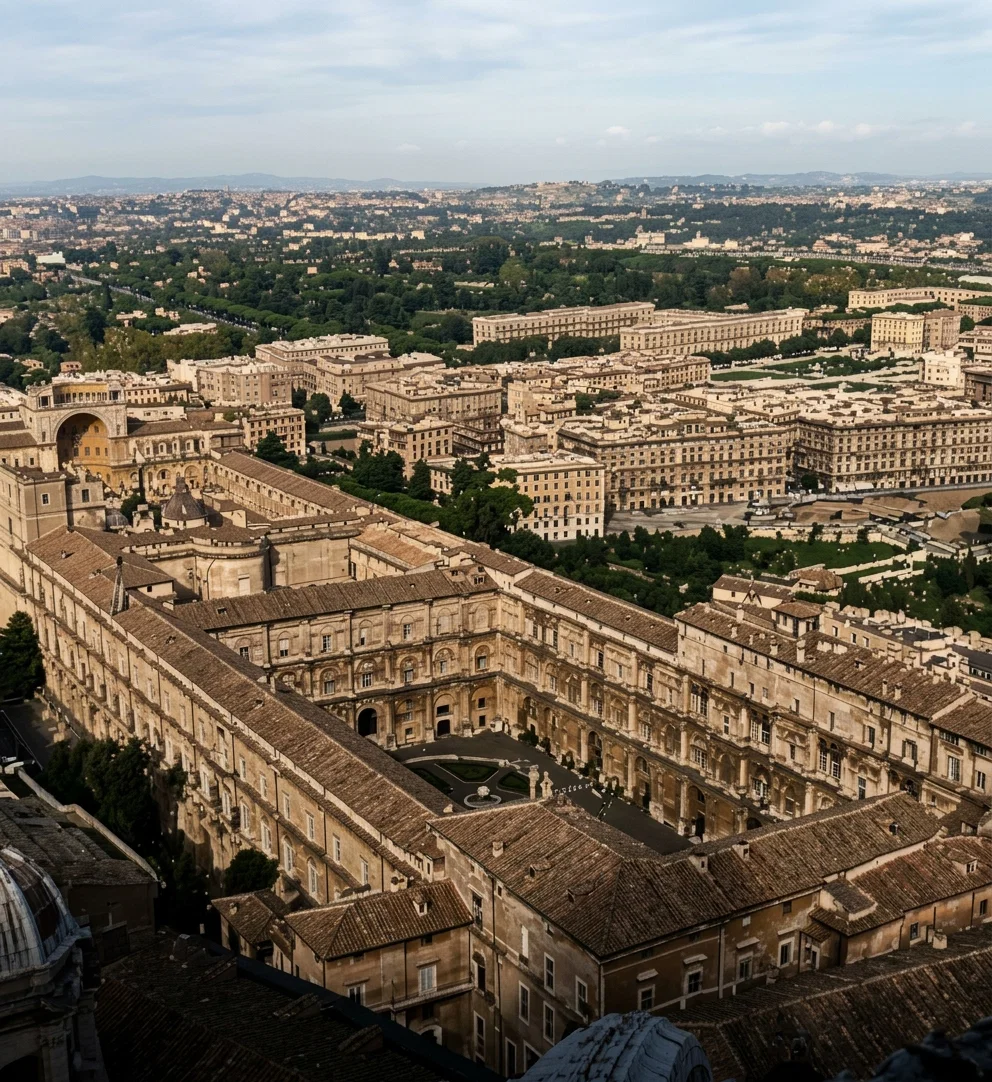
THE VATICAN FROM THE DOME OF ST. PETER'S
The fulfillment of the prophecy seemed improbable, almost impossible. Age after age rolled away. By degrees the mists which hung over it became less thick. The clouds began to break. Some features of the dark mystery began to appear, dimly at first, then more clearly, like mountains at daybreak. Then the form of the mystery became more and more distinct. The seven hills, and the woman sitting upon them, became more and more visible. Her voice was heard. Strange sounds of blasphemy were uttered by her. Then they became louder and louder. And the golden chalice in her hand, her scarlet attire, her pearls and jewels, were seen glittering in the sun. Kings and nations were displayed prostrate at her feet, and drinking her cup. Saints were slain by her sword, and she exulted over them. And now the prophecy becomes clear, clear as noonday; and we tremble at the sight, while we read the inscription, emblazoned in large letters, “Mystery, Babylon the Great,” written by the hand of St. John, guided by the Holy Spirit of God, on the forehead of the Church of Rome.—“Union With Rome,” Chr. Wordsworth, D. D., Longmans, Green & Co., 1909, pages 58-63.

The Vicar of God

In A. D. 1294 Boniface VIII became Pope, and by his superior audacity he threw into the shade even Innocent III. He deserves to be designated the most usurping of mankind, as witnesses his celebrated bull Unam sanctam. In this document the full claims of the Papacy come out. We have noted several ever-increasing stages of papal assumption already, but now we reach the climax—the claim which, if it were a true one, would abundantly justify all the rest; we reach the towering pinnacle and topmost peak of human self-exaltation. What was the claim of Boniface VIII? It was that—

The Pope Represents God Upon Earth.

As this claim is the most extraordinary and audacious ever made by mortal man, I will state it, not in my own words, but in the words of the highest papal authority. In the summary of things concerning the dignity, authority, and infallibility of the Pope, set forth by Boniface VIII, are these words: “The Pope is of so great dignity and excellence that he is not merely man, but as if God, and the vicar of God (non simplex homo, sed quasi Deus, et Dei vicarius). The Pope alone is called most holy, . . . divine monarch, and supreme emperor, and king of kings. The Pope is of so great dignity and power that he constitutes one and the same tribunal with Christ (facit unum et idem tribunal cum Christo), so that whatsoever the Pope does seems to proceed from the mouth of God (ab ore Dei). . . . The Pope is as God on earth (papa est quasi Deus in terra).”
That which was claimed by Boniface VIII in the thirteenth century has been claimed ever since by a succession of popes down to Pius IX and Leo XIII in the nineteenth century. The Pope speaks today as the vicar of Christ, as God's vicegerent. The great ecumenical council of 1870 proclaimed him such, and declared him to be infallible. A professor of history in the Roman university, writing on the council of 1870, uses the following language, which strikingly expresses the papal ideal: “The Pope is not a power among men to be venerated like another. But he is a power altogether divine. He is the propounder and teacher of the law of the Lord in the whole universe; he is the supreme leader of the nations, to guide them in the way of eternal salvation; he is the common father and universal guardian of the whole human species in the name of God. The human species has been perfected in its natural qualities by divine revelation and by its incarnation of the Word, and has been lifted up into a supernatural order, in which alone can it find its temporal and eternal felicity. The treasures of revelation, the treasures of truth, the treasures of righteousness, the treasures of supernatural grace upon earth, have been deposited by God in the hands of one man, who is the sole dispenser and keeper of them. The life-giving work of the divine incarnation, work of wisdom, of love, of mercy, is ceaselessly continued in the ceaseless action of one man, thereto ordained by Providence. This man is the Pope. This is evidently implied in his designation itself, the vicar of Christ. For if he holds the place of Christ upon earth, that means that he continues the work of Christ in the world, and is in respect of us what Christ would be if he were here below, himself visibly governing the church.”
Do you hear these words? Do you take them in? Do you grasp the thought which they express? Do you perceive the main idea and central principle of the Papacy? The Pope is not simply man, but “as if God” and “the vicar of God,” as God on earth. No wonder the sentence is addressed to every pope on his coronation, “Know thou art the father of princes and kings, and the governor of the world;” no wonder that he is worshiped by cardinals and archbishops and bishops, by priests and monks and nuns innumerable, by all the millions of Catholics throughout the world; no wonder that he has dethroned monarchs and given away kingdoms, dispensed pardons and bestowed indulgences, canonized saints, remitted purgatorial pains, promulgated dogmas, and issued bulls and laws and extravagants, laid empires under interdicts, bestowed benedictions, and uttered anathemas!
Who is like unto him on the earth? What are great men, philosophers, statesmen, conquerors, princes, kings, and even emperors of the earth compared to him? Their glory is of the earth, earthy; his is from above, it is divine. He is the representative of Christ, the Creator and Redeemer, the Lord of all. He is as Christ; he takes the place of Christ. He is as God, as God on earth. This blasphemous notion is the keystone of the entire papal arch; it is the stupendous axis on which the whole papal world has rotated for ages, and is rotating at this hour.—“Romanism and the Reformation,” H. Grattan Guinness, D. D., F. R. A. S., London, J. Nisbet & Co., 1891, pages 16-18.

The Papacy in Prophecy

THERE are three distinct sets of prophecies of the rise, character, deeds, and doom of Romanism. The first is found in the book of Daniel, the second in the epistles of Paul, and the third in the letters and Apocalypse of John; and no one of these three is complete in itself. It is only by combining their separate features that we obtain the perfect portrait. Just as we cannot derive from one Gospel a complete life of Christ, but in order to obtain this must take into account the records in the other three: so we cannot from one prophecy gather a correct account of Antichrist; we must add to the particulars given in one those supplied by the other two. Some features are given in all three prophecies, just as the death and resurrection of Christ are given in all four Gospels. Others are given only in two, and others are peculiar to one. As might be expected from the position and training of the prophet who was a statesman and a governor in Babylon, Daniel's foreview presents the political character and relations of Romanism. The apostle Paul's foreview, on the other hand, gives the ecclesiastical character and relations of this power; and John's prophecies, both in Revelation 13 and 17, present the combination of both, the mutual relations of the Latin church and Roman state. He uses composite figures, one part of which represents the political aspect of Romanism as a temporal government, and the other its religious aspect as an ecclesiastical system.—“Romanism and the Reformation,” H. Grattan Guinness, D. D., F. R. A. S., London, J. Nisbet & Co., 1891, page 7.

The Papacy

Who can measure it, or analyze it, or comprehend it? The weapons of reason appear to fall impotent before its haughty dogmatism. Genius cannot reconcile its inconsistencies. Serenely it sits, unmoved amid all the aggressions of human thought and all the triumphs of modern science. It is both lofty and degraded; simple, yet worldly-wise; humble, yet scornful and proud; washing beggars’ feet, yet imposing commands on the potentates of earth; benignant, yet severe on all who rebel; here clothed in rags, and there revelling in palaces; supported by charities, yet feasting the princes of the earth; assuming the title of “servant of the servants of God,” yet arrogating the highest seat among worldly dignitaries. Was there ever such a contradiction,—“glory in debasement, and debasement in glory,”—type of the misery and greatness of man? Was there ever such a mystery, so occult are its arts, so subtle its policy, so plausible its pretensions, so certain its shafts?—“Beacon Lights of History,” by John Lord, LL. D., Vol. V, page 99.

THE PROTESTANT MAGAZINE

of Washington, D. C., now in its seventh year of publication, is indorsed by the leading Protestant writers and speakers throughout the country. It stands in a class by itself—a thoroughly reliable, avoiding personal attacks, but dealing with facts, irresistible in fighting the aggression of Romanism to overthrow American liberties. Known among Protestant and patriotic societies as “an anti-Catholic classic.”
Send ten cents for specimen copy. Address
THE PROTESTANT MAGAZINE
WASHINGTON, D. C.

THE BEREAN LIBRARY

ALL who desire to study further the important Bible subjects presented in this series of Extras should order from this list of valuable books put up in paper covers, postpaid, at the following very low prices:—
Steps to Christ, 144 pages............... $ .25
Thoughts on Daniel, 345 pages........... .25
Thoughts on Revelation, 430 pages....... .35
Religious Liberty in America, 448 pages. .35
His Glorious Appearing, 124 pages........ .15
The Sabbath in the Scriptures, 216 pages. .25
The Sabbath in History, 600 pages....... .50
Capital and Labor, 208 pages............ .25
Here and Hereafter, 360 pages........... .25
Bible Footlights, 320 pages............. .35
Our Paradise Home, 128 pages............ .15
The Coming King, 320 pages.............. .50
Order from the publishers, whose address is given below

The Two Mysteries

If God humbling himself to take the place of man be "the Mystery of Godliness," man exalting himself to take the place of God is surely "the mystery of iniquity."—Guinness.

You have reached the end of this edition.

Review and Herald · Sep 13, 1915