NEW BRUNSWICK is a province of Canada on the Atlantic coast of North America. It has an area of 28,200 square miles, and a population of 321,270. This province has a sea-board of about five hundred and forty-five miles, and carries on an extensive industry in fishing. The surface of the country is generally undulating, but in the northern and north-western parts there are many high ranges of hills, varying from ten hundred to twenty-five hundred feet in height. The scenery is picturesque and varied. Vast forests abound all through this section, and furnish material for an extensive lumber business. Lumbering is one of the chief industries.
The coast line is indented with numerous fine bays and harbors. The Bay of Fundy, which is a large arm of the sea extending into the land between New Brunswick and Nova Scotia, is noted for its high tides, said to be the highest in the world.
The whole of New Brunswick is well watered; rivers, bays, and lakes are numerous. The St. John River, famous for its scenery, rises in Maine, and is over four hundred and fifty miles in length. It is navigable for vessels of moderate tonnage for about one hundred and fifty miles. A trip up this “Rhine of America” on a beautiful day on one of the well-equipped steamers is one of the most interesting and pleasant we ever enjoyed. This river is an important highway for the lumber traffic.
A large portion of the country is well adapted for agriculture, the soil being very fertile. The principal grains raised here are wheat, oats, buckwheat, corn, rye, and barley; the most important vegetables are potatoes, turnips, beets, celery, carrots, parsnips, beans, and peas; fruits, such as apples, plums, cherries, gooseberries, currants, strawberries, and raspberries, are also grown. Imported fruits are generally high. Butternuts and filberts are about the only native nuts, but a great variety of imported nuts can be had at reasonable prices.
We find no difficulty in living up to the principles of health reform in this country, although we do not have many of the things we thought were necessities when we were in the States.
The climate is subject to pronounced extremes of heat and cold, but is considered healthful. The past summer was very wet, and cooler than usual. During the day it was generally very hot, but the nights were cool. We were not very much troubled with mosquitoes, which was a great blessing. They are rare in these parts. At this writing we have had snow for about four weeks, and the thermometer has stood at twenty-five degrees below zero. The winters are long, beginning about November and continuing to the last of March or the middle of April.
A large proportion of the population is composed of immigrants from Great Britain and France, and their descendants. At the close of the Revolutionary War many of the American loyalists settled in this province. Their habits and customs are similar in many respects to those of the fatherland. They keep Sunday strictly, and speak disapprovingly of the “American” way of keeping it. The various denominations are represented. The people are conservative in their opinions, and are slow to receive anything different from their old ideas. Because of this the third angel's message moves slowly, but none the less surely, in this field. As a rule, when they receive the message, it comes to stay.
In this city, Woodstock, there seems to be a more liberal spirit in some respects toward us now than there was some time ago. We are getting acquainted with some of the leading people. This has been brought about partly as a result of a series of revival meetings held here several weeks ago. Five of the different churches arranged for union services, and engaged an evangelist from Boston, Mass. They rented the opera house for two weeks. In the same building is a hall which we use Sabbath afternoon and Sunday evening. The same entrance leads to both halls. I saw that our meetings would be crowded out for the time, so I postponed them until after the union services.
The committee for the meetings did not say anything to me about their arrangements, but took the seats out of the hall we rent, and used them in the other hall. I attended several of the meetings, and was much pleased with the way they were conducted; there was no excitement. A few days after they began, the chairman of the committee, the Methodist minister, met me on the street, and apologized for their action in not seeing me about the hall before they made their arrangements. Of course I accepted his apology, and he invited me to occupy a seat on the platform with the other ministers. I accepted the invitation, which gave me an opportunity to get acquainted with the people. Quite a number professed conversion, and I am holding Bible readings with some of them. I hope to see some take their stand to obey the Lord fully. We have resumed our public meetings with fair interest. I hope to secure a better hall where we can push the work uninterruptedly.
Woodstock.
Just Where You Stand in the Conflict
“JUST where you stand in the conflict,
There is your place!
Just where you think you are useless
Hide not your face!
God placed you there for a purpose,
Whate’er it be;
Think he has chosen you for it;
Work loyally.”
Simple Faith
THE following incident was related by Mrs. D. Bradley, of Lucknow, India. The circumstances occurred in that city:—
A missionary lady was laboring among certain secluded Mohammedan ladies. She was seeking to impress upon their minds the fact that Christ had more power than Mohammed. To do this she read and commented upon the account of the man who was born blind, whom the Saviour healed and forgave his sins. The blind man was thus led to worship the Saviour. See John 9.
She had no thought of conveying to her hearers the idea that the Saviour would restore the blind now, but that he was able to do this, and consequently he alone could forgive sins, and to lean upon other support would prove a broken reed.
Present at the interview was a lady who had lost her sight. She could only discern light from darkness, and had been told by eminent physicians that there was no hope for her, only by a very painful operation, and then it was ten chances to one if she would not lose her sight altogether. Her heart was wrung with anguish at the thought that she would probably never again have her sight. The missionary woman took great interest in the case, and manifested much heart sympathy.
The next time the missionary returned, this woman met her with a happy face, having the assurance of her Saviour's love; her countenance beamed with joy, and her sight had been restored. The following is the substance of the Mohammedan lady's own story:—
“After you left the other day, I thought I would go to your Jesus, and see what he could do for me. I purified a place and made ready so that at the regular season of prayer I told Jesus that the missionary woman had been here, and she had said that he could forgive sins and restore the blind. I told him that that missionary woman said he was in heaven, but that he looked down and saw us pray just the same as though he were upon earth. I then told him that as he was not here personally, I would go and wash, and trust he would heal my eyes.
“I went, and washed, and came seeing—my eyes were perfectly restored. Now,” said the poor woman, whose heart was swelling with gratitude and praise to him who had forgiven her sins, “I shall hereafter believe in your Jesus.”
Are there any who would question the power of God in the conversion of this soul to Jesus Christ? Hundreds of young ladies are wanted to enter these secluded homes in India to-day, protected by the English government, and administer consolation to not only such individuals, but to hundreds of thousands of Hindu widows whose lives are made bitter by servitude and oppression, growing out of the cursed custom of caste. Are there not here open doors? Who is there that reads these lines that will give himself to God for the perishing souls in India?—Selected.
Produce, Markets, and Communication of Santa Catharina, Brazil
By F. W. Spies
F. W. SPIES
The chief crops grown in Santa Catharina are corn, sugar-cane, mandioca, and tobacco. Corn is the staff of life for man and beast. From it the planter bakes his bread and feeds his stock; hence it might be regarded as the leading crop of the province. Next to corn comes sugar-cane, from which sugar and cachasse (rum) are manufactured. From the mandioca root is made a product called “farina,” which is first grated and then roasted.
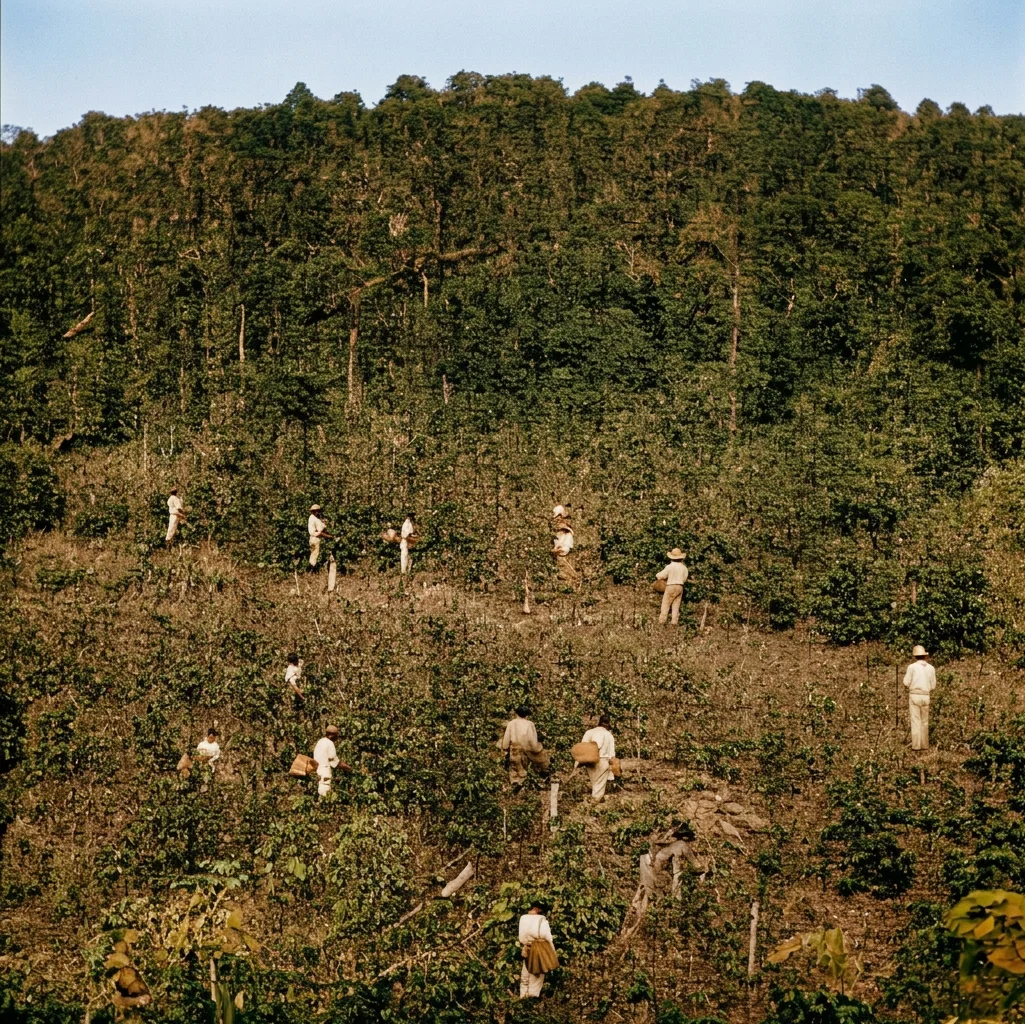
COFFEE PICKING IN BRAZIL
This farina, perhaps, ranks next to corn as a food, it being used largely by the natives. Butter and lard are also produced to considerable extent, and on the table-land the raising of cattle, horses, and mules is the chief occupation, and furnishes hides and dried meat for exportation. There is also a limited trade in lumber, but by far the largest amount of the excellent timber felled each year is consigned to the flames, and what they do not destroy is left to rot on the land, and is a hindrance to the planter as long as it exists.
The chief reasons why the excellent timber here can not be more fully utilized are, first, the lack of proper roads for transporting the same; and, second, even at those places where there is sufficient water, the timber can not be floated, as almost all varieties are so heavy that they sink in the water like a stone.
In general, the means of communication are very poor, and this makes it difficult for the planter to market the small portion of produce which he has to sell, it often being impossible to get certain things to market without the transportation amounting to almost as much as the thing is worth, or perhaps more.
Even traveling, which must be done as a rule on mule-back, is often interrupted for days, and even for weeks, on account of the overflowing rivers in the rainy season. Bridges across streams are seldom found. Thus Brazil is, in fact, a country of “paciencia” (patience), for to get along here one must have patience, and also perseverance.
There is only one railroad in the province, and that is probably not more than seventy-five miles in length, and even this is operated in one of the most thinly populated districts of the province.
For a short distance from the seacoast, communication is kept up on some of the rivers by small steamers and other boats, but the rivers of Santa Catharina are, as a rule, so full of rapids and waterfalls that they are not navigable for any great distance; and the mountainous condition of the country makes it very difficult to construct roads without great expense, and the constant and heavy rains have a ruinous effect upon them after they have been constructed. I have traveled on roads that had cost many thousands of dollars, and they were in places almost impassable. Thus it will be seen that communication in the interior of the province is very deficient, and the communication with other provinces by water is not much better.
These conditions naturally affect our work materially, and it often takes us as long as two weeks of hard, wearing travel on mule-back over mountains and across streams to make a distance which in the United States, with a well-equipped train, could be covered in about eight hours. Yet despite all these disadvantages, the work is onward.
Concerning the markets there is not much to be said. Tobacco is the only article exported to Europe. All other articles produced in the province are simply a matter of interstate commerce, and the most important of these are sugar, cachasse, farina, butter, lard, carne secca (dried meat), and hides.
This produce is usually bought up by the merchants, who keep for themselves such a large commission, and charge such high prices for their merchandise sold to the planters, that most of the latter never get out of debt, while in a short time the merchant usually acquires considerable wealth. In fact, in some sections the business between merchant and planter is simply an exchange of the produce of the one for the merchandise of the other.
Thus we have portrayed some of the conditions as they obtain here; but as a people whom the Lord has called to make known to the world the last message of mercy, we should not be influenced by either advantages or disadvantages, but should work faithfully to gather souls into the heavenly fold; for soon he who shall come will come, and will not tarry.
Rio de Janeiro.
Mission Notes
ELEVEN Protestant denominations are represented in evangelistic work in Cuba.
THE Germans rank third in foreign missionary effort, Great Britain, including her colonies, being first, and the United States second.
It is said that “a line could be drawn inside the Sudan inclosing an area of a million and a quarter square miles, and from sixty to ninety millions of souls, and yet find that inside of that line there is not one missionary, not one Christian, and scarcely any have so much as heard of Jesus Christ.” What does this mean?
IN China, when the Boxers were killing the Christians, two little boys were left till the last, and then were told to say they did not believe in God. “We will kill you if you do not deny him,” said the enraged Chinese. “Even if you do kill us, we will still believe,” said the brave boys. Without further parley, the Boxers slew them.—Extract from a Missionary’s Letter.
THERE are three thousand lepers in the colony of Surinam, Dutch Guiana, South America. They are of various nationalities, but about one half are coolies. For the safety of the colony, a leper home is maintained at Groote Chillon, known as Bethesda House of Mercy. Three Moravian missionaries—a minister and his wife, and a deaconess, who is also a nurse—are at work among them. To work among these people requires that heroic self-sacrifice of the Master himself, who gave his life that we might live.
The Message in Japan
By P. W. Field
The new year has opened propitiously for the work in Japan. We postponed our week of prayer till early in January, after the readings were received from America. We had a very profitable time. The Spirit of God moved upon hearts, personal differences were put away, and a sweet spirit of love and harmony came in. Previously to this season of prayer, but few of our brethren were paying First-day offerings. The envelope plan of collecting the offerings was introduced, and a goodly number are faithfully following it. It works well. These offerings may not be very large, but we are glad to see our members taking up the financial burdens of the work.
With the closing months of last year, the work seemed to receive a new impetus. By the end of the year, three had begun to observe the Sabbath in Wakamatsu, and one in Tokyo. Since then five more in Wakamatsu, and six in Tokyo, have decided to obey. Some of these have been severely tried; but so far as we know, all still remain faithful. Yesterday at our Sabbath meeting, five expressed a desire for baptism. Of these, one young man was a student in a government school. He had to leave school when he began to observe the Sabbath, because attendance is required on the Sabbath. At such schools tuition is free, the student agreeing to enter the service of the government after graduation, so working out his school expenses. But should he fail to do this for any reason, he or his friends who have gone surety for him, must pay for his schooling. So our young brother finds himself in a painful situation. He is entirely unable to pay the school expense for the year he has attended the school; and his brother is much displeased with his course, and refuses to help him. He is much distressed lest the authorities shall proceed to collect this debt from a friend in Tokyo, who went surety for him. But while seeing no way out of the difficulty, he remains firm in his determination to serve and trust the Lord.
Another young man is a student in a Tokyo school for the study of English. His people are Buddhists, yet they did not object to his studying the Bible; and his father even advised him to attend our Bible classes for the help he would receive in English. But when he decided to keep the Sabbath, so losing a day from school every week, his father promptly turned him away from home. He was told that he might join some other church where he could keep Sunday, and so not lose time from school. In Japan, as elsewhere, a religion that changes the life and affects the worldly prospects is an unwelcome innovation.
Still another young man has met with much opposition. His keeping the Sabbath interfered with his school work; so, refusing to attend school on the Sabbath, he was closely confined at home, day and night. Finally he escaped, and came all the way from Wakamatsu to Tokyo on foot, a journey of four days. Part of the way lay over mountain roads through deep snow. We expected that his father would come to Tokyo and take him back home; but instead, we learn that he has been disinherited by his father. In Wakamatsu his friends say that he has gone mad; and the master of the school he attended has forbidden the students to attend the Seventh-day Adventist meetings.
These young men have given up all their worldly prospects for Christ; and to-day the two last mentioned are out canvassing for our books on present truth. Three more young men in Wakamatsu are also enduring trial for the truth's sake, and we are praying that their faith and courage may not fail.
One of our workers has had an interesting correspondence with two young ladies. They were students in a mission school at Kanazawa, on the west coast of Japan. They became much interested from reading our Japanese paper, Ow ari No Fukuin, and decided to leave school, as they could not keep the Sabbath there. They are now at home, and one is meeting with opposition from her people. We know of these only by correspondence.
We are glad to report a substantial addition to our literature in the Japanese language. The following tracts have been translated, and the printers' work on them will be completed this week: "Marshaling of the Nations," "The Second Advent," "The New Testament Sabbath;" also an original tract, "The Way of Salvation." Another, called "The True God and His Holy Day," will be ready soon.
A decided interest in our medical work is being awakened; but I will leave this for Dr. Lockwood to report. We rejoice that the work is progressing. Our needs are many, but we trust in One who is able to supply them. Phil. 4:19. P. W. FIELD.
Tokyo.
The British Field
By Ole Andres Olsen
JANUARY 2-11 a workers' institute and general meeting for the North England Conference was held at Nottingham, a thriving city of nearly two hundred and fifty thousand inhabitants. The attendance was not very large, but quite representative. All the ministers and Bible workers and many of the canvassers were present, also the elders and leaders of churches. The meeting was favored with the presence of Elder Corliss, and other laborers recently from America. Brother Corliss's studies were much appreciated.
The special object of this meeting was to give practical instruction in the various departments of work. To this end the subject of organization was carefully studied. The duties of elders, deacons, leaders of meetings, church treasurers, church clerks, and librarians were fully taken up. The general canvassing agent daily gave instruction in canvassing, and the canvassers spent from three to five hours each day in actual work in the city, selling books and papers.
Every evening a discourse was given on some leading subject, and these meetings were well attended. The interest continued to increase until the close. The plan is to follow up this interest with a tent-meeting during the coming season.
Elder Andross, the president of the North England Conference, is taking hold vigorously, and the blessing of the Lord is attending his efforts. He saw the need on the part of the workers of more definite instruction, and called this meeting to supply it. The result was very satisfactory. The brethren and sisters who attended left for their homes in the best of courage.
At this meeting the tract and missionary work received special attention. Brother C. H. Castle, having lately come from America, was appointed secretary and treasurer, also secretary and treasurer of the conference. Sister Castle was appointed secretary of the Sabbath-school work for the conference.
This conference is planning for three tents for the coming summer. It is indeed gratifying to see their plans for aggressive work in this important field. Here are hundreds of cities and millions of souls in darkness concerning the things that are soon coming to pass. The urgent calls for help are so many that only a few of the most important can receive attention.
We are exceedingly grateful to the Mission Board, and to our brethren in America generally, for the interest they are showing in this field, and it is our earnest prayer that this interest may be rewarded by the rapid advancement of the work in this country.
Since the close of the meeting already mentioned, I have labored in the South England Conference, visiting Bath, Plymouth, Bristol, Southampton, East Cowes (on the Isle of Wight), and Portsmouth; also several places about London. I find our people of good courage, and the work growing. Especially was this the case at Plymouth. That church is making a steady growth, and the Lord's blessing is with the work in a marked manner.
At Portsmouth I met Brother Champness, who has labored here for some time. I found him and his family well, and very busy. The attendance at the meetings is large, and a good interest is maintained. Some souls have decided to walk in all the commandments of God. I remained over only one night. We had an interesting meeting, and I was favorably impressed with the general outlook.
During the past six weeks we have been engaged in raising money for our sanitarium. The REVIEW family are familiar with the circumstances leading to the purchase of the Caterham property, and have had a very large part in bringing it about. Here in this country the matter of raising our £1,000 ($5,000) was taken hold of vigorously. The sum to be raised averaged one pound sterling, or five dollars, to each Sabbath-keeper, which you will see could not but be a very heavy draught on a poor people. But the brethren did not hold back. The conference officers and the ministers all worked with energy, and the result is that last week the purchase was made. The entire amount had been raised,—ten thousand dollars came from America, and five thousand dollars was raised here. Some of the churches sent in even more than their full quota. In some instances where the individuals could not secure the money so quickly, others advanced it for them, and thus the whole amount was raised, the purchase price19paid, and the institution placed in our possession entirely free from debt. It will soon be ready to receive patients. Already we hear of a goodly number who are waiting anxiously for the institution to open. May God's special blessing attend this work. O. A. OLSEN.
Hold Up the Hands of the Workers
By V. O. Cole
A CANVASSERS’ institute will be held at Graysville, Tenn., beginning April 13 and lasting four weeks. Thirty-four of the students of the Southern Training School desire instruction in this important branch of the Lord’s work, and have expressed a desire to spend a part, if not all, of their five months’ summer vacation in selling the printed page. Thus we see the results of a true Christian education.
If any who are not connected with the training school, but who have a desire to canvass, wish to receive the instructions to be given at this time, we would extend to them a hearty invitation to attend. No tuition will be charged, and we trust that all may be benefited by attending. We hope that the Holy Spirit will not only guide in giving the instructions, but also in receiving them. We take fresh courage as we see the old-time missionary spirit coming back into this department of the work.
A recent Testimony says that the Lord calls for many more to enter the canvassing work in the year 1903. So, brethren, let us begin now to pray that his Spirit may so rest upon us that we may not disappoint the Saviour in this matter. Let us show our faith by our works. We are told, in “Christ’s Object Lessons,” that “all his biddings are enablings,” and that “we should never once think of failure. We are to co-operate with One who knows no failure.” So let us cease doubting, and begin to pray for the “faith that works.”
If there are those in the North who have a burden for this field and for this work, who can come well recommended from their home conference, we shall be glad to correspond with them. No doubt such will be familiar with the many Testimonies concerning the needs of this field.
Everything indicates that this will be a prosperous year for the book work, and we trust that the Lord may impress our hearts with the importance of making the best use of the time that remains, while the angels are yet holding the four winds, until this work can be completed, and every soul warned of the approaching danger.
One thing more I would mention here, and I trust that every Seventh-day Adventist in the Southern field may read carefully and pray earnestly over this closing remark. The Testimony must certainly mean something which says, “Where there is one canvasser in the field, there should be one hundred,” and, “If there is one work more important than another, it is that of getting our literature before the people, thus leading them to search the Scriptures.” And surely there is a place where every one can have some part in this closing work. On page 327 of “Christ’s Object Lessons” we read these words: “Not more surely is the place prepared for us in the heavenly mansion than is the special place designated on earth where we are to work for God.” We would not construe this to mean that every one should go out and sell our books, or that it is necessary for all to leave their homes in order to do the work that the Lord would have them do in spreading this truth. But is there not some way in which those who can not leave their homes can hold up the hands of those who are able and willing to do? For certainly we all must have some part in this work. Are there not those who wish to have some one canvass in the place where they live, who can furnish a room free or cheap board to one or two lady canvassers during the summer season? And are there not others who can furnish a home over Sabbaths and Sundays to some of our brethren while they canvass the county in which these live? There may be some who can help in other ways, and we believe that a rich blessing will come to those who make a little sacrifice, and thus hold up the hands of these faithful workers.
We shall be glad to correspond with any one who wishes to encourage this work, either by attending the canvassers’ institute, preparatory for entering the work, or by tending a helping hand to others. May the Spirit of God guide each of us in this matter. V. O. COLE. Cleveland, Tenn.
The First Washington Church
By LOUIS A. SHEAFFE
Some months have passed since the Lord Review readers have heard from us. We have been hard at work. The Lord's hand is stretched out still in love and power. We can truly say that he is in this place; for where iniquity abounds, the promise is that grace shall much more abound. The marked interest of last summer has, to a large degree, been maintained throughout the winter, the attendance at our church in the northeast, at the large hall Sunday nights, in the northwest, and at our numerous Bible studies, has been large and constant. Conversions have been numerous. The additions to the church have reached a total of eighty persons.
The prayer meeting is a very important meeting with us. We have succeeded in getting the church to attend the prayer meeting and the Sabbath-school, and the results are gratifying to all. There were so many requests for help from the people, that we asked the Chesapeake Conference for a Bible worker. The conference did not feel able to grant us one, on account of shortness of funds; so we have ourselves agreed to pay a Bible worker for a limited time, until the conference sees its way clear to take this responsibility. This church has some long-standing debts, and the present members are doing what they can to pay the same. All whose hearts have stirred them up20to accept and obey the truth, have a while mind to work. In our services we are making clear the importance of two things,—a true conversion and consecration to God and his work.
We are praying, and working as we pray, for a large tent that will seat at least one thousand, for our meetings in this city the coming season. This is a wide, needy field. We hope to pitch our tent some time in May. The church, assisted by its friends, is trying to purchase such a tent. We ask at least your sincere prayers that God may grant us wisdom and strength to carry forward this long-neglected work for God and the people.
LOUIS A. SHEAFFE.
The Work in Colombia
By I. G. Knight
Colombia
Bocas del Toro.—We arrived at Bocas del Toro, Friday, the 6th, and were met by Brother Brooks and the rest of the company, with a very hearty welcome.
Having been here so short a time, it is impossible fully to portray this field and its needs. Yet some of its needs stand out so plainly that it is only necessary to be here to see them. In the first place, one of the great needs of this country, in connection with the work, recognized not only by us, but also by those who have been here before us, is medical workers. My wife is a nurse. She is already being called out to care for the sick.
The captain of a boat from St. Andrews Island brought us word from Brother Smith. The work is onward there. We shall visit him as soon as convenient. We find our time all taken up, and we enjoy the work. The third angel's message is just the same in its results here as in America, bringing out a people earnest and full of the Spirit.
I. G. Knight.
JOHN HOFFMAN
By John Hoffman
Finland
BORGA.—There is considerable suffering here this year on account of the crops being a total failure in many places. Many of the people are grinding bark with their flour, and in many places they are making their clothing from gunny-sacks. Besides this, the Russian yoke is pressed heavier and heavier upon the poor people. Their liberties are being gradually taken away. All the young men, and many of the young women, leave home to get away from the Russian military service. Of course the young women do not have to serve in the army, but when the young men go, the women go, too. Those who can not secure passports go out into the Baltic Sea in open boats, and are taken up by passing steamers and carried away to foreign shores. Some of these are caught by spies, and what they do with them I do not know. I think they must put them in the Russian army. They took a young brother in this way over a month ago, and we have not heard a word from him since.
From five to six hundred people get away every week, and most of them land in America. I think that many of them go to Minnesota.
We now have “Great Controversy,” “His Glorious Appearing,” “Steps to Christ,” “Ministration of Angels,” and “Christ and His Righteousness,” in the Finnish language, and are working on “Thoughts on Revelation.” We also have a number of tracts.
We can get the books made. Will you not help us to sell them? I believe a harvest of souls will be reaped among this people. When you talk about foreign missions, please remember the Finns in the States also. I hope that the One who has bought the poor Finns with his own precious blood, may help you to do what you can for them.
JOHN HOFFMAN
Meetings at Riverside Schoolhouse
By H. Clay Griffin
Arkansas
DELAWARE.—I began a series of meetings at Riverside schoolhouse, February 27, and although it has rained almost incessantly, and the roads have been very muddy, the congregations have been fair and the interest good. I am now in the midst of the Sabbath question. Three adults have begun the observance of the Sabbath, and quite a number are in the valley of decision. This is the first time these people ever heard the message, and they are hungry for the truth. I could use tracts on the Sabbath, and any of our books and papers, to good advantage, if sent prepaid to me at Delaware, Ark.
Riverside is two miles from Delaware. I have three other calls in adjoining neighborhoods—all new territory. It does my soul good to go to the hungry people with the precious message; they appreciate it. I could use some German tracts and papers also.
H. CLAY GRIFFIN.
Work for the Colored People of Virginia
By I. E. Kimball
SINCE my last report, I have labored in the cities of Norfolk, Portsmouth, Newport News, and Hampton. During twelve weeks at Portsmouth, while I was laboring diligently with my hands each day in printing, I also held evening meetings with the churches in Norfolk and Portsmouth, with good results. Quite a number acknowledged the Sabbath and the truths applicable to our times, and the church, which had languished under church trials, was resuscitated. It was practically newly organized, and its membership more than doubled. New life and zeal have been inspired, and new courage animates the church as the result of these meetings.
My wife returned from Vermont to accompany me to Newport News and Hampton, where we have put forth our winter’s effort. This has been the best of all my experiences in the third angel’s message. Not being driven to overwork, my health has improved, and I have felt more bodily vigor than since I was seventeen, when I received the message at the first. My wife and I called it the most happy of all our missionary experiences. I preached in nearly all the churches of the city, as I had also done a year before, and the influence of those meetings was excellent, as was testified by the deep solemnity which pervaded hearts when Christ was lifted up before them, accompanied by tears and confessions. In ten of the principal cities of the Atlantic coast where I have thus labored, preaching in many of the leading churches, all doors remain open to me, and urgent calls come to repeat my efforts among them.
We have this winter sold a larger amount of reading matter than ever before—about two thousand books and booklets. We have also distributed the Signs of the Times, and nearly two thousand penny tracts, which I have given away at the services. We have also given away a large number of books.
I held quarterly meetings with the three churches of Norfolk and Newport News, which were seasons of refreshing. We organized the colored church of Newport News the night before Brother J. H. Strickland departed for Jamaica (W. I.), where he is now laboring. He had expended much faithful labor on this company, and wished to see them organized before his departure. Two of these brethren had stood stiffly for the truth for years—the one at Hampton, the other at Newport News. These brethren now stand as elder and deacon in the church. I met with this company usually three times in the week while I was there. Two were baptized by the elder.
In the ten cities where I have labored, there has been no worker for the colored people except my wife and myself. The third angel’s message is something entirely new to them. Almost all the colored people of these cities have never heard of such a people as Seventh-day Adventists. Our brethren, many of them, sit quietly in their homes, and try to enjoy their own ceiled houses while God’s house lies unbuilt. They quiet their consciences, thinking some one will doubtless do the work some day, and many are ready to complain that what is being done is not being done right.
There must be hundreds of workers for the colored people before we can see the fullness of the loud cry going to them. To this end I have had it in mind for more than two years to raise up workers with all possible dispatch, and I have sought to prepare workers among the colored people themselves, a necessity which is becoming more and more apparent. I have arranged for this season to take six or eight workers with me to Vermont, to work on my father’s farm sufficiently to meet expenses while studying. We now have our school organized, and every one is enjoying it. We have six with us, and others may come later. They are matured men and women, some of them elders and deacons of our churches. Some have known something of the truth for many years. I have been preaching to all of them for more than a year, and during the summer I shall aim to systematize the truth in their minds, so they may be able to give Bible readings and become spiritual helpers. I intend to return with them in the fall, to establish permanent work in one or more of these cities. We are now taking the forenoons for study, and the afternoons for work. We have Bible studies, also language, physiology, and Testimony studies at present. History is quite fully taken up in connection with our study of prophecy. We intend to continue these studies until November.
I find myself able to do heavy work on the farm, and am glad to be able to set the example of diligence. Most of these brethren must be self-supporting in their missionary undertakings. They need your prayers, and we all need your sympathy. Give us at least your moral support, while we seek to do what we can.