A DAY or two ago a representative of the Philadelphia Press interviewed a number of ministers of various denominations regarding the observance of Lent. The statement of Rev. Joseph A. Seiss, a Lutheran minister, is worthy of attention.
He says: “I have noted in recent years that the observance is becoming more general in our denomination, as well as in others. In fact, forms of religion seem to be gaining. We are all approaching, in some degree, the Roman Catholic. Not that our basic principles have been changed at all. Not that our belief has been modified. It is simply the change in expression.
“Baptists and Methodists, I note, as well as the Lutherans, are leaning more toward the ritualistic. Why it is I can not see. Science may be responsible in a degree. Biblical interpretation has been aided by excavations in Babylonia, in Egypt, in Palestine. Knowledge has increased. The world is more cultured, and as the people become more refined, the need of an appeal to the senses increases. And ceremonials, vestments, high-class music,—pageants,—lend dignity and impressiveness.
“This observance of feasts and fasts, of saints’ days and martyrs’ days, in my opinion, is not harmful. It increases the veneration of worshipers for the church. It brings them in closer sympathy with its institutions.
“The church as a whole is a mighty instrument. All denominations, whatsoever their specific tenets, have one common ground—the desire to promote the love of good, the inculcation of moral ideas; and whatever it may be that will draw them closer together, whether it be the discoveries of science, whether it be the observance of ceremonies, or any other thing upon which various religious bodies may come together and work for the common cause without antagonisms, is for the good of all mankind.”
Truly, “forms of religion” are “gaining,” but the power of religion is waning. The church has “so spread out, under the inflation of the rich and ungodly,” that its refinement (?) needs no longer the appeal of the Spirit of God to heart and life, but in its stead, like paganism of old, like Roman Catholicism today, “ceremonials, vestments, high-class music,—pageants,” are installed to “appeal to the senses,” and “lend dignity and impressiveness.”
Notice also what Rev. Seiss says concerning “the observance of ceremonies, or any other thing upon which various religious bodies may come together and work for the common cause without antagonisms.”
There is one “thing” they all agree on already, and will continue to agree on, and that is Sunday observance and its enforcement; and truly do they all believe already that in pressing the claims of this institution, they are working “for the good of all mankind.”
With the “observance of feasts and fasts, of saints’ days and martyrs’ days,” of “ceremonials, vestments, high-class music,—pageants,”—for the sole purpose of appealing to the senses, and in which they “are all approaching . . . the Roman Catholic,” how flat seems the statement that in all this their basic principles have not been changed, nor has their belief been modified.
Said the Rev. Chas. Wood, of the Second Presbyterian Church: “Not within recent years has the tendency to observe the lenten season been so general among Presbyterians. This feeling seems to be prevalent among all Christian churches at this time. I feel that it will result in universal good, and people are wise to take advantage of it.
“We will hold Ash Wednesday services in the Second Presbyterian church in the evening, with special music. . . . Each Friday afternoon and Wednesday evening there will be special lenten services. . . . It may be that the increased observance of Lent is one of the indications that all branches of the church are drawing nearer together, accepting from each other the best that each has to give.
“Perhaps the day is not far distant when there shall be in Philadelphia only one church besides the Roman Catholic Church, which will be called, as one of our clergymen has lately suggested, ‘the12Church of God,’ of which there will be various forms and phases named Episcopalian, Baptist, Presbyterian, Methodist, Quaker, and on down the long list of denominations.”
In that day surely they will have all drawn “closer together;” they will have all found the one “thing” through which they can “come together and work for the common cause without antagonisms;” and the American Catholic Church will work not “for the good of all mankind,” but for the best interests of the “holy Roman Catholic Church.”
The statement of Rev. Chas. Wood brings forcibly to mind the remark of the venerable Dr. Patton, who for so long a time was president of Princeton College. In a commencement address, the doctor, speaking on the fundamental principles of Presbyterianism, said: “There is a certain tendency in the church to change or withdraw from them. Some Presbyterians have gone so far as to observe Good Friday. It has come to this, that the question is not, How soon will Presbyterians observe holy week, but how soon will they have holy water?”
Surely Babylon is fallen, and over her door posts is inscribed the word “Ichabod,” and the cry is heard, “Come out of her, my people, that ye be not partakers of her sins, and that ye receive not of her plagues.”
The Dorcases
“THE DORCASES who have only their hope, their needle, and their trust in God have been of boundless blessing to the world.”
A Hymn of Beauty
By James Ashcroft Noble
God of beauty, thou hast spread
Beauty round us everywhere;
Not alone by daily bread
Live we, but by all things fair.
Father, thou dost call the least
Of thy children to the feast.
When on us thy sun doth shine,
Fill our souls with heavenly light;
When descends the night divine,
And the stars are brimming bright,
As the stars, O, let us be
Faithful ministers to thee!
Waves the wind among the trees:
Let thy Spirit on us blow:
We would feel the heavenly breeze,
Which our hearts rejoice to know
Is thy quickening, healing breath,
And prevents our soul from death.
In the hedgerow, countless flowers
Through the summer bud and bloom,
Glorifying all the hours
With their color and perfume.
Lord, we would delight thine eyes,
Make us flowers of paradise.
Beauty glows where’er we look;
All around, below, above,
In the world’s great open book,
Every page says, “God is Love.”
Heavenly Father, we would be
Worthy of thy world and thee.
As thy beauty clasps us round,
Make us beautiful within;
May our hearts and lives be found
Free from folly, pride, and sin.
Then thy stars and fields and flowers
Will indeed be truly ours.
— James Ashcroft Noble.
God’s Eye Is Upon His People
By H. E. Sawyer-Hopkins
H. E. SAWYER-HOPKINS
THE assurance that the eye of the Lord is ever upon his people should cheer the heart of the pilgrim traveling to the heavenly Canaan. He can look up and rejoice that he who holds his children as in the hollow of his hand, neither slumbers nor sleeps; and that he remembers his promise to keep every son and daughter “as the apple of the eye,” and to hide them “under the shadow of his wing.”
O the boundless love, the tender care, the long-suffering and patient forbearance the Father of mercies manifests toward those who have enlisted under the blood-stained banner of Prince Immanuel! And is not the love of him who takes notice of even the little sparrow’s fall, a beautiful, a grand theme upon which to dwell? Through the sweet singer of Israel, the Lord has said, “I will guide thee with mine eye.” Peter says, “The eyes of the Lord are over the righteous” (1 Peter 3:12), and Job says, “He withdraweth not his eyes from the righteous.” Job 36:7.
Then why cherish anxious thoughts or fears when perplexities and annoyances arise? Could we but see the Lord’s purpose in permitting these difficulties, and how through them he shows his love and manifests his divine power more fully to draw our minds from self and earth’s vain and transient allurements, thereby bringing us into closer connection with him, perhaps this shrinking and complaining so often indulged in because of the roughness of the way, might be easily overcome; for he has given his word to be a help in every time of need. The furnace will be heated no hotter than is necessary to consume the dross. To be thoroughly transformed every taint of sin must be eradicated from the heart. There should be a willingness to surrender all unreservedly to him who gave up all for our benefit. Let us cheerfully submit to the purifying process, though often it may be a painful one. Our Heavenly Father knows best what is necessary for the spiritual advancement and eternal welfare of his chosen ones. “All things work together for good to them that love God.”
“They Shall Be All Taught of God”
What treasures of knowledge are revealed to God’s children! It has been “precept upon precept; line upon line, line upon line; here a little, and there a little,” as the days went by. None need go astray; for has he not said, “If ye abide in me, and my words abide in you, ye shall ask what ye will, and it shall be done unto you”? Blessed assurance that wisdom, good judgment, and an abundance of light await the demand of every one who earnestly and perseveringly seeks them.
“The blessing of the Lord, it maketh rich, and he addeth no sorrow with it.” Jeremiah, in mentioning the Lord’s mercies, says, “They are new every morning: great is thy faithfulness.” Lam. 3:23. Why not take all that our bountiful Giver holds out to us? Why not be loyal and true to him “as the needle to the pole,” and render implicit obedience to every one of his requirements? Let the heart be filled with love, and all our service be actuated by love; then, like David, we shall delight to do his will. Is he not worthy of our best endeavors and deepest devotions?
“O worship the Lord in the beauty of
holiness.
Bow down before him, his glory
proclaim;
With gold of obedience, and incense
of lowliness,
Kneel and adore him, the Lord is his
name.”
The “Elijah Message”
By William Knight
WILLIAM KNIGHT
VOICES are heard to-day proclaiming that Elijah has come to earth again. By their respective followers, he is said to be incarnate in one or another who is commissioned to announce the closing days of earth’s history as now being upon us, and themselves as living signs indicative of that fact.
The matter is one of the greatest interest, and should claim some attention, more particularly because the Scriptures warrant an expectation to hear the “Elijah message.” The promise as given through the prophet Malachi reads: “Behold, I will send you Elijah the prophet before the coming of the great and dreadful day of the Lord.”
As a preliminary to whatever God in his providence would do on behalf of the Jewish people, to effect their deliverance and restoration to independence, they counted on the reappearance of his prophet to prepare the way to bring this about. The disciples’ rejoinder to Christ, “Why then say the scribes that Elias must first come?” expressed the common feeling. In his reply, Jesus declared, “This is Elias, which was for to come.”
Unlike the aspirants for the position to-day, it is significant to note that neither Elijah nor John were conscious of any supreme distinction ministering to personal pride. The humility of the men, their absorption in the message they gave, to the exclusion of all else, call for special note.
We meet Elijah for the first time when he dared to announce, “As the Lord God of Israel liveth, before whom I stand, there shall not be dew nor rain these years, but according to my word.” This declaration was made as a protest against the apostasy of both king and people.
To his questioners John disclaimed his right to be called Elijah, simply asserting, “I am the voice of one crying in the wilderness, Make straight the way of the Lord.” After giving his message, Elijah seeks refuge in hiding; and John, for his temerity, finds himself in prison. In each case an alarming suddenness is characteristic of the message, combined with a brief period of personal manifestation to the public view. In both, the circumstances were extremely critical. Elijah arose to stem the tide of Israel’s adoption of heathen sun-worship, while John came upon the scene when in the most glaring way the traditions of men were made to supersede the commandments of God.
Prior to the “great and dreadful day of the Lord” we are encouraged to expect a world-wide announcement of its near approach; but will it be by a reappearance of the Elijah of old? or will the voice of John the Baptist be again heard in our streets? Speaking of the latter, and referring to his work of turning the hearts of the people to the Lord their God, the angel Gabriel declared to Zacharias, “He shall go before him in the spirit and power of Elias.” This we understand to be the divine comment and interpretation of Malachi’s promise.
Ere the impending crisis, the messengers of God, with the spirit and power of Elijah, will be heard calling a halt. The claims of God for worship and obedience, as opposed to all other rivals, will be advocated. The thought is a solemn one, even now the fullness of the time has come, and the “Elijah message” is due to the world.
The Duty of Being Pleasant
You have not fulfilled every duty, unless you have fulfilled that of being pleasant.—Charles Buxton.
Courage for the Discouraged
“GOD can not use a discouraged man, but he can take a discouraged man and put courage into him. He can give him new strength for duties and trials; new wisdom to meet perplexities; and then the man, in the strength of this new help, can go forth and do whatever work the Lord may appoint to him.”
Where Thou Art
“Just where thou art, lift up thy voice
And sing the song that stirs thy
heart.
Reach forth thy strong and eager hand
To lift, to save, just where thou art.
Just where thou standest, light thy
lamp,
’Tis dark to others as to thee;
Their ways are hedged by unseen
thorns,
Their burdens fret as thine fret thee.
“Out yonder in the broad full glare
Of many lamps thine own might
pale,
And thy sweet song amid the roar
Of many voices slowly fail;
While these thy kindred wandered on
Uncheered, unlighted, to the end.
Near to thy hand thy mission lies,
Wherever sad hearts need a friend.”
The Father in the Home
“I HAVE no theories of fatherhood to present, only a radiant memory,” Henry Turner Baily declares in the Kindergarten Review, and then describes the memory.
“I remember a tall man with a full black beard, clear, light-blue eyes, a high, white forehead with a flourish of dark hair above it. He wore a tight-fitting suit of overall cloth, and Russian imperial boots of grain leather which came above the knees. I can see him now, walking to his mill with a quick, long stride, or standing before a turning lathe with a snow-storm of shavings powdering him from head to foot.
“This was the man whom mother was always glad to see. This was the man who never came into the house without stopping to put his arm about her and kiss her and whisper something in her ear. This was the man who drew me between his knees before breakfast, and called me ‘Little Sonny.’ He rode me upon his shoulder, set me upon his knee, and practiced me on the sounds of the alphabet until I never mispronounced, and took me upon the front seat by his side whenever he drove anywhere. This was the man who sang bass in church, and who sat in the twilight Sunday evening, and played a mellow-toned flute of ebony with machinery of German silver.
“I was afraid of him, just a little; because he was so tall and strong, and because everybody and all the animals I knew, minded whatever he said. I used to think mother was afraid of him, too, because she used to blush when he came near her. And then once when I was busy playing, and said, ‘Wait a minute’ twice, when mother asked me to put away my things and go to bed, he looked at me and said ‘Henry!’ in such a way that I never forgot it. I imagine it was
the memory of such a look that made my brother Fred once ask mother to punish him for some disobedience rather than tell father about it; or perhaps it might have been Fred’s recollection of a punishment which I received for lying. ‘Is it possible that my first boy will tell a lie to his mother?’ my father had asked, with a piercing look straight through me. He talked with me calmly, kindly, but to his sorrow I persisted in my lies, defying him and everybody else to make me say anything I did not please to say. ‘Then I shall have to punish you,’ he said, and reached for a maple shoot which I had been using upon my wooden horse. I have never forgotten that whipping,—the thrill of it which took my breath away, the pain of it which surprised me beyond measure, the wonder that father’s face could be so calm through it all. He shut himself into his bedroom afterward, and prayed to God with tears that his boy might never tell a lie again. I discovered that day the heinousness of sin.
“Not long after, when father was away, I was throwing stones near a shoe shop in the village, and broke a pane of glass. Somebody told mother. She called me in and said, ‘You know what your father told you about throwing stones in the street?’ Yes, I knew. ‘When he comes home, tell him at once what you have done, that you are sorry, and that you will never do so again.’ O, the agony of that afternoon! What would father say? What wouldn’t he do! He would kill me. Ah, how little I knew him! When at last he came, and I had managed to sob out my poor story, his keen eyes softened with tears, he wrapped his strong arms about my shrinking little body, and lifted me tenderly into his lap. He told me that he would forgive me, that he was happy to know that I had told the truth, that he would pay a man to set the glass; and then his voice failed him, and he kissed me upon the forehead. The memory of that kiss will go with me as a benediction forever. I knew that day the joy of a pardoned sinner.
“How I admired that man! When I awoke of a spring morning, I could hear him whistling while he spaded the garden. He hived bees, and managed horses; he could mow and milk, and run the machinery in the mill. He could make the most wonderful things with a jack-knife—toads that could hop, jumping-jacks, willow whistles, darts, bows and arrows, windmills. When the new church was built in the village, he sawed the shingles, turned the rosettes, carved the ornaments with his own hand, made the great clock dials, and set up the clock.
“Then came illness. The dust of the mill was too much for his lungs. The puffing engine, the humming planer, the great crying and singing saw which ate its way through oak logs, the buzzing lathe, and the clucking shingle jointer were all sold and carried away. Father built a shoe shop, and set up new machinery. He was often away, and had wondrous stories to tell of locomotives and steamboats and elevators, of which we boys never tired.
“When I was about seven years old, father took me to Boston. It was just after the great fire. I remember the heaps of red-hot ashes, the queer, distorted shapes of iron, the weird ruins of granite walls, and the soldiers with tall hats and glittering regalia standing guard. It was a gala day for me, but a day of thick darkness for him. The fire had ruined his business. The creditors came to the factory in the country, examined the machinery, looked through our house, walked over the little homestead, and went away.
“Again everything was sold. With hired money, father built a little cottage from plans which he drew himself, and into it we went. There were four of us boys then, all as vigorous and as hungry as healthy country boys alone can be. We must be fed. He opened a repair shop in the village. It was our delight. There were a buzz saw, a jig saw, a carpenter’s bench, a hand forge with rotary blower, a turning lathe, together with all sorts of big tools for repairing machinery, and all sorts of little tools for repairing clocks and watches.
“But business was slack. It was a hard winter. Day after day no work came to the shop. But what good times we had at home! Father played horse with us. We rode upon his back as he crawled about the floor on his hands and knees. He told funny stories. He taught us how to make little trellises for house plants, and how to saw wall brackets from thin wood, which, later, we sold from door to door in a neighboring village, and so earned our first money. We had enough to eat, such as it was,—the simplest and often coarsest of fare,—but mealtimes were always jolly. Father was the light and joy of the house.
“But every day there was a time when we missed him. I wondered about it at first; but once or twice I found him in a room alone with a Bible before him, and once I found him upon his knees. I have that Bible now; and when I turn to the twenty-third psalm, and find the pages soiled and worn, or to the last chapters in John’s Gospel and his Epistles, and find the leaves loose and brown and spotted as with tears, I know the secret of those silent hours, and I know also the secret of that perpetual joy which like a fountain of living water overflowed upon us all in prosperity or adversity, morning, noon, and night, every day of his life.
“He never made us boys a promise which he did not keep; never deceived us; when he wished us to obey him, never spoke more than once; and never required the formation of an intellectual14or moral habit which he did not himself exemplify. And yet he was not harsh or unkind, or even inconsiderate in dealing with us. We were taught by example a reverence for sacred things, a respect for age, and a thoughtful courtesy toward women.
“On Sunday afternoons he read aloud the Bible stories until we knew the old book almost by heart. When we began to read for ourselves, he knew what we read. Because of his thoughtfulness in those days I have never read a useless or vicious book.
“Another invaluable lesson taught by example was industry. We were to do with our might whatever our hands could find to do, simply because it was right to work that way. Moreover we were to be generous in our living. We were to help—to help one another, and to help God save the world. Therefore we must give of our time, our talents, our money, to assist in every good work. In the darkest days, one tenth of the scanty earnings was set aside as consecrated money, and given away as occasion served. No one ever pleaded a worthy cause in vain.
“From my earliest recollection of him to the sad day of his death I never heard a cross or unkind word or saw an angry or impatient look pass between him and the woman he loved, the sweet mother of the seven children who now rise up and call him blessed.
“With beams December planets dart,
His cold eye truth and conduct scanned;
July was in his sunny heart,
October in his liberal hand.”
The Care of Growing Children
In an article on “The Growing Child,” in the Youth’s Companion, Dr. Mary Putnam Jacobi gives some information and sensible advice to parents on the natural development and training of children, which she prefaces with the words of Rousseau, that the “return to nature” is the only way of escape from “the innumerable evils engendered by the artificial luxury of civilization.” Of the imperative necessity for pure air, especially for infants, she says:—
“It is not the sentimental fact of living near to nature which enables so many country children to triumph over the hardships of their environment, but their exposure to abundance of fresh air.
“They run about all day in scanty clothing, wherefore the light and air can reach their limbs and brown their skin. They sleep at night in houses unsupplied with furnaces, where the wind whistles through the cracks. The air comes to them free from the dust and unspeakable impurities of the city, laden, on the contrary, with oxygen from the breathing of forests and meadows. It is literally the breath of life. Rushing into the lungs, it distends their delicate cells, passes its oxygen across the diaphanous walls of these into the blood stream, by which it is carried to every tissue of the body, and contributes to the nutrition of every cell.
“The ingestion of oxygen into the blood is the first step in the long and intricate series of chemical processes by which the child’s body is built up to maturity. The need of air is proportionately greater while the tissues are more immature. Gardeners place glass over many young plants to concentrate upon them a greater force of sunlight during the first moments of their growth above ground. So during the first weeks and months and years of a child’s life he is more dependent upon air and light than at any other time, and in his almost vegetative existence, more dependent upon air than upon almost anything else. He is as yet incapable of the muscular exercise by which, later in life, he will be able to quicken his circulation and increase the depth of his respiration. Air must be supplied to his passive reception.”
Pure Air an Aid to Digestion
“The first infantile function to attract attention through its unfortunately frequent disorders, is not respiration, but digestion. The digestive organs, the stomach, liver, and intestines, are at birth, and during infancy, normally larger in proportion than at any other time of life. That is, they should be so, for the act of feeding is proportionately of more importance during the period of growth, when nutriment is required not only to sustain the present life of the body, but to provide for its rapid increase.
“Often, however, the digestive organs do not attain the development proper to the age. Relative deficiency in their mass, or defect in the elaboration of their structure, is probably an immediate cause of much infantile malnutrition, of rickets, of dyspeptic conditions which persist through life. It is impossible directly to overcome these defects; impossible to make the alimentary canal develop better and digest more by forcing more food upon it. We can stimulate the growth and work of muscles, even that of the heart, by stimulating them to work; but with digestive glands we must evade the difficulty. Food easy of digestion must be supplied to the feeble digestive organs.
“But after regulation of its natural or substitute food, the great remedy for the indigestions arising from a feeble development of the child is again, air. The air, which stimulates the nutrition of all tissues, is the most powerful agent to stimulate the development of the digestive organs, which are, for the moment, chiefly appropriating the developmental forces to themselves.
“Many a dyspeptic city-bred baby first knows freedom from the torments of indigestion when it has been removed from its city prison, and placed on the sand at the seashore, or on the slope of a mountain, or on the dandelions of any dry, sunny grass-plot, where it may for the first time fully breathe.”
Importance of Cold Bathing
“After air and food, the third natural necessity for the child is cold water, which is more easily obtainable than the other two, but far more apt to be neglected, or even deliberately repudiated. Mothers dread cold bathing for young children, and can with difficulty be convinced that the children’s cries do not prove that the bath is doing harm.
“A child should be accustomed to bathing from its birth; the temperature of the plunge being at eighty degrees until the age of six months, but from that time on steadily graded downward, until a temperature of sixty-five degrees, or even sixty degrees, is reached in early childhood.
“With the first opportunity the child should be taught how to swim. The prejudice, wide-spread among city people, against fresh-water bathing, is as unfounded as the correlative prejudice against daily cold baths in winter at home.
“The advantages of swimming are twofold. The shock of the cold water on the surface of the body offers a powerful stimulus to the network of nerves spread over the skin, a stimulus conveyed directly to the nerve centers. This first advantage is shared by home bathing or by swimming in the tanks of city gymnasiums. But in addition to this first effect the complex muscular exercise involved initiates the system of muscular training, on which, from the age of three years, must be placed our chief reliance for the invigoration of children.”
“Thou Renewest the Face of the Earth”
By Emerson
APRIL cold with dropping rain,
Willows and lilacs, brings again
The whistle of returning birds,
The trumpet-lowing of the herds;
The scarlet maple-keys betray
What potent blood hath modest May;
What fiery force the earth renews,
The wealth of forms, the flush of hues;
What joy in rosy waves outpoured,
Flows from the Heart of Love, the Lord.
— Emerson.
Health to the True Worshiper
“AND thine health shall spring forth speedily.” Godliness has promise of the life that now is, as well as that which is to come. How can anybody who believes the Bible, read such passages as this, and still think that it is necessarily the lot of God’s people to suffer from disease? Nothing can be more plain than that the Lord promises health to all those who serve him intelligently and in truth. Ex. 23:25. This is not an arbitrary thing, but the result of a definite cause. Notice that there is here a close connection between health and food. The rule among men is to consider only their appetite, and to eat whatever pleases it. Most people eat for the mere enjoyment of eating, and not in order that they may have the most perfect life; and thus they defeat themselves; for although they have a momentary enjoyment while the delicate morsels are going down their throats, the suffering which they undergo in consequence of disregarding the laws of life are almost continual; while those who eat only to have life wherewith to glorify God, not only get pleasure in the act of eating, but are continually filled with the joy of the life of the eternal God.—Selected.
Progress in Rhodesia
By M. C. Sturdevant
M. C. STURDEVANT
We are glad to know that the Lord is moving upon the hearts of our brethren and sisters in the home field, and that they are taking fresh courage to press the work to the ends of the earth. It gives us courage here.
MISSION FARM CHURCH
We are all quite well, though pressed with work almost beyond our strength. Brother and Sister Anderson have gone down country to attend the conference meeting, for a three months' rest. They have needed this for some time. They left us the latter part of December; so the entire work falls on Mrs. Sturdevant and myself, with the help of Brother Tarr, except the work our native teachers are able to do in the school.
There are twice as many in the home as there were when we came. And besides caring for her own family, my wife has between forty and fifty in the school home. She has to see that all food is prepared, and also has the oversight—which is truly the doing here—of all washing, house-cleaning, mending, and garment-making, and the care of the milk and butter from thirteen cows, which is in itself enough for one woman. She also helps in the Sabbath meetings, and looks after the sick and suffering.
My work is the general oversight of all—finding work daily for thirty boys, which is no small task, since we have so few tools with which to work; the care of about one hundred and twenty-five head of cattle, goats, and mules; I teach arithmetic in the day school, and have the care of the night school, with the precious charge of a church of seventy, young people mostly, ten having been baptized at our last quarterly meeting, which was held December 27. With this I have the care of two out-stations with four young native teachers, and they also look after the store, with the help of a native boy. Brother Tarr does the plowing, as our boys can not do it yet. He also goes into the field with the boys, when he is not plowing.
DR. GREEN TREATING A PATIENT
There is no comparison here with farming in the States. We have in about ten acres of peanuts and Kafir peas, twelve or fifteen acres of corn and enyouti, and three acres of sweet potatoes, with our gardens. This means as much work as one hundred acres in the States, with tools and horses. The dry weather has nearly ruined all crops. Last week we had quite a rain, so many began to plant again. We then planted one third of what I have mentioned, yet it is very dry again the last four days, and without more rain at once there will be scarcely any harvest. Our farm looks better than any other farm which I have seen for miles around. Our peanuts and Kafir peas look splendid. The old people say it is the driest they have ever seen it here. We know that the Lord has especially blessed our place. While others' grass was so dead and dry it would burn, ours was fresh and green.
“O . . . let us exalt his name together.” What I have written looks like a dark story. But be assured it is not so dark here. No; the Sun of Righteousness shines upon us daily, so we can see our way clearly, though clouds do gather. While we are weary in body, and do greatly feel the need of help, we are confident that it was the Lord who led us here, and are truly happy in our lot. Our courage never was better. I never knew the leading of my Father more than now, and my only anxiety is, Am I letting him do the work in me? I do pray daily to walk softly before the Lord, and his peace fills my heart. The Lord is giving us precious children here, and it is so much more to me than farm or stock or goods. I believe I can see the Spirit of God moving upon the hearts of some of the older ones. I have a great burden for them. It seems to me that some of them must also take hold of God's truth.
There is work here for at least three earnest families. I believe there should be three families at each station. Thus they could carry the work, letting one have a three months' rest yearly. But for one or two families it is too much.
I have had three fever patients here the last few days, but all are better now. To-day I have one in the kraal. Yesterday I went to see a man buried who had been sick only two days with the fever.
I truly believe that Christ is coming in this generation, and am encouraged to know that our people are awakening to the fact, and are taking hold of the work. Looking at it here in Africa, seeing what must be done,—the people in utter darkness,—from a human standpoint it means ages of work. But when the spirit of Pentecost comes, and seventy-five thousand people are living the message, one shall chase a thousand, and two put ten thousand to flight, and the trumpet will call us home. O glorious rest! I wish those at home, holding on to farm and houses, could know the joy of laboring in a foreign field. I am of good cheer; for we are well able to go up and possess the land.
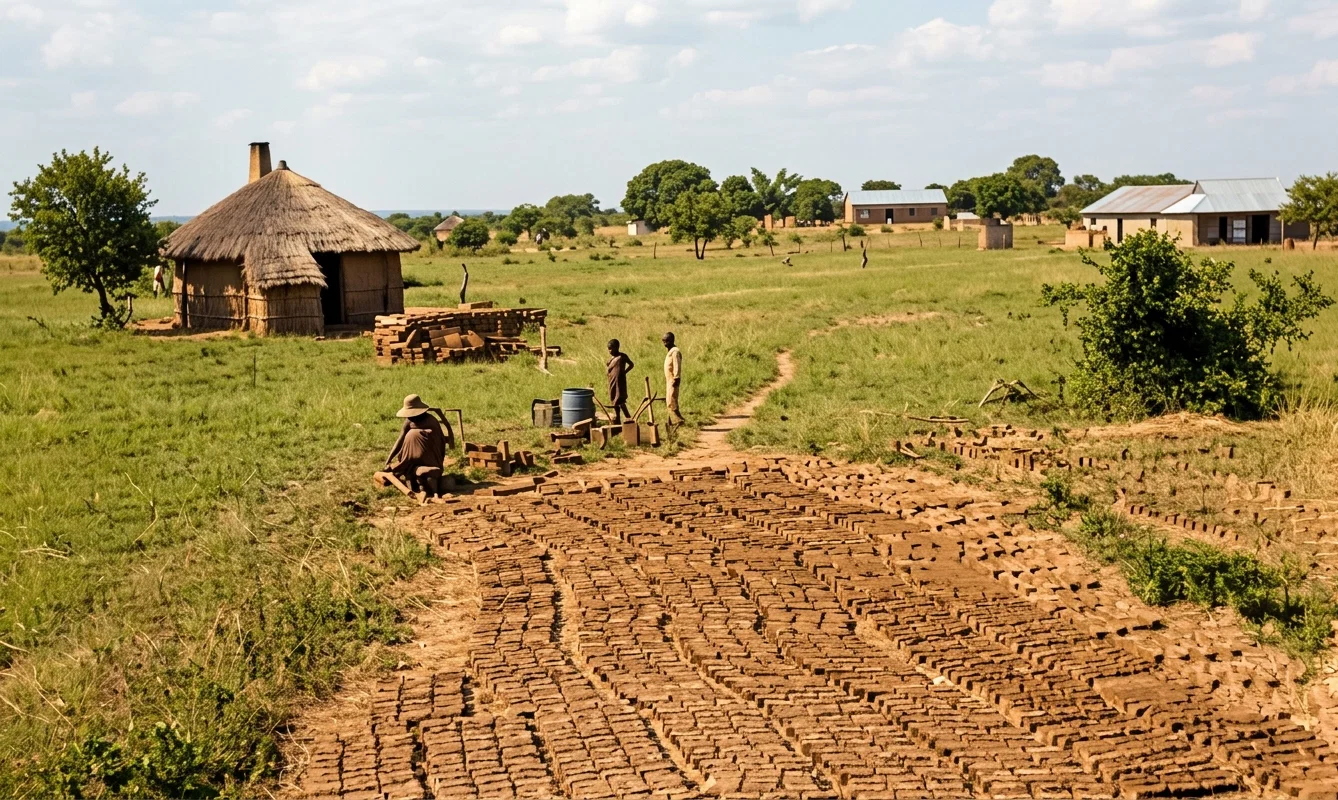
SCENE IN THE BRICKYARD
Bulawayo.
Progress of the Gospel in Japan
It is interesting to note that, although the first Japanese convert was baptized only thirty-six years ago, and the first Japanese congregation—of nine members—was organized so recently as twenty-nine years ago, there are to-day in that country 42,461 Christians in a population of 44,000,000, or one Christian to every nine hundred of the people.16There are at the present time 757 Protestant missionaries in Japan. The awakening that has followed their labors during the last few years is marvelous. One missionary writes that the trial upon all the missions is the lack of men and money to extend the work and gather in the inquirers.