The Youth’s Instructor, Vol. 64, No. 44.

CORNELIA AND HER SONS

The Youth’s Instructor

Oct 31, 1916

Review and Herald Publishing Assn. · Takoma Park Station, Washington, D. C. · Oct 31, 1916
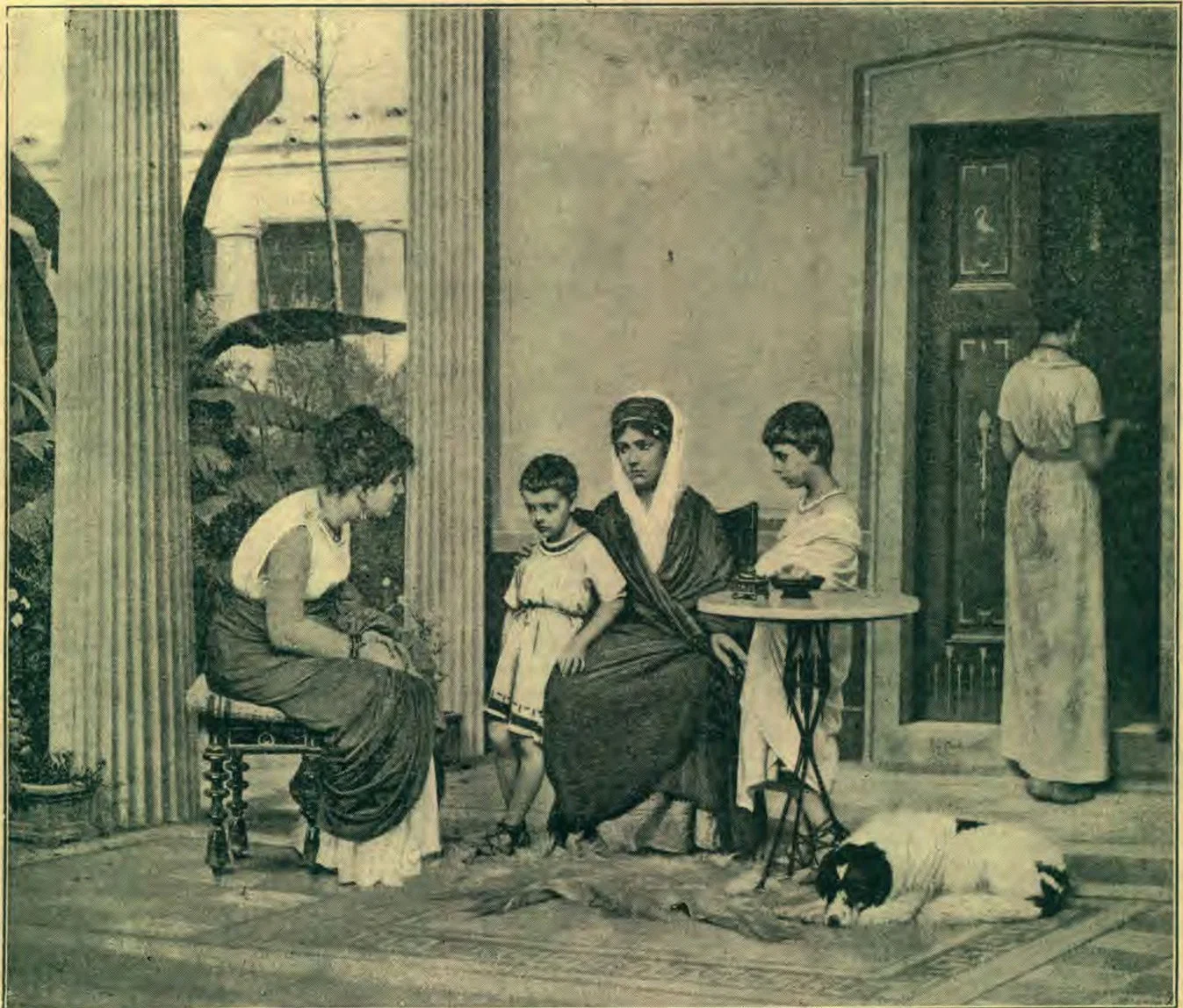
From the original painting by R. Sorbi

CORNELIA AND HER SONS

“Cornelia, daughter of Scipio Africanus, and wife of Tiberius Sempronius Gracchus, was, when left a widow, the mother of eleven sons and one daughter. Nine of these sons having followed each other, in quick succession, to the grave, the bereaved mother concentrated her affection upon the two boys that remained; and henceforth it became the all-absorbing business of her life to direct their education and mold their unfolding powers. To this task she brought qualities of mind and heart singularly rich and noble, and to these was united a spirit of joyous self-sacrifice in the truest sense heroic. Nothing could for a moment distract her from the thought and oversight of her gifted boys. The king of Egypt sought her hand in marriage, but for her sons’ sake she refused to share that ancient throne; and to the end of life and for all time, though full proud of being the daughter of the Great Scipio, she preferred to be known as the mother of the Gracchi.”
“Our picture illustrates the well-known story of Cornelia’s maternal pride. A Campanian lady, after having made a display of her jewels, expressed a desire to see those of Cornelia. The latter, calling her sons to her side, said proudly, ‘These are my jewels!’ The boys — Tiberius and Caius — justified her pride and fulfilled her high hopes, though each of them, after an exhibition of great powers and of heroic patriotism, fell an early victim to a cruel and corrupt oligarchy. After the death of the second son, Cornelia retired to Misenum, where, says the historian, ‘she lived for many years, not so much sorrowing for the loss of her sons, as dwelling with delight on the memory of their acts. Many visited her in retirement to hear the story of the old reformers. Calmly and loftily she told the tale, declaring that her sons had found worthy graves in the temples of the gods. In after days her statue in bronze was set up in the Forum, and beneath it were placed these words only: “Cornelia, the Mother of the Gracchi.”’”

Miscellaneous News Items from Around the World

American shipyards are said to be building a new ship every day.
Nikolas Kalogeropoulos, a friend of ex-Prime Minister Venizelos, recently accepted the premiership of Greece.
Milk may soon be delivered in red bottles, as chemists have found that it spoils much less quickly in red than in transparent bottles.
Kioto, the ancient capital and most sacred city of Japan, is the city where emperors are crowned and buried, though now they reign in Tokio.
An aviator of San Diego, California, advertises “jitney air-bus trips” about San Diego, moonlight flights over the harbor, or from San Diego to Coronado for five dollars a passenger.
During the first seven months of 1915 the book sales in Vermont amounted to $3,556. During the corresponding months of 1916 the sales amounted to $8,900, a gain of almost 250 per cent.
Seamless hot water bottles are regarded as superior to those with seams. Such bottles have been given the name “Wonpeace” Molded Water Bottle. They are manufactured by the Goodrich Rubber Company, of Akron, Ohio.
Several patents for artificial sausage skins have recently been issued by the government at Washington. One patent, issued to a German firm, is for a skin made of woven tendons of animals. Another, to a man in Canada, is for a thin-walled tube of dried cellulose hydrate, containing an ingredient which is waterproof, but which will dissolve in the digestive fluids, and which is edible. Sausage skins made of the intestinal tubes of animals will evidently soon be a thing of the past.
The British Salvation Army has established a War Matrimonial Agency. There has long been a surplus of women in Great Britain. At present there are 1,250,000 more women than men in the United Kingdom. At the close of the war there will be a much greater discrepancy. Commissioner David Lamb, of the British Salvation Army, has started a one-million-dollar fund for the purpose of sending women to Canada, Australia, New Zealand, and South Africa, where they are welcomed as wives by the farmers. If the generous spirit of a prosperous Canadian farmer, who asked for and received a mother with six children, characterizes the majority of the men, the agency will not necessarily be long-lived.
Filipinos, learning wisdom from the European battle fields, have done much toward exterminating the locusts that infest their country, by the use of chlorine gas. Locusts fly in the Philippines in swarms so dense that it often takes hours for them to pass a given point. The sun is obscured, and the hum of their wings in flight may be heard for miles. Never a year passes but that damage to the extent of millions of pesos is done by droves of these insects throughout the scattered archipelago. It was Dr. Vivencio Rosario, of the faculty of the Philippine University, who first discovered the use of chlorine gas to combat the locusts. Where locusts have not passed beyond the “hopper” stage, they may be mowed down, as it were, with the gas.

Grains of Wisdom from the Visiting Nurse

A VISITING nurse had lectured to a group of school children. On being requested to write out what they had learned from her visit, they recorded the following rules of health:—
“Don’t let the baby suck its thumb, for there might be a fly on it and it would get the disease of the fly.”
“Don’t rock the baby, as it will toss its brains.”
“If a baby gets beer every day, it won’t grow very large and it won’t be good in school.”
“Rocking is not good for babies; it makes them sick and stiff.”
“Bad habits are easily made by the mothers, and the babies get wise to them.”
“If you give the baby alcohol, he will lose one-half pound every year and will become drunk when he is old.”
“Never lift it up by the arms, because it will place them out of place. Never pick up the baby by the arms whatever.”
“The public owes the baby as follows: Pure air and sunshine; pure, cool, fresh, free-flowing air at night; its own private bed, sufficient covering of fluffy, porous materials, and the chance to be a perfect man or woman.”

Anti-Gossip Clubs

A YOUNG girl killed herself not long ago, in a small village in England. The coroner’s verdict was “killed by idle gossip.” The girl had done nothing wrong, but was unable to bear the whispered taunts and remarks that started in some unknown fashion.
This started an anti-gossip crusade and the formation of a club to suppress even apparently harmless criticism. A very small entrance fee was named, so rich and poor alike would join, and a fine of a shilling named for the first breach of the rules. Two shillings were for the second, three for the third, and so on up to ten, the maximum. After that the woman was blackballed as an incurable gossip.
It will be interesting to see whether such an organization lives or fails. There is such a subtle distinction between casual comment and lighter gossip. And harmless gossip so soon grows into something more malicious.—Selected.

Right Action and Truthful Speech

If it is not right, do not do it; if it is not true, do not say it.—Longfellow.

The Reward of Duty Is Power

The reward of one duty is power to fulfil another. — George Eliot.

The Hill of God

JOHN FRANCIS OLMSTED
Who shall ascend into the hill Of Christ, the mighty King, Or who shall ever, ever stand Where only angels sing?
He that hath cleansed his hands and heart From every earthly way, Who hath not lifted up his soul, Nor vain deceit displayed.
He shall receive the blessing from Our God who rules and reigns, Who blesses us with righteousness And cleanses sinful stains.
Can it be true that God will save A sinner poor like me, And change my vile and sinful heart Till I am ever free?
Yes, God will save each trusting soul Who would his favor win, Whoe'er will spurn, forsake, and leave The paths of earthly sin.

A Trip in Java

(Concluded)
K. M. ADAMS
CONTINUING our trip through Java, we left Samarang for Surabaya, traveling by the northern route through Goendih and Tjepoe. The country is for the most part level, and rice fields abound. On the way we passed through the great teak forests of Rembang, where grows the best teak in the world.
It was here that we saw an original form of irrigation pump. A man standing near the bank of a pond had a pole about twenty feet long pivoted on a post set in the ground. On the other end of the pole was a wooden tub of about seven gallons’ capacity. He would dip this bucket into the pond, raise it up, lift it over to an irrigation ditch, and empty it, the water running away and watering the fields near by. This work was kept up with a regular swing that reminded one of working at the pumps on a ship.

A Javanese Wedding

On reaching Surabaya we witnessed part of a Mohammedan Javanese wedding ceremony. The ceremony generally lasts several days, so we were not able to see the entire performance. When we were coming up a street, several lights appeared, and there was a great commotion. The lights were numerous gas jets on a frame mounted upon a gas tank, and carried by a coolie. The arrangement of the jets was according to a very pretty design. There were several of these torches borne before the bridegroom as he came to the bridal feast. On alighting from his European carriage, an umbrella fringed with lace about a foot and a half long was held over his head.
In front of the bridegroom was a corps of drummers beating Javanese drums. Close in front of the drummers and facing the bridegroom was a row of singers. As the procession moved along and the drums sounded, these singers walked backward, chanting to the beat of the drums and bowing in unison before the bridegroom. As the drums beat, the one holding the umbrella over the bridegroom’s head would twirl it about. Ahead of the singers and facing the bridegroom was a man carrying a green Mohammedan flag, with the star and crescent. When the drums were sounded and the song rang out, the flag was waved back and forth.
In going down a narrow alley about one hundred and fifty feet long, to the house where the feast was to be held, the procession went so slowly that nearly fifteen minutes were required to cover the distance. The bridegroom, who did not appear to be more than seventeen years of age, was profusely decorated with silks and flowers.
When the house was reached, the bridegroom went in. Before the house was a large shed about one hundred feet long, built for the occasion. It was covered with galvanized iron roofing, and under it was the table laid for the feast. There were plates of rice, meats, watermelon, and other delicacies. At one end was a Javanese band playing European music on European instruments.
In a few moments the women friends of the bride came out to partake of the feast. They were all married women, and most of them were not over sixteen. They were gorgeously arrayed in silks, with heavy gold bracelets, and several wore large diamond rings. The bride came out last of all. She was thirteen years old, and appeared to be somewhat frightened. She had a veil over her head, and was covered with a profusion of silks and sweet-scented flowers. Her face was powdered white, and her eyebrows and lashes were penciled a jet black. The women took places about the table and began to eat. They ate with their fingers, but were very dainty about it. Their fingers were never placed in the mouth. In about fifteen minutes, they arose from the table and entered the house. Soon the women guests departed. We were told that each guest was expected to bring a cash present to the bride and groom.
The real marriage ceremony was probably performed at an earlier time by the priest, as these were undoubtedly the closing scenes of the marriage.

The Surabaya Market

The market in Surabaya is an interesting place. It is just right; not too dirty to be offensive, as in Batavia, and not so clean and precise as to be uninteresting, as in Singapore. It covers several acres, and has shops selling commodities of every description. In one place are vegetables, nuts, rice, beans, and other eatables; in another part of the market are fresh and dried fish; in still another section, cloth, embroidery, and jewelry can be bought. There are stalls selling medicines, potteries, clocks, tools, toys, and an almost innumerable variety of things.
For the payment of a cent or two, women with baskets follow the buyers in order to carry the purchases. It is wonderful what heavy loads they can carry on their heads. We saw one small woman who did not weigh more than ninety pounds, carrying a basket of stones that took two men to lift up on her head. It must have weighed two hundred pounds.
It is interesting to see the children in Surabaya running about the streets with faces powdered as white as snow. This powder is made from rice, and is plastered over the children’s faces in order to keep them cool. Europeans who have tried it say the powder really has a cooling effect.
There are large cement and lime kilns in Surabaya, and bricks are manufactured in large quantities. This city is the headquarters for teak wood. This timber is sold by the cubic meter, and the strange part of it is that the smaller the board, the more it costs. The lumber sellers say that when the boards are sawed up small, more is wasted in sawdust and more labor is expended, so they must charge more heavily for it. Most of the wood sawing in Java is done by hand, as in China. One sawyer is above the log and another beneath, and they will saw away all day long. There are a few steam sawmills in Singapore.
Teak is not a hard nor a heavy wood, but it does not warp much and is seldom attacked by white ants. This latter property makes it especially valuable in a country where no other wood is safe from the ravages of these insects. They refrain from feasting upon teak because of the siliceous matter it contains. Silica, another name for sandstone, gives the wood a gritty character that wears out the ants’ mandibles. This same characteristic dulls the carpenters’ tools when working teak. This wood is of a light-caramel color and takes a beautiful polish. The better furniture and the interiors of houses are made of it. There are woods in the tropics so hard that a nail cannot be driven into them, and others so heavy that a piece will sink in sea water.
There is a delightful mountain resort close to Surabaya, and as the heat of the city was depressing, we decided to again breathe some cool air. We traveled an hour from Surabaya by train to Porrong, where we changed to a sado. The volcano, on the side of which is Soemberwekas, our destination, could easily be seen from Porrong. The distance between these two cities is about sixteen miles. The road rises gradually, and it is hard for the pony to haul his load. The road is well kept, and passes through a beautiful country. Much of this land is used for growing sugar cane. Here and there are seen the tall white smokestacks of sugar mills, and great fields of sugar cane with waving white plumes stretching into the distance.
Halfway we changed to a sado pulled by two horses, as the road was becoming steeper. From this place the road no longer skirts the foot of the mountain, but runs directly toward it. Soon we reached the village of Prigen, part way up the mountain side. Here we left the carts and finished the journey on foot. Away we went, across the mountain streams pure and clear, up steep slopes, past terraced rice fields, with the tropical sun beating down upon us. When we reached our destination, we were exceedingly thankful for the cool, refreshing breeze which the height above the plain afforded.
From our point of vantage we could look far out over the country. We were told that on clear days, boats on the sea could be seen sailing by. On one side was the extinct cone of a volcano, its steep sides rising abruptly from the plain. On the other side rose a still taller cone, from which issued smoke and steam and from which sulphur is mined. On the slope of the latter peak, opposite us, lay a village which is a much-frequented mountain resort for the residents of Surabaya.
There are two small concrete bathing pools in this place, and they are kept filled by the water of a clear mountain stream. The suggestion that we have a bath was eagerly seconded. The shock of the cool water brought a tingle to the skin that we had not experienced since leaving America, and we enjoyed the sensation to the fullest extent. Our sore, tired feeling left like magic, and we felt more than fitted for the return journey.
After a stay of an hour, we retraced our steps. At Prigen we purchased some large oranges and bananas to relieve our hunger, and then hastened toward the railway for our return trip to Surabaya, and thence to Weltevreden. With regret we left this delightful spot, and we found the heat of the plain most stifling after enjoying the cool air of the mountains.

Javanese Versus Sundanese

On the journey through the island we noted two main types of people, the Javanese and the Sundanese. The Javanese are more beautiful and refined than the Sundanese. These two types speak different languages, yet on the coast many of both classes understand Malay, but in the interior the Malay is little spoken.
The Javanese are a musical people. They have many kinds of instruments. The most common one is a series of bamboo sticks or strips of metal laid on a frame, the music being produced by striking these keys with a hammer. There are many of the same kind of instruments in America. The Javanese are great theatergoers. They have a native theater called a wayang, which travels from place to place. The actors are wooden puppets that cast a shadow. These are dressed to represent the gods and heroes of their mythology. While these puppets are manipulated about the stage, a reciter is repeating the play. These entertainments are greatly loved by the Javanese.
The dress of the Javanese is a coat, trousers, and sarong for the men, while the women wear the sarong and a long coat that comes nearly to the knees. The sarong is the distinctive dress of the Javanese and Malays. It is made of a piece of cloth two yards wide and one yard broad. It is sewed so as to make a cylinder, open at both ends. This is placed about the body, drawn tight, with the slack in front. The slack cloth is folded lengthwise with the body, and the top tucked in to hold it in place. The slack is open at the bottom, so that the feet have free play. It is really a beautiful garment. The natives make them with colors and designs; some of them are made of silk and cost as much as one hundred dollars.
The money used in Java is the guilder, which is worth forty cents of American money. The guilder is divided into one hundred cents, so that the cent in the Netherlands Indies is worth only four mills of American money.
At Weltevreden we secured ship passage to Singapore on the same boat that had brought us to this beautiful island. The run was smooth and uneventful, and we were glad when we saw the harbor of Singapore and knew that at last we were home again, and able to take up our work with renewed vigor.

Character, Not Religious Activity

To satisfy the religious instinct in man, Satan has always set before him rites and ceremonies designed to lead his mind away from God. And when God has ordained ceremonies in the church to turn men's hearts to him, it has always been Satan's design either to pervert them in such a way that men should fail to see God, or to implant the idea that there is virtue in the ceremonies themselves. If these are of value in themselves, then the more often they are repeated the more efficacious will they be for the one performing them.
Ceremonies aside from those which God has ordained, lead away from him. All those which he has ordained lose their value when confidence is placed in them instead of in God. The heathen trusts in the frequent repetition of his ceremonies. The Catholic does the same. The corresponding error in some Protestant churches is to trust in church activity instead of in a character molded by the hand of God into his image.
The question should not be primarily, “What do I?” but, “What am I?” In the midst of Jewish exclusiveness, ritualism, and narrow, bigoted formalism, Jesus found one who saw clearly this principle. “And the scribe said unto him, Well, Master, thou hast said the truth: for there is one God; and there is none other but he: and to love him with all the heart, and with all the understanding, and with all the soul, and with all the strength, and to love his neighbor as himself, is more than all whole burnt offerings and sacrifices.” Mark 12: 32, 33.
In the midst of these same things in Catholic and heathen lands, the missionary finds a few who place character above ceremonialism. In Protestant lands the worker finds a few who realize that “to obey is better than sacrifice,” and who accept the testing Bible truths. The true Christian does not confide in his profession or church activities, but seeks to perfect “holiness in the fear of God.” To all such Jesus says, “Thou art not far from the kingdom of God;” and if we follow on to perfection, when Jesus comes we shall enter in.
E. W. THURBER.

The Birthday of European Christendom

Never, perhaps, did the nobility of Peter’s soul receive greater test than during the course of his ministry in the home of Cornelius, the Roman centurion at the head of the Italian cohort of soldiers stationed at Cæsarea.
The Lord in mercy had prepared the apostle at least in part for that which was to take place. While Christ was still upon earth, Peter and his fellow disciples had been told repeatedly that their mission was to be a world-wide one; and on the day of Pentecost, Peter had caught a glimpse of the spread of gospel truth throughout the earth, when he declared, “Whosoever shall call upon the name of the Lord shall be saved.” On the same memorable occasion he said, “The promise is unto you, and to your children, and to all that are afar off, even as many as the Lord our God shall call.” But how little did he understand the full significance of these prophetic words!
Years passed. Saul the persecutor was converted, and after a brief sojourn in Damascus and a longer period of retirement in Arabia, he sought out Peter at Jerusalem, and told him of his experience and of his call to preach the gospel he had once despised. Doubtless Peter then caught further glimpses of God’s purpose to bestow upon all nations the benefits of the gospel; for Paul during his visit at Jerusalem had a vision in which he was apprised of his mission to the Gentiles. Yet Peter had still further experiences to pass through before he could be persuaded to lay aside his earlier circumscribed conceptions of the work of God in the earth. Not until there was revealed to him, in the form of an acted parable in vision, the eternal truth that what God has cleansed no man is to call common or unclean, was he prepared for the call to minister in the home of a Gentile seeker after truth whose heart was open to conviction and obedience.
When, in the good providence of God, the Roman soldier and the Jewish fisherman are brought face to face, declares Dr. Macduff (“Footsteps of St. Peter,” pp. 465-470), “Peter, with the outspoken and generous manliness of his nature, tells Cornelius what induced him to respond so readily to his solicitation. He alludes in the first instance to the barriers separating Jew from Gentile, which hitherto were deemed insuperable, and specially precluding the former from accepting the hospitality of the latter, on account of the meats proscribed by the Hebrew law. But he now informs him that his scruples had, by the clear voice and intimation of heaven, been removed.
“Cornelius, in his turn, briefly rehearsed the story of the heavenly visitant, by whose express command it was he had ventured to ask the apostle to undertake that long journey of thirty miles from Joppa.
“If Peter had any wavering or hesitation before, as to the path of duty, he has none now. We may feebly imagine his emotions in that hour of joyous marvel; how his whole soul must have kindled into rapture. . . . He gives vent at once to a rush of unpremeditated words,—one of those noble epigrammatic addresses or discourses, attempting to paraphrase which, would be to spoil and mutilate,—‘Of a truth I perceive that God is no respecter of persons: but in every nation he that feareth him, and worketh righteousness, is accepted with him.’ [For the text of the address, see Acts 10: 34-43.]
“While the inspired preacher was still speaking, the Holy Ghost descended on all present. . . . ‘They of the circumcision’ who had accompanied Peter from Joppa, were specially filled with astonishment. They beheld sights strange to Jewish eyes. They listened to sounds strange to Jewish ears. . . . What proof more was needed? ‘On the Gentiles also was poured out the gift of the Holy Ghost.’
“Amid that scene of profound interest, Peter’s voice again interposed. He saw his way to put still further the seal of apostleship on the transaction; and that way surely must have been clearly made plain, when he acted entirely on his own responsibility without asking the advice or coöperation of his colleagues in Jerusalem. With the thing signified so palpably before him, how could he hesitate for a moment to add the sign itself? God had baptized with fire; surely he, his servant, may not be hindered from baptizing with water. ‘Can any forbid the water’ (it is in the original, not simply water as in our Authorized Version). It is the complement to ‘the Spirit’ in the close of the sentence—‘Can any forbid the water, that these should not be baptized, who have received the Spirit?’ . . .
“The company assembled in the house of Cornelius were forthwith baptized in the name of the Lord; and as if to strengthen them in their adopted faith, and to vindicate his own honorable office as through them the opener of the kingdom of heaven to the Gentile nations, the apostle responded to their wish to tarry with them for some days.
“We shall not further linger on this great crisis hour in Peter’s history, however tempted to do so. The exclusive Jewish ritual with its galling restraints was repealed,—the burdensome yoke of the ceremonial law forever removed,—the stranger and foreigner made a fellow citizen with the ‘saints, and of the household of God.’ It was, of all incidents in apostolic story, that which was most momentous in its bearing and results to us. It was the birthday of European Christendom.” C. C. CRISLER.

A Mighty Purpose

“I will place no value on anything I have or may possess, except in relation to the kingdom of Christ. If anything will advance the interests of that kingdom, it shall be given away or kept, only as by the giving or keeping of it I shall most promote the glory of him to whom I owe all my hopes in time and eternity. May grace be given me to adhere to this.”— From Livingstone’s Journal, May 22, 1853.

The Ideal Missionary Volunteer

OUR understanding of the word “ideal” is an imaginative conception of, and conformity to, a certain standard of perfection. There is only one standard of perfection for the Christian—the Christ-life; and fundamentally there is only one course to pursue to reach that standard. His life was that of an ideal Missionary Volunteer. The name Missionary Volunteer at once suggests those qualities essential to the achievement of idealism in a young person’s Christian life. Think of the two words “Missionary Volunteer” separately. Missionary really spells service for Christ,—service for him every day all through life. Volunteer means to offer one’s services willingly, never seeking to be excused. Therefore we can see only one standard of perfection, one ideal for our youth in this Missionary Volunteer movement; that is, whole-hearted, willing devotion, and service to Christ every day.
This ideal is not reached in one day, nor in one year; no more than is the development of Christian character. The young person must employ certain agencies, undergo certain training, in order to attain this ideal. These agencies are all found in this Missionary Volunteer movement. It is making the development of this missionary spirit possible in the lives of hundreds of young people in this cause today, and it will develop all who properly appreciate and employ its agencies. Owing to the misconception of the scope of the Missionary Volunteer work in the minds of many, the strength of this truth has not been so fully realized as it might have been.
The Missionary Volunteer movement deals with every phase of the young person’s life in accomplishing the ideal. For convenience rather than for exactness we will divide his life into four phases,—the spiritual, intellectual, social, and missionary,—as these have a direct bearing upon the proclamation of this message. We have definite features prepared to foster and develop each one of the four phases. His spiritual life is developed and encouraged by the use of the Morning Watch, in the prayer bands organized, and by reading the Bible. His intellectual life is stirred to activity by our educational work, such as the Standard of Attainment, Reading Courses, and the training derived from helping on the programs rendered by the society. Also we are succeeding in turning the minds of our young people in the home churches toward our training schools. Their social life offers one of the largest problems in the movement; however, we are ever urging the youth to follow more closely the principles laid down in the Spirit of prophecy.
The spiritual, educational, and social all bear toward the fourth phase,—the missionary. True to its name this Missionary Volunteer movement is one gigantic missionary enterprise. Therefore, it calls for the development of the real missionary spirit; and we must diligently cultivate the first three mentioned features in order to make the missionary spirit possible. It is evident that the person who does not pray nor observe the Morning Watch, who does not study his Bible, who associates with worldly companions, enjoying their evil ways, cannot become a missionary while following this course. On the contrary the one who brings into his life, prayer, Bible study, and proper associations, will have an inborn passion and love for souls which will cause him to exclaim, “I will give my life, my all, for suffering humanity, whether it be at home or abroad, and in any vocation in life.”
In conclusion let me emphasize the fact that we must recognize our present Missionary Volunteer methods as means to one common end,—the development of ideal missionaries. Consequently the ideal Missionary Volunteer will be found observing the Morning Watch, for his life will be the prayer life. The prayer band will find him there. He will read his Bible, and possess, or endeavor to secure a Standard of Attainment certificate. He will prefer the Reading Course books to cheap, unwholesome literature; and he will cultivate his taste for the higher kind of music. He will not be found enjoying the company of the pleasure seeker, the boisterous and uncouth, for he is living with Christ, above worldly things. To the ideal Missionary Volunteer, service for Christ will be the sweetest and most satisfying, and to this end will his energies be spent. CHESTER S. PROUT.

Diligence in Business Brings Honor

“SEEST thou a man diligent in his business? he shall stand before kings.”

Be Sure You Are Going Somewhere

“Don’t be satisfied to ‘keep going.’ Be sure you are going somewhere.”

Our Legacy from Livingstone

“I go back to Africa to try to make an open path for commerce and Christianity; do you carry out the work which I have begun?” “I LEAVE IT WITH YOU.” —Livingstone.

Today’s Opportunity

AFTER a recent concert given for the entertainment of a number of Europe’s soldiers, one of them was asked to propose the vote of thanks. He arose and said: “We are very grateful for the amusement afforded us tonight; and we appreciate all the musical talent brought for our enjoyment. But we are off to the front tomorrow; and I do not know how to die—I am not prepared to meet God: I only wish there had been something for our souls.”
This soldier voiced the unexpressed feeling of many of his comrades; for one Christian worker engaged in distributing literature among them said:—
“I disposed of the literature that you sent me, ‘in the turning of the hand.’ As I betook myself to the distribution, I was literally overwhelmed in the barracks, as everybody wanted to get a Bible or a New Testament. When I now walk through the barracks, I often see here and there a war prisoner with a Bible in his hand, and, sitting around him, four to six men, sometimes even more, to whom he reads aloud out of the Bible, all attentively listening.”
Another in speaking of the eagerness of the soldiers for spiritual reading said: “They came in great haste, like hungry wolves, to get a Bible or Testament.”
Dr. J. H. Jowett, pastor of the Fifth Avenue Presbyterian Church, New York City, says:—
“I do not know of any opportunity among all the many opportunities in Europe to do good which is more fraught with promise. The Russian people are essentially a reverent people. This reverence may sometimes express itself in forms of superstition, but nevertheless it is there, a great fruitful awe in the presence of the unseen. I suppose it would be true to say that the Russian people are the most reverent people in Europe. If only that rich bed of reverence could be planted with the seed of the kingdom of our Lord, the harvest would be inconceivable in its range and influence.
“Everybody knows how difficult it has been to evangelize Russia, and how the obstacles have sometimes appeared overwhelming. But now great masses of Russian soldiers are interned in Germany and Austria, and the door is open to present to them the gospel of our Lord. It can be done not only by the spoken message, but perhaps even more effectively by the printed word. The days of these prisoners are long and they drag wearily on, and therefore they will welcome any form of reading, and preëminently I think they will eagerly welcome the story of our Saviour’s love.”
“I commend the movement to the Christian people of this country. This country has shown its beneficence toward stricken Europe in a hundred ways; in none could that beneficence be more fruitfully expressed than in sending the evangel of the Lord Jesus to these great multitudes of Russian prisoners.”
As the result of the work of these missionaries among Europe’s soldiery many conversions are reported. The Gospel Committee for Work Among War Prisoners, New York City, solicits means for conducting a campaign at the prison-camps. The committee proposes to print and distribute, by personal workers in the camps, Bibles, Testaments, Gospels, and other Scripture portions, beginning with the Russian prisoners and gradually extending as the work advances. A Russian translation of “Pilgrim’s Progress” permits its use if friends will provide funds for printing. It will also print, in the various languages of those it is designed to reach, a variety of other literature of a spiritual character, suited to the needs of the work. Among the latter will be addresses in leaflet form by Moody, Spurgeon, and other spiritual leaders, which have been most effective in reaching the hearts of men.
A Russian prisoner at Camp Schneidemühl writes:—
“With much joy do I receive and read your literature, and I desire to express my best thanks for same. I can also inform you that the Lord is working by his Spirit in our camp. Already seven men have been converted. In our midst there is also a Russian preacher captive, and he puts himself to much trouble to preach the gospel among the rest. Many inquirers are coming with questions. Please send me some tracts in the Russian language.”
These missionaries are doing a good work, and we hope our people in Europe are taking similar advantage of their opportunities.

Bible Facts About the Antediluvian Patriarchs

Bible Chronology from the Creation to the Flood

Years Years from creation
From Adam to Seth (Gen. 5:3) 130 130
From Seth to Enos (verse 6) 105 235
From Enos to Cainan (verse 9) 90 325
From Cainan to Mahalaleel (verse 12) 70 395
From Mahalaleel to Jared (verse 15) 65 460
From Jared to Enoch (verse 18) 162 622
From Enoch to Methuselah (verse 21) 65 687
From Methuselah to Lamech (verse 25) 187 874
From Lamech to Noah (verse 28) 182 1056
From Noah to the flood (Gen. 7:6) 600 1656

Ages of the Antediluvian Patriarchs

Years
Adam lived (Gen. 5:5) 930
Seth lived (verse 8) 912
Enos lived (verse 11) 905
Cainan lived (verse 14) 910
Mahalaleel lived (verse 17) 895
Jared lived (verse 20) 962
Enoch lived on earth (verse 23) 365
Methuselah lived (verse 27) 969
Lamech lived (verse 31) 777
Noah lived (Gen. 9:29) 950
All these patriarchs lived contemporaneously with Adam except Noah. Lamech, Noah’s father, was about 56 years old when Adam died. Noah lived about 350 years after the flood began. Seven of these ten patriarchs lived more than 900 years. Methuselah, the oldest, died the same year the flood began, and probably helped Noah build the ark. Allowing that Noah preached the coming flood for 120 years (Gen. 6:3), he began 1,536 years from creation. Lamech, Noah’s father, died about five years before the flood.
ARTHUR L. MANOUS.
Continue reading: The Christian's Glory