IN a recently published work by Melville D. Landon (Eli Perkins), entitled, “Kings of the Platform and Pulpit,” I find the following:—
He [Mr. Ingersoll] is opposed to the enforcement of the old Connecticut Blue Laws to make people good. He believes a man made good by law is not really good at heart, but is simply made to appear good. He is a legal hypocrite.
One day a fanatical talker—a Puritanical Blue Law man—who was in favor of enforcing strict Sunday laws, absolute prohibition, etc., came in on the New York Central train. Mr. Ingersoll heard him talk a spell and then asked him several questions.
“Would you like to live in a community where not one cigar could be smoked and not one drop of spirituous liquors could be sold or drunk?” “Certainly,” said the Blue-Law man, “that would be a social heaven.”
“And you would like to live where no one could play on the sabbath day; and where no one could laugh out loud or enjoy a frolic?”
“Yes, sir; that would suit me. It would be a paradise to live in a community where everyone was compelled to go to church every Sunday; where no one could drink a drop; where no one could swear; and where the law would make every man good. There the law would make every man’s deportment absolutely correct.”
“Then,” said Mr. Ingersoll, “I advise you to go right to the penitentiary. At Sing Sing there is a community of 1,500 men and women governed in precisely that manner. There all are good by law.”
There is many an infidel who to-day stands nearer the ideal taught by Christ than some of his professed followers. The same thing Jesus himself declared true in his time. “The publicans and harlots go into the kingdom of God before you.” Matt. 21:31. This was addressed to those who made the loftiest profession ever made by men.
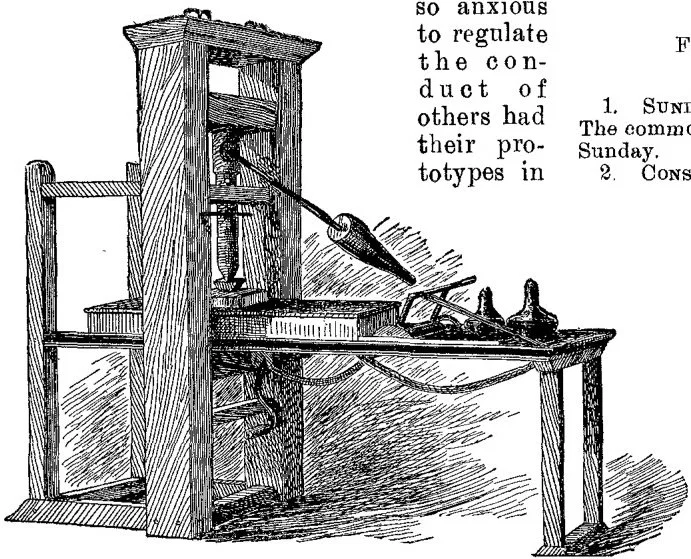
The Press, on Which the Declaration of Independence Was Printed.
These modern would-be reformers who are the first century. Jesus addressed them, “Thou hypocrite, first cast out the beam out of thine own eye, and then shalt thou see clearly to cast out the mote that is in thy brother’s eye.” Matt. 7:5.
Jesus Christ never used force and never approved of it, but always condemned it. If our friends who are trying to make men good by law would drink in a little more of the Spirit of the Master, it would lead them to labor more to convert the hearts of men, and not to be so strenuous about the outward conduct of sinners and those Christians who differ from them in some prominent points of doctrine.
When I consider how recent events in Canada and Tennessee and other places have revealed the disposition of professed Christians to inflict hardship and suffering on other professed Christians because they differ in the matter of Sabbath observance, I am almost dumb with amazement. Are not these Sabbatarian Christians men who live above reproach and endure many inconveniences to carry out those principles which are impressed on them as they read the sacred volume? Is it not as painful to them to see men work on the seventh day of the week as it is to others to see them work on the first day? Are not these men kind neighbors, honest in their dealings and faithful in all their duties as citizens? Their only offending is the violation of Sunday statutes which have come to us from the Dark Ages. And these modern professors who put this law in operation have forgotten the Golden Rule if they ever knew it. And most amazing, of all of the thousands of religious papers in the world, only about one in a hundred raises its voice in protest against these unchristian proceedings.
If these things had transpired a century or two in the past, they would have been classified with the doings of Nero and the Spanish Inquisition. It seems almost useless to appeal to the sensibilities of men who are so blind to the blazing light of the Christ who even prayed for his enemies. But let the hearts of those who cry for religious freedom take courage. Outside of the ranks of professed Christians are those who, like the Samaritans of old, will gladly welcome the divine light of the King of kings, who is the King of peace. “The Gentiles shall come to thy light, and kings to the brightness of thy rising.”
SUNDAY LAWS UNCONSTITUTIONAL IN ILLINOIS.
WILLIAM S. EDEN vs. THE PEOPLE OF THE STATE OF ILLINOIS.
Filed at Springfield, May 12, 1896.
161 Ill. Reports, p. 296.
1. SUNDAY—Common law rule as to observance of. The common law does not prohibit ordinary labor on Sunday.
2. CONSTITUTIONAL LAW—“Due process of law”—Laws of unequal operation. A barber is deprived of property without due process of law by a statute making it unlawful for him to do business on Sunday, where it does not apply to any other class of business.
3. SAME—Police power does not justify unequal statute. The police power does not justify a statute making it unlawful for barbers to do business on Sunday, without including any other class of business.
4. COURTS—May determine what callings are within police regulation. It is a judicial question whether a trade or calling is of such a nature as to justify police regulation.
Wilkin, J., dissenting.
Writ of Error to the Criminal Court of Cook County; the Hon. Judge Gibbons, presiding.
STATEMENT OF THE CASE.
This was a prosecution begun before a justice of the peace in the city of Chicago, under what is known as the “Cody law,” which prohibits, under penalty, the keeping open of any barber shop on Sunday. An appeal was taken from the judgment of the justice of the peace convicting and fining the defendant. In the Criminal Court of Cook County, the case was, on appeal, tried de novo before Hon. John Gibbons, without a jury. In deciding the case the trial judge, after discussing extensively the statute, and holding it to be unconstitutional, said: “While I am irresistibly led to the conclusion that the law in question is void, I am, notwithstanding, anxious that the question should be decided and finally settled by the Supreme Court; and as the defendant may, and the State cannot, appeal, the judgment of the court is that William S. Eden be fined the sum of $25 and costs, and that judgment be and the same is entered accordingly.” From that judgment the present appeal is prosecuted.
BASIS OF OPINION.
Neither the common law nor any general statute of the State of Illinois prohibits the pursuit of such ordinary labor, business or calling, in a quiet manner, on Sunday. Richmond vs. Moore, 107 Ill. 429; State vs. Brookshank, 6 Ired. 73; Rex vs. Brotherton, 1 Strange, 702; Comyns vs. Boyer, Cro. Eliz. 485; Sayles vs. Smith, 12 Wend. 57; Drury vs. Defontaine, 1 Tamut. 131.
Any legislation which is not general in its scope,206and which affects only one class or body of citizens, is in conflict with the spirit of this Government and with the Constitutions of the United States and of this State. Calder vs. Bull, 3 Dall. 386; Constitution of U. S. 14th Amendment; Constitution of Ill. 1870, Art. II., Sec. 2, and Art. IV., Sec. 22; Ritchie vs. People, 155 Ill. 98; In re Jacobs, 98 N. Y. 98; Low vs. Printing Co., 41 Neb. 127; Ex parte Westerfield, 55 Cal. 550; Butchers’ Union Co. vs. Crescent City Co., 111 U. S. 746; Millet vs. People, 117 Ill. 294; Frorer vs. People, 141 id. 66; People vs. Gillson, 109 N. Y. 389; State vs. Goodwill, 33 W. Va. 179; State vs. Loomis, 115 Mo. 307; Railroad Co. vs. Jacksonville, 67 Ill. 37; Johnson vs. Railroad Co., 43 Minn. 223; Cooley’s Const. Lim., 393; Railroad Co. vs. Baty, 6 Neb. 37; Godcharles vs. Wigeman, 113 Pa. St. 431.
Where the ostensible object of an enactment is to secure the public comfort, welfare or safety, it must appear to be adapted to that end. It cannot invade the rights of persons and property under the guise of a police regulation when it is not such in fact. Ritchie vs. People, 155 Ill. 98; Lake View vs. Cemetery Co., 70 id. 194; Railroad Co. vs. Jacksonville, 67 id. 37; People vs. Gillson, 109 N. Y. 389; Millett vs. People, 117 Ill. 296; Calder vs. Bull, 3 Dall. 386; In re Jacobs, 98 N. Y. 109.
OPINION OF THE COURT.
Mr. Chief-Justice Craig delivered the opinion of the Court:—
Plaintiff in error was convicted in the Criminal Court of Cook County for the violation of an act to prohibit barber shops from being kept open on Sunday, and for a violation of the law he was fined $25. The act was passed in the last session of the legislature, and contained two sections, as follows:—
“Sec. 1. Be it enacted by the People of the State of Illinois, represented in the General Assembly, That it shall be unlawful for any person or persons to keep open any barber shop, or carry on the business of shaving, haircutting or tonsorial work, on Sunday, within this State.
“Sec. 2. Any person, by himself, agent or employé, violating the provisions of Section 1 of this Act, shall, upon conviction thereof, be fined in any sum not exceeding two hundred dollars (200) for each and every offense.”
It is contended in the argument that by the act in question that part of the Fourteenth Amendment of the United States Constitution (Sec. 1) has been violated, which reads as follows: “Nor shall any State deprive any person of life, liberty or property without due process of law, nor deny to any person within its jurisdiction the equal protection of the laws.” It is also contended that the act violates Section 2 of Article 2 of the Illinois Constitution of 1870, viz.: “No person shall be deprived of life, liberty or property without due process of law,” and also Section 22 of Article 4, the general clause of which reads, “In all other cases where a general law can be made applicable no special law should be enacted.” It is conceded in the argument that if the legislature had enacted a law prohibiting all business on Sunday its validity could not be questioned,—that such a law would violate none of the constitutional provisions relied upon.
Common Law Does Not Prohibit Sunday Labor.
The common law of England, as adopted in this State as a part of our jurisprudence, does not prohibit the citizen from pursuing his ordinary labor on Sunday, nor is a contract entered into between two parties in this State void because executed on Sunday. (Rex vs. Brotherton, 1 Strange, 702; Drury vs. Defontaine, 1 Tamut. 131; Sayles vs. Smith, 12 Wend. 57; Richmond vs. Moore, 107 Ill. 429.) On the other hand, at common law Sunday has always been regarded dies non juridicus—a day upon which courts could not transact other than necessary or ministerial business. In England, however, the law which permitted the transaction of business and the pursuit of one’s ordinary labor was changed by statute (29 Char. II.), which provides that “no tradesman, artificer, workman, laborer or other person whatsoever shall do or exercise any worldly business or work on the Lord’s day,” works of necessity and charity being excepted.
This statute has been substantially adopted by the legislatures of many of the States in the Union. This State has not, however, followed the other States in the adoption of the English statute, but we have legislated on this subject for ourselves in a manner thought to be for the best interest of our people. That legislation will be found in paragraph 261 of our Criminal Code, as follows: “Whoever disturbs the peace and good order of society by labor (works of charity and necessity being excepted), or by any amusement or diversion, on Sunday, shall be fined not exceeding $25. This section shall not be construed to prevent watermen and railroad companies from landing their passengers, or watermen from loading or unloading their cargoes, or ferrymen from carrying over the water travelers and persons moving their families, on the first day of the week, nor to prevent the due exercise of the rights of conscience by whomever thinks proper to keep any other day as Sabbath.” The preceding paragraph (260) provides: “Sunday shall include the time from midnight to midnight.”
There is a wide and well-marked distinction between the English statute and ours. The English statute prohibits labor and business on Sunday, while our statute merely prohibits labor and amusement which disturbs the peace and good order of society. In Richmond vs. Moore, supra, in speaking of the difference between the two statutes, it is said (p. 433): “A mere glance at that and our statute will show that they are materially different. That prohibits labor and business; ours only prohibits labor or amusement that disturbs the peace and good order of society. The offense by that statute is the performance of labor or amusement against the peace and good order of society. The offense by that statute is the performance of labor or business, and by ours it is the disturbance of the peace and good order of society. The British statute is much more comprehensive in its purposes and language than ours. Ours only prohibits labor that disturbs the peace and good order of society, not naming business, whilst the British statute renders the mere act of labor or business penal.”
Under the law of this State, as it existed prior to the passage of the act in question, each and every citizen of the State was left perfectly free to labor and transact business on Sunday or refrain from labor and business, as he might choose, so long as he did not disturb the peace and good order of society. By the act in question an attempt has been made by the legislature to inaugurate a radical change in the law as to a class of the laboring element of the State,—the barbers. The statute, as has been seen, declares “that it shall be unlawful for any person or persons to keep open any barber shop, or carry on the business of shaving, hair-cutting or tonsorial work on Sunday.”
Labor Is Capital.
That act is plain, and its meaning is obvious. The owner of a place where is carried on the barber business is prohibited from doing any business whatever during one day in the week. He may have in his employ a dozen men, and yet during one day in seven he is deprived of their labor and also deprived of his own labor. The income derived from his place, and his own labor and the labor of his employés, are his property; but the legislature has by the act taken that property from him. The journeyman barber who works by the day or the week, or for a share of the amount he may receive from customers for his services, is by the law denied the right of laboring one day in the week. He may rely solely upon his labor for the support of himself and family; his labor may be the only property that he possesses, and yet this law takes that property away from him. His labor is his capital, and that capital is all the property he owns. Can a law which takes that from a laborer be sustained?
The Constitution of the United States says the State shall not deprive any person of property without due process of law, and our State constitution declares the same thing. What is understood by the term “due process of law,” is not an open question. “Due process of law” is synonymous with “law of the land,” and the “law of the land” is “general public law, binding upon all the members of the community, under all circumstances, and not partial or private laws, affecting the rights of private individuals or classes of individuals.” (Millet vs. People, 117 Ill. 294.)
Is the act in question a law binding upon all the members of the community? A glance at its provisions affords a negative answer. The act affects one class of laborers and one class alone. The merchant and his clerks, the restaurant-keeper and his employés, the clothing-house proprietor, the blacksmith, the livery-stable keeper, the owners of street car lines, and people engaged in every other branch of business, are each and all allowed to open their respective places of business on Sunday and transact their ordinary business, if they desire; but the barber, and he alone, is required to close his place of business. The barber is thus deprived of property without due process of law, in direct violation of the Constitutions of the United States and of this State.
In Millet vs. People, supra, the validity of an act of the legislature requiring owners and operators of coal mines to weigh coal in a certain specified manner arose, and it was held not competent for the legislature to single out owners and operators of coal mines and provide that they should bear burdens not imposed on other owners of property or employers of labor, and prohibit them from making contracts which it is competent for other owners of property or employers of labor to make, and that such legislation cannot be sustained as an exercise of the police power.
In Frorer vs. People, 141 Ill. 171, where the validity of an act of the legislature arose which prohibited persons engaged in mining or manufacturing from keeping stores for furnishing supplies, tools, clothing, provisions or groceries to their employés while so engaged in mining or manufacturing, the law was held to be in conflict with the constitution. In the decision of the case it is among other things said (p. 180): “The privilege or liberty to engage in or control the business of keeping and selling clothing, provisions, groceries, tools, etc., to employés, is one of profit,—of presumptive value; and thus, by the effect of these sections, what the employers in other industries may do for their pecuniary gain with impunity, and have the law to protect and enforce, the miner and manufacturer, under precisely the same circumstances and conditions, are prohibited from doing for their pecuniary gain. The same act, in substance and in principle, if done by the one is lawful, and if done by the other is not only unlawful but a misdemeanor. . . . The privilege of contracting is both a liberty and a property right, and if A is denied the right to contract and acquire property in a manner which he has hitherto enjoyed under the law, and which B, C and D are still allowed by the law to enjoy, it is clear that he is deprived of both liberty and property to the extent that he is thus denied the right to contract.”
In Ramsay vs. People, 142 Ill. 380, the case last cited was quoted with approval, and it was held that the act of 1881, which requires the owners and operators of coal mines, when the miner is paid on the basis of the amount of coal mined and delivered by him, to weigh the coal on pit cars before it is screened, and to pay on such weights, is a violation of Section 2 of Article 2 of the State Constitution, as depriving a class of persons of the liberty and property right of making contracts without due process of law.
In Braceville Coal Co. vs. People, 147 Ill. 66, the question of the validity of an act of the legislature arose which required certain specified corporations to pay their employés their wages weekly. It was held that as an act was applicable only to certain corporations, and did not operate upon all corporations for pecuniary profit, and individuals, it was unconstitutional, as depriving the corporations affected thereby of the right of liberty and property without due process of law.
Liberty Defined.
In speaking of the term “liberty,” as used in the constitution, it is there said (p. 70): “There can be no liberty protected by government that is not regulated by such laws as will preserve the right of each citizen to pursue his own advancement and happiness in his own way, subject only to the restraints necessary to secure the same right to all others. The fundamental principle upon which liberty is based in free and enlightened government is equality under the law of the land. It has accordingly been everywhere held that liberty, as that term is used in the constitution, means not only freedom of the citizen from servitude and restraint, but is deemed to embrace the right of every man to be free in the use of his powers and faculties, and to adopt and pursue such avocation or calling as he may choose, subject only to the restraints necessary to secure the common welfare.”
In Ritchie vs. People, 155 Ill. 98, the question arose in regard to the validity of a statute which provided that no female shall be employed in any factory or workshop more than eight hours in any one day or forty-eight hours in any one week, and it was held that the right to labor or employ labor, and make contracts in respect thereto, upon such terms as may be agreed upon, is both a liberty and a property right, and is included in the guaranty of Section 2 of Article 2 of the Constitution, and that the act prohibiting the employment of females in any factory or workshop for more than eight hours a day is unconstitutional, as being partial and discriminating in its character.
In the decision of the case it is said (p. 104): “Labor is property, and the laborer has the same right to sell his labor and to contract with reference thereto as has any other property owner. In this country the legislature has no power to prevent persons who are sui juris from making their own contracts, nor can it interfere with the freedom of contract between the workman and the employer.”
If the legislature has no power to prohibit, by law, a woman from being employed in a factory or workshop more than eight hours in any one day or forty-eight hours in a week, upon what principle, it may be asked, has the legislature the right to prohibit a barber from laboring and receiving the fruits of his labor during any number of hours he may desire to work during the week? If a woman may be allowed to determine the number of hours she may work in a week, why not allow a barber the same right? Moreover, if the merchant, the grocer, the butcher, the druggist, and those engaged in other trades and callings, are allowed to open their places of business and207carry on their respective avocations during seven days of the week, upon what principle can it be held that a person who may be engaged in the business of barbering may not do the same thing? Why should a discrimination be made against that calling, and that alone?
But it is said that the law may be sustained under the police power of the State. In Tiedeman on Limitations of Police Powers, the author (Sec. 85) says: “The State, in the exercise of its police power, is, as a general proposition, authorized to subject all occupations to a reasonable regulation, where such regulation is required for the protection of the public interest or for the public welfare. It is also conceded that there is a limit to the exercise of this power, and that it is not an unlimited, arbitrary power, which would enable the legislature to prohibit a business the prosecution of which inflicts no damage upon others.” The author also lays down the rule that it is within the discretion of the legislature to institute such regulations when a proper case arises. But it is a judicial question whether the trade or calling is of such a nature as to justify police regulation.
In Millett vs. People, supra, in speaking of police powers of the State as applicable to the case then before the court, it is said (p. 303): “Their requirements have no tendency to insure the personal safety of the miner, or to protect his property or the property of others. They do not meet Dwarri’s definition of police regulations. They do not have reference to the comfort, the safety, or the welfare of society. (Potter’s Dwarris on Stat. 458.)” In Austin vs. Murray, 16 Pick. 121, it was said: “The law will not allow the rights of property to be invaded under the guise of a police regulation for the promotion of health, when it is manifest that such is not the object and purpose of the regulation.” See also Waterman vs. Mayo, 109 Mass. 315, and cases referred to in Matter of Application of Jacobs, 98 N. Y. 109.
In Cooley’s Constitutional Limitations (Sec. 484), in speaking in reference to a regulation made for one class of citizens, it is said: “Distinctions in these respects must rest upon some reason upon which they can be defended,—like the want of capacity in infants and insane persons; and if the legislature should undertake to provide that persons following some specified lawful trade or employment shall not have capacity to make contracts or receive conveyances, . . . or in any other way to make such use of their property as was permissible to others, it can scarcely be doubted that the act would transcend the bounds of legislative power, even though no express constitutional provision could be pointed out with which it would come in conflict.”
Not a Sanitary Measure.
It will not and cannot be claimed that the law in question was passed as a sanitary measure, or that it has any relation whatever to the health of society. As has been heretofore seen, as a general rule a police regulation has reference to the health, comfort and welfare of society. How, it may be asked, is the health, comfort, safety, or welfare of society to be injuriously affected by keeping open a barber shop on Sunday? It is a matter of common observation that the barber business, as carried on in this State, is both quiet and orderly. Indeed, it is shown by the evidence incorporated in the record, that the barber business, as conducted, is quiet and orderly,—much more so than many other departments of business. In view of the nature of the business and the manner in which it is carried on it is difficult to perceive how the rights of any person can be affected, or how the comfort or welfare of society can be disturbed. If the act were one calculated to promote the health, comfort, safety and welfare of society, then it might be regarded as an exercise of the police power of the State.
In Toledo, Wabash and Western Railway Co. vs. City of Jacksonville, 67 Ill. 37, it was held that if the law prohibits that which is harmless in itself, or requires that to be done which does not tend to promote the health, comfort, safety or welfare of society, it will in such case be an unauthorized exercise of power, and it will be the duty of the courts to declare such legislation void.
In Ritchie vs. People, supra, in speaking of the police power of the State, the court (110) said: “The police power of the State is that power which enables it to promote the health, comfort, safety and welfare of society. It is very broad and far-reaching, but is not without its limitations. Legislative acts passed in pursuance of it must not be in conflict with the constitution, and must have some relation to the ends sought to be accomplished,—that is to say, to the comfort, welfare and safety of society. Where the ostensible purpose of an enactment is to secure the public comfort, welfare or safety, it must appear to be adapted to that end. It cannot invade the rights of persons and property under the guise of a mere police regulation, when it is not such in fact; and where such an act takes away the property of a citizen or interferes with his personal liberty, it is the province of the courts to determine whether it is really an appropriate measure for the promotion of the comfort, safety and welfare of society.”
We do not, therefore, think the law was authorized by the police power of the State. If the public welfare of the State demands that all business and all labor of every description, except works of necessity and charity, should cease on Sunday, the first day of the week, and that day should be kept as a day of rest, the legislature has the power to enact a law requiring all persons to refrain from their ordinary callings on that day. (Cooley’s Constitutional Limitations, 725.) All will then be placed on a perfect equality, and no one can complain of an unjust discrimination. But when the legislature undertakes to single out one class of labor, harmless in itself, and condemn that and that alone, it transcends its legitimate powers, and its actions cannot be sustained.
The judgment will be reversed.
Judgment reversed.
Mr. Justice Wilkin, dissenting.
AN UNPUBLISHED LETTER BY THOMAS JEFFERSON.
The following letter, written by Thomas Jefferson to Governor John Davis, of Worcester, Mass., was recently presented to the American Unitarian Association, by Hon. Horace Davis, of San Francisco. It will be of interest to all readers of the SENTINEL, not only as coming from the pen of the writer of the Declaration of Independence, but as bearing upon the subject of Jefferson’s religious views, concerning which history has supplied us with little, if any, definite information:—
“Monticello, Jan. 18, ’24.
“I thank you, sir, for the copy you have been so kind as to send me of the Rev. Mr. Bancroft’s Unitarian sermons. I have read them with great satisfaction, and always rejoice in efforts to restore us to primitive Christianity, in all the simplicity in which it came from the lips of Jesus. Had it never been sophisticated by the subtleties of commentators, nor paraphrased into meanings totally foreign to its character, it would at this day have been the religion of the whole civilized world. But the metaphysical abstractions of Athanasius, and the maniac ravings of Calvin, tinctured plentifully with the foggy dreams of Plato, have so loaded it with absurdities and incomprehensibilities as to drive into infidelity men who had not time, patience, or opportunity to strip it of its meretricious trappings and to see it in all its native simplicity and purity. I trust however that the same free exercise of private judgment which gave us our political reformation, will extend its effects to that of religion, which the present volume is well calculated to encourage and promote.
Not wishing to give offense to those who differ from me in opinion, nor to be implicated in a theological controversy, I have to pray that this letter may not get into print, and to assure you of my great respect and good will. THOS. JEFFERSON.”
From a Subscriber Who Ordered Four of Our Premium Bibles.
By Clara M. Whitmer
North Liberty, Ind., May 26.
PUBLISHERS AMERICAN SENTINEL—Gentlemen: I received my Bibles and can say I am very much pleased with them. I thank you for the names stamped on each. I am also glad through your liberal offer to have the SENTINEL sent to so many of my friends. The SENTINEL is to me a very valuable paper.
Wishing you success, I remain your friend,
CLARA M. WHITMER.
Premium Bible and Combination Bible Offer
A PARTY who has seen our “Premium Bible” and orders a Combination Bible says: “Your $3 Premium Bible with the SENTINEL gives the very best of satisfaction, and I expect mine will do the same when it comes.”
Circular of the Combination Bible free. Send card for it.
PACIFIC PRESS PUBLISHING CO., 39 Bond St., New York.
“OUR NATION’S HISTORY AND SONG.”
“Of making many books there is no end.” One of the latest that has come to our table is “Our Nation’s History and Song with the Campaign Songs Our Fathers Sung.” The book contains 480 pages, is bound in paper covers, and sells for fifty cents. It is well worth the price, as it gives much of real interest not to be found in common histories.
Address the publishers, Charles H. Kerr & Co., 56 Fifth Ave., Chicago, Ill.
The Eastern Question: What Its Solution Means to All the World
ONE of the very best numbers of the Bible Students' Library ever issued is “The Eastern Question. What Its Solution Means to All the World.” Everybody ought to read it. Price 2 cents. Pacific Press Publishing Co., 39 Bond Street, New York.
PURE PRODUCT OF NUTS. NUTTOSE
Perfect Substitute for Beef and other Flesh Foods.
Makes Fat and Blood.
The contents of each can are equal in nutritive value to 2½ lbs. of beef, 3 lbs. of salmon, 2½ lbs. of chicken.
Thoroughly Sterilized. Partially Predigested.
Easily Assimilable. Delicious.
Ready to Eat at Once. . . Will Keep Indefinitely.
Price, 1 1-2 lb. can, 40 cents.
A reasonable discount in quantities.
SANITAS FOOD CO., Battle Creek, Mich.
(Send five two-cent postage stamps for sample package.)
The Only Alternative of Success.
By G. H. Lyon
— By G. H. LYON. —
Some Condition of Success in the Prohibition Party is Wanting. What Is It?
The Sunday issue has become so involved with the prohibition issue, by reason of the compulsory holiday, making an idle day; and by reason of diverting of work for prohibition to one day in seven; that it behooves Prohibitionists quickly to give heed to it.
NOTE THE ABSOLUTE CONDITIONS.
See page 22, “For Repeal of the Sunday Laws.” Protection for every man equally in his right to one day of rest in seven; whichever day he holds, not by compulsory Sabbath laws, but in freedom to worship God.
PRICE, 15c. 8 COPIES $1.00,
Address, G. H. LYON, Sistersville, W. Va.
SAFETY PENCIL POCKET.
NEAT, CHEAP, SERVICEABLE.
It perfectly secures pen or pencil in the pocket, so that it can not fall out when stooping. Can be easily and safely attached to any part of the clothing. A small investment will prevent the loss of a valuable pen or pencil.
Sent by mail on receipt of price. We guarantee these pockets superior in every particular to similar styles formerly sold and still offered at much higher prices.
PACIFIC PRESS PUBLISHING CO.,
39 Bond St., New York.
Oakland, Cal. Kansas City, Mo.
A LITERARY WONDER.
THE NEW WEBSTER DICTIONARY
AND
Complete Vest-Pocket Library.
45,800 Words.
Absolutely Full Punctuation.
In quantity it is greater than any other abridged dictionary by several thousand words. More than this—the same covers contain Four Other Complete Books.—
A GAZETEER—PARLIAMENTARY MANUAL—
EXPERT CALCULATOR—LITERARY GUIDE.
Condensation without omission is a notable feature of this book. It abounds in novel time-saving and space-saving devices; but the greatest of all achievements in modern dictionary-making is the addition to the dictionary of 25,300 words by means of a single page, called the—
“COLUMBIAN WORD BUILDER.”
Bound in Morocco leather, with gold edge.
REGULAR PRICE, .50
WITH SENTINEL, one year, $1.25
ADDRESS, AMERICAN SENTINEL,
39 Bond St., New York.
THE “CYCLONE” STILL WHIRLS
Sweeping Everything Clean Before It.
SEE WHAT THE PEOPLE SAY:
Terra Ceia, Fla., Jan. 29, 1896.
CYCLONE WASHER CO.: I received the machine, and to say that I am pleased is too tame. I am perfectly delighted with it. I have shown it to several and they are all pleased with its work, and talk of buying it. I shall try for orders, and if successful will want one dozen at once. Mrs. E. A. LEONARD.
Address, COON BROS., Battle Creek, Mich.
Priest's Manuscript on the Vatican Stolen and Recovered
As reported in the New York Journal, of the 11th ult., Monsignor Antonio D. D. Conte Renior, an aged priest of the church of Rome, now ministering in this city, but for a number of years attached to the Vatican in Rome, has written a book entitled, “The Open Vatican.” This fact was made public by the theft of the manuscript and the arrest of the thief. The priest intimates that it was stolen for the purpose of suppressing it.
“‘The Open Vatican’ is the revelation of the politics and diplomacy of the Vatican from 1846 to 1881. It gives new light upon European diplomacy showing how the Vatican’s politics are pernicious to the development of civilization.”
This is the priest’s own description of his book, which is of course not yet published; but it is to be hoped that he will be successful in recovering his manuscript and giving the book to the world.