Pacific Press Publishing Company · New York · Jul 2, 1896
MEANING OF THE DECLARATION OF INDEPENDENCE.
By S.
The Declaration of Independence has a deeper meaning than that of simple renunciation of allegiance to the government of Great Britain. While it was just that that allegiance should be renounced, the occasion was a vastly greater one than could be measured by the commercial and personal interests bound up in our colonial relationship with the mother land. A greater cause was to be championed by that declaration—a vaster audience addressed than the assembled Parliament of Great Britain.
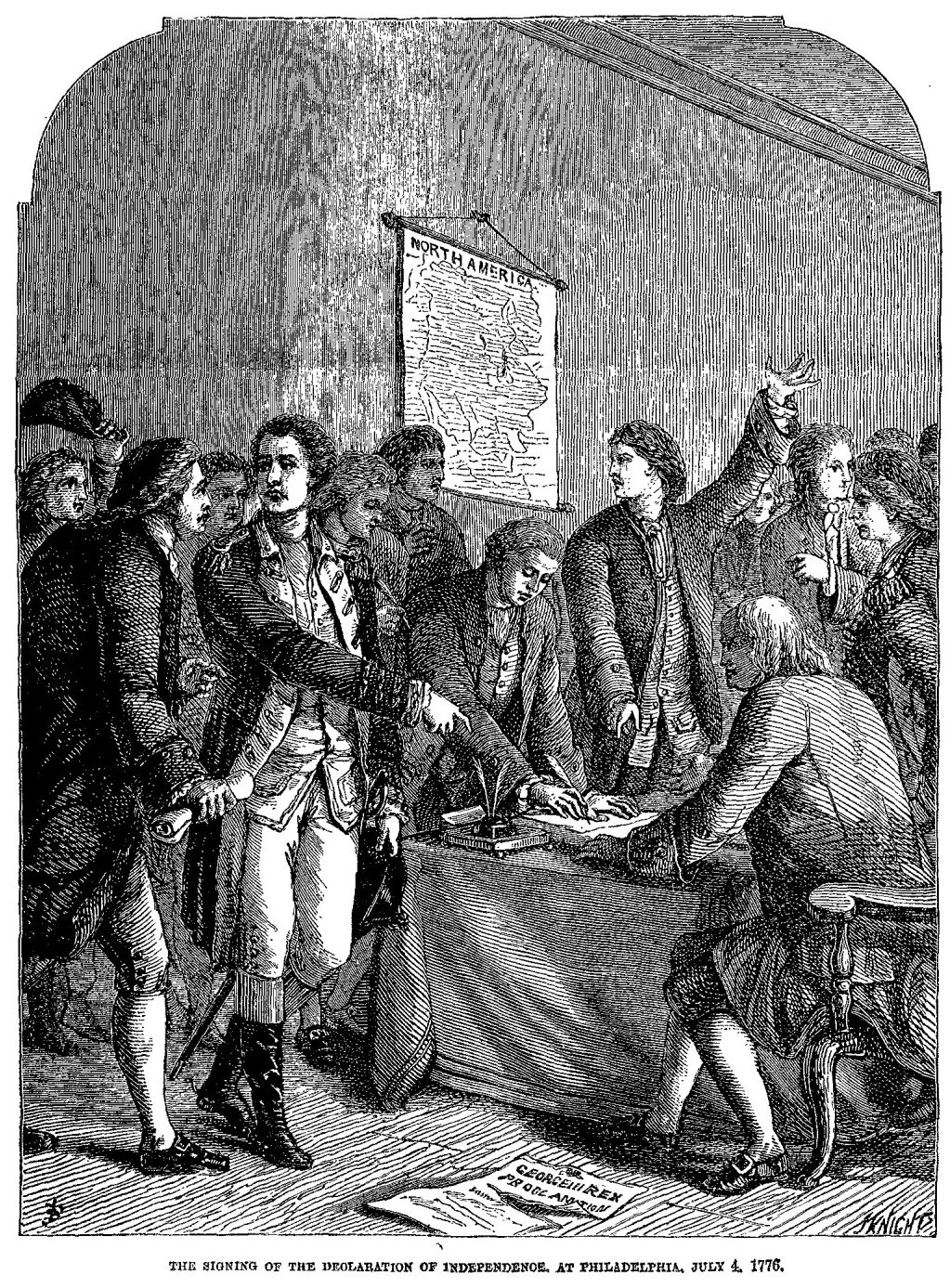
THE SIGNING OF THE DECLARATION OF INDEPENDENCE, AT PHILADELPHIA, JULY 4, 1776.
“We hold these truths to be self-evident, that all men are created equal, that they are endowed by their Creator with certain unalienable rights, that among these are life, liberty, and the pursuit of happiness; that to secure these rights, governments are instituted among men, deriving their just powers from the consent of the governed; that whenever any form of government becomes destructive of these ends, it is the right of the people to alter or to abolish it, and to institute new government, laying its foundations on such principles and organizing its powers in such form, as to them shall seem most likely to effect their safety and happiness.” Such a declaration was of necessity addressed to the whole civilized world. It spoke in behalf not only of the thirteen American colonies, but of all the victims of oppression the world over.
“The heart of Jefferson in writing the declaration, and of Congress in adopting it, beat for all humanity; the assertion of right was made for the entire world of mankind and all coming generations, without any exception whatever; for the proposition which admits of exceptions can never be self-evident. As it was put forth in the name of the ascendent people of that time, it was sure to make the circuit of the world, passing everywhere through the despotic countries of Europe; and the astonished nations, as they read that all men are created equal, started out of their lethargy, like those who have been exiles from childhood, when they suddenly hear the dimly-remembered accents of their mother tongue.”
The Rights of the People.
In the long contest which has made all lands its battlefield, between liberty and oppression, the time had at length arrived when the world was to hear proclaimed in no uncertain tones the doctrine of individual rights, and not merely the rights of certain individuals, but the rights of all individuals, or in other words, the rights of the people. The world had long been hearing about the “divine right” of kings; the monarchs had diligently proclaimed this doctrine to the people. The world had heard also about the rights of barons and nobles; Magna Charta had proclaimed them. The Petition of Right, Bill of Rights, and the Writ of Habeas Corpus, had also struck more or less effectually against monarchical usurpation of power, in favor of the rights of the people. But in the immortal Declaration put forth by Jefferson and his associates, the doctrine of the rights of the people first found full and complete expression. Then was heard a voice proclaiming liberty throughout all the land to all the inhabitants thereof,—a voice which went “out through all the earth,” and its “words to202end of the world;” and which, while it could not directly confer liberty upon the oppressed, announced to them their possession by divine right of a personal independence of those oppressive relations which had bound them in slavery to their rulers, and roused them to put forth manly efforts to make that freedom real.
One more proclamation of liberty remained to be given,—the Proclamation of Emancipation;—and that was necessary only because the principles of the Declaration of Independence had been denied and prevented from being universally carried into effect in the very land which gave it birth, by the institution of negro slavery.
To Deny Rights Is to Deny the Creator.
The significance of the Declaration of Independence lies in the fact that it speaks for the individual. Considered from the standpoint of what is theirs by creation, the human race must be considered as individuals; and it is upon the fact of creation that the whole Declaration is based. “All men are created equal;” they “are endowed by their Creator with certain unalienable rights,” among which “are life, liberty, and the pursuit of happiness;” and “to secure these rights, governments are instituted among men, deriving their just powers from the consent of the governed.” These are the fundamental, self-evident principles which support and justify all else which the Declaration sets forth. Man has certain rights which are unalienable; and he has these rights not as a part of society, but as an individual. And therefore the primary rights of mankind are individual rights, and not rights which pertain to men in the aggregate. The rights of the organized body are secondary, growing out of the rights of the individuals composing it. And any form of government which subordinates the individual’s right to “life, liberty, and the pursuit of happiness” to the real or supposed rights of the majority, ignores the fact of man’s creation, and with that ignores God.
The Declaration of Independence has lost none of its force by transmission through the century that has elapsed since its original proclamation. It is to-day a charter of civil liberty for every individual,—a declaration of independence from the despotism which to-day would mask itself in the garb of civil authority, as it did formerly in the days of George III. He who sees in it only an interesting relic of antiquity,—a mere momento of the wisdom and determination of our forefathers—is blind to its real significance, and to his own best interests as well.
The Declaration of Independence is the world’s charter of civil liberty, as the gospel is its charter of soul liberty. It was—and is—the mission of Jesus Christ “to proclaim liberty to the captives, and the opening of the prison to them that are bound.” Isa. 61:1. It was the same Jesus Christ who created man, and by creation endowed him with the unalienable rights which the Declaration of Independence sets forth. The two are in harmony with each other. S.
THE ILLINOIS SUPREME COURT ON SUNDAY LEGISLATION.
By Editor
We print on another page of this paper the recent decision of the Supreme Court of Illinois declaring void the so called “Cody Law” of that State prohibiting barbering on Sunday.
The opinion of the Court in this case is of more than ordinary interest, because unlike many judicial decisions it deals more in principles than in technicalities.
The broad principle underlying the decision is that “if the law prohibits that which is harmless in itself, or requires that to be done which does not tend to promote the health, comfort, safety and welfare of society, it will in such a case be an unauthorized exercise of power; and it will be the duty of the courts to declare such legislation void.”
It is true that the court does say that “if the public welfare of the State demands that all business and all labor of every description, except work of necessity and charity, should cease on Sunday,” etc., “the legislature has the power to enact a law requiring all persons to refrain from their ordinary callings on that day.” But before using this language the court very clearly shows that no such condition exists, and that in the very nature of certain employments it could not exist, for barbering and other secular pursuits are declared to be not only not harmful but laudible and even necessary to the health and comfort of the people; and if harmless and even necessary203six days in the week they certainly cannot become harmful upon one day by reason of anything of which the legislature can take cognizance.
Some of the remarks made by Justice Craig in passing seem very favorable to general Sunday legislation, but common sense forbids such an interpretation of his language. The court holds that the workingman's labor is his capital, and asks: “Can a law which takes that from a laborer be sustained?” The question admits of only a negative reply; and it is obvious that the case would not be made better by making the law broad enough to deprive all laborers in the State of one-seventh of their capital instead of taking it from a certain class only. It is a well-established principle of constitutional law that no one can be deprived of property without compensation. A man's time being property the State has no right to deprive him of any portion of it unless the public service requires it, and even then a man's time can no more be taken from him without compensation than could his land or his money.
The fact is, that under this decision the State of Illinois cannot maintain any Sunday statute prohibiting either labor or business on that day, but only such laws as may be necessary to protect “the peace and good order of society,” which in the very nature of the case could not be disturbed by ordinary employments on Sunday followed in a quiet and orderly manner. It is safe to say that for the present, Illinois is safe from the inroads of Sunday “law” fanaticism. But be it remembered that “eternal vigilance is the price of liberty.”
“THE SHADOWS OF VICTORY.”
The National Bureau of Reforms was incorporated on the 23rd of May, under the name of the Reform Bureau. In a circular issued under date of May 25, the secretary, Mr. Crafts, states that “the receipts for the last four weeks have been only $109.14, while the liabilities for the same time are $290.”
The work of the Bureau for a single week is thus recounted by Mr. Crafts:—
The Shadows of Victory.
On May 25th, President Cleveland sent to the office of the Reform Bureau the pen with which he had just signed the F. H. Gillett divorce bill, in recognition that the Bureau had originated and promoted the bill, in coöperation with the Congressman named, who had ably done his part. Only a week previous, May 17, the Bureau, in coöperation with a movement originated by the Endeavorers of Mt. Vernon, N. Y., had secured not only the sabbath closing of the post-office in that place, but also the implied adoption of the local option principle, originated by Hon. John Wanamaker, for all such cases, of which Endeavorers and others in many towns should hasten to avail themselves. The Saturday preceding, the distinguished trustees of the Bureau named elsewhere, incorporated it; and the Monday following the Commissioners of the District of Columbia approved the sabbath law for the Capital which the Bureau had introduced in Congress in coöperation with the Churchman's League. This is but a week of the Bureau's work.
Do our readers realize that a powerful ecclesiastical lobby is at work in our national capital, and that already our institutions have begun to bend under the weight of its influence?
THE CASE FOR SUNDAY “LAWS.”
By S.
“TIME is money.” What right then has the State to demand one-seventh of an individual’s time by a Sunday “law”? If time is money, it is property, and the State cannot, by the express declaration of the National Constitution, deprive any citizen of it “without due process of law.”
What does the State want with a person’s time, anyway? Unless that time is spent in labor for the State, the State can have no possible use for it. And the State has no right to appropriate the labor of an individual except in the case of a criminal. But by a Sunday “law,” the State appropriates no labor, but merely the individual’s time. It simply robs the individual without enriching itself.
The Creator alone has the right to demand one-seventh of every individual’s time, and he has done this by the commandment to rest on the seventh day. But he does not, like the State, demand mere idleness, but he asks that the seventh day shall be actively employed in communion with him, through his word, his works, and by prayer and other forms of religious devotion. This is the purpose for which the Sabbath was instituted, and the only basis upon which it can in reason be sustained.
And this is the basis which in the minds of men upheld the Sunday “laws,” when such “laws” were first framed. They were, in other words, based solely on religious grounds. They were religious “laws,” and as such they have come down the centuries to us. The thousand and one civil “reasons” for them were never heard of until their manufacture became a necessity on account of the enlightened sentiment of modern times, which repudiated the principle that the State can rightfully enact laws on religious grounds.
It is absurd for the State to assume the right to claim a part of the people’s time; it is sacrilegious for it to thus—albeit unwittingly—put itself in the place of God. It is unjust for it to tax the people by taking one-seventh of their time, and foolish to demand a tax for which it can have no possible use. This presents in part the case for Sunday “laws,” considered from the standpoint of reason and justice. S.
PROPOSED OATH OF ALLEGIANCE.
By Editor
A correspondent sends us the following for publication:—
OATH OF ALLEGIANCE
TO AMERICAN CONSTITUTIONAL LIBERTY, DESIGNED TO FORM A PART OF THE LEGAL QUALIFICATION OF EVERY AMERICAN VOTER.
I, A B, do solemnly swear (or affirm) that I believe in and will ever strive to preserve, unimpaired, American Constitutional Liberty, as thus defined:
The right and privilege of every civilized American citizen of adult age and sound mind, to act upon his or her personal conscience and judgment, in every action that may arise, without interference from others, till it can be plainly shown that his or her action is a positive interference with or a serious menace of the equal rights rights of others.
Our correspondent adds this comment in a subsequent paragraph:—
Most intelligent American citizens are willing to defend American liberty if they can only get a clear concept of what it is; and this measure is designed to give every voting citizen, and, through them, all others, such a concept.
This suggests the only value such an oath could possibly have. The man who is genuinely attached to the principles of liberty will cheerfully award to every other man the rights which he demands for himself; and this he will do to the best of his understanding, whether bound by an oath to do so or not. On the other hand, the man who has not this genuine love of liberty, but who is actuated simply by a selfish desire for freedom for himself, will not regard the rights of others, even though he has taken a solemn oath to do so. What the American people want is not to take iron-clad oaths to do justice, but the principles of justice implanted in their very souls. The form of oath to which we have given place may, as our correspondent suggests, assist some to an understanding of the subject, and for this reason we print it.
Will It Satisfy Anybody?
May 28, the following bill was introduced in the Senate by Mr. Kyle, by request, was read twice and referred to the Committee on the District of Columbia:—
A BILL
To regulate labor and business on Sunday in the District of Columbia.
Be it enacted by the Senate and House of Representatives of the United States of America in Congress assembled, That the heads of Government Departments or bureaus, the courts of justice, and the board of trustees of common schools in Washington shall not, except as hereinafter provided, require subordinate officers or employés to perform work on or during Sunday: Provided however, That nothing herein contained shall apply to the Executive Department, the Capitol, the Naval Yard, the Weather Bureau, the Metropolitan Police, or the employés about the courts, the police stations, the jail, or the District buildings.
Sec. 2. That it shall not be lawful for any person to keep open on Sunday any place of business for the transaction of business in which money is received, except restaurants, apothecaries, physicians, bakers, undertakers, vendors of milk, vendors of ice, vendors of fruit or other perishable merchandise, vendors of soda water, ice cream, or refreshments other than intoxicants, publishers and vendors of newspapers, telegraph and telephone operators, street-car, rail-road, steamboat, herdic, and omnibus companies, hotels and boarding-house keepers, and salaried preachers, janitors, livery-stable keepers, and other persons whose business contributes to the comfort or instruction of the public and is not of such a nature as to disturb public assemblies or the peace or good order of the community.
Sec. 3. That public assemblies of any kind held on Sunday shall be conducted in a quiet and orderly manner, so as not to interfere with the peace of residents in their neighborhood.
Sec. 4. That no church bells shall be rung before eight o'clock antemeridian, or after seven o'clock postmeridian; and no bell shall be rung more than two minutes at a time or oftener than every half hour.
Sec. 5. That the Congressional Library, National Museum, Smithsonian Institution, Monument, and Capitol shall be kept open on Sundays, from nine o'clock in the forenoon to four o'clock in the afternoon, for the accommodation of the public.
Sec. 6. That the penalty for the willful violation of any of the provisions of this Act shall be a fine not exceeding twenty dollars or imprisonment not exceeding ten days, at the discretion of the court; but it shall be a sufficient defense to a prosecution for labor on Sunday that the defendant usually keeps another day of the week as a day of rest.
Sec. 7. That all acts and parts of acts inconsistent with this Act are hereby repealed.
This bill is a curious illustration of the universality of the idea that there must be some legislation concerning Sunday. It reminds one of the story of the boys in a sinking boat. They could neither pray nor sing, so one of them, remarking that “something religious has got to be done,” proceeded to take up a collection!
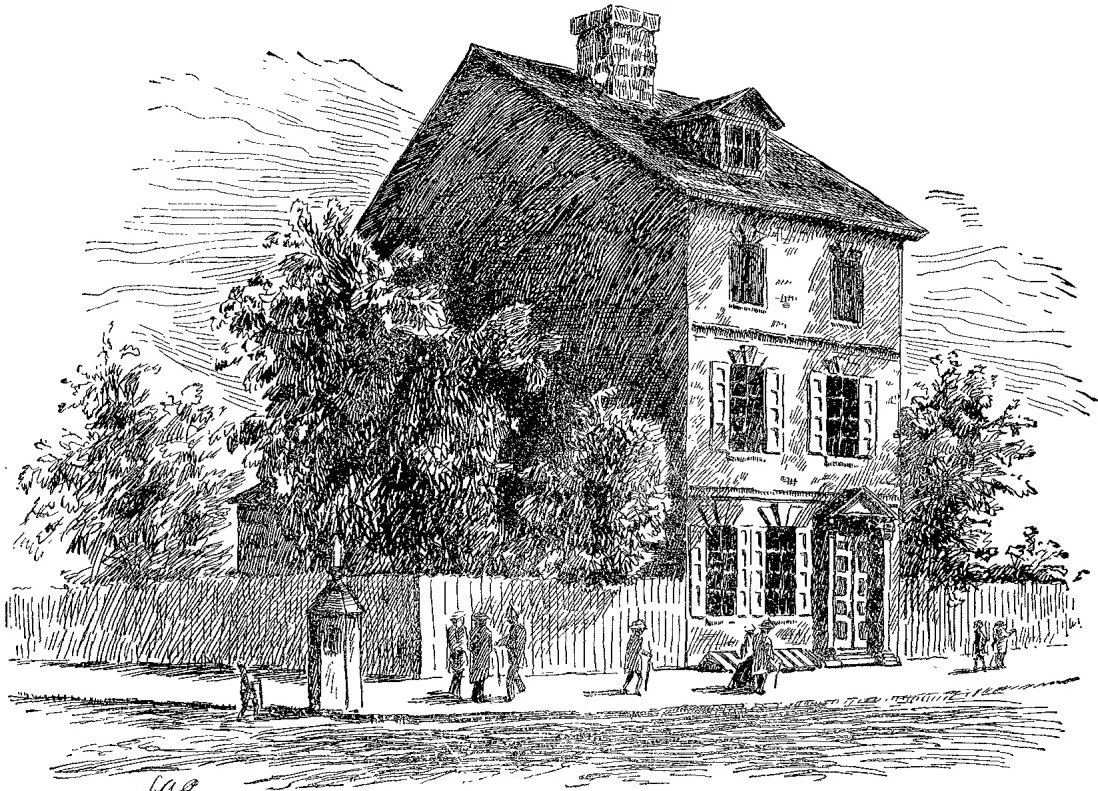
House at 702 Market Street, Philadelphia, in Which the Declaration of Independence Was Written.
• An unwholesome sentiment demands something religious of the government, and so divers Sunday bills are proposed. This, the latest one introduced, would be about as harmless as any such “law” could be, so far as interfering with anybody is concerned; but it violates the principle just as much as though it were an ironclad National Reform measure.
SOUTH AFRICAN CORRESPONDENCE.
By G. B. Thompson
BY G. B. THOMPSON.
The South African Republic, or Transvaal, is governed by the Dutch, the larger part of whom are supposed to be descendants of the Huguenot refugees who landed in Cape Colony in A. D. 1688, and afterwards emigrated across the Vaal River, and thus laid the foundation of what is now the Transvaal.
The legislative power is vested in two chambers, called the Volksraad (from volks, people, and raad, advice, or counsel). The members of both chambers are elected by the people. The following qualifications for office are required:—
The qualifications of a member of the First Chamber are that he must be thirty years of age, and that he must either have been born in the country or have been a qualified voter for fifteen consecutive years. He must, furthermore, be a member of a Protestant church, a resident in the country, and in possession of fixed property within its limits. No person of an openly bad character, or one who has been sentenced for some criminal offense, or an rehabilitated insolvent, or persons being to each other in the relationship of father and son, or stepson or colored persons, or bastards, or officials receiving salary, are allowed to take a seat in the Volksraad.—The Transvaal, by John De Villiers, p. 16.
Unbelievers and Catholics are thus excluded from a voice in the law-making assembly; also persons of color. Religion is a qualification for office. This is very different to the stipulations of the American Constitution; and much might be said concerning the iniquity and injustice of such requirements. With such legislators, and a strict Sunday law, such as already exists, the country is one on which the most puritanical National Reformer can look and exclaim, Thou art a child after my own heart! It is a Christian government, according to National Reform Christianity. Yet, what do we find? Many of the inhabitants, thinking that their lives were in danger from revolutionary strife in Johannesburg, fled at the beginning of this year from the country. The country for months has been seemingly on the point of war, and every preparation for the probable conflict has been made. At the present time about three-score of the leading citizens are in the jail of the capital under sentences of imprisonment for the crime of treason in a greater or less degree. Rumors are everywhere rife of corruption, both State and municipal. Boodlers abound, and capital rules the same as in other places; prostitution flourishes, and poverty and wretchedness abound the same as in other lands.
The Volksraad is now in session, and some steps are contemplated toward a more strict censorship of the press. A new press law has been published in the Staats Courant which is to be laid before the present session of the Volksraad. One article of this contemplated law reads as follows:—
The State president has at all times the right (with the advice and consent of the Executive Council) to prohibit entirely or temporarily the dissemination of publications printed outside the republic, the contents of which, are, in his opinion, contrary to good morals or dangerous to peace and order in the republic.
It is through some such imperial ukase as this that the Herold der Wahrheit, a paper published in Hamburg, Germany, and devoted entirely to the teaching of Bible truth as understood by its managers, and which takes no sides whatever in political questions, has been proscribed in Russia. What was taught in the paper did not coincide with the “opinions” of the law-making power of the government, and was, therefore, deemed to be against the best interests of the State, and inimical to peace; so it was prohibited.204
The prospective law of the Transvaal seems to find its precedent in the imperial ukases of the Czar. While the intent of the law-making power may be the very best, such a law is exceedingly dangerous, and apt to be made a wrong use of. Take, for instance, the literature which is printed outside of the domain ruled by the Republic which teaches that the seventh day is the Sabbath, and that Sunday is only a relic of popery, and a day on which it is no sin to do manual work. This, in the “opinion” of the State president (the executive concurring), might be deemed heresy, and therefore “contrary to good morals,” or “dangerous to peace and order in the Republic.” Especially so, when they could cite such examples as in Canada where some gospel ministers were sentenced to imprisonment for such acts as pouring water in a barrel, etc., on the “venerable day of the sun.” And in various portions of free(?) America, where Christians who had kept the Sabbath “according to the commandment,” have been immured in filthy prison cells for such misdemeanor(?) as husking corn, gardening, cutting a little fuel for a widow, plowing away from any residence or road, removing sprouts from stumps in a secluded place, lifting a wheel-barrow over a fence, etc., on Sunday.
Another important division of South Africa is the Orange Free State. This is also a republic governed by the Dutch. The Volksraad is now in session; and the Sunday question has been introduced, and an effort is being made to secure a more strict Sunday law. The following, taken from the Cape Times, of May 16, 1896, will show what is being done:—
This morning the Raad discussed the law for the better observance of the sabbath. The commission reported the work at the mines was necessary for the welfare of the industry, recommended doubling the tariff on Sunday telegrams, and were of the opinion that not much sabbath desecration in way of amusements existed. Mr. C. Wessels opposed it on the grounds that it infringed the liberty of the subject, and referred to the case of the Jews, whose Sabbath was on Saturday, but would, under the proposed law, be compelled to observe the Christian sabbath. Messrs J. Wessels and Steyn objected that if the Jews did not care to observe the Christian sabbath, they should stay away. Mr. Clote argued that the law was contrary to the institutions which guaranteed full religious liberty. Mr. Van der Walt said that under this law the President could be arrested for driving to church on Sunday. This afternoon in the Raad the discussion was continued. The law was strongly supported by Mr. Fraser, who said that mine owners rest on Sunday as well as burghers, and there was not the slightest necessity for games such as tennis, football, etc. After a lengthy discussion, the Raad approved of the principle of the law.
It is thus that Church and State are bound together in all lands, and the dove of freedom, with weary wing, hovers over all civilized lands, seeking for a place of rest, but finding none. The place of her abode, if found, must be amid the haunts of the untutored aborigines. Can it be that religious freedom,—the right to worship God according to the dictates of conscience,—has taken its everlasting flight from the earth? Verily, it seems so.
Cape Town, So. Africa, May 20.
RESIGNED FOR CONSCIENCE’ SAKE.
[Cincinnati Commercial Tribune, June 18.]
MIDDLETOWN, O., June 17.—Rev. Lyman J. Fisher, a retired Baptist minister, has resigned from the Board of City School Examiners, giving as his reason that the duties of that office conflict with his conscience. He sent a paper to the Board saying that he had, after a life-long investigation of the Scriptures, concluded that Saturday is the Sabbath, and as most of the examinations fall on that day he can not, in keeping with his conscience, hold the position longer. He says:—
I will attempt no self-justification further than to say that my convictions of personal responsibility in the matter are the result of a life long search of the Scriptures. For a longer period than I have held the position to which you called me, I have been persuaded that the seventh day is the Sabbath of the Lord. But it was first a disclosure mainly to my intellect. Meanwhile, the immenseness of the fact of Sabbath perversion dazed me, and left me with a feeling of helplessness to stem such a current. I still feel like a breaking, momentary bubble on the bosom of a restless tide. But not wholly so, at least. An appeal breaks in from the skies. With tender directness it speaks to my conscience and heart. I feel my littleness ennobled in the presence of a duty, which I am sure I can do for my King.
The resignation was unanimously accepted.
IMPRISONED FOR HIS FAITH.
P. M. HOWE, one of the three Seventh-day Adventist ministers, convicted of Sunday work some months since at Darrell, Ont., has at last been committed to jail at Chatham. He writes as follows to the president of the International Religious Liberty Association:—
Chatham Jail, June 19, 1896.
ELDER ALLEN MOON—Dear Brother: I am a prisoner in jail since 9:30 yesterday morning. The chief of police of Ridgeton came for me at 7 o’clock. He made many excuses for not taking me before. He has told so many tales that we hardly know when to believe him.
The jailer came very near refusing to take me, but did at last, and went to Judge Bell to see if I could be legally imprisoned. He said I could, and so settled the dispute as far as this court is concerned.
They treat me well. I have the same food as the other poor fellows have to eat; and besides, the comfort of the Holy Spirit bringing me joy and peace, with a contented mind. I feel as satisfied to be here as though I were sent to work for my heavenly Master in the open sunshine of heaven.
The Spirit has impressed upon my mind for some years that I would be imprisoned sooner or later, and I am sure that He who doeth all things well, will care for me while here and make me a power to some souls hereafter.
I never felt more determined to live out the truth of the Third Angel’s message than now.
I know the power of a fallen Israel will unite with the State to crush out the truth by every kind of persecution; but God says for the comfort and encouragement of his little flock: “Hear the word of the Lord, ye that tremble at his word; Your brethren that hated you, that cast you out for my name’s sake, said, Let the Lord be glorified: but he shall appear to your joy, and they shall be ashamed.” Isa. 66:5.
I am glad to suffer with Him.
Your brother in bonds,
P. M. HOWE.
It will be remembered by our readers that this man’s offense, for which he must spend forty days in jail, was assisting in preparing some mortar preparatory to erecting a church building at Darrell late last fall. The work interfered with no one, and disturbed no one, except as it occasioned mental annoyance to bigoted minds simply from the fact that it was done on Sunday. It was only the annoyance of intolerance. Imprisoning a man for such an offense is not as bad as burning him at the stake, but the principle is the same.
THE TROUBLES IN CRETE.
[New York Observer, June 11, 1896.]
SERIOUS fighting in Canea, the political capital of Crete, between the Christians and the Turks, promises to bring the Cretan question again to the front. It is true that something approaching civil war has existed in the island for some months past, the Cretans have virtually besieged the Turkish garrison in Vamos, but as the disorder has been inland, and the lives of foreign consuls and merchants were not menaced, no attention has been given it. The outbreak in Canea, and the report that the Cretans are preparing for further trouble with a view to forcing some action in their behalf, has, however, at once aroused the interest of the powers, doubtless in the fear that the disturbances may reopen the Eastern question in an acute form. Though order has been temporarily restored in the capital, and the siege of Vamos has been raised, the Cretans retreating to the mountains, the hurried despatch of reinforcements by the Porte excites suspicion that it intends to restore order in its usual summary fashion. It is not impossible that this is precisely what the Cretan Christians hope it will attempt, in the certainty that it would compel the intervention of Greece, which claims Crete in reversion, and so that of all the powers if a general war were to be averted. Since the island was restored to Turkey in 1840, revolt after revolt has occurred, but either through concessions on the part of the Porte, or the use by the powers of concerted pressure upon Greece, any general embroilment has been staved off. The danger now is that the concert of the powers may no longer exist, and thus that the Cretan outbreak may give the signal for the long-expected convulsion; the assumption being that in the event of a change in the relations of Crete to the Porte, England would oppose its cessions to Greece, as being under Franco-Russian influence, while France, Russia, and probably Germany would support it. That any action will be taken by the powers until a general insurrection has occurred is not to be expected, though if proper pressure were brought to bear upon the Porte the whole question of Turkish sovereignty over the island, the rights of Moslems and the liberties of the Christians in it, might be bridged over until the Ottoman Empire is broken up. If the sultan were induced to recall his garrison and appoint a foreign Christian prince ruler of Crete for life, with absolute powers, binding him only to send an annual tribute to Constantinople, the Cretan205question would be settled for a generation. Such a prince could create his own army for the preservation of order, just as Prince Alexander did in Bulgaria, could protect Moslems and Christians equally as is now done in Bosnia, and could in time make government more liberal as was done in Servia. The Cretans are not advanced enough for popular government, do not care for it so long as government is good and their rights are protected, any more than the prince would care whether his subjects were Moslem or Christian so long as they were orderly and paid their taxes. In this way the sultan could get all that he now gets out of Crete—his tribute—would still be sovereign, and as he has already promised the island a Christian governor, would not suffer indignity by delegating his authority to a Christian prince.
BISHOP WIGGER'S QUERY.
[Journal (New York), June 8.]
The Catholic Diocesan Union of New Jersey held a large and enthusiastic meeting in the Y. M. C. A. hall in Harrison, N. J., yesterday afternoon. President Murphy, of Jersey City, was in the chair, and delegates from all parts of the State were present.
The coming Presidential election was discussed, and Rev. Father Bogan, of St. Mary's Church, Rahway, at the request of Bishop Wigger, of the diocese of Newark, offered a resolution that the secretary of the union be directed to forward to each of the Republican candidates for the nomination for President the following question:—
In the event of your election to the Presidency of the United States, will you, in the administration of that office, make any discrimination against Roman Catholics on account of their religious belief?
When the question was read there was great applause, and the resolution was adopted unanimously. Bishop Wigger was prompted in having the resolution offered by a letter which he received from the Marquette Club, of St. Louis, which recently took similar action. The letter was indorsed by Rt. Rev. John J. Kane, bishop of St. Louis. Other Catholic societies throughout the country will take similar action.