Your ShelfYour Projects

Signs of the Times, Vol. 42, No. 48.

Let Not Your Heart Be Troubled

Signs of the Times

Dec 7, 1915

Pacific Press Publishing Association · Mountain View, California · Dec 7, 1915

“Let Not Your Heart Be Troubled”

Promises That Are Wonderfully Clear—Given to Fill the Soul with Comfort—They Tell of the Coming One—How Can They Be Doubted?
By IRWIN H. EVANS
“LET not your heart be troubled: ye believe in God, believe also in Me. In My Father’s house are many mansions: if it were not so, I would have told you. I go to prepare a place for you. And if I go and prepare a place for you, I will come again, and receive you unto Myself; that where I am, there ye may be also.” When Christ spoke these words to His followers, He left them a definite promise of His return to this earth. This return could be no other than His second coming.
At the time this promise was made, the Saviour’s work on this earth in behalf of sinners was nearly finished. Gethsemane, that night of wrestling alone in prayer, was still before Him. One of His chosen disciples was yet to give the traitor’s kiss. An overconfident disciple was to deny Him thrice. Then would follow the cruel mockings and scourgings, the cross, and Calvary; and all would be done. In the face of all this, with death before Him, and the yawning grave awaiting Him on the morrow, the Master made the definite promise to His disciples: “I go to prepare a place for you. And if I go and prepare a place for you, I will come again, and receive you unto Myself; that where I am, there ye may be also.”

HE RETURNS IN GLORY

Who could read such a promise from the lips of the Saviour, just preceding His death and resurrection, and not believe that He is to come to this earth again?
After the resurrection, only ten days preceding Pentecost, the promise of Christ’s return to this earth was most emphatically reiterated. The scene was a very dramatic one. Christ had appeared in Jerusalem, revealing Himself to His disciples, after which they went to Mount Olivet for quietude and conversation. They were in sight of the city where Jehovah had been worshiped by the people of God since the days of Solomon; that city over which the Saviour wept in pity as He foresaw its utter destruction but a few years thereafter; the city in which stood the beautiful temple, the pride and joy of the Jewish nation, the temple in which the veil separating the holy from the most holy had been rent in twain by an unseen power. While talking with His disciples, the Master suddenly began to ascend into heaven, in a cloud of glory. And while the disciples were beholding this miraculous event, and looking heavenward for a last glimpse of their departing Lord, two men, in shining apparel, stood by them, and said: “Ye men of Galilee, why stand ye gazing up into heaven? this same Jesus, which is taken up from you into heaven, shall so come in like manner as ye have seen Him go into heaven.”

DID HE MEAN TO DECEIVE?

Can we suppose for an instant that Christ meant to deceive His disciples, or that these angels from the courts of heaven were conveying a promise to them which God did not intend to keep? When they said, “This same Jesus, which is taken up from you into heaven, shall so come in like manner as ye have seen Him go into heaven,” it was in language as clear and simple as could be uttered. His coming was not to be hidden or mysterious; but as they saw Him depart in glory, so He would be seen returning to this earth.

THEY WHO SAW IT TOLD IT

Every one of the disciples who saw Christ ascend into heaven on this occasion, whose writings have come down to us, mentions most confidently his expectation of the Saviour’s return.
Peter, the ardent and zealous one, who traveled far and wide to preach the gospel of the kingdom, says: “That the trial of your faith, being much more precious than of gold that perisheth, though it be tried with fire, might be found unto praise and honor and glory at the appearing of Jesus Christ.” “Wherefore gird up the loins of your mind, be sober, and hope to the end for the grace that is to be brought unto you at the revelation of Jesus Christ.” 1 Peter 1:7, 13.

WAIT PATIENTLY FOR IT

The apostle James, who seemed to be one of the pillars of the church in Jerusalem, wrote as follows, in his epistle: “Be patient therefore, brethren, unto the coming of the Lord. Behold, the husbandman waiteth for the precious fruit of the earth, and hath long patience for it, until he receive the early and latter rain. Be ye also patient; stablish your hearts: for the coming of the Lord draweth nigh.” James 5:7, 8.
John the beloved, whom the Master seemed to hold in such tender affection, wrote: “Beloved, now are we the sons of God, and it doth not yet appear what we shall be: we know that, when He shall appear, we shall be like Him; for we shall see Him as He is.” 1 John 3:2.
Jude, the brother of James, used this language concerning Christ’s return to the earth: “And Enoch also, the seventh from Adam, prophesied of these, saying, Behold, the Lord cometh with ten thousands of His saints, to execute judgment upon all, and to convince all that are ungodly among them of all their ungodly deeds which they have ungodly committed, and of all their hard speeches which ungodly sinners have spoken against Him.” Jude 14, 15.

“EVERY EYE SHALL SEE HIM”

The author of the book of Revelation again and again repeats the promise of Christ’s second coming. It seems to be the keynote of the Apocalypse. Let us read a few of the texts in Revelation referring to the event:
“Behold, He cometh with clouds; and every eye shall see Him, and they also which pierced Him; and all kindreds of the earth shall wail because of Him. Even so, Amen. I am Alpha and Omega, the beginning and the ending, saith the Lord, which is, and which was, and which is to come, the Almighty.” Rev. 1:7, 8.
“Behold, I come quickly: hold that fast which thou hast, that no man take thy crown.” Rev. 3:11.
“And, behold, I come quickly; and My reward is with Me, to give every man according as his work shall be.” “He which testifieth these things saith, Surely I come quickly. Amen. Even so, come, Lord Jesus.” Rev. 22: 12, 20.
How can any one read such scriptures without concluding that the disciples of Christ, who were present at the time of His ascension, and heard the words of the heavenly messengers, believed in the second coming of the Son of man to this earth?

PAUL TAUGHT THE SECOND COMING

The apostle to the gentiles, too, was an ardent Adventist; for again and again, in his letters to the churches, he mentioned the return of Christ to this earth. In his letter to Titus, we find these words: “Teaching us that, denying ungodliness and worldly lusts, we should live soberly, righteously, and godly, in this present world; looking for that blessed hope, and the glorious appearing of the great God and our Saviour Jesus Christ.” Titus 2: 12, 13.
Writing to Timothy, he said: “That thou keep this commandment without spot, unrebukable, until the appearing of our Lord Jesus Christ;” and, “I charge thee therefore before God, and the Lord Jesus Christ, who shall judge the quick and the dead at His appearing and His kingdom.” 1 Tim. 6:14; 2 Tim. 4:1.
To the church at Thessalonica, Paul gave the most emphatic assurance that Christ was to come again, in these words: “But I would not have you to be ignorant, brethren, concerning them which are asleep, that ye sorrow not, even as others which have no hope. For if we believe that Jesus died and rose again, even so them also which sleep in Jesus will God bring with Him. For this we say unto you by the word of the Lord, that we which are alive and remain unto the coming of the Lord shall not prevent them which are asleep. For the Lord Himself shall descend from heaven with a shout, with the voice of the Archangel, and with the trump of God: and the dead in Christ shall rise first; then we which are alive and remain shall be caught up together with them in the clouds, to meet the Lord in the air: and so shall we ever be with the Lord. Wherefore comfort one another with these words.” 1 Thess. 4:13-18.

WHAT COULD BE PLAINER?

Surely such language must have inspired, in the hearts of those who read these epistles, both hope and faith in the second coming of Christ.
In the epistle to the Hebrews, we find this declaration: “So Christ was once offered to bear the sins of many; and unto them that look for Him shall He appear the second time without sin unto salvation.” Heb. 9:28.
Reader, are you an Adventist? Do you believe the advent message taught by Christ and His disciples, that Jesus Christ will come to this earth again? Do you believe that these promises must be fulfilled, and that the Lord will return to this earth to gather to Himself those who have been faithful and true? If not, why not?

The Time to Begin

THE time to begin to be a Christian, and the time to begin to remain a Christian, is when you are first converted. And the proper time to become converted is when one has arrived at the age of accountability.
When young, the mind is usually tender, and easily impressed by the Holy Spirit. This is the time to respond. But the very moment one commences to resist and put off yielding to its influence, a hardening process takes place in the life; and the longer one resists and refuses to yield, the harder and less impressible is the mind certain to become.
It is most dangerous to resist the Holy Spirit, and sin against light and knowledge that come to us. Very many of us have realized a demonstration of this fact in our own lives; and all who have had this experience, have, with few exceptions, regretted it with much sorrow. Blessed and happy is he who gave himself to the Lord, to be guided by His counsel alone, in early life, and has walked constantly therein up to the last moment. This is the only reasonable course to pursue,—a course which no one will ever have cause to regret.
But if a person has failed to make this early start in the Christian life, the time to begin, in his particular case, is now. Because you have not already done this, is no reason why you should not do so now. God, in His infinite love and mercy, will receive and cleanse you when you have realized that you are a sinner, and repentantly come to Him in sincerity of heart and purpose.
J. W. Lowe.

MABEL CORINNE CRAKER

Besetments

O GRACIOUS Father, guide my feet Around the stones which yesterday Lay in my path — those stones o’er which I stumbled. For, perchance, to-day, Should my path lead that same way, I could but fall. When left alone, No strength have I by which to turn My steps aside. I’ve weaker grown Since yesterday. But if Thou lead, I cannot fall. Those stones so wide, But signal that it’s time to press Still closer to my matchless Guide.

MABEL CORINNE CRAKER

Tablet and Monument Utter Their Voices
What They Say of Creation, the Fall of Man, the Deluge, the Tower of Babel, and the Confusion of Tongues—Archeology Arraigns Present-Day Biblical Criticism
By A. EARL HALL, B. A.
This is the fourth of Professor Hall’s articles on the reply of archeology to present-day Biblical criticism. In previous articles, he has stated the principles of the higher critic movement, and has shown that the teachings of the critics have filled the world with a disguised infidelity cloaked with the Christian religion. Last week, his article told of the finding of the Rosetta Stone and the Behistun Rock, and how these monuments of antiquity enabled the archeologist to read the inscriptions that hitherto had baffled the profoundest scholarship.
His article next week will show, from the monuments, that the record in Genesis 14, as well as other portions of the Old Testament, is founded on fact. These scriptures are not fiction, as the critics had affirmed before men learned how to read the tablets and monuments of antiquity.
EDITOR.
“If these should hold their peace, the stones would immediately cry out.” Before proceeding to a study of archeological evidence as related to the Old Testament, let a few principles be thoroughly understood. The reader will then have a better idea of the nature of the evidence, what is claimed for it, and just to what extent the historical portions of the Bible are corroborated.
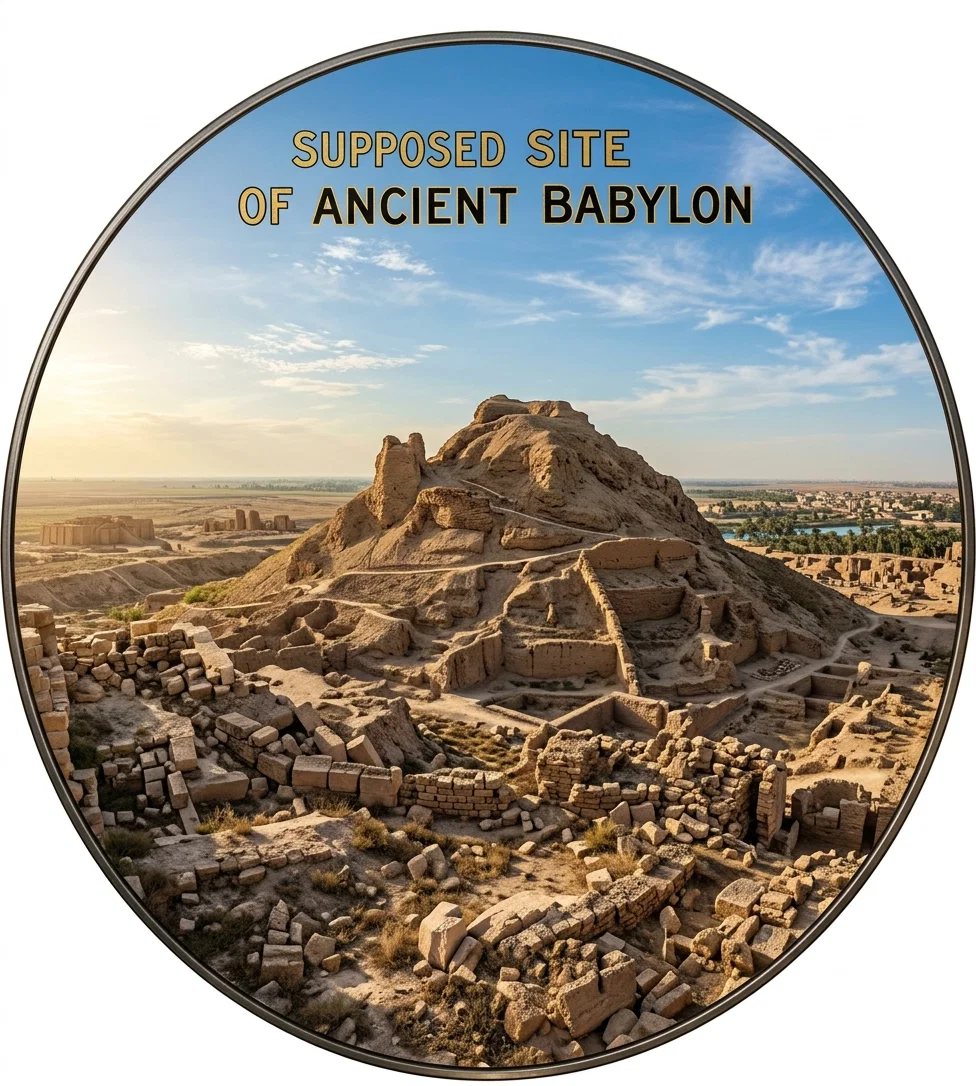
SUPPOSED SITE OF
SUPPOSED SITE OF

THE CRITIC MUST PROVE

First: It must be remembered that here, as well as in similar discussions, “the burden of proof lies with the critic.” This is not to say, by any means, that a doctrine is right simply because, for a long period of time, it has been believed to be true. But we do contend for the truthfulness of the following statement,—that certain facts handed down by the Jews through their long career, believed and taught by Christ, accepted by the apostles and the apostolic church, and universally held by the Christian churches until well into the past century, ought not to be given up on such slight evidence as has thus far been given, despite the vast amount of literature which professes to expose the so-called “errors” of the Bible.
One author thus states this principle of the one who is to furnish the proof in such controversies: “In presence of undeniable facts of which a certain explanation has been traditionally given, the historian is bound to admit the explanation so generally given, or to offer another and more credible one.”—Alexander Stewart, “Handbook of Christian Evidences,” chapter on the resurrection, note 1. Again, quoting from Keim, who, after giving his views on the same subject, says, “Let those who ridicule, present us with a better explanation.”
Second: It is not claimed that the monuments will substantiate every statement of a historical nature,—that Jericho fell as the Bible says; that Moses wrote Genesis, or that he did not copy his laws; where the garden of Eden was; or that there was a drought in the days of Ahab. It has already been shown that we are not called on to “defend” the Bible; we are doing more than the case demands, but are glad to do so for the help it will be for our own faith and that of others. In harmony with this, the articles that follow will be written along this plan:
(a) The discoveries made up to date give accurate historical background for the Old Testament.
(b) In a multitude of instances, the records have found exact confirmation in the facts of archeological discovery.
(c) This is especially the case in instances which, for lack of information, were formerly regarded as difficult or suspicious.
(d) New discoveries have brought into stronger relief the marvelous exactness of the Bible writers in matters that depend on men’s being careful observers.
(e) The discoveries have brought into relief, by contrast, the soberness and reticence of our Scriptures by the side of legendary literature found elsewhere and alleged to be parallel. (John Urquhart, “Archeology’s Solution to Old Testament Puzzles,” in preface by Willis J. Beecher.)
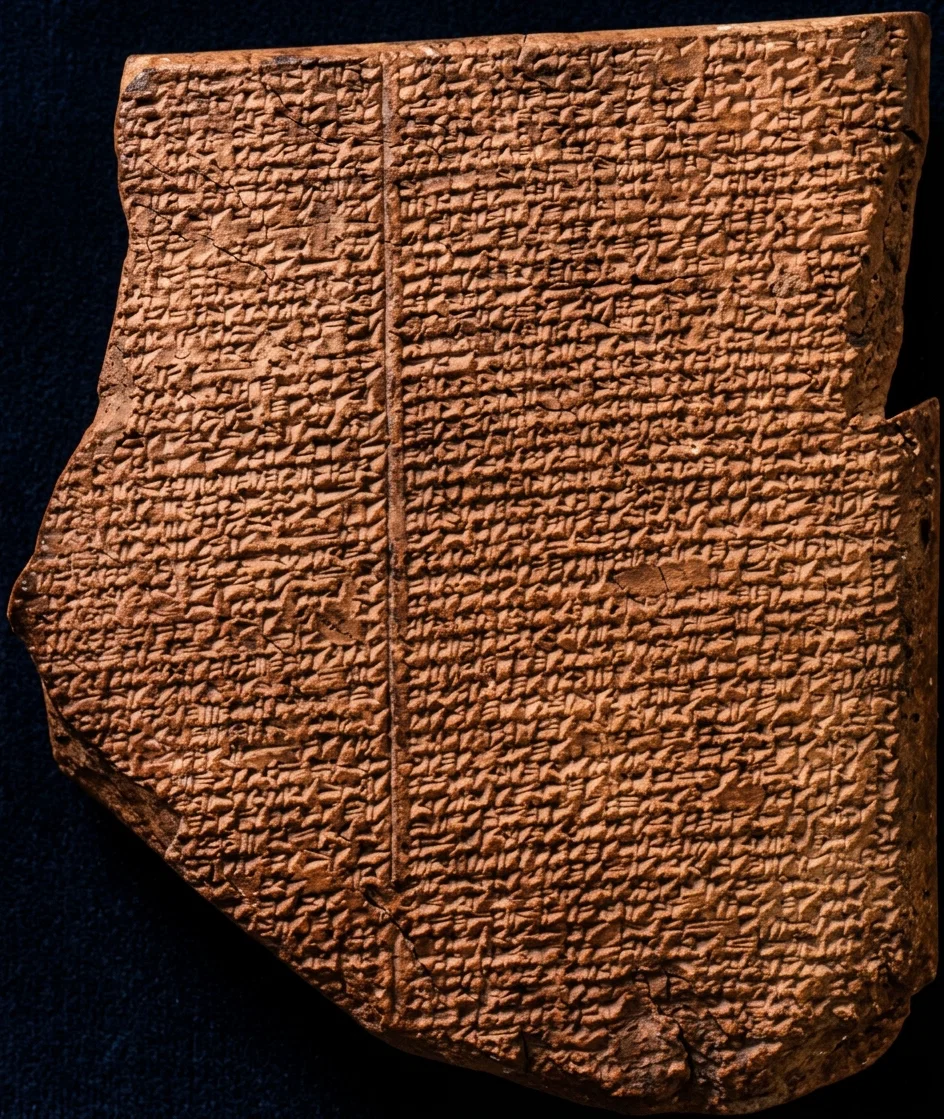
Fragment of a baked clay tablet inscribed with the Babylonian account of the Deluge. The original is in the Nineveh Gallery of the British Museum.
Third: No theory of Biblical criticism is to be fully accepted, and made a part of faith and life, until tested and attested by archeological facts. The functions of archeology are here given for the benefit of the reader:
I. It is to supply the historical setting of Scripture. II. It is to be a guide to critical methods. III. It is to be a guide concerning interpretation of ancient literature. IV. To provide facts with which to test the critical theories. (M. G. Kyle, “Deciding Voice of the Monuments,” preface, page 10; pages 17, 20, 26, 29.)
Two significant sentences are here given for close consideration:

WHAT THE CRITICAL SKEPTIC SAID

“This conception—Israel’s dependence upon Babylonia—has grown steadily within the last few decades, so that the edifice which has been reared has now reached its full height, the capstone has been set, and the structure is complete. A change of names, that is all, and a Babylonian deity, Marduk or Bel, becomes Christ.”—A. T. Clay, “Amurru, Home of the Northern Semites,” page 20.

REPLY FROM THE ASSYRIOLOGIST

“It seems as though God had held back the knowledge of facts that men might give free scope to their unbelief, and then let the full flood of information sweep away the objections raised against His word, as the tide sweeps away the structures children had erected on the sand.”—Thomas Laurie, “Assyrian Echoes of the Word,” page 3, preface.
In 1845, A. H. Layard said that four years before, “a case scarcely three feet square inclosed all that remained not only of the great city Nineveh, but of Babylon itself.”—“Nineveh and Its Remains,” volume 1, page 17, quoted by Goodspeed in “History of the Babylonians and Assyrians,” page 17. But now the museums of Europe and America are crowded with this material. A few years ago, the “British Museum alone had more than thirty thousand tablets, awaiting the patient toil of the cuneiform expert. To-day in published form there is more than six times as much literature as is contained in the Hebrew of the Old Testament. . . . Not one quarter of all the inscriptions has been published.”—Price, “Monuments and the Old Testament,” page 62.

THE ASSYRIAN TABLETS OF CREATION

The clay tablets of the creation were found by Smith in the library of Ashur-bani-pal, king of Assyria 668–626, and are now in the British Museum. This king’s name is found as Asnapper in Ezra 4:10—Osnappar in the Revised Version.
As it is not possible to give the translation of this tablet, the following table will help the reader in comparing the two accounts—the Babylonian, and the record as found in Genesis:

GENESIS

  1. Earth waste and void.
  2. Light dispels darkness.
  3. Dry land appears.
  4. Sun, moon, and stars placed.
  5. Animals and creeping things created by God.
  6. God creates mankind.

BABYLONIAN

  1. Time when all was chaos.
  2. Merodach overthrows Tiamat, demon of chaos.
  3. Merodach creates dust.
  4. Merodach places sun, moon, and stars as mansions of the gods.
  5. Numerous gods create animals.
  6. Merodach creates mankind.
One marked feature differentiates these two accounts: Genesis mentions one God as Creator; the Babylonian has no such Being or work done, but many gods have a share in the “beginning of things.”

THE SABBATH OF THE BIBLE AND THE TABLETS

BIBLICAL

  1. Sabbath was made for man.
  2. God never angry with His people.
  3. Occurred regularly every seventh day.
  4. Israel was to prepare food on Friday; special sacrifices on that day; day of worship for all; lawful to do good on the Sabbath day; enemies to be prayed for at all times.

BABYLONIAN

  1. Day or rest of the heart.
  2. Gods ceased from their anger on that day.
  3. Occurred on seventh, fourteenth, nineteenth, twenty-first, and twenty-eighth days of the month.
  4. King could not eat meat roasted, or put on his royal robes, or go into his chariot, or enter the temple; physicians could not visit the sick; enemies could not be cursed on those days.
A few excerpts from A. T. Clay will be offered here:
“For some years, a number of the Assyriologists who have written upon the Sabbath of the Hebrews have reached the conclusion that not only ‘the word “Sabbath” is Babylonian indeed,’ but also that the institution originated in the Tigro-Euphrates valley, . . . expressed in the statement, ‘The Sabbath rest was essentially of Babylonian origin.’”—“Amurru,” page 55.
Professor Clay shows clearly, using even statements from the critics as to the meaning of the term in the cuneiform, that the word “Sabbath” comes from the word shapattam, and means, “appeasement of the gods, expiation, from the root that means to conciliate.” Also it is a synonym for gamara, which means, “to be complete, to be full.”
It is now known “that shapattam was the name of the fifteenth day of the month; and considered in connection with the synonym gamara, it doubtless had reference, as has been suggested, to the full of the moon in the middle of the month. But until some evidence is forthcoming, we cannot justifiably assume . . . that there was a cessation of work, or that it was a rest day from human labor. No other conclusion, therefore, can be reached than that the Babylonians did not observe a day in every seven, that was called the Sabbath.”—Id., pages 56, 57.

THE FALL OF MAN

We do not hesitate to acknowledge that we have in the tablets no direct evidence concerning this subject, but mention is to be made of a very interesting seal cylinder. On this, there is a group of figures, in the center of which is a tree, upon which fruit may be seen. A figure of a man is seen on one side, and that of a woman on the other side, of the tree. Behind the latter is a figure representing a serpent. We know, from the cuneiform records, that the early people of Babylonia knew of “a wicked serpent,” which was responsible for the fall of man, and “a tree of life.” Not a word is found on the cylinder. Where only could such an idea be obtained? The reader may answer for himself.

STORY OF THE DELUGE IN THE TABLETS

The following facts can readily be noted by a reading of these tablets of the Deluge as related to the account in Genesis. We quote from Price: 1. The building of an ark (ship). 2. The preservation of the seed of life. 3. The deluge of water, with a great storm. 4. A landing on a mountain. 5. A sending out of a bird. 6. An offering of sacrifice upon landing . 7. An acceptance of a sweet savor by the deity (gods). (“Monuments and the Old Testament,” page 94.)
BIRS NIMRUD, NEAR BABYLON
Aside from the tablets found by Smith, three more are mentioned by Clay, the most important of which was in the possession of the late J. Pierpont Morgan. It is thought that this was written about 2,000 B.C. (“Amurru,” page 73.) It is to be remembered that the Chaldean account of the Deluge is the only one that gives a moral reason for this judgment by God, or, we add, by the gods.
In this connection, we wish to call attention to a fact discussed fully by Lenormant, concerning the number of generations from creation to the Flood. From his researches, it seems that the Egyptians, the Assyrians, the Armenians, the Chinese, the Germans, the Scandinavians, and the Arabs have a common tradition that there were ten generations, or heroes, or mythological personages, who lived during a similar period of time. In the Assyrian list, the seventh is Edomachus, who corresponds to Enoch of the Biblical list. The fact that “both conversed with their deities, and the former ruled 365 years, the same number that the latter lived on earth, and the further fact that the tenth and last of each list are the heroes of the Deluge—Xisuthros and Noah—seem to be points that cannot be considered simply as coincidence.”—Clay, “Amurru,” page 69.

TOWER OF BABEL

For the subject of the Tower of Babel, a note will be copied from George Rawlinson, giving the ancient authority upon the subject:
“At that time, the men of antiquity are said to have been so puffed up with strength and haughtiness that they despised even the gods, and undertook to build that lofty obelisk which is now called Babylon. And when they had already built it up into the heavens almost as high as the gods, the gods, by the help of the winds, smote the well-contrived but futile work, and prostrated it to the ground. And that rubbish took the name of Babel. For up to that time, men relied upon the use of one language; but then a various and discordant confusion of tongues was sent by the gods upon those who had heretofore used but one language.”—“Historical Evidences,” note 69, lecture 2.
The reader will have no trouble in comparing the foregoing account with that in Genesis. In the British Museum there is a tablet which, though badly broken, gives in substance the facts in the preceding note. See “Records of the Past,” old series, volume 7, pages 129, 132.

WHAT IS PROVED?

Now that we have this material, of what value is it? Does it prove anything? How do you know that the writer of Genesis did not copy his accounts from these sources? No one now living saw Moses write his book, neither can we go back a number of generations and ascertain the fact in reference to it. The monuments do not, and in the very nature of the case, cannot, answer that question. We ask the reader, in view of the statements in the previous articles and in this one, to read carefully, and weigh the evidence, and judge for himself as to whether the “stories” of Genesis are copied from Babylonian sources, or are inspired by the Creator of the universe. Note particularly what the following authorities say:
“These are not traditions peculiar to Semitic peoples and religions as growing out of their characteristics. They are common to all civilized nations of antiquity. Their common elements point to a time when the human race occupied a common home and held a common faith. . . . Early races of men, wherever they wandered, took with them these primeval traditions; and with the varying latitudes and climes, their habits and modes of life have carried these, and present them to us to-day in their different dresses. One ancient religion did not borrow these universal traditions from another, but each possessed primitively these traditions in their original form. A careful examination of all these traditions shows that the Genesis record is the purest, the least colored by extravagances, and the nearest to what we must conceive to have been the original form of these traditions.”—Price, “Monuments and the Old Testament,” pages 95, 96.
“Principal Cave quotes extensively from the literature of ancient Babylon, Egypt, India, China, Persia, Japan, Siam, Greece, Rome, and the traditions of Mexico, Nicaragua, Brazil, Cuba, Borneo, the Scandinavians, the Tartars, the North American Indians, the South Sea Islanders, all confirming, in the most remarkable manner, the historical accuracy of the first fourteen chapters of Genesis.”—J. H. Brookes, “Testimony of History to the Bible,” page 13.
“A voice out of the tombs of thirty centuries confirms the historical accuracy of Moses, and demolishes the whole system of Biblical criticism, which has taught that this portion of the book of Genesis was impossible of truth, a pure imagination.”—W. C. Prime, in Brookes, pages 13 and 14.
“The Bible has undergone a certain amount of revival in credit and authority in consequence of these criticisms. My own protracted observation of the controversy, parallel and in some important respects analogous to that on the poems of Homer, compels me to entertain but a mean opinion of negative speculation.”—W. E. Gladstone, quoted in Brookes, page 15.

PERSUASIVE EVIDENCE

Circumstantial evidence is sometimes misleading, although, as Thoreau once said, circumstantial evidence is quite persuasive, as “when one finds trout in the milk.”
The fact that the accounts of Scripture are similar to the Babylonian account, is not proof in the least that the former narratives were copied from the latter. A further discussion of this principle will be given in the next article in connection with the Code of Hammurabi and the charge that Moses also copied from it.

The Greatest Mind Developer

The Hasty or Careless Reader Does Not Get the Effect—Wide Range of Subjects, and Stimulus to Highest Thought—Hearing the Voice of the Eternal
By the late MRS. E. G. WHITE
For the mind and the soul, as well as for the body, it is God’s law that strength is acquired by effort. It is exercise that develops. In harmony with this law, God has provided in His word the means for mental and spiritual development.

CARELESS READER DOES NOT DISCERN

The Bible contains all the principles that men need to understand in order to be fitted either for this life or for the life to come. And these principles may be understood by all. No one with a spirit to appreciate its teaching can read a single passage from the Bible without gaining from it some helpful thought. But the most valuable teaching of the Bible is not to be gained by occasional or disconnected study. Its great system of truth is not so presented as to be discerned by the hasty or careless reader. Many of its treasures lie far beneath the surface, and can be obtained only by diligent research and continuous effort. The truths that go to make up the great whole must be searched out and gathered up, “here a little, and there a little.”

THE STRUCTURE REVEALS THE INFINITE

When thus searched out and brought together, they will be found to be perfectly fitted to one another. Each Gospel is a supplement to the others, every prophecy an explanation of another, every truth a development of some other truth. Every principle in the word of God has its place, every fact its bearing. And the complete structure, in design and execution, bears testimony to its Author. Such a structure no mind but that of the Infinite could conceive or fashion.
In searching out the various parts, and studying their relationship, the highest faculties of the human mind are called into intense activity. No one can engage in such study without developing mental power.

GREATEST MIND DEVELOPER

And not alone in searching out truth and bringing it together does the mental value of Bible study consist. It consists also in the effort required to grasp the themes presented. The mind occupied with commonplace matters only, becomes dwarfed and enfeebled. If never tasked to comprehend grand and far-reaching truths, it after a time loses the power of growth. As a safeguard against this degeneracy, and a stimulus to development, nothing else can equal the study of God’s word.
As a means of intellectual training, the Bible is more effective than any other book, or all other books combined. The greatness of its themes, the dignified simplicity of its utterances, the beauty of its imagery, quicken and uplift the thoughts as nothing else can. No other study can impart such mental power as does the effort to grasp the stupendous truths of revelation. The mind thus brought in contact with the thoughts of the Infinite cannot but expand and strengthen.

WIDE RANGE OF SUBJECTS AND STIMULUS TO HIGHEST THOUGHT

In its wide range of style and subjects, the Bible has something to interest every mind and appeal to every heart. In its pages are found history the most ancient; biography the truest to life; principles of government for the control of the state, for the regulation of the household,—principles that human wisdom has never equaled. It contains philosophy the most profound, poetry the sweetest and most sublime, the most impassioned and the most pathetic. Immeasurably superior in value to the productions of any human author are the Bible writings, even when thus considered; but of infinitely wider scope, of infinitely greater value, are they when viewed in their relation to the grand central thought. Viewed in the light of this thought, every topic has a new significance. In the most simply stated truths are involved principles that are as high as heaven and that compass eternity.

KEY TO THE WHOLE TREASURE HOUSE

The central theme of the Bible, the theme about which every other in the whole book clusters, is the redemption plan, the restoration in the human soul of the image of God.
He who grasps this thought has before him an infinite field for study. He has the key that will unlock to him the whole treasure house of God’s word.
The science of redemption is the science of all sciences; the science that is the study of the angels and of all the intelligences of the unfallen worlds; the science that engages the attention of our Lord and Saviour; the science that enters into the purpose brooded in the mind of the Infinite,—“kept in silence through times eternal;” the science that will be the study of God’s redeemed throughout endless ages. This is the highest study in which it is possible for man to engage. As no other study can, it will quicken the mind and uplift the soul.

HEARING THE VOICE OF THE ETERNAL

With the word of God in his hands, every human being, wherever his lot in life may be cast, may have such companionship as he shall choose. In its pages, he may hold converse with the noblest and best of the human race, and may listen to the voice of the Eternal as He speaks with men. As he studies and meditates upon the themes into which “the angels desire to look,” he may have their companionship. He may follow the steps of the heavenly Teacher, and listen to His words as when He taught on mountain and plain and sea. He may dwell in this world in the atmosphere of heaven, imparting to earth’s sorrowing and tempted ones thoughts of hope and longings for holiness; himself coming closer and still closer into fellowship with the Unseen; like him of old who walked with God, drawing nearer and nearer the threshold of the eternal world, until the portals shall open, and he shall enter there. He will find himself no stranger. The voices that will greet him are the voices of the holy ones, who, unseen, were on earth his companions,—voices that here he learned to distinguish and to love. He who through the word of God has lived in fellowship with heaven, will find himself at home in heaven’s companionship.

Death Vanquished

By ELIZA H. MORTON
’TWAS long and long ago that Christ arose, A conqueror above His foes, And death stood still Until the graves gave up the ones God chose To do His will.
Full soon another resurrection morn In splendor glorious will dawn, And death depart, And all its gloomy shadows be withdrawn. O joy, my heart!

The Sabbath — A Gibraltar

The Sabbath, at its birth, stood in sinless Eden, a sign and memorial of a finished creation, hence of all the power of the almighty Creator.
God placed it, and it still stands, as a Gibraltar in the very gate of Genesis revelation. Gen. 2: 1-3.
It occupied the bosom portion of the divine constitutional law when given amid the thunders and lightnings of Sinai. Ex. 20: 8-11. Its name and character were there engraved in the tables of stone, by the same hand that carved the beauties of the universe. Ex. 32: 16.
It stood as one of the beautiful cardinal virtues in the life of the Son of God. Luke 4: 16. As Lord of it, He established its obligations as a part of His own righteousness. Mark 2: 27, 28; Ps. 119: 172.
As the Lord rested at the close of creation’s week, so at the close of re-creation’s week, He said, “It is finished” (John 19: 30); and through “the Sabbath day according to the commandment” (Luke 23: 56), He rested in the tomb, having confirmed the covenant with His own blood. Gal. 3: 15.
The Sabbath will stand, with all its Edenic purity and power, when the curse of sin has been removed from this world, and Eden is restored. “For as the new heavens and the new earth, which I will make, shall remain before Me, saith the Lord, so shall your seed and your name remain. And it shall come to pass, that from one new moon to another, and from one Sabbath to another, shall all flesh come to worship before Me, saith the Lord.” Isa. 66: 22, 23.
The Sabbath stands, then, as a great rainbow of promise, with one end in sinless Eden, and the other in Eden redeemed, and spanning the great chasm of a lost world. “Remember the Sabbath day, to keep it holy.”
ALBERT E. PLACE.

Sweetness in Bitter Waters

You have had a long, hard march? You are weary and thirsty, and have found the waters bitter? Utter not one word of murmuring or complaint. This is your hour of opportunity. God waits your call of faith. Cry to Him, and He will certainly discover to you the branch that will sweeten the bitter draught. “Mara” is never disappointment to the one who by faith discerns in it His-appointment. Concentrated bitterness becomes concentrated sweetness to the child of trust and prayer. C. L. TAYLOR.
Continue reading: Responding to Christ’s Love