The Youth’s Instructor, Vol. 49, No. 15.

IN GETHSEMANE

The Youth’s Instructor

Apr 11, 1901

Review and Herald Publishing Company · Battle Creek, Mich. · Apr 11, 1901

IN GETHSEMANE
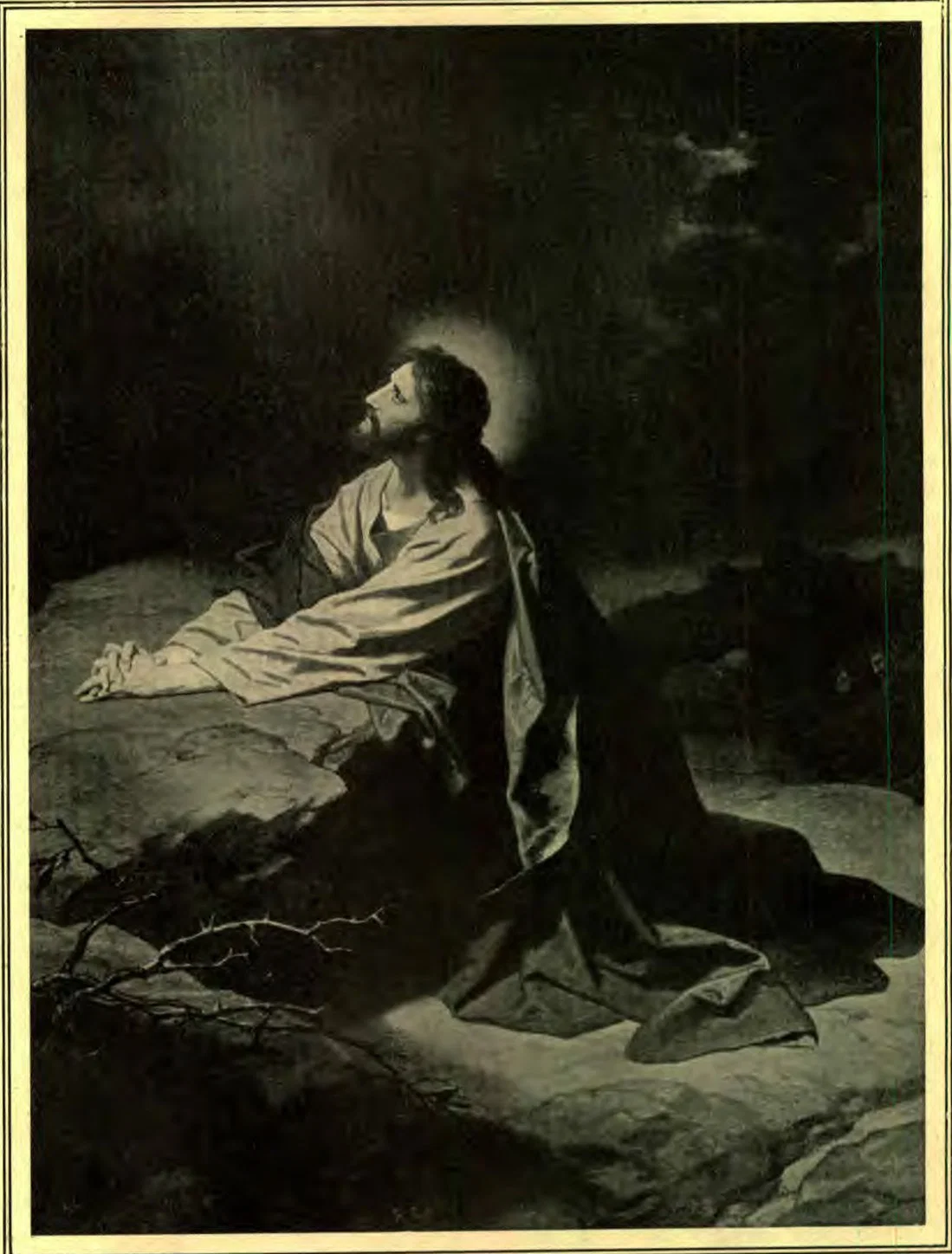
When the passover supper was ended, Jesus left the upper chamber with his disciples, and together they crossed the brook Kedron. Sorrow and anguish pressed upon the heart of the Saviour, and with sadness he said to his disciples: “All ye shall be offended because of me this night; for it is written, I will smite the shepherd, and the sheep of the flock shall be scattered abroad.” Peter, always foremost in speech, assured his Master of his fidelity. “Though all men shall be offended because of thee,” he said, “yet will I never be offended. Jesus said unto him, Verily I say unto thee, That this night, before the cock crow, thou shalt deny me thrice. Peter said unto him, Though I should die with thee, yet will I not deny thee. Likewise also said all the disciples.”
As Christ entered the garden of Gethsemane, he bade his disciples remain near the entrance, while he took Peter, James, and John with him a short distance. Then urging these three to watch and pray, he left them. The Saviour desired to be alone with God, that he might wrestle with him in prayer. The agony that pressed upon his soul was not for the physical suffering that he must endure. He was feeling the offensive character of the sin that he must bear. He must suffer the penalty of the broken law, and bear the Father’s wrath.
- CHRIST IN THE GARDEN
  • CHRIST IN THE GARDEN
In the deepening gloom that surrounded him, every stay seemed falling from Christ, and his soul reached out for human sympathy. At length, weary, and pressed with an inexpressible weight of agony, he arose, and moved through the darkness to the place where he had left his three friends. But he found them sleeping. “What, could ye not watch with me one hour?” he asked.
At this most important time—the time when Jesus had made special request for them to watch with him—the disciples slept. Christ had taken them with him that they might be a strength to him, and that the events they should witness that night, and the instruction they should receive, might be indelibly imprinted on their memories. This was necessary in order that their faith might not fail, but be strengthened for the test just before them. But instead of watching with Christ, they fell asleep. Even the ardent Peter, who only a few hours before had declared that he would suffer, and, if need be, die for his Lord, was asleep when Jesus needed his sympathy and prayers.
With the words, “Watch and pray, that ye enter not into temptation,” the lonely Sufferer turned again to his solitude and prayer. Again his voice was borne upon the sympathizing air: “O my Father, if this cup may not pass away from me, except I drink it, thy will be done. And he came and found them asleep again: for their eyes were heavy.
“And he left them, and went away again, and prayed the third time, saying the same words.” The Saviour is alone in his sorrow. Jerusalem is in slumber; even the disciples in Gethsemane are sleeping. His form bowed to the earth, Jesus prays such a prayer as the angels have never before listened to. It is the voice of helpless suffering that speaks. “O my Father,” he says, “if it be possible, let this cup pass from me.” His heart seems bursting with agony, and from his pale brow fall drops of blood. The very life-current seems flowing from his bleeding heart.
The powers of darkness were encompassing the Son of God; for the destiny of a lost world hung in the balance. Satan was clothing him with the garments of sin. Christ had placed himself in the sinner’s stead, and he felt that a great gulf separated him from his Father. It was a moment of soul-agony for the Son of God. It was the hour of the power of darkness. Shall he drink the cup? Shall he take upon his divine soul the guilt of a lost world, and consent to be numbered with the transgressors? It was here that the mysterious cup trembled in his hand. The billows of wrath were rolling over his head, but the woes of a lost world also rose before him; and he consented to the sacrifice. “Nevertheless,” he said, “not my will, but thine, be done.”
The Redeemer had poured out his soul with strong crying and tears unto Him who was able to save him from death; and he was heard. Even with Calvary before him, he had defeated the enemy, and his soul rested calmly in his Father’s love.
Again Christ came to his disciples, and found them sleeping. “Sleep on now,” he said, “and take your rest: behold, the hour is at hand, and the Son of man is betrayed into the hands of sinners. Rise, let us be going: behold, he is at hand that doth betray me.”
Soon glaring torches were seen among the trees, and the heavy tramp of an approaching mob broke the stillness of the night. Helmeted soldiers, with glittering swords and flaming torches, drew up around the Son of God. As his eye rested on them, Christ inquired, “Whom seek ye?” They answered him, Jesus of Nazareth. Jesus saith unto them, I am he.” As they looked upon the blood-stained face of Christ, their physical strength failed them, and they fell as dead men to the ground. It was not Christ’s suffering that unnerved them; for they were accustomed to the sight of human suffering. It was the voice of God speaking to them through Christ that melted their hearts in terror.
Seeing their foe fallen, the disciples took courage. “Simon Peter having a sword drew it, and smote the high priest’s servant, and cut off his right ear. . . . Then said Jesus unto Peter, Put up thy sword into the sheath: the cup which my Father hath given me, shall I not drink it? Then the band and the captain and officers of the Jews took Jesus, and bound him, and led him away.”
MRS. E. G. WHITE.

VICTORY

OUT of the grave of gloom He rose! Where are the boastings of his foes? Where are the tauntings of the crowd But recently so loud? Out of the weeping place comes joy; Faith is enraptured; hopes destroy The terror of that night of gloom; For lo! he spurns the tomb!
Victor he stands o'er finished strife, Clothed in a new, immortal life,— Victor for all the years, is he, In life's own majesty.
Where are the priests and Pharisees? Where?—Ah! forgotten now are these. He bears his victory abroad,— The risen Son of God.
Shout halleluiahs through the years Until that longed-for dawn appears When we, by him who conquered strife, Are clothed with endless life!
B. F. M. Sours.

THE BIRTH OF A COMMONWEALTH

To Australia the advent of the new year brought not only a century mile-post on the brief road of human life, but was also the date chosen for the inauguration of a new nation. Heretofore the colonies into which the continent was divided have existed in an independent form, having no internal bonds of union except that they were distinct parts of the same empire. Instead of union and mutual interests, jealousy and rivalry were more frequently exhibited.
For several years broad-minded and far-seeing statesmen have been pleading for a closer bond of union. Gradually this sentiment spread abroad, although many, from the narrow grounds of selfish interests, strongly opposed the movement for federation. Delegates from each of the colonies met, and framed a bill for the federation of the Commonwealth of Australia. This bill provided for the formation of a general government on lines quite similar to those upon which the United States nation is established. There are to be two houses of parliament, senators and representatives, or, perhaps, council and assembly. The executive consists of a governor-general, appointed by the crown, and a cabinet chosen by the governor-general, usually through the leader of the prevailing party in the government. That is, the governor calls upon the leading statesman, or the most influential political potentate, to form a government. He proceeds to appoint the various ministers, or cabinet members, from among his own friends. He almost invariably begins by appointing himself premier or prime minister; and if he is quite greedy, he may retain a separate portfolio as well. The tenure of office of these men, who are all members of the lower house, depends upon the length of time which they can maintain their place in the confidence of the lower house of parliament. There is always an opposition party, which is watching with eagle eye every move of the government. As soon as the opposition leader detects a flaw upon which he can safely base such an action, he immediately rises and moves that “this house has no confidence in the existing government.” If this motion prevails, every member of the cabinet hands in his resignation. The governor applies to the leader of the opposition to form a new cabinet. He becomes premier, and the ex-premier and his followers take seats on the “left,” or opposition side of the house, while the victors walk over to the government side.
The bill also provides for federal customs, postage, defense, etc. This bill was submitted to each of the colonial parliaments, and after almost interminable discussion was adopted by each, and submitted to the vote of the people. In Victoria, Tasmania, New South Wales, and South Australia, the affirmative vote was strong. In Queensland the contest was close and severe, but favorable; while West Australia accepted the proposal very gingerly. New Zealand has taken no action in reference to the matter. Thus the case went to the British Parliament, where it was discussed, criticised, slightly amended, and finally passed, receiving the royal assent.
Australians are noted for their fondness for holidays. They allow none to escape. The present season, however, seems likely to satiate them to some degree. The departure of the various contingents of soldiers for the South African war had to be duly celebrated. Various victories gained by the soldiers furnished pretexts for further holidays, which were closely followed by the beginning of days for celebrating the homecoming of the volunteers; and these, in turn, fairly mingled with the reception of the new governor-general, the Earl of Hopetoun, and the great festival of Christmas. New Year's, 1901, ushered in a new year, a new century, and a new nation. The celebration of the latter centered in Sydney, which was given up to jollification for one week. Troops came from London and India to participate in the celebration. Thousands of persons crowded the metropolis from all parts of Australasia. The inauguration of the commonwealth and the “swearing in” of the executive officers formed a grand pageant. Upon the frolic and festivities of the week, millions of dollars were lavished by the government and private individuals. The former paid one hundred thousand dollars for champagne in a single order, and as much more for fireworks. Music, illuminations, processions, etc., were the order during the whole period.
Nor is this all that pertains to the birth of a nation. The country will now proceed to elect its first federal parliament. This body will meet in Melbourne until the site of the federal capital is fixed. The law requires the capital to be in New South Wales, but at least one hundred miles from Sydney. To open the work of this body the Duke and Duchess of York will come to Australia on a grand steamer, chartered expressly for them, and escorted by ships of war. The Duke is the son of the king of England, and, after him, heir apparent to the British throne.
Whatever is still lacking in the way of holidays will doubtless be made up at this time, when the country will exert itself to show due honor to the royal visitors.
Thus is the Australian nation being born. The colonies now appropriate to themselves the title of States. Elder Burden and family, recently arrived from California, started for the colonies, but reached “the States.” “U. S. A.” may now mean the United States of Australia.
Though we are glad to see this step in unity and progress taken, the show of pomp and enthusiasm does not appeal to the heart of God's true children. Just beyond the brief career of this new nation there cometh One whose glory infinitely transcends that of this world's proudest demonstration. Before his glorious appearing all nature shrinks into insignificance, and trembles in the presence of her King. With what rapturous joy will his waiting people witness his conquering and saving power! It would seem as if the enemy of Christ were now trying to blind the eyes of the world to the glorious things to come. But let us who are of the day be sober; let us watch for the glory.
G. C. TENNEY.

OUR LITTLE BROTHERS AND SISTERS IN JAPAN

Our little Japanese neighbors, like boys and girls the world over, have some pleasant times. You know they wear wooden clogs, instead of shoes. In the cold, snowy parts of the country, pieces of iron are fastened on the bottom of these clogs in the winter, making a rude sort of skates. On these the children slide. You would laugh to see a long line of them begin at the top of a slope, each squatting down, and holding the coat of the one next in front, and slide nearly down the decline. Their narrow-skirted dresses do not seem to hinder their sport; they tuck the bottom up under their belts, leaving their ankles quite bare. Sometimes the feet are bare, too, or very poorly protected with stockings made of white or dark-blue muslin. These reach to the ankle, and have a toe for the big toe—a sort of foot-mitten, you see. The thong of the clogs fits in between the big toe and the one next it. Sometimes the poor little ankles are badly chapped from exposure.
The children also build snow forts and make snow men. Later in the year, when spring opens, the kite-flying fun begins. Old and young fly kites. Big and little fly kites. Rich and poor fly kites. The whole heavens are dotted with kites. Sometimes a bamboo whistle is cleverly fitted into the kite-frame, and the buzz and whir of dozens of these musical kites make a loud sound.
Once a year comes a holiday called “boys’ day.” Great paper fishes are fastened to bamboo poles set by the gate or front door. These paper fishes are hollow, the mouth being held open with wires; and when the air enters, it fills the hollow forms, and floats them out,—big, jolly, plump fellows, sometimes fifteen or twenty feet long. One is hung out for each boy in the family; sometimes five or six, of graduated sizes, may be counted in front of one home. How would you like to see a big paper carp floating in the air in your honor? The carp, the Japanese say, swims up-stream; and so the boy who means to make a worthy man will overcome every difficulty.
The girls are by no means forgotten, though they are not thought nearly so much of in Japan as boys. You know that is true of all lands where Christ is not honored. The Japanese girls have a festival called “dolls’ day,” which is three days long. At this time ancient and modern heroes are represented by dolls, which are ranged on graduated shelves. A sumptuous feast is spread for them, and guests are invited in, to partake of the eatables.
But of all the great days in Japan, New Year’s day is the greatest. That lasts three days, too! The front gates are decorated with bamboo and pine branches. Special foods are prepared, and games played. Strangest of all, everybody has a birthday! For in Japan, a person is reckoned a year old when he is born, and the next New Year’s he is two years old. A child may be born on the last day of the year, but on New Year’s morning he is counted as two years old! No one bothers about the day he was born—New Year’s is the great national birthday!
LAURA DE LANY GARST.

A CALL TO THE YOUTH

O youth in life's fair morning! Jesus is calling thee. Leave every path of folly, From all thy sin now flee; Be cheerful, kind, and tender, Loving and hopeful, too; Unentered fields are waiting For work that you may do.
What though earth's passing pleasures Tempt you to go astray Far from the fold of Jesus, Far from the narrow way? List to the gentle whisper Of thy dear Saviour's voice; With longing hearts the angels Are waiting for thy choice.
Think of the glorious mansion That waits in heaven for you,— Think! and then choose the noble, Beautiful, pure, and true. Willing to work for Jesus, Willing the cross to bear, Then with the faithful and honored A shining crown you'll wear.
PAULINA M. ALWAY-ANDERSON.

OUR SOLAR SYSTEM

In our last study of astronomy, which appeared in the INSTRUCTOR of Aug. 23, 1900, we presented a diagram of the solar system showing the positions of the sun and accompanying planets as they would appear during the first part of the following month, with the promise that if time permitted, we would follow the different worlds in their God-given courses about the sun, noticing their positions from month to month. Sickness cut our work short, but while we are sorry to have lost so much valuable time, we are thankful to our Heavenly Father for his restoring hand that has been over us for good, and we gladly take up once more with the readers of the INSTRUCTOR the beautiful study of his great workshop.
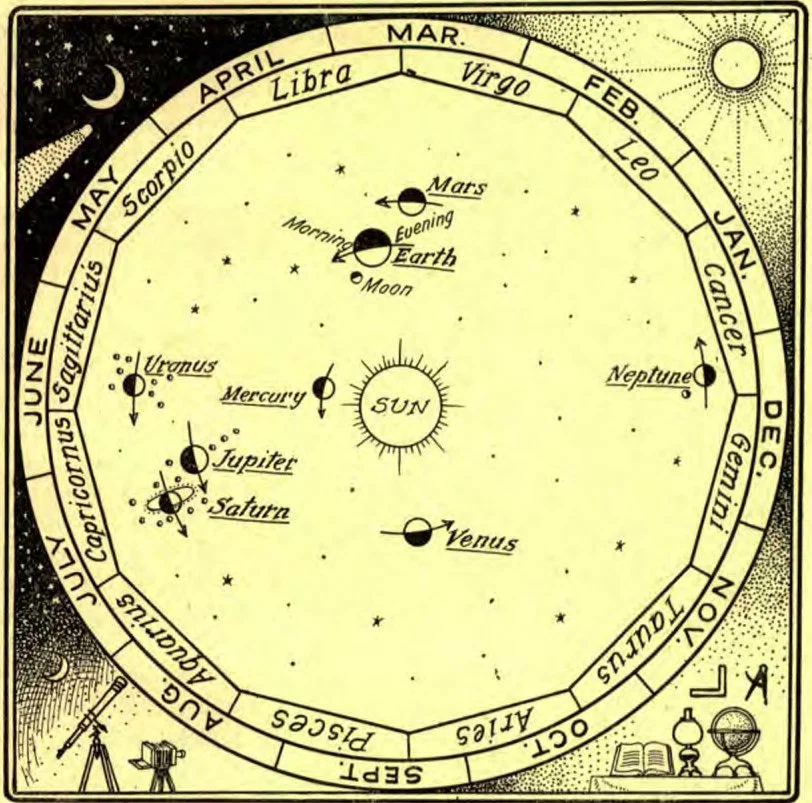
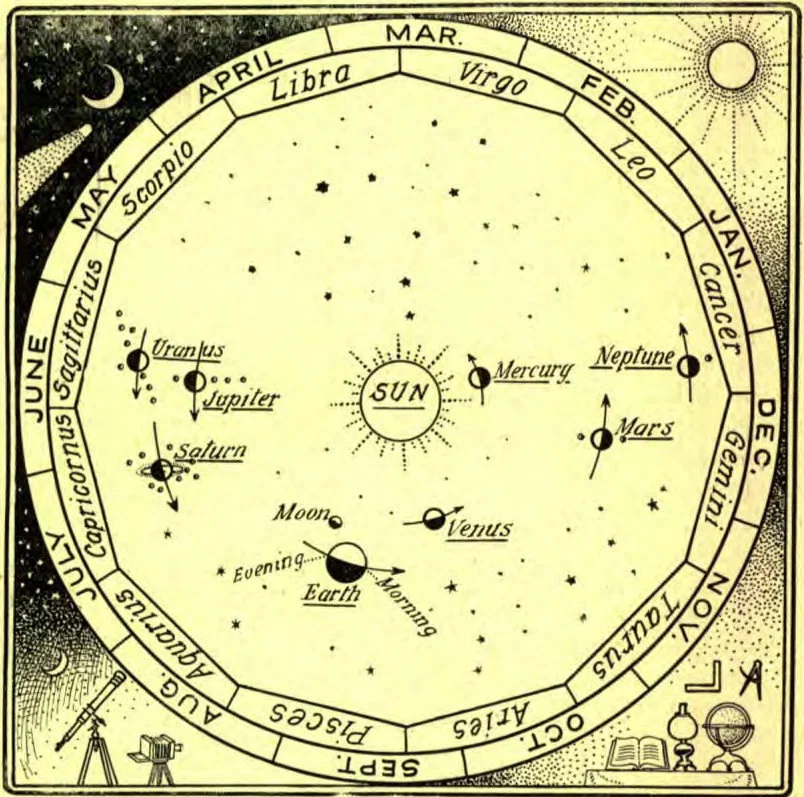
In order to obtain something of an idea of what has been going on in our solar system since last we met for study, and also to gather up the threads of our work where we left it some time ago, we present, with this, two diagrams, the first, Fig. 1, being a reprint of the one that appeared seven months ago, showing the positions of the planets as they were Sept. 1, 1900; while the second, Fig. 2, shows them as they were the first of the present month—April. By comparing the two we see at a glance just what onward progress each world has made during the time that has elapsed since our last study.
FIGURE 2
FIGURE 2
Mercury, as you will notice, was then passing rapidly along his path between the sun and the sign Cancer; to-day, April 1, we find him hurriedly passing between the sun and the sign Sagittarius. But remember that it takes Mercury only about eighty-eight days of our time to complete one whole year of his time; consequently, during the last seven months he has passed completely around the sun two and about one-half times, so that a child born upon that planet at the time of our last study would now be two and one-half years old, according to their time.
Venus, the next farther planet from the sun, having a larger circle in which to travel, has not made the seeming progress that Mercury has.
The yearly circle of Venus being two hundred and twenty-four days of our time, we find the planet within two-days’ travel of the exact point in the heavens where we last saw it, in the sign Aries.
Our own earth has passed from Pisces nearly around to Scorpio, and we all well know of the climatic changes that have taken place upon it during this time.
Mars we left in Gemini, but now we find him just passing from Virgo into Libra. We wonder how many of our INSTRUCTOR class are following this “ruddy god of war” in his apparent westward course among the stars that bedeck our evening skies? In our next study we shall learn many interesting facts regarding this near neighbor of ours.
Jupiter has passed from Sagittarius into Capricornus; while Saturn, with his rings and moons, has seemingly not done so well, remaining still in that part of the heavens known as Capricornus. Jupiter, it will be seen, has been slowly gaining on Saturn, while the two have been leaving the more tardy Uranus in the rear. You remember with what interest we watched the planets Jupiter and Saturn in their movements among the stars last summer? Well, this coming summer and fall, when they again appear, they will be much nearer together than they were last season; and we hope that by that time all our readers will have become so familiar with these planets that they can point them out, and be able to tell many interesting things concerning them.
The next planet is Uranus, and we can scarcely pass this interesting and unique planet without stopping for more than a mere mention. Uranus is very different from the other planets, away off there by itself, rolling and tumbling along in a manner peculiarly its own. It does not stand up and simply turn around, as do all the others, giving their inhabitants a comparatively equal day and night, but appears to lie down and roll over. In other words, its poles are not perpendicular to the plane of its ecliptic, or nearly so, but they are almost horizontal. At a certain season of its year its north pole points almost directly toward the sun; and at that season the sun does not rise and set, as it does with us, but merely describes a small circle in the northern heavens each day, which is about ten hours of our time. As the season progresses, this circle in the northern heavens becomes larger and larger, till soon the sun sets in the northwest and rises in the northeast. As the weeks and months go by, the sun keeps working farther to the south, setting in the west and rising in the east. As this southern movement of the sun progresses, the nights grow longer (Uranus had no night at all to start with), and the days become shorter until at last the sun appears for a short time each day above the southern hillsides, and finally disappears altogether, leaving the inhabitants who live near its north pole, if such there be, to either move to the southern part of their globe or else remain in the darkness of constant night for at least forty years of our time.
These are interesting thoughts. Why did the Creator so make this wonderful world? Why is it so different from all the rest of our family? Praise his holy name, we soon, if faithful, shall have the privilege of visiting these noble worlds that he has created, and then we shall know. We hope, before long, to spend a whole evening studying the planet Uranus.
Although Neptune, the farthest away from the sun of any of the planets with which we are acquainted, has been during the last seven months plunging along at the enormous rate of eleven thousand miles each hour, its circuit is so great, requiring one hundred and sixty-six years of our time to complete one year of its time, that neither in the heavens nor on our small chart can we notice a very perceptible change in its position.
When we realize that eye hath not seen, nor ear heard, neither have entered into the heart of man, the things that God has prepared for them that love him, and contemplate the reward that awaits the faithful of earth, so soon now to be realized, how careful ought we to be in all holy conversation and godliness, looking for and hastening unto the day of God!
DR. O. C. GODSMARK.
FIGURE I
FIGURE I

A REMARKABLE CLOCK

Has just been invented by one William L. Bundy, who has worked on it for twenty-three years. The clock shows the days of the week, month, and year, the years, the phases and shapes of the moon, and the seasons, also setting to work, every quarter of an hour, a great many interesting automata and miniature scenes. The speed of the wheels varies from six hundred revolutions a minute to one revolution once in ten thousand years. The clock is a perpetual calendar, even taking cognizance of the leap-years.

WHICH WAS THE GRUMBLER?

“Where’s mama?” cried the children, as they gathered in the cozy sitting-room one winter evening, and found only Aunt Harriet, with her usual knitting, sitting at one side of the cheerful, open fire.
“She was called out for a little time,” answered Aunt Harriet; “but what is it? Can I do something for you?”
“No’m, nuthin’, I guess,” answered twelve-year-old Tom, slowly, but little Ted volunteered the information that they had come to have mama tell them their story. Then sister Nell, who thought Auntie should know more, made a further explanation: “Mama always tries to tell us a story just this time in the evening,—three stories, I mean; one for Ted first, ’cause he’s the smallest; one for me, for I’m next, you know; and then one for Tom.”
Aunt Harriet Bowen, who had been visiting the family for several days, generally went to her room at this hour for a rest; so she had missed this part of the evening program. Now, as she continued her quiet rocking, a peculiar little smile crept into her face, which Teddy, who had been watching her closely, was the first to interpret.
“O Auntie! can’t you tell me a story?” he asked, eagerly; and without waiting for her reply, he hurriedly brought his own little chair, and seated himself close by her side.
“Why, yes, little man, I’ll try,” Auntie cheerfully replied. “Do the others listen when you have your story?”
“Oh, that depends,” Tom answered, somewhat loftily; “sometimes we do, and sometimes we don’t.”
“Well I do, most generally,” said Nell, as she curled up in papa’s big chair; “for I like all mama’s stories, big or little, boys’ or girls’.”
Tom sat down by the study table, and taking up his youth’s magazine, which had come that day, was soon apparently absorbed in what he found to read.
“Once upon a time,” began Auntie, in such a delightful “story” voice that Nell had to curl up again in the big rocker, and Ted tried to get his chair a little closer, “I knew a little boy just about your size, Ted, only I think he wasn’t quite so heavy, and his eyes were blue as the skies on a sunny day, while yours are brown,—but I love brown eyes,” she added, bending over to kiss the chubby little face turned up to her. “This boy’s name was Tad, for short; at least nearly every one called him that, except his father. We were great chums, Tad and I, and were always together in all the frolics we children used to have, in the days when I was a little girl.
“But Tad had one fault. Even I could see it, much as I loved him. Nothing ever quite suited him; anyway, it seemed he must always complain a little at first. Especially was this noticed at the table. He never was what you would call cross or ugly about it, either; that was the peculiar part of it all; for he was invariably good-natured, and often there was a twinkle in his eyes, even when he was whining his little complaints.
“If we had graham mush for breakfast, Tad would very likely say, ‘I wish we could have oatmeal, ma; I like oatmeal better’n this.’ And if next morning mother made oatmeal, thinking to specially please Tad, he would be sure to ask, ‘Why didn’t you cook some rice, ma? We haven’t had any rice for a long time.’ Or if there was no complaint about the mush, he was sure to suggest something different to eat with it.
“A word from father or mother was generally sufficient to quiet any further remarks of that sort, and then the meal would be eaten as cheerfully as if it had been just what he desired in the first place. Mother often talked with Tad about this bad habit of complaining; but when the next meal came, whether it was breakfast, dinner, or supper, almost without fail there was sure to come some sort of complaint.
“Finally one morning it seemed the faultfinding was worse than ever. Nothing was just right. Even the rest of the children, who ordinarily paid no attention to the little grumbler, looked at Tad in astonishment. Suddenly father spoke to Tad, and his voice, though quiet, sounded very stern.
“‘Thaddeus,’ he said, ‘if you are hungry enough this morning to eat a slice of bread, you may have it. But you must take that and sit down by yourself in another part of the room; you are too much of a grumbler to sit at the table with the rest of us. We want to enjoy this good breakfast which mother has prepared for us.’”
“At first Tad looked up in surprise, as if he failed to understand. But when father again remarked, ‘I mean what I said; you are excused from the table,’ Tad climbed down from his stool, and ran hastily from the room.
“After father was gone, Tad came back into the dining-room, looking very much ashamed of himself; but even then it almost seemed as if the lesson had not been severe enough. He begged mother to try him once more, and let him get up to the table to eat his breakfast. He was very hungry, and promised never to make any more complaints. But mother was firm, telling him he would have to do just as father said. Then he asked for something to eat on his bread; and when he had been refused, and had eaten his slice with considerable relish, he asked for another. Again mother was obliged to say no; and finally Tad made up his mind to stop teasing, and was as good-natured as could be till dinner-time.”
When Aunt Harriet began telling her story, she noticed peculiar glances exchanged between Teddy and his sister, and occasionally a little sound came from Tom over by the table, although if any one looked at him, he pretended to be very busy with his reading.
But now Ted could stand it no longer, and looking up into Auntie’s face, he asked, “Aunt Harriet, did mama tell you that, or write to you about it?”
“Why, no, dear boy,” she replied, divining at once the trouble; “you know I told you this happened when I was a little girl. Can you tell me your papa’s first name?”
“Why, it’s Thaddeus!” exclaimed both the children, “Thaddeus Ezra Bowen;” and then Teddy quickly added, “and so it was my papa who grumbled at the table, and had to be sent away with only a slice of bread for his breakfast;” while little Nell added, softly: “I ’most knew mama never said a word about that, Ted; you know mama never tells things about us to anybody.”
Just then mama came home, and as Auntie was very tired, she asked to be excused for that evening, and mama finished the stories. The next day, however, when Aunt Harriet happened alone with Nell and Teddy for a few minutes, Nell suddenly asked: “O Auntie! you remember that story you told Teddy last night about papa? Was he cured of grumbling that first time that grandpa sent him away from the table?”
“No, my dear, I am sorry to say that he was not. In a short time he seemed to forget all about it, and began to grumble again as bad as ever. One day I remember in particular, he was complaining about some mittens mother had just made for him. They were ‘too big,’ and he didn’t like the color so well as mine. Mother looked so sad for a moment; then she quietly took them away, and he had to wear his old patched ones long after the rest of us had our new ones.
“A few days after that, grandpa brought Tad a new cap from town. It was a surprise, and Tad was very much pleased with it; but soon he saw something he thought he might not like about it, and began to find fault, wishing it might have been different. Father immediately took it away from him; and the next time he went to town the cap was exchanged for something for one of the other boys, and Tad wore his old one the rest of the winter. This made him think very hard, and I know that he did try faithfully to reform; for as sure as he forgot, and began his old grumbling, just so sure was he to lose the thing he was complaining about.
“The last lesson that I remember anything about was one morning. Mother had such a good breakfast for us, and we were all hungry. Suddenly Tad began to find fault about something, and we children all looked up in surprise; for we felt sure of the punishment that would follow. Father immediately told Tad to leave the table, and that he should have nothing at all to eat until dinner. As Tad had eaten only a mouthful or two, he was hungry enough before dinner-time. But I do not remember ever hearing him grumble again, at least at the table.
“No’m, nor I either,” broke in Teddy. “I never heard him complain a word. But there is some one else who complains once in a while,—though not very often,—and I don’t b’leve he’ll complain much more, Aunt Harriet!” he added, hastily.
MRS. E. M. PATTON.
Continue reading: SOMEBODY'S BIRTHDAY