Elders Conradi and Erzenberger left Hagen the evening of the tenth of January, as they were to spend the eleventh and twelfth in Basel, where the German-Swiss auditing was to be done. Elder H. F. Schuberth and the writer, taking a different route, met with our small church in Frankfort-on-the-Main, one of the great banking cities of the world, whose capital is largely invested in the Rhinelands, in Switzerland, and in the Netherlands. The city has 311,000 inhabitants. Here lived Goethe and the Rothschilds.
On our way to Heilbronn, the place of our South German Conference, we being passed through the “most beautiful town in all Germany,” Heidelberg, with its castle and famous university. This city, as well as Constance, where was held the council which condemned Huss and Jerome to the stake, is located in the Grand Duchy of Baden, a state whose 1,800,000 people are chiefly engaged in agriculture and forestry. In the Black Forest large quantities of wooden toys are made, and exported to various parts of Europe.
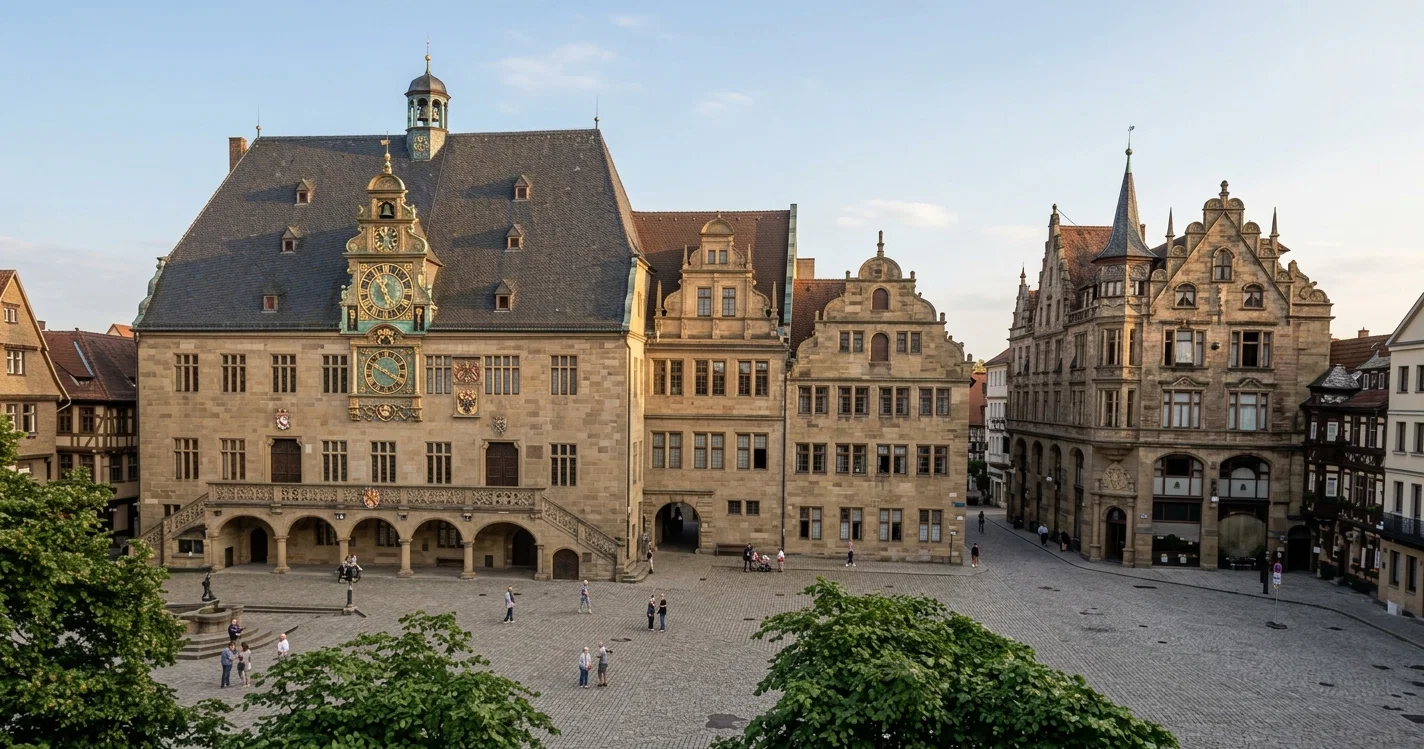
Heilbronn is a neat little city of 40,000 inhabitants. It is in the kingdom of Wurtemberg, which has a population of 2,100,000, the larger number of whom are kept busy in caring for their corn-fields, vineyards, and fruit-trees, although some find employment in mining and weaving. Indeed, in Heilbronn itself there is some manufacturing, soap, sugar, salt, machinery, soda, candles, and paper being produced, as well as silverware and wine. The Neckar River, with the canal, is navigable, and the Heilbronn harbor is commodious. The public buildings are substantial. The dwellings are large, and many of them are surrounded with beautiful gardens. Several ancient towers and the Gothic cathedral, and the antique city hall, with its characteristic clock, testify to the age of the place.
The meeting began the evening of the thirteenth, and lasted until the night of the seventeenth of January. The daily sessions were held in our local hall, while the public lectures were delivered to an audience of from three hundred to three hundred and fifty in one of the largest and best halls we could have secured. The subjects presented to the outside audiences were chiefly on the prophecies and the nearness of the second coming of Christ and our need of preparing to meet him. Elders Erzenberger, Conradi, and Schuberth had remarkable freedom in presenting the message to those who came to hear.
Of the nineteen churches and companies in the conference, sixteen were represented by forty-one delegates. About one hundred and twenty or one hundred and thirty of our brethren and sisters were able to attend. The church at Ulm, and the companies in Erlangen, Pforzheim, Langensteinbach, Baden-Baden, and Offenbach were received into the South German Conference.
The spirit present was strongly evangelical. The presentation of the East African Mission created a great interest. The people seemed anxious to do what they could to make the work in that field a success. In one place in the South German Conference, every member has been threatened with a fine of six dollars for attending the meetings; but God opens the way for them to come together, nevertheless. Many instances showing what a man may be called upon to endure, in these lands where the truth is young, and our people are little known, came to my attention; but the persecutions some are compelled to pass through do not keep them from feeling for the heathen in Africa, and their missionary spirit is not destroyed by their unfavorable surroundings any more than was the case in the early days of Christianity.
CITY HALL, HEILBRONN
Another thing that was noticeable at this meeting: former brethren, who had fallen away from the truth, were present to distribute their literature, and to attempt to draw away disciples after themselves; so remarkable were their untruthful statements, that it was thought best for Elder Conradi to spend an hour in examining their teachings, testing them by the law and the testimony. This exercise was very profitable to our brethren, as they saw the truthfulness of the third angel’s message more fully than ever. We feel sure that these outside movements will not harm the truth; for truth is eternal and remains, no matter who may disbelieve it—no matter who may turn away from it. If we only trust in God, we shall never be ashamed; but it is absolutely certain that we must come to that place where we shall trust him: if we do not come to such a time, and if we fail to have the experience of knowing him for ourselves, the trials that are ahead of us will certainly cause us to fall out by the way.
To strengthen the material fund for ‘Christ’s Object Lessons,’ and to constantly circulate that book; to increase our Sabbath-school offerings, all of which are used in the missionary work of the German Union; to devote our First-day offerings to the mission in German East Africa (and to increase these offerings); to pay a more strict tithe, two tenths of which will be hereafter16given by this South German Conference to the German Union, for missionary purposes; and to heartily thank God for the care he has had over the work the past year, were resolutions taken at this meeting, at the suggestion of the committee on recommendations.
To show their honesty of intention, a collection amounting to about twenty dollars, for German East Africa, was taken up on Sunday; fifty-eight dollars was raised for the Material Fund; twenty-one dollars was donated to the Conference Poor Fund at this meeting. On Sabbath afternoon, six were baptized, and the Lord’s supper was celebrated with those who had not been granted this privilege during the quarter; two church elders were also ordained on this holy day. The Sabbath services were very solemn, and we believe their results will be lasting.
The auditing work did not consume much time, and there was still a little left over in the conference treasury to begin the new year. In 1903 the tithe of this field was $4,102; Sabbath-school gifts, $284; First-day offerings, $87.85; week-of-prayer donations, $221.85. One hundred and three persons were baptized, eleven were received by vote, and the present membership is three hundred and thirty.
Besides the States mentioned in the second and third paragraphs above, there are in the territory of the South German Conference, the agricultural, manufacturing, mining kingdom of Bavaria (population, 6,176,000), where are located Spires and Augsburg, two cities so famous in the Reformation; the imperial province of Alsace-Lorraine, with 1,719,500 inhabitants; that part of the Grand Duchy of Hesse-Darmstadt south of the Main, with about 750,000 people; the Grand Duchy of Luxemburg, with 211,000 inhabitants; and the Duchy of Hohenzollern, with 66,000 inhabitants. The entire population of the South German field is about 13,000,000, and for these millions, we have three ordained ministers, three licentiates, and five Bible workers. Elder C. W. Weber, again chosen president of this conference, finds that here, as is the case elsewhere, the work is great, hedged up by difficulties, and yet that the laborers are few. We should therefore pray that the Lord of the vineyard may send forth laborers into his harvest.
Dresden.
The Message in Japan
By F. W. Field
F. W. FIELD
THE eyes of the world are now turned to the far East as the seat of war, and we know that our brethren will be interested in our welfare, and in the progress of the truth here at this time. We are glad to be able to report progress in the work, and freedom in presenting the truth. The excitement of war distracts the minds of many; but our workers still find many who are willing to listen to the gospel of peace.
About March 9 eleven candidates were baptized in Kobe, and united with the church there; and on Sabbath, March 26, five were baptized here in Tokyo. There are five persons awaiting baptism in and near Wakamatsu, and a number of others far to the south. The Lord is calling old and young out of heathenism. Among those recently baptized are a man of sixty-five, and a woman of sixty-seven years. These have been brought to the Lord by witnessing the power of the gospel in transforming the lives of those with whom they dwell. Here in Tokyo one man, who has heard the truth presented for several years past, has just decided to obey the Lord, and requests baptism.
For some time past Brother Okohira has been in correspondence with a convict in a government prison in Hakkaido. This man was a counterfeiter, and has several years of his sentence yet to serve. But through correspondence and the reading of our literature, he has found the Lord and his truth, and has decided to obey. He is not waiting till his time is out before beginning to work for souls. He writes that about forty of his colleagues are receiving Bible instruction from him. Thus the light of truth is penetrating even such dark corners.
As we had expected, Brother Kuniya was called to join the army that is being sent forward to the war. But he was excused by the examining physicians on account of his health. We are thankful that he is spared to continue his work.
The dangers and troubles of the last days seem about to break over us; but this prospect should only urge us to more earnest endeavor. We trust that this field and its workers will be remembered often in prayer.
Tokyo, Japan.
Mission Notes
BROTHER J. M. FREEMAN has accepted a call to work in the Orange River Colony, South Africa. Brother and Sister Chaney will take his place in Basutoland.
A CHINAMAN ordained a deacon by Bishop Cassels in January, was a Mohammedan who entered the China Inland Mission school fifteen years ago, and has finally entered the Christian ministry, with earnest devotion to the Master.
BROTHER I. G. KNIGHT reports from Bocas del Toro: “The work is progressing. We are able to reach many more people with the launch than we were without it. We hope to place a goodly number of books in the hands of the people. Dr. Henriquez, from Jamaica, has just arrived to locate with us. We trust to be able to enlarge our sphere of influence for good.”
OUR workers in Japan write that the probabilities are that the war will be confined to the disputed territory, though that of course they can not anticipate the great complications that may arise. Already prices on staples are advancing slightly, and the government is planning to increase the tax on incomes, salt, and sugar, besides tobacco and intoxicants. If the war continues long, they will suffer financially. The liability of our native brethren to military service is cause for their greatest anxiety, but the Lord has thus far worked for them beyond their expectation. Our laborers in these fields need our prayers at this time.
EVERY year a few Mohammedans are converted in India. A brother of the head Moulvi of the Deoband Mohammedan college, in North India, became interested in Christianity through reading controversial literature. On New-year’s day he and his wife and his two children were baptized in the C. M. S. church at Agra. Din Mohammed, a Mohammedan Moulvi, has been baptized at Delhi, with his wife and three children.
FROM Padang, Sumatra, Brother R. W. Munson writes: “We have an increasing interest among the Chinese, particularly among the Singkes, or China-born Chinamen. Our large front room is crowded every Sabbath with interested hearers, among them several women. Three of these have been baptized. Three others have not, but are fully persuaded of the truth. One of them in particular—a middle-aged woman of uncommon intelligence and education for a Chinese woman—is evidently in love with the blessed gospel truth. She sits for hours, and eagerly drinks in the words of truth.”
DESCRIBING their field in British Central Africa, Brother Thomas Branch says: “The country is like a garden of Eden, always green, having many large and beautiful trees, and pretty, sweet-scented flowers the whole year round. There is also a large variety of delicious fruit. Here are millions who have never heard of Jesus and his love. It is sad to see them coming and going day after day,—a people of fine physique, obliging and polite, yet living in the darkness of heathenism with all its superstition, without a Saviour, and bound about with many peculiar beliefs and customs. They believe that when one of their loved ones dies, he is joined by his father or mother, or both, who have died before, and together they enter their eternal reward. Before death occurs, the friends gather around the hut of the sick one, and carry on a low wailing, which after death is increased by the addition of six or eight native drums. This is called mourning for the dead, and the wailing, drum-beating, dancing, smoking, and drinking are kept up for nearly a week, then the dead is buried without box or coffin, simply laid in the earth. God alone is able to break this chain of sin and superstition by which they have been bound these many years, and we are willing that he should use us to his glory in this great harvest-field.”
British West Indies
By W. G. Kneeland
GRENADA.—We pitched our tent here March 23, and have had fair attendance, although the weather has been somewhat unfavorable. This is the dry season, but we have had plenty of rain. Then *during “holy week” all the churches were holding special services every night. However, we have not had less than fifty on a rainy night, and as many as five hundred at other times. We are located unfavorably, as the people here are of the rough element, and there are rum shops, etc.; but it was the only place we could obtain.
There has been much inquiry concerning the truth. There are four persons who claim to be Sabbath-keepers, besides our regular members. We are able to sell some books and tracts at the tent, toward expenses.
We are all fairly well, and like Grenada as a place of residence. We hope we may be able to gather out a good company. Although people have been kept back by bigotry, they are willing to read, and our canvasser is doing well.
W. G. KNEELAND.
Central America
By H. C. Goodrich
BELIZE, BRITISH HONDURAS.— We organized a church of twelve members here in Belize last Sunday. I believe they are an earnest, true-hearted class. Three more wish to be baptized, and I hope to baptize these next Sabbath. The openings for work are so many. There are three places up Old River where the people are asking to hear the Word. In one of these places, three are keeping the Sabbath, from reading. In another, I have just heard that one more has begun to keep the Sabbath. In Ruatan there are several good openings such as I have never seen before. All Spanish Honduras is open. If I were well and strong, I could not begin to do the work. And as it is, I can see that the work will suffer, unless I can have help. A minister for the field, a teacher for Utilla, and three colporteurs for the interior are much needed. These should learn Spanish. I have always felt that colporteurs would do more for Spanish Honduras than any other class of workers, for a time, and I believe Brother Allen’s work is proving it. Tegucigalpa is also a promising field for labor, and ought to be entered now.
H. C. GOODRICH.
A Visit to Prince Edward Island
By Wm. Guthrie
ONE year ago we solicited help from a number of the brethren and sisters in the States to assist in building a tabernacle for use in Prince Edward Island. To those who so generously responded to the call I am glad to say that it has been more than a success. We had expected to use it about eight months in the year, but to our delight we have been able to use it twelve months in the year, and find it very comfortable, even in the coldest of the winter.
Last month I made a trip from Halifax, Nova Scotia, to Charlottetown, to assist in moving the tabernacle to a new location. This work was accomplished in about four days, and the little band of Sabbath-keepers are much pleased to have so pleasant a house of worship.
It was my privilege to speak to them while there, and on Sunday and Sunday night the room was well filled with attentive listeners. O how we longed to see the truth obtain such a hold on them that the old-time customs of following men may fall before the love of God, as the stubble before the consuming flame! Brother James Hanna is doing a good work there, and the little company of believers is growing in grace daily. May the Lord add to their numbers such as shall be saved.
Our work here in Halifax is onward, and all are of good courage. Since the dedication of the church ten have been added to our numbers, and we are full of hope for others.
Our general meeting is to be held here June 3-12, and we trust that it may prove a means of great blessing to our people.
Since our call for help for the Halifax church, to which some have nobly responded, we have received one hundred and twenty dollars. While we had hoped for more, we are very grateful for what we have received, and may the dear Lord bless the donors for their sacrifice in our behalf. As receipts have been sent directly to all, we will not report the names here.
This is a needy field, and we are praying that the Lord may place the burden on some stronger conference to send us a good, experienced young man, and support him for two years at least.
Beloved, this message is soon to close up in a glorious victory, and I want a part in that closing scene of the gospel work. If we will but take God at his word, we shall see many turn to the Lord in a day, and “there shall be delay no longer.” Wm. GUTHRIE.
Natal
By J. H. Camp
PIETERMARITZBURG.—Elder Edmed is going to Johannesburg in a fortnight, and he will join with Elder Kuehl in a tent effort, which we hope will be the means of raising up a good church. The only help they will have is two workers who accepted the truth this year in Natal. Brother Altman is in Durban. He opened tent-meetings last Sunday night, with a good interest. The only workers that he has with him are a Zulu to care for the tent, and a young man who accepted the truth recently, to help in visiting, etc. Sister Robertson, our only Bible worker, remains here in Pietermaritzburg to follow up the work that has been carried on by Elder Edmed with such good results the past year, about forty having accepted the truth.
At the beginning of this year we organized our tract society, and bought out the Echo Publishing Company, at a cost of eight hundred pounds. Our book work is on a good basis, and our sales for the first three months amounted to nearly one thousand pounds. Then we have opened treatment rooms, and have furnished them plainly, at a cost of about one hundred pounds, which is fully paid. Besides this, we have opened a food store in connection with our tract society. So we now have every phase of our work organized and in running order.18
We wish we had two or three more ministers. But if we had, we could not support them. On every hand calls are even coming in to open meetings, but we can only wait. Our great hope is that in the near future we shall have some local talent, ready to bear some of the burdens. Our tithes are coming up well. They reach about seven hundred pounds a year now, and our membership is less than one hundred. We are of good courage, and intend to press on. We are thankful to God for his past leadings, and trust him for the future.
J. H. CAMP.
England
By Ole Andres Olsen
BATH.—April 4 I returned to London from a tour in the North England Conference. I was pleased to note the progress of the work. I remained in London two days, then started for the Welsh mission field, to attend a meeting at Newport. The meetings continued four days. Sabbath evening thirteen were baptized, and on Sabbath forenoon a church of thirty-three was organized. Of these, twenty-seven were new members, not having been connected with us before. I am glad to say that a very encouraging work has been well begun at Newport. Brother Ballenger has been laboring at that place for the past nine months; but the work there is by no means finished. A goodly number are on the very point of obeying the truth.
I came here to remain one week, after which I will go back to London. The last week in April we are to have a meeting of the British Union Conference, to plan for our work of the coming season. The South England Conference will hold its next annual meeting at Southsea, May 20-29. The Lord has blessed us in a marked manner in this conference, for which I feel sincerely thankful.
O. A. OLSEN.
India
By Harry Armstrong
CALCUTTA.—We are thankful for all the blessings we have received since coming to this field, and for the many opportunities of service. We leave Calcutta, feeling that it has been good for us to be here. I have had quite a good interest among the medical students at the government college. The work there has already borne fruit.
This month (March) we close up our work here, and after spending a little time in the hills, we shall proceed to Colombo. We have already secured our passage, and made arrangements in Ceylon. I am sure the Lord will give us a harvest of souls there. We have two canvassers now in Colombo, and quite a number of subscribers to our paper. I have had already several letters from Ceylon, from those who are deeply interested in the Oriental Watchman, and I intend to get into close touch with these souls, and by the blessing of God win them to the truth. Colombo will afford a good opportunity of spreading our literature among all nations of the world, as ships from all countries call there.
We feel to praise God for the health and strength we enjoy. We have never worked so hard in any other field, and yet, notwithstanding climatic conditions, our health is good. Our souls burn with the love of this glorious truth which must bring the history of this world to a close in this generation. We ask you to remember all our Indian workers before the throne of grace. We are glad to read of all the way the Lord is leading his people. May the journey soon end, and his kingdom come.
HARRY ARMSTRONG.
Friendly Islands
By W. W. Palmer
NUKUALOFA, TONGA.—Our Sabbath-school is slightly increasing in membership. The Lord is blessing us here; and though the increase is small, we are of good courage, knowing that it does not depend on numbers, but unity and a pure church. All the children of our school belong to European parents. There are four half-castes, three of whom live in the household of Brother and Sister Butz. Only four of the children belong to Seventh-day Adventist parents.
One native man, who has been a regular attendant for some time, was baptized the first Sabbath in the new year, with another brother. That day we held our Sabbath-school half an hour earlier, and after meeting we all went to the beach, about half an hour's walk from our little chapel. There was quite a large gathering of spectators. We held the ordinances at half-past seven in the evening, and all could testify that the Lord was especially near us that day.
This native brother—Timothy—is the first native to take his vows in this way in Tonga, and we hope that it is the beginning of good times, and that he is the first of a goodly number who will take their stand for the right. It is very hard for the natives to give up their pork and tobacco; and they realize that they must do so if they wish to live near to God.
Timothy attends the Sabbath-school and meetings very regularly, and we have started a native class, which I teach. I translate the lessons into the Tongan language, and he takes them home and studies them. Sometimes two or three come in and join us, and we have a good time.
Our schoolroom is nearly finished, and by the time it is completed, we hope the teacher from Australia will have arrived.
It has encouraged us greatly to know that those across the waters and far away from our lonely isle, are interested in our work here. I sincerely pray that in these later days God will so work upon these people's hearts that they will yield and take their stand for him.
W. W. PALMER.
Southern Illinois
By M. G. Huffman
I HAVE now been in Illinois three years, and I can truly say that I like this State as a field in which to labor. I am kept busy in the Lord's vineyard, and I still love the truth, and am glad that the Lord continues to bless my efforts, to the salvation of some dear souls for whom Christ died.
For the past year and a half I have spent the greater portion of my time in Peoria, the second largest city in the State. I am glad to report the fact that the cause is progressing in this city. We have a good, strong church here, and also a sanitarium established near the center of the city. This institution is exerting a good influence for the cause of present truth, and many are receiving substantial benefit from the treatments they receive.
I held a series of meetings at Farmington, about thirty miles from Peoria. This place has about eighteen hundred inhabitants, and is surrounded with fine farming country. The Lord greatly blessed, and as the result of efforts put forth a good church has been organized, with a full corps of officers. All seem deeply in earnest, and are doing what they can for the promulgation of the truth which they love so well. Last Sunday, May 1, the church met in a beautiful grove about two miles from Farmington. Here they enjoyed a Sabbath-school basket meeting, or picnic, at the close of which, in a beautiful, running stream, I buried eight willing souls with their Lord in baptism, who we trust came forth to walk a new life, even the life of faith.
The interest in Farmington is still good, and we have reasons to believe that others will yet take their stand with the remnant people of God, to keep his commandments and the faith of Jesus.
I am thankful that the Lord still grants me some humble part in his work, and I hope and trust that I may have a part in the Master's vineyard till he comes to gather his children home to himself, that where he is we may be also. Although Satan wages his battles fierce and hurls his fiery darts thick and fast, in Jesus Christ we can come off more than conquerors. O, blessed thought to know that Jesus is soon coming to take his people from this sin-cursed earth! How grand, how sublime, to know that we are so near our blest home! How unlike the present one will be the one to come. Will you be there? Shall I? We can if we will. God grant that we may.
M. G. HUFFMAN.
Argentina
By Arthur Fulton
CASCARANA, SANTA FE.— The law here compels all teachers, both of public and of private schools, to pass the public examinations, and a refusal to comply may cause the school to be closed. Accordingly, I attended a two months' institute in the city of Gualeguaychu, at the other side of the province.
School is held every day except Sunday and feast-days. When I registered, I spoke about being excused on the Sabbath. As I did not attend on that day, after a few Sabbaths' absence I was questioned about the matter, and was told that in no wise would I be excused; that if I was called upon to recite on that day, I should be marked zero; that the daily classifications would count one half on the examination.
I went home, and wrote out a petition, stating my reasons, and asking to be excused on that day. From the first, the whole school took an interest in how the matter would turn out, and I had many opportunities to explain why I could not attend. Some advised me to go to my pastor and lay the matter before him, telling him how much I would lose, and ask him to pardon me the fault. As the time neared for the final examinations, the professors, four in number, became more strict. Once during the course each candidate for a diploma must give a practise lesson to the children, before the whole school. The practise days were Sabbaths and Tuesdays. One Friday I was called in, and assigned work for the following day. It so happened that the director was sick, and his sister had taken his place for the day. Finding I would not yield, she changed my name for that of another. The director seemed angry when he found it out, but at last let me give the class on Tuesday.
The examinations were to be on Thursday, Friday, and Sabbath. I made a last petition to take the work in the two days, and Thursday evening I was refused. That night came a telegram from the capital, setting the time for the next week, beginning Wednesday. I at once wrote a petition to the superintendent of the province, stating the case, and asking permission to take the two branches assigned for the next Sabbath on the other days. Wednesday came the answer, and I was told my request was granted. One of the professors asked me if I had not been praying for this. I said, 'Yes, indeed I have.' As he turned away, he said, 'He will be more set than ever in his heresy.'
Out of the forty-five present, only twelve were successful in everything. So I have abundant reasons to be thankful for the way the Lord helped me in it all. The branches were only the common ones,—pedagogy, history, grammar, civil government, arithmetic, biography of eminent Argentinians, geography, agriculture,19and stock-raising: It was quite difficult for me, however, in the Spanish language and the local studies, also more memorizing is required than I am accustomed to.
If I had failed in the examination, the improvement that I have made in the language would be more than the worth of the time spent in the school. I have also been able to form some friendships that I hope will be of use in missionary correspondence. O for more of that spirit to work! for the time is fast closing, and so little is being done here in this dark land.
ARTHUR FULTON.
France
By B. G. Wilkinson
PARIS.— The interest here is good. Last week I held as many as four or five services a day. At our Sabbath-school yesterday forty were present; about ten regular members were absent on account of the spring diseases now prevalent. Every night last week I held services, and these I shall continue this week, with the exception of Monday night. I now have a large list of people who should be visited, but this I can not do.
I have just received a letter calling my attention to the necessity of continuing the services in a church where the first of February we had a two-weeks' canvassing school, and where we left a splendid public interest; and another letter calls for a laborer in a village where we had a good interest for some time, and where there is danger of losing the interest.
This week the captain of the Salvation Army at Paris, who has been studying for some time, declared for the truth. He says he kept last Sabbath, and that he wishes baptism. He expects to join us in our worship next Sabbath.
The field work here is very interesting. I could give all my time right here to Paris. Every day is fully occupied with Bible readings, house meetings, and our public services. If I could add another burden to my work, I could open up English meetings with good results. A good English Bible worker here would find plenty to do.
I shall not omit to mention my interest in the Washington work. I wish you success in obtaining the one hundred thousand dollars. My prayer is that something very solid and highly productive will be the outcome of each institution that is built in Washington.
B. G. WILKINSON.
Dedicatory Services at Washington
By Arthur Grosvenor Daniells
THE Washington, D. C., Memorial church of Seventh-day Adventists, located at the corner of 12th and M Streets, N. W., was dedicated to the service of God in the cause of the third angel's message, Sabbath, May 7.
The weather was all that could have been desired. The brethren and sisters of Washington had looked forward to the occasion for weeks with much interest. The house was filled to its utmost capacity.
Sister White gave a discourse very appropriate indeed for the occasion. She based her remarks upon the words of our Saviour as recorded in the Gospel of John, chapter 15, verses 1-8. She dwelt principally upon the fact that Christ's believers are branches to bear fruit to his glory, and showed that to fail to bear fruit is to fail utterly to meet the one great purpose for which the church is placed in the world. Her sermon was fresh and vigorous, and deeply impressive.
It was a great privilege to all to hear these words of instruction and encouragement from this aged servant of the Lord. At the close of the discourse, Elder Washburn made a brief historical and financial statement of the church. He related how the attention of the little company of believers was first called to this building in the fall of 1902. At that time there were only about thirty members meeting in the tent that had been used for meetings during the summer. The winter was approaching, and they had no suitable place for worship. They were poor; and the price of the church was $12,900. The task of paying for such expensive property seemed utterly impossible to them, yet they felt so deeply impressed that they ought to secure the property that they ventured, even though it seemed altogether unreasonable.
No public effort was made to secure help outside of Washington, until January, 1903. With the exception of one or two articles written by members of the General Conference Committee, the funds had been raised through efforts made by the Washington church; that is to say, they had done the corresponding and general writing required to communicate with our people. As soon as the first announcement was made through the REVIEW, money began to come in, and it continued steadily until the church was paid for; and then of their own accord, the brethren and sisters sent in funds for repairing and improving the church, until $16,180.49 had been received.
Brother Washburn related many touching incidents in connection with his experience in securing this money. He expressed the deepest gratitude in behalf of the church to our brethren and sisters throughout the world who had so cheerfully and so generously contributed to the purchase and the furnishing of the church.
At the close of his remarks Elder Washburn handed to the writer a deed of the church, made to the General Conference Corporation of Seventh-day Adventists. Every heart present must have felt profoundly grateful for the signal blessings of God that had attended this enterprise, and every one must have realized that there was a special providence in securing and paying for this church building. More money had been received than was required to pay for the church and furnishings, and the surplus will be turned over to the Washington fund.
Many felt exceedingly grateful to their pastor, Brother Washburn, who had devoted himself so whole-heartedly and untiringly to the raising of this money. He started in with the strongest confidence that God had led them to purchase the church, and that he would give them means to pay for it, so that not a cent of indebtedness would be standing against it. The Lord honored his faith, and gave him the desire of his heart.
It was a pleasure to bow before the Lord and dedicate by prayer this house to his service. We felt that he accepted the gift from our hands, and we understood that we were returning to him his own.
A reporter of the Washington Post was present, and published an excellent report of the service.
The dedicatory services were continued Sunday afternoon and evening. At three o'clock in the afternoon the writer gave a statement of the history and mission of Seventh-day Adventists as a denomination, and their object in making Washington denominational headquarters.
In the evening Professor Prescott gave an address on the Third Angel's Message. We believe that what has been accomplished in this city is only the beginning of what is before us. It has become perfectly clear that the purchase of this church was in the direct providence of God, and that we shall soon see much greater things. May the Lord teach us how so to walk before him that his approving smile can rest upon us until his work in the earth is finished.