To any who may have become discouraged, I would say, Take heart; there is more than one footprint on the sands of time to prove that some forlorn and shipwrecked soul has traversed the way before you, and has come off conqueror through the Beloved.
When temptations come in like a flood, till they seem so fierce as to sweep our very feet from beneath us, we must pray, and keep on praying. We shall have times of great trial. Again and again we shall be perplexed, harassed, troubled, distressed,—but never shall we be forsaken if we believe in God. Let us take him at his word, and carry every trial and discomfort and threat of evil straight to his feet. Let us trust him with all the intricate problems of life. In God's own good way we shall some day receive the blessing desired, and know for ourselves the joy and sweetness of that triumph. We are near the time when we shall have to know for ourselves the power of prayer, in order to face bravely the conflict before us.
Perrysburg, Ohio.
Behold, What Love!
By Worthie Harris Holden
WORTHIE HARRIS HOLDEN
AMAZED I view the cross of shame,
The cruel crown of thorns,
The Uncondemned there glorified,—
For grief the Gift adorns.
Again I gaze in wonderment,
And hear my Saviour’s plea;
His pierced hands, the blood he shed,
Now intercede for me.
Behold, what love our God bestows
To call us sons of God!
Our triumph is his sacrifice;
Our life, the path he trod.
Our altar is his cross to bear;
Our joy, to own his shame;
Our hope, till Christ in glory comes,
To laud his matchless name.
Portland, Ore.
Neglected Training
By O. B. Kuhn
O. B. KUHN
“PARENTS are entitled to a degree of love and respect which is due to no other person. God himself, who has placed upon them a responsibility for the souls committed to their charge, has ordained that during the earlier years of life, parents shall stand in the place of God to their children.”—“Patriarchs and Prophets,” page 308.
“The fifth commandment requires children not only to yield respect, submission, and obedience to their parents, but . . . it also enjoins respect for ministers and rulers, and for all others to whom God has delegated authority.”—Ib.
“Even after they are of age, children are required to respect their parents, and to look after their comfort. They should listen to the counsel of godly parents, and not feel that because a few more years are added to their life, they have grown out of their duty to them.”—“Testimonies for the Church,” Vol. I, page 217.
“Heaven has placed a fearful responsibility upon parents.” Children must be taught that they are not their own, for they are bought with a price, and that “every physical and mental capability should be carefully preserved, and put to the best and highest use, to advance the glory of God.”—Id., Vol. V, page 115.
“Religion lays the soul under the greatest obligation to her claims, to walk by her principles. . . . The claims of religion point to the glory of God. You are bound, by your baptismal vows, to honor your Creator, and to resolutely deny self and crucify your affections and lusts, and bring even your thoughts into obedience to the will of Christ.” “Religion should dictate and guide you in all your pursuits, and should hold absolute control over your affections.”—Id., Vol. III, pages 45, 47.
If children are thus taught to have an eye single to the glory of God, they will not, when they enter the years of manhood and womanhood, suffer love-sick sentimentalism so to blind their vision that they can not discern the high claims God has upon them as Christians. No motive will be sufficient to move them from the straight line of duty; they will be loyal and true to God. The pleadings of affection and love, the yearnings of friendship, will not move them aside from truth and duty. They will not sacrifice duty to inclination. See “Testimonies for the Church,” Vol. III, pages 44, 45.
It is neglect of such training and teaching that permits Satan to weave “his meshes about them in unwise attachments and poor marriages.”—Id., Vol. V, page 114. “They see no danger, and do not guard against his devices. He prompts them to fasten their affections upon one another without seeking wisdom of God, or of those whom he has sent to warn, reprove, and counsel.”—Id., Vol. V, page 106. Satan sees8that this is the most successful way to “allure them from the path of holiness.”—Id., Vol. V, page 115. “The minds of the youth run in this channel because Satan leads them there, making them believe that they must be married in order to be happy, when they have not the ability to control themselves or support a family. . . . This is one of the alluring snares of the last days, in which thousands are ruined for this life and the next.”—Id., Vol. V, page 123.
“Most of that which the youth of today term love is only blind impulse,”—unsanctified passion,—“which originates with Satan to compass their destruction.”—Id., Vol. V, page 109. “Imagination, love-sick sentimentalism, should be guarded against as would be the leprosy.”—Id., Vol. V, page 123.
“There are men . . . whose lives God would accept and make full of usefulness on earth and of glory in heaven, but Satan is working persistently to defeat his purposes, and drag them down to perdition by marriage with those whose character is such that they throw themselves directly across the road to life.”—Id., Vol. V, page 124. “There are many of the young whom God would accept as laborers in the various branches of his work; but Satan steps in and so entangles them in his web that they become estranged from God and powerless in his work.”—Id., Vol. V, page 105. “Under this bewitching delusion the momentous responsibility felt by every sincere Christian is laid aside, spirituality dies, and the judgment and eternity lose their awful significance.”—Id., Vol. V, page 110.
“Unsanctified marriages are filling up the ranks of Sabbath-keepers.”—Id., Vol. V, page 122. “Anciently, children were not permitted to marry without the consent of their parents. . . . It was considered a crime for children to contract marriage upon their own responsibility.”—Id., Vol. I, page 218. Isaac accepted and loved the one chosen by the Lord through his delegated authority.
Disobedience to the fifth commandment is one of the special sins of the last days, and is a sign of the end.
If, in ancient Israel, this question was considered of so much importance, how much more significance and importance should be attached to it in these last days of God’s closing work! Should not the youth consult godly parents and the church before taking one step that would lead to a matrimonial alliance? If they are led by truth rather than error, they will obey their parents, and sacredly regard the voice of the church. See “Testimonies for the Church,” Vol. V, pages 107, 108.
“The sincere Christian will make no plans that God can not approve.” Those of the youth who consecrate their “whole spirit and soul and body” to the work of God will never unite their interests with another in marriage unless the glory of God can be advanced thereby. Who is better fitted to choose life companions for the youth than those whose delegated authority makes them capable through the wisdom of God,—God-fearing parents?
“Pure and holy affection is not a feeling but a principle. Those who are actuated by true love are neither unreasonable nor blind. Taught by the Holy Spirit, they love God supremely.”—“Ministry of Healing,” pages 358, 359.
Some Simple Remedial Agents
By A. B. Olsen, M. D.
A. B. OLSEN, M. D.
Most people suffer from chronic constipation at one time or another; for it is one of the most common of all digestive disorders. Constipation is more a symptom than a disease, usually indicating general inactivity of all the organs of digestion, and more especially of the intestinal tract. The patient's kidneys, too, are often sluggish, and his skin is dry.
The causes of constipation are numerous, yet they can be classified briefly under six heads; namely, a sedentary life, errors of diet, the use of opiates and other drugs, indiscriminate medicine taking, neglecting the calls of nature, and special diseased conditions.
Exercise is essential to sound health. The wise advise of Paul, “If any would not work, neither should he eat,” contains the truth in a nutshell. In order to use the food eaten to the best advantage, physical activity is necessary. The stomach and bowels are muscular organs, and general exercise of the body serves to stimulate them to activity.
On the other hand, a sedentary life, with close confinement indoors, tends to languor and general inactivity of the body and its various organs, including the digestive system. Dyspepsia soon follows, as well as constipation, dull headache, feelings of depression, despondency, and general discomfort. If to the sedentary life we add a concentrated diet and overeating, the condition is much aggravated. Alcoholic beverages and tobacco, as well as tea and coffee, have a bad effect upon the stomach and bowels, and lead to digestive disturbances. They are stimulants and not foods, and those who wish to attain the highest degree of physical efficiency will do well to avoid them.
The habitual use of purgatives and laxatives is productive of evil. It is unnatural to be always swallowing some obnoxious pill or bitter draft after the meal. Don't think that by so doing you are insuring digestion; for in the majority of cases the reverse condition is likely to result.
Then there are such disturbances as chronic catarrh, stricture, and partial paralysis, all of which produce constipation of a very obstinate nature.
Normally, in the case of most people, the bowels should move once a day. If the contents are retained longer, some of the effete matter is absorbed into the system, and soon causes trouble. The blood and tissues become clogged, the natural functions of the different organs are interfered with, the breath is foul, and the mouth has a bad taste.
Now what can be done to remedy the evil?—Remove the cause by changing the habits of life. Insist on two hours of brisk exercise out-of-doors daily. Drop purgative pills and cathartic medicines. Drink from two to four pints of water every day. Maintain regular habits. Have a regular time for going to stool. The morning hour, soon after breakfast, is a good time.
The diet should consist largely of fruit, both fresh and stewed. Fresh apples, oranges, bananas, and grapes may be considered as mild, natural laxatives, and can be taken in abundance. Stewed prunes, apples, raisins, and apricots, baked apples, steamed figs, tinned fruits, dates, etc., are all excellent for constipation. It is well to use the coarser breads, made with brown or whole-meal flour.
Still, with all these aids, chronic constipation will often require local treatment, and for this purpose we would recommend warm-water enemas. To give the injection one should have a fountain syringe, which can be obtained from any chemist. From one to three pints may be taken at a time. In obstinate cases a little pure Castile soap may be added to the water; and the bowels may also be kneaded by an attendant to assist their action. Repeat the operation until the bowels are well cleaned out. The enema may be taken daily in diminished quantities until the bowels act naturally.
Caterham, England.
Love Affairs in Schools
“THIS magazine,” says Edward W. Bok, writing in the Ladies’ Home Journal for October, “is in constant receipt of letters from school-teachers and principals, asking if some word can not be written to awaken parents to even a partial realization of the appalling conditions that exist among the pupils of their schools, especially of those schools which boys and girls attend, and of which the parents are in absolute ignorance. These teachers feel their helplessness, in that their authority is limited to the time in which the children are at school.
“Every teacher lays emphasis on the universal commonness of love affairs between pupils, of which the parents are absolutely ignorant. The preoccupation of these young people with each other is often so great as to interfere seriously with school duties, and the parents wonder why their children’s study averages are so low. These lovers, say the teachers, go to and from school together, and have still better opportunity for intercourse if they travel, as so many do, by train or by trolley-car. Clandestine interviews are arranged far enough away from the school to escape its authority. Social clubs and so-called literary and dramatic societies, of which both sexes are members, are popular because of the facilities they afford for intercourse. Social affairs at places other than at the school are arranged at school, and permitted by unsuspecting parents. Picnics, expeditions for gathering botanical specimens or nuts or leaves, are arranged under the guise of ‘nature study.’ The parents never think of asking whether these excursions into the woods are chaperoned, or, if so, if they are adequately chaperoned. Children are allowed to go to other children’s houses when the mother is not present; they are permitted to stop on the way from school at ostensibly protected places; and in seemingly a hundred or more ways the ingenuity of the young is taxed to the utmost to secure unchaperoned intercourse between the sexes, with resultant conditions, as all those teachers are unanimous in saying, that would be appalling to hundreds of so-called careful parents.
“It is difficult to see just what more this magazine can say on this subject than it has said, although none so well as this magazine recognizes the need of the right word. It has repeatedly warned parents of the existence of these and similar conditions, of which their children are a part; but the rejoinder has invariably come back: ‘That may be true of other children, but not of ours. We know our children, and naturally you can not and do not.’ Before such blind faith the weightiest argument falls. Now and then a horrible exposure of conditions among school-children comes to the surface, and the heads of parents are bowed in shame and humiliation. But even then it never occurs to the parents who read and hear, and whose children happen not to be directly concerned, to consider whether their own children may not be involved in similar conditions. It has, perhaps, been brought home to no other magazine as it has to this periodical—the pitiful and criminal ignorance which exists to-day among parents as to the appalling practises that are going on of which their children are a part. The facts can not be printed: that is impossible. The teachers acknowledge that they dare not speak; for where they have done so, they have either met with rebuff from the parents, censure from their superiors, or have lost their positions. The average mother is fully content to believe that all is right with her children, however much may be wrong with other mothers’ children. And there the matter stands—with our duty, as we see it at least, fully discharged, so far as it lies within our limitations. The solution lies with each individual parent. The teacher stands helpless before unmentionable conditions.”
The Comfort of Cheerfulness
By J. G. Greenbough
CHEERFULNESS is an indispensable feature of a desirable home,— cheerfulness even when dark clouds are passing over it, and sorrow is an occasional visitor. Bright faces are better than sunshine; good temper is a white-winged angel seated on the hearth. Gratitude for all the good things, and a happy way of taking the cross things, is a sweet fruit of religion, while a spirit of discontent, with its gloomy moods, sour faces, and perpetual naggings and complaints, slowly destroys all the best feelings and affections, and makes a home as uninviting as the cheerless streets, and as terrible as a haunted house.
Finally, remember that unless “the Lord build the house, they labor in vain that build it.” The wisdom of the wisest mother will fail, if it be not the wisdom which comes from above; and the most careful and unselfish ministry will have disappointing results if it be not directed and sustained by unceasing prayer. The best and happiest homes are always those in which Christ is the unseen head, and his peace rules in all hearts.—J. G. Greenbough.
Two Wishes
“O, DEAR!” said one girl to another, “don’t you wish you never had to do anything that you didn’t like?” The other thought a moment. “I don’t know,” she said; “I think I’d rather like everything that I have to do.” These two wishes showed the difference between the two girls. Instead of wishing that you were never obliged to do anything but the thing you like, try to like everything that you are obliged to do. That is the spirit that makes happy, successful workers.—Selected.
Biennial Meeting of the India Union Mission
By J. L. Shaw
J. L. SHAW
The fourth biennial meeting of the Indian Mission field was held at Lucknow, North India, October 21 to November 3. Workers from thirteen mission stations located in different parts of India and Burma, and representing eight different languages, were in attendance. For months our workers and isolated Sabbath-keepers had been looking forward to this meeting. Some came as far as eighteen hundred miles, that they might have the benefit of this occasion.
GROUP OF WORKERS ATTENDING THE INDIA MISSION CONFERENCE AT LUCKNOW
The presence of the Holy Spirit was manifest from the first. Prof. W. W. Prescott conducted throughout the entire meeting a very helpful line of Bible study, which was much appreciated by all. Only those who are continually fighting against the false ideas of paganism know how strengthening and inspiring is a study of the Word of God with those of like faith. Professor Prescott’s studies seemed especially adapted to present needs, setting forth as they did the place of Jesus Christ in the doctrine of present truth. We are sure our workers in India feel as never before like “knowing nothing among” the peoples of India “save Jesus Christ, and him crucified.” Our hope of winning souls in this land lies in holding forth Jesus, who of truth is the all and in all.
India, Burma, and Ceylon were set off as a separate union mission field, to be known as the India Union Mission. This great field has five divisions,—Bengal, North India, West India, South India, and Burma. It seemed wise to follow language areas quite largely in making the division of the field. Bengal includes Bengali, Oriya, Santali, and Assamese language areas. North India comprises Hindi, Bihari, Rajasthani, Punjabi, and Sindhi language areas. West India comprises Marathi and Gujerat language areas. South India comprises the Tamil, Telugu, Kanarese, Malayalam, and Singhalese language areas. Burma includes the country of that name.
Reports of work in various parts of the field show a steady advancement in the different vernaculars in which work is being carried on. The mission among the Tamils has baptized twenty persons during the past year; the dispensary has been treating from fifty to one hundred patients daily; and a school of one hundred eleven has been organized. The mission now owns a substantial bungalow, located in a healthful place, for its workers. We now have Elder J. S. James and wife and Elder G. G. Lowry working for the Tamil people.
The workers in the Marathi language have not yet found a suitable location for a mission. Several places have been under consideration, and definite decision as to a location was to follow this conference. Several English-speaking people living in that part of India have recently become interested in the truth. A Sabbath-school has been organized. A day-school for native children, attended by twenty-eight pupils, has also been started. Elder G. F. Enoch and wife and Brother A. G. Kelsey and wife comprise our workers for the Marathi people.
The advancement of the truth in Burma presents many encouraging features. The church in Rangoon is growing. In tithes and offerings these believers present a worthy example. During the last year a school for Burmese boys has been opened at Meiktila, North Burma. Sixty pupils attend. Several thousand rupees have been given to the school by interested Burmans and others, for the purpose of providing buildings and facilities necessary for an industrial school. Elder H. H. Votaw and wife, Elder R. B. Thurber and wife, Brother R. A. Beckner and wife, Dr. Ollie Tornblad [formerly Oberholtzer], and Miss Mary Gibbs make up the list of workers in Burma.
Among the Hindustani people, considerable work has been done in producing literature along evangelical and health and temperance lines. Three canvassers have been engaged in selling tracts and pamphlets, and good results have followed this work. Two training-schools have been conducted,—one in Mussoorie for men, and one in Dehra Dun for women and girls. Eight persons have been baptized. Two dispensaries, one at Mussoorie and the other at Najibabad, have treated a large number of sick people.
The Garhwal school was opened a year ago, and has sixty students, most of whom are boarders. A suitable house for our workers has been built on land donated by the government. Two dormitories are now under process of construction. Our mission located among the Garhwal people is very fortunately situated. Being in the mountains, the hot weather is never oppressive; and as it is somewhat remote from other mission stations, no counter-influences from other societies are experienced. In close proximity to the present location are excellent openings for mission work, and from the near-by villages come urgent requests from parents for the admittance of their children into the school. Brother L. J. Burgess and wife, Sisters Bertha Kurtz, Belle Shryock, and Mrs. O’Conner constitute our European force of workers among the Hindustani people. Elder S. A. Wellman and wife are studying the language; but owing to his doing editorial work on the Oriental Watchman, he has not been able to put in full time in language study.
The reports from Bengal, where our work first began in India, show marked evidences of advancement, especially in East Bengal. One hundred Sabbath-keepers are reported from that part of Bengal. Twelve Sabbath-schools were organized the last year. Workers have had good success in selling the monthly journal, Signs of the Times, started two years ago. It now has a circulation of twenty-five hundred copies monthly. Aside from East Bengal, mission work is now being successfully carried forward at Calcutta, Karmatar, and Babulmohal. Each station reports several baptisms and interesting experiences showing the advancement of the work in Bengal. Our present force of workers consists of Brother L. G. Mookerjee and wife [Sister Mookerjee has since died], Brother A. G. Watson and wife, Brother W. A. Barlow and wife, Brother R. A. Leech and wife, and the Misses Della Burroway, Louisa Scholz, and Caroline Brunson. Elder French and wife are now joining the Bengal force.
Bengal has been the field of our largest effort in India. More work and money and sacrifice have been put into this field than in any other part of India. Here, too, we have buried Elder J. C. Little, who died August 10. A memorial service was held during the conference in his memory. As fellow laborers, all felt it a privilege, though it be in sadness, to pay this last tribute of esteem, love, and affection for our comrade, who fell while courageously standing at his post. He filled a large place in the hearts of the Indian workers and in our work in India.
The medical work carried on at Mussoorie and at various mission stations makes very manifest the importance of this work as a factor in evangelistic work in India. Owing to the unsuitable quarters now occupied by the Mussoorie Sanitarium, action was taken providing for the purchase of a property suitable for sanitarium work. A resolution was also passed for the opening of a school for the children of missionaries and other English-speaking children of Sabbath-keeping families in India. The publishing work also received consideration.
A number of helpful papers on various phases of the work were read by different workers. These, with the discussion growing out of them, formed an important and instructive feature of the conference, giving the combined experience of different laborers in meeting conditions which obtain in climate, customs, languages, literature, and religious beliefs of the people among whom work is being carried forward. Experience in India, as in every other land, is a valuable asset.
As we looked into the faces of the earnest and substantial company of workers convened in conference, our minds went back fifteen years, when one lone worker, Sister Georgia Burrus, who was forbidden by her physician to come to India, landed in Calcutta without any visible means of support. Since then God has provided, the health of this sister has been wonderfully maintained, other workers have come to the field, and money from thousands of believers in America and other lands has been given for the work in this field. Now our mission force, counting the wives of missionaries, numbers more than seventy, not including native workers, of whom there are about twenty-five. For what God has wrought during these fifteen years, so much of which has been spent in wrestling with unknown conditions peculiar to a heathen, tropical land, and for the souls who have found the way of truth during these years, we feel profoundly thankful, and give God the praise.
Of the calls for more men and means to strengthen the work already begun, and to fill the numerous openings many times before presented, we can at this time say nothing.
Near the close of the meeting four persons were baptized by Elder W. W. Miller in the Gumpti River.
Mussoorie, India.
J. J. WESTRUP
By J. J. Westrup
From China to Sweden
J. J. WESTRUP
WHEN we left Seattle some years ago, it took us twenty days to reach Shanghai. I remember that then we said to each other, “We are now so far from our native country [Sweden] that we shall hardly again see our dear parents and relatives.” In the meantime, the Trans-Siberian Railroad has become a reality; and when we were ready to go home on furlough, we found that we were only about one day farther from our native land than we were on leaving Seattle. It took us twenty-one days from Chow-kiakow, China, to Malmo, Sweden; but we were delayed by flood one day in going from our mission station to the railroad, and stayed in Peking two days and in Moscow two days. Hence we covered the eight thousand miles in about sixteen days.
The sunny September weather made it a pleasant trip, although being shut up in the train for so many days is rather tiresome. We rode on the Chinese railroad to Mukden, and from there to Changchun on the Japanese railroad. At Changchun we boarded the through train, and it took us eleven days to go from there to Moscow. On this stretch we passed through fifty tunnels. The railroad makes many curves. The second track was completed for thousands of miles. Siberia is a fine country in the summer, having a great deal of level, rich land and plenty of forests. Many are immigrating into this land.
We knew that Moscow and St. Petersburg would be hard to pass through, on account of the language. Hence we prayed to God every day to help us in those two places. And the Lord led us so plainly that we could see that he had heard our prayers. Arriving in Moscow, we had to transfer to a station in another part of the city. As we were unable to speak the Russian language, we resorted to signs, and thus succeeded in getting the driver to understand. We arrived safely at the St. Nicholas station, where we had to wait all day for the evening train. Here we checked our hand-baggage, planning to go out in the city to find a restaurant, and try to make some one understand what we wanted.
As Mrs. Westrup and I were checking the baggage, a gentleman came along and began to talk with Joseph. Joseph felt so happy to think that he had found one in that great city who could speak English, that tears of joy came into his eyes; and he asked the man to come and have a talk with us.
It did not take us long to ask him if he knew where any Seventh-day Adventists lived. “Yes,” he said, “I have a friend who is porter in Hotel du Bazar Slavé, who is a Seventh-day Adventist. He is a good man, an earnest Christian. He does not work on Saturday, and keeps it strictly. I will help you find him.” We stepped into the hotel’s omnibus, and soon met Brother Herring, who received us heartily. As soon as he learned that we were Seventh-day Adventist missionaries from China, he took us to Elder O. Wildgrube’s home, where we stayed Sabbath and Sunday, preaching four times, Elder Wildgrube translating. As I told them how remarkably God is opening the way for us in China, and how many are accepting the message, the Holy Spirit’s presence was manifest, and many eyes were filled with tears.
On the Sabbath (Sabbath-school and preaching lasted three hours) we had a prayer-meeting following the service, when I again spoke about the importance of prayer, emphasizing the thought that we always win our victories on our knees, hence we ought to pray in all trying times. Many of the brethren wept and prayed. Our hearts have been with those dear brethren ever since, and our prayer is that they may stand firm unto the end, and that they may have the crown of life. There are some forty members. While they have liberty to preach in Russia, still the established church is using every method to annoy and persecute. It is against the law to invite people to meeting, or even to tell them when and where the meetings are held. Elder Wildgrube had some cards printed, stating when and where they held meetings, and has distributed some; for this he has been accused and must go to court. If the case turns against him, he and his evangelist may be condemned to prison for a whole year—and the Russian prisons are fearful. He and his evangelist and family certainly need our earnest prayers.
Elder Wildgrube wrote to our two evangelists in St. Petersburg, who met us at the train; and Brother Herring wrote to a porter, who helped us get our passport viséed. On account of the cholera, we stayed in St. Petersburg only a few hours. Here they have some eighty members.
In Helsingfors we inquired for and found Sister Wickholm, who has charge of the work, where there are some eighty members.11
We have had blessed meetings with our relatives, and many tears of joy were shed. Our visit with them was of short duration this time, as we were anxious to get to the Nyhyttan Missionary School by the time it opened. The school lasts only six months; and when that closes, we shall visit at home again, and we believe that some of our dear ones will accept this blessed truth.
God has blessed us here at the school, and already some earnest souls are being filled with a purpose to go to the mission fields. On Sunday we go to other places near by, preaching the truth, and in the evening take part in the young people’s meetings.
Nyhyttan, Sweden.
Sowing Beside · All Waters
By Joel C. Rogers
JOEL C. ROGERS
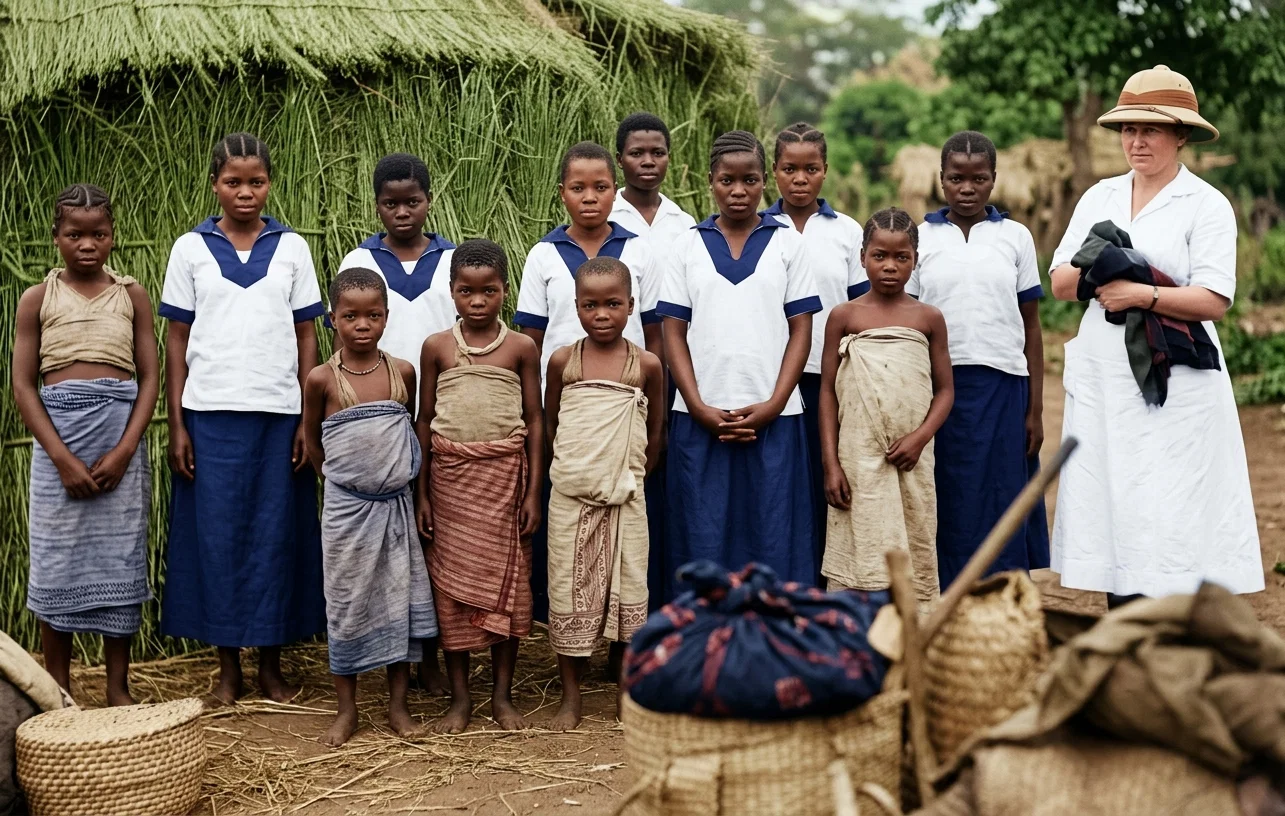
NYASA SCHOOLGIRLS IN REAR; UNTUTORED AND POORLY CLAD GIRLS FROM KRAALS IN FOREGROUND
WHEN I think of the heathen populations of Central Africa,—no one knows the number,—the solemn question presses into my heart, “How shall they hear this message?” And the answer comes in two Bible expressions: “The Lord gave the word: great . . . the army of those that published it.” “Blessed are ye that sow beside all waters, that send forth thither the feet of the ox and the ass.”
In Bible times the wealth of a man was represented by his oxen and asses. The figure is still true, and there is literal truth in the words. Where the ox and the ass go, under direction of any Christian, there the gospel and civilization follow. We may speak, and we should, of the crisis and opportunity in the East. It is all true. It is a wonderful opportunity.
Just now a wave of Mohammedanism is creeping over Central Africa. But the gospel of Christ is the heritage of Africa’s children. Why did Israel sojourn in Africa more than two hundred years? Why have all African tribes traditions of the great Bible events? Who sent Stanley and Livingstone to open Africa from side to side? and why? Who will deny that these latter were God’s forerunners of the last message?
Also in God’s good providence, he has planted the seeds of this message clear around this continent. As a wise general, his advance forces are in position. How long shall we stand on the borders? Has not the time come to “close in”? Probably there are few of the leaders, now occupying these advance posts, who are not “constrained” to go on to the heart of the continent. What is necessary that this shall be done?
First, give us men and women to hold and increase the work already in hand. I feel impressed that the present is a time of special reason for advancing north and west from Nyasaland. Four of us who are now here have a working knowledge of the language used by millions to the northeast of us. Brother and Sister Konigmacher are on the border of the great Portuguese country, with its densely populated districts, which is their natural field for extension. A new man and wife could take their present station, and free them for that important field. I want to go into the far north of Nyasaland, into virgin territory. But in order to do that, a man and wife of some experience must be found to superintend the old main station at Cholo. My wife is anxious to join me in the north country.
Elder W. H. Anderson is pressing on toward the Kongo State on the northwest of his mission, and Elder M. C. Sturdevant eastward in his large territory. These great fields, white to the harvest, must have some part of the Lord’s army of publishers of his Word. They must also have a part of the oxen and asses represented in the houses and lands and earning power of the blessed home lands. Delay now is—shall I say?—“treason.”
Malamulo Mission, Nyasaland.
A Memorial on Opium
An imposing list of names of Christian leaders from all over the world has been signed to a memorial to the British government in regard to the opium traffic. This document represents the moral opinion of the world, as the names appended are those of leaders in all lands. The memorial declares: “We the undersigned, who as delegates from the various missionary societies of the world are in Edinburgh, attending the world’s missionary conference, in view of the now unquestioned sincerity of the government of China in its endeavor to suppress the opium evil, beg to express to the government of Great Britain our earnest desire that China may be left entirely free with regard to the importation of opium, and that the government of Great Britain will take such other steps as may be necessary for bringing the opium trade to a speedy close.” Then follow the names of a thousand or more prominent delegates and visitors.
— Selected.
Christianity’s Transformation of Korea
It is indeed very remarkable to see what wonderful changes have been brought about in a few brief years in Korea, leading the people away from their long-cherished worship of idols, to the service of the true God. “In 1888 it was death for a native to be known as a Christian. The preaching of the gospel was forbidden by law; and, set up by the wayside, tablets could be seen bearing such inscriptions as these: ‘If you see a foreigner, kill him;’ ‘If you see a native reading the Christian Book, kill him.’ To-day, we are told, the baptized converts number over three hundred thousand souls; all the laws against Christianity are repealed, and there is perfect freedom. When mission work began, no word suitable for ‘God’ could be found in the language; but fixing upon its nearest equivalent, the missionaries added to it a meaning which it had never had before. Through the advent of Christianity and modern ideas, some twenty-five thousand new words have been added to the language, and to-day fourteen hundred of the two thousand schools in Korea are conducted by Christians. Lack of space forbids more extended reference here to this miracle of modern missions.”
Tact
By Henry Lee
TACT is that rare quality which ever acts wisely and discreetly. It is courteous and refined, and embodies many virtues. It is, from every point of view, a very desirable acquirement. It disarms prejudice and jealousy. With it, the politician can soothe the ruffled feelings of his opponent. In home life, it possesses a charm of manner which captivates all hearts. By its use, breaches are healed, the jagged edges of friction become smoothed, words of anger become words of love; and where discord reigned, there are harmony, peace, and happiness.—Henry Lee.
Asking for Faith
If it is not possible to take hold by faith, it is possible to ask for the faith to take hold.