The young people of our church have started a Young People’s Society, holding their meetings every Friday evening. We had quite a number to start with, but some have moved away. All, old and young, were invited to participate in the meetings, and I was glad of an opportunity to take part.
At the last meeting, only six were present. But we had the Bible study given from the INSTRUCTOR, followed by a song service, in which we learned some new pieces of music for Sabbath-school and meeting, then a Bible lesson on the four Gospels. Some very interesting points were brought out. In conclusion the programs for the two following meetings were outlined by the leader.
We are planning to help in making some of the garments for the Nyassaland Mission, and have sent for patterns.
This is a young church, having been organized only last fall. We are desirous of carrying on other phases of missionary work, such as mothers’ meetings and a Dorcas society.
I write this, not as an officer of the Young People’s Society, but from a personal interest in the movement. NANCY J. CADY.
Some of Our Common Ants
By Floyd Bralliar
IN a meadow about two hundred yards from my boyhood home was a dry, well-drained bank, where lived a colony of large red ants. You have seen such a colony, I am sure; but I am going to tell you something about this colony that you may never have noticed. They had a farm about five yards across, and raised grain, too. You think this is queer, so I will tell you how they did it. First, they plowed the ground by working through it back and forth, and cutting it all up fine. They plowed deep, too, and were careful to destroy all grass, and everything that might injure the crop. Next they sowed the seed. There was no regularity nor order about this; but when it came up, there was a good, even stand, after all. Their crop was a sort of short grass, that grew only about a foot high. This was tended with the utmost care. Sentinels were stationed over it at all times, and woe to the luckless grasshopper that attempted to forage in this field! He was278promptly driven off, or killed and taken home.
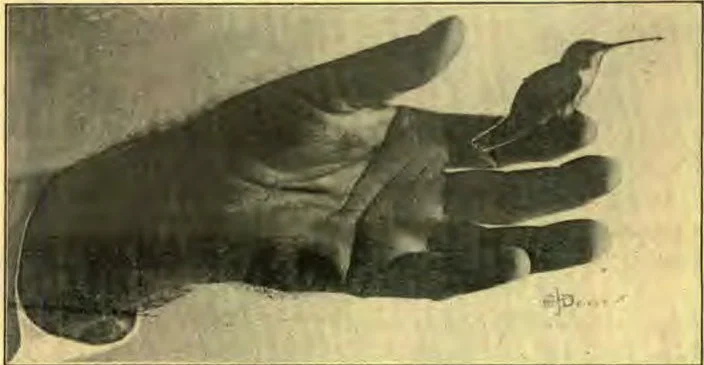
“AND SAT ON HIS FINGER”
In August the grass ripened heads of grain,—pretty white grains that looked almost like small kernels of rice, only they were no larger than a radish seed. Harvest was a busy time. Ants clambered over each plant, gathered the grain, seed by seed, and spread it out to dry in the sun. Before this, storehouses had been hollowed out below the surface of the ground, and had been well drained. As soon as the grain was quite dry, it was stored in these granaries; but as it would not dry in one day, and as dew would dampen it, it was carried down in the evening and back in the morning. Even after it had been stored for the winter, it was sometimes necessary to carry it up to dry after a hard rain.
The granaries were not very large, but there were a number of them,—I did not dig enough to find out how many,—and there were empty rooms, where, in all probability, that mysterious process of turning the grain to a liquid took place; for an ant eats nothing without first turning it to a liquid.
One who watches an anthill will learn some interesting things. Sometimes there are thousands of open doors, and the busy workers are cleaning house. Again, you will find no doors at all, and not an ant is stirring. When danger is near, they usually have all doors closed.
It is interesting to see several ants drag a large grasshopper to the mouth of one of their houses, and find him too large to take inside. First a leg or a wing is cut off and carried in, then another. Finally some general comes, looks the situation over, and touches his horns against the horns of two or three others, and away they all run into the hill. By and by an opening large enough to admit the dismembered carcass into a room is made, and it is dragged to that opening and into the hill. Soon the door is closed so tightly that no one could tell where it had been. Ants build walls and arches of little balls of dirt, which rival the work of a stone mason.
I know only one tribe of ants in Iowa that are farmers. The remainder are hunters, professional warriors, or stock-raisers. The warriors are so shiftless that they will not wash their own babies, or even themselves, and would starve were it not for their slaves, whom they compel to take care of them. They are large, strong fellows, nevertheless, and are terrible in battle. There are only a few of this kind.
There are many herders, and next week I will tell you about them. A large colony of them kept their herds only about fifty feet from the corner of our house. I suppose they would be there yet, had they not stolen so much from our cupboard. As it was, they became a nuisance, and I led a colony of warriors against them. After fighting two days and one night, both colonies were exterminated. The battle was terrible. I never would have started it, had I known its horrors; but, once begun, it was too late. Every chip and stick was covered with struggling ants. They asked no quarter and received none. Ants with their legs cut off still fought whenever an enemy came in reach, and I saw many severed heads still hanging to their enemy with a death-grip that could not be released. Satan rules even among the ants when they go to war. FLOYD BRALLIAR.
Little Ruby-Throat
By Edison Driver
Ruby-throat was building a nest somewhere, that I knew. I had seen her again and again, sitting on a favorite perch, with long strands of spiderweb hanging from her slender bill. I had watched her dart like a shot away through the leaves, and had tried my best to follow, but all in vain. Throw a needle into a haystack, as far as you will, and it will not be harder to find again than was that little winged, sun-painted dewdrop among the dark shadows of the great fig-trees.
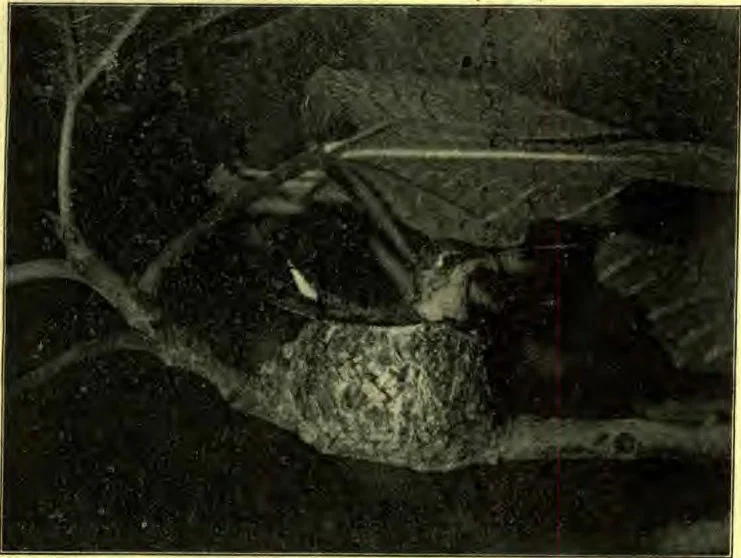
“ON THE VERY END OF THE TWIG”
But thread the needle before you throw it,— thread it with a snow-white thread,—and the finding again will not only be possible, but very easy. So this thread that led me to Ruby-throat’s nest was the buzz and hum of her lightning wings one day as I was walking under the trees. Instantly I looked up on hearing the hum, and there, sure enough, was the industrious little worker, weaving some filmy stuff into the walls of the tiny, half-built home.
Wise little creature! Her house was on the very end of the twig, roofed in by a great, dark leaf. The twig was so slender no cat nor lizard would dare venture upon it; and the leaves screened it from the sunlight’s heat and glare above, while the breeze could kiss it from below, and rock the babies there. Ah, yes! wise, little, God-taught jewel! As the days went by, and the nest grew very big and white,—as big as a silver dollar,—Ruby-throat decided to paint it. There must be no prying eyes peering into that little cradle, now that it was done. No, indeed! So she brought lichens and green blossoms, and glued them on till the nest was all gray and green, like the limbs and leaves around it. Now, O boy! find it if you can!
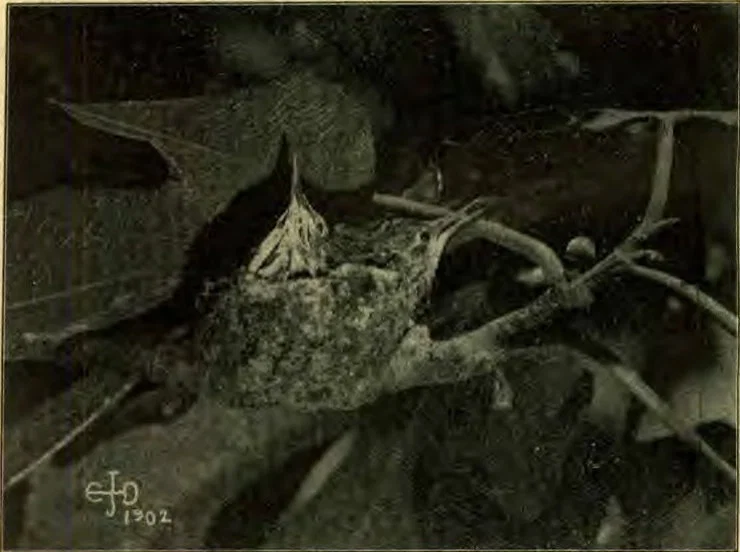
“THE TINIEST OF ALL FEATHERED BEINGS”
One day I fancied it would be worth while to take a peep inside the gray little walls. And sure enough, there they were, two little egg-shaped, pea-like, creamy pearls. Like an angry bee, Ruby-throat buzzed about me. She was sure her nest was found then; yes, and all her work done for nothing. But by and by, as she came to know me better, she merely hovered near when I came to the nest to look and admire.
How did I contrive to get her picture? One sunny day I set my camera near the nest, and made it all ready to take the photograph. I reflected light in through the leaves with a mirror, tied a long string to the camera shutter, and hid behind a neighboring tree. Mrs. Ruby-throat, and for that matter Mr. Ruby-throat, too, spent a great deal of time scolding the camera, and darting about it, before deciding that it was harmless. But at last she lighted for an instant in the nest. “Click!” said the camera, and away she darted, but not soon enough to escape the lightning shutter.
In just ten days the little pearly ellipses were broken open, and two wee black creatures, the tiniest of all feathered beings, lived and breathed and moved in the wind-rocked home. Have you ever seen a baby hummer? Wonderful sight! It is like a little, black, featherless honey-bee—no larger.
But the little creatures grow fast, and it was not long till the pin-feathers came, and tiny beaks stretched up above the nest rim. Ruby-throat fed them every few minutes, putting her bill into their little mouths, and injecting food as from a syringe. Often have I seen her come home from her honey gathering, the top of her head yet yellow with flower pollen, hover over me an instant, fly to the little ones, and away again in a flash—so with the tireless faithfulness of her mother-love all the day, that the little darlings in the nest might not grow hungry. Wonderful is the love of a mother, even a bird mother.
But the great test of her love for them came as they were ready to fly. One had already flown from the nest, and fallen to the ground, so I took him and his companion into the house to look at them more carefully, leaving the door wide open. They were hungry, and began to call for mother. Her keen, anxious ear, away out there among the trees, caught the tiny, familiar sound, and she came. What love must have been hers, to lead her into that dark, strange house, with all its terrors and dangers! But in through the open door, to where they sat by the window, she came, and was preparing to feed the little ones, when she saw my brother and me. Then fright overcame her, and she tried to escape by the window. Again and again she dashed against the glass, till, completely exhausted, she fell into my brother’s hand, and sat there on his finger, as you see in the picture.
After that she flew away, and I saw her only from a distance, feeding her little ones up in a mulberry-tree. EDISON DRIVER.
The Humming-Bird
By Laura M. Marquand
THERE is a silence in this summer day,
And in the sweet, soft air no faintest sound.
But gentle breezes passing on their way,
Just stirring phantom branches on the ground;
While in between the softly moving leaves,
Down to their shadows on the grass below,
The brilliant sunshine finds its way, and weaves
A thousand patterns, glancing to and fro.
A peace ineffable, a beauty rare,
Holds human hearts with touch we know divine,
When, hush!—a little tumult in the air;
A rush of tiny wings, a something, fine
And frail, darting in fiery haste, all free
In every motion; scarce we've seen or heard
Ere it is gone! How can such swiftness be
Incarnate in an atom of a bird!
To know this mite, one instant poised in space,
Scarce tangible, yet seen, then vanishing
From out our ken, leaving no slightest trace!
Ah, whither gone, you glowing, jeweled thing?
Before you came, the very air seemed stilled;
More silent now because with wonder filled.
—Laura M. Marquand.
A Riding-Whip
By J. Edgar Ross
A slender rawhide or rattan riding-whip can be bought for a very small sum, and will make an excellent base upon which to weave horse-hair. Failing this, the small end of a broken buggy-whip will do nicely. The length should be about two and one-half feet; but if you have a cracker on the tip, it may be somewhat shorter.
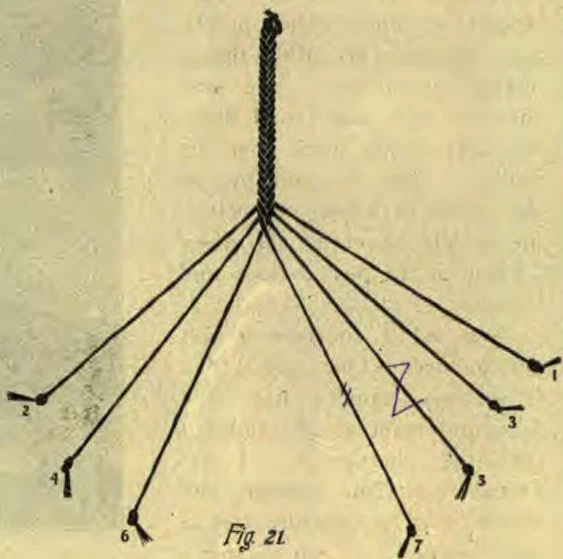
Fig. 21
The whip will be tapering; so a larger number of threads of woof will be needed at the butt than at the tip. It is best to begin weaving at the large end, as it is easier to drop threads that are no longer needed than it is to take up new ones, and much less work to finish with a small number of threads in the woof than where there are more.
The first thing to do is to provide the whip with a loop by which it may be carried on the wrist, or hung on the saddle-horn when not in use. This may be of leather or of braided horsehair. If hair is used, it should be braided flat, as a square or round braid is so rough that it cannot be carried on the wrist with any degree of comfort. The loop should be not less than six inches in length. That will require twelve inches of braid; and as an inch from each end will be used in fastening it to the whip, the braid must be at least fourteen inches long.
A flat braid can be made with any odd number of strands, but seven will be best for this purpose. The braiding is quite simple, and will be readily understood by referring to Fig. 21. The strands are there numbered in the order that they are to be used; and when all have been used once, they will have changed sides. Take 1 and pass it over 3, 5, and 7 to the other side, where it is left in front of 6. Next pass 2 over 4, 6, and 1, and leave it in front of 7. In their turn the other strands are used in a similar manner until the braid is finished.
To fasten the loop to the whip, let the ends of the former overlap the butt of the latter about an inch, and then wrap them tightly with strong thread. Begin the weaving at this end of the whip in the ordinary manner. Be sure that your woof contains a sufficient number of threads to begin with, as it will be easy enough to drop them out when they get crowded. When it is necessary to drop a thread, skip it, and use the next one. When you come to that place on the next circle of stitches, take the thread that was skipped, and draw it under the warp, just as you would in splicing a thread.
Fig. 22.
If the whip is to be finished without a cracker, the best way to hide the ends of the woof is to pass each thread through a needle, and draw it under the weaving, and up through the latter about half an inch from the end. What is left of the thread can then be cut off.
Fig. 23.
If a cracker is desired, the threads of woof can be separated into four strands, and braided around the warp for about two inches. Then bring the end of this braid back to the place where it was begun, to form a small loop, and fasten it securely with strong thread wrapped around and sewed through and through both braids. Now cut off whatever remains of the ends of warp and woof, and cover this place with needlework.
Fig. 24.
Fig. 22 shows the whip completed, with the exception of the cracker. This latter should be a leather thong about eight or nine inches long, three eighths of an inch wide in the middle, and tapering to a point at each end. Beginning an inch on each side of the middle of this thong, cut two slits about an inch long, pass the thong through the small loop on the end of the whip, and fasten it in the manner shown in Fig. 23, when it will be ready to use.
A Pen and Pencil Vase
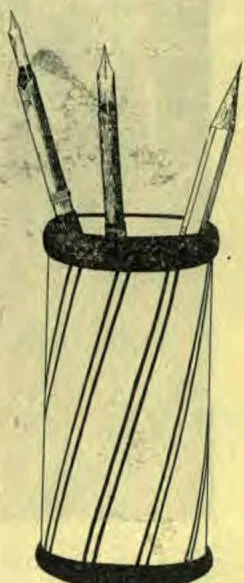
A vase to hold pens and pencils is a useful thing on any writing-desk; and when such a vase is covered with horsehair woven in some appropriate pattern, beauty is combined with utility.
The base upon which the hair is woven may be either a tin can or a round glass bottle from which the top has been cut. An ordinary glass bottle will be much heavier than a tin can of the same size, and a vase woven upon such a base will not be as easily tipped over as one in which tin is used. But glass is so easily broken that the advantage is probably on the side of the tin. If tin is used, a coat of dark stain on the inside will improve its appearance.
The vase from which the drawing (Fig. 24) was made measures four and one-half inches in height and two inches in diameter. This will be found a convenient size; but if it was somewhat smaller, it would probably serve the purpose equally well. To cover a base of this size, I used one hundred and twenty-six threads of woof, each of which contained ten hairs. The needlework on the top and bottom of the vase brought the total number of hairs used up to nearly fifteen hundred, with an aggregate length of more than two thousand feet. That would make quite a long string if stretched out in one line; yet the weaving of this vase was by no means as much work as one might suppose from the amount of hair it contains.
This vase contains twelve threads of white hair to two of black, the arrangement being ten white threads, one black, two more white, and another black. This is repeated nine times. The needlework on the top and bottom is entirely of black hair. Of course different patterns may be followed if you choose.
It will be best to begin weaving at the bottom of the vase. When you have woven to within a quarter of an inch of the top, the threads of woof may be passed under the warp, and the latter wrapped tightly around several times, and tied, to hold it in position till the needlework can be put on to hide the ends. J. Edgar Ross.
Your Father Knoweth
“Your Father knoweth.” This is one of the tender words of Scripture, the sweet, hushing answer of a love that understands all, and can do all. There is such joy in the words: “Your Father knoweth that ye have need of these things.” It may be heart-need or life-need or soul-longing, the unattained desire, the unfulfilled wish. To every pang of disappointment, to every powerless reaching forth of hope, no less than to every sigh over temporal need this word comes: “Your Father knoweth.”—Selected.
MEMORY VERSE: “Behold the lamb of God, which taketh away the sin of the world.” John 1:29.
(The chapter given as the Lesson Scripture is the lesson to be studied. Read this every day, and think over it until you know just what it teaches. Then the following notes, which should be read several times, will help to a fuller understanding of the lesson. Lastly, go over the questions carefully, and be sure that you can answer each in the words of Scripture.)
“By faith Abraham, when he was tried, offered up Isaac: and he that had received the promises offered up his only begotten son, of whom it was said, That in Isaac shall thy seed be called.” Heb. 11:17, 18.
We have already learned who was the Seed promised to Abraham. In the third chapter of Galatians, Paul tells us plainly that when God said to Abraham, “And to thy Seed,” he was speaking of Christ. God had more than once promised Abraham that Christ should come in the line of his son Isaac.
Yet God told Abraham to go and offer up Isaac as a burnt-offering. How, then, could God’s promise be fulfilled? Ah, Abraham had learned from the birth of Isaac that nothing can keep the word of God from being fulfilled. He knew that since God had promised it, Christ must come through Isaac, even though he should take his life, as God commanded.
So “he that had received the promises offered up his only begotten son,” “accounting that God was able to raise him up, even from the dead.” Notice that Abraham told his servants: “I and the lad will go yonder and worship, and come again to you.” In this he showed his faith that God would bring Isaac from the dead, and that he would return home with him.
In the bitter trial of offering up his only son, Abraham learned more of the wonderful love of God in giving his only begotten Son to die for us.
Isaac was a type of Christ, the only begotten Son whom God gave, and who willingly gave himself for us. We are twice told that “they went both of them together”—Abraham to offer, and Isaac to be offered. Like Jesus, Isaac carried the wood upon which he was to be sacrificed.
Isaac could easily have escaped from his aged father, if he had wished, and not have let himself be bound on the altar. But, like Jesus in this also, he delighted to do the will of God, even when God’s will was that he should be offered as a sacrifice.
“God will provide himself a lamb.” These words of Abraham in answer to Isaac’s question, “Where is the lamb?” were a prophecy of Jesus, “the Lamb of God, which taketh away the sin of the world.”
Abraham found near at hand the ram that God had provided, and offered this in the place of Isaac, who went home rejoicing. This also teaches us the gospel that God has given Jesus to take place, and suffer death for us, while we may go free because he has “found a ransom.”
Questions
1. When Isaac was a young man, how did God try Abraham’s faith? Gen. 22:1, 2.
2. When was it that God spoke with him? How long did Abraham wait before he obeyed? Verse 3. Whom did he take with him? What did they carry?
3. How long did their journey take them? Verse 4.
4. When Abraham saw the place where the sacrifice was to be made, what did he say to the young man? Verse 5.
5. Why did he say that they would come again, when he expected to offer up Isaac? Heb. 11:17–19.
6. What had God told him about Isaac that made him sure that God would give him back? Heb. 11:18.
7. What did Isaac carry as he went to the place of sacrifice? Verse 6. Of whom was he a type?
8. What did Abraham carry? Verse 6. Through the offering of Isaac, what was God teaching Abraham about himself?
9. What is twice said about Abraham and Isaac as they went to the place of sacrifice? Read verses 6 and 8. In this whom were they like?
10. What question did Isaac ask his father? Verse 7.
11. Of whom was Abraham’s answer a prophecy? Verse 8; John 1:29.
12. Tell how Abraham was kept from slaying Isaac. Verse 10–12.
13. Did he offer any sacrifice? Verse 13.
14. How have we all been saved from death, and set free, as Isaac was?
XI— The Everlasting Continuance of the Kingdom of God
(September 13)*
LESSON SCRIPTURE: Texts inserted in the lesson.
MEMORY VERSE: “Thy throne, O God, is forever and ever: a scepter of righteousness is the scepter of thy kingdom.”
Synopsis
When Nebuchadnezzar began to wonder what the future of his kingdom would be, God showed him that Babylon should fall, but that a kingdom would arise in its place which should stand forever. “Nebuchadnezzar began to see that the men whom he trusted to reveal mysteries failed him in his great perplexity;” indeed, God had taken the dream from him “that his pretended wise men by their claimed understanding of mysteries should not place upon it a false interpretation,” and that the king of Babylon might behold the greatest of all mysteries.
The secret of that fifth kingdom which Daniel showed the king is a mystery which has been hidden in God from the beginning of the world. Eph. 3:8, 9. Christ’s parables were given to reveal this same mystery (Matt. 13:35), and that, too, in explanation of the kingdom of heaven. Notice how many of the parables begin, “The kingdom of heaven is like,” etc. Christ said to his disciples, “It is given unto you to know the mysteries of the kingdom of heaven” (Matt. 13:11); and it is also given unto us.
Jesus, the Son of God, is the only key which unlocks the mystery of God’s kingdom. He has manifested the Father’s glory in our flesh (John 1:14); he that hath seen him hath seen the Father (John 14:9); and this very fact links him at once with the great mystery of godliness (1 Tim. 3:16), which is also called the mystery of Christ. Eph. 3:4.
The everlasting continuance of God’s kingdom is assured because of the everlasting existence of the King. “Thy throne, O God, is forever and ever. . . . They [the heavens] shall perish; but thou remainest; . . . they shall be changed; but thou art the same, and thy years shall not fail.” Heb. 1:8, 11, 12. Christ’s very name, “I AM,” shows his everlasting being. Rev. 22:13.
If we accept his character, and seek for his glory (Rom. 2:7), we also shall live forever. “Whoso eateth my flesh, and drinketh my blood, hath eternal life.” John 6:54. “To eat the flesh and drink the blood of Christ is to receive him as a personal Saviour, believing that he forgives our sins.”—“Desire of Ages.”
Sin makes us come short (Rom. 3:23) of the glory which Christ has given us (John 17:22); but according to the mystery of his will, the forgiveness of sins restores to us the riches of his grace, even all that we have lost through sin. Eph. 1:7, 8, 9. Whom God forgives, he quickens—makes alive (Col. 2:13); and thus to have continual forgiveness is to have continual life. This is indeed a great mystery, but it is the secret of the everlasting continuance of that fifth kingdom whose King is eternal, and whose subjects live forever.
Questions
1. What was the secret which God showed the king of Babylon?
2. What did this experience reveal to Nebuchadnezzar concerning the men in whom he had always trusted?
3. In fact, why had God taken the dream from him?
4. From what time has the mystery of the kingdom of God been hidden?
5. In what way did the Saviour reveal the mysteries of his kingdom?
6. What shows that his parables are given in explanation of the kingdom of heaven?
7. What has Jesus said that it is given to us to know?
8. Who is the key which unlocks this mystery?
9. What has been manifested in our flesh?
10. This revelation which Christ has made in our flesh links him with what?
11. What is the mystery of godliness also called?
12. What makes the continuance of God’s kingdom sure?
13. What scripture shows that the King is eternal?
14. What else that he ever is?
15. Upon what condition can we also live forever?
16. What is it to eat the flesh and drink the blood of Christ?
17. What hinders us from having the glorious character of Christ?
18. How can it be restored to us?
19. What does God do for one whom he forgives?
20. Then how can one have continual life?
21. What does this wonderful mystery show us concerning the continuance of the kingdom of God?
NOTE.—Study carefully all the texts given in the lesson. They are full of wonderful thoughts which do not lie on the surface.
Over 225 Years
Is the total length of time the eight men named below have written shorthand. They are the most widely known, and stand highest in their chosen branches of the profession, of any stenographers in the world; and hence an unusual weight is attached to the unsolicited opinions they have expressed regarding “The Rogers Compendium of the Graham System of Shorthand.”—
“Does away with all useless study.”—Henry L. Dietz, Stenographer and Notary, Chicago, Ill.
“The best condensation of any shorthand system I have ever seen.”—James W. King, Official Stenographer, Three Rivers, Mich.
“More ounces to the pound and pounds to the hundredweight than has hitherto been dreamed possible.”—Thomas I. Daniel, for 32 years Official Stenographer, Jackson, Mich.
“No better text-book could be put into the hands of a pupil.”—James H. Emery, Official Stenographer, Toledo, Ohio.
“A monument of conscientious and intelligent labor.”—David Wolfe Brown (since 1864), Official Reporter of Debates, House of Representatives, Washington, D. C.
“One of the most advanced text-books for the successful teaching of shorthand that I have seen.”—Francis H. Hemperley, editor of “The Stenographer,” Philadelphia, Pa.
“Replete with practical shorthand information, and will fill a long-felt need in the shorthand world.”—Prof. P. B. Cornwall, Shorthand teacher, Columbia Commercial College, Evansville, Ind.
“The best arrangement for the study and acquirement of Graham stenography that I have ever seen.”—Ruel Smith, for twenty years Official Stenographer of the Maine Supreme Judicial Court, Bangor, Me.
Our specially low tuition rates for correspondence instruction based on “The Rogers Compendium” are in effect only until October 15.
FIRESIDE CORRESPONDENCE SCHOOL, Battle Creek, Mich.