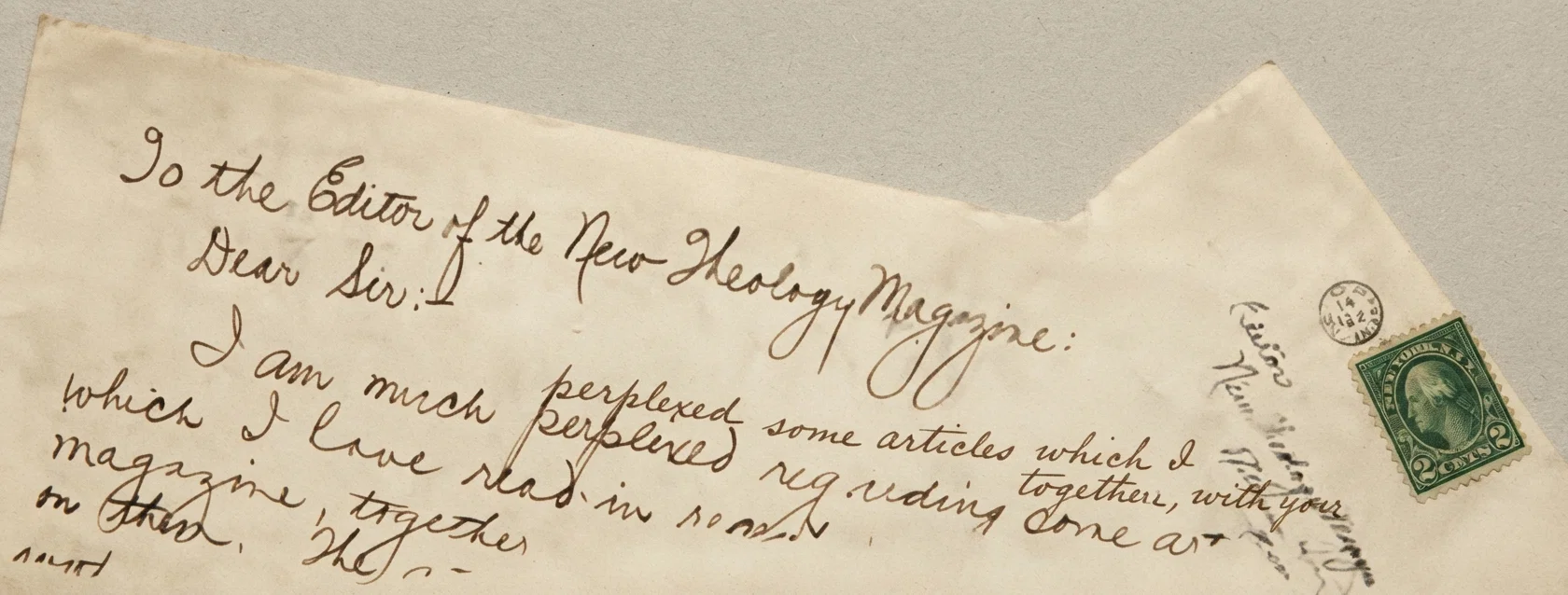
Dear Sir: I am much perplexed regarding some articles which I have read in recent numbers of your magazine, together with your editorials commenting on them. The articles I refer to have been dealing with the earlier parts of the Bible, and especially with such topics as the creation, the Flood, and miracles in general. The customary teachings of modern science are said to render it impossible for us any longer to accept these Bible records in the older sense as real historical accounts of actual facts, and we are told that they must be understood as merely pretty stories surviving from a more ignorant and more credulous age.
Your comments on these articles accept these new views as to the Bible stories; but nevertheless you claim that the value of these Bible narratives is in no way diminished by these discoveries of modern science, but that we now have even clearer views of their transcendent beauty as stories with profound moral significance, of permanent value in the ethical and cultural training of the race.
These comments on the articles puzzle me. I can well understand the attitude of the older generation of scientists who utterly repudiated any idea of divine inspiration as attaching to records dealing with the early history of our race, which they believed to be palpably untrue, and contradicted by the discoveries of science; but I am quite perplexed at your attitude regarding these questions. You seem to believe all that Huxley and Spencer and Haeckel have ever said concerning the mistakes of the Bible in these matters of science; yet you say, in the very next breath, that you continue to have the same high opinion of the ethical character of the Bible, and the same faith and confidence in the God of the Bible, that you have always had.
As I have thought over the matter, I have concluded that your experience in this matter must be very much like some childhood experiences of my own; and with your permission, I shall narrate a few of them, hoping that they may throw some light on the present situation regarding these larger matters of science and religion mentioned above.
Found Him in a Rosebush(?)
I HAD the dearest and best of mothers. She endeared herself to me as a child by supplying my every need, and I used to go to her with all my childish questions and troubles.
I distinctly remember how my mind used to dwell on the great problems of life, among which was, "Where did I come from?" One day, I ventured to ask my mother about it. "Oh," she replied, smiling, "I found you in a rosebush; and I think the fairies must have put you there, for you were all wrapped up so warm and snug, and you seemed to have just come down from above." A little while later, I learned the facts of life and its origin from some older children; and at first, I was much perplexed to know why mother had not told me the truth in the matter, instead of telling such a fable, especially when the truth would have been just as good to tell as the story. But I concluded that she must have had some reason for doing as she did, and I tried not to let any little thing like this come in between me and my perfect confidence in my mother.
Frequently she would entertain me and the other children for hours by describing a beautiful house she was having built for us just across the river. The country over there, she said, was far nicer than where we lived. The woods, and the green fields, the flowers, and the songs of the birds, were ever so much better than anything we had ever known of, and the place was, in fact, a perfect paradise. And each of us was to have a house of his own when we grew up — if we were good.
This led me to think more critically about the house we were then living in. It was a small house, but pretty good and comfortable, with a good cement foundation, brick walls, heavy slate roof, and all beautifully decorated inside. I asked her who built it. "Oh, I built it," she said; "and it took us just six days." She went on to describe in detail just what was done each day, what a large crowd of men she had working at it, and how, on the sixth day, the family had moved in, and the house was just as nice and comfortable as could be desired.
Putting Confidence in Fables
Of course, this was very interesting; and as I knew that mother could build such a nice house so easily, I felt sure that the one across the river must be a beauty indeed, for she assured me that she was taking the greatest pains with it. But when I mentioned the matter to my teacher, he said: "Why, my dear boy, the thing is absurd.
That house of yours could never have been built in six days." And he went on to describe, with much detail, how contrary to all the principles of architecture such a hurried piece of work must be.
"Your mother must have meant six months, instead of six days. But never mind," he added, as he saw that I looked disappointed over what he had told me. "Your mother only wanted to impress upon your mind very strongly the fact that she was the one who had built the house, that she owned it, and that you children should always look to her for whatever you might need. She had no thought of giving you lessons in carpentry and brickmaking." He went on with a broad smile: "Of course your mother built the house; there is no doubt at all about that. You have a very remarkable mother; and it is quite right that you should put the utmost confidence in what she says, if you are careful only to understand her statements in the right way."
I also had my full share of childish troubles and fears. I was always very much afraid of two neighbor children, Adam and Eva Black. I asked mother what made them so bad. "Well," she said, "they used to be very good, just dear little children. But one day, about six years ago, they were out in the orchard eating green apples, which their mother had warned them against, when they were both bitten by a big, poisonous snake, and nearly died. From that time, they seem to have become perfect little imps for devilry."
Helped by the Snake Bite
ONE day at school, I happened to mention to my teacher what mother had told me. "Well," he said, "that is certainly a good joke. Why, Eva and Adam are ever so much better than they used to be. If you had been here eight or ten years ago, you might well have been afraid of them. They were more like baboons than human beings. I guess that snake bite — if they ever had one — must have helped them a lot; for they are certainly much better than they were, and they are steadily improving."
Once when I ran to mother in fear of these dreadful children, she told me not to be afraid, for she knew how to quiet them and make them behave. "Once they came into the yard," she said, "and made so much trouble that I just turned the water hose on them and nearly drowned them." This encouraged me very much, until I happened to mention it to the Black children, telling them they had better let me alone. But they only laughed, and said it was all only a made-up story. "Your mother has no water hose," they declared, "and she never had any. You just go and look." I did look, and found no hose, nor was there any place where one could be attached to our water pipe. I was much puzzled at this, and hardly knew what to think of the situation; but I concluded that mother had told me this story to cheer me up a bit.
Once the river was running very high, and I was afraid to go for water; but she told me not to fear, for she would watch me, and see that I did not get drowned. "Once your brother Lazarus fell in, and was under the water four hours, before I found him and got him out. But I had no trouble in bringing him around all right." This encouraged me, and I went for the water. Afterwards I told the doctor about it, for I was always proud of what mother could do. "My dear child," said the wise old man, "don't you know that it is quite impossible to restore to life a person who has been under water for one hour, to say nothing of four? Your mother only wanted to teach you that she would look after you, that was all."
Like most boys, I did not always care to go to school, and one day I had actually planned to run away. But mother found it out somehow, and she talked to me so seriously that I had to give up the idea. She told me how much I would lose by not going to school, and what a bad habit truancy is.
"Your brother Jonah played truant one day, and started to run away — to Spain. But soon after he started, a big eagle caught him, and carried him away to its nest, where it kept him for three days. He was a very frightened little boy when I found him," she continued; "and the next day, he went to school all right." This put a stop to my plans for running away, although I afterwards found out, in the geography class, that there were no eagles in this part of the country at all, and that besides, no living eagle could possibly carry off a big boy like Jonah. But then, the story accomplished a very useful purpose with me, and I thought it was only a small matter.
"White Lies" to Impress Truth
I THINK I could recall one or two dozen stories like these that mother used to tell me to impress upon6my mind some good moral lesson. But I can assure you that she never told me any such "white lie" without some good moral truth as a lesson behind it; for I would have you know, my dear sir, that my mother was an example of perfect truthfulness, and was very careful to train her children in absolute veracity, as well as in all other virtues.
AN OPEN LETTER
(Continued from page 5)
But one day I was sick, very sick, so sick that I could not walk. As I lay in my bed in my little room on the third floor, thinking about the beautiful home that mother had so often promised me, I noticed a smell of smoke; and as I looked toward the bedroom door, I could see dense clouds of smoke pouring in around the door and over the transom. The sharp crackling of flames could be distinctly heard coming from the hallway, growing ever louder minute by minute. In my helpless condition, with no one near me, I began to call loudly for help. Soon I heard mother's voice in the yard below. "All right, Georgie! Don't be afraid. I am going to bring you down the fire escape." Oh, how thankful I was to hear my mother's voice again, and that she was coming to save me! But — horror of horrors! — my next thought was, There is no fire escape! Our house had always been regarded as fireproof, and a fire escape had not been thought necessary.
As I lay there, feverishly listening to the steady roar of the flames, watching them as they crept under the smoking door and licked up the varnished wainscoting and the paper hangings on the wall, with the smoke now grown thick almost to the point of suffocation, my thoughts naturally called up the stories mother had told me — stories to encourage my trust and confidence in her and her motherly care — which I had afterwards found out were only stories, and quite impossible of accomplishment. And as I thought of these, and realized that the means by which she now promised to save me had no existence, and knew that in a very few minutes I would be past all possible help, do you wonder, sir, can you blame me, that I almost cursed my mother in my heart, as I began with feverish haste to tie the bedclothes together for a rope and to grope my trembling way toward the open window?
My allegory has become too plain, and cannot be carried further. But I believe that the above is in no way an exaggerated view of the kind of God the current pseudo criticism and pseudo science would make the God of the Bible to be.
In conclusion, my dear sir, I must say regarding these alleged disclosures of dishonesty on the part of the Bible writers, or of cruelty and incompetence on the part of the One who made the world, that any one who asserts that these disclosures make no difference in our opinion of the value of the Bible and our regard for the God of the Bible, must either be a fool himself or think all his readers are fools.
Yours for honesty and truth,
GEORGE MCCREADY PRICE.
Preferred Slavery to Liberty
By George F. Enoch
"Bewildered and deceived, he moved on toward eternal ruin—toward death that should know no waking, toward night that should see no morning."
By George F. Enoch
MAN, by his sin, placed a great gulf between himself and God—a gulf so deep and broad that he, by his own efforts, could never hope to cross. He turned his back on the light of heaven, and his face toward the darkness of eternal night. Helpless and hopeless, his lot beggared description. He chose the prince of darkness to be his ruler; but instead of liberty, he found a slavery whose bondage knew no hope. Bewildered and deceived, he moved on toward eternal ruin—toward death that should know no waking, toward night that should see no morning. Down through the ages, generation after generation marched steadily onward into the relentless jaws of the tomb, whose portals never outward swing to permit the entrance of a single ray of hope.
After four millenniums of such gloomy procession, lightened only by the faith of those who grasped the promise of a Saviour to come, a voice was heard proclaiming, "Lo, I come." This voice penetrated the gloom, and hope began to vibrate the hearts of men. God so loves the world, that He sends His only-begotten Son, that whosoever believes in Him should not perish. Now the fullness of the time has come.
As foretold by the inspired prophet, an angel visits the virgin of Nazareth, and announces that through her the divine Son of God is to tabernacle among men. He will thus become Immanuel—God with us. At the same time, devout men and women began to understand. One, speaking of the significance of this event, says, "Through the tender mercy of our God; whereby the Dayspring from on high hath visited us, to give light to them that sit in darkness and in the shadow of death, to guide our feet into the way of peace."
Thus the Son of God was born the Babe of Bethlehem. He now becomes a partaker of our flesh and blood, "that through death He might destroy him that had the power of death, that is, the devil; and deliver them who through fear of death were all their lifetime subject to bondage."
Completely Bridges the Gulf
HE is therefore Immanuel—God with us. Now the gulf is bridged, and the way provided by which we can cross to God and immortality. Had God the Son remained in heaven, the ladder would have reached far out from God's side, but could not have bridged the gulf. Were Jesus of Nazareth but a man among men, the ladder would have rested securely on man's side of the gulf, and stretched far out over the chasm, but it would not have compassed it, and would have left us still to perish.
But, thank God, He was God, and He became one of us by His birth in Bethlehem. We cannot explain how it was, any more than we can explain the mystery of our own birth, but we know it is a blessed fact. The gulf is bridged. One end of the ladder rests on the shores of eternity, securely anchored in the nature of God; the other, stretching quite across the gulf, grasps human nature, once more connecting man with God, providing the channel by which the grace of God can reach the sinful human heart and restore in it the image of God.
"He came unto His own, and His own received Him not." Such keep their face turned persistently toward eternal night, and will perish as utterly as though the Babe of Bethlehem had never been born.
"But as many as received Him, to them gave He power to become the sons of God, even to them that believe on His name: which were born, not of blood, nor of the will of the flesh, nor of the will of man, but of God." To such the night of death will, at the first resurrection, merge into the blessed morn of immortality and life—a life that measures with the life of God. Have you received Him yet? If not, delay no longer, for the day of salvation is soon to end forever.
Protestantism at the Parting of the Ways
By Sanford B. Horton
Writing the Reformation's Last Chapter
DR. SCHAFF, in his "German Reformation," volume 1, pages 7, 8, has very aptly said, "The Reformation of the sixteenth century is not a finale, but a movement still in progress."
The Reformers were divided into two schools, one of which held that it was necessary to return to the Bible for all gospel teaching, and accept no doctrine based upon the tradition of the church. These were called "radicals." The other, still under the mysterious influence of Romanism, maintained a conservative position. Among the radicals was Carlstadt, who, while the colleague of Luther in the controversy with Dr. Eck, differed in several fundamentals with the Wittenberg monk. Carlstadt, according to Dr. Sears Barnas, in his "Life of Luther," "held to the divine authority of the Sabbath from the Old Testament," on the ground that "we should not, in things pertaining to God, regard what the multitude say or think, but look simply to the word of God;" and in regard to traditional doctrine, that "it is sufficiently against the Scriptures if you find no ground for it in them."
But Carlstadt was not alone in maintaining that the seventh-day Sabbath was still binding upon Christians and should be kept by the adherents of the reform movement. A. Ross, in "Abbildung d. Relig. in Europa, 1665," page 440, enumerating the different churches of the sixteenth century, has the following:
"8. Sabbatarians, so called because they reject the observance of the Lord's day as not commanded in Scripture; they consider the Sabbath alone to be holy, as God rested on that day and commanded to keep it holy and to rest on it."
John Frith, an English Reformer burned at the stake July 4, 1533, held to the Sabbath truth by the following positive statement: "The Jews have the word of God for their Saturday, sith [since] it is the seventh day, and they were commanded to keep the seventh day solemn. And we have not the word of God for us, but rather against us; for we keep not the seventh day, as the Jews do, but the first, which is not commanded by God's law."—"Frith's Works," page 69.
In the Light of History
THE spirit of antinomianism operated against a recognition of the obligation of the Sabbath commandment; and attempts were constantly made, by fines, imprisonments, and even death itself, to discourage the true Sabbath propaganda. But these attempts were not effective.
Very much more might be said on the subject of the Sabbath question in the time of the Reformation; and if the reader is interested to inform himself from an exhaustive treatise on the subject, I would recommend the securing of a copy of "History of the Sabbath," by J. N. Andrews and L. R. Conradi. The true Sabbath has been observed from the apostolic days to the present time; but God purposed, we believe, to reserve for this time a more extensive Sabbath movement than was evidently possible in the time of the Reformation. This phase of the subject will be considered in another article.
With the open Bible now in our hands for over a century, students of the Sabbath question are compelled to admit the permanency of the seventh-day Sabbath. And in the light of history, Sunday observance is clearly discerned to be but a human ordinance, without divine authority. We ask the reader to examine the following admissions, and determine his Christian duty as to Sabbath observance:
"The Bible is the word of God in the fullest sense; but it was never intended that we should learn our faith and practice from it. . . . The Bible nowhere commands us to make any change in our holy day. Any man who gets his faith and practice from the Bible is bound, at whatever inconvenience, to observe Saturday as the Sabbath."—The Rev. E. A. Wasson, in Church Standard, August 31, 1895.
"There are some points of great difficulty respecting the fourth commandment. . . . In the first place, we are commanded to keep holy the seventh day; but yet we do not think it necessary to keep the seventh day holy; for the seventh day is Saturday. It may be said that we keep the first day instead; but surely this is not the same thing; the first day cannot be the seventh day; and where are we told in Scripture that we are to keep the first day at all? We are commanded to keep the seventh; but we are nowhere commanded to keep the first day. . . . Another difficulty on this subject: We Christians, in considering each of the Ten Commandments, turn to what our Lord says in explanation of them. . . . 'Not one jot or tittle' of the law shall fail; that He has come 'not to destroy but to fulfill' the law; and then He shows in the instance of the sixth, seventh, and third commandment, how He will require them to be fulfilled by Christians, not in the letter only, but in the spirit, and the heart, and thought."—"The Church Catechism," volume 1, pages 334, 335, by the Rev. Isaac Williams; James Pott & Co., 12 Astor Place, New York.
Not Based on Divine Appointment
THE above extracts are from Protestant Episcopal sources of recognized standard. The Baptist brethren furnish admissions also. Roger Williams, writing from Rhode Island to friends in England in 1671, said, "You know yourselves do not keep the Sabbath, that is, the seventh day." Previous to this, he had come in contact with the civil authorities in Massachusetts Bay Colony because he held that the magistrate might not punish for nonobservance of Sunday laws, and he was in consequence driven away from civilization, to make his home with the Indians in Rhode Island. Said Dr. E. F. Hiscox, author of "The Baptist Manual," before a meeting of ministers in New York in 1893:
"There was and is a commandment to 'keep holy the Sabbath day,' but that Sabbath was not Sunday. It will, however, be readily said, and with some show of triumph, that the Sabbath was transferred from the seventh to the first day of the week. . . . Where can the record of such transaction be found? Not in the New Testament — absolutely not."
Only Two Courses Open
IN a controversy between the Presbyterians and the Episcopalians in the sixteenth century, over the question of festivals ordained by the church, the Presbyterians rejected the authority of the church. This controversy is related by the distinguished theologian Hengstenberg as follows:
"The opinion that the Sabbath was transferred to the Sunday was first broached in its perfect form, and with all its consequences, in the controversy which was carried on in England between the Episcopalians and Presbyterians. The Presbyterians, who carried to extremes the principle that every institution of the church must have its foundation in the Scriptures, and would not allow that God had given, in this respect, greater liberty to the church of the New Testament, which His Spirit had brought to maturity, than that of the Old, charged the Episcopalians with popish leaven, and superstition, and subjection to the ordinances of men, because they retained the Christian feasts. The Episcopalians, on the other hand, as a proof that greater liberty was granted to the New Testament church in such matters as these, appealed to the fact that even the observance of the Sunday was only an arrangement of the church. The Presbyterians were now in a position which compelled them either to give up the observance of the Sunday, or to maintain that a divine appointment from God separated it from the other festivals."
We would not weary the reader by adding the many more testimonies available upon8this important Sabbath controversy. But in the admissions quoted, is there not a clear confession that the present-day Protestant churches are out of harmony not only with the Bible but with their articles of faith, which say, "The Bible and the Bible only is the religion of Protestants"? As Dr. Hiscox, already quoted, said in the meeting mentioned, "I wish to say that this Sabbath question, in this aspect of it, is, in my judgment, the gravest and most perplexing question connected with Christian institutions which at present claims attention from Christian people."
In our judgment, there is but one of two things to do — either proceed with the work of the Reformation by returning to the Bible for all doctrines, including Sabbath observance, or return to Rome, who not only repudiates the Bible as the teacher, but is the mother of the Sunday-sabbath institution. There is not, nor can there be, any middle ground. Either the Reformation principle and movement were right, or they were wrong. If right, they must be maintained until the last chapter of the great Reformation is written.