I HAVE been surprised to notice how many children have suffered death rather than deny Jesus. I want to tell you about one of these young martyrs. In Antioch, where the disciples were first called Christians, a deacon from the church of Cæsarea was called to cruel torture to force him to deny his Lord. While he was still being tortured, he declared his faith, saying, “There is but one God, and one Mediator between God and man, the Man Christ Jesus.” His body was almost torn to pieces. The cruel Emperor Valerian seemed to enjoy looking upon his suffering. At length the martyr said to his tormentors, “Ask any Christian child whether it is better to worship one God, the Maker of heaven and earth, or the gods many and the lords many whom the Romans serve.” There stood by a Roman mother with her little boy, nine years old. The question was asked the child. He quickly replied, “God is one, and Christ is one with the Father.” The prosecutor was filled with fresh rage, and he cried out, “O base and wicked Christian, thou hast taught this child to answer thus.” Then turning to the boy, he said more mildly, “Child, who taught thee to speak thus?” The boy looked lovingly into his mother’s face, and said, “It was God that taught it to my dear mother, and she taught me that Jesus Christ loved little children, and so I learned to love Him for His first love for me.” “Let us see now what the love of Christ can do for you,” cried the11cruel judge, and at a sign from him the officers, who stood by with their rods, after the fashion of the Romans, quickly seized the poor boy, and made ready to torture him. “What can the love of Christ do for him now?” asked the judge, as the blood streamed from the tender flesh of the child. “It helps him,” answered the mother, “to bear what his Master endured for him when He died on the cross.” Again they smote the child, and every blow seemed to torture the agonized mother as much as the child. As the blows, faster and heavier, were laid upon the bleeding boy, they asked, “What can the love of Christ do for him now?” Tears fell from the heathens’ eyes as the mother replied, “It teaches him to forgive his tormentors.”
The boy watched his mother’s eye, and no doubt thought of the suffering of his Lord and Saviour, and when his tormentor asked him if he would serve the gods of the Romans, he still answered, “I will not deny Christ. There is no other God but one, and Jesus Christ is the Redeemer of the world. He loved us and died for us, and I love Him with all my heart.” The poor child at last fainted under the repeated strokes, and they cast his torn and bleeding body into his mother’s arms, saying, supposing that the boy was dead, “See now what the love of Christ has done for your Christian boy.” As the mother gently pressed him to her heart she answered, “That love will take him from the wrath of man to the peace of heaven, where God shall wipe away all tears.” But the boy had not yet passed over the river. Opening his eyes, he said, “Mother, can I have a drop of water from our cool well?” As he closed his eyes again the mother said, “Already, dearest, thou hast tasted of the well that springs up into everlasting life. Farewell, the Saviour calls for thee; for His sake may He grant thy mother grace to follow in thy bright path.” To the surprise of all, after they thought he had breathed his last, he raised his eyes, and, looking to where the other martyr stood, he said, in almost a whisper, “There is but one God, and Jesus Christ whom He has sent.” With these words on his parched lips he died.
Are you, my dear young friend, a Christian? If not, you can become one now. That same Jesus who suffered and died to save that little Roman boy, suffered on the cross for you, and is ready to give you a “new heart,” so that you will love Him so much that you will be willing to die a death of suffering rather than deny Him.
E. PAYSON HAMMOND.
THE CHILD
By Mary Wood-Allen
By Mrs. Mary Wood-Allen, M.D.
IV.—TRUSTWORTHINESS.
“You would not assert,” said my friend to me, “that trustworthiness can be called a characteristic of infancy? Surely a child must have been developed until it can understand what is said to it, and until it has some powers of judgment of its own, before it can be taught to be trustworthy.”
In reply, let me ask you a question. Would you assert that the child is not learning language during the period of its infancy, when it is hearing words, but is making no effort to pronounce them? Would you wait until it is old enough to talk before you would talk to it or in its hearing?
In its very earliest infancy, the child may be learning lessons of trustworthiness. He must first learn to trust, before learning to be trustworthy. The very regularity of his times of feeding gives him a feeling of assurance and of trust. If he learns by experience that food does not come regularly, and that he must cry or fret before he is cared for, he comes to have a feeling of uncertainty which must make him more or less unhappy.
All of his little experiences are educating him, either in trustworthiness or in distrust. He feels a confidence in the strong arms that hold him, until some one—perhaps in mere playfulness—frightens him with a pretense of being about to drop him. He trusts all the implied promises of good care, until repeated disappointments prove to him that they are not to be relied upon.
Mothers sometimes deceive their children by a pretense of going to bed with a child, and then slipping away after he is asleep. Sometime he discovers her absence, and becomes suspicious; distrust takes possession of his little heart, and the ruse is no longer successful. Perhaps the mother, finding that baby objects to her absence, deceives him by hiding her wraps and slipping away from him, it may be going so far as to say to him, “Mama is not going anywhere; she is right here in the next room.” Some day he discovers her absence; after that he is on the alert, and she has great difficulty in carrying out this deception. He is becoming distrustful, and through distrust is learning to be untrustworthy.
Parents very frequently make promises to the child which they do not fulfil. It may be that mother purchases freedom to absent herself with the promise that she will bring something home for baby. That part of the contract slips her memory, and she returns empty-handed. Baby discovers that the promise made to him has no value in her mind; therefore it will be only natural that he should attach no value to a promise made by himself in later years. Promises made to children should be kept to the very letter, even if it be a whipping that is promised. Children soon learn to rate at their proper valuation the threats made by angry parents. “If you do that again, I will whip you within an inch of your life,” may at first frighten the child into obedience; but discovering that disobedience is not followed by so severe a punishment, and perhaps not by any punishment at all, he learns to disregard the threat, and loses confidence in the parent.
It is a serious matter when the child doubts the truthfulness of the parent, even if the fulfilling of the promise which was made were better broken than kept, and would have been better still if never made.
A little child on a railway train was very restless. The mother said, “If you don’t keep still, the conductor will come along and cut off your nose.”
Seeing the conductor enter with his gleaming punch, the child shrank behind the bulwark of its mother’s shoulder, waiting for what might come. The conductor came along punching the tickets, and paid no attention to the child. After he had gone, the little girl came out from her hiding-place, and looking into her mother’s face, said, “Mama, you lied;” and the mother laughed as if it were something amusing; but it was a most terrible and truthful arraignment, which should have overwhelmed the mother with shame and confusion.
A little girl of five was once left in my charge while her mother went on an errand. The child cried and would not be pacified. “Your mother will be back soon,” I said, comfortingly.
“No, she won’t,” said the little one stoutly.
“But she said she would,” I asserted.
“O, I know her,” said the little one faithlessly.
It is not a little thing when a child of five so distrusts the mother’s word.
Long before the child can manifest untrustworthiness in himself, he must have absorbed into his nature the idea from the conduct of others. If we would have our children worthy of trust, we must ourselves be worthy of their trust. They learn all of their first lessons of life through imitation. If those who are training them live up to the highest ideals; are truthful in the smallest matters, treating even the most unimportant personages with scrupulous honesty, keeping all promises, even the most trivial, the idea of reliability and trustworthiness will become part of the fabric of the child’s character; and even before he can talk, he will manifest that he can be trusted.
SPEAK THE GOOD WORD.
By William J. Lampton
[William J. Lampton, in New York Herald.]
It isn't the thinking how grateful we are
For the kindness of friends come to bless
Our sorrow or loss,
'Neath the weight of the cross;
It is telling our gratefulness.
It isn't the love that they have in their hearts,
And neglect or forget to reveal,
That brightens the lives
Of husbands and wives;
It is telling the love that they feel.
It isn't the thinking of good to mankind
That comes as a cooling drink
To the famished ones
Of earth's daughters and sons;
It is telling the good that we think.
It isn't the music asleep in the strings
Of the lute, that entrances the ear,
And brings to the breast
The spirit of rest;
It is only the music we hear.
It isn't the silence of hope unexpressed
That heartens and strengthens the weak
To triumph through strife
For the great things of life;
It's the words of good cheer that we speak.
The Happiness of a Home
By Max O’Rell
The most important factor in the happiness of a home is a cheerful, loving, and caressing daughter. A father and a daughter should be all but sweethearts.—Max O’Rell.
VIGOR AND VEGETARIANISM.
By S.
The non-meat diet is proving itself a health-preserver and strength-producer among classes of men who had been supposed by many to require a heavy meat diet. Men who have given themselves to athletics are finding that they can accomplish more and do better what they do accomplish by living on a grain and fruit diet. To the surprise of many in the Old World the majority of their athletic endurance tests are being won by vegetarians. Even the pugilist is not insensible to the benefits to be derived from the diet that discards meat, as will be seen from the experience of “Kid Parker,” related in The Vegetarian of April 15:—
My experience as a vegetarian dates back to last June. I was in England at the time, and I noticed there that the strongest and most rugged class were vegetarians not from choice, but as a matter of necessity, as meat in England is a luxury which only the wealthy can afford. So I began to give the matter serious thought, and as a result I determined to experiment a little on myself. Previous to this time I had been a great believer in the merits of a flesh diet, and always ate meat three times a day and frequently more often. But I decided to eat meat but twice a week, and I felt better because of it, so I cut it to once a week. I got such good results from this that I then reduced my meat meals to once in two weeks, and, surprising as it may seem, I felt better in every way. I next got it down to once a month, and with such gratifying results that I decided to leave off the use of meat altogether. Since that time I have been a strict vegetarian, and I have been rewarded in more ways than one. I have gained in mental power and increased my physical endurance. The increased clearness of intellect is unmistakable, and I believe I am a better man in every way—physically, mentally, and morally. This diet, with temperance in other things, including healthful habits, will surely work wonders for any one who is open to conviction, and who will give vegetarianism a good, fair trial; and I will say further that any fair-minded man who is open to conviction, and who will give this idea sober consideration, will surely find plenty of good food for thought in this great subject.
If such a diet will keep a pugilist alive, certainly the man of ordinary vocation will not starve upon it. On the contrary, he will thrive on it; and there is no doubt that the pugilist who adopts the vegetarian diet will gradually lose his brutal tendencies until he will cease to take delight in such an occupation, not because his vitality is weaker, but because his brain is clearer, his blood cleaner, and his heart purer, and he is able to see something better and more important in life than the inducements of the prize ring and the applause of the blood-mad audience.
S.
OSTRICH FARMING IN CALIFORNIA.
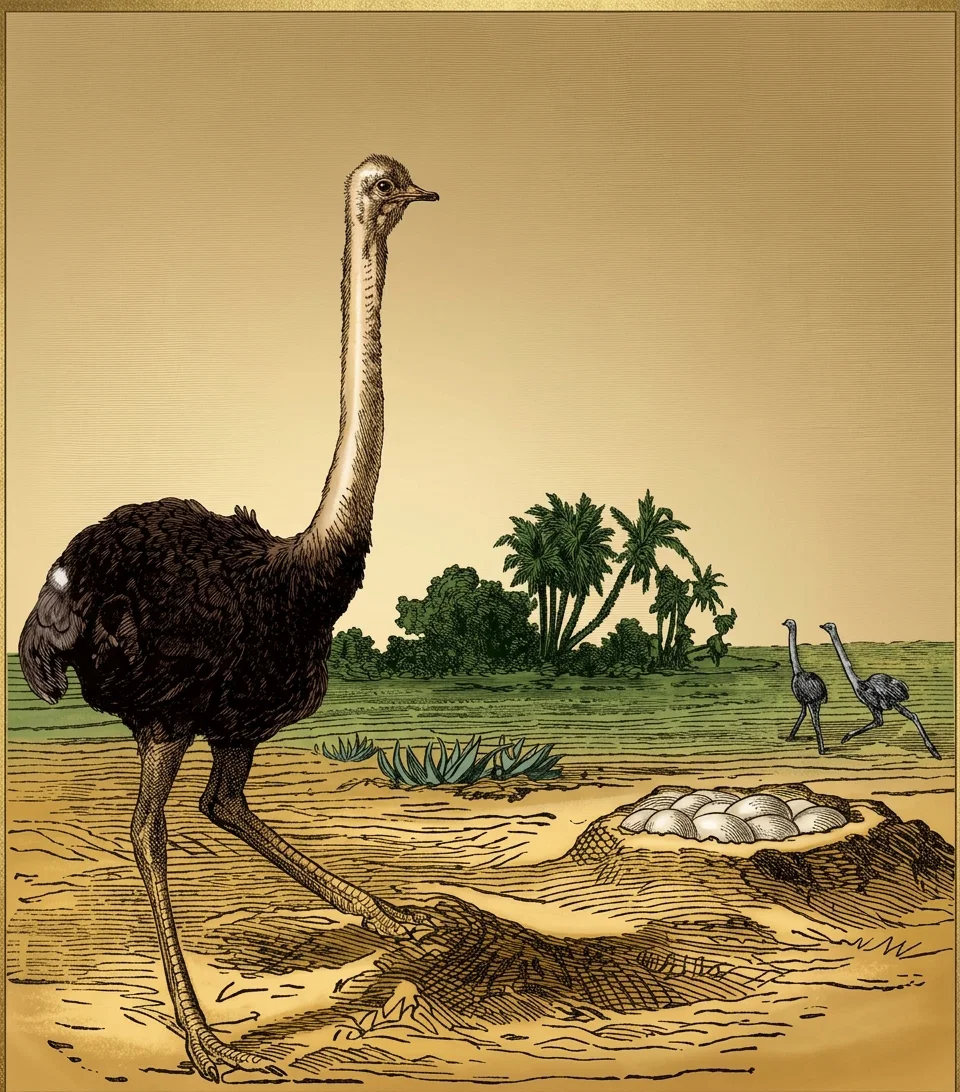
Those interested in matters curious will find much to their taste in an account of a new California industry, written by Ernest Horsfall Rydall, in the May Era. Any one thinking of raising ostriches will be glad to know that the care of the ostrich is a very easy and inexpensive matter. An ostrich has to be kept four years before it arrives at adult age; it may then be expected to yield annually about thirty dollars' worth of ostrich feathers to the owner. Feathers are obtained from the ostrich even at the age of one year, but these are of small value. The cost of the keep of an ostrich is no more than that of a sheep; so that a farmer of very limited experience can easily figure the cost of a flock of ostriches. The balmy climate of California permits the birds to remain in the open all the year round. The feathers are always in demand, and range in value from ten to a hundred dollars a pound. No more easy occupation can be entered into, and few more profitable in the raising of live stock, than the raising of the domesticated ostrich. Ostriches live to the age of about sixty years; it has been found that the climate of the Pacific States south of Cape Concepcion is admirably adapted to the African ostrich, the Struthio camelus. Constipation is, perhaps, the only malady to which adult American ostriches are subject; this can be easily rectified by the well-known methods practised by the ostrich farmers of the Cape. On the nourishing alfalfa that grows so readily and so plentifully in California the ostriches thrive; they will eat all kinds of grain and vegetables. Common opinion has it they will eat anything; while the temptation naturally is to feed the ostriches in California upon anything that may be of low value in the produce market, yet the experience of the average American ostrich farmer so far has been that the better the ostriches are fed the better egg-layers they become. The digestive powers of the stomach of an ostrich are proverbial from remote times, and modern statements are that cigars, newspapers, and miscellany of the most varied description have gone successfully into the stomach of an ostrich; but this is all exaggeration, altho of course ostriches do require a certain amount of gravel to assist digestion, as do other birds. Second-class oranges, beets, the refuse of wineries, and other things not suitable for other cattle, can be safely and profitably used to sustain the ostrich.
CHILDREN LIVE UP TO OUR EXPECTATIONS.
By C. M. G.
[C. M. G., in Ladies’ Home Journal.]
I had heard much about a certain little girl who every one said was so naughty and disobedient. I saw her first when she was six years old. After a few days of observation, my only wonder was that she behaved as well as she did. Her mother expected her to be naughty, and would say in the child’s hearing, “I suppose I shall have to take Ruth, but I know she will act like fury.” Of course Ruth did that very thing; but when away from her mother, she seemed to me a very lovable, docile child. One day she sprang to hand a crutch to an invalid. Her mother spoke out suddenly, “Well, I am surprised. It would have been more like you to run and hide that.” A sudden cloud overshadowed the bright little face, and my heart ached for the poor child, who only needed encouragement to make her a good girl.
Children usually live up to the expectations of their elders. If it is taken for granted that they will do right, they will not often disappoint. But if one expects them to do wrong, they seldom fail in doing so.
DIAMONDS
By Frank S. Arnett
[Frank S. Arnett, in Ainslee's.]
THE world has never seen, and in no other part of the world is there now to be seen, anything like America's jewel-madness, as shown by the conditions of to-day, when more than three hundred New York establishments are engaged solely in the importation of precious stones, when agents of American dealers are searching Europe for the white gem, and hopelessly endeavoring to supply American appeals for rubies and emeralds, and when six thousand men in South Africa are toiling to obtain diamonds, more than half of which are to add to the beauty and happiness of the American woman. It is she that has caused the United States to become the greatest diamond-market in the world. For her we have imported in a single year twenty million dollars' worth of precious stones; for her at one period we smuggled them in at the rate of seven million dollars a year; for her we annually buy something like twelve million dollars' worth of diamonds, and thus for her sake heartlessly leave of the world's total output of diamonds only some eight million dollars' worth to satisfy the vanity of all the rest of the women on earth. For her adornment we annually cause to be brought to this country diamonds weighing in the aggregate one thousand two hundred pounds, a weight three times that of the total output of the famous Kimberley field, and practically the equal of that of the whole of South Africa, the world's greatest diamond-mine.
A STEED YET UNTAMED.
MR. GEORGE WESTINGHOUSE, president of the Westinghouse Manufacturing Company, does not believe that electricity will make travel safer. He makes these points: Electrical energy enough to run a heavy train will melt quite a large bar of iron, or start a dangerous fire if anything goes wrong. If two electrically fitted cars should collide, the results would be terrible; for in that case fire would be almost unavoidable, unless the cars were made of steel, as he thinks they may well be. By so much as electricity is more potent than steam, it is more dangerous. He affirms that the tremendous current needed in moving through trains, in an accident would play such havoc with life and property as to make the accidents of the present day seem almost insignificant. He is the most wonderful adapter and inventor in this country, as the history of his own inventions and their subsequent modifications shows. He has well said that further experiments should be very carefully made in controlling our railways.—Christian Advocate.
HOT WATER FOR SLEEPLESSNESS.
A WRITER in the Dietetic Gazette gives the following experience of one who, being unable to get more than a few minutes’ sleep at night, adopted the hot-water remedy:—
I took hot water—a pint, comfortably hot, one good hour before each of my meals, and one the last thing at night—naturally unmixed with anything else. The very first night I slept for three hours, turned over, and slept again till morning. I have faithfully and regularly continued the hot water, and have never had one bad night since. Pain gradually lessened and went; the shattered nerves became calm and strong, and instead of each night being one long misery spent in wearying for the morning, they are all too short for the sweet refreshing sleep I now enjoy.
Hot water taken in this way is beneficial in many cases. It can not be recommended for all, however, especially before meals. Experience has taught that it is too relaxing for most stomachs, and interferes with the churning of their contents; the muscles of the stomach do not regain their tone in the time between the removal of the water from the stomach and the entry of the food. But taken at night the hot water is generally rest-giving and therefore beneficial.
HOW TO HAVE A SUNNY BOY.
When our little boy came to us, his father and I tried the experiment of always greeting him with a smile wherever and whenever he met either of us. We wished to impress upon him that a smiling face was not a thing to be worn occasionally, but should be a matter of each day and hour. Now he is nearly five, and we have adhered to this plan. A merrier boy you can scarcely find, and a sunnier disposition it would be difficult to imagine. The effect on us as parents has been as salutary as it has been on our boy. So successful has been the experiment that I would strongly recommend it to parents present and to be.—Ladies’ Home Journal
MODEST APPAREL.
DR. TALMAGE says in his sermon “Gates of Hell.” “I charge all Christian women neither by style of dress nor adjustment of apparel to become administrative of evil. Perhaps none else will dare to tell you, so I will tell you that there are multitudes of men who owe their eternal damnation to the boldness of women’s attire. Show me the fashion-plates of any age between this and the time of Louis the Sixteenth of France and Henry the Eighth of England, and I will tell you the type of morals or immorals of that age or that year. No exception to it. Modest apparel indicates a righteous people. Immodest apparel always indicates a contaminated and depraved society.”
A BOOK YOU NEED
By Mary Wood-Allen
By Mary Wood-Allen M. D.
ALMOST A WOMAN, — — — — $0 25
Gives the instruction that girls need in the form of a mother's talk with her daughter.
Wood-Allen Publishing Co.,
300 Summit St., Ann Arbor, Mich.
WHAT PROGRESS?
EVERY Christian worker [and that means every Christian] may know, year by year, if he really desires to know, whether the trust committed to him is being kept. How is it with our evil habits? Are we waging relentless war with them? The soul can not work in isolation, but Christ is ready to work for the soul if we will let Him have His way. His victory is a victory that can only come to us through pain. It is only by surrendering ourselves, by suffering His Spirit to fill and drive us, that our consecration can be made perfect. It is only as we enter into His willing mind that the will of God can be done within us, and that means very much more in the way of sacrifice than we yet conceive. One day in which we yield our will to Him is of more value than years of toiling self-will.—Christian Work.
FEASTS OF OLD TIMES.
By Clarence Santee
There were three principal feasts to which the children of Israel were called. “The feast of unleavened bread,” or the Passover. The “feast of weeks,” or the “feast of harvest,” and the “feast of ingathering” at the close of the year, when all the harvest was gathered in. The round of the year was, to the Jews, a reminder of every phase of the Christian life, from deliverance from sin to the final rest in the kingdom. At all these gatherings they were made familiar with these truths by the teaching of the Levites and priests.
The Passover, at the beginning of the year, was a suitable time for teaching deliverance from sin, and the beginning of the Christian life. To Israel, Egypt has ever been a word representing sin. It is so represented in Rev. 11:8. Conversion was the subject of this feast, and all nature was in accord with this call to a new life.
Then came the “feast of harvest.” Following the feast of the Passover by but a few weeks, “a week of weeks,” the theme for this gathering was labor for souls. Following conversion and a new life came a time of instruction in the gathering of souls, the harvest. This feast came in the typical year where the harvest-time comes in the Christian life, between conversion and the final rest. What a grand time, with all nature to aid them, for teaching every soul how to labor, when to labor, and diligence in putting in the sickle. The Lord says, “Immediately he putteth in the sickle.”
At this feast they were to bring a sheaf from every field of grain, and present it to the Lord. This was the “first-fruits” of the harvest. These sheaves were accepted, and in this was acceptance for all the sheaves from the fields from which they came. This was a pledge from God of His acceptance of, and blessing on, the work of the faithful harvester. This sheaf from each field represented those who were raised at the resurrection of Christ, and who, accepted of God, and taken to the heavenly sanctuary, are an assurance from God for all the sheaves of the fields whence they were taken. The statement is made that these persons “were chosen and holy ones of every age, from creation down even to the days of Christ.”—Early Writings, part 3, p. 53. These were presented before the Lord, in the hands of the priest, Christ, and were accepted. Lev. 23:10, 11.
The Passover could only be eaten by those who gave outward evidence of conversion. They must be circumcised. Ex. 12:48. God did not authorize any to pry into the secrets of the heart, but they must have the outward sign of a child of God. They might deceive, but for this they must answer to God alone. Man has never been authorized to resort to any measure for the purpose of finding the secrets of the heart. The harvest feast could be eaten by all. Deut. 16:10, 11.
There was still another feast before the year closed. It was a feast of experiences. This feast disclosed the results of the year’s labors. There was nothing more to gather, and the work of the harvester was done. It was “the feast of ingathering,”—a fit time to teach the solemnity of the close of the harvest, the close of probation,—and to settle the solemn question, Who will sit at the feast in the kingdom when the work is ended? At that feast each one knew what sheaves he had gained. He knew where the disappointments had been, and where were the successes. But when he had made his “freewill-offering,” it was recorded that he was at the feast. He was not cut off. If one failed to come to these feasts, he was cut off, unless there13was a reason why he could not come. Thus with all his failures, he was encouraged, as the year closed, to believe that, as he had come to this feast and been numbered with Israel, so, if still faithful, he would be at the “supper” when the day of salvation was over.
Some have thought that the people who lived in olden time were to be pitied for their dim vision. But instead they saw phases of the Christian life at every step, and in the changes of the seasons there was a basis for ever-new instruction. God was taught in nature. The lesson written for them was also for those living to-day. 1 Cor. 10:11. At the supper, when the Lord will “gird Himself, and make them sit down to meat, and will come forth and serve them,” each one will know more fully than he can know now of the failures and the successes in the work of the harvest, then past. But with all the unfaithfulness, the ingratitude, he has persevered, and now, with robes washed pure and white in the blood of the Lamb, he is there.
The Israelites labored diligently that success might be reported at the last feast; and if one was unfortunate, it was the duty of others to lend a helping hand, so that he might be at the feast, and that none should appear empty-handed. The Lord, to-day, desires that, as His people are preparing for this last feast, they look carefully lest there may be some heart-burdened, discouraged one, who, seeing no sheaves to fill his garner, has decided to yield up the struggle, but who may with a brother’s or sister’s encouragement, arise and yet come to the feast.
Have you had a part in the feast of the Passover? Is the outward sign of deliverance from Egypt upon you? It must be there; but added to this, to gain the spiritual benefit, must be God’s sign of a “new heart.” Have you passed from this to participation in the feast of the harvest? Are you now bringing your “first sheaf,” or are you now gathering the sheaves in the field whence the first was taken? Is the first one yet to be brought? Soon this feast will be past, and the last, and the best, will be entered upon. It will be the best because of faithfulness in the others, and all the good experiences of these will enrich this one, besides the blessing all its own. Decide, dear brother, dear sister, that you will be at the feast.
CLARENCE SANTEE.
WHY SOUTH AMERICA SHOULD BE ENTERED NOW.
By J. W. Westphal
WHILE many redeeming features have come into South American life, there is no lack of evidence here, as elsewhere, of a decay that forbodes a rapidly approaching end. In religious persecution there is still a redeeming feature, as many engage in it thinking that they are doing right. “The time cometh, that whosoever killeth you will think that he doeth God service.” Paul is an example of this. God regards this principle, and seeks to use the zeal, turning it into right channels. But when from motives of hatred or personal gain the lives of others are taken, there can be no excuse. And this is coming to be the condition here. Murder and other crimes are rapidly on the increase. In the Buenos Ayres Standard of Jan. 1, 1902, in a series of articles giving a history of that city seventy years ago and comparing it with the present, we find the following statements: “The truth is that armed vigilance was not so necessary as it has become later on; crimes of every class were infinitely less numerous. We do not mean to say that absolutely none were committed; but the truth is, they were very rare. As regards premeditated robbery and assassination, the most of the violent deaths were exceptional, and resulted from fighting.” “Suicide was almost unknown. In the space of many years only now and then a case occurred, and the suicides were always foreigners.”
The principles of liberty in government seem also to have reached their zenith. Governments, as men, follow bad examples more readily and quickly than good ones. It took many years of demonstration to prove to the world that it was best for both the government and the people to grant to all the fullest possible liberty. And even then they were slow to follow. One misstep on the part of the ideal is quickly followed; and so, following the example of the people of the United States, many of the people of the Argentine Republic have petitioned their congress for Sunday laws. This has created much discussion; and being supported by so many people, it is a certainty that Argentina and other South American republics will very soon follow the example of the United States, and turn their backs upon the principles that have made them what they are. Scarcely are they turned away from the Papacy and her principles, when the United States, by her imperialistic policy, swings them back to a course of religious despotism.
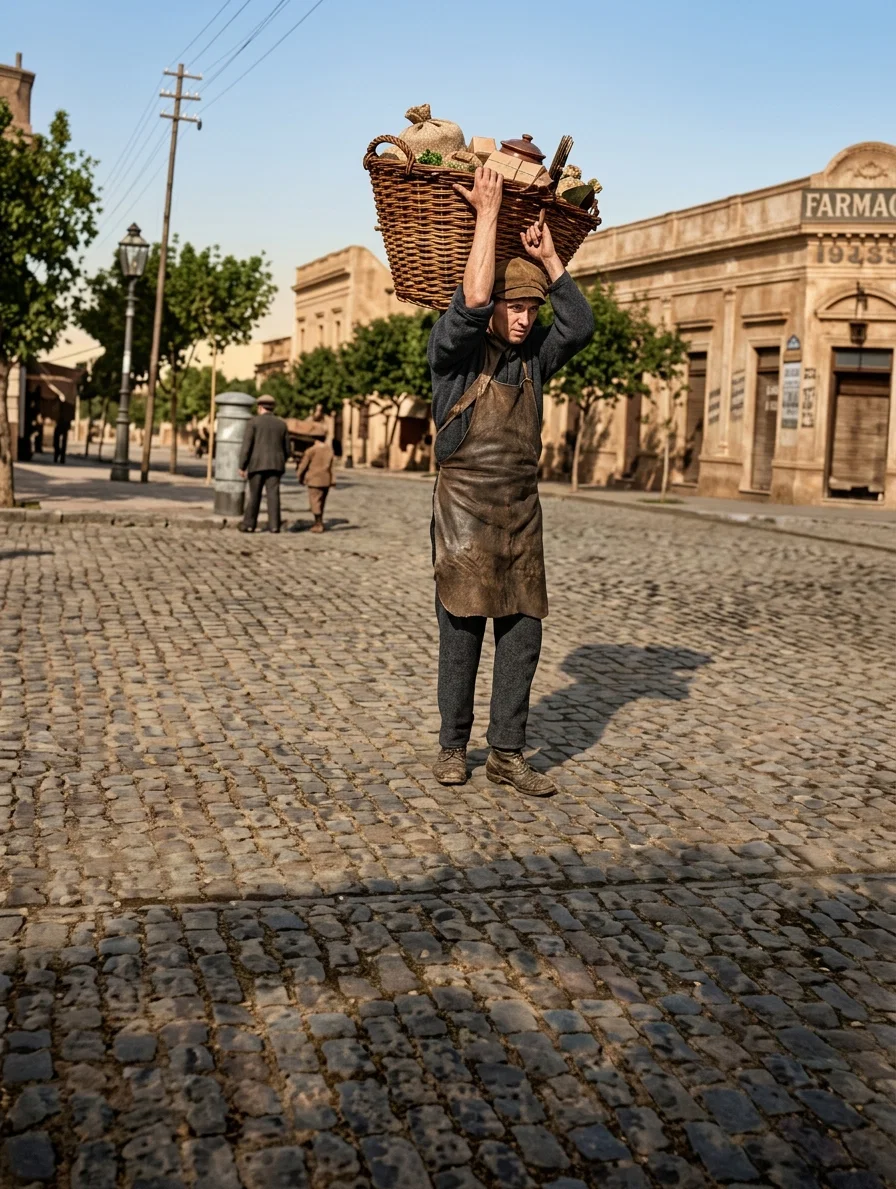
An Argentina Delivery Man.
It is evident from the foregoing that this is the favorable time to work in South America. God has had a hand in developing things in a way that is favorable to the progress of His work. Many years ago the countries of South America, always with clerical opposition, and despite its decided and determined action, began to exercise a more liberal policy. Parallel with the development of the Third Angel’s Message, they have, one by one, granted the assurance of liberty of worship to all. Thus they opened their doors to hear the last call of mercy. Was this without any meaning? Was it not intended that as each door was opened, God’s people should step in? But because of a lack of appreciation of this message and work, and a failure to recognize God’s opening providences, we have let the golden opportunities pass. Where thousands might be rejoicing in the truth, there is still midnight darkness. God’s providences are far in advance of us. All the fields are now thrown open to us, and the mute appeals of this needy people are still calling imploringly, “Come over and help us.” Will not God’s people arise and enter them all?
In the providence of God the message of truth first entered all Protestant lands from the United States, and is it not possible that God intends that from these South American countries, the youngest children of the Papacy, and the ones most advanced in their professions of liberty, the present truth, with its standard of soul and civil liberty, shall yet invade the creed-bound mother countries—Spain and Portugal? The importance of the work in these countries may be much greater than we appreciate. At all events it must not be longer delayed. “Now is the time to work in foreign countries.”
J. W. WESTPHAL.
Buenos Ayres, Argentina.
I SHALL NOT PASS THIS WAY AGAIN.
By W. R. Fitch
I shall not pass this way again!
The thought is full of sorrow:
The good I ought to do to-day,
I may not do to-morrow.
If I this moment shall withhold
The help I might be giving,
Some soul may die, and I shall lose
The sweetest joy of living.
Only the present hour is mine—
I may not have another
In which to speak a kindly word,
Or help a fallen brother.
The path of life leads straight ahead;
I can retrace it never;
The daily record which I make
Will stand unchanged forever.
To cheer and comfort other souls,
And make their pathway brighter;
To lift the load from other hearts,
And make their burdens lighter—
This is the work we have to do;
It must not be neglected;
That we improve each passing hour,
Is of us all expected.
I shall not pass this way again!
O, then, with high endeavor,
May I my life and service give
To Him who reigns forever;
Then will the failures of the past
No longer bring me sadness.
And His approving smile will fill
My heart with joy and gladness
—W. R. Fitch.