The Youth’s Instructor, Vol. 32, No. 15.

THE LAND OF EDOM

The Youth’s Instructor

Apr 9, 1884

S. D. A. Publishing Association · Battle Creek, Mich. · Apr 9, 1884

THE LAND OF EDOM.

Running north and south, between the Dead Sea and the eastern arm of the Red Sea, is a mountain range, one hundred miles in length and nearly twenty miles in breadth. This is Mount Seir, which Esau took possession of, and named Edom. The average hight of the range is two thousand feet. Toward the west, the mountains slope gently down to the desert. On the east is a high, unbroken limestone ridge, that descends gently into the Arabian Desert.
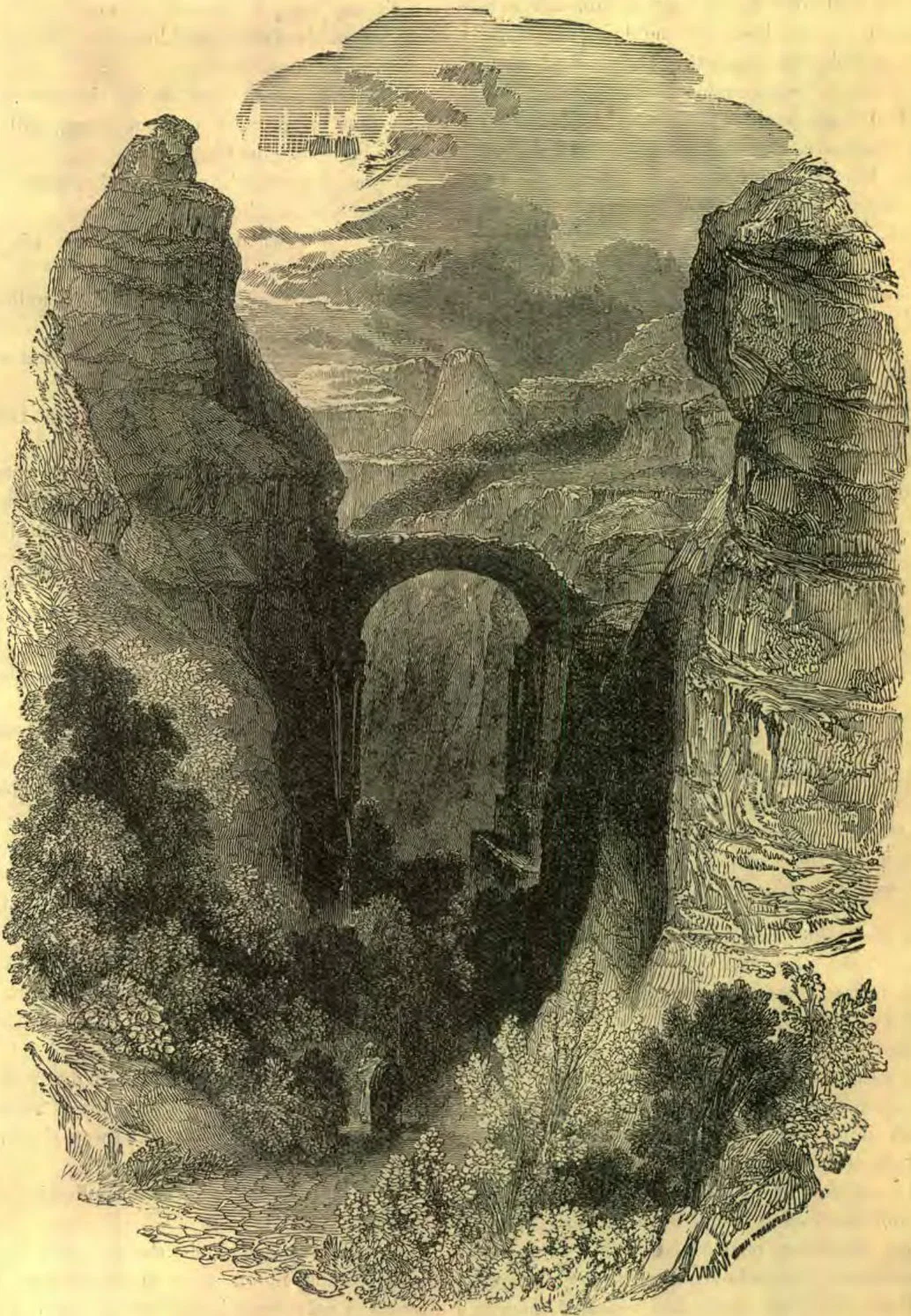
A ridge of porphyry rock forms the backbone of the country, and over this lie cliffs of red and variegated sandstone, arranged in the most picturesque shapes. The mountains are everywhere intersected by deep and dark ravines, such as are shown in the accompanying picture.
Edom does not suffer from want of rain, as do the deserts to the east and west of it, and so everywhere in the valleys and on the flat terraces of the mountains, a luxuriant growth of gorgeous mountain flowers, tamarisks, and oleanders greet the eye. It is indeed the place of which Isaac spoke to Esau: “Behold, thy dwelling shall be the fatness of the earth, and of the dew of heaven from above.”
The chief object of interest to the traveler is the ruins of Petra. In olden times, when Petra was in her glory, the principal entrance to this city was from the east, through a narrow ravine. On either side of the ravine rose sandstone cliffs, not more than a hundred feet high at the entrance of the pass, but gradually rising to the hight of three hundred feet as you approach the city. This pass in the mountains varies in width from twelve to thirty feet, and is about a mile long. It is so narrow that the sunlight never enters, and in some places the cliffs so overshadow it that you can hardly catch a glimpse of the blue sky above. The red color of the sandstone is soft and subdued, and harmonizes well with the shadowy coolness of the place. A tiny brook, bordered with oleanders and tamarisks, threads its way along the path, toward the sunlight. A short distance from the entrance to the city, a buttressed arch spans the gorge. This is the ruins of an ancient aqueduct.
A sharp turn in the ravine brings us face to face with the shattered remnants of Petra’s glory. Almost the first thing that strikes the eye is a rock-hewn temple, called the Khuzneh. This is carved out of rose-colored rock, and stands in a niche, with the same rock all around it. It forms a striking contrast to the dark cliffs around, and the bright green of the vegetation. The cliffs on either side are lined with rock-hewn tombs and dwellings. But there is not space to describe these tombs, nor the temples in which the place abounds.
In speaking of the general appearance of the architecture and ruins, a writer says: “They are not, in themselves considered, very high specimens of art; but two circumstances unite to give them an indescribable charm. One is their singularly wild and romantic position; the other is the endless variety of hues displayed by the living rock in which they are hewn.” “They present,” says another writer, “not a dead mass of dull, monotonous red; but an endless variety of bright and living hues, from the deepest crimson to the softest pink, verging also sometimes to orange and yellow.” However beautiful Petra may have been in its prime, it is now a mass of crumbling ruins. Even the Arabs do not live in the better preserved houses, but dwell in their black tents in the neighborhood around.
The descendants of Edom cherished a perpetual hatred toward the Israelites, and never lost an opportunity to annoy and harass them. When the chosen people of God journeyed from Egypt to the promised land, the Edomites curtly refused them a passage through their country, so they were obliged to take the longer way—the way of the Red Sea—to compass the land of Edom. The Edomites greatly rejoiced over the fall of Judah, and willingly aided the Chaldeans in conquering the land.
In their rocky fastnesses they had deemed themselves well-nigh impregnable; yet “because that Edom had dealt against the house of Judah by taking vengeance, and had greatly offended, and revenged himself upon them,” the word of the Lord came to them by the mouth of the prophet Jeremiah, “Thy terribleness hath deceived thee, and the pride of thine heart, O thou that dwellest in the clefts of the rock, that holdest the hight of the hill; though thou shouldst make thy nest as high as the eagle, I will bring thee down hence, saith the Lord. . . . Every one that goeth by shall be astonished, and shall hiss at the plagues thereof.”
Edom did indeed fall, and its ruins stand to-day a fit monument to the sure word of the Lord.
W. E. L.

EASTER MORN.

Tis Easter morn! No more the world Lies hushed in silent gloom; No more the sepulchre's dread walls The living Lord entomb; Rejoice! the stone is rolled away; The Lord is risen—'t is Easter day!
O lilies! ope your fairest buds To greet this gracious morn; And roses, in your crimson hearts Be sweetest odors born, To rise and float upon the air, Like sighs that saints have breathed in prayer.
O sorrowing soul! that long hast kept Thy weary watch with sin, Throw wide thy darkened doors to-day, And let the sunshine in;— Be sad no more; lift up thine eye! The Lord is risen; he reigns on high!
The Lord is risen! O earth, rejoice! Thy myriad voices raise, Till heaven's blue arches ring again With songs of solemn praise; And far resounds the exultant cry, “The Lord is risen; he reigns on high!”
—Christian at Work.

THE GOLDEN RULE.

It was a chilly, foggy evening in autumn. Edith sat by the window, looking out into the gray gloom, in a state of mind something like that of the weather, disconsolate and depressed, she could not tell why. She was not alone in the room; her father was there, and a group of brothers and sisters.
“No one takes any notice of me, or cares if I feel sad,” she thought. “Now, when you feel gloomy, it is so pleasant to have some one come and cheer you up.” Conscience whispered, “Do you know what is the matter with you? You are a little tired, and idle, and cross.” She did not listen much to the voice. Suddenly there darted into her mind the words which she had taught little Lulu that morning, “As ye would that men should do to you, do ye even so to them.”
She did not care to listen to these words either, but they would not be dismissed; they seemed to say themselves over and over again in her memory, more times than little Lulu had repeated them in her anxiety to say them correctly at school, till at last she began to see what they meant.
“I wonder,” she said to herself, “if I really must do for somebody else everything that I want somebody else to do for me.”
She turned from the window, and went and stood by her father’s chair.
“Father,” she said, “you must have had a wet and disagreeable walk home. Don’t you want your slippers?” “Why, yes, I believe I do. I was too tired to think much about it, though. Thank you, dear. It is pleasant to get home.”
The mother just then brought in a lamp.
“It is such a gloomy evening I thought I would light up early,” she said, drawing the curtains.
Edith looked around on the group. Susie was lying on the sofa, with hot, flushed cheeks.
“Poor little girl!” said Edith, kneeling down beside her, “you have one of those troublesome headaches, I know. I have something good for you—the nice cologne in the red bottle Aunt Julia gave me.” And in a minute she was bathing the hot forehead with it.
Meanwhile she noticed the cloud on her brother Russell’s face, as he pored over his school-books.
“What’s the matter, Russ?” she said, looking over his shoulder.
“Matter enough,” he answered. “See here! I have eight sums to do, and I cannot get the first one, and I don’t know how many hours I’ve wasted on it.”
Not many, Edith suspected, but she did not say so. At any rate, he wasted no more, for a few words of explanation gave him the clew to the solution of all his difficulties.
“I say, Edie,” said Max, seeing that she looked kinder than usual, “get me some string, will you, and the bottle of glue?”
“O you inventor!” she said, bringing them, “what are you making now?”
“You’ll see when it’s done,” was his only answer.
Lulu’s ever-happy face was full of smiles, as usual, this time at her doll, preparing for bed. Edith laid a caressing hand on the fair curls as she asked, “Where’s Fanny, little pet?”
“Up stairs,” said Lulu. “Please tie Bessie’s night-gown.”
As “Bessie” was laid to rest, with her staring blue eyes wide open in her cradle, Edith went upstairs to find Fanny, wondering what could keep her up there alone in the cold. Fanny was next to herself in age, and shared her room. She was sitting in a little arm-chair in the growing darkness.
“I missed you, dear,” said Edith, “and came to find you.”
There was no answer, and Edith sat down on the arm of the chair, and asked, “Are you sick?”
“No, no,” cried Fanny, bursting into a flood of tears on Edith’s shoulder; “but I want to be a Christian, Edie, and I cannot do anything till I know that Christ has forgiven all my sins.”
Edith was startled; she had not thought of this.
“I am so glad, darling,” she whispered.
Edith did not know how to lead her sister as she would be led; so she went down stairs for mother, staying in the nursery herself to put little Lulu to bed.
A happy family rejoiced that night with one who was beginning to know the joy of salvation, having found Him who taketh away the sins of the world.
Edith pondered upon her new application of the Golden Rule.
“How selfish I was,” she thought, “to sit there moping because no one came to cheer me up, when, after all, I only needed to go and do my duty, and there was nothing to be gloomy about! Next time I think I want some sympathy, I’ll remember to go and sympathize with all the rest.”
It was a good resolution, and one that Edith has persevered in carrying out, until it has become second nature for her to be helpful and thoughtful of others’ comfort.—Ladies’ Repository.

MID-OCEAN EXPERIENCES

FOREIGN TRAVEL.—NO. 2.

MID-OCEAN EXPERIENCES.

As our pilot took his place in the little boat, we steamed away from Sandy Hook, in company with several other ocean steamers, gradually separating from them, and losing sight of all land.
Our ship was a fine one, nearly four hundred feet in length, forty-three in breadth, and rated at four thousand five hundred tons burden. She carried three masts, and her engines were of nearly seven hundred horse-power. Her usual rate of speed was twelve or thirteen miles per hour. Her condition, inside and out, was excellent. Her officers were very gentlemanly and courteous. She carried a crew of about ninety, and there were comparatively few passengers.
To one who has never taken a voyage, ocean life presents both pleasant and unpleasant aspects. It becomes quite tiresome to spend ten or twelve days within the narrow compass of a ship. One day’s programme varies but little from those that preceded it. We breakfast at 8:30, take lunch at 1:00, and dine at 5:30. The fare is abundant; but the style of cooking is not such as we have been accustomed to, and seasickness does not add to its attractiveness. At table the captain sits at the head, and the other officers at the foot, while the first-class passengers take their places between. Conversation is often quite interesting, as different countries and various experiences in traveling are described and commented on. Everything in the dining-saloon is fastened down solid, chairs, table, and all. When the weather is anywise rough, there is placed upon the table a framework made of four strips of wood, raised two or three inches high. The strips divide the table lengthwise into three spaces, and so keep the dishes from sliding off when the vessel rolls in a storm.
There are three classes of passengers aboard. Those in the first cabin associate with the officers, and can go anywhere in the ship. The second-cabin passengers pay less, and have poorer quarters. The steerage passengers are at the very hindmost part of the ship, where the vessel is steered. Their quarters are not very inviting; but they are carried cheaply. They are tossed about by the waves much worse than those in the center of the ship.
The first experiences out at sea are not generally pleasant. Old ocean is a very uneasy body. The great monster ship sways and rocks and pitches about like a swinging basket. One’s head begins to feel curious, and his stomach catches the spirit of uneasiness everywhere prevailing. This grows more and more marked as the hours slowly pass by. As you look at the faces of some of your fellow-passengers, you see a noticeable paleness around the eyes and mouth. Now and then one of them loses his admiration for the beauties of old ocean’s ever-changing aspect, and drops out of the company, and confines his attentions to the state-room. The second morning out, our company had no particular desire for breakfast. Lunch and dinner came, and their places at the table were still vacant. Forty-eight hours slowly passed away, and still they clung to the little berths. The wind had risen. The surface of the ocean was like a huge, boiling pot. White-caps were plentiful. The sea was all hillocks and hollows, rolling and tumbling in wild confusion. We could not see much of it, but we could feel it plainly enough. When the ship made a bigger lurch than usual, a great rush of green sea water would roll up, completely covering our windows, that, in a calm, were eight or ten feet above the water. At such times, everything loose in the room was flying about in dire confusion. We could then see why the glass in our windows had to be an inch thick, and why our narrow beds had to have such high side boards.
At such times it was anything but pleasant for the poor, seasick sufferers. Every roll added a pang, a twinge to the giddy, dizzy brain and the uneasy stomach. If the ship would only settle down! The moments seemed so long!
But we will drop this unpleasant subject, and go upon deck. One can never forget the grandeur and majesty of the ocean. The water, when quiet, is a deep blue, almost black. When foaming, it is a pale green. The waves do not come in long, continuous swells, but in ever-changing hillocks and hollows, ridges and depressions. It bears up the great ship with its thousands of tons as easily as the egg-shell is borne upon the surface of the water.
The sights at sea have been few. One day we saw a school of perhaps a dozen porpoises. For half an hour they seemed to be trying to keep the ship company. Every few minutes they would disappear below the surface, and then re-appear, sometimes leaping entirely out of the water. Then they disappeared in the sea.
On another day we saw an iceberg in the distance. It looked as if it were two or three miles away, and ten or fifteen feet high, and perhaps one hundred feet long. The captain said it was probably ten miles away, over one hundred feet high, and a mile long. He could see it with his spy-glass much better than we. These are vast bodies of ice which are formed on the high, perpendicular cliffs of Greenland, by water flowing and freezing till they at last project so far out as to drop off by their immense weight. Four-fifths of their bulk is under water, and one can imagine what the size must be when they are a mile long and one hundred feet above the water.
One morning we saw little birds about as large as swallows, flying along close to the surface of the water, then dipping down into the water and disappearing from view. They kept close to the surface. Sometimes they remained floating some little time, then went out of sight in the dark waters. These were “Mother Carey’s chickens,” or “stormy petrels,” or the “storm swallows;” for they are called by all these names. Here they were seven hundred miles from land. They ride upon the highest waves, in the storm, and seem perfectly at home.
All the voyage, sea gulls have been constantly flying about the ship. They follow often from shore to shore, picking up bits of food dropped from the ship. Their bodies look about as large as a dove’s. Their wings are much larger.
The ocean makes us think of God and his greatness. What an emblem of his boundless love! How precious to think he made it and rules it all, and that we can trust him without fear! Yes, our God made the world and all things therein. Best of all, he is our God. UNCLE IDE.

Christian Grace and Charity to Men

I HOLD that Christian grace abounds Where charity is seen; that when We climb to heaven, ’tis on the rounds Of love to men. —Alice Cary.

The Binding Power of Love

No cord or cable can draw so forcibly, or bind so fast, as love can do with only a single thread.

LEAVE IT WITH HIM.

Yes, leave it with Him; The lilies all do, And they grow, They grow in the rain, And they grow in the dew— Yes, they grow.
They grow in the darkness, all hid in the night, They grow in the sunshine, revealed by the light; Still they grow.
They ask not your planting, They need not your care As they grow; Dropped down in the valley, The field, anywhere, There they grow.
They grow in their beauty, arrayed in pure white, They grow, clothed in glory by heaven’s own light, Sweetly grow.
The grasses are clothed, And the ravens are fed, From his store; But you who are loved And guarded and led, How much more Will he clothe you and feed you and give you his care! Then leave it with Him; He has, everywhere, Ample store.
Yes, leave it with Him; ’Tis more dear to His heart, You will know, Than the lilies that bloom, Or the flowers that start ’Neath the snow.
Whatever you need, if you ask it in prayer, You can leave it with Him, for you are His care, You, you know.
—Selected.

NEW-TESTAMENT HISTORY.

LESSON 182.—PAUL AT JERUSALEM.

1. How long did Paul remain at Tyre? Acts 21:4.
2. What was said to him by the disciples that he found?
3. How did they know that it was dangerous for him to go there?
4. How did these disciples take leave of Paul and his company?
5. At what place did Paul next stop? Verse 7.
6. How long a visit did he make there?
7. Where and with whom did Paul and his company abide for a short time? Verse 8.
8. What was there remarkable about the family of Philip? Verse 9.
9. How long did Paul remain in the house of Philip? Verse 10.
10. Who came down from Judea during this time?
11. What did this man do and say?
12. What plea was then put in by Paul’s companions, and all the rest that were in the house?
13. What reply did Paul make? Verse 13.
14. What course did his friends then take? Verse 14.
15. Who accompanied Paul when he finally went back to Jerusalem?
16. How was Paul received there? Verse 17.
17. What did Paul immediately do? Verses 18, 19.
18. How were the brethren at Jerusalem moved by his account? Verse 20.
19. Why did the brethren fear the tumult among the people? Verses 20–22.
20. What did they advise Paul to do? Verses 23, 24.
21. What did they say about the believing Gentiles? Verse 25.
22. How did Paul comply with their request? Verse 26.
23. What occurred before these days were ended? Verse 27.
24. By what words did these Jews stir up the people? Verse 28.
25. What led them to think that Paul had polluted the temple? Verse 29.
26. How well did these Jews succeed in stirring up the people? Verse 30.
27. What did they prepare to do? Verse 31.
28. How were they prevented from carrying out their wicked designs? Verses 31, 32.
29. What action did the chief captain take? Verse 33.

NOTES.

Acts 21:3. Landed at Tyre.—A city of Phoenicia, formerly very opulent, and distinguished for merchandise.—Barnes. When Paul came to this city, it was neither in the glorious state described in the prophecies of Ezekiel and Isaiah, when “its merchants were princes,” nor in the abject desolation in which it now fulfills those prophecies, being “a place to spread nets upon.” It was in the condition in which it had been left by the successors of Alexander, the island which once held the city being joined to the mainland by a causeway, with a harbor on the north and another on the south. In honor of its ancient greatness, the Romans gave it the name of a free city.—Conybeare and Howson.
Ver. 4. Through the Spirit.—They were shown, by the spirit of prophecy, that he would meet with great sufferings and trials if he went thither, and they supposed that he might lawfully decline the journey and avoid the danger; but he judged otherwise. “They, understanding by the revelation of the Spirit what danger awaited Paul, out of love, and not by any special command of the Spirit, entreated him not to go up to Jerusalem.”—Scott.
Ver. 7. Ptolemais.—A seaport town of Galilee, not far from Mount Carmel, between Tyre and Cæsarea. It was first called Accho, and belonged to the tribe of Asher. It was enlarged and beautified by the Egyptian Ptolemies, from whom it was called Ptolemais.—Clarke.
Ver. 8. Cæsarea.—A maritime city on the shores of the Mediterranean Sea, and distant from Jerusalem seventy miles.
Ver. 10. Agabus.—This is the same Agabus who foretold the famine in the days of Claudius Cæsar. Acts 11:28.—Rev. Com.
Ver. 11. Girdle.—The loose, flowing robes, or outer garments, which were worn in Eastern countries, were bound by a girdle, or sash, around the body, when they ran, or labored, or walked.—Barnes. Bound his own hands and feet.—It was common for the prophets to perform actions emblematic of the events which they predicted, thus making the prediction more forcible and impressive by representing it to the eye.—Ibid. Into the hands of the Gentiles.—That is, the Romans; for the Jews had not, properly speaking, the power of life and death.—Clarke.
Ver. 15. Took up our carriages.—We made ourselves ready; packed up our things; got our baggage in order. This is what the text means.—Ibid.
Ver. 17. Were come to Jerusalem.—The apostle arrives now at Jerusalem for the fifth time since he left it on his persecuting errand to Damascus. It is the last recorded visit that he ever made to the Jewish capital.—Hackett.
Ver. 20. Zealous of the law.—The Jews of the first century in great numbers were willing to acknowledge Jesus as the Messiah, but they were reluctant to give up their privileges as the chosen race, and so they clung to their law with an attachment more devoted than ever. The hostility of the Jewish Christians to Paul sprang from the consciousness that he looked upon the law as abolished.—Rev. Com.
Ver. 21. Thou teachest . . . to forsake Moses.—From anything that appears in the course of this book to the contrary, this information was incorrect; we do not find Paul preaching thus to the Jews. It is true that, in his epistles, some of which had been written before this time, he showed that circumcision and uncircumcision were equally unavailable for the salvation of the soul, and that by the deeds of the law no man could be justified; but he had not yet said to any Jew, Forsake Moses, and do not circumcise your children. . . . He showed them that their ceremonies were useless, but not destructive; that they were only dangerous when they depended on them for salvation.—Clarke.
Ver. 24. Purify thyself.—By observing the forms of purification prescribed by the law of Moses.—Barnes. Be at charges with them.—Share with them the expense of the sacrifice and offerings when the vow is complete. See Numbers 6.—Ibid.
Ver. 27. The Jews which were of Asia.—Who lived in Asia Minor, but who had come up to Jerusalem for purposes of worship.—Ibid.
Ver. 28. Brought Greeks also into the temple.—This was a most deliberate and malicious untruth. Paul could accomplish no purpose by bringing any Greek or Gentile into the temple; and their having seen Trophimus, an Ephesian, with him, in the city only, was no ground on which to raise a slander that must materially affect both their lives. Josephus informs us that on the wall which separated the court of the Gentiles from that of the Israelites was an inscription in Greek and Latin letters, which stated that no stranger was permitted to come within the holy place on pain of death. With such a prohibition as this before his eyes, was it likely that Paul would enter into the temple with an uncircumcised Greek?—Clarke.
Ver. 31. About to kill him.—Seeking to kill him. This was evidently done in a popular tumult, as had been done in the case of Stephen. They could not pretend that they had a right to do it by law.—Barnes.

Notes on the Sabbath School Department

For additional Notes, see S. S. Department in Review for April 8.

EASTER FLOWERS.

OLD as creation itself, yet new every spring-time! The coming forth from the dull, gray earth of the fresh, green grass, the putting out of the leaves, and the opening of the flowers.
And more than eighteen hundred times have the followers of our Lord Jesus Christ welcomed Easter Sabbath, which still comes to us with its fresh, new joy each year. It comes with the first spring flowers, and we welcome its dawning, bringing into God’s house flowers from forest and greenhouse. Claribel had been watching her one rosebush for many days, with hope and fear. But her hopes were fulfilled, and on Easter morning she found one full-blown rose. With this single offering she started for church.
“Claribel,” said her mother, “will you have time to go around by Mrs. O’Niel’s, and leave this jelly and blanc-mange for Kitty? She liked that which I took to her Friday so much that I would like her to have some more to-day. I’ve put in a bottle of beef tea. The doctor says if she can have something to tempt her appetite, and to take her mind from herself, she may get well again.”
“There’s plenty of time,” said Claribel. “I’ll walk fast, and it is an hour to the time Miss Clark told us to be there with the flowers.” And Claribel tripped away with her little basket of dainties for her sick school-mate, and her treasured rose. She stopped a moment to speak to Kitty, and tell her that mamma had sent her something nice for her Sunday dinner. But Kitty had only eyes and thoughts for the beautiful rose which Claribel had in her hand.
“Oh!” she exclaimed, “what a sweet rose!”
“Isn’t it!” returned Claribel. “You know it is Easter morning, and I am going to take this to the church! Miss Clark told us to bring all we could get, and she will fix them. I had only this one, but it is so beautiful that I think it will make up for there only being one.”
“Will you let me hold it a minute?” asked Kitty.
Claribel rather unwillingly gave her treasure to Kitty for a moment. If anything should happen to it!
“Oh, if I could only see the flowers!” said Kitty, with a weary sigh. “But I don’t suppose I shall ever see another rose.”
Suddenly there flashed through Claribel’s mind what her mother had said about Kitty’s having something to take her mind from her own pain and sorrows, and the thought followed, what if she gave her the rose? Would it help? Kitty seemed to enjoy just holding it in her hand for a few minutes. Should she leave it? Could she go to church without a single flower? She had looked forward to this morning so eagerly, and watched so anxiously the budding of this rose. She had welcomed its opening with such joy, could she leave it here instead of taking it to the house of God, as she had meant to? Was it not a way of showing her love for Christ, bringing flowers to his house on this morning, when his resurrection was to be celebrated? These thoughts darted through Claribel’s mind, and there followed another, even the words of Christ himself, uttered long ago, “I was sick, and ye visited me;” and she said, with a lump in her throat:—
“Kitty, one little flower wont be missed very much, and you may have the rose.”
“O Claribel, how good you are! If I get well, and I do believe I shall, I’ll do something nice for you. This will make me happy all day.”
Claribel hurried away. She was afraid she would cry and spoil everything. Not that she was sorry she had given away the rose, not at all! But there was a sharp pain for a few moments over the thought that she had no Easter offering to bring. Had she but known it, she had brought more than they all. I am afraid that Miss Clark herself could not have willingly given away her beautiful bouquet of rare greenhouse flowers, which she had bought out of her ample allowance. She and the girls wondered a little that Claribel had no flowers, for they knew about her rosebush; but the little girl did not tell of her unselfish deed. But she always told her mother everything, and when they were settled down for their Sabbath afternoon talk, she told of her visit to Kitty.
Mamma’s eyes filled with tears, but she asked: “Claribel, why didn’t you take your rose to church, and have it sent to Kitty afterwards? You know the flowers are often sent to the sick people in the village.”
“I know, but you see Kitty would have had to spend all the long, lonesome day without anything to comfort her. The flowers are to be distributed to-morrow morning, and I will ask Miss Clark to send Kitty some. My little rose will be wilted by that time.”
And thoughtful little Claribel was the bearer of Miss Clark’s pretty bouquet the next morning.
“Kitty had the most comfortable day yesterday that she has had in a long time,” said Kitty’s mother. “I thought in the morning she would have a hard day, but your visit seemed to set her right up; she just lay with the rose in her hand or on her pillow all day, and the doctor said last night that he had more hope of her than at any time since she was taken sick.”—The Pansy.

Letter Budget.

Louie Dysert, writes from Sandusky Co., Ohio. He says: “I am ten years old. I have one brother eight years old, and a sister two years old. We have always kept the Sabbath. I love to read the INSTRUCTOR.”
Samuel Griffith, of Livingstone Co., Mo., writes: “I am twelve years old. I get the INSTRUCTOR at Sabbath-school, and like it much. We have a good Sabbath-school. I hope you will pray for me, that I may be ready with the INSTRUCTOR family to meet Jesus when he comes.”
Jennie Miller writes from Windham Co., Ct. She says: “We have a Sabbath-school of eight members. I study the lessons in the paper. I have two sisters and one brother. We have a boarder, a bright little boy, three years old. I was baptized last April, by Eld. I. Sanborn. I am eleven years of age.”
Maud S. Carpenter writes from Kent Co., Mich. She says: “I am ten years old. My ma and I keep the Sabbath. I am always glad to get the INSTRUCTOR, for I like to read it. I like the Budget so well that I thought I would write a letter for it too. I go to Sabbath-school, and study in Book No. 1. I am trying to be a good girl.”
Sallie Kivett, writing from Cass Co., Mo., says: “Dear little friends, I am a constant reader of your valuable paper, and have been for about three years. I think it is the best paper I ever read. As I have never seen a letter in it from this place, I thought I would write one. If this is not printed, I will try again. I go to day-school, Sabbath-school, and prayer-meeting. I have attended four camp-meetings. They are so good I think they ought to last two weeks instead of one. I hope I shall be able to meet all the INSTRUCTOR family in heaven.”

EASTER SONG.

CLEAR in the soft, warm sunshine, The Easter hymns are ringing. The low note of a spring bird Chimes with the children's singing, “To Thee the praise.”
The lilies snowy whiteness Shines out to grace the day. May the children's hearts be always As pure and fair as they, “To Thee the praise.” —I. R. Ogois.

A SPRING SONG.

Wake, robin; wake, and blithely sing, For tidings glad to thee I bring, That spring is coming, witching spring! Clear must be the strain to greet her! Pure should be the heart to meet her!
Where fairy footsteps tread the glade, Gay blossoms in their path are laid, For spring is coming, witching spring! Sweetly will the violets greet her— Brightly cowslips spring to meet her.
All tiny insect voices raise Their portion of the song of praise To welcome spring, the witching spring! Glad are they at last to greet her, On dainty wing they come to meet her!
A thousand colors paint the hill— Fierce, angry wind, at once be still! Thou canst not check the witching spring; Nature's hosts have come to greet her, All with welcome glad to meet her.
— Elizabeth Taylor.

You have reached the end of this edition.

The Youth’s Instructor · Apr 9, 1884