A boy went to live with a man who was accounted a hard master. He never kept his boys—they ran away or gave notice they meant to quit; so he was half his time without or in search of a boy. The work was not very hard, opening and sweeping out the shop, chopping wood, going errands, and helping round. At last Sam Fisher went to live with him.
“Sam’s a good boy,” said his mother.
“I should like to see a boy nowadays that had a spark of goodness in him,” growled the new master.
It is always bad to begin with a man that has no confidence in you, because, do your best, you are likely to have little credit for it. However, Sam thought he would try. The wages were good, and his mother wanted him to go. Sam had been there but three days before, in sawing a cross-grained stick of wood, he broke the saw. He was a little frightened. He knew he was careful, and he knew he was a pretty good sawyer, too, for a boy of his age; nevertheless, the saw broke in his hands.
“Mr. Jones will thrash you for it,” said another boy who was in the wood-house with him.
“Why, of course, I didn’t mean it, and accidents will happen to the best of folks,” said Sam, looking with a very sorrowful air on the broken saw.
“Mr. Jones never makes allowances,” said the other boy. “I never saw anything like him. That Bill might have stayed, only he jumped into a hen’s nest and broke her eggs. He daren’t tell of it; but Mr. Jones kept suspecting and suspecting, and laid everything out of the way to Bill, whether Bill was to blame or not, till Bill couldn’t stand it, and wouldn’t.”
“Did he tell Mr. Jones about the eggs?” asked Sam.
“No,” said the boy, “he was afraid; Mr. Jones has got such a temper.”
“I think he’d have better owned up at once,” said Sam.
“I suspect you’ll find it better to preach than to practise,” said the boy. “I’d run away before I’d tell him.” And he soon turned on his heel and left poor Sam alone with his broken saw.
The boy did not feel very comfortable or happy. He shut up the wood-house, walked out in the garden, and went up to his little chamber under the eaves. He wished he could tell Mrs. Jones, but she wasn’t sociable.
When Mr. Jones came into the house, the boy heard him. He got up, crept down-stairs, and met Mr. Jones in the kitchen.
“Sir,” said Sam, “I broke your saw, and I thought I’d come and tell you before you saw it in the morning.”
“What did you get up to tell me for?” asked Mr. Jones. “I should think morning would be time enough to tell of your carelessness.”
“Because,” said Sam, “I was afraid if I put it off, I might be tempted to lie about it. I am very sorry I broke it, but I tried to be careful.”
Mr. Jones looked at the boy from head to foot, then, stretching out his hand, he said, heartily:—
“Sam, give me your hand; shake hands. I’ll trust you, Sam. That’s right, that’s right. Go to bed, boy. Never fear. I’m glad the saw broke; it shows the mettle in you. Go to bed.”
Mr. Jones was fairly won. Never were better friends after that than Sam and he. Sam thinks justice had not been done Mr. Jones. If the boys had treated him honestly and “above board,” he would have been a good man to deal with. It was their conduct which soured and made him suspicious. I do not know how that is. I only know that Sam Fisher finds Mr. Jones a kind master and a faithful friend.—Scotch Tract.
For the Laundry
IF you use the old-style flat-irons, the holders should be lined with a layer of old, soft leather, such as the top of a worn shoe: this will protect your hand from heat far better than any cloth.
In washing white silk handkerchiefs, no soap should be rubbed on the silk; no soda should be mixed with the water, and the handkerchiefs must not be boiled. Make a warm, soapy lather with finely shredded white soap, wash the silk with the hands until clean, then rinse thoroughly in cold water until it is freed from all soap, rinse again in water in which a very little bluing has been dropped, and when most of the water has been squeezed out, let the silk get nearly dry, then iron it, with a cloth between the iron and the silk.
It is recommended, when ironing starched clothes, to keep a bit of soap on the table, and to occasionally run the flat-iron over it, then over a bit of paper, and this will prevent the iron’s sticking, and at the same time give a nice gloss to the clothes.
White silk ties may be cleansed by rubbing them over with French chalk and holding them over the heat. The heat will cause the chalk to absorb any grease, and it can then be shaken out.
A tablespoonful of turpentine in the water intended for boiling the white clothes, will whiten them, remove stains, and render the washing much easier. The clothes must, in all cases, be well rinsed, in order to remove all traces of soap, as the soap yellows them.
Do not attempt to iron every piece that goes through the wash. Sheets can be folded as taken from the line, and laid one on top of the other, if thoroughly dried before taking down, and they will have few creases in them, if hung straight on the line at first. All coarse towels should be hung straight on the line, and when dry, folded and pressed by hand. Knit underwear, and soft linen table-cloths, and many other pieces will look just as well if carefully folded and laid away. Ironing in summer-time is usually very uncomfortable work, and should be made as easy as possible.
When the chimney takes fire, throw salt on the fire in the stove, and shut off the draft as much as possible. It will then burn out slowly. If oil is spilled and takes fire, throw common flour over the flames, and this will smother without spreading the fire. Salt is also good.—The Commoner.
Evils of Scowling
DON'T scowl. Scowling spoils even the prettiest of faces. Before you know it, your forehead will resemble a small railroad map. There will be a grand trunk line from your scolding locks to the bridge of your nose, intersected by parallel lines running east and west, with curves arching your eyebrows.
And then think how much older you will look. Scowling is a habit that steals upon one almost unawares.
We frown when the light is too strong, and when it is too weak. We tie our brows into a knot when we are thinking, and we knit them even more tightly when we are not thinking.
There is no denying there are plenty of things to scowl about. The baby in the cradle wrinkles up its little nose when something fails to suit. The little toddler who likes sugar on his bread tells his troubles in the same way.
“Cross” we say about the children, and “worried to death” about the grown people, and as for ourselves, we simply “can’t help it.” But one must. Its reflex influences make others unhappy. It cheapens our religion. Scowling is silent scolding. It shows that the soul needs sweetening.
For humanity’s sake straighten out these creases before they become deeply engraved on the countenance.—St. Louis Republic.
Anti-Cigarette Law
THE Berry anti-cigarette act, prohibiting the use of cigarettes, cigars, or tobacco by any person under eighteen years old in any public place, which was enacted at the recent session of the Illinois Legislature, has been approved by Governor Deneen. A penalty also is provided for furnishing smoking materials to persons under this age, while for manufacturing, selling, or giving away cigarettes containing any substance deleterious to health, other than tobacco, a penalty of a one-hundred-dollar fine or jail imprisonment of thirty days is provided. This is an excellent law. Cigarette smoking is a peril to the health of all who indulge in it, and is especially harmful to boys. The law should be rigidly enforced.—Selected.
Solusi Mission and Experience with African Fever
By G. A. Irwin
G. A. IRWIN
Since the arrival of Brother and Sister Sturdevant five years ago at the Solusi Mission, not one person has been sent to South Africa to engage in native mission work south of the Zambesi River.
Up to the time of the arrival of Brother Sturdevant, very little effort had been made to raise crops of any kind upon the mission farm. Brother Sturdevant at once began to clear away the bush near the mission buildings, and break up the ground, and plant it to some kind of crop, believing that with early planting and proper care and attention, paying crops could be raised. The Lord has honored his faith, and has blessed his efforts. Each succeeding year has seen more ground cleared and planted, until the present year they have two hundred acres under cultivation, divided as follows: one hundred and fifty acres of mealies, twenty-two acres in nyauti, five acres in Kafir peas, fifteen acres in monkey nuts, and five in sweet potatoes. All of the later-mentioned crops are looking well, and fully one hundred acres of the mealies is as good as you would find on an average throughout the corn-raising States of America. The other fifty acres was so damaged by locusts that much of it had to be replanted the third time, and hence will make only a partial crop.
A threefold blessing is obtained by these farming industries: first, the mission family is thus supplied with an abundance of good food, and with a surplus to sell, to pay the expense of operating the mission, and to make needed repairs; second, it furnishes employment for the boys and girls, by means of which they are not only learning how to work and make themselves useful, but they are by this means making it possible for themselves to receive an education and fitness to carry the third angel's message to their own people; third, the breaking up and cultivation of the land is making the place much more healthful.
The improvements on the farm are quite substantial for this country. The main buildings are on a line east and west, and front to the north. They consist of two brick cottages, each twenty-five by twenty-five feet, with verandas around three sides, and a back addition eleven by twenty-five feet, with a hall, or corridor, eight feet wide, roofed in with the main building. Each of these cottages stands in the center of a lot one hundred and fifty feet square, and surrounded by a stone wall four feet high and two and one-half feet thick. Between the two cottages there is a space of two hundred and fifty feet, in the center of which, and even with the back line of the cottages, is a brick store and grain house, twenty-eight by thirty-six feet. Two hundred feet west of the main cottage stands the schoolhouse, a brick structure thirty by forty feet, roofed with grass. One hundred and forty feet west of the schoolhouse stands the church, a brick and iron building twenty-eight by forty-eight feet. West of the church one hundred feet is the graveyard, a lot one hundred feet square, and surrounded by a stone wall three and one-half feet high and two feet thick. Three hundred feet back of the main cottage stands the students' dining hall and girls' quarters, a united brick building, fifteen by one hundred and five feet. To the east of this building, but on a line with it, stands a row of round huts for the boys, six feet high and twelve feet in diameter, made of poles and mud. In front of the row of main buildings, and two hundred feet away, stand the carpenter and blacksmith shop and the wagon sheds. Still north of this, four hundred feet, is the large cattle kraal.
This mission home, when seen from a distance, so as to take in all the buildings as they stand in line and related to one another, with the growing crops surrounding it, and the rock-kopjes for a distant background, is certainly a pleasing sight.
There are at present fourteen native kraals located upon the mission land, with an aggregate population of three hundred. There were many more than this in the beginning, but of late years they have been moving farther back, where land is better.
There are at present fifty-four students living at the home and attending the school—thirty-five boys and nineteen girls. Counting those who attend day-school from the outside, the average attendance is seventy-two. They have at present only two white teachers,—Brother Sturdevant and Brother Ellingworth, a young man who came up from Cape Town to assist for a time in the work. They have ten native teachers, three of whom are teaching in the school. The other seven are carrying on small schools at out-stations, of which they have four at present, the nearest being fifteen miles away, and the farthest thirty-five.
One can have but little conception of the endless round of duties that come from early morning until late at night, to the man and his wife having charge of one of these mission homes, until he remains there for a time, and has opportunity to see with his own eyes. Nor are these duties confined to the business of the mission and mission family. Natives come as far as fifteen miles to have the fondusi (teacher) treat their different ailments. As I recall what I saw while at Solusi, it was as follows: first a man to have a tooth pulled, then a man with a boy who had been bitten by a snake; they had walked five miles to have Brother Sturdevant cauterize the wound, and administer antidotes to counteract the poison. The next was a poor woman with a cancerous throat, whom her husband had brought a long distance in the hope that she would get help. Next came a man with a gash five inches long on his leg, made by the tusk of a wild boar. The next was a young girl with sore eyes. These instances are but a sample of the almost every-day calls and demands that are made upon the missionary's time, and for which nothing in the way of remuneration is received in return.
February 25 Brother Sparrow arrived at the mission, bringing with him Brethren Hyatt and Branch, who had been spending a few days at the M'kipuvula Mission. It was the plan for us all to remain at Solusi until the sixth of March, and then go on to Somabula. In order to catch the right train at Bulawayo, it would be necessary for us to leave the mission the morning of the fifth. Our preparations were all made the day before, so we might get an early start. But “man proposes, and God disposes.” During the night I was attacked with fever, and when morning came, my temperature was found to be 102½°, and it was plain to those of experience that I was in for a run of fever. Brother Branch went on according to arrangements, but Elder Hyatt remained to assist in caring for me. The brethren told me that the fever would last for at least seven days, and it might be ten days before it would be broken. But by the blessing of God upon the efforts put forth and the remedies used by the brethren, the fever was broken inside of seven days, and I was up and around, though weak from loss of sleep and lack of food.
At first I could not understand why the fever had come upon me. I had been very careful, and had taken every precaution that I knew, and all that others had told me of, except the taking of quinin. I had not gotten wet, nor been bitten by mosquitoes. But as I reflected over the matter, it became more clear to my mind. Had I been permitted to visit these missions in February and March—the two worst months in the year for fever—without getting the fever, I would no doubt have attributed the fact to my own ability to care for myself, and would have been inclined to look upon the brethren as sinners above others because they had fever frequently. I would have said that it was the result of carelessness on their part. I could not have entered into their experiences, nor sympathized properly with them in their afflictions. Nor would I have been able to make a true report before the council of our mission work in Africa, of what our missionaries must face.
The Lord saw all this, and allowed me to have the fever, and pass through one of those dreadful chills which goes14along with it, and for the time destroys all one's power of control, causing one to feel that he is in the grip of some dread monster, who has set out to break every bone in his body, and to separate the flesh and muscles from the bones. The Lord allowed all this that I might in a measure enter into the experiences of some of our missionaries who have in the past endured these things at intervals for weeks and months before they could succeed in expelling the malarial poison from the system.
When the time arrived for me to go on to Beira to take the boat for Mombasa, on my contemplated trip to our mission on Lake Victoria, in Uganda, I was still weak, and liable to another attack; hence it was thought unwise for me to take the risk, inasmuch as I would be compelled to travel most of the way alone. So I remained at Solusi until the fifteenth of March, when Elder Hyatt and I came on to Somalula, where we have been stopping for a few days.
Some Missionary Problems
By J. N. Anderson
J. N. ANDERSON
Of the different recommendations passed at our recent council at Shanghai [these appeared in the REVIEW of May 30, on page 13], at least two call for special mention. When read from this side, they are perfectly intelligible; but to people in the home land, where conditions are quite different, they are quite sure to be more or less misunderstood.
Reference is made to the fourth and fifth as they appear in the series. They read as follows: “We recommend that all our gospel workers, native and foreign, be urged to teach carefully all inquirers repentance toward God and faith in and obedience to the Lord Jesus Christ as a personal Saviour from sin; and, further, that all candidates for church fellowship give evidence of a new life and a sincere love of God’s Word; and in particular, that they abstain from idolatry in any of its many forms, including ancestral worship, also from polygamy, gambling, opium, tobacco, and wine. We recommend that as foreign workers engaged in missionary work under special treaty rights, we scrupulously abstain from interference in disputes and litigations among Chinese subjects, and that we do our utmost to prevent our Chinese helpers and church-members from giving encouragement to, or having any connection with, this evil.”
The first part of the fourth resolution presents nothing out of the ordinary; it is indeed only what we as a people in all parts of the world insist on with reference to those who seek admission to our churches. To join the church is but a formal and outward step, the evidence of a vital and spiritual operation which has taken place in the life-springs of the individual. As for the second part of the resolution under consideration, it might at first thought seem to be so absolutely obvious that even the mere mention of these requirements reflects on our loyalty to the truth of the message we as a people bear. I can indeed almost hear some say that all converts as a matter of course should lay off all these; and so indeed they should. But when one stops to think that other missionary societies freely allow the use of wine and tobacco, and even furnish the latter to the inquirers, directly or indirectly, it can be seen that at least so far as the Chinese and other missionaries are concerned, it is not superfluous to dwell especially upon these two sins. They are outstanding and universal.
Opium is, beyond a peradventure, the curse of this empire; and it is gratifying to know that all missionaries, as well as the Chinese government, are set against its use. A lively crusade is just now being waged against this drug. It15should be borne in mind, however, that it is not merely the use of opium and its importation into China that makes it so deadly to this race; it wields a more subtle, and hence a more deadly, influence on China in the temptation it presents to the rural people in its culture. Like the raising of tobacco and swine in the States, it promises material prosperity to the poor farmer; and thus by the fact of its being a domestic article, it easily and rapidly insinuates itself among the masses. This is China’s awful incubus, which the government is vigorously exerting itself to throw off. We are glad to put ourselves on record against this deadly thing.
Gambling is a vice that runs deep into the life of this people. It is well-nigh universal, its victims representing all classes and both sexes. Its forms are legion, and the very foundations of society are honeycombed with it. The Chinese themselves many times fail even to regard it seriously. All Christian people are of right unequivocally set against it.
Coming now to idolatry, the very web and woof of Chinese life, teaching, feeding, molding the entire mass of this great nation, it is the one great force that in the past has made, and in the present continues to keep, China what she is. With us idolatry is an abomination; but with the Chinaman it is not only respectable, it is a positive virtue, and the means to all good. Every day throughout the year it holds in its benumbing embrace this entire nation. Its spirit is one; its forms and aspects are countless. The folly, the mischief, the ruin wrought by Chinese idolatry does not spring so much from the fact that false gods are worshiped as it does from the fact that dead men are worshiped as gods.
This is ancestral worship, “filial piety gone mad,” as one writer puts it. For decades during the early history of Roman Catholic missions in China, this specious form of idolatry was not only winked at, but pronounced consistent with both the spirit and the letter of Christianity. Later the pope by a bull pronounced against this opinion, though in so doing he reversed the infallible dictum of a former infallible pope. The Catholics hold to this belief to the present day. In general, all Protestant missionaries hold the same position with reference to this question. There is, however, a sentiment gaining ground that ancestral worship is not, after all, so very serious; that it is, in reality, not worship; and that to require converts to lay off this much-cherished custom is as unnecessary as it is impossible. It is filial piety, very commendable in the Chinese, and to be encouraged in a measure in the people of the West. In many ways it presents some very mild and apparently helpful aspects; but in reality it is the very heart and soul of all the false worship that pervades this great land. It ignores the true God by deifying man, and so strikes at the very heart of the gospel of Jesus Christ. Between Christianity and ancestral worship there can be no reconciliation.
MEMORIAL AGAINST CLERICALISM
With reference to the fifth recommendation, it is well known that interference in political matters in China has been the fruitful source of mischief in this field. The frightful outburst of the popular, fanatical indignation of 1900, was in a large measure the fruit of such ‘filial’ interference on the part of missionaries. Chinese converts and adherents are constantly seeking for some material advantage through the gospel and those who represent it here. Disputes and litigations are very common among Chinese people, and in all these differences the foreigner can be, if he will, a very convenient and helpful factor. There is a constant temptation to us as foreigners to lend a helping hand as we hear pitiful tales of oppression, and even persecution, which in many cases fall to the lot of those who turn to the Christian faith. It is a very simple matter oftentimes for the foreigner to help out in such cases; but while it may seem to be a harmless matter, and at times a manifest duty, it nevertheless entails serious consequences. The treaty under which we are in this land as missionaries stipulates that we entirely refrain from such interference.
Canton, China.
MRS. W. R. SMITH
By Mrs. W. R. Smith
Korea
MRS. W. R. SMITH
This, of all countries, is said to have customs the queerest of all to the westerner. The houses are low and straw-thatched. The walls are built of mud, plastered onto a network of Kafir-corn, between heavy posts. The doors are frames, covered with oiled paper, to admit some light, but scarcely enough by which to read, especially in cloudy weather. Mother earth is the floor, covered with stiff straw mats. The rooms are small, about eight feet square. The floor of the kitchen is dug out about two feet lower than that of the living-room. In the side of the kitchen next to the living-room is a fireplace, in the top of which are large iron pots, built in with mud, for the purpose of cooking the food.
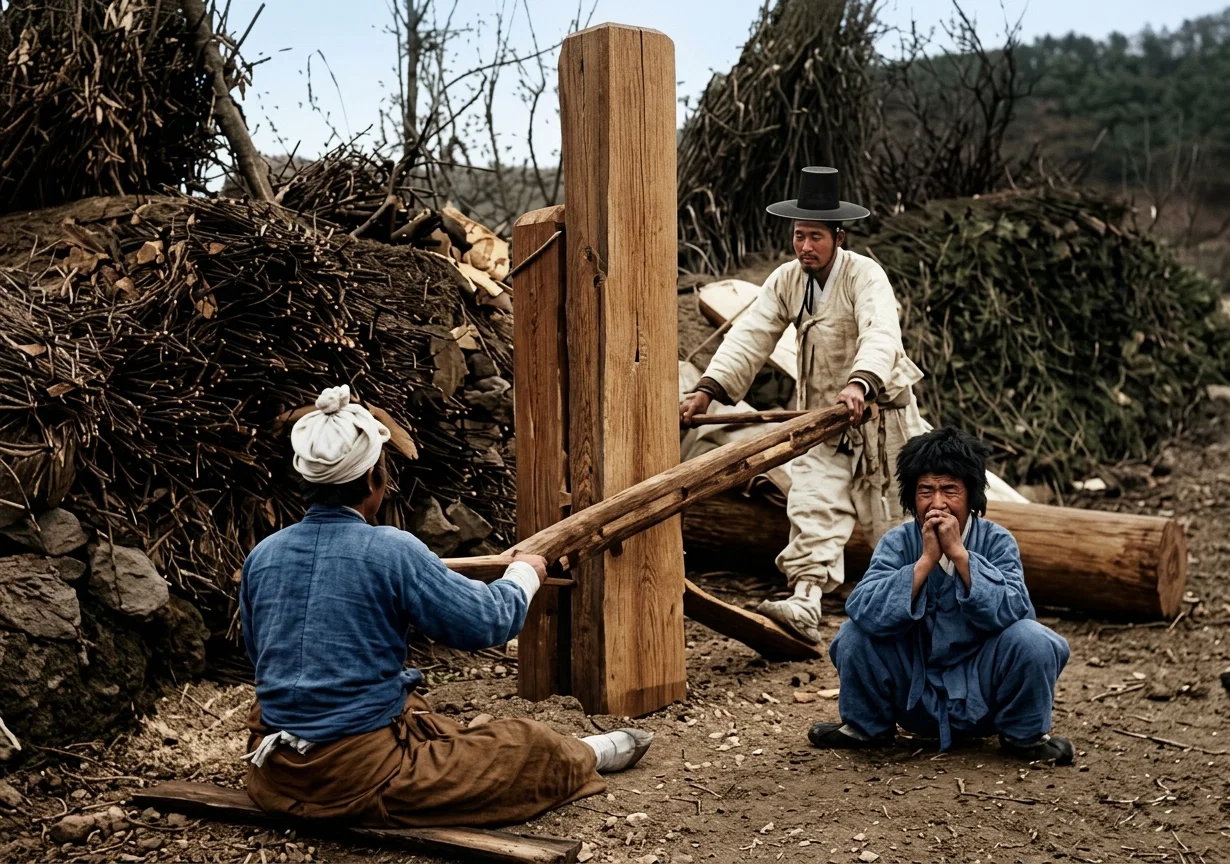
A KOREAN SAWMILL
The same heat that cooks the food passes on through trenches under the floor of the other room, making its exit at one common hole at the opposite side of that room. Thus the room is kept quite comfortable. But two meals a day are cooked. Breakfast is eaten between eight and nine o’clock, and supper late in the evening, leaving the floor warm for the night. A lunch is often served at about one o’clock.
The floor, with a thick cotton comfort for a covering, serves as a bed, and is quite warm—so warm that I have found it impossible to sleep until nearly midnight, when the floor begins to cool.
The low flue—when there is a flue at all—draws poorly; so the kitchen is very black and smoky. The women, with their babies tied on their backs, have to spend considerable time in the smoke, which no doubt is one cause of so much eye trouble among this people.
The principal food of the Koreans is rice, with pickled turnip and cabbage for relish. Some beans, dried fish, eggs, and meat are eaten. Also, a taffy, made from malt extract from Kafir-corn and barley, is freely eaten. They say that their food does not digest well unless they eat some of this taffy.
Noon seems to be the calling hour. One is met at the door with the greeting, “Have you come in peace?” The salutation returned, “I have come in peace,” the invitation is given to enter; but the shoes are left outside. Introductions are not given by a third party. A stranger introduces himself, although he may be in company with a friend of the host. There is a certain routine of questions asked, such as, “Where is your home? Are your parents living? How old are they? How old are you? Have you a son?” and often many others.
Korean women are secluded, as in some of the other Eastern countries. Those of the high class in the cities never go on the streets during daylight. They are married very young, and we have been told that an unmarried girl over fourteen years of age is scarcely to be found. A man or boy that is married can always be known by his topknot and hat. Before marriage he goes bare-headed, and wears his hair braided down his back.
Girls are not sent to school; therefore, but few of the women are able to read. The ambition of men is to be able to read Chinese characters, and to live without work. We try to impress upon their minds, by precept and example, that labor is ennobling. Some have told us that they know it is bad not to work; “but,” they say, “what would the other people say, should we work?” A school where the young people could be taught to labor with their hands, as well as be instructed in the principles of truth for this time, is greatly needed. In the country, away from the large cities, land is quite cheap. The climate varies from very warm in the southern part to cold in the northern.
The truth is still finding its way into some hearts. One week ago last Sabbath (March 30) fifteen men were baptized. We ask that this field may be remembered in your prayers.
Soonan, Korea.
FRANK S. BOND
By Frank S. Bond
Spain
FRANK S. BOND
We are now in the midst of another great Spanish fiesta. This one is being celebrated in honor of San José. When one witnesses the results of one of these fiestas, and takes into account that there are perhaps a dozen or two others after the same order celebrated each year, it is not difficult to determine the cause of the want and misery existing in these Catholic lands.
The present fiesta is of three days' duration. Some of the others run a week or longer. Let us think for a moment what this means to the great majority of Spanish people. Farmers, mechanics, clerks, and bookkeepers receive all the way from twenty to eighty cents or a dollar a day. Out of this paltry amount rents must be paid, the family must be supported, and taxes must be met. Tobacco and wine also play a prominent part in expending the small wage, no matter how small it may be. During these fiestas almost all kinds of business are suspended, as is also the wage. But these poor people must go right on eating, even though it may be fiesta.
On these saints' days special services are held in all the churches, and every Catholic is expected to attend. Special collections are taken, and thus the church employs these occasions for the replenishing of her never-empty coffers.
We believe that some of these eighteen million souls thus bound are honest in heart. The only remedy for such is the gospel as revealed in the messages of Rev. 14:6-12.
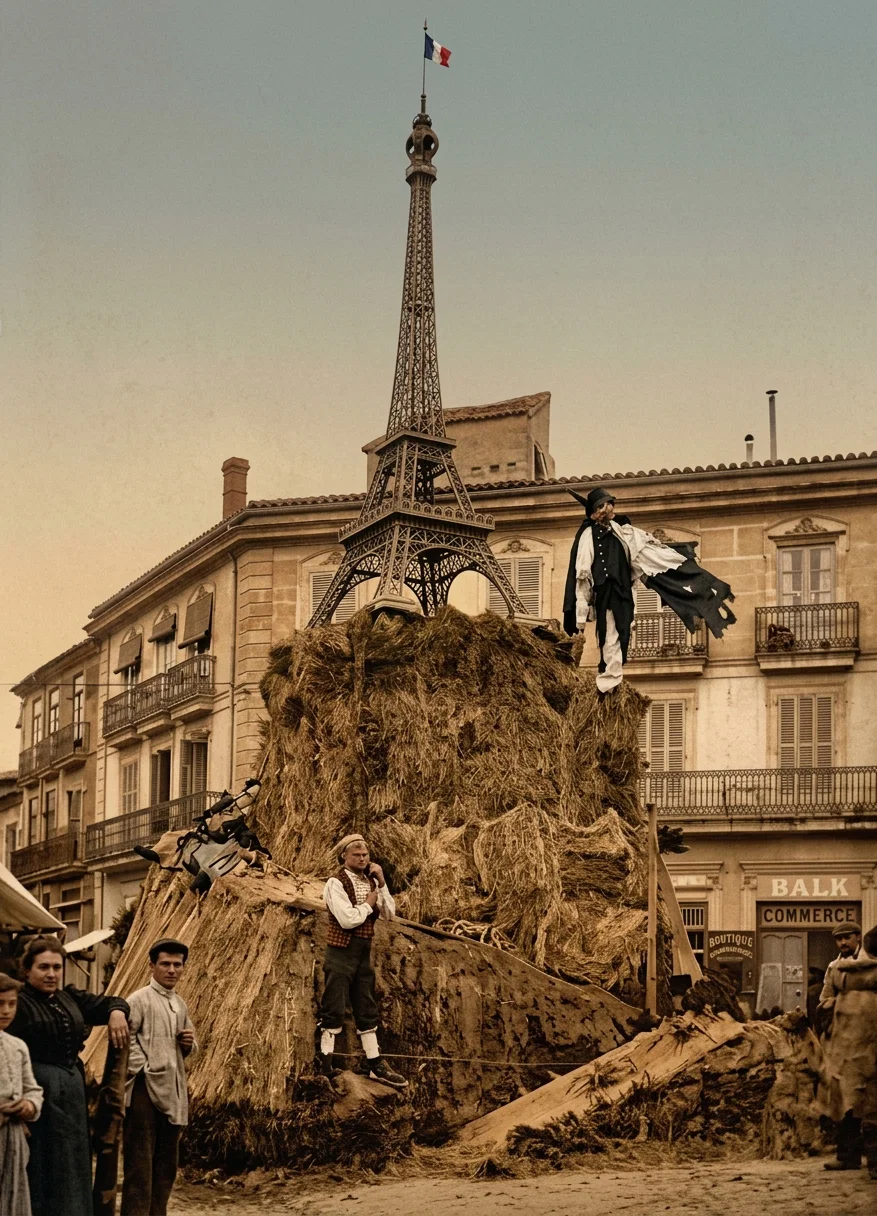
It is the custom in Valencia during the fiesta to erect, in different parts of the city, temporary monuments, illustrating various movements, political and otherwise. I will try to give you an idea of one of these which I have visited. It is a steep mountain, around which winds a narrow path. On the peak is a very good miniature likeness of the Eiffel Tower of Paris. Near the tower is a beautiful woman, bearing the French flag. This woman represents the French government. Wending their way down the mountain trail are many great black buzzards, and numerous mammoth bugs, which I shall not attempt to describe. These repulsive-looking creatures represent the curates, friars, monks, and nuns being expelled from France.
At the foot of the trail is a blindfolded man, who is sucking his finger. He, of course, is supposed to be Spain, which is receiving all the above-mentioned outcasts.
The whole thing very vividly portrays the feeling existing in the hearts of16many Spaniards. It seems really wonderful that such an object as described above is allowed to remain two or three days in the streets of a Spanish city. Were such men as the one who designed this object-lesson allowed to rule, Spain would soon have a separation of church and state.
We find that Spaniards are very slow, as a rule, in making changes for the better. Not only is this true in agricultural and commercial lines, but it is also the case in social and religious questions. We are thankful to announce, however, that the truth is beginning to exert an influence here. Several dear souls have recently begun to walk in all the light. Two young men have given up the use of wine and tobacco. We expect to have baptism here soon. Our prayer is that the Master of the harvest may quickly send more laborers into this part of his vineyard.