The financial problems of this time are creating as much discussion as anything before the world. The “trusts,” the “big interests,” the “money power,” etc., are terms that have become very common, and form the basis of a great deal of discussion both from the rostrum and through the press. How to deal with the great problems of business and finance was one of the leading factors in dividing the Republican Party into the “Progressives” and the “Stand-patters.” It was this same question that split the Republican Party in its recent convention in Chicago, and laid the foundation for the new National Progressive Party that is just being formed. It was around the problems of business and finance that the most heated discussions of the Baltimore convention centered. Mr. Roosevelt, in his speech before the National Progressive convention in Chicago, which speech was supposed to sound the key-note of the new party, devoted most of his time and thought to questions that are purely economic, and that therefore radiate from the financial and business problems that are before the world.
This discussion is not confined to America. The same problems, altho with slightly differing conditions, are confronting England and France and Germany, and practically all of the rest of the civilized world.
In view of the fact that these problems and issues are world-wide, and that they are uppermost in the discussions of the time, and in view of the further fact that it is admitted on every hand that unless they are settled properly we will have world-wide revolution in consequence, has it ever occurred to you that such momentous and such far-reaching questions might have crossed the vision of the ancient prophets? It is quite universally conceded that the difficulties that center in the question of finance in this time present a menace to the world greater than anything that has appeared in past history. In this connection let us read a few short verses from the Bible, using the American Standard edition: “But know this, that in the last days grievous times shall come. For men shall be lovers of self, lovers of money, boastful, haughty, railers, disobedient to parents, unthankful, unholy, without natural affection, implacable, slanderers, without self-control, fierce, no lovers of good, traitors, headstrong, puffed up, lovers of pleasure rather than lovers of God; holding a form of godliness, but having denied the power thereof: from these also turn away.” 2 Tim. 3:1-5.
Now observe that this prophecy is very definite and specific in a number of particulars. In the first place, it says that it applies in the “last days.” It says that in these last days “grievous times shall come.” The leading occasion for these “grievous times” is that men shall be “lovers of self” and “lovers of money.” Then self-love and money-love are to make the last days grievous.
This scripture has been in existence for over eighteen hundred years. It was woven in and out through the literature of the Middle Ages, as well as that of modern times; hence it is not fraudulently brought forward in these times and made to fit the case. It fits the case in hand accurately, but the striking part of it is that it was written more than eighteen hundred years ago. For all of these centuries we have been told that the last days would be grievous, because men in that time would be filled with self-love and money-love.
Observe, however, that there are many other important specifications that are to apply in the times when these men are filling the world with grievousness because of their selfishness and greed for money. These people are to be boastful. They will be telling of their mighty achievements, and of the wonderful things that have been accomplished through their mighty aggregations of wealth. They have been able to tunnel the mountains, build lofty structures, span the great rivers; and of this they are boastful. And the prophecy says also that they will be haughty, and railers; furthermore, they will be disobedient to parents, and unthankful, and unholy; they will be slanderers; they will be without self-control, fierce, and no lovers of good. Moreover, they will be “lovers of pleasure rather than lovers of God.” And with all these, they will still hold “a form of godliness,” but in their lives they have denied its power.
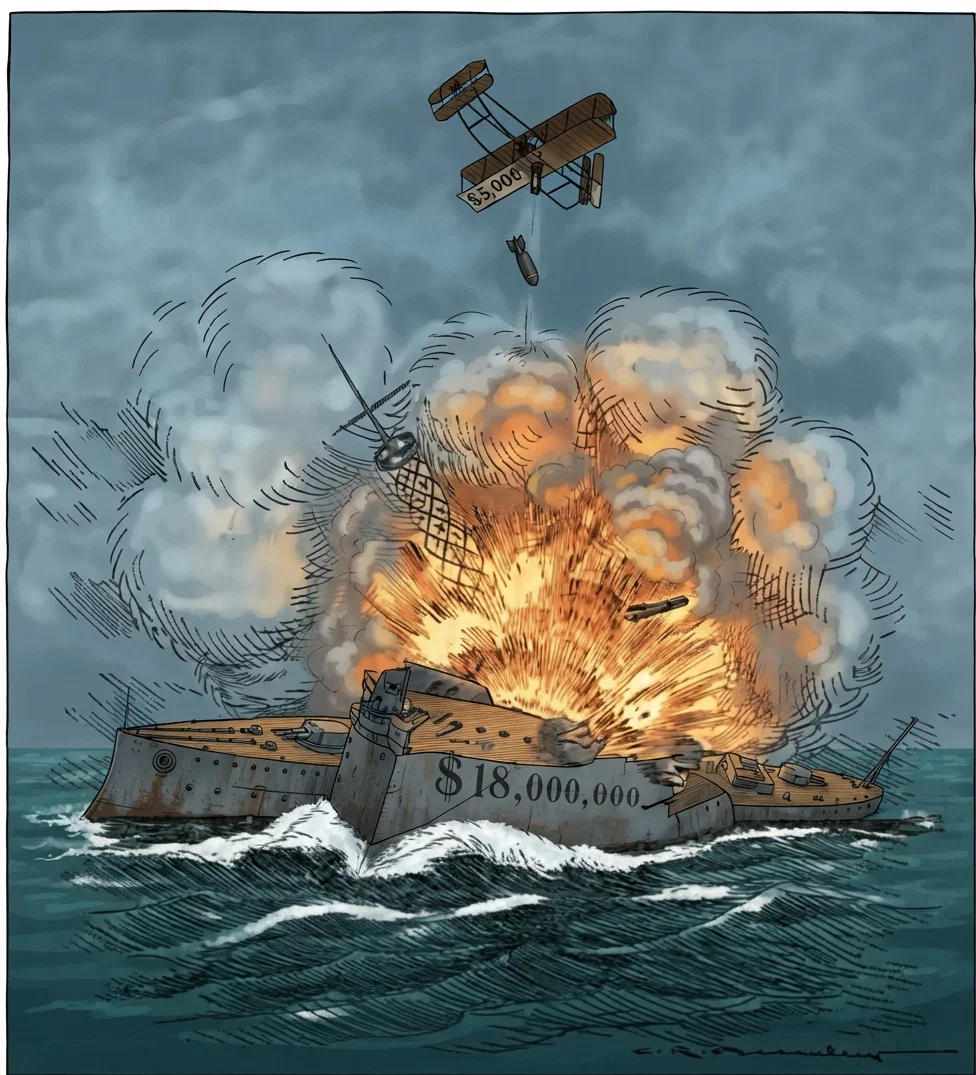
In the above illustration the artist shows how a $5,000 air-ship may drop a bomb that will destroy an $18,000,000 battle-ship. The air-ship may not be developed to the place at the present where it can do such a thing as this, but it is very rapidly approaching the degree of perfection and capacity that will enable it to do it. This is only one of the myriads of illustrations which serve to show the spirit of intensity that is in the world, driving men forward in the great struggles of war preparation.
Now notice particularly that this prophecy goes into detail in its description of the individuals who will make the last days perilous. It gives a list of some eighteen specifications of the men who will be doing the deeds that cause the grievousness and the peril. This prophecy calls for so much that not all can be fulfilled without definitely showing its accuracy and its divine truthfulness.
Let your mind run over the list of great financiers at the present time, and you will find that a large number of them are professedly Christians. Some of the most grasping and greedy of them even claim to be very devout. True, there are a few of them that hold to forms of skepticism, but in the main they hold the “form of godliness.” Doubtless many of them think that because they have hoodwinked the great mass of mankind, they will be able to deceive the Almighty; but this prophecy ought to make it clear to them, and to every one else, that they can not deceive Him, for He has had them described, and their description has been on record for more than eighteen centuries.
Now we ask every candid reader to study carefully this prophecy, and to note how marvelously it is fulfilled in these very times in which we live. Financial problems of the magnitude that are confronting the world to-day never confronted it before, and in the very nature of things never could, for we never had such colossal financial organizations. Individuals have owned great wealth in the past, but it remained for the American nation within the last hundred years to invent the creature of law known as the corporation, and then followed the trust, or combine, which organizes the corporations into one.
Next week we will give Scripture testimony which shows that other prophets have seen the same thing exactly that Paul saw as he wrote this letter to Timothy. And with these prophecies before us, and with the facts before us as they exist in the world to-day, there should be no question in regard to the times in which we are living. T.
Appealing to the People
By T.
In his speech before the National Progressive gathering in Chicago a few days ago, Ex-President Roosevelt made continual affirmation of the fact that this new party in a special sense is to go to the people. He claimed that both of the old parties are "controlled by professional politicians in the interests of the privileged classes," and hence, he affirms, "the first essential in the Progressive program is the right of the people to rule." Then there followed such statements as, "The American people, and not the courts, are to determine their own fundamental policies;" and then, "The acts of the courts should be subject to, and not above, the final control of the people as a whole;" then again, "The people themselves must be the ultimate makers of their own constitution." His address brought in frequent expressions of this character, showing that the new party in a peculiar way is making a bid direct to the people.11There is no question but that such doctrine may be made very popular, for the people like to be told that they are the rulers; but every one knows, who has ever read history to any extent at all, that no class of people have ever been more ridden down by tyrants than were the peoples of different times who were made to believe that they were ruling, when certain leaders, or demagogs (whichever you wish to call them), were carrying on their own notions and schemes by getting the people to shout for them.
It was mistaken notions of the rule of the people that gave France her great revolution a century ago. It seems all right in theory to say that the people can be trusted, but as a matter of fact one of the most important functions of constitutional law is to guard the people against acts that they will commit when under excitement, or before they have sufficiently weighed matters to arrive at a proper conclusion.
Then when the theory becomes general that everything must be referred to the people, it develops a class of politicians who care nothing for principle, but only that they may be popular with the people. They want to have political office, or some kind of political preferment, and the question is not one of principle with them, but how they may be popular with the people. Such individuals fain would have themselves believe, and would try to make others think, that they are leaders. They are not leading, they are following the people. One great demagog in the time of the French Revolution, on hearing a commotion in the street, looked out to see a great crowd of people rushing along, he knew not whither. As soon as he saw it, he said: "There go the people. I must follow them, for I am their leader." And thus it is with a great many of these supposed leaders. They are all the time saying, by their actions, that they must follow the people, because they are their leaders.
But barring any difference of opinion on all these questions, there is a peculiar statement made in the thirteenth chapter of Revelation that ought to be watched in this connection. There is a power introduced in that chapter which will say "to them that dwell on the earth" that they should do certain things. This shows that whatever that movement may be that is spoken of in the prophecy, it will be a popular one, it will appeal to "them that dwell on the earth," it will go to "the people."
Now we would not wish any one to think that we were giving sufficient prominence to either Mr. Roosevelt or his party to believe that they are directly fulfilling this prophecy, but we would like to suggest that there is a popular trend in this time toward appealing to the people direct for everything, that will yet become so general that it will fulfil this very prophecy to which we are referring.
It is truly marvelous, when we come to consider it, how all the events of this time find expression in the ancient prophecies of the Scripture. The times are unnatural, the times are ominous. Such unnatural and such ominous times could not have escaped the notice of God, and He could not have failed to give us warning concerning them through the prophecies.
We know that in this time, as well as in all past time, the great majority will make light of these prophetic utterances, and they will make light of the claim that prophecy is being fulfilled through the events that are transpiring; but careful study of the prophecies, and comparing them with current events, certainly ought to cause any man to think seriously. T.
Where Liberty Exists
THE following paragraph from Prof. Francis Lieber, on "Civil Government and Self-Government," is worthy of more than a mere passing reading. It very clearly sets forth the true principles involved in the question of majority rule.
"Liberty has not unfrequently been defined as consisting in the rule of the majority; or, it has been said, where the people rule, there is liberty. The rule of the majority, of itself, indicates the power of a certain body; but power is not liberty. Suppose the majority bid you drink hemlock, is there liberty for you? Or suppose the majority give away liberty and establish a despot. We might say, with greater truth, that where the minority is protected, altho the majority rule, then, probably, liberty exists. But in this latter case it is the protection, or in other words, rights beyond the reach of the majority, which constitute liberty,—not the power of the majority. There can be no doubt that the majority ruled in the French massacres of the Protestants; was there liberty in France on that account? All despotism, without a standing army, must be supported or acquiesced in, by the majority. It could not stand otherwise."
Constantine, the "Christian" emperor.—
By Editor
Ice in Schenectady.— The city government of Schenectady, New York, bought and put in storage last winter thirty tons of ice, intending to give it to the poor this summer during the intensely hot months, the same as water is given to the passer-by at public parks. But the local ice dealers objected to such a procedure, and a judge was found who enjoined the officials of Schenectady from disposing of the ice on any terms, either giving it away or selling it. That would seem to be a very peculiar procedure, and one of the interesting things to the ordinary individual is that the despatches tell of similar things continually, and then there is editorial comment made concerning them, and as this goes on it makes more and more discontent among the common people. And who will say that it does not appear to them that they have just grounds for this discontent? And who can predict the revolutionary storm that will burst forth when this discontent becomes a little stronger?
Constantine, the "Christian" emperor.—
The Rev. Thomas S. Gregory, in one of his historical sketches in the Hearst papers, entitled the "Battle of Adrianople," rightly says of Constantine: "Constantine was one of the worst men that ever lived, and he did nothing in the whole course of his life that was morally great, but he was an excellent fighter, and was never known to show the white feather."
Washington and Religious Liberty.—
We have cited heretofore a statement from Washington in a letter to the Baptists as to how he regarded religious liberty. We note another sentiment, expressed in an address to the Hebrew congregation at Newport:
"All [citizens of the United States] possess alike liberty of conscience and immunities of citizenship. It is now no more that toleration is spoken of as if it were by the indulgence of one class of people that another enjoyed the exercise of their inherent natural right, for happily the government of the United States, which gives to bigotry no sanction, to persecution no assistance, requires only that they who live under its protection shall demean themselves as good citizens, in giving it on all occasions their effectual support."
The police in Atlanta have recently discovered a well-organized gang of boys calling themselves the "White Caps." They are fully one hundred strong, and have affiliated with them a girl contingent which they call the "White Stockings." Miss Margaret Laing, the probation officer, was listening to the idle chatter of some girls in the children's court when she got the clew that led to the detection and arrest of some members of the gang. They have been in existence for over a year, and some five hundred burglaries have been committed by them. The girls did not do much of the robbing, but they were aware of what was going on, and came in for a division of the spoils. They were all sworn to the greatest secrecy, and it is with the utmost difficulty that anything can be drawn from any one of them against another. One boy affirmed he would spend his life in prison rather than tell a word to incriminate his companions. If parents were all doing their duty, we would not have any such conditions as this. But in many instances the grinding heel of greed or else the depravities of the saloon, have driven mothers into the position where they are obliged to go from home to work to help support the family, and the children are left to shift for themselves, and they get into just such things as this. Child criminality has come to be one of the problems of the age. And with our "white slave" traffic, and with our grafting city officials, and with all the rest of the criminality and injustice that is cursing the world, who can be deceived into the notion that the world is getting better?
Brigadier-General Clarence Edwards, who was one of the commissioners sent to Europe in the interest of the Panama-Pacific International Exposition, is said to be enthusiastic over the prospect for a gathering of the "crack" regiments of the various nations of the world in San Francisco in 1915 for a competitive military tournament. The fact that the army reservation in San Francisco would furnish ideal drill grounds, and further that foreign troops could be landed right at the place by their own war-ships, adds to the feasibility of the plan, and foreign powers are said to be very favorable to it.
The Department of Commerce and Labor, in a recent report, has pointed out that the great wireless station at Sayville, Long Island, is backed by German capital. Some are of the opinion that this move shows too much aggressiveness on the part of Germany. But it is more than likely that no one would have thought anything about it had it not been for the discussions over the aggressiveness of Japan in the Magdalena Bay affair.
An explosion in the Haytian executive palace on August 8 killed President Cincinnatus Le Conte, and 400 others perished with him. It is believed by the best informed that the explosion was the work of dynamiters in the revolutionary party. The capital city is placed under martial law, and while the people are terror-stricken, the soldiers are keeping order.
Secretary of the Navy Meyer is urging the building of more Dreadnoughts, because if we do not, we will soon be far behind as a naval power. The British and German programs are so active in this respect that it is argued that the United States will soon be a third or fourth if not a fifth class naval power unless more battle-ships are built here.
Theodore Roosevelt was nominated for President, and Governor Johnson, of California, for Vice-president, by the Progressive Party, in Chicago. This makes five presidential candidates in the field, Messrs. Taft, Wilson, Roosevelt, Chafin, and Debbs.
Insanity and the Saloons
By Baptist Chronicle
INSANITY in this country has increased at three times the rate of the population. The use of alcoholic drinks and narcotics is ascribed as the chief cause. The license tax of saloons will scarcely pay for the maintenance of the additional asylum equipment and support of inmates required. Readers may remember an editorial some time ago as to the work of the Alexandria saloons in sending a formerly useful man to the Pineville asylum, leaving, practically, a widow and several children. Now, $10,000 is being appropriated to build another building, not, of course, because of this one inmate; but let a test be made and see if the new building, or even all of the old ones, would be required if it were not for the wrecks wrought by the saloons. This does not take into consideration the cost of support of those impoverished by the saloon nor the loss of the labor of the insane and the drunkards. Alas, what wo is wrought by the evil! — Baptist Chronicle.
HOME AND FIRESIDE
MAKE it mine
To feel, amid the city's jar,
That there abides a peace of Thine
Man did not make and can not mar.
—Matthew Arnold.
Habits That Cause Homeliness
By Dr. E. J. Leonard
By Dr. E. J. Leonard
WOODS HUTCHINSON once remarked, in effect, that well-defined facial ugliness points an accusing finger at early and woful neglect of the jaws and teeth. In the minds of many, an ignorance of or an indifference to the latter is the origin of more facial unsightliness than any other single factor.
I do not know of anything more productive of an eyesore than infant mouth-breathing coupled with the habit of thumb-sucking. With this combination, it is doubtful if a child with a good physical inheritance would grow to an adult even "easy to look at."
Mouth-breathing predisposes a long, narrow jaw; and the persistent working of that infant thumb may produce the situation sometimes referred to as, "She'd look all right only for her teeth."
A mother must know, if her child's nasal passage is choked with adenoids, that the mouth-breathing, not being a habit, is an obvious effect. See to the prompt removal of these growths, and you are doing more than you can readily imagine in fostering the child's good health and appearance.
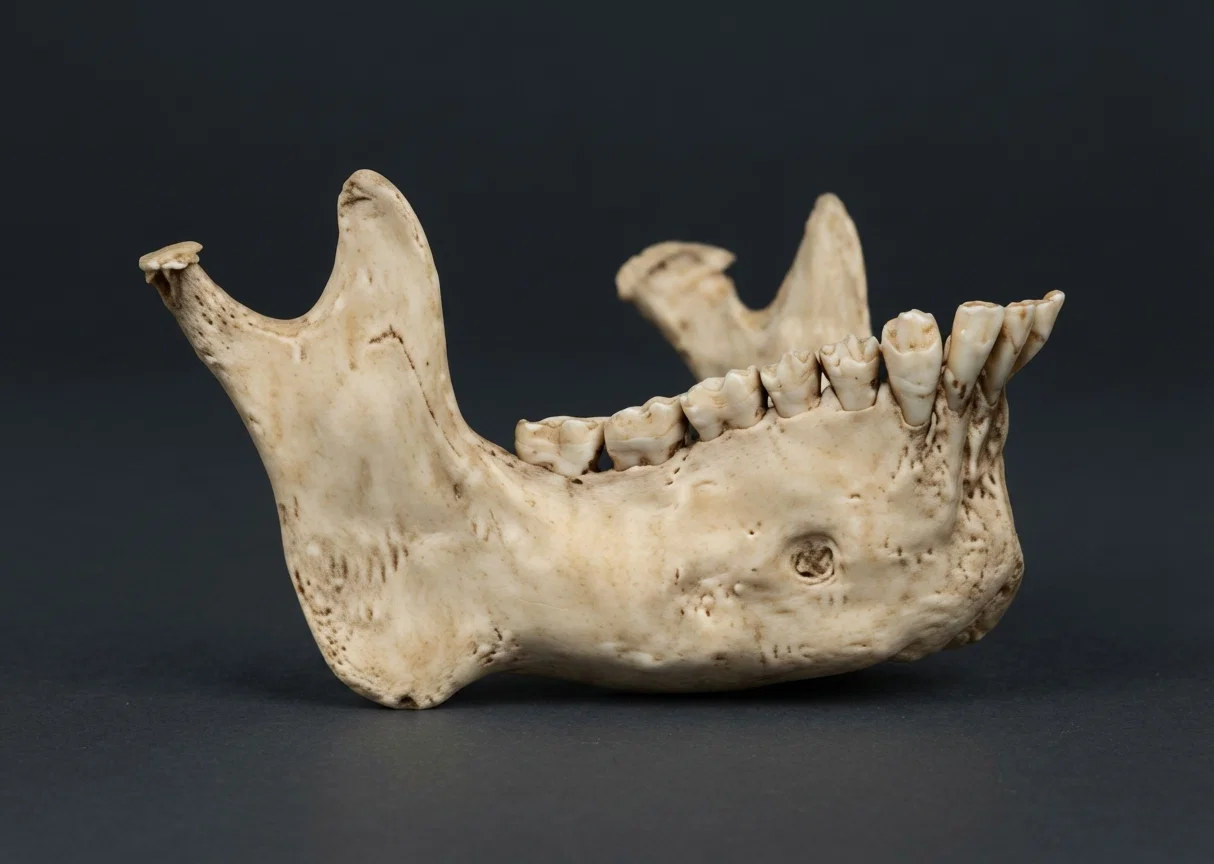
The juvenile habits of thumb-sucking and lip-biting must be stifled with determination if the infant is to be saved from future dental ugliness. The photograph of the lower jaw, herein shown, is an excellent sample of the effect upon the teeth of the "biting down" of the upper lip. In this case, the protrusion of the front teeth is so well marked that it requires little imagination to restore a thick, exceedingly prominent lip on its original possessor.
The teeth are the real guardians of the normal development of the lower jaw, and a big factor in determining the contour of the face. In fact, were a child brought to the dentist when its first or "milk" teeth had arrived, and the mother impressed with the relation of these organs to the teeth that are to come, most of our dental ugliness would be unknown.
A great trouble is, that mothers are very often unable to distinguish the "baby" tooth from the permanent variety. If in a boy of six or over the teeth give offense, they are in many cases thought to be of a primary character, and soon yield to the forceps of a busy dentist. Nine times out of ten, a tooth will never succeed the extracted organ; and the effect of this practise is shown in the accompanying photograph of the young girl.
If your child's teeth are inclined to be irregular, the one remedy is a good dentist; and even his skill, to be but fairly painful, must be sought out with promptness.
See to it that your child is not a mouth-breather; discourage firmly the habits of thumb-sucking, lip-biting, and tongue-sucking; instil in the young mind the hygiene of the mouth, and you are doing a good share in the production of a people soon to bask in the glow of better health and improved appearance.
The Lady and the Little Dog
THEY got off the train together, the woman and the poor little dog that had to dress as she said. Everybody stared at the dog, and he felt his shame keenly. He was short-legged and fluffy by nature, with reddish hair in his eyes, and a foolish, helpless look to his fat body. But if he had been let alone, everybody would have said that he was at least doing his best — none would have mocked him.
This illustration shows how the appearance as well as the value of the teeth may be improved by proper care
Effect on front teeth of continuous abnormal pressure, as of thumb-sucking, or “biting down”
He had not been let alone.
Around his neck there was a bright pink ribbon tied with a big bow. And on the ribbon there was a little bell that tinkled foolishly.
On his back he had a little jacket made of bright blue silk — a sort of a cross between a horse blanket and a pair of trousers. It had little sleeves that came down over his front legs. At the end of this arrangement, near his tail, was a little bow of pink ribbon. He was led by a fancy gilt chain.
Everybody looked at this poor creature, some in pity, more in contempt. You could see, as he pattered along dismally, that he was ashamed of himself and felt his position keenly.
Yet foolishly dressed as he was, the unfortunate small dog was much more sensibly arrayed than the woman that owned and led him.
He hadn't any holes in his ears, with earrings fastened to them — she had.
His hair was its natural color — hers was dyed bright yellow.
He did have a foolish blue silk thing around him, but at least it was loose and let him breathe — hers was just as foolish in color, and it was squeezed in in a way that would have made a skeleton say, "Ouch!"
The little dog's head was protected only by its natural growth of hair — the woman had on a hat that might have been invented by the lady in the violent ward who thinks she is queen of Sheba.
The dog's feet were comfortable and natural. His toe-nails rattled along on the boards noisily and comfortably — her feet were squeezed, butchered, thrown up into the air on high heels in a way that put her spine out of plumb and will ruin her health ultimately.
The dog had an honest, straightforward, altho rather pathetic expression — the lady simpered foolishly, actually well pleased with the ridiculous features of her costume.
She had tried her best, without success, to make a small poodle look as foolish as a tall, would-be fashionable woman.
The people stared and laughed at the dog — they should have laughed and stared at the foolish human being that led him.
Women, why do you dress and ornament yourselves and squeeze and hunch yourselves so foolishly?
Don't you know that a dog or a cat, and especially a cow, would look ridiculous in the things that you wear?
Why do you put upon yourselves a rigging to which you would not condemn a respectable cow? Please reform! — New York "Evening Journal."
The Change
MARJORIE, staying with an aunt for a time, went with her to call upon an old friend of her aunt's. The girl was delighted with their hostess.13"Such a calm, well-poised, delightful old lady," she said, enthusiastically, "and so brightly interested in everything and everybody. How I would like to have known her as a girl—she would have made an ideal chum, I'm sure."
"She was one of the most disagreeable girls in the village—for a time," was her aunt's surprising reply. "She was an only child, spoiled, wilful, headstrong. Then she lost her parents and her home suddenly, and made life a burden to those who opened their home to her. Then came a severe illness, the direct result of overindulged grief and unrestrained rebellion against her lot in life. In that illness and weakness God found a way to reach her as He had never done in her pride and strength. She saw the selfishness and wickedness of her past years; she realized that she had no right to hurt and sadden her own life and the lives of others; that rather she had a place to fill, a duty to perform, or God would not allow her to live. She gave up her will to Him; she resolved to make herself a blessing, a cheer, an inspiration, to every one she touched in her daily life. You saw to-day how well she succeeded," said her aunt. "I often think what a pity it was that she did not learn the lesson sooner, and so make sweet all those years that were so bitter through her own fault."—Onward.
Dedication of Portland Branch, Pacific Press Publishing Association
By H. H. Hall
A STRIKING indication of the advancement of the publishing work in the North Pacific Union Conference was given by the dedication of the branch office of the Pacific Press Publishing Association, Sunday, July 21. In January of 1904 this office was opened in rented quarters on Second Street. The demand of the business called for a larger building, and quarters were secured at 285 Salmon Street. In 1906, when the main office of the association was destroyed by fire, the directors felt it would be necessary to discontinue the Portland branch; but the various conferences in that union contributed $500 to its support, and it was therefore continued at 61 Park Street North, where still larger space was occupied. The business has continued to increase, until early in the spring of this year a lot was purchased at Twenty-first and East Flanders streets, and a beautiful concrete building 28 x 45 feet was erected.
The dedication service was a very pleasant one, coming as it did during the educational council held at Erroll Heights, in the suburbs of Portland. More than a hundred teachers, together with the union conference committee, representatives of the various churches in Portland, and other visitors, were present.
Elder H. W. Cottrell, formerly president of the association, presided. Elder C. W. Flaiz told of the advancement of our publishing work in his union, and expressed his appreciation of the fact that it had become necessary to build such a depository, and said he hoped it would speedily be found too small to accommodate the growing business. Brother J. F. Beatty, manager of the office, Prof. H. R. Salisbury, educational secretary of the General Conference, H. G. Childs, treasurer of the association, and H. H. Hall, also spoke briefly. Elder S. W. Nellis offered the dedicatory prayer.
Front view of our new branch office, Twenty-First and E. Flanders streets, Portland, Oregon
H. H. H.
"WE are not here to play, to dream, to drift;
We have hard work to do, and loads to lift.
Shun not the struggle; face it; 'tis God's gift."
BOOK NOTICES
"The Critical Period of American History, 1783-1789." By John Fiske. Cloth. $2.00. Houghton Mifflin Co., Boston and New York.
This book is the substance of a course of lectures given in the Old South Meeting-house in Boston in 1884. It is really a sketch of the political history of the United States from the end of the Revolutionary War to the adoption of the Federal Constitution. It does not treat upon the Revolution itself as the critical period of American history, but upon the times which immediately followed that period, the formative state of the nation and government, the turning-point in the development of political society in the western hemisphere. To that period and to that crisis, more than to any other in the history of America, the author attributes the molding influences which shaped America into the mighty nation and tremendous world force she has been. He who wishes to become conversant with the formation of the great republic of the West, who would learn of the secret springs which helped to form the mighty rivers, certainly needs to read "The Critical Period of American History."
"Christ Among the Cattle." By Frederick Rowland Marvin. Cloth. 12 mo. 60c net. By mail 65c. Sherman, French & Co., publishers, Boston.
This little book is written with an object in view, and that is the rights of animals at the hands of men. The author believes that it justifies their production. A few years ago it was believed that animals had no rights that men are morally bound to respect, and cruelty was everywhere manifest, altho frequently rebuked. A great change has taken place, and the popular conscience has been quickened, and the author hopes that this little book against cruelty and vivisection will help to strengthen the sentiment which has been created. The basis of the book is taken from our Lord's14birth in a manger, surrounded by the lowly cattle, and he feels that our Saviour's advent associated with beasts of the stall should teach us lessons of respect for and kindness toward the animal world. Other passages of Scripture are quoted to the same end. Even the promises of the new heavens and the new earth show that God has regard for the animal kingdom. The little volume is a tremendous arraignment of cruelty to animals; of the fashions which murder thousands of birds simply for their plumage, regardless of the effect of the slaughter; of the breeding and fattening of animals; of the bull fighting and the bear baiting and the cockpit, the stag-hunt and the fox-hunt, and vivisection.
BOUND VOLUMES
By Editor
SIGNS OF THE TIMES
can still be secured as follows:
8 leather 1907 at $2.00 each
9 paper 1907 at 1.75 each
4 cloth 1909 at 2.00 each
6 cloth 1910 at 2.00 each
3 paper 1910 at 1.50 each
21 cloth 1911 at 2.25 each
These prices are post-paid
Those desiring volumes of the SIGNS in this convenient form should write at once with remittance to