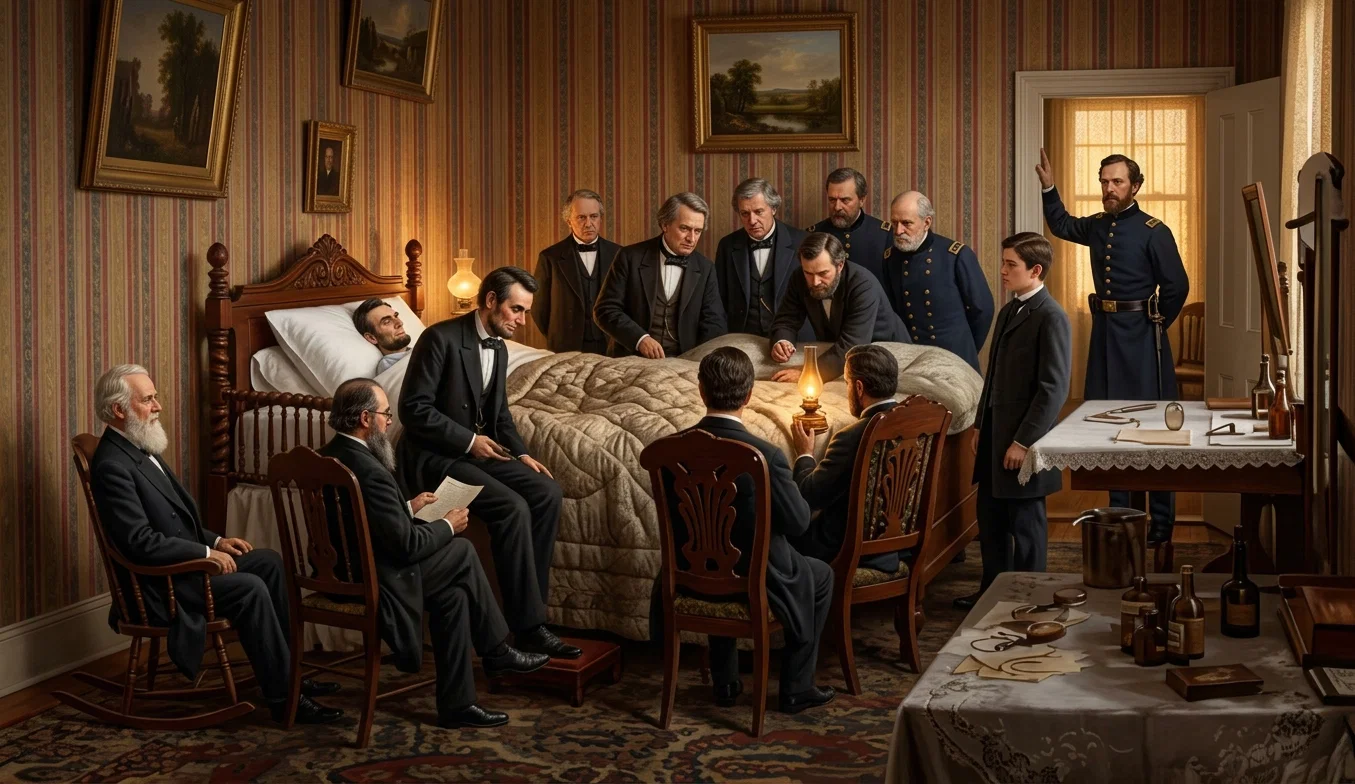
Much, very much, was said of Abraham Lincoln on the centenary of his birth, February 12. We believe that the anniversary of his death should cause all true lovers of country and liberty to pause a little time and consider the principles which made the man what he was, and which placed him in a position which resulted in his death, and to inquire what hold these principles are having upon the body politic now.
There may be others, but the following traits of character stood out prominently in the life of the Kentucky “rail-splitter,” the indifferent “clerk,” the “backwoods surveyor,” the “awkward country lawyer,”—for by all these terms has he been called,—and made him what he became, a mighty chief among men, and under God a saviour of his country.
1. SIMPLICITY.—There was nothing “put on” about Lincoln. The artificial was unknown to him. His simple but effective style of speech was garnered largely from the Bible, one of his best-read books. His primitive life in the forest and field, surrounded by all the open transparencies of nature, bred within him the simple, unaffected manner which put timid souls at ease and won hearts. And he was simple and natural to the end.
2. HONESTY AND INTEGRITY.—We are told that he was honesty personified. When in the practise of law, in the statement of the case before the jury, he would state as fairly his opponent’s side as he could his own. No judge, sitting upon the case, could do it more impartially, we are told. He did not do this that he might the more readily win his case; he acted as he did from his innate honesty. He would not take a case in which his client was acting dishonestly if he knew it; and if dishonesty developed during the trial, it always affected his advocacy.
In his early career in the practise of law he often showed at a disadvantage, for he was far from a “well-read” lawyer; but as the years went by, the people came to know him, they knew his honesty, his integrity, his absolute dependableness. They could trust him. He would brush aside all the little technicalities of the law, often used to defeat justice, and would base his case upon his sound, logical, analytical argument, and his honest statement became convincing. The sobriquet, “Honest Abe,” had a real basis in character. He demonstrated that “honesty is the best policy,” but only so when it is never used as a policy but the outcropping of an inborn principle.
3. JUSTICE.—He believed in justice. A sincerely honest man could not do otherwise. It was not for justice for the rich or great that he stood, but for the individual, how humble soever he might be. Things must be fair. The other man must have a fair chance. He would take no mean advantage of an adversary. Whole-souled justice and fairness himself, he believed that his opponent had the same right. He did not talk “square-deal,” but he gave it on all occasions.
4. TRUTHFULNESS.—One of his old acquaintances declared that he was truthfulness personified. He did not act a part. Some of the mighty speeches he made for liberty, his most intimate friends plead with him not to deliver, because it was “not expedient,” it would “hurt his chances,” it was not “good politics.” That mattered not to Lincoln. The truth must be spoken at whatever cost. Whitney declares that he was not only morally honest; he was intellectually honest, or true to his standard of right. Other great men can argue on both sides of a question if expediency demands; Lincoln could not thus falsify. His greatest trophies were, indeed, moral achievements. But the basis of all true moral achievement is the love of truth.
5. MAGNANIMITY.—Every man in active public life is bound to make enemies. This is inevitably true if he is honest, conscientious, truthful, just. It is even more likely if he is popular, and yet lacking in grace or culture. Most public men become enemies to their enemies. Some of them hold their enmity implacably to the end. It was not till the closing years of his life that Jackson could forgive his enemies. Mr. Lincoln seemed to have none on his part. He held no hardness against his most caustic critic, against his most inveterate enemy. Anecdote after anecdote is given in the various biographies of Lincoln illustrating this trait in his character. His was no little mind. It could busy itself with the smallest details where principle was involved, it could sweep away all the punctiliousness of centuries of precedent—court and social—if it stood in the way of direct justice or affirmative truth and honesty.
6. HIS LOVE OF LIBERTY.—He learned it from the trees and mountains and streams; from the purling brook and the deep-toned thunder; from the songs of the birds and the shining of the stars. Nature dealt with him openly, frankly; and the Bible pressed home all her principles of simplicity, truth, honesty, and freedom. It was love of liberty which impelled him to say: “If slavery is not wrong, nothing is wrong.” “He who would be no slave, must have no slave.” “They who deny freedom to others, deserve it not for themselves, and under a just God can not long retain it.” He saw that the country could not exist half-free and half-slave; it must be one or the other.
Had he lived, all his plans for reconstruction might have been thwarted by unscrupulous politicians. But his magnanimity, his love of mankind, his abounding generosity, would not have permitted the regime of carpet-bagging which followed the Civil War, and would not have aroused the bitterness, the enmity of the stricken South. When Abraham Lincoln died the morning of April 15, 1865, the South lost her best human friend.
7. COURAGE.—His was a courage born of righteousness and faith. He believed in all these principles we have named. They were essentials in his character. Justice, integrity, honesty, truthfulness, magnanimity, love of liberty, were attributes of Deity, God-given to man. He knew they were of God. He knew, or seemed to know, that God had called him to their manifestation and exemplification in politics and government, and his marvelous courage was the fruit of his faith. Mr. Whitney, in his “Life and Works of Lincoln,” says: “Mr. Lincoln’s preeminent greatness lay in the combination of the powers of analysis and synthesis. He could discover and unmask a fallacy more completely than any other living man; and he could define a moral, political, or legal issue more perspicaciously than any statesman in American history.” But in all the questions where these powers of the man were revealed moral principles were involved, and the moral principles in the man enabled him to see clearly the strength or fallacy of a proposition. The greatness of Lincoln rested in the moral man, in his absorption of divine truth, in his simple life, in his great love of humanity.
How Much Has Been Gained?
Look over the land. Note the prominent statesmen of our nation. Witness the political chicanery and graft and fraud and dishonesty and double-dealing in our city, state, and national life, in commercial, social, political, religious circles; in the capital-and-labor worlds. There is no slavery under the Constitution, but in fact it still exists in our great factories and mines and cities, our trusts and unions.
The religious world is seeking to bind the11bands of the tyrannies of the medieval ages upon modern humanity. Under the guise of necessity and benevolence it is demanded that all shall observe outwardly, at least, a religio-political sabbath by law. From Maine to California the struggle is on. Confederations which ignore the very foundation principles of Christianity are behind the efforts. The individual under the increasing influence of socialism in various forms is ignored and his rights forgotten, while the mass is becoming more and more in evidence. Men forget that the rights of all are the equal, inalienable rights of each one.
For the principles of liberty Abraham Lincoln died. For those principles God calls men to live to-day. Preeminently, perfectly, they have been found in but the one Man—Jesus of Nazareth. For them He died. We may be called to die as did He; and the espousal of these principles may mean death; but there is no other way to a true earthly manhood, to an inheritance eternal.
Germany’s Challenge to British Sea Power
A theater play has upset all England. In that play is shown how it is possible for England’s foes to enter her domain and possess themselves of the country. It is an old English tradition, bred in the bone, that an Englishman’s house is his castle, but the outcome of the agitation over the theater play has shown that England has more to take into account than her great navy. Since then it has been learned that Germany is building as rapidly as England can build and Germany has a land force while England has little. A short time ago it was thought that no nation could build a “Dreadnaught” as quickly as can England, in about four months, say; Germany now, it is found, can build in about the same time; and it is said that Germany is bearing the great financial burden, and building as she is, with the one idea of crushing Britain’s sea-power and giving Germany the supremacy. The end of course will be Armageddon.
Unchristian and Childish Pleas
On the 26th of February, the Christian Advocate tells us, there were nine different bills demanding consideration before the committee on Legal Affairs of the Legislature of Massachusetts. One of these bills asked that the Hebrew shopkeeper have the legal right to do business on Sunday. One rabbi contended that “in order to meet competition and keep up with the struggle for existence many Jewish storekeepers are forced to transgress the tenets of their own faith by remaining open for business on Saturday, when if they knew they could remain open legally the following day, they would live up to their religious duty and stay closed.” No truly conscientious Sabbath-keeper ever ought to put forth such a plea as that. If he has faith in God and faith in the Lord’s Sabbath, he ought to keep the day anyway, whatever might be the consequences.
That is the same plea that is put forth by keepers of the first day: “We can not keep the first day unless you will close other shops on that day.” It is an utter denial of faith in God and clearly indicates that the religion that would make such a plea as that is hardly worth considering. Yet the Christian Advocate declares that to ordain such a day, that is, Sunday, without the protection of law, would bring about a similar result such as is seen in the Old World; and while it feels that the Jew would not be accommodated because that would demoralize Sunday, yet on the other hand it feels that the Sunday-keeper himself ought to be protected because he would be thrown into competition with a very large class were it not for the law.
The plea is a pitiful one. If the Sabbath is a Christian institution, it ought to stand on the same basis that all other Christian institutions stand—in the faith of the Christian himself and in his personal relationship to God and to His church. The state has absolutely nothing to do with it. It is in itself a crime to make criminal on one day of the week what is not criminal on every other day of the week.
The Advocate argues that some of the Jews sell seven days in the week, and then follows this incident: “We have heard of a Christian and a Jew who were partners in a business concern, open seven days in the week. The Christian man ran the Saturday business, while the Jew spent the day after the manner of his religion.” But that was their legal right. At least, that was their inalienable right as men, and the law had no business to prevent it. The Christian ought to have conscience enough to do otherwise, and so also ought the Jew. If either were misrepresenting his brethren, the communion to which he belonged ought to have dealt with him. It was not a matter however for the state to deal with.
As to just how much our Sunday-law friends believe in exempting those who may not agree with them, take the following sentence from the article: “One thing is sure; if there be a law for Sunday, and exemption given to a whole class of people on any ground, much greater evils will follow to the whole people than under the present situation. . . . To make all things equal in their operation on all classes has never been possible. The principle of the greatest good to the greatest number must ever settle many a difficulty.”
Cabin where Lincoln was born Feb. 12, 1809. Place of birth matters little.
The Christian Advocate and its coworkers for religious legislation can easily help matters in the things suggested in the first two of the last sentences, by refusing to have anything to do with religious legislation. Religious laws are always class laws, always unequal laws, always discriminating laws, always unjust laws. The very principle of tyranny is in them from the initiative to the close. The principle of the greatest good to the greatest number is another one of those fallacies which will ever work out tyranny. Such a condition ought to come as a result always, but never as a basic principle from which to operate. The only true principle is the absolute protection of the individual in all his inalienable rights. If the individual is protected, all are protected, and the very reason for the very basis of civil law, the reason for its existence, is that the weak may be protected instead of the strong, the minority instead of the majority. In a truly free republican government it ought to be the individual, and in the individual are protected all others.
Lincoln’s Warning
“What constitutes the bulwark of our own liberty and independence? It is not our frowning battlements, our bristling seacoasts, our army and our navy. These are not our reliance against tyranny. All of those may be turned against us without making us weaker for the struggle. Our reliance is in the love of liberty which God has planted in us. Our defense is in the spirit which prizes liberty as the heritage of all men, in all lands everywhere. Destroy this spirit and you have planted the seeds of despotism at your own doors. Familiarize yourselves with the chains of bondage and you prepare your own limbs to wear them. Accustomed to trample on the rights of others, you have lost the genius of your own independence and become the fit subjects of the first cunning tyrant who rises among you.”
The Province of the Church
The province of the church was ably defined recently by Judge E. D. Sanders of New Orleans in a discussion with a prominent divine of that city, who was profuse in his statements of the mission of the church. Said the judge: “The danger of Christianity to-day is because its advocates claim too much for it. . . . The church makes a mistake when it leaves its province and deals with things that should be handled by other bodies of society. . . . The church should not meddle with political or social movements. The work of Christianity is with the individual only, and through him it should redeem the world.” Commenting upon this statement, the Baptist Chronicle truly says: “Judge Sanders is not a bad theologian when he talks of the individual and of Christianity’s relation to him. We can not redeem humanity en masse. Social conditions may be bettered, but salvation can only come through individual contact with an individual Saviour.”
The Noiseless, Smokeless Gun
Among the wickedest inventions of the present strenuous age, it seems to us, is the new noiseless, smokeless gun. It is described in detail in newspapers and other journals, welcomed of course by the hunters because it makes no noise when they kill their victim. It would be welcomed also by the vast, increasing, growing, turbulent murderers in the various nations. Mr. Maxim probably invented the gun as a mere matter of scientific pleasure, but we may well believe that behind him was a grinning demon. It was stated that the sound of a thousand or ten thousand of these rifles fired at once would be so slight as to make it possible for all orders to be heard by a regiment if given by its officers in the regular way. One can be fired and the noise not be heard a hundred feet away. It seems to us that the bigger the noise a killing instrument could have, the better it would be for humanity.
Catholic Censorship of School-Books.
The State Board of Education of Louisiana has rejected Meyer’s Ancient, Medieval and Modern History as a text-book to be used in the schools of that state. The reason given by one of the members of the board is, “Unless I mistake, the priests will object to some of the statements.” Naturally they are not very proud of the history of medieval times, for “the Catholic Church wrote her history of that period with a sword dipped in the blood of innocent victims.” But history is a record of facts; because the text-book mentioned gives these facts, it is widely used; only such text-books as teach the truth should be used, even tho truth is set forth in uncomfortably plain terms.
Steel Trust Cuts Workers’ Pay
It was announced about the middle of March that for the first time since its origin in 1901 the billion-dollar steel trust makes a cut in the pay of its workers, ranging from fifteen per cent to twenty per cent, and embracing every boy and man in the service except only the highly paid executive heads. The wage-earning army numbers more than 240,000. This will go into effect April 15. The public is left to guess whether the reduction is based solely on business conditions or is the outcome of some political plan.
Calls for Legislation on Noiseless Guns
“The Scientific American” says of the noiseless gun that its “deadly character”, “renders it in the hands of unscrupulous people a distinct menace to society; and we are strongly of the opinion that it should be made the subject of immediate and very stringent legislation.”
Mohammedan and Chinese Temples—Singapore
Our Work in Singapore
By J. E. Fulton
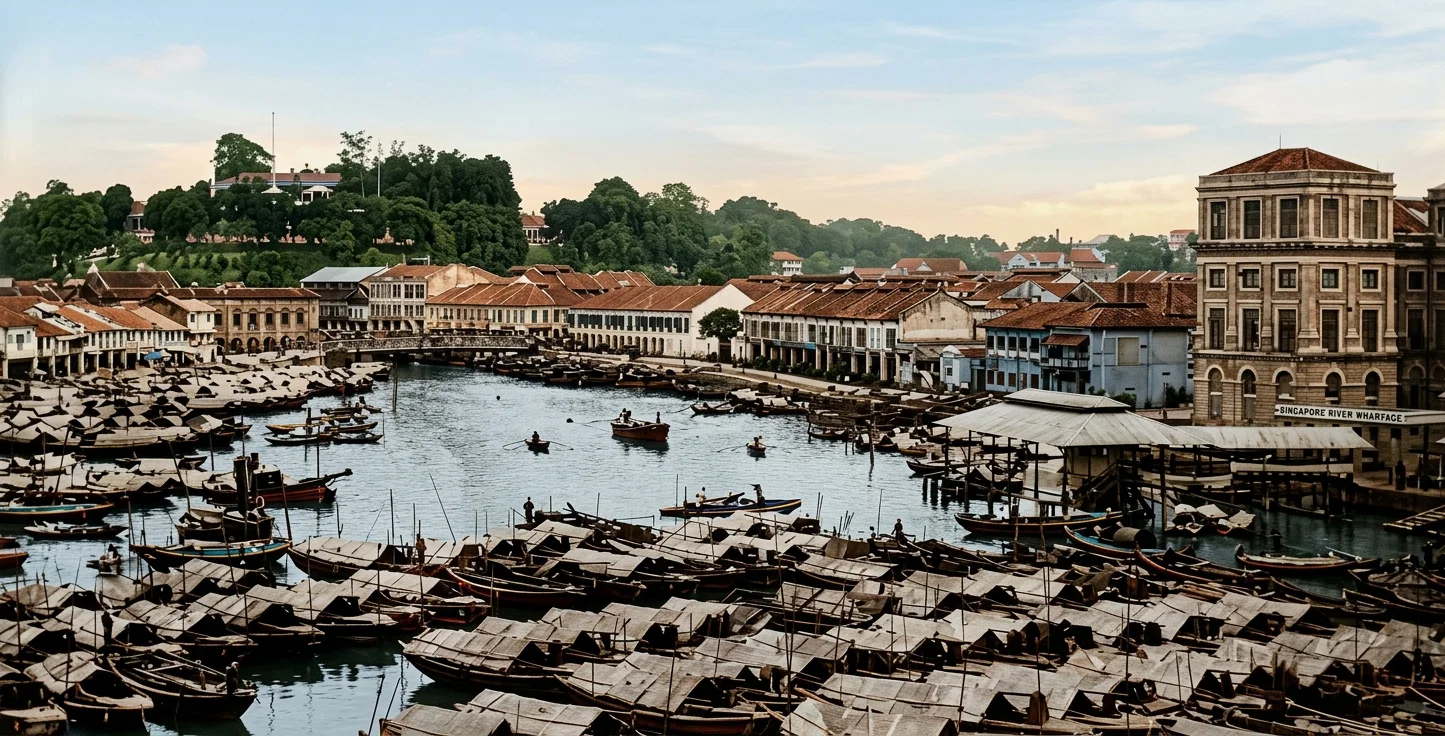
Boat Quay, Singapore
SINGAPORE is a most interesting place. To one born and brought up amid Western civilization this city furnishes a series of strange sights. One here sees examples of every variety of Eastern races, and of many different religions and modes of life. The city is English only because it is ruled by them, for the mass of the people are Chinese, there being 240,000 of them out of the entire population of 300,000. The native Malays seem swallowed up among the vastly greater numbers of Chinese and amid their incessant activity. Besides the Chinese there is a large number of Klings from western India, and Arabs, and these are mostly engaged in little businesses of their own, some however on quite an extended scale.
There are Mohammedan mosques, Hindu temples, and Chinese joss-houses, representing the worship of these different nationalities. Some of the houses of the Chinese are large and compare favorably with those of their white neighbors; others and many of them are low, dirty hovels; the rich Chinese may be seen riding in very fine carriages drawn by imported horses, while the poor coolie is usually found either trudging along under some heavy burden, driving upon an ox-cart loaded with some merchandise, or, as is the case with thousands, running in the hot sun with a loaded rickshaw. There are trams, carriages, and rickshaws as means of conveyance, but the greater number travel in the latter. It seems very hard to the writer to have a man in the shafts, the poor fellow running along sometimes at great speed, bathed in perspiration. We are told that soon we shall get accustomed to this, but we would rather travel in some other manner.
Singapore has a good harbor, and being one of the great crossings of ocean highways, contains a wonderful amount of shipping. Here one sees ships and steamers from every part of the globe. And then beside the large vessels there is an innumerable company of small craft,—Chinese junks, Malay proas, fishing-boats, and passenger sampans, launches, tugs,—and, we imagine, all other sorts. The commerce of Singapore amounts to many millions a year. There are great stores and ware-houses, banks and public buildings. The city in some respects seems quite modern. Here one sees electric trams, electric lights, telegraph, telephones, and newspapers. Were it not for the strange faces and the tropical vegetation, we might quite imagine ourselves to be in an Australian city.
Our work has been started in this wonderful center. Many books have been sold here by our canvassers. Then Pastor Jones and his wife have been here now for several years doing hard, faithful work. They labored alone for some time, and the Lord has blessed their efforts. Some good souls have taken hold of the truth, especially from among the Chinese, and some of these have now so far developed that they are engaged as laborers. Other laborers from abroad have joined Brother and Sister Jones in the work, so that at the present we have six European laborers in Singapore. Much opposition has been shown by the other churches, but our workers labor on and we know that the honest in heart will be won to the truth. Preparations are now completed for the erection of a neat chapel in Singapore. This will add greatly to the upbuilding of the work, for at present the meetings are held in the mission which is not by any means an ideal place. We feel to especially ask that our brethren afar off would remember our workers here at the throne of grace. The climate is trying and the work is difficult and taxing. They need great wisdom, for the work is especially important at this center.
J. E. FULTON.
God’s Way and Mine
By F. Watson Hannan
I asked my Lord to lead me for a day,
I did not know or care what He might say;
So long as He would lead me, I’d agree
To follow paths I could or could not see,
Or try to carry loads I scarce could lift,
And move as He directed, slow or swift.
I would not murmur if the road was rough,
Nor ask for more when He had giv’n enough
To meet my simple needs, both few and small—
I’d be content and thankful in it all.
But when He bade me suffer and be still
I then rebelled against my Master’s will,
And said I would not have Him for my guide,
Because His will ran counter to my pride.
And yet I suffered, suffered once again;
I asked for joy, He gave me only pain.
I asked for rose-strewn pathways, sunny morns,
I chose to tread on petals, not on thorns;
But through the thorns He led me up the hill.
I murmured at His “suffer and be still”—
I could not grasp His meaning; I was prone
To ask Him for His way but keep my own.
But one day, when my struggles had been sore,
I asked my Lord to lead me just once more.
This time I would not murmur ’gainst His will;
I’d go or stay, or “suffer and be still.”
I would not have my own way—His was best;
I’d gladly do, endure His wise behest.
And then I understood why all my pain
And thorns came to me once again.
It was withdrawing, by His gentle art,
The thorns which pride had thrust into my heart,
His oil and wine, poured on sin’s open sore,
The pain was just to heal, and nothing more.
His thorns were lances to relieve disease.
His hilly pathway led to plains of peace.
He meant my life for joy, for power and bliss—
Pain was remedial, work was happiness.
And so my Lord has led me all these years,
Sometimes He leads through smiles, sometimes through tears;
But each day shows me that His way is best,
For through its cloud or sunshine I am blest.
— F. Watson Hannan, D.D.
The Bible as a Guide
By Goethe
It is a belief in the Bible which has served me as the guide of my moral and literary life.—Goethe.
The Bible Is the Best Book
By John Adams
THE Bible is the best book in the world. —John Adams.
The April Number of the Signs of the Times Monthly Is Pleasing the Workers
It has a Beautiful Resurrection Cover Design, and its timely articles and prophetic studies can not fail to be appreciated.
In ordering 200 copies, one lady who began work with the March issue, writes: “From my experience this month, working steadily with the Signs Magazine, getting customers that I may do a follow-up work every month, I feel I would be lost doing anything except this work.”
Another new agent refers to her experience:
“I enjoy the work very much, and get acquainted with a great many people who seem to be hungry for Bible truth.”
Have you thought of spending at least a little time in this kind of missionary work? Your first order need not be large. Twenty-five, or even ten copies will give you a start. Twenty-five cost only $1.00.
• Order of your Tract Society, and ask for copy of the “Signs Worker,” a little paper containing helpful thoughts for workers.
Orders in Central and Northern Union Conferences now filled very promptly from stock in Kansas City, Mo.
SIGNS OF THE TIMES, Mountain View, California
The Fairest Hands
By Emily H. Watson
By Emily H. Watson
NOT jeweled hands, the passing fair
In flashing gems both rich and rare;
The opal’s hue, the diamond’s gleam
Must fade away like empty dream.
Not soft, white hands, the maiden’s pride,
Their beauty may not long abide;
Their snowy whiteness can not bless
The world with works of usefulness.
Not shapely hands, whose graceful mold
Seems chiseled after works of old;
These can not meet the world’s demands,
Not such as these the fairest hands.
But willing hands, that ever move
Responsive to the voice of Love;
Untiring, patient hands that bring
Blessings by gentle ministering.
Our Work and Workers
Early in March three members were added to the church at Duluth, Minn., by baptism.
Ten of the young people of the church at San Jose, Cal., were recently baptized by Brother D. T. Ferro.
Seventeen students of the Western Normal Institute at Lodi, Cal., and two from the village, were baptized by Brother D. T. Ferro, Sabbath, March 20.
A church of fifteen members has been organized at Mercedes, Texas. The membership is made up largely of believers who have come in from other places.
Brother and Sister W. L. Black report the organization of a Sabbath-school of twenty-two members at Phoenix, Ore. Brother Black recently baptized three at Ashland, Ore.
During 1908 the Middle-Russian Mission took into church-membership 866 persons. The present membership is a little over three thousand. Brother J. T. Boettcher reports splendid interest.
On March 20, six were received into the Dover (Colo.) church, five by letter, one by baptism. Two others were baptized who had been previously received into membership. Brother J. W. Lair makes the report.
Brethren Robert S. Fries and L. L. Hutchinson, the latter a former worker at the Pacific Press, have been conducting meetings at Elmhurst, a suburb of Oakland, Cal. Five have taken hold of the truth through their labors.
Writing from Nyasaland, East Africa, Brother J. C. Rogers says: “At our last baptismal service seventeen were baptized. Six months before, a chief of one of the villages was baptized. Others who were too old or too young to walk seventy-five miles for baptism are still waiting (about a dozen or more). Among those last baptized was the son of a chief of several villages among which is one of our out-schools. We have baptized forty-eight since coming here. Forty to fifty more are receiving instruction in preparation for baptism. We seldom baptize until they have been taught one year or more.”
Christ Our Saviour.—By Mrs. E. G. White.
We have in this book the life of Christ our Saviour from His birth to ascension, given in simple and direct language. It is printed in large, clear type, and is finely illustrated by engravings made especially for it. The simplicity with which this “Old, Old Story” is told, the aptness of the illustrations, and the general appearance of the better-bound styles, will attract and hold the reader’s attention to the very close. 182 large octavo pages, and bound as follows: Fine English cloth, 75c; cloth back, board covers, in colors, 50c.
Also in German, Danish, Spanish, and Swedish at same prices. Address this office.
For Children and Young People
GOSPEL PRIMER
This book begins with an attractive alphabet, each letter of which is connected with some Bible scene. Following that the word method of reading is introduced, together with illustrated Bible stories. It contains 128 pages. Price in board binding, 35 cents; cloth, 60 cents. Published in German, Danish, Swedish, and Spanish at the same prices.
MAKING HOME HAPPY
A bright, cheery story in which good, wholesome lessons are taught. Contains 200 pages. Price, in cloth binding, 75 cents.
MAKING HOME PEACEFUL
A companion volume to “Making Home Happy,” by the same author. It tells more about Deacon Beardsley’s family and how an unhappy home was made peaceful. Cloth binding, 75 cents.
THOSE BIBLE READINGS
By the author of “Making Home Peaceful.” A series of practical, helpful, family talks on Bible subjects. The “Readings” in this volume are given in narrative form, and while especially interesting to the younger members of the family, they will hold the attention of every one. Beautifully bound in cloth, 75 cents.
CHRIST OUR SAVIOUR
A graphic account of the birth, death, resurrection, and ascension of Christ, interwoven with many interesting incidents in His life. Contains 182 pages. Price, board binding, 50 cents; cloth, 75 cents. Published in German, Danish, Swedish, and Spanish at the same prices.
UNCLE BEN’S COBBLESTONES
Familiar talks with boys and girls about such common things as air, water, sunshine, fire, smoke, glass, coal, salt, paper, matches, etc. Uncle Ben has a very pleasing way of telling about the origin and use of these things. Profusely illustrated. Contains 221 pages. Price, $1.00.
STEPS TO CHRIST
One of the most helpful books for young Christians ever written. It presents in a simple and practical manner the steps by which the sinner may find Christ and be made complete in Him. Contains 163 pages. Price in cloth, 60 cents. Published in German, Danish, Swedish, French, Dutch, Spanish, Finnish, Portuguese, Italian, Polish, and Bohemian at the same price.
HOUSE WE LIVE IN
Sets forth in an interesting and instructive manner all the wonders, uses, functions, etc., of the human body in all its various parts. The plan of the book is conversational—a mother talking with her children. It is a book for home reading and will be of great assistance to mothers in teaching their children how to care for themselves physically, and to avoid the evil effects of narcotics and stimulants. Contains 218 pages, nearly 150 illustrations. Cloth, $1.00.
BIBLES
The publishers of this paper carry a line of Oxford Bibles, a description of which will be gladly sent on request.
PACIFIC PRESS PUBLISHING ASSN.
Mountain View, California.
61 Park St., N., 1109 E. 12th St., Portland, Ore. Kansas City, Mo.
Box 666, Regina, Sask., Canada.
“HERALDS OF THE MORNING”
The appalling loss of life by murder and suicide, political and social troubles, dissatisfaction between employer and employee, strikes and fires, wars and rumors of wars—all these are of daily occurrence. What do they mean? and is there any significance to these things at this particular time? To the close observer, all these are evidences that there is a nearing social vortex into which all unsettled factions, and the world at large, will be plunged. When and how this will be brought about is revealed in “Heralds of the Morning.” By appealing to the “sure word of prophecy,” the author clearly shows that these conditions were to exist just before the Lord’s return, and points out many other signs that the Scriptures tell us are certain heralds of the glad morning when strife shall cease, and peace and happiness reign forever. That the reader may understand these events, and be prepared for the final outcome, is our reason for calling attention to this valuable work. More than 150 illustrations vividly portray that upon which the subject-matter treats. A live book upon a live subject.
Bound in cloth, with marbled edges. Special price for a short time, $1.75.
PACIFIC PRESS PUBLISHING ASSN.
Mountain View California
THE MAN OF VALOR.
The latest book from the press. By A. W. Spaulding. Equally interesting to young and old. Telling in a most pleasing way of the triumphs of Israel, under the leadership of Jonathan (The Man of Valor), through faith in the power of their God. A most inspiring book, and should be in every home. 247 pages. Price, 75 cents, post-paid. Address this office.
The Law of God
Printed on good, white paper, size 9¾ x 13¾, giving the law as found in Ex. 20: 1-17, surrounded by texts from the Old and New Testaments showing that the law as given at Mount Sinai was not done away with or changed, neither can be, but will stand forever. Price, five cents; $1.00 per 100. Address this office.
Bibles
Bibles.—Remember that we are headquarters for anything in the Bible line. We shall be pleased to send you our catalog of Bible selections on application. Pacific Press, Mountain View, Cal.