WHAT do we plant when we plant the tree?
We plant the ship, which will cross the sea;
We plant the mast to carry the sails;
We plant the planks to withstand the gales—
The keel, the keelson, and beam, and knee,—
We plant the ship when we plant the tree.
What do we plant when we plant the tree?
We plant the houses for you and me.
We plant the rafters, the shingles, the floors;
We plant the studding, the lath, the doors,
The beams and siding, all parts that be;
We plant the house when we plant the tree.
What do we plant when we plant the tree?
A thousand things that we daily see;
We plant the spires that out-tower the crag,
We plant the staff for our country's flag,
We plant the shade, from the hot sun free;
We plant all these when we plant the tree.
—Henry Abbey.
Temperance in the Home
By AUGUSTA C. BAINBRIDGE
AUGUSTA C. BAINBRIDGE
OUR life contains a thousand springs,
And dies if one be gone;
Strange that a harp of many strings
Should keep in tune so long.
“Mama, may we make white sugar candy to-day?”
“I think so. It’s a long time since we have had candy,—what brought it to your mind?”
“Miss Manning told us about nerves to-day, and said they were fine, glistening, silvery threads, and looked very much like white sugar candy when you pull it. I thought I’d like to make some.”
“Well, when you get your weeds all pulled, and Pearl has finished hemming her towel, you may.”
So Nathan ran to the garden, stopping on his way to whisper to Pearl, as she sat on the porch, industriously hemming the towel that must be finished before play-time.
“Yes, children, it is all ready to pull, be quick, now,” said Mrs. Neal, as Nathan and Pearl were helped generously.
“Now, Nathan, let’s see the nerves,” said Pearl.
“It is not white, yet. There! now it begins to look right. Hold the strings up to the light, and see how they shine.”
“Do you suppose our nerves are as large as these strings, mama?”
“Your spinal cord is about the size of that little string Boy has. Here, dear, pull it out long, and see these. Here are several sizes that are about right. That outside one near your thumb is about the size of your optic nerve, and these finer ones could well represent the sensory nerves.”
“Those are the nerves that carry messages to the brain, aren’t they, mama?”
“Yes, my son. Do you notice how firm they are as they cool? That is like a healthy nerve. Lay this one back in the pan, and put it on the back part of the stove. Now watch it.”
“It gets soft. Now it is all melting again,” said Pearl.
“Yes, and that well represents a weak or diseased nerve. When healthy, they are like cord; when diseased, more like ravelings.”
“What would disease a nerve?” asked Nathan.
“Many things. Principally intemperance in any form. Overwork, worry, overeating, despondency, and the use of narcotics, are other causes. The most common cause to-day is the use of intoxicants.”
“What effect do they have, mama?”
“Since alcohol is a narcotic, Pearl, what harm would it do to the sensory nerves?” asked mama.
“It would put them to sleep, and they could not report properly to the brain. You might be cold and not feel cold, or warm and not feel warm.”
“Could you have a pain, and not know it?” asked Nathan.
“Yes, indeed,” said mama.
“Then isn’t alcohol a good pain-killer?”
“Pain is the sentinel that tells us when an enemy is at work. It is the natural outcry of the body against injury. Would you think it wise to put the watchman to sleep, in order to save the city?”
“Not for a minute!” said Nathan. “He must never be found ‘sleeping on guard’ if the city would be safe.”
“That is the action of alcohol, and many whose nerves are like that half-melted string of candy, imagine they are well because they do not feel any pain.”
“Well, I would rather feel a pain, if it is there; then I could do something to cure it,” said Nathan.
“You would be in a queer fix to do anything, brother, if alcohol affects the motor nerves the same way. Does it, mama?”
“Yes, it paralyzes them also. Can you tell me how you would act if your motor nerves were under the influence of a narcotic?”
“If I were drinking liquor, my sensory nerves would be partly paralyzed, and I would not know when I had enough, and would keep on until my motor nerves refused to act, and I was helpless. I suppose this helplessness comes on gradually,” answered Pearl.
“Indeed it does, and that is one of its chief deceptions. Truly ‘Whosoever is deceived thereby is not wise.’”
“Just look at Boy! What a mess he has made of himself with that candy, mama.”
“Never mind, he has enjoyed it,” answered mama, “and there is more outside of him than inside.”
“You precious baby, I am sure your sensory nerves are carrying a very sticky message of sweetness to your brain,” said Pearl, catching the happy little fellow up in her arms.
“And I think your motor nerves had better use a basin of water and a wash-rag, or a certain little brother I know will not be ready to meet papa,” said Nathan, as he helped mama clear away the things.
San Francisco, Cal.
The Necessary Saloon
THE Emporia (Kan.), Gazette of November 7, in a leading editorial entitled, “The Necessary Saloon,” takes substantially the position—as Mr. Dooley put it some time ago—that if the saloon is necessary, it is not an evil; and if it is an evil, it is not necessary. The Gazette goes on to point out that there have been seven saloon murders in Kansas City, Mo., in the last three months, to say nothing of the fifty saloon fights in which men were badly, and in some cases permanently, injured. It points out, further, that this Kansas City record can be duplicated in almost any town, and that any truthful policeman will testify that the majority of crimes find their inspiration in bar-rooms.
It says they talk of regulating saloons, but to regulate them would require the constant presence of a policeman on duty in every one. The owners of the saloons will not regulate them because they are not men of high enough character. Saloons will never be regulated until men of high moral character take charge of them, which is a self-contradictory proposition. The Gazette points out that wherever saloons have existed in Kansas City, Mo., they are murder mills. It closes by saying, “The moral must be sufficiently plain to any person who uses his head to carry his brains in.”—Home Herald.
The Desire for Larger Living
By Phillips Brooks
SAD will be the day for every man when he becomes absolutely contented with the life that he is living, with the thoughts that he is thinking, with the deeds that he is doing; when there is not forever beating at the doors of his soul some great desire to do something larger, which he knows that he was meant and made to do, because he is still the child of God.—Phillips Brooks.
Haiti
By W. J. TANNER
W. J. TANNER
SINCE the first of the year we have been hindered in our work in this field, first by the revolution, which broke out in January, and then by fever, which has been keeping two of us off the active working list a part of the time. The revolution was short-lived; but it has been followed by a general unrest that seems to indicate that the worst is not over yet. This state of uncertainty is anything but helpful to the progress of evangelical work of any kind. However, we have a few items of progress that we believe our people in America will find interesting.
Last month I made a trip to Pignon, a village nine leagues from Cape Haitien, where four candidates had been awaiting baptism for more than a year. These, with two others from neighboring departments, made a company of six who were buried in the clear waters of a stream to arise to walk in newness of life.
I was particularly impressed with the faithfulness of the four Sabbath-keepers at Pignon. There are no stores at this place, as is usual with towns situated in the interior of Haiti. The only occasions for buying and selling are at the village markets, which are held on specified days, when the people come together to barter and trade. The market day at Pignon is Saturday. Any other day one can not buy so much as a pinch of salt, for the salt merchants and all others have gone to other markets. This makes it hard for the Sabbath-keepers, but they show their willingness to overcome difficulties by walking to Ranquitte, where the market is held on Friday. To do this they have to walk twenty-four miles. When the Sabbath comes on, it finds them with weary bodies, but with consciences clear and at peace with God.
At the Pignon meeting we met the government doctor from the next department farther on. This young man, who has been keeping the Sabbath for several months, appears to be one of the brightest and most active we have yet gained in Haiti. At this time also I was enabled, for the first time since coming to this field, to do as much work as we are sometimes called upon to do in the English islands. Including the Friday evening meeting, I conducted five services (none were short), a marriage, and a baptism on the Sabbath, and then spoke to an interested congregation the evening after the Sabbath.
YAO VILLAGE, TEN MILES NORTH OF BLANTYRE
The Catholic clergy are becoming more active than ever in their efforts against us. The priest at Grande Rivière is devoting one night in each week to a review of our Sabbath-school lessons for the first quarter of the year (the same as the English lessons for last quarter of 1907). He has now reached the subject of the "little horn" of Daniel 7, and the twenty-three hundred days,— subjects that he has tried to make the basis of a torrent of ridicule and vilifying charges against us. The bishop here at the Cape began the publication of a small monthly journal in January. I have never seen the object of this departure expressed; but as each number is used largely to counteract our work, it is evident to us that our presence in the republic has had something to do with it. This is the only paper that the Catholics have seen fit to publish here, so far as we have been able to learn. They are also circulating, for the encouragement of the faithful, a large quantity of a sort of Catholic mission ary magazine published in France, entitled, Annales de la Propagation de la Foi. As the circulation of our literature has been the mainspring of our work in Haiti, it seems from the foregoing circumstances that the enemy has determined to try to fight us with our own methods. It is interesting to note, however, that those who circulate these publications never ask the people whether they want them or not; they are simply left with the statement that the price is to be paid to the priest, who holds a list of those who have received them. Thus far none of these things have hurt our work.
There are many things about the Haitien people themselves that we could wish otherwise. Those who accept the principles of the truth in theory have to be labored with patiently and perseveringly before they can be brought to see the necessity of practical godliness. Never before in our lives have we so fully sensed the need of power from on high to take an active, quickening hold of a people, and produce in them the fruits of the Spirit. The message itself, however, has an assuring promise on this point. It tells us that some will be gathered out of all nations, who will bear the seal of God. To us this means that God will co-operate in, and bring to success, the otherwise impossible task of preparing some of these priest-ridden people of Catholic countries for a place in his kingdom.
Cape Haitien.
A Conference of Missionaries in Nyassaland
By JOEL C. ROGERS
JOEL C. ROGERS
February 13, 14, a mission conference was held in Blantyre. Representatives attended from all societies working in Nyassaland. The meeting was called by the governor to inquire into the best way of distributing impartially a grant of money made by the imperial government for native education. The Livingstonia mission was represented by its well-known superintendent, Dr. Laws. The heads of the other missions present were Rev. Dr. Hetherwick, of the Blantyre mission; Rev. W. Murray, of the Dutch Reformed Church missions, Mr. A. Hamilton, of the Zambesi industrial missions; Mr. Oliver Deeath, of the Nyassa industrial mission; a representative of the White Fathers’ Catholic mission; and the writer, representing our own mission.
While it was not my intention to apply for a part in the grant, I felt it to be a favorable opportunity to meet the missionaries and the governor, and to represent our work among them as the way might open. This is the first time that Seventh-day Adventists have been recognized officially, or otherwise at all favorably. In the past our mission has been heard of only when some trouble or suspicion arose regarding its work.
On the day preceding the meeting with the governor, all the missionaries were invited by the superintendent of the Blantyre mission to meet there to discuss the questions under consideration. The discussion turned largely on the basis and aim of native education. All appeared to agree and assume that the great aim in all missions is evangelization through teaching of Bible truth. While the common branches are taught quite systematically, following an outline, or code, yet each mission follows its own plans for religious instruction, without interference from the government or any other mission.
Whether native education should be14built on the idea of making the European teacher or the native teacher the main factor was a question which received much attention. Dr. Laws and others expressed the conviction that the native teacher must be the great factor, under the supervision of the European. This conviction has pressed itself upon me continually. So in our own mission we encourage the training of native teachers, and put them to work as fast as they are ready. We now have twelve native teachers and four assistants. There is scarcely any limit to the number who might be employed if the teachers can be trained and their wages provided. Those now at work receive an average wage of £1 2s 5d a month with food. The usual wage paid teachers for the first year is £1 a month. This amount is increased from year to year as the teacher gains in experience and ability. As a rule not more than £2 5s is paid to any native teacher. As these teachers are able after a short training to teach the simple lessons required by their own people better than a foreigner, I feel that it should be our aim to train as many of them as possible.
I felt impressed that I should endeavor to meet the governor personally, and I prayed that the way might be opened for me to do so. My prayer was answered. After the conference was over, and all the missionaries had retired, I returned, and inquired if the governor could be seen. I was directed to a cottage. Knocking at the door, to my great surprise the governor himself opened it, and invited me in. Every kindness was shown me, and opportunity given to speak of our mission. With me the conviction is quite strong that such opportunities should be seized, trusting God to impress favorably “the powers that be.”
While meeting the missionaries who have given their lives to Africa, and labored many years to give the Bible to the African people, I earnestly pray that this third angel’s message may be endowed with such power from God that it will reach the hearts of the missionaries as well as of the native Africans.
Malamulo Mission, Cholo, Nyassaland.
Grenada, West Indies
By MRS. W. A. SWEANY
MRS. W. A. SWEANY
DAILY we thank God for the blessing of health and strength, and trust we shall be able to keep right on in this work, either here or in some more needy field, till it is finished, and Jesus comes. It is our very life, and we can not bear the thought of anything but earnest activity in it.
In spite of difficulties, the message is making progress. We have worked long and hard, sowing seed, and now it looks as if the Lord is going to give us a bountiful harvest. Mr. Sweany baptized four persons last Thursday, and there are about twenty who contemplate taking this step soon. Still there is no excitement. Our meetings are not largely attended, but the interest is widening and deepening day after day. Many others are interested, and are regular attendants at our services, but have not yet expressed a desire to identify themselves with us. We feel anxious to keep out of the way, and let the Lord work.
We hardly knew what we were going to do about baptism this time, as the pool where we have gone hitherto was nearly dry. In fact, all the streams are very low, as we have been having an unusually dry season. It is so far to go to the sea, and the waves are so high, that it is not a very suitable place. Our nearest neighbor is one of the wealthiest men on the island. He is more or less opposed to all religious bodies, and to Adventists in particular. However, we knew of a nice pool on his estate, which would just suit our need. He has always been very kind to us, so we decided to ask for the privilege of using it. After earnestly seeking the Lord about it, Mr. Sweany went to this man with his request, and he very kindly granted it. It was an ideal place—a waterfall of about twenty feet, and a nice basin below, right in the cocoa. There was a large attendance, and all seemed to realize that God and holy angels were present. Tears were shed as one candidate after another was buried beneath the water.
One who has asked for baptism next time is our old landlord, an East Indian. The Lord has been speaking to him, and he is yielding. He has given up drink and tobacco, and seems really converted. One of his sons-in-law reads the Hindi, and comes over and talks and reads with him. This is a great help to him, as he knows but little English. A son-in-law, who has long known the truth, but has been resisting, has expressed his determination to walk in it.
Another family in whom we feel the deepest interest is that of a certain school-master. This man has taught the same school here for twenty-one years,—a school of nearly three hundred children. There are father, mother, and seven children. Three of the sons are teachers, and the wife taught nine years prior to her marriage. Two of the sons were among the number baptized last Thursday, and the oldest one now has charge of our little school. He is such an earnest Christian that we feel to thank the Lord for giving him to us for our school work. The parents attend all our services, and seem to drink in the truth. They attended our meetings in the town of Sauteurs, living about a mile from there. They now come to our meetings at Mt. Rose, a distance of three miles. One young man comes six or seven miles to our Sabbath services. We feel sure he will influence others in his neighborhood, if he is faithful.
And so I might keep on, telling of interests springing up here and there all around us. For a long time the school work took so much of my time and energy that it kept us from visiting as much as we wanted to. Now we shall have more time. Yesterday I was mentioning that it is just about a year since we tried to find a teacher. The Lord says: “Workers in new territory should not feel free to leave their field of labor till the needed facilities have been provided for the churches under their care. Not only should a humble house of worship be erected, but all necessary arrangements should be made for the permanent establishment of a church-school.” “This work is to be done in America, in Australia, . . . and wherever companies are brought into the truth. The companies that are raised up need a place of worship. . . . The schoolroom is needed just as much as the church building.” We followed this instruction, and then claimed this promise: “The Lord has persons to engage in the work of establishing church-schools as soon as something is done to prepare the way for them.” At the time of the Minnesota camp-meeting, I wrote over to see if they could not send us some one, and assist in supporting that one until we could get a start. But they said they had no one who would just fit the place.
Then I wrote to various individuals. They expressed an interest in the needy fields, and a willingness to come, if the Lord wanted them. I thought it was the matter of support that was keeping them back. Then that notice appeared in the REVIEW, saying a brother had pledged the support of a teacher in Grenada for one year, money to be forthcoming when the teacher was found. Next correspondence was taken up with this brother. But when the money did not materialize, that had to be abandoned. We tried to get a sister from Tobago, then one from Demerara, then a brother from Trinidad, but did not succeed. We knew that the Lord had some one to engage in this work, for he says so; but it seemed to us we were a long time in finding one. On January 6 I opened the school, to get it going nicely by the time the new teacher should come.
For years prior to my marriage, and before I knew this truth, I was a teacher in the public schools. I always had to be careful not to be up too late at night, as I could not stand my work if I did so. But the Lord has promised, “As thy days, so shall thy strength be;” and, although carrying on a series of meetings in Sauteurs, in addition to our local work, the Lord gave me strength day after day to teach our school, and not give way under the added strain. We are four miles from Sauteurs; so by the time we reached home and got to rest, it would be near midnight. We had meetings there three times a week. Each month we closed school two days, to take a trip down the coast, to visit, study with the people, and do them what good we could. Day after day we would cry to the Lord for strength for one more day, and plead for a teacher. And he did not forsake us, but in his own good time and way supplied our need. We can see the hand of God in it all, and feel like giving our lives more fully to him than ever before, for all his goodness and mercy to us.15
Our new teacher has been working with me now for the past two weeks. Our little schoolroom is nicely filled. We have about fifty. We could have many more, outsiders, but have not room for them.
There is a deep interest in St. George among my readers of the Caribbean Watchman and Good Health (English), also along the coast where my husband visits. We wish we could get around among them oftener. We were planning to move to St. George next month, as soon as we can get the new teacher thoroughly acquainted with his work, but it seems hard to go away and leave such an interest. We shall have to divide our time among all the places on the island, as much as possible.
The Indian woman whom I taught to read has moved about nine miles from us. She and her daughter (now a member of the church) walk to meeting every Sabbath. She is getting up quite an interest among the people in her neighborhood. Last Sabbath she brought one woman to church. She said four others intended to come, but were detained. We want to drive out there and visit her interested ones, and help her all we can. She visits them, reads and prays with them, and does all she can to help them to live pure, upright lives.
In February we held a harvest-in-gathering service, the first ever held here, in a large cocoa house. All seemed to enjoy it greatly. We decorated it as prettily as we could with evergreens, plants, and flowers. The program consisted of songs, recitations, and Scripture exercises, on the subject of seed-sowing and harvest. We had quite a nice display of fancy work and needle-work of various kinds, including a patch-work quilt made by the schoolchildren. Then there was the fruit of the ground which our people had raised. The sale of these articles, together with a collection taken, amounted to about thirty dollars.
This month the schoolchildren are making some little girls' dresses. These will be sold, and the profits put into the school fund. I have had the older children stay two or three times a week, and spend an hour or two sewing. The parents feel very grateful for this, as there is great need for instruction in sewing.
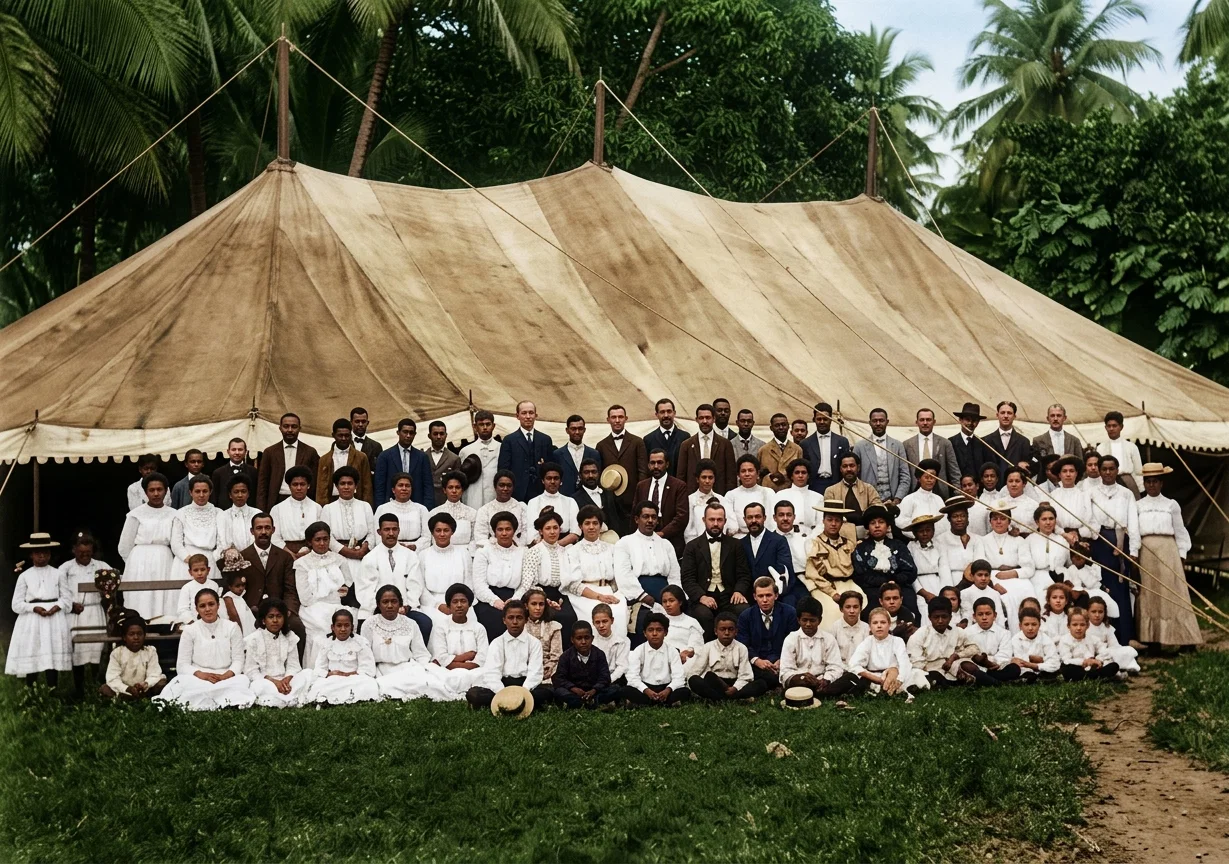
A GROUP OF BELIEVERS AT THE FIRST CAMP-MEETING IN THE CENTRAL AMERICAN CONFERENCE, HELD AT COXEN HOLE, RUATAN, BAY ISLANDS
The Lord gives us fresh cause to praise him each day. He has moved upon the heart of a noted American dentist to come here from Trinidad, and operate on, and treat without charge, an ulcer of long standing. There being no one in Grenada with whom we could trust the case, we wrote to this man, who had, on our coming to the West Indies, rendered us the treatment needed at that time. On receiving this letter, he came immediately to the hotel here, and wrote for us to call at once. He bought a nurse, and engaged a surgeon to assist him. But the case proved not so serious as he had feared. We stayed a week, and he treated the ulcer every day. He said it ought to be watched daily for a month, before he could assure us it was entirely well. However, he thinks it is all right now. We know the Lord helped. This man claims to be an infidel, but he is very kind-hearted. His parents were Adventists. The wonderful part of it all to us is, he would take no pay for his services, although he was at large expense in coming to us. The Lord knew that our means had all been put into his cause; so when we needed help, he moved upon the heart of this man to deal thus with us.
We read with deepest interest of the progress of the work in other parts of the field, and we pray for the work and its workers. And we mean, by the help of the Lord, to have the work finished here by the time it is completed elsewhere.
The Kimberley (S. A.) Baths
By J. V. WILLSON
J. V. WILLSON
It is about one year since the work at the Baths has been reported for the REVIEW. This has been a prosperous year for the institution, although the last half of the year was marked by serious financial reverses in Kimberley. The principal business in the town is the diamond industry. Up to the middle of 1907, this business has been one of the most flourishing and remunerative in the world. There are five main diamond mines, employing many thousand people, and supporting nearly the whole population of Kimberley.
About the middle of the year, owing to competition from the famous Premier diamond mine near Pretoria, Transvaal, and also owing to the great financial depression in the United States, where about two thirds of the diamond output has been purchased, the diamond industry suffered a severe depression, which has caused the discharge of a large portion of the men employed, thus seriously affecting all branches of business in Kimberley. This caused a falling off in the receipts at the Baths; but notwithstanding this drawback, the institution showed a financial gain of $1,194.61 for the year. The outlook for the coming year is not so encouraging, financially.
The development of our medical work has been encouraging. The leading physicians of the city have continued to send us patients suffering from various maladies, and the results of the treatments given have been satisfactory. The influence of the Baths has gone out for hundreds of miles, and patients have been sent here by physicians over six hundred miles distant. We are confident that the medical missionary work is a great help in reaching the people with the truth.
There has been a large sale of health foods. They keep well in this climate, and are well liked by the people. The people seem ready to read our literature. We distribute a large amount from our reading rack in our waiting-room. We need more help here. The city and country ought to be canvassed for our health magazine and other health publications. This literature would enlighten the people in regard to the right methods of treating disease, and then there would be a greater call for our treatments.
I feel a great interest in the medical missionary work in this country. The people are in great need. Thousands are destroyed every year by alcoholic drinks and the use of tobacco and other soul-and-body-destroying vices. Who is there to go out into the different cities and towns to carry our literature, and labor for the people, and teach them how to glorify God in their bodies as well as in their spirits? The gospel of health is needed to go hand in hand with the other truths of the third angel's message.
We are of good courage in the work, and hope to press the battle to the gates, and be found in active service when the Lord comes.
Mt. Vernon (Ohio) Canvassers' Institute
By Morris Lukens
It was the privilege of the writer to attend the institute at Mt. Vernon, Ohio, April 27 to May 6, held in connection with the school. About thirty consecrated young men and women were in attendance. With their hearts filled with the love of Christ, and for those for whom he died, they will enter the work.
Five classes were held daily in the study of the following books: “Daniel and Revelation,” “Great Controversy,” “Home and Health,” “Coming King,” and “Heralds of the Morning.” Instruction was given by E. R. Numbers, State agent of Ohio, and C. J. Foote, State agent of West Virginia. Elder E. R. Palmer, of Washington, who was there a part of the time, rendered valuable assistance, which was greatly appreciated.
The faculty united with us in doing all they could to make the institute a success. The presence of God was manifest in all the meetings. Especially was this true on Sunday night. After a discourse on the subject of faith, the Spirit of the Lord came in, and about twenty young people, students of the school, gave their hearts to the Saviour.
Some of those attending the institute will canvass in other conferences; but as most of the students are from Ohio, that conference will receive the greatest benefit.
A part of Tuesday and Wednesday were spent in the field canvassing. Thus all in attendance had practical experience. We shall be glad to have you remember these faithful workers in your prayers. MORRIS LUKENS.
Bermuda
By J. A. MORROW
HAMILTON.—Bermuda has had a very good opportunity to hear the message. About fifteen years ago, J. F. Pogue and his brother canvassed the islands for “Bible Readings,” and sold a large number. It is very common to find these books in the homes of the people. Later, the islands were canvassed for “Great Controversy,” and more than one hundred were sold. Since coming here, with the aid of a native brother I have canvassed the island thoroughly for “Coming King.” I think about four hundred were sold. I have canvassed and recanvassed the larger part of the island for other books and papers. The last was the special missionary number of the Signs, of which we sold one hundred copies. The first three years I sold nearly fifteen hundred dollars’ worth of books of all kinds.
Series of meetings have been held in the following places: Paget, three miles west of Hamilton; Hamilton; North Shore; Crawl, seven miles east of Hamilton; Herrington Sound, seven miles southeast; Flats, four miles east; Port Royal, eight miles west; Somerset, twelve miles west; Davonshire, three miles southeast. Besides this, I have held Bible readings with many interested families. There have never been any public meetings held in St. George, a village at the extreme east end of the island. It is my intention to put forth an effort there in the near future. I inquired last week concerning the rent of a schoolroom that I think would be suitable for holding meetings. The teacher promised to give me an answer this week as to whether she will rent it.
We have only one church organization. The members are scattered all over the island. There are only three places where regular second-Sabbath meetings are held at present,—Hamilton, Crawl, and Herrington Sound.
J. A. MORROW.
Alabama
By A. J. HAYSMER.
ONLY a few workers have been in the field during the winter and spring, and not so much has been accomplished as we desired to see. During the winter we held several general meetings. Efforts were made to revive the old-time missionary zeal, and we were encouraged to see the interest manifested. At our last conference Brother R. I. Keate was chosen as our general canvassing agent. He has taken hold of the work with earnestness. Two profitable institutes have been held and we hope to have a score of faithful canvassers in the field this summer. Very few of the sixty-seven counties of Alabama have been canvassed; so the present number of agents will by no means cover the territory. If there are any of our people who have a burden to come South and help us finish this work, and who would like to engage in the selling of our good literature, I should be glad to correspond with them. I am satisfied that the success of the work in Alabama depends largely upon our faithful canvassers and colporteurs.
In the large cities our papers and journals sell well. We will give a club of the Watchman to a family in each city who will come and spend their time in this work. I am sure that in this way a good living could be made, and at the same time these cities be warned of the soon-coming destruction. Who will respond.
We are now getting our tent companies started. Elder W. S. Cruzan and Brother Hugh Jones are pitching a tent at Pensacola; Elder E. W. Webster and Brother Iles, at Birmingham; and early in June, Elder T. B. Buckner and Brother Lawrence will pitch one at Selma. They are in great need of a folding organ for the work among the colored people. Is there not some one who would like to furnish an organ for this work? If so I should be glad to hear from such.
We were made to rejoice to learn of the interest manifested by our loyal conferences in the North in providing several tents and tent companies for the needy States in the Southern field. I believe the Lord will greatly bless such efforts to finish this work. Alabama no doubt will get one of these. We shall surely be glad to receive such a company, and promise to do all in our power to make their stay pleasant and their efforts successful. There are several places we desire to enter at once, but are not able to. We earnestly desire the prayers of our people that we may have wisdom so to conduct the work here, that the greatest amount of good can be accomplished in the shortest possible time.
A. J. HAYSMER.
Wisconsin
By W. W. Stebbins
“So we built the wall: . . . for the people had a mind to work.” Neh. 4:6. I am glad that the Lord still gives me a work with his people. Fifty-three years ago I accepted the message under the labors of Elders J. N. Loughborough and Ingraham. At that time the REVIEW began coming to our home. The message grows more precious to me. I love God's people, and I never enjoyed the work more than the past winter.
April 10 I joined Elder S. T. Shadel at Iron River, Wis., to assist him in binding off the work, which he and Brother P. M. Hanson had done during the winter. Nine precious souls were baptized in Moon Lake, and a church of twelve members was organized, with a leader, treasurer, librarian, and clerk. April 27 I came to Superior, Wis., where two of our Bible workers have been doing faithful service. We held fifteen meetings, and gave twelve discourses, while with this church, closing May 5. The Bible workers rejoiced to see the fruit of their labor develop. Four willing souls were baptized and united with the church at this place. I am sure they will grow strong as burden-bearers in the church. Others are greatly interested, and will, we trust, soon take their stand for the message.
The ordinances were celebrated, and the church was greatly blessed and encouraged.
I thank God for the widely extended victories of the message over the earth. When it moved westward in an early17day, crossed the Mississippi River, and pressed onward to the Pacific Coast, our hearts leaped with joy; but now its trumpet tones are heard the world around. Brethren, let us praise the Lord, and fill the treasure-box of the Foreign Mission Board till they say, “It is enough.”
W. W. STEBBINS.
Portugal
By E. Schwantes
OPORTO.—Soon after the return of my wife and daughter last year to Brazil, I joined Elder C. E. Rentfro in Lisbon, and labored about six weeks there.
From January on I have begun again to hold lectures in Oporto. My meeting hall, which seats only from eighty to one hundred persons, became too small. I have just purchased twenty more chairs, and yet on Sunday quite a number of persons were unable to find seats. I hope that among the number who are hearing, some may receive the word of salvation. The people have shown much interest.
As I had no one to help with the music, Brother Rentfro has joined me for some weeks, playing the organ and leading in the singing. As the song service has been conducted with open windows, many people have gathered around the house to listen. I regret that I shall have no one to help in the music when Brother Rentfro must again return to Lisbon.
We have here one able brother who for nearly a year has been diligently studying the truth through the few books we have in Portuguese, and also through our French literature. We hope he will become a worker.