It was the year 1555, when Queen Mary sat upon the English throne with her Spanish husband at her side, and filled the land with trouble because of her terrible persecution of the Protestants.
In the west of England was a little village called Harrant. At one end of the hamlet, standing apart from the few dwellings scattered along either side of its single street, was the blacksmith’s shop, with his small house just back of it, and a tiny garden in the rear.
The smith’s wife was dead, but his bonny, blue-eyed little daughter kept his house. When lonely, she pushed aside a small panel in the end of the shop, and crept in and stayed with him, unless the sound of voices or hoof-beats on the road drove her away; for she was a shy little thing.
One day when she had stolen in, her father was standing behind the door. He had a sliver in his big hand, with which he touched the side of the great black beam in the corner. Suddenly a block of wood fell forward, disclosing a small opening. Into this he thrust a dark leather-bound book, and quickly but carefully fitted the chip into its place, so that no sign of the hidden space remained.
Seeing his daughter, he started, and said, sternly, “Ailsie, child! how dare you spy upon your father?”
“O father! I am not spying!” and the blue eyes filled with tears.
“Of course you were not. I was wrong to say so,” said the smith, remorsefully. “But you saw what I did?”
“You put the Holy Book into the beam, father. It is a fine hiding-place, too; for surely neither priest nor soldier can find it there.”
“I would you knew not its place of concealment; for the knowledge may bring you into danger, lass. You must never betray it. When Parson Stow went away to foreign lands, he gave me the Sacred Word, and told me to keep it as my very life; for by the queen’s orders all the Bibles have been gathered up and burned, and we are forbidden to read from its holy pages. This is the only one between here and the sea, and it is more precious than the crown jewels. You are fifteen, Ailsie, and old enough to understand; so I have told you all.”
“You need not fear, father,” said Ailsie, firmly; “I will not tell.” But the rosy cheeks grew pale as she remembered all that her promise might mean.
Now there was a certain priest that came sometimes to Harrant to preach to the villagers; but, being all Protestants, they would neither listen to him nor pay him tithes. He was very angry at their behavior, and spied about until he became sure there was a Bible among them; and he knew it was in the blacksmith’s possession, because he was the only man in the village who could read.
After trying in vain to find the book, he went to the nearest town, and lodged information against the village with officers there; and one day, when the smith chanced to be away from home, an officer and six men marched into Harrant.
They called upon the cottagers to surrender their Bibles, but one and all declared they had none. Then the soldiers searched every dwelling, and threatened to burn them every one, unless the book was found.
GIVE US A NAME AND COUNTRY
But that did not suit the priest at all. He would get fewer tithes than ever if the village was destroyed. So he told the soldiers to let the rest of the villagers alone, for the Bible was in the blacksmith’s possession. It was getting late, and the soldiers were in a great hurry to be gone; so they resolved to burn the two little buildings, and thus destroy the book quickly and surely.
At the first sight of the strange men, Ailsie had fled through the garden, out upon the moor, and hidden among the furze bushes. She was terrified; for she feared that they might find her, and demand the hidden place of the precious Bible.
It was growing dark when she saw a bright light against the sky, and sprang to her feet. Her father’s house was on fire! The sight made the shy child a heroine. Forgetting all about her danger, she only remembered that she must save the Bible at any cost.
Swift as an arrow, she flew homeward. The soldiers were intent upon piling straw round the burning buildings, and did not see the little figure that darted in between the house and shop, whose thatched roofs were all ablaze. Breathless and determined, she pushed aside the panel, and stumbled through the blinding smoke.
The hungry flames scorched her dress and hair, and burned and blistered her hands and face before she secured what she sought. But at last she reached the Bible, and fled out into the open air.
No one had noticed her, and she crept safely into the little garden, and sank down, choked and suffering, among the vines.
But she felt that the Bible was in danger even now. She slipped off her woolen petticoat, and wrapped it round the volume; then digging with her little burned hands in the soft soil, she buried it under an immense cabbage. Then she crawled upon her hands and knees to the spring at the foot of the garden, where her father found her an hour later, half unconscious with pain and fright. As long as he lived, he never ceased to praise his little daughter for her brave deed that day.
The Bible always remained in the family; and years and years afterward, Ailsie’s great-grand-daughter carried it with her when she followed her Puritan husband across the sea to the lonely coast of New England.—Mary S. Hitchcock, in Morning Star.
FACTS ABOUT EGGS
By W. S. Chapman
Eggs of owls and turtles are nearly round; of ducks, crocodiles, and snakes, oval; of sea-fowl, pear-shaped. Frogs' eggs are laid in masses, and resemble pearl tapioca; they are surrounded with a tough, albuminous substance, which becomes a jelly in water. Toads' eggs are strung together like beads. The white ant is the most prolific layer among insects, depositing eggs at the rate of sixty a minute, or over eighty thousand daily for two years; so that a single ant lays fifty millions of eggs. The spawn of a single oyster numbers one million eight hundred thousand. A fish, the roach, has been opened, and found to contain over four hundred and eighty thousand eggs; a herring, nineteen thousand eight hundred; a turbot, three hundred and eighty-five thousand; a cod, four million, eight hundred and seventy-two thousand. An ostrich's egg will outweigh three dozen eggs from barnyard fowl. In Africa the shells of these eggs are sometimes used for drinking cups.
W. S. CHAPMAN.
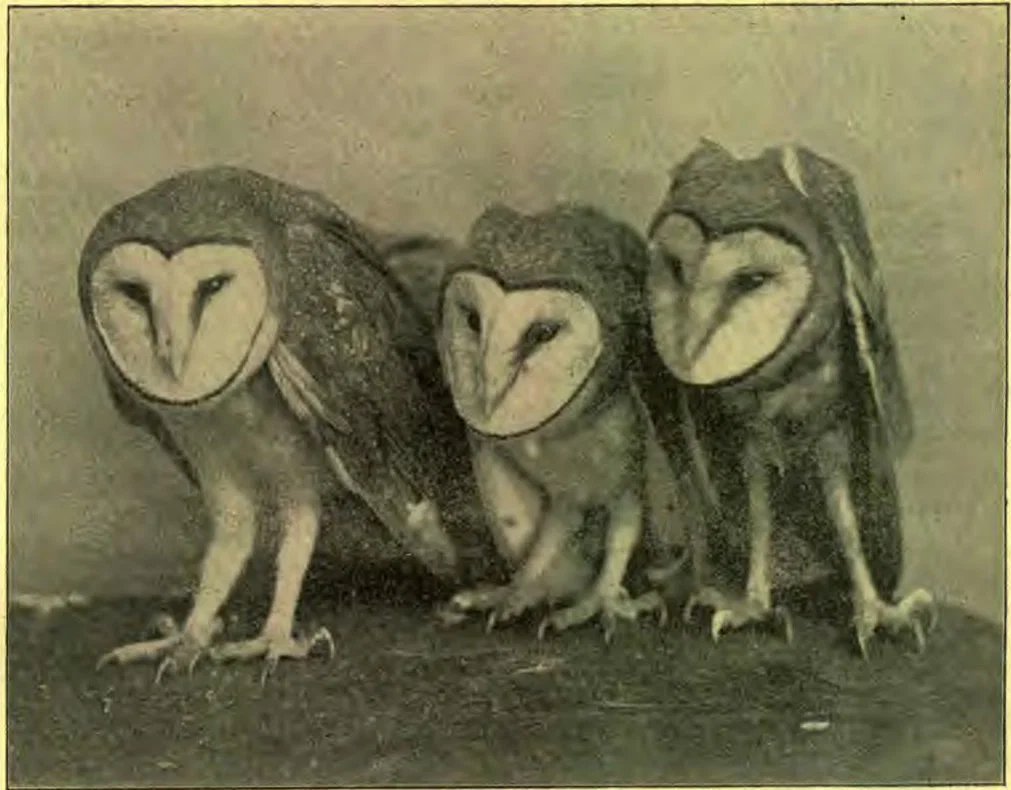
LOST! A NAME
By Elizabeth Rosser
Well, may we three look solemn,
For we have lost our name!
Nobody seems to know us,
Or the country whence we came.
Pray, is our plumage somber,
Or gay with red and gold?
And what may be our habits?
And are we young or old?
Oh, won’t somebody tell us,
And set our minds at ease?
Give us a name and country;
And now—don’t all speak, please!
ELIZABETH ROSSER.
Identify the Odd-Looking Animals in the Picture
By Editor
¹Who can name and accurately describe the odd-looking animals shown in the picture? Their photograph, and a description of them, was sent to the editor of one of our foreign papers; but while the cut was being made, the description was mislaid, and has never been found. Perhaps some one in the big family of INSTRUCTOR readers can answer the questions that Mrs. Rosser makes the solemn-faced creatures ask.—EDITOR.
A Little Child's Loving Heart and Kind Deeds
A little child may have a loving heart,
Most dear and sweet,
And willing feet.
A little child may have a happy hand,
Full of kind deeds,
For others’ needs.
A little child may have a gentle voice,
And pleasant tongue,
For every one.
—Selected.
NOVEMBER STUDY OF THE FIELD
By Editor
(November 4-10, 1900)*
The Study for This Month.—The following articles in the November number of the Missionary Magazine are named for special study: “Buddhism in China;” “In the Country of Russia;” “Landmarks in Argentine History;” “Among Our Churches in Argentine.” Inasmuch as later studies will be devoted to Russia and Argentine, and this is the closing one of the series on the religions of China, we have devoted our entire space for notes this week to a further glance at Buddhism.
Importance of Such a Study.—There are two facts that make the study of the religions of China of prime importance. One is the vastness of the population—over four hundred and two millions, or about one fourth of the inhabitants of the globe. The other is the length of time that these religions have been in existence—Buddhism, almost one thousand nine hundred years; Taoism, two thousand five hundred years; and Confucianism, four thousand years. The hosts who have gone down into Christless graves during these centuries, under the baneful influence of these false religions, are beyond comprehension. The field of action has been an empire where literature has been progressive, and the arts have flourished; under a government that has seen Babylon fall, Nineveh destroyed, and Greece and Rome crumble into dust. Surely if man by searching could find out God, this land of Sinim would have found him ages long since passed away.
The Missionary Spirit of Buddhism.—For two centuries Buddhism made little progress; but after the invasion of India by Alexander the Great, the new faith was patronized. King Ashoka, the Constantine of the Buddhist Church, 250 B. C., established the first “Board of Foreign Missions” (Dharma Mahamatra). This organization sent forth enthusiastic preachers, who, “aided by Dashoka’s political and diplomatic influence,” went clad in rags and with the alms-bowl in hand, to all the surrounding countries. The king set an example by sending his son as a missionary to Ceylon, and forthwith the whole island accepted the faith. “Thenceforth every caravan of traders that left India for Central Asia was accompanied by Buddhist missionaries.” There was no mountain too high, no plain too broad, no desert too barren, for these indefatigable zealots. They went everywhere, teaching the doctrines of Buddha. At this early day eighteen Buddhist monks reached China, but failed to plant their religion there.
Introduction into China.—The sacred books of the Buddhist religion all agree that the emperor Mingte (A. D. 61), in a vision of the night, beheld “an image of gigantic proportions, resplendent as gold,” and that he dispatched an embassy to go westward in search of this new religion. Whether this is true, or whether it was because in the campaigns of Central Asia the armies brought an image of Buddha, or whether reports had come that a mighty personage had appeared in Judea, we do not know; but, it is said, the embassy returned, accompanied by an Indian priest, and bringing “the Sutra of forty-two sections.” Buddhism, thus invited by the emperor made an easy entrance into this country.
Contact with Christianity.—The Christian religion has had its influence upon Buddhism. Many of the incidents relating to the early life of Buddha are strikingly similar to the gospel narratives. An examination of the most ancient Buddhistic books, however, reveals scarcely any details of Buddha’s life, and none whatever of the special events which seem to tally with those in the life of Christ. None of these legends had been introduced into their books before the fifth and sixth centuries of our era. Before this time the Nestorians had reached Central Asia, and “true to its eclectic instincts, Buddhism adopted many Christian ideas, traditions, and ceremonies.” The resemblance is especially seen in the Buddhism of Tibet, where, among other beliefs, the adherents of this faith look forward to “the coming One.” The missionary who gains the ear of the Tibetans can, like Paul, from their own doctrines preach the true God.
Buddha’s Doctrine of Women.—“A woman’s body has many evil things in it; at birth her parents are not happy; rearing her is ‘without taste;’ her heart fears men; she must rise early, work late, and be very busy; she can never eat before others; her father and mother begrudge the money to be spent on her wedding; she must leave father and mother; she fears her husband; if he curses her, she is not permitted to get angry; in youth father and mother rule; in middle life, her husband; in old age she is at the beck and call of her grandchildren.”
Worshipers Women.—In every land, religion takes a deeper hold on the hearts of women than of men, who in the busy marts are subjected to the temptations of the great world without. This is especially true of the women of China, three fourths of the worshipers being of the gentler sex. Probably seven eighths of the three or four hundred million dollars spent annually in idolatry is contributed by toiling women, who scarcely have money to purchase coarse food.
Conclusion.—Does not this dark picture appeal to every young heart who knows the love of God? Shall not the eternal interests of one fourth of our race stir up the deepest sympathies of our natures, and cause us to give our lives to the work of carrying the glad news of salvation and of the coming King to those who sit in darkness and the shadow of death?
THE LAST HOUR
By Clara Thwaites
The sunset burns across the sky;
Upon the air its warning cry
The curfew tolls from tower to tower:
O children! 'tis the last, last hour.
The work that centuries might have done
Must crown the hour of setting sun.
And through all lands the saving Name
Ye must in fervent haste proclaim.
Ere yet the vintage shouts begin,
O laborers! press in, press in,
And fill unto its utmost coasts
The vineyard of the Lord of hosts!
It is a vineyard of red wine,
Wherein shall purple clusters shine.
The branches of his own right hand
Shall overspread Immanuel's land.
The fields are white to harvest. Weep,
O tardy workers! as ye reap,
For wasted hours, that might have won
Rich harvests at the set of sun.
We hear his footsteps on the way:
Oh, work, while it is called to-day,
Constrained by love, endued with power,
O children! in this last, last hour.
—Clara Thwaites.
The Bible Text-Book
By O. A. Johnson
By Elder O. A. Johnson, Instructor in Bible and History at Union College,
Is a Compendium of Bible Subjects, bound in a neat and attractive form, and easy to carry in the vest or coat pocket.
The book contains forty-nine tersely written Bible readings on as many different subjects. There are five charts explaining difficult Scripture subjects, such as the “Weekly and Yearly Sabbath,” the “Two Laws,” “The Week,” “The Seven Seals,” “The Seven Plagues,” and the “Millennium.”
Every minister, Bible worker, and church-member should procure a copy at once. All should unite to give this book a wide circulation.
It contains 208 pages, table of contents, and general index of subjects; is bound in two styles of binding.
Price in Cloth, 30 cents.
Price in Leather, 50 cents.
WHAT OTHERS SAY OF THE “BIBLE TEXT-BOOK.”
“The Bible Text-Book” is indeed a work of rare merit.
ELDER S. H. LANE.
BALTIMORE, MD.
REVIEW AND HERALD: I have taken pains to examine “Bible Text-Book,” and find it an up-to-date book. The readings are the most practical that I have seen in any book of Bible readings. It is a book that will have liberal sale in this Conference.
CHAS. D. ZIRKLE.
OAKLAND, CAL.
REVIEW AND HERALD PUB. CO.: Bible students will find the new work, “Bible Text-Book,” a great help to them in the study of the vital topics of the word of God. Although small in size, the work covers an extensive scope of Bible subjects, and develops Present Truth in a convincing manner.
ELDER W. T. KNOX.
NEW YORK CITY.
REVIEW AND HERALD PUB. CO.: As a suggestive text-book for ministers, Bible workers, and Bible students, we know of none superior to “Bible Text-Book,” by O. A. Johnson. It covers a series of topics embracing nearly every doctrinal subject of the word of God, as well as many practical lessons. It will be a great help to those who are either teaching or making a special investigation of Bible questions. Every seeker after truth should own one.
ELDER I. H. EVANS.
Place your order with your tract society, or with the—
REVIEW AND HERALD PUB. CO.,
Battle Creek, Mich.,
Or PACIFIC PRESS PUB. CO., Oakland, Cal.
A NEW SUBSCRIPTION BOOK
ENTITLED
Easy Steps in the Bible Story
From Creation to Sinai
By ADELAIDE BEE COOPER
Editor of the Youth’s Instructor
Introduction by
ELDER S. N. HASKELL
THE EARLY BIBLE STORIES never lose their beauty, freshness, and charm. They bring new inspiration to those advanced in years, and are read with pleasure and eager delight by youth and children.
The principles revealed in the lives of the early Bible characters will, if instilled into the minds of the young, make an indelible impression for good, that neither time nor later associations can erase. Mothers, read them for your children.
In this book the author retains the beauty, simplicity, and sweet expression of the Bible narrative, and gives a clear, vivid description of the six days of creation; the planting of the garden of Eden, the beautiful home of the first man and woman; their disobedience, and its result. The following outline shows the order in which a few of the many important subjects considered in this volume are taken up: Noah is told of the flood; the building of the ark; the tower of Babel; Abraham, the “Friend of God;” Lot leaves Sodom; Isaac and Rebecca; Jacob and Esau; Jacob at Haran; the story of Joseph (this should be read by every fireside; he was truthful, obedient, noble, spirited, and dared to do right); the children of Israel in Egypt; Moses at the court of Pharaoh, and as leader of Israel; the plagues; the Passover; the firstborn slain; Israel released; crossing the Red Sea; in the wilderness; the giving of the manna; water from the rock; the visit of Jethro; and the ten commandments spoken at Sinai.
The book contains 160 pages, table of contents, and list of illustrations. Our artist has prepared 150 beautiful pen-drawings illustrating the text of the book. It also contains many full-page illustrations. Beautiful cover design. Two styles of binding.
PRICE, IN CLOTH, 50 CENTS
PRICE, IN PAPER, 25 CENTS
The price brings the book within the reach of all. Now ready for delivery. Agents wanted. Send for printed canvass.
At the beginning of this lesson a few review questions are given on the verses immediately preceding the present lesson text. If previous lessons have been well prepared, you will have no difficulty in answering these questions without the references. Review the chapter carefully before beginning the study of the questions and notes. See how much you can get out of the text for yourself before seeking the aid the questions and notes are designed to give.
QUESTIONS
1. What is the relation of the law to the promises? How do we obtain righteousness? Why not by the law? When we are counted righteous by faith, what does the law do?
2. What is the relation of the law to sin? Why does the law shut up all under sin? What is the condition of all before faith comes?
3. What is the law likened to before we come to Christ? What does it do? For what purpose? V. 24; note 1.
4. How do we become free from the law? V. 25. In what sense are we then not under the law? Note 2.
5. Whose children do we become? How? V. 26; note 3.
6. Who have put on Christ? How have they been baptized? V. 27. What must first be put off? Eph. 4: 22. What is it to put on Christ? Vs. 23, 24; note 4.
7. What distinctions are done away in Christ? What is our relation to one another in Christ? V. 28; note 5.
8. Who are Abraham’s seed? What blessing does this secure to them? V. 29.
NOTES
1. The law, as our pedagogue, or guardian, will not let us run away and play truant. But it holds us fast, and by the whippings of conscience it drives us to Christ, the great Teacher. And from him we learn how we may become free from the curse of the law, by being justified by faith in him. None would realize their need of a Saviour if it were not for the threatenings and scourgings of the broken law.
2. The boy who was brought to school by the pedagogue came under the control of the teacher during the day. So we come to Christ, and learn the ways of righteousness by faith. Then the law has no charge to make against us, and we are free from its condemnation. But at the close of the day the boy was again taken in charge by the pedagogue, and hurried back home. How often we, by our perverseness, leave the school of Christ, and so come again under the law. Christ says, “Abide in me.” If we do this, we shall be free indeed.
3. Christ does not simply become our Teacher for a time each day; he adopts us into his family, makes us his own children. Thus we come under his instruction all the time. He invites us to attend his school. “Learn of me,” he says.
4. Baptism is the sign of the washing of regeneration and of death to sin. Abraham was counted righteous by faith; and then “he received the sign of circumcision, a seal of the righteousness of the faith which he had yet being uncircumcised.” Rom. 4: 11. So baptism is the outward sign of the inner work of grace that has been wrought in response to our faith.
5. “We are all one in Christ.” This truth of the brotherhood of mankind is one of the grandest and most precious truths of revelation. It has ever been the work of the enemy to separate men into cliques and casts, based upon differences of race, nationality, sex, and social condition. All false religions recognize and encourage or enforce these distinctions. Christianity elevates mankind to a common brotherhood, and unites all hearts by the bonds of love.
THE BEST THINGS
By Ida Reed Smith
We strive for power and fame and gold,
Our toil with sorrow fraught;
But life's best gifts,— work, hope, and love,—
These come to each unsought.
—Ida Reed Smith.
THE HOUSE WE LIVE IN,
By Vesta J. Farnsworth
By Vesta J. Farnsworth.
This book tells how the human body is made, by comparing its parts to the different parts of a house. It also tells how to care for the body. In doing so, many other interesting things are told in a pleasing way. It is printed in large, clear type, with many instructive pictures. It contains 218 pages, and is nicely bound in cloth, with a house scene on the front cover. Price, 75 cents.
We offer the Youth’s Instructor for one year and this beautiful book, postpaid, for $1.15; or, we will send the book, postpaid, for five new subscriptions at 75 cents each. Address—
The Youth’s Instructor,
Battle Creek, Mich.
Destroy the Germs; Cure the Disease!
By E. J. Worst
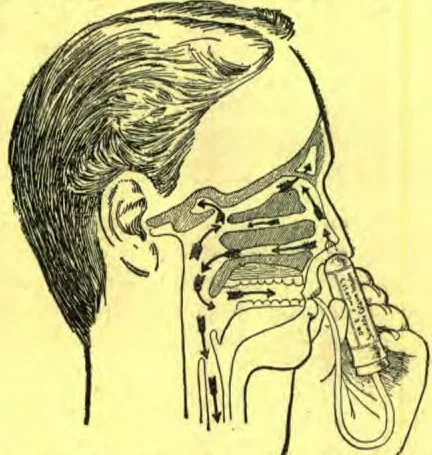
The above illustration shows how the E. J. Worst Scientific Catarrh Inhaler sends the medicated air into every air passage of the head. Nothing but air can penetrate these fine air cells and reach the homes of the living germs that cause disease.
No snuff, powders, douche or spray can possibly reach them. Don't be deceived—make no mistake—apply common sense, and you will find that
E. J. Worst's Catarrh Inhaler
is the only instrument that will give you quick return for a small outlay, and perfect satisfaction as a Cure for Catarrh, Colds, Pains and Roaring in the Head, Bronchitis, Sore Throat, Headache, Partial Deafness, and all Diseases of the Air Passages.
SPECIAL OFFER.
For a short time I will mail to any reader, naming this paper, one of my new Scientific Catarrh Inhalers, with medicine for one year on three days' trial, free. If it gives satisfaction, send me $1.00; if not, return it after three days' trial. Could any proposition be fairer?
E. J. WORST, 421 Main Street, ASHLAND, O.
Not Sold by Druggists. AGENTS WANTED.
CHICAGO & GRAND TRUNK R'Y
E. W. Meddaugh and Henry B. Joy, Receivers.
CHICAGO & GRAND TRUNK R'Y.
Trains leave Battle Creek.
WEST-BOUND FROM BATTLE CREEK.
No. 9, Mail and Express, to Chicago 12.15 P. M.
No. 1, Chicago Express, to Chicago 8.30 A. M.
No. 3, Lehigh Valley Express, to Chicago 3.50 P. M.
No. 5, International Express 2.15 A. M.
No. 75, Mixed, to South Bend 8.30 A. M.
Nos. 9 and 75, daily, except Sunday.
Nos. 1, 3, and 5, daily.
EAST-BOUND FROM BATTLE CREEK.
No. 8, Mail and Express, East and Detroit 3.45 P. M.
No. 4, Lehigh Express, East and Canada 8.27 P. M.
No. 6, Atlantic Express, East and Detroit 2.25 A. M.
No. 2, Express, East and Detroit 6.50 A. M.
No. 74, Mixed (starts from Nichols) 7.15 A. M.
Nos. 8 and 74, daily, except Sunday.
Nos. 4, 6, and 2, daily.
W. C. CUNLIFFE, Agent,
G. W. VAUX, BATTLE CREEK.
G. P. A., CHICAGO.
Pen Drawing for Reproduction: First Article in Series
By Editor
We take pleasure in printing this week the first number of a series of articles on Pen Drawing for Reproduction, by Pedro Lemos, whose series on Drawing from Nature will be remembered by all interested in this subject.
SMOKE from a volcanic eruption in Hawaii has been observed to travel six hundred miles out over the ocean, and then, the wind changing, to turn, and drift back to its starting-place. So may a thoughtless, unkind, or cruel word travel far, darkening many an otherwise bright sky in its journey, and finally return to shut out the sunlight from the heart of the one who first uttered it. The best place for unkind words is behind the door of the mouth: there, at least, they do less harm than anywhere else. There is, of course, a yet better way—to have a heart so in accord with the great heart of Love that there will be in it no room for unkind thoughts, clamoring for expression.