The Youth’s Instructor, Vol. 50, No. 45.

Their Word of Honor

The Youth’s Instructor

Nov 13, 1902

Review and Herald Publishing Company · Battle Creek, Michigan · Nov 13, 1902

Their Word of Honor

THE president of the Great B. railway system laid down the letter he had just reread three times, and turned about in his chair with an expression of extreme annoyance.
“I wish it were possible,” he said, slowly, “to find one boy or man in a thousand who would receive instructions and carry them out to the letter without a single variation from the course laid down. Cornelius,—” he looked up sharply at his son, who sat at a desk close by,—“I hope you are carrying out my ideas with regard to your sons. I’ve not seen much of them lately. The lad Cyrus seems to me a promising fellow, but I’m not so sure of Cornelius. He appears to be acquiring a sense of his own importance as Cornelius Woodbridge 3d, which is not desirable, sir—not desirable. By the way, Cornelius, have you yet applied the Hezekiah Woodbridge test to your boys?”
Cornelius Woodbridge, junior, looked up from his work with a smile. “No, I haven’t, father,” he said.
“It’s a family tradition; and if the proper care has been taken that the boys should not learn of it, it will be as much a test for them as it was for you and for me, and for my father. You have not forgotten the day I gave it to you, Cornelius?”
“That would be impossible,” said his son, still smiling.
The elder man’s somewhat stern features relaxed, and he sat back in his chair with a chuckle. “Do it at once,” he requested, “and make it a stiff one. You know their characteristics; give it to them hard. I feel pretty sure of Cyrus, but Cornelius—” He shook his head doubtfully, and returned to his letter. Suddenly he wheeled about again.
“Do it Thursday, Cornelius,” he said, in his peremptory way, “and whichever one of them stands it shall go with us on the tour of inspection. That will be reward enough, I fancy.”
“Very well, sir,” replied his son, and the two men went on with their work without further words. They were in the habit of dispatching important business with the smallest possible waste of breath.
On Thursday morning, immediately after breakfast, Cyrus Woodbridge found himself summoned to his father’s library. He presented himself at once, a round-cheeked, bright-eyed lad of fifteen, with an air of alertness in every line of him.
“Cyrus,” said his father, “I have a commission for you to undertake, of a character which I can not now explain to you. I want you to take this envelope,”—he held out a large and bulky packet,—“and without saying anything to any one, follow its instructions to the letter. I ask of you your word of honor that you will do so.”
The two pairs of eyes looked into each other for a moment, singularly alike in a certain intent expression, developed into great keenness in the man, but showing as yet only an extreme wide-awakeness in the boy. Cyrus Woodbridge had an engagement with a young friend in half an hour, but he responded, firmly:—
“I will, sir.”
“On your honor?”
“Yes, sir.”
“That is all I want. Go to your room, and read your instructions. Then start at once.”
Mr. Woodbridge turned back to his desk with the nod and smile of dismissal to which Cyrus was accustomed. The boy went to his room, opening the envelope as soon as he had closed the door. It was filled with smaller envelopes, numbered in regular order. Infolding these was a typewritten paper, which read as follows:—
“Go to the reading-room of the Westchester Library. There open Env. No. 1. Remember to hold all instructions secret. C. W., Jr.”
Cyrus whistled. “That’s funny! It means my date with Harold is off. Well, here goes!”
He stopped on his way out to telephone his friend of his detention, took a Westchester Avenue car at the nearest point, and in twenty minutes was at the library. He found an obscure corner and opened “Env. No. 1.”
“Go to office of W. K. Newton, Room 703, tenth floor, Norwalk Building, X Street, reaching there by 9:30 A. M. Ask for letter addressed to Cornelius Woodbridge, Jr. On way down elevator open Env. No. 2.”
Cyrus began to laugh. At the same time he felt a trifle irritated. “What’s father at?” he questioned, in perplexity. “Here I am away uptown, and he orders me back to the Norwalk Building. I passed it on my way up. Must be he made a mistake. Told me to obey instructions, though. He usually knows just about why he does things.”
Meanwhile Mr. Woodbridge had sent for his elder son, Cornelius. A tall youth of seventeen, with the strong family features, varied by a droop in the eyelids and a slight drawl in his speech, lounged to the door of the library. Before entering he straightened his shoulders; he did not, however, quicken his pace.
“Cornelius,” said his father, promptly, “I wish to send you upon an errand of some importance, but of possible inconvenience to you. I have not time to give you instructions, but you will find them in this envelope. I ask you to keep the matter and your movements strictly to yourself. May I have from you your word of honor that I can trust you to follow the orders to the smallest detail?”
Cornelius put on a pair of eyeglasses, and held out his hand for the envelope. His manner was almost indifferent. Mr. Woodbridge withheld the packet, and spoke with decision: “I can not allow you to look at the instructions until I have your word of honor that you will fulfill them.”
“Isn’t that asking a good deal, sir?”
“Perhaps so,” said Mr. Woodbridge, “but no more than is asked of trusted messengers every day. I will assure you that the instructions are mine and represent my wishes.”
“How long will it take?” inquired Cornelius, stooping to flick an imperceptible spot of dust from his trousers.
“I do not find it necessary to tell you.” Something in his father’s voice sent the languid Cornelius to an erect position, and quickened his speech.
“Of course I will go,” he said, but he did not speak with enthusiasm.
“And—your word of honor?”
“Certainly, sir.” The hesitation before the promise was only momentary.
“Very well. I will trust you. Go to your room before opening your instructions.”
And the second somewhat mystified boy went out of the library on that memorable Thursday morning, to find his first order one which sent him to a remote district of the city, with the direction to arrive there within three quarters of an hour.
Out on an electric car Cyrus was speeding to another suburb. After getting the letter from the tenth floor of the Norwalk Building, he had read:—
“Take cross-town car on L Street, transfer to Louisville Avenue, and go out to Kingston Heights. Find corner West and Dwight Streets, and open Env. No. 3.”
Cyrus was growing more and more puzzled, but he was also getting interested. At the corner specified he hurriedly tore open No. 3, but found, to his amazement, only the singular direction:—
“Take Suburban Underground Road for Duane Street Station. From there go to Sentinel office, and secure third edition of yesterday’s paper. Open Env. No. 4.”
“Well, what under the sun, moon, and stars did he send me out to Kingston Heights for?” cried Cyrus, aloud. He caught the next train, thinking longingly of his broken engagement with Harold Dunning, and of certain plans for the afternoon which he was beginning to fear might be thwarted if this seemingly endless and aimless excursion continued. He looked at the packet of unopened envelopes.
“It would be easy to break open the whole outfit, and see what this game is,” he thought. “Never knew father to do a thing like this before. If it’s a joke”—his fingers felt the seal of “Env. No. 4”—“I might as well find it out at once. Still, father never would joke with a fellow’s promise the way he asked it of me. ‘My word of honor’—that’s putting it pretty strong. I’ll see it through, of course. My, but I’m getting hungry! It must be near luncheon-time.”
It was not; but by the time Cyrus had been ordered twice across the city and once up a sixteen-story building in which the elevator service was out of order, it was past noon, and he was in a condition to find “Env. No. 7” a very satisfactory one:—
“Go to Café Reynaud on Westchester Square. Take seat at table in left alcove. Ask waiter for card of Cornelius Woodbridge, Jr. Before ordering luncheon read Env. No. 8.”
The boy lost no time in obeying this command, and sank into his chair in the designated alcove with a sigh of relief. He mopped his brow, and drank a glass of ice-water at a gulp. It was a warm October day, and the sixteen flights had been somewhat trying. He asked for his father’s card, and then sat studying the attractive menu.
“I think I’ll have”—he mused for a moment, then said, helplessly, with a laugh—“Well, I’m about hungry enough to eat the whole thing. Bring me the—”
Then he recollected, paused, and reluctantly pulled out “Env. No. 8,” and broke the seal. “Just a minute,” he murmured to the waiter. Then his face turned scarlet, and he stammered, under his breath, “Why—why—this can’t be—”
“Env. No. 8” ought to have been bordered with black, judging by the dismay its order to a lecture-hall to hear a famous electrician caused. But the Woodbridge blood was up now, and it was with an expression resembling that of his Grandfather Cornelius under strong indignation that Cyrus stalked out of that charming place to proceed grimly to the lecture-hall.
“Who wants to hear a lecture on an empty stomach?” he groaned. “I suppose I’ll be ordered out, anyway, the minute I sit down and stretch my legs. Wonder if father can be exactly right in his mind. He doesn’t believe in wasting time, but I’m wasting it to-day by the bucketful. Suppose he’s doing this to size me up some way; he isn’t going to tire me out so quick as he thinks. I’ll keep going till I drop.”
Nevertheless, when, just as he was getting interested, he was ordered to go three miles to a football field, and then ordered away again without a sight of the game he had planned for a week to see, his disgust was intense.
All through that long, warm afternoon he raced about the city and suburbs, growing wearier and more empty with every step. The worst of it was, the orders were beginning to assume the form of a schedule, and commanded that he be here at 3:15, and there at 4:05, and so on, which forbade loitering, had he been inclined to loiter. In it all he could see no purpose, except the possible one of trying his physical endurance. He was a strong boy, or he would have been quite exhausted long before he reached “Env. No. 17,” which was the last but three of the packet. This read:—
“Reach home at 6:20 P. M. Before entering house, read No. 18.”
Leaning against one of the big white stone pillars of the porch of his home, Cyrus wearily tore open No. 18—and the words fairly swam before his eyes. He had to rub them hard to make sure that he was not mistaken:—
“Go again to Kingston Heights, corner West and Dwight Streets, reaching there by 6:50. Read No. 19.”
The boy looked up at the windows, desperately angry at last. If his pride and his sense of the meaning of that phrase, “My word of honor,” as the men of the Woodbridge family were in the habit of teaching it to their sons, had not both been of the strongest sort, he would have rebelled, and gone defiantly and stormily in. As it was, he stood for one long minute with his hands clenched and his teeth set; then he turned and walked down the steps away from the longed-for dinner, and out toward L Street and the car for Kingston Heights.
As he did so, inside the house, on the other side of the curtains from behind which he had been anxiously peering, Cornelius Woodbridge, senior, turned about and struck his hands together, rubbing them in a satisfied way.
“He’s come—and gone,” he cried, softly, “and he’s on time to the minute!”
Cornelius, junior, did not so much as lift his eyes from the evening paper, as he quietly answered, “Is he?” But the corners of his mouth slightly relaxed.
The car seemed to crawl out to Kingston Heights. As it at last neared its terminus, a strong temptation seized the boy Cyrus. He had been on a purposeless errand to this place once that day. The corner of West and Dwight Streets lay more than half a mile from the end of the car route, and it was an almost untenanted district. His legs were very tired; his stomach ached with emptiness. Why not wait out the interval which it would take to walk to the corner and back in the little suburban station, read “Env. No. 19,” and spare himself? He had certainly done enough to prove that he was a faithful messenger.
Had he? Certain old and well-worn words came into his mind; they had been in his “writing-book” in the early school-days: “A chain is no stronger than its weakest link.” Cyrus jumped off the car before it fairly stopped, and started at a hot pace for the corner of West and Dwight Streets. There must be no weak places in his word of honor.
Doggedly he went to the extreme limit of the indicated route, even taking the longest way round to make the turn. As he started back, beneath the arc light at the corner there suddenly appeared a city messenger boy. He approached Cyrus, and, grinning, held out an envelope.
“Ordered to give you this,” he said, “if you made connections. If you’d been later than five minutes past seven, I was to keep dark. You’ve got seven minutes and a half to spare. Queer orders, but the big railroad boss, Woodbridge, gave ’em to me.”
Cyrus made his way back to the car with some self-congratulations that served to brace up the muscles behind his knees. This last incident showed him plainly that his father was putting him to a severe test of some sort, and he could have no doubt that it was for a purpose. His father was the sort of man who does things with a very definite purpose indeed. Cyrus looked back over the day with an anxious searching of his memory to be sure that no detail of the singular service required of him had been slighted.
As he once more ascended the steps of his own home, he was so confident that his labors were now ended that he almost forgot about “Env. No. 20,” which he had been directed to read in the vestibule before entering the house. With his thumb on the bell-button he recollected, and with a sigh broke open the final seal:—
“Turn about, and go to Lenox Street Station, B. Railroad, reaching there by 8:05. Wait for messenger in west end of station, by telegraph office.”
It was a blow, but Cyrus had his second wind now. He felt like a machine—a hollow one—which could keep on going indefinitely.
The Lenox Street Station was easily reached on time. The hands of the big clock were only at one minute past eight when Cyrus entered. At the designated spot the messenger met him. Cyrus recognized the man as the porter on one of the trains of the road of which his grandfather and father were officers. Why, yes, he was the porter of the Woodbridge special car! He brought the boy a card which ran thus:—
“Give porter the letter from Norwalk Building, the card received at restaurant, the lecture coupon, yesterday evening’s Sentinel, and the envelope received at Kingston Heights.”
Cyrus silently delivered up these articles, feeling a sense of thankfulness that not one was missing. The porter went away with them, but was back in three minutes.
“This way, sir,” he said, and Cyrus followed, his heart beating fast. Down the track he recognized the “Fleetwing,” President Woodbridge’s private car. And Grandfather Cornelius he knew to be just starting on a tour of his own and other roads, which included a flying trip to Mexico. Could it be possible—
In the car his father and grandfather rose to meet him. Cornelius Woodbridge, senior, was holding out his hand.
“Cyrus, lad,” he said, his face one broad, triumphant smile, “you have stood the test,—the Hezekiah Woodbridge test, sir,—and you may be proud of it. Your word of honor can be depended upon. You are going with us through nineteen States and Mexico. Is that reward enough for one day’s hardships?”
“I think it is, sir,” agreed Cyrus, his round face reflecting his grandfather’s smile, intensified.
“Was it a hard pull, Cyrus?” questioned the senior Woodbridge, with interest.
Cyrus looked at his father. “I don’t think so—now, sir,” he said. Both gentlemen laughed.
“Are you hungry?”
“Well, just a little, grandfather.”
“Dinner will be served the moment we are off. We’ve only six minutes to wait. I’m afraid—I’m very much afraid—” the old gentleman turned to gaze searchingly out of the car window into the station—“that another boy’s word of honor isn’t—”
He stood, watch in hand. The conductor came in and remained, awaiting orders. “Two minutes more, Mr. Jefferson,” he said. “One and a half—one—half a minute.” He spoke sternly: “Pull out at 8:14 on the second, sir. Ah—”
The porter entered hurriedly, and delivered a handful of envelopes into Grandfather Cornelius’s grasp. The old gentleman scanned them at a glance.
“Yes, yes—all right!” he cried, with the strongest evidences of excitement Cyrus had ever seen in his usually quiet manner. As the train made its first gentle motion of departure, a figure appeared in the doorway. Quietly, and not at all out of breath, Cornelius Woodbridge 3d walked into the car.
Then Grandfather Woodbridge grew impressive. He advanced, and shook hands with his grandson as if he were greeting a distinguished member of the board of directors. Then he turned to his son, and shook hands with him also, solemnly. His eyes shone through his gold-rimmed spectacles, but his voice was grave with feeling.
“I congratulate you, Cornelius,” he said, “on possessing two sons whose word of honor is above reproach. The smallest deviation from the outlined schedule would have resulted disastrously. Ten minutes’ tardiness at the different points would have failed to obtain the requisite documents. Your sons did not fail. They can be depended upon. The world is in search of men built on those lines. I congratulate you, sir.”
Cyrus was glad presently to escape to his stateroom with Cornelius. “Say, what did you have to do?” he asked, eagerly. “Did you trot your legs off all over town?”
“Not much, I didn’t!” said Cornelius, grimly, from the depths of a big towel. “I spent the whole day in a little hole of a room at the top of an empty building, with just ten trips down the stairs to the ground floor to get envelopes at certain minutes. I had not a crumb to eat nor a thing to do; and could not even snatch a nap for fear I’d oversleep one of my dates at the bottom.”
“I believe that was worse than mine,” commented Cyrus, reflectively.
“I should say it was. If you don’t think so, try it.”
“Dinner, boys,” said their father’s voice at the door, and they lost no time in responding.—Grace S. Richmond, in Youth’s Companion.

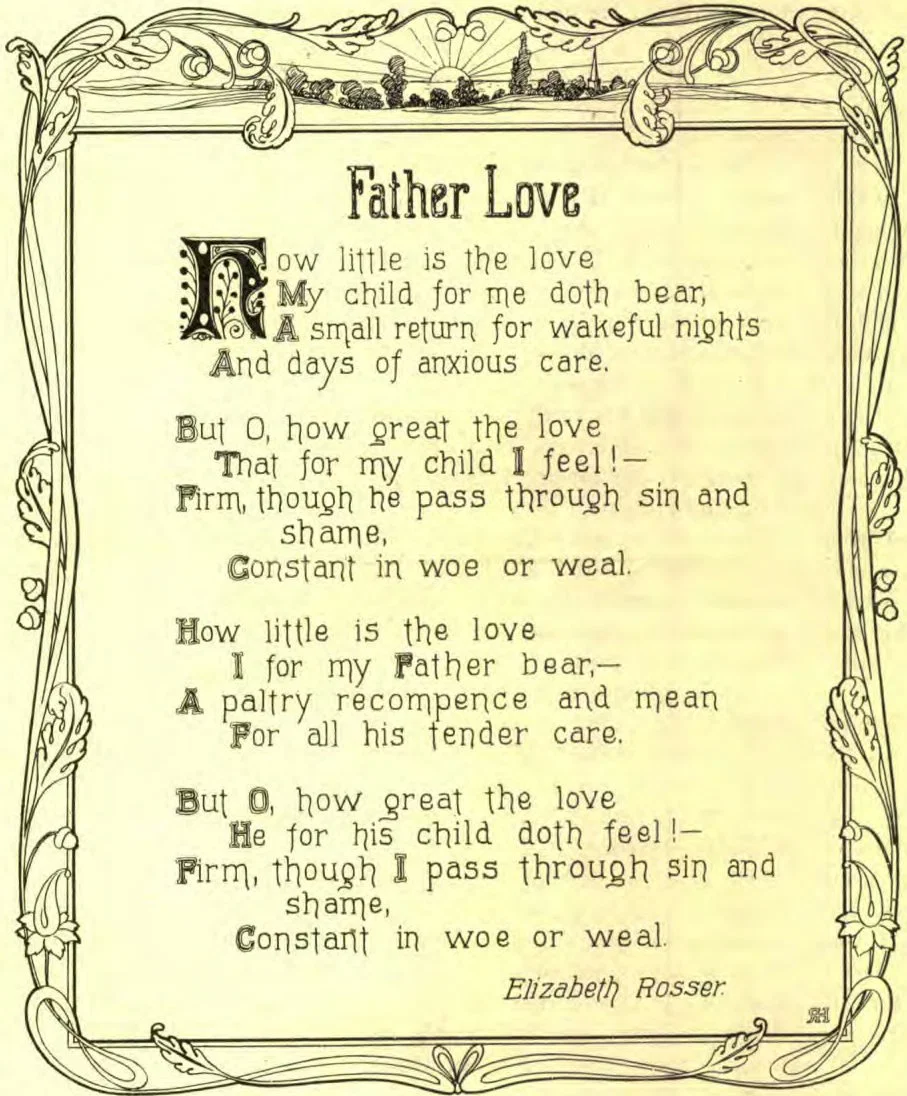
Father Love

How little is the love My child for me doth bear, A small return for wakeful nights And days of anxious care.
But O, how great the love That for my child I feel!— Firm, though he pass through sin and shame, Constant in woe or weal.
How little is the love I for my Father bear,— A paltry recompence and mean For all his tender care.
But O, how great the love He for his child doth feel!— Firm, though I pass through sin and shame, Constant in woe or weal.
Elizabeth Rosser.

Some Things about Tonga

The Native Dress

ORIGINALLY the native dress consisted simply of a girdle of green leaves about eighteen inches wide, and a mat or strip of native cloth wound about the loins. At present they usually wear a strip of cloth about two yards long, wound about the loins, of any material or color the wearer happens to fancy. This is worn by men, women, and children alike. On special occasions the fine mat or fine native cloth is worn. The men wear a shirt on the upper part of the body; while the women wear a sort of loose “mother hubbard,” extending down to the knees. This is cut low at the neck, so that the chest, shoulders, and back are exposed, the exposed parts being anointed with oil. They are quite fond of wearing flowers, and spend considerable time in making girdles and neckwear of leaves, flowers, and barks, which they color with diamond dyes.
Tapa, the native cloth, is made from the bark of tapa poles, which grow straight up from ten to fifteen feet. The bark is stripped off, and the rough epidermis removed and dried. When the natives wish to make it into cloth, it is soaked, and then pounded out to a thin gauze, with a heavy wooden mallet about a foot long. These strips are rendered adhesive by a starchy tuber being rubbed over them, and then they are beaten together till the desired size and thickness is reached. The work is done by the women and girls, who work in companies, making the cloth in one large piece, which is divided when finished. I stepped one piece, which proved to be one hundred and fifty steps long and five steps wide. The click, click, click of the tapa mallets, keeping perfect time, and often accompanied with singing, is a pleasing sound.
They use a decoction made from barks of trees to dye the cloth. Part of the color is put on with a sort of stencil, and part by hand. It is very fashionable to wind immense quantities about the body. It is also used for bedding and funeral shrouds.
A very old torn piece of tapa or mat is worn on funeral occasions. The older and more torn, the more sorrow is expressed.

Native Houses

The typical native house is covered with thatch and inclosed with reeds. The frame is supported by large posts set in the ground. Earth is thrown up to raise the floor a few inches. It is covered with coarse mats, made from cocoanut and palm leaves. There is but one room. When desired, they curtain off another with a piece of tapa.
With a few exceptions, there are no chairs, table, or furniture of any kind. When you enter the house, they throw down a clean mat or sweep a place on the floor for you to sit down. It is a great breech of Tongan etiquette to stretch out the legs, and it becomes wearisome for those who are accustomed to sitting on chairs to sit on the floor, with the legs doubled up in this manner.
The meals are served on green banana leaves, and eaten with the fingers. They do not lay up stores for rust to corrupt and thieves to steal, but simply provide for their present necessity, taking “no thought for the morrow.”

Education

There are public schools in all the villages, in which the children are taught to read and write their own language. So there are very few who can not read. There are also schools carried on by the different churches.
The government has what they call a college for the sons of chiefs. Here some sciences and mathematics are taught. English is also taught, but they do not learn sufficient to be of any service to them. They are very apt at music, have good voices, and love to sing. They have a good brass band connected with the school.
The Bible and a few other books have been translated into the language. They do not care to read much. Perhaps it is because of their meager literature.
E. S. BUTZ.
Nukualofa, Tonga.

The Rose and the Violet

One eve, to while away the hours, I sauntered forth among the flowers. Some fluttering there seemed to be, The cause of which I paused to see. Beside me grew a regal rose, Whose beauty all the wide earth knows. As queen of flowers, Rose seemed to say, To all who were beneath her sway: “Cease now this talk, and list to me, To-morrow morn, you know, will be The time for flowers, or Children’s Day. I mean to make a grand display. For this day did I long prepare; I’ve gathered perfume from the air, I’ve deeper blushed, whene’er the sun Peeped from the clouds, as if in fun. Of all the flowers around me here There is not one will be my peer. They’ll place me far above the rest, Because, you see, I’m gayer dressed.”
A whispered sneer fell on the air From those who thought themselves more fair; But, far below the Rose’s throne, A Violet spoke in modest tone: “I’ll wait to-morrow’s rising sun, Happy, if but God’s will be done.” Thus, any sphere content to fill, The Violet ceased, and all was still.
Ere one short hour had passed away, A petal of the rose so gay Broke from the stem, and fluttered round, Then fell in silence to the ground. The Rose in sadness moaned all night, And strove to hold her petals bright, But when the sun lit up the sky, And Violet ope’d her deep-blue eye, Lo! at her feet the boastful Rose Had fallen to her last repose; But that day in God’s house of grace The Violet held an honored place.
Let none, then, of to-morrow boast: To-day is all that’s promised us.
MRS. IDA B. HIBBEN.

“A Man Named John Wesley”

In one of her lectures, Frances Willard told the story of a young nobleman who found himself in a little village away off in Cornwall, where he never had been before. It was a hot day, and he was thirsty, and his thirst increased as he rode up and down the village streets seeking in vain for a place where something stronger than water could be had.
At last he stopped, and made impatient inquiry of an old peasant who was on his way home after a day of toil.
“How is it that I can’t get a glass of liquor anywhere in this wretched village of yours?” he demanded, harshly.
The old man, recognizing his questioner as a man of rank, pulled off his cap and bowed humbly, but nevertheless there was a proud flash in his faded eyes as he answered, quietly: “My lord, something over a hundred years ago a man named John Wesley came to these parts,” and with that the old peasant walked on.
It would be interesting to know just what the nobleman thought as he pursued his thirsty way. But what a splendid testimony was this to the preaching of John Wesley! For more than a century the word that he had spoken for his Master had kept the curse of drunkenness out of that village; and who can estimate the influence for good thus exerted upon the lives of those sturdy peasants? What nobler memorial could be desired by any Christian minister?—M. C. Hazard.

Chinese Medical Practices: Life Spots and Demon Possession

DR. JOHNSON, a well-known medical missionary who has spent a long time in China, tells some curious things about the practises among the Chinese. “The first task of a Chinese medical student,” he says, “upon entering the Imperial College at Shanghai, is to learn the three hundred ‘life spots’ in the human body. A ‘life spot’ is supposed to be a place through which a needle may be passed without causing death. The Chinese believe firmly in demon possession, and their doctors do a great deal of stabbing and prodding, making holes for the purpose of letting out the evil spirits that are causing the sickness. I was called to see one poor fellow who was dying of jaundice, and counted over eighty punctures in his chest and arms. When a criminal is executed, the native doctors are nearly always on hand, to secure portions of the body to use in compounding their medicines. Different parts are believed to be specifics for different diseases.”

Vastness of China's Population

THE vastness of the population of China may be inferred from the striking statement of Professor Giles, at Columbia University, New York City, that “if the Chinese should begin to file past a given point to-day, the procession would never end, as the next generation would begin to pass on as soon as the present had gone by.”

Standard Oil Lamps Light Asian Villages Without Gospel

THE Standard Oil Company sends its flickering lights throughout the length and breadth of Asia, and laughs at the difficulties that must be overcome. There will be thousands of households lighted by that oil to-night in the villages of Asia where the true light has never shone.—Robt. E. Spear.

Missionary Effort

As soon as you have decided that God has surely called you to be a worker with him to save the perishing, the first thing is work, moved and overseen by the Spirit. God has given you something to do to-day,—“Go work to-day in my vineyard.” “For the vineyard of the Lord of hosts is the house of Israel.” “So then, as we have opportunity, let us work that which is good toward all men, and especially toward them that are of the household of the faith.” Gal. 6:10, R. V.
Your work, then, will naturally begin among your associates in your home church; for the church is the house of Israel, and this is especially the vineyard where you are asked to work. You will find work to do like that which Jesus found daily. The members of the household of faith whom he first helped were his mother and his brothers and sisters. He had quick understanding in the work which his Father had sent him to do, so he anticipated his mother’s wants, and she did not always have to ask him to do things that needed doing. If you want to know the real, actual, common names of the things he found to do at home, your question will be answered by finding what there is to do in your own home. While some customs and ways of Bible times were different from ours, the necessities of daily life were the same. God gives you opportunity, and the time to do the duty is immediately. O, how many times we pass by on the other side of these duties, forgetting that the same opportunity never comes twice. If you refuse to give the cup of cold water when the thirsty traveler is passing, he goes on, never to return with that opportunity, but carries it to somebody who will gather the harvest of blessing intended for you. And what is the blessing?—“Ye have done it unto me.” “Well done, . . . enter thou into the joy of thy Lord.”
Jesus knows what it is to give bread to the hungry; for often, in childhood and youth, he divided his own scanty meal, or gave the whole of it to another, carried water from the spring under a burning sun to refresh the stranger; and put his own clothes upon one who was in need of them. So he knows the joy it will bring to us.
The highest type of missionary work is service. And it must be service at home; for wherever the child of God is, or wherever he is sent, there is his home, and there he must work. If you do not serve others where you are now, you certainly can not be ready to serve when you are sent to another place. You know that Jesus “took upon him the form of a servant;” so, learning to serve your fellow men for their salvation should be your highest ambition in life.
I will suggest some ways of missionary service at home. Your father is a hard-working man, rising early and working late to provide a home and its comforts for his family. His hair is becoming gray, and his strength is lessening with the cares of life and added years. You are in the strength and vigor of youth. He has been in the habit, as most fathers are, of arising with the first break of day to build the fire for the morning meal, leaving you to sleep till breakfast is ready. Tell him to-night that you want him to rest in the morning, and that you will get up to build the fire. The joy that will come to his heart when he sees that you have a care for him and an interest in his welfare, will help him forget his weariness, and his rest will be sweeter.
When the morning fire is kindled, you will find other chores that father has always done. Perhaps there are horses to be fed, stables to be cleaned, and cows to be brought up from the field. And don’t forget mother. Bring in wood enough for the day, fill the water pails, and get the vegetables from the garden or cellar.
If you start the day in this helpful way, never forgetting the morning prayer before leaving your room, you will find many opportunities all through the hours for loving service. How many daughters who read these lines are in the habit of rising as early as mother does, to help and cheer her with the thousand pressing duties of the new day? Can you tell why you should not do this? Do you need more rest than she? Has she not often let you know, by gentle word or look, that she longs for your help? Is she not doing scores of things each day that you ought to do? She does not always want to be asking you to do little things which you yourself should notice, and your willing hands should do without asking.
As you work thus for others, God will give you a word in season to speak to him that is weary. Isa. 50:4. Tell to those nearest and dearest to you what Jesus is doing for you, as opportunity offers. See to it that you are drinking deeply from the wells of salvation (John 4:14); then you must tell of His joys. He puts his words into your mouth (Isa. 51:16), even fitting them into your lips (Prov. 22:18), to be spoken to the weary. J. C. ROGERS.

A Missionary to Ancient Egypt

(November 16-22)
THE study of Bible characters will be most helpful to us if we keep ever in mind the thought of learning how we may better serve our own generation, as they did. The story of their lives is written for our learning “upon whom the ends of the world are come.” We desire to be missionaries for God at home and abroad. Then let us follow the missionary side of the lives of some of the young people of Bible times.
It is suggested that we take Joseph’s life as the topic for this week’s meeting. First, let some member prepare (or find) a map showing the location of the countries concerned in the story and their relation to the ancient world. It would be a good thing for our young people to become accustomed to using a map in all their historical reading and Bible study. Make the facts of history live over again before your eyes, as it were. Far too many read these things as though all were unreal and fanciful, and fail to see that Bible characters lived in a world as real and as full of bustle and life as the world is to-day.
The story of the missionary Joseph—he was a foreign missionary too—may be divided as follows:—
Home Life and Training.—Genesis 37.
Witnessing in Obscurity.—Genesis 39 and 40; Acts 7:8, 9; Ps. 105:16-19.
Made a Witness before All the World.—Genesis 41-47; Ps. 105:20-22.
The study may be assigned to one or to three members. But all should study the subject so as to be prepared to suggest helpful lessons in the meeting.
It will be easy to sketch very briefly the special points in the story that have missionary lessons. Of course only the briefest possible outline of the story of Joseph can be attempted; but note all along how naturally the lad who was faithful and cheerful found some way of serving, and how one lesson prepared him for the next.
What a different story this might have been had not Joseph had a spirit that led him to find out how he could help people who looked sad. Gen. 40:7. Love teaches the way, and seeks the way of service. See how much a young people’s band may do to brighten sad faces in your community.
“The marked prosperity which attended everything placed under Joseph’s care was not the result of a direct miracle; but his industry, care, and energy were crowned with the divine blessing. Joseph attributed his success to the favor of God, and even his idolatrous master accepted this as the secret of his prosperity. Without steadfast, well-directed effort, however, success could never have been attained. God was glorified by the faithfulness of his servant. It was his purpose that in purity and uprightness the believer in God should appear in marked contrast to the worshipers of idols,—that thus the light of heavenly grace might shine forth amidst the darkness of heathenism.”—“Patriarchs and Prophets.”
“The integrity, the simple trust, the noble nature of the youth, bore fruit in the deeds of the man. . . . There are few who realize the influence of the little things of life upon the development of character. . . . The formation of a noble character is the work of a lifetime, and must be the result of diligent and persevering effort. God gives opportunities; success depends upon the use made of them.”—“Patriarchs and Prophets.”
The population of ancient Egypt is put by scholars at from five to seven millions. This was the manner of life: “Drunkenness was a common vice among the young; and among the upper class generally pleasure and amusement were made, ordinarily, the ends of existence. False hair was worn; dyes and cosmetics used to produce an artificial beauty; great banquets were frequent; games and sports were in vogue; dress was magnificent; life was passed in feasting, sport, and a constant succession of enjoyments.”—Rawlinson’s Ancient Egypt.
Joseph’s world was very like our own. God sets us here as witnesses, to let the world know that there is something higher to live for than selfish pleasure. Study to see how the principles that made Joseph successful in Egypt may be applied to the work we young people have to do now.
The first missionary to Ireland, Patrick, was carried captive by pirates into that land while still a youth. He served a heathen chief as herdboy. There the Spirit of God brought conviction to his heart. He later escaped to his own land, Scotland, where he seemed to hear voices from Ireland calling, “We beseech thee, child of God, come and again walk among us.” Believing God called him to evangelize the Irish people, he returned to that country, and a great work was wrought. He established schools, which sent out missionaries to many parts. He died about the year 493.
Why should not our Young People’s Societies take special interest in canvassing every member of the church for the Review? Every family should by all means have this, with its good instruction and its weekly record of progress in all lands. Plan also for an organized effort to take subscriptions in the neighborhood for the Signs, Good Health, or the Sentinel. Our societies can do much to help the tract society. In this work let us not plan to work independently, but help in the regular tract society work. All our papers can be sold by single copy, just as many are selling the Life Boat so successfully. It is a good season of the year to push the literature. W. A. S.

Great Ideas and Small Duties

A soul occupied with great ideas best performs small duties.—James Martineau.
Continue reading: Where Does Oil Come From?