“WHERE does oil come from, Grandpa?” asked the Boy.
“Yes, please tell us about it,” said the Girl, closing her book.
“And what’s a ‘go-devil’?” the Boy demanded.
“Petroleum,” said Grandpa, stirring the fire, and adding a few lumps of coal, “depends on the flood, much the same as coal does. The oil we burn, and with which we sprinkle our streets to make them hard, comes from the plant and animal life that existed when Noah was hewing out the timbers of the ark. When the flood came, great masses of dead creatures were washed together, and covered with mud and rocks and clay, which hardened into stone. Then hundreds and thousands of years passed. Slowly the oils that were in the dead matter collected in pools, which grew larger and larger, till many of them were at last good-sized ponds of petroleum. Now when the well-borer sends his drill into one of these underground ponds, he is said to ‘strike oil.’
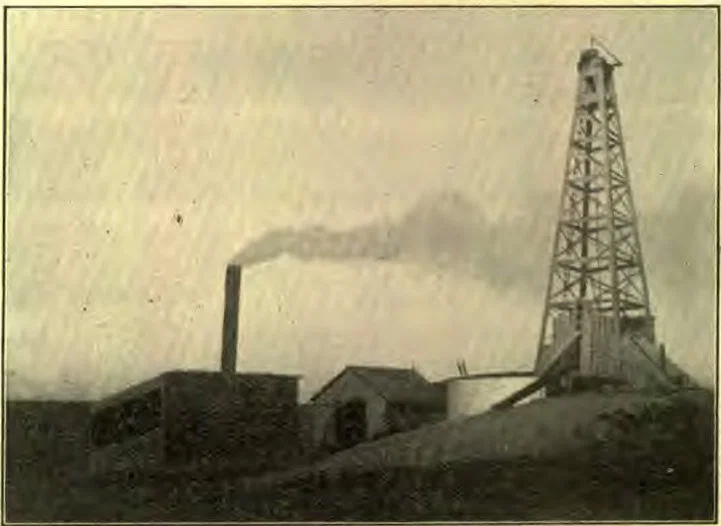
“Of course, ‘all over the oil in these ponds there is a great deal of gas,—coal gas and the like,—under high pressure, like the steam in an engine boiler. When the well is drilled, therefore, and reaches the oil, this great pressure forces the oil up the pipe, so that it spurts above the ground, and makes a ‘gusher’ well. After the pressure of the gas is somewhat relieved, the oil no longer flows of itself, and the well is called a ‘pumper.’”
“By and by the oil gets pretty low, and the owners see that it will soon give out unless something is done to better things. So they call around the ‘nitroglycerin,’ or ‘go-devil,’ man. He comes, bringing some long, round cans of greasy stuff in his wagon, and proceeds to let them down with half a mile, more or less, of string to the bottom of the well. When he thinks he has enough of the explosive lowered for this time, he calls, ‘Look out!’ to his fellow workers, while he himself drops the heavy iron bar, called a ‘go-devil,’ into the mouth of the pipe. Then he himself ‘looks out,’ and waits. It takes quite a while for the ‘go-devil’ to go down the long well, but by and by it strikes; and then there is an earthquake, and a minute later great streams of mud, oil, and rock shoot from the pipe with tremendous force. The owners and the ‘go-devil’ man then examine the well to see if the ‘shooting’ was a success.”
“What does it do, if it is?” asked the Boy.
“Why, the explosion breaks things all up down there in the rock, and if there are any more ponds of oil near, it breaks holes into them so that the oil will flow into the first pond. Sometimes it takes many trials to get a good flow, and sometimes it can not be had at all. Then the well is abandoned, and a new one drilled in another place.
“How do they know there is any oil there in the first place?—Well, in oil regions there is generally a film of oil floating on the surface of the water, or else a smell of gas coming up through seams and cracks in the rock. These things indicate the presence of oil somewhere underground. At first people did not know what the oil on the water was, and it is said that the Indians of New York used to collect and sell it as medicine to the white men. The white people, of course, thought the wonderful ‘Indian oil’ a cure for almost everything. Some other time I may tell you more about that, but now it’s time for bed.”
EDISON DRIVER.
Pancho: A Pet Spider Monkey's Journey
By Winifred Holmden
Pancho
PANCHO is his every-day name; but when visitors come to see him, we always tell them that his name is Bonito Pancho Sierra, for he is a little Spaniard of royal blood, and his surname was given him in honor of the Honduranian president, while Bonito signifies that he is our dear little pet.
A “PUMPER”
Pancho is only about three years old, but he has already become quite a traveler, and has had many experiences, which, I am sure, would be very interesting could he relate them. He was born on the coast of Honduras. I do not know his earliest history; but I suppose a man with a gun came along one day, shot his mother, and, not heeding in the least his piteous cries, carried him and his small sister away across the bay to the little island, where we bought him. At first Pancho did not like the idea of living in captivity, and would scream if we even touched his chain. But after a short time he became more docile, and would run around and catch the big spiders and roaches. The spider was a very delicious morsel for him, but he would always bite off the head of a roach, and cast its body away.
His sister, Panchita, went to live with a lady just across the street. This lady did not rise very early in the morning; and nearly every day before her mistress was up, little Panchita would untie her string, and run across the road to call on Pancho. I believe her main object in coming, however, was to get her breakfast; for the first thing we would see of her, she would be on the top of a bunch of bananas, or plantain, which were hanging in the kitchen, and deliberately helping herself, without so much as a “By-your-leave.” When caught, she would put both little arms around our necks, and act so loving that we could not find it in our hearts to scold her.
Many happy days did Pancho and Panchita spend in this way, but there came a day when Pancho had to bid farewell to his little sister, his native land, and the bright, warm sunshine and balmy breezes in which he had played all the days of his babyhood, and go into a little, square box, and out onto the big steamer, and across the blue waters. He soon made friends with the captain and mate, and with all the passengers. Only the Chinese steward, Yang Fung, was a little suspicious of him, and in taking him to his berth, carried him at arm’s length. He was scarcely comfortably settled before the motion of the ship made him very seasick.
There were other pets on board more accustomed to the rolling billows. First, there were Beer and Bottle, two cats which the captain had received from a man in La Ceiba, in exchange for a bottle of beer, hence their names. They were fat and sleek, and were fed at each meal by captain, mates, passengers, and steward, each one in turn coming on deck with something for them, until at last the surfeited animals had to turn away for want of a place to put it. Then there was a fat little squirrel, with a bushy tail, that sat and nibbled all day; and Kruger, a rough-looking cur, with his hair bristling out in every direction, running about on three wabbly legs. He always made me think of the Slough of Despond, for no matter how much you put into him, he was never full, and he looked as if he might have come out of just such a place. Kruger had been rescued by the captain of the ship, and taken on board in New Orleans. One time during a hard storm he fell from the deck, breaking three of his legs, and nearly killing himself. But the ship’s carpenter mended his legs next day, and he finally recovered.
One other pet there was on board, a little white-faced monkey, a near relative of our own Pancho, I suppose. He was on his way to Washington, to live with one of the senators there, and at that time was traveling in company with the United States consul.
After a five-days’ voyage, Pancho, having somewhat recovered from his recent illness, arrived in harbor in New Orleans, where he was taken in a hack up to Hope Mission. Going along the streets every one who looked our way began to smile, and I wondered what was the matter. It did not occur to me then that the monkey was rather a curious object to those not accustomed to him.
After a few days’ rest in New Orleans, Pancho resumed his travels by rail. On the train, the porter, not knowing there was live-stock in the box, asked us to let him take it away, and so give us more room; but we thanked him kindly, and told him we were very comfortable. Before we reached Chicago, however, Pancho began to resent his confinement, and barked as hard and as loud and as long as such a little fellow could. A happy pet he was when he reached home, and could once more turn somersaults on the floor, play peekaboo, have his daily bath in the washbowl,358and don his nightie when bedtime came.
Since coming here [to Battle Creek], he has displayed a taste for music, and will sit quietly by the hour, while some one guides his fingers over the keys of the organ. He has a disposition of his own, however, and if one attempts to do the playing himself, he is angry in a moment.
He is not very strong, and is subject to pneumonia. Last winter, indeed, he came near dying from this cause, but was cured by a hot bath.
Though over two thousand miles from home, he displays no signs of homesickness, and we hope he will live to a good old age.
WINIFRED HOLMDEN.
In School and Out
By Frank Walcott Hutt
In school the busy children bend
Above their many tasks, and know
What pleasant, sure rewards attend
Their earnest work and zeal,—and so
All day the long school hours they fill
With trials of strength and tests of skill.
And afterward, when school is out,
They seek the school-yard and the street,
And with a merry laugh and shout,
In many a dextrous game compete,
And join together with a will
In trials of strength and tests of skill.
But when school-days are over, and
The world has need of them, they go
Their different ways on sea and land,
And, like true men and women, show
Unconquered zeal as they fulfill
Life’s trials of strength and tests of skill.
FRANK WALCOTT HUTT.
First Lessons in Geography
By Floyd Bralliar
Lesson IX
We can scarcely understand how much the flood changed the appearance of the earth. Before the flood, most of its surface was land, so it was all in one great body. It was made this way in order that all of it might be inhabited; for, “He created it to be inhabited.” But God would have it inhabited by righteous beings.
When men delighted only in evil, this arrangement was changed; and when the earth was broken up by the flood, about three fourths of it was covered with water. The larger bodies of water, as we have learned, are called Oceans. Name them. The other fourth was left in large bodies, or masses, of land. These are connected on opposite sides of the world, and form two great bodies, often called the Old World and the New World, or the Eastern Hemisphere and the Western Hemisphere.
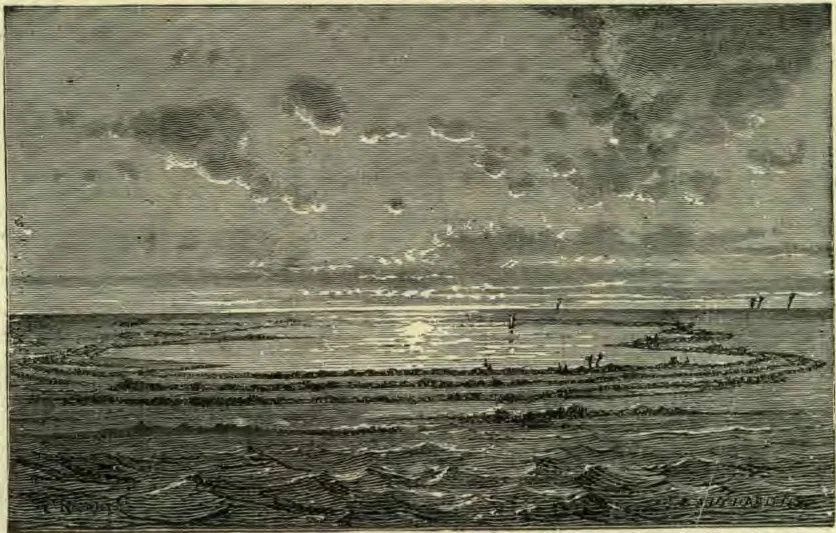
A CORAL REEF
Both hemispheres are divided into irregularly shaped masses called Continents. In the eastern hemisphere there are three continents. Their names are Europe, Asia, and Africa. A narrow strip of land that connects two continents is called an Isthmus. The Isthmus of Suez joins Africa to Asia.
In the eastern hemisphere is another continent called Australia. It lies in the Pacific Ocean, far from the other continents. Australia is the smallest of the continents.
In the western hemisphere there are two continents. We call them North America and South America. They are connected by the Isthmus of Panama.
Of course in the breaking up of the earth, the shore-line did not break straight. In many places the land projects into the water, and in others the water runs into the land. But “He hath compassed the waters with bounds, until the day and night come to an end.” “Will ye not tremble at my presence, which have placed the sand for the bounds of the sea by a perpetual decree, that it can not pass it?” So while the shore of the sea may change, God has made it, and he alone can change it.
In some places the land runs out into the sea for miles and miles, and is often narrower where it joins the mainland than it is out in the ocean. We call such a strip of land a Peninsula. Where these jutting points are smaller, and are only a point of land extending into the sea, they are called Capes. A cape is also called a Headland. Many peninsulas are very large, containing thousands of square miles of land.
In many places, arms of the water extend into the land. These are sometimes large and sometimes small. We call them Seas, Gulfs, Bays, etc. There seems to be no rule for naming them. They are really all alike.
REVIEW.—How much of the earth could be inhabited when it was first created? What has changed it so much? How much of the earth’s surface is now covered with water? Into how many great masses is most of the land divided? What do we call these? Name the continents in the old world. What is an isthmus? What isthmus joins Asia and Africa? Name the continents in the New World. What isthmus joins them? Who formed the seashore? Describe it. What is a peninsula? What is a cape? What are seas? Gulfs? Bays?
Lesson X
You have often played on the bank of a river after the water has been high, and have noticed how the banks have been washed away. Here you will find a place where the ground was hard, or perhaps there were stones to turn it aside, and it projects out into the river. A little farther along, the current has struck the bank, and has washed in till it has made an arm of water into the land. If you will look along the bank for a few rods, you will see little capes, bays, gulfs, peninsulas, and, in fact, all the forms of land and water we have spoken about. If there is no river near, follow along some creek or brook, and you will see the same things.
If you look far enough, you will find places where the water has washed around some land, and has left it entirely surrounded by the water. Such a body of land is called an Island. As the oceans were forming after the flood, large bodies of land were often broken from the coast in this way. Usually there are several islands near one another, forming a group. Since the flood the winds and waves have often formed islands by breaking capes and peninsulas from the shore. Some islands are low, and have had a great deal of sand washed over them.
Places that were the most wicked, suffered the most during the flood. Where men had built their grandest cities and palaces, and had brought gold and silver to worship their false gods, there are now the most desolate places. Many of them lie in the bottom of the ocean. Where there were mountains, their tops sometimes rise out of the water in the very middle of the ocean, and form islands. We call such islands Oceanic Islands.
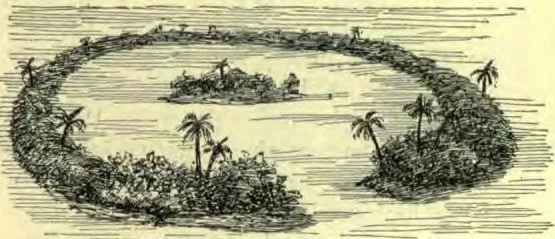
CORAL ATOLL AND ISLAND
Sometimes these mountains were entirely covered with water; but millions of tiny animals, each making a little limestone shell called Coral, lived on them; and as, year after year, new shells were added, the top of the mountain finally rose above the water, and became an island. Such359islands are often horse-shoe shaped, or even ring-shaped. We call them Atolls. The waters wash sand and soil over them, and seeds of palm-trees and other plants have taken root, and grow there. Most coral islands are found in the Pacific Ocean.
But we must not think that everything now is just as it was when the waters of the flood dried away. Since then the winds have uprooted trees, torn great rocks from their places, and driven sand and pebbles against rocks till their sides are worn in peculiar shapes. In storms at sea, the waves beat against the shore, and wear away the hardest stone. In some places these have been broken and carried into the sea, till it is dangerous for a ship to come near the shore. As we near the end, we may expect these storms and winds to increase.
REVIEW.—Where can we find capes, bays, peninsulas, etc.? What is an island? How were the islands along the shore of the ocean formed? Why do we sometimes find islands far out at sea? What are coral atolls? How were they formed? How have the winds and the waves changed the earth since the flood? FLOYD BRALLIAR.
Listening to Hear What God Speaks
WHAT child who has heard the old, sweet story of the boy Samuel,—how he went in and out in the temple, ministering to the aged priest, and how in the night the Lord himself called him by name,—has not wished that he, too, might hear that gentle voice speaking to him, just as a loving father would speak to his little son? But did God love Samuel more than other children? Was he the only child to whom God speaks?—No! He speaks daily to children of every age, calling them to listen to his word. How does God speak?—In many ways. The heavens declare his glory; the earth tells of his life and his love; and by his own Spirit he speaks to the heart, counseling against sin, inviting all to come to him. But Samuel listened,—he was ready to hear, willing to obey. If we are like him, we shall be surprised to know how often and how plainly God will speak to us.
Manners for Boys
ON THE STREET
KEEP step with any one you walk with.
Hat lifted in saying, “Good-by,” or, “How do you do?”
Hat lifted when offering a seat in a car, or in acknowledging a favor.
Always precede a lady upstairs, and ask her whether you may precede her in passing through a crowd, or public place.
IN THE HOUSE
Let ladies pass through a door first, standing aside for them.
Let a lady pass first always, unless she asks you to precede her.
Look people straight in the face when speaking or being spoken to.
In the parlor stand till every lady in the room is seated; also older people.
Rise if a lady comes in after you are seated, and stand till she takes a seat.
Hat off the moment you enter a street door, and when you step into a private hall or office.
IN THE DINING-ROOM
Never play with knife, fork, or spoon.
Use your handkerchief unobtrusively always.
Do not take your napkin in a bunch in your hand.
In the dining-room take your seat after ladies and elders.
Rise when ladies leave the room, and stand till they are out.
Eat as fast or as slowly as others, and finish the course when they do.
If all go out together, gentlemen stand by the door till ladies pass.
Special rules for the mouth are that all noise in eating and smacking of the lips should be avoided.
These rules are imperative. There are many other little points which add to the grace of a gentleman, but to break any of these is almost unpardonable.—Selected.
Good Habits Are Formed Daily
“Good habits are not made on birthdays. The workshop of character is every-day life.”
THE YOUTH’S LESSON
VIII — The Vision of the Ram, the Goat, and the Little Horn
MEMORY VERSE: “And he said unto me, Unto two thousand and three hundred days; then shall the sanctuary be cleansed.” Dan. 8: 14.
“In the third year of the reign of King Belshazzar a vision appeared unto me, even unto me Daniel, after that which appeared unto me at the first. And I saw in the vision; now it was so, that when I saw, I was in Shushan the palace, which is in the province of Elam; and I saw in the vision, and I was by the river Ulai. Then I lifted up mine eyes, and saw, and, behold, there stood before the river a ram which had two horns: and the two horns were high; but one was higher than the other, and the higher came up last. I saw the ram pushing westward, and northward, and southward; and no beasts could stand before him, neither was there any that could deliver out of his hand; but he did according to his will, and magnified himself. And as I was considering, behold, an he-goat came from the west over the face of the whole earth, and touched not the ground: and the goat had a notable horn between his eyes. And he came to the ram that had the two horns, which I saw standing before the river, and ran upon him in the fury of his power. And I saw him come close unto the ram, and he was moved with choler against him, and smote the ram, and brake his two horns; and there was no power in the ram to stand before him: but he cast him down to the ground, and trampled upon him; and there was none that could deliver the ram out of his hand. And the he-goat magnified himself exceedingly: and when he was strong, the great horn was broken; and instead of it there came up four notable horns toward the four winds of heaven. And out of one of them came forth a little horn, which waxed exceeding great, toward the south, and toward the east, and toward the glorious land. And it waxed great, even to the host of heaven; and some of the host and of the stars it cast down to the ground, and trampled upon them. Yea, it magnified itself, even to the prince of the host; and it took away from him the continual burnt-offering, and the place of his sanctuary was cast down. And the host was given over to it together with the continual burnt-offering through transgression; and it cast down truth to the ground, and it did its pleasure and prospered. Then I heard a holy one speaking: and another holy one said unto that certain one which spake, How long shall be the vision concerning the continual burnt-offering, and the transgression that maketh desolate, to give both the sanctuary and the host to be trodden under foot? And he said unto me, Unto two thousand and three hundred evenings and mornings; then shall the sanctuary be cleansed [“justified,” margin].” Dan. 8: 1–14, Revised Version.
Questions
1. When was this vision given to Daniel?
2. How long was this after the vision of Daniel 7?
3. Where was the prophet at this time?
4. Where were the scenes of the vision located?
5. What was the first object that appeared in the vision?
6. How many horns did this ram have? What peculiarity did Daniel notice about the horns?
7. What was the power of this horn? How did he act?
8. While Daniel was still beholding, what appeared on the scene? From what direction did the goat come? What was especially peculiar about him?
9. How did he attack the ram? With what result?
10. How was the weakness of the ram manifested?
11. Why was not the ram delivered out of his hands?
12. What effect did this have upon the he-goat? In the height of his power what happened to the great horn? What appeared in its place?
13. What further developed from one of these horns? How extensive was his power? How did he treat the host of heaven?
14. How much further did he go in his evil course?
15. How did he interfere with the established religion and place of worship?
16. What was given into his hands? Verse 12. Why?—Through transgression.
17. Just at this time what did Daniel hear? What was the burden of the one who spoke? (Note the question which the angel asked.)
18. What reply was made to Daniel?
Notes
As the interpretation of this vision is given in the remaining part of the chapter, and will form the basis of the lesson for next week, the time may be profitably spent this week in becoming perfectly familiar with every detail of the vision. The main point is the rise and work of the little horn, especially in its attitude toward the worship and service of God, as connected with the sanctuary and its services.
The Revised Version of this chapter is used as being in some respects more clear than the Authorized Version. The text is printed in the INSTRUCTOR for the benefit of any who may not have a copy of the Revised Version at hand.
MEMORY VERSE: “In thee shall all nations be blessed.” Gal. 3: 8.
(The chapter given as the Lesson Scripture is the lesson to be studied. Read this every day, and think over it until you know just what it teaches. Then the following notes, which should be read several times, will help to a fuller understanding of the lesson. Lastly, go over the questions carefully, and be sure that you can answer each in the words of Scripture.)
The famine that God had warned Pharaoh about was sore in all lands, and not only in the land of Egypt. The fame of Egypt’s storehouses filled with grain had gone into all countries. And as “all countries came into Egypt for to buy corn,” they would learn why the Egyptians had gathered such a store when the earth was bringing forth by “handfuls” year after year. Then they would hear about the God of Joseph, and how he had warned them, and taught them what to do, and thus many people of all lands would be led to trust in him. These would become missionaries to carry the good tidings—the gospel—back to their own lands.
Do you not see that in sending the famine, God was working to bring the true heavenly bread of life to all the people of the earth? This is what the people found when they came to buy the corn of Egypt. And so the promise began to be fulfilled that all the nations of the earth should be blessed in Abraham’s seed. For Joseph was a child of God, and therefore a true son of Abraham.
Perhaps Jacob’s sons had heard of the great ruler who had saved the land of Egypt by his wisdom, but they little thought that he was the brother whom they had sold as a slave. God had overruled their wicked act, to save their own lives; for Egypt was the only place where they could go to get corn. Does not this again remind you of Jesus, who was rejected by his brethren, but exalted by God to save them and feed them with the bread of life?
In the life of Joseph, God was giving the children of Israel a wonderful object-lesson to teach them of his great plan to save the world through Christ, the true seed of Abraham, even though he should be despised, rejected, and cast out.
When Joseph’s brothers sold him, they said, “We shall see what will become of his dreams.” But now they bowed themselves before him, with their faces to the earth, just as he had seen in his dreams, without knowing that the dreams were then being fulfilled, and all they had done had only helped to bring them to pass. But Joseph remembered, and he saw how God’s hand had led him all the way, that he might fulfill his own purpose.
Questions
How did the earth bring forth in the seven years before the famine? How much corn did Joseph gather? Gen. 41: 47. Where did he store it?
Where was the famine felt? Who came to Egypt to buy corn? Verse 57.
What would the people be sure to learn when they came to Egypt? What was God’s purpose in sending the famine?
Who came from Joseph’s old home to buy corn? Gen. 42: 5. Did all his brethren come?
Did Joseph’s brothers know him when they saw him? What did they do?
What did Joseph think of when his brethren bowed before him? What had they said about his dreams?
How did Joseph treat them? What did he say they must do before he would sell them any corn? Verses 15-17.
What did he at last allow them to do? Verses 18-20. What did he do to make sure they would come back?
Careful Attention to Small Things Brings Success
By Horace Bushnell
ACCURATE and careful detail, the minding of the common occasions and small things, combined with general scope and vigor, is the secret of all the efficiency and success in the world. It is only thus that any disciple will become efficient in the service of his Master. He can not do up his works of usefulness by the prodigious stir and commotion of a few extraordinary occasions. Laying down great plans, he must accomplish them by great industry, by minute attention, by working out his way as God shall assist him.—Horace Bushnell.
Bookkeeping at Home
The Quickest; the Best
A FULL course in “Fireside Accounting” by our correspondence method for $3.
One valuable feature given in the Examination Set is a Special Column Journal showing how the transactions common to any family may be accurately and easily recorded by the Double Entry method of bookkeeping.
A certificate is given when the course is completed.
Solicitors engaged on commission or salary. For particulars address—
FIRESIDE ACCOUNTING INSTITUTE, 29 N. Washington Ave., Battle Creek, Mich.
SOLID THROUGH TRAINS OF WIDE VESTIBULE COACHES and PULLMAN SLEEPING CARS BETWEEN
Battle Creek and Chicago, Buffalo, New York, Philadelphia, Toronto, Montreal, Boston
For time-tables, descriptive matter, and information, apply to any representative of the company.
Good Words of Counsel
By G. C. Tenney
I
To one who is just starting out on the journey of life, the motives given in Prov. 4:23-27 are excellent for guidance in forming and protecting the character.
“Keep thy heart with all diligence; for out of it are the issues of life.” The word “heart,” though it occurs about a thousand times in the Bible, rarely, if ever, refers to the principal organ of the circulation of the blood, but always to the affections and moral and spiritual faculties. The heart is a treasure-chest: “A good man out of the good treasure of his heart bringeth forth that which is good; and an evil man out of the evil treasure of his heart bringeth forth that which is evil; for of the abundance of the heart his mouth speaketh.” It is also likened to a fountain: “For from within, out of the heart of men, proceed evil thoughts, adulteries,” and all evil words and deeds. Thoughts are born, or produced, in the heart. These crystallize into words, deeds, and results. What the thoughts are to be will be determined by the principles dwelling in the heart. And the character of the thoughts will determine the character of the life.
While it is true that mistakes will sometimes spring from accidental or momentary forgetfulness, or from defective knowledge, many of the misdeeds and wrong words which we are apt to excuse because, “I didn’t think,” or, “I forgot,” are really the fruit of evil principles, which dwell deep in our hearts. Evil-speaking and evil doing can not spring from right principles, even by accident. The accident is brought about by a failure to guard the evil principle as closely as one intends to.
The only way that we can exclude evil from our lives is to have it thoroughly taken out of the heart by the grace of Christ. Then we must keep the heart with all diligence. Evil suggestions, like the germs of disease, are all about us. They seek by every means to find a lodgment in the heart. Through the eyes, the ears, the appetite, evil seeks an entrance to the heart. Once admitted, it is sure, sooner or later, to appear in the life. If we want the life to be pure and sweet, we must guard well the fountain. We must, as the margin of the text reads, keep it “above all keeping.” G. C. TENNEY.