The Youth’s Instructor, Vol. 34, No. 1.

THE GALLEY-SLAVES

The Youth’s Instructor

Jan 6, 1886

S. D. A. Publishing Association · Battle Creek, Mich. · Jan 6, 1886

THE GALLEY-SLAVES.
“I LOVE the Lord, because he hath heard my voice and my supplications,” read Susie out of her little Bible.
“That is the one hundred and sixteenth psalm, isn’t it?” asked her uncle, as he turned round from the fire.
A WINTER PIECE.
A WINTER PIECE.
“Yes,” said Susie. “When grandma gave me this Bible, she made me promise to read a psalm every day, and I’ve done it.”
“That is right,” said her uncle. “I remember, when I was a little boy, of one day learning the one hundred and sixteenth psalm, and then grandma told me a story about how that psalm was once sung.”
“Tell it to me, won’t you?” said Susie.
“It was in the days when the Protestants of France were persecuted by wicked kings, and obliged to flee from home for their lives. The people who sang it had been caught, and, by the king’s order, were to be galley-slaves.”
“What were they?” asked Susie.
“Well,” said her uncle, “the galleys were French ships about one hundred and fifty feet long and forty feet wide; and along each side of the ship, there ran a sort of bench for the rowers. On this bench sat the galley-slaves, or men who were made to row the vessel with such heavy oars that they could hardly pull them. These slaves were fastened by an iron chain around one leg, and this chain was so long that they could lie down to sleep on the deck occasionally. These poor slaves had very little to eat; and night and day, in cold winters and hot summers, they were kept pulling at the oars. And if ever they stopped pulling, they were whipped most unmercifully by an officer who watched them.”
“But where were they rowing to all the time?” asked Susie.
“Up and down the coast. The galleys were vessels that were employed to watch the coast of France and guard it,” said he; “and sometimes they attacked English ships that happened to sail near them.”
“Well,” said Susie, “I should think that those folks would have felt more like crying than like singing a psalm, if they knew they were going to the galleys.”
“Yes,” said her uncle; “but they were ‘persecuted for righteousness’ sake,’ you know. One of them, whose name was John Huber, wrote in his journal about the way they were treated. He says that that night he, with his wife and children and fourteen galley-slaves, arrived at a little town in France. They were all chained, and the priests of the place came and offered to set them free if they would give up their Christian religion. But Huber and the others could not do such a thing as that. Then the women and children of the town came out and threw mud at them. But he did not answer them back;” and taking a book from one of the library shelves, he found what John Huber wrote about this trying experience.
“The women and children of the place covered us with mud. I made my little party fall on their knees, and we put up this prayer, in which all the fugitives joined: ‘Gracious God, who seest the wrongs to which we are hourly exposed, give us strength to support them, and to forgive in charity those who wrong us. Strengthen us from good even unto better.’”
“They had expected to hear complaints and outcries; our words astonished them. We finished our little act of worship by singing the one hundred and sixteenth psalm. At this, the women began to weep. They washed off the mud with which our children’s faces had been covered, and they sought permission to have us lodged in a barn, separate from the other galley-slaves, which was done.”
“But what do you suppose made Huber choose the one hundred and sixteenth psalm?” asked Susie. “I should think he would have chosen some more sorrowful one, like the one hundred and second, ‘a prayer for the afflicted when he is overwhelmed.’”
“Well,” he replied, “I cannot tell just why Huber picked out the psalm he did. Perhaps he thought that fifteenth verse was appropriate, ‘Precious in the sight of the Lord is the death of his saints.’ I am sure that when Huber thought of the old, white-headed men, good ministers, and young boys being killed by hundreds in the torture of life in the galleys, that he must have been sure that the time would come some day when the poor, persecuted Christians would be freed, and could say with David, in that eighth verse, ‘Thou hast delivered my soul from death’ and ‘mine eyes from tears.’”
“Well,” said Susie, “did such dreadful times last always?”
“No,” said her uncle; “but they lasted for many years, so many that often the galley-slaves died before the time of freedom came. Every little while these Christians were offered freedom if they would only give up their religion; and when they refused, they were whipped and treated worse than before.”
“How many of them were there?” asked Susie.
“Well, there were known to be at least a thousand of them; but it is feared that there were many more, for those were dark days in France, and evil deeds did not always come to light.”
“How did they all get free at last?” asked Susie.
“It was through Queen Anne, of England,” said her uncle. “She begged that the Christians might be set free; and so, at last, in 1713, word came to the poor galley-slaves that the day of deliverance had come. I think they must have felt like the children of Israel when they escaped from the Egyptians that had ‘made their lives bitter with hard bondage.’”
“But what could they do?” asked Susie. “They had no homes to go to.”
“They went to the city of Geneva,” said her uncle. “It was a sad procession of maimed, halting, feeble people, their bodies bearing the marks of whip and chain. But the city of Geneva received them with great joy, for this city had become noted as a refuge for Protestants. The magistrates and ministers, with a great throng of people, came out of the gates as the galley-slaves approached the walls, and received them with great honors. One writer says, ‘Every citizen took to his arms some one of the band of martyrs, and bore him proudly and fondly to the comfort and luxury of his Protestant home.’”
“I’m glad they had such a good time at last,” said Susie. “There never were any more galley-slaves after that, were there?”
“Yes,” said her uncle, “there were some, even during the reign of the next king, Louis XV., or the ‘Well-Beloved,’ as he was called. But in 1769, fifty-six years after the city of Geneva received that procession, the very last galley-slave in France was set free. He was an old man, named Alexander Chambone, and he had been a galley-slave twenty-seven years, and all because he attended a religious meeting. He was eighty years old when he was released.”
“But the day will come, Susie, when these galley-slaves will rejoice more than they did on the day when they were released; for they will receive the inheritance that Christ spoke of when he said, ‘Blessed are they which are persecuted for righteousness’ sake, for theirs is the kingdom of heaven.’”—N. Y. Observer.

A WINTER PIECE.

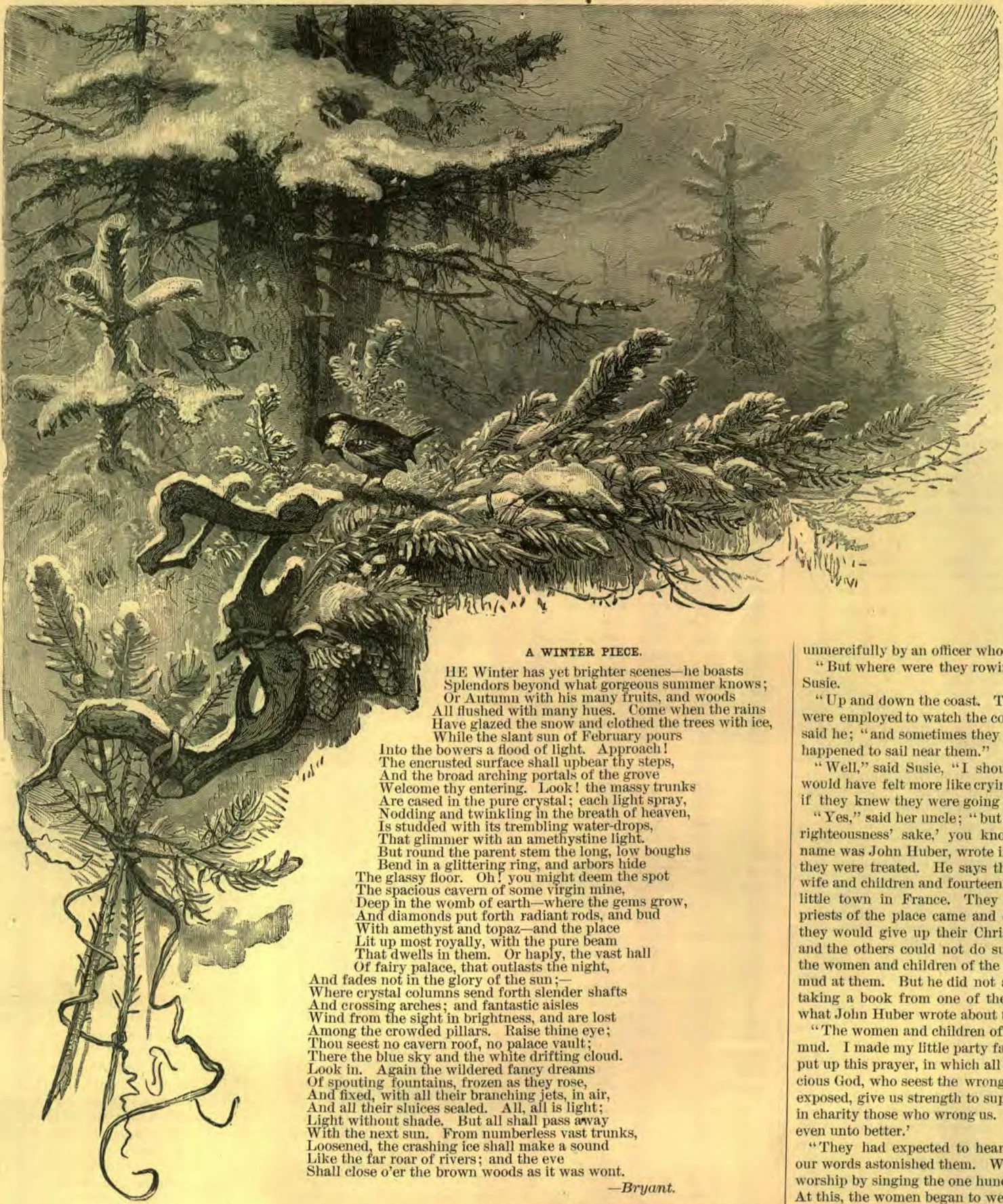
The Winter has yet brighter scenes—he boasts Splendors beyond what gorgeous summer knows; Or Autumn with his many fruits, and woods All flushed with many hues. Come when the rains Have glazed the snow and clothed the trees with ice, While the slant sun of February pours Into the bowers a flood of light. Approach! The encrusted surface shall upbear thy steps, And the broad arching portals of the grove Welcome thy entering. Look! the massy trunks Are cased in the pure crystal; each light spray, Nodding and twinkling in the breath of heaven, Is studded with its trembling water-drops, That glimmer with an amethystine light. But round the parent stem the long, low boughs Bend in a glittering ring, and arbors hide The glassy floor. Oh! you might deem the spot The spacious cavern of some virgin mine, Deep in the womb of earth—where the gems grow, And diamonds put forth radiant rods, and bud With amethyst and topaz—and the place Lit up most royally, with the pure beam That dwells in them. Or haply, the vast hall Of fairy palace, that outlasts the night, And fades not in the glory of the sun;— Where crystal columns send forth slender shafts And crossing arches; and fantastic aisles Wind from the sight in brightness, and are lost Among the crowded pillars. Raise thine eye; Thou seest no cavern roof, no palace vault; There the blue sky and the white drifting cloud. Look in. Again the bewildered fancy dreams Of spouting fountains, frozen as they rose, And fixed, with all their branching jets, in air, And all their sluices sealed. All, all is light; Light without shade. But all shall pass away With the next sun. From numberless vast trunks, Loosened, the crashing ice shall make a sound Like the far roar of rivers; and the eve Shall close o'er the brown woods as it was wont. —Bryant.

IN HIS NAME.

In 1864, some wounded soldiers lay in a farmhouse in the Shenandoah Valley. Mrs. B——, the mother of one of them, the wife of a neighboring planter, rode ten miles every day to see her boy, bringing with her such little comforts as she could obtain. Her house was burned, the plantation was in ruins, trampled down by the army. One day she carried him a pipkin of beef tea. Every drop was precious; for it was with great difficulty, and at a high price, that she had obtained the beef from which it was made.
As she sat watching her boy sip the steaming, savory broth, her eye caught the eager, hungry look of a man on the next cot. She turned away with a quick, savage pleasure in his want. He was a Yankee, perhaps one of the very band who had burned her home. She was a bitter secessionist. But she was also a noble-hearted woman, and a servant of Christ. Her eye stole back to the pale, sunken face; and she remembered the words of her Master, “If thine enemy thirst, give him drink.”
After a moment’s pause, and with pressed lips, for it required all the moral force she could command for her to do it, she filled a bowl with the broth and put it to his lips, repeating to herself the words, “for His sake; for His sake; for His sake I do it.” Then she brought fresh water, and bathed the soldier’s face and hands as gently as if he, too, had been her son. The next day, when she returned, he was gone, having been exchanged to the North.
Last winter the son of a Senator from one of the Northern States brought home during the Christmas vacation, as his chum, a young engineer from Virginia. He was the only living son of Mrs. B——, the boy whom she had nursed having been killed during the later years of the war. She had struggled for years to educate this boy as a civil engineer, and had done it. But without influence, he could not obtain a position, and was now supporting himself by copying.
Senator Blank became much interested in the young Virginian, inquired into his qualifications, and after he had returned home, used his influence to procure an appointment for him as chief of the staff of engineers employed to construct an important railway. It would yield him a good income for many years. Senator Blank inclosed in the appointment a letter to Mrs. B——, reminding her of the farmhouse on the Shenandoah, adding, “The wounded man with whom you shared that bowl of broth, has long wished to thank you for it. Now he has done it.”
The divine principle embodied in the act of the true-hearted Southern mother was never better exemplified; and the fruits of it, like those of every obedience to divine law, were a natural result, as well as the fulfillment of the promise that “bread cast upon the waters shall be found after many days.”—Selected.

FLAKES OF SNOW.

Gently, gently falling down, O’er the meadows seared and brown, Come the flakes of purest snow To the earth so far below. Merry voices welcome thee, Emblem of sweet purity.
Come and spread thy fleecy veil, Over mountain, hill, and dale, Till the earth is robed in white, Like a maiden pure and bright On her joyous wedding night.
Now the flowerets lie below, ’Neath their covering of snow, Yet we know they are not dead, Though their beauty now has fled; They have only gone to sleep, ’Neath thy snowy mantle deep.
When the gentle breath of spring Vivifying showers shall bring, Then the earth shall gently throw From her form its robe of snow; And with flowers upon her breast, In her robe of green be dressed.
Pure and white, the snow is given, Like the manna, fresh from heaven, Hiding every stain from sight, Pure, unsullied, clean, and white. May our souls as spotless grow As the pure and drifting snow.
MRS. L. D. A. STUTTLE.

Written for the Instructor

THE OLD AND THE NEW YEAR.

Time’s wheel keeps turning. It has just completed a revolution, bringing us to the dividing line between the years. At this point it is well to tread softly, and to deal candidly with one’s self; for each revolution of the wheel makes more impressive the fact that life is but a vapor, which soon vanishes.
How is it with you, dear young friends, as you stand upon the threshold of the new year; do you look back upon neglected duties, wasted opportunities, upon lives all stained with sin? If so, the prospect is not satisfying, surely; and life is very uncertain, so that this unhappy, unsaved condition is not safe.
Would it not be well, at the very beginning of the new year, to make it a time for a general searching of self, in order to learn where and what our weak points are, and what traits of character we possess which are most unlike Christ? and, having learned our true standing, to strive for victory over all our imperfections?
You read of great generals, as Grant, and others, who have taken strongly fortified cities, and are called heroes; yet the Bible says that he that ruleth his spirit is even a greater hero than they, from which we judge that it is no small thing to overcome sin. If left to ourselves, we could never perfect Christian characters. But all heaven is interested in every soul who wants help; so we may “come boldly unto the throne of grace, and obtain mercy, and find grace to help in time of need.”
How many will begin at this time to make God their first choice, giving him the best of themselves and of what they possess? When we do this, we only render him his due. But how richly he will reward the faithful, let him say: “Because he hath set his love upon me, therefore will I deliver him. I will set him on high, because he hath known my name. He shall call upon me, and I will answer him. I will be with him in trouble; I will deliver him, and honor him.” And what is best of all, he says, “With long life will I satisfy him, and show him my salvation.” By long life, he means eternal life.
Dear young friends, shall we merit this rich reward? Let us seek pardon for the mistakes of the past, making each one a “step that will help us to heaven at last.” We wish you each and every one a glad and happy New Year, and with you, will try to connect with God, that we may share his blessing now, and in all the future.
“Another year! while its moments fly, Be it our aim to live each passing day Upright and pure, thrusting all evil by, And walking firmly in the holy way. For strength of God let us unceasing pray, That so, in all we’re called to do, no fear May rise to turn our trusting hearts astray From that bright clime, where splendors shall appear, When we have entered life’s unending, glad New Year.” M. J. C.

Cowardice, Expediency, Vanity, and Conscience

COWARDICE asks, Is it safe? Expediency asks, Is it politic? Vanity asks, Is it popular? but Conscience asks, Is it right?

The Robin in an English Church.

It was the night before Christmas, in England, and snow was falling. They did not mind it in happy homes, where lamps were lighted, and fires burned cheerily, and tables were spread for tea. But a little robin, cold and hungry, hopped about wearily, seeking shelter and food. Our robins fly away south before snow comes, but this was across the sea, where the robin stays all the year.
The little bird lighted on window-sills, and tapped with his beak, but was seldom heard. Once, two little girls looked out of the window, and saw him; but it was so very cold that they quickly ran to the warm fire, and birdie flew away.
After awhile an old man came along in the path that led up to the village church. Robin hopped behind him; and when he opened the door, birdie was close by, and went in, without being noticed. Oh, how warm and comfortable the church was! The Sunday-school children had been there with their teachers, trimming the church with holly and mistletoe, and singing Christmas carols. The fire was to be kept all night, that the church might be warm for the Christmas service. The old man put on fresh coal, and went home. Birdie hopped about in the firelight, picking up some crumbs he found on the floor. Some cakes had been given to the children. How welcome this little supper was to the hungry robin, you can guess. Then he perched on the railings of the stairs, and tucked his head under his wing,—a very sleepy and happy bird. In the morning, his bright eyes espied, first thing, the scarlet holly berries. That was, indeed, a royal feast in robin’s eyes, enough to last for many weeks of wintry weather.
The hours flew on, and the happy children came and sang the Christmas carols.
Just as the first verse was finished, a clear, rich, joyous song burst from birdie’s little throat, high above, among the green branches. No one had seen him, and what a sweet surprise! The minister raised his hand to keep silence while birdie sang, and then, opening the Bible, read in reverent tones:—
“Yea, the sparrow hath found a house, and the swallow a nest for herself, where she may lay her young: thine altars, O Lord of hosts!”
“This time,” said the minister, “our favorite bird, our little Robin Redbreast, has found a lodging and breakfast in the church, where we come to pray for our daily bread. Snow is all around, covering the ground and bushes; he was cold and hungry, and might have perished in the storm, but the good All-Father, in his pitying love and tender care, guided the tiny wings hither.”
“The little bird praises him in its joyous song. Shall not we, with far greater reason, praise him gladly?”—Selected.

BRUSHING AWAY GOSSIP.

The Rev. Rowland Hill was a zealous though eccentric clergyman. He had a large fund of humour, and frequently drew upon it, in order “to paint a moral or adorn a tale.” On one occasion, while visiting a friend in the country, the conversation degenerated into idle gossip, and the character of several friends and acquaintances was severely reviewed.
Mr. Hill was much annoyed, but he remained silent until there was a lull in the tattling. Then he rose and rang the bell. The servant appeared.
“Have you a hearth-brush and dust-pan handy?” asked Mr. Hill. “Yes, sir,” replied the servant, wondering, as did the family and guests, what the eccentric clergyman could be thinking of.
“I wish you would let me have them for a few minutes,” said Mr. Hill. When they were brought to him, he began brushing the carpet.
“A prodigious quantity of dust and dirt has been scattered this evening,” he remarked, as he brushed away, “and I think it had better be removed.”
The hint thus picturesquely conveyed was taken. During the remainder of the evening, the conversation was more becoming to Christian ladies and gentlemen.

REGULAR HABITS.

Most people are apt to procrastinate, and leave to-day’s work for to-morrow. Yet habits of regularity contribute largely to the ease and comfort of life. A person can multiply his efficiency by it. We know persons who have a multitude of duties, and who perform a vast deal of work daily, who set apart certain hours for given duties, and are there at the moment, and attend rigidly to what is in hand. This is done, and other engagements are met, each in order, and a vast deal accomplished, not by strained exertion, but by regularity. The mind can be so trained to this that at certain hours in the day it will turn to a particular line of duty, and at other hours to other and different labors. The very diversity is restful, when attended to in regular order. But let these all run together, let the duties get mixed, and what before was easy is now annoying and oppressive. And the exact difference between many is just at this point. There are those who attempt to do several things at once, and accomplish little, while another will quietly proceed from one duty to another, and easily accomplish a vast amount of work. The difference is not in the capacity of the two, but in the regular methods of the one, as compared with the irregular and confused habits of the other.—Sel.

FOURTH SABBATH IN JANUARY.

LESSON 3.—SERVICES OF THE EARTHLY SANCTUARY.

1. Give a brief description of the sanctuary built by Moses.
2. Name the furniture of the holy place, and give its arrangement.
3. Describe the furniture of the most holy place.
4. Where was the altar of burnt-offering located? Ex. 40:6.
5. What was its use? Ex. 40:29.
6. What stood between this altar and the sanctuary? Ex. 30:18.
7. By what general name were the people of God designated at this time? Hosea 11:1.
8. What was the origin of this title? Gen. 32:28.
9. Into how many tribes was Israel divided? Ex. 1:1-5; Gen. 49:28.
10. Who were to minister in the sanctuary? Heb. 8:4, 5.
11. What tribe was selected to do the service of the tabernacle? Num. 3:5-7.
12. What particular family of this tribe was chosen to fill the sacred office of the priesthood? Num. 3:10.
13. Describe the regular daily offering and service of the sanctuary. Ex. 29:38-41; 30:7, 8.
14. How did the offerings on the Sabbath differ from those of other days? Num. 28:9, 10.
15. When an individual sinned, what was he required to do? Lev. 4:27, 28.
16. What disposition was made of the blood? Lev. 4:30.
17. Where did this altar stand?
18. When a priest sinned, what was required of him? Lev. 4:3, 4.
19. What was done with the blood of his offering? Lev. 4:5-7.
20. State the chief difference between these two offerings.
21. When a priest or the whole congregation sinned, how were their sins transferred to the sanctuary? Lev. 4:6, 17.
22. When one of the common people sinned, was the blood of his offering taken into the sanctuary? Lev. 4:30.
23. Then how were his sins transferred to the sanctuary? Lev. 10:17, 18.
24. Were the priests to partake of all the sin-offerings? Lev. 6:30.
25. Where were all these services performed? Ex. 29:42; Lev. 4:17, 18; Heb. 9:6.
26. What change was made in the continual round of service which we have described? Heb. 9:7.

PARIS RAG-PICKERS.

The chiffonniers (rag-pickers) live in certain streets which are occupied by members of the fraternity only. The best known of these is Rue Mouffetard, on the left bank of the Seine; but there are also large colonies at Montrouge, Montmartre and La Villette, and everywhere their habitations look more like gypsy camps than anything else. Their huts are built of the most extraordinary materials, the walls being either of kneaded mud, or, like those of the ancient lake dwellers, of wattle filled in with clay. A carriage wheel often does duty for a window, the spaces between the spokes being covered with oiled paper; and the roof consists of tarpaulin, or at best, of pieces of roofing paper, patched together. Some few buildings are constructed of brick, gypsum, or wood spars; but these are owned only by the very prosperous. Great cleanliness is, of course, out of the question, considering the nature of the goods which are piled up in and around the huts until they are sold; but the chiffonnier is personally less dirty than might be expected, and his health is as good as that of other people. Most of the fraternity have been chiffonniers all their lives, for the calling is hereditary in certain families, and has been for so many generations that the chiffonniers form a distinct caste, speaking, as Mr. Simons says, not a word of real French. The chiffonnier's principal treasures are bones, rags, paper, scraps of copper, sardine cases and other tins, and broken glass; and of these, 200 weight of bones bring him four francs, the same weight of paper from one to five francs, and green bottle glass one franc twenty centimes, or about a shilling. Cigar ends are also carefully collected and converted into Regie cigarettes. Money, jewelry, and the like he is expected to give up to the concierge or porter of the house opposite which he has found it, and he bears a high character for honesty in this respect. The sardine and other tins, of which such thousands are thrown away, go to support a branch of industry which is deeply interesting to the youthful part of the population; and after being stamped into shape by machines of simple construction, they reappear in the form of countless armies of tin soldiers, which are sold at prices so low that the manufacturer could not possibly afford to buy his material new from the tinman. They have never taken part in the frequent revolutions, they kept tranquil during the commune (the revolution of 1871), and it is said, went their nightly rounds, and calmly picked their dust heaps even during the fearful week when one part of the beautiful city was in flames, and Versaillists and communards were fighting like savages in other quarters.—Selected.

IMPORTANT BIBLE SUBJECTS.

LESSON 2.—THE APARTMENTS OF THE EARTHLY SANCTUARY.

[NOTE TO THE STUDENT.— Do not consider the lesson learned until you can give at least the substance of every text, with the correct reference for each. The references in black letters indicate those texts that should be committed to memory. A little diligent application each day will enable you to learn them, although this need not be considered a test of scholarship.]
  1. After the general instruction in regard to building the sanctuary, what seems to have been the first article of its furniture that Moses was instructed to make? Ex. 25:10.
  2. Where was this ark placed? Ex. 26:34.
  3. Describe the mercy seat, and give its position. Ex. 25:17–21.
  4. What was the testimony? Ex. 31:18.
  5. What was written upon these tables? Ex. 34:28.
  6. Where was this testimony placed? Ex. 25:21.
  7. Where was the altar of incense placed? Ex. 30:6.
  8. For what was this altar used? Ex. 30:7, 8.
  9. What were the people doing without, while the priest was burning incense within, the sanctuary? Luke 1:10.
  10. What beautiful allusion does David make to this service? Ps. 141:2.
  11. What other articles of furniture did the first apartment, or holy place, contain? Ex. 25:23, 31.
  12. For what was the table used? Ex. 25:30.
  13. How did Moses know how to make all these things? Ex. 25:40.
  14. Of what was this sanctuary a pattern, or figure? Heb. 9:24.
  15. Why was this structure erected? Ex. 25:8.
  16. How was God’s presence manifested in this sanctuary? Lev. 16:2.
  17. What place in the sanctuary did the Lord especially choose where he would thus manifest himself? Ex. 25:22.
  18. Did he ever meet with them in the first apartment? Ex. 29:42, 43.
OUR schools will notice that two lessons are given in this number. This was done in order that schools in distant parts of the country, such as Maine, Texas, and California, may have the lessons at the same time with our inland schools, thus doing away with the necessity of printing an extra edition for their benefit. Schools near the house of publication will thus have the lessons a week earlier than usual; but it was thought that this would be a better plan than to have the paper occasionally too late for the remote Sabbath-schools.

S. S. WORKERS, ATTENTION!

The year has closed, and your subscription to the S. S. Worker has expired. Have you renewed? If not, do so at once. No Sabbath-school worker can afford to be without this valuable magazine. Every number contains matter of vital importance to all growing Sabbath-schools. If you have not subscribed, you should do so at once, in order to work intelligently.
But you may ask, Why cannot the INSTRUCTOR contain these articles, and thus save us the expense of another paper? The space that can be devoted to the work in this paper is so small as to be wholly insufficient for the wants of Sabbath-schools. We could not find room to print long articles in regard to plans and methods. The Worker is devoted solely to this work. Every one, whether superintendent, teacher, or older scholar, ought by all means to have this magazine. Many of the plans are of general interest to all. If you are not at present a teacher, you may be asked to take a class, and should therefore keep informed in regard to the best methods of work.
The Worker will be published quarterly, as heretofore. Save twenty-five cents somewhere, and subscribe. Get up a club in your school, canvass the ground thoroughly. You will be amply repaid for all your efforts, in seeing a growing interest in your school.

ALASKAN GLACIERS.

The following description of Alaskan glaciers was published in Golden Days in November, 1884. Further discoveries may have been made since:—
“Of the ten thousand known glaciers of Alaska, two hundred or more flow into the ocean and drop off icebergs. The only scientist of note who has made a study of the glaciation of Alaska is Professor John Muir, of California, who visited it in 1879 and 1880, but has not yet made known his theories and discoveries.
“One of the six great glaciers that dip down and empty into Glacier Bay, at the foot of Mount Crillon, is named for the circumstance of his having been the first and only white man known to have visited it up to last July.
“Revenue-cutters and men-of-war had gone to the mouth of the bay, but were prevented from exploring bergs. John Muir went to the glacier in a canoe, and with his blankets on his back, and his pockets full of hard-tack, spent days of scientific delight among its crevasses and moraines.
“Last summer Captain Carroll seized the propitious time, and cruised along the front of the icy cliffs, the lead giving soundings of eighty fathoms at that point.
“The Muir glacier presents a frontage of two miles at the point where it breaks into the sea; and the icy wall, fretted and worn into a thousand fantastic shapes, rises five hundred feet and more from the water. Steep mountains and old moraines wall it on the sides.
“At low tide there is a continuous crack as fragments fall into the sea, and a thunder as of artillery when larger pieces detach themselves and go floating off to join the fleet of icebergs drifting with the tides up and down the bay.
“A subterranean river boils up midway on the front, and a muddy torrent emerges from the side of the glacier and pours down the ravine at the left. Access is had to the ice plain from that side; and as far as the eye can reach, stretch the sloping miles of the ice river, with smaller glaciers pushing in from every ravine.
“Over the broken pinnacles one looks down upon the bay, and a hollow gurgle and roar come from the infinite depths of the ice-world. In that high latitude the sun sets about ten o’clock, and the full rays falling on the front of the great glacier glorify the scene beyond all imagery.”

BANKING IN CHINA

You have recently read something about banking in India. The following paragraphs from the Youth’s Companion are regarding Chinese banking:—
“The ways of business houses are by no means the same the world over. According to a resident of Hong Kong, some peculiarities of custom attend banking transactions in that place. He says that the interior of the bank consists of a large, somber hall kept fairly cool by the waving of innumerable punkahs. We wish, suppose, to cash a check.
“‘Schroff!’ shouts the clerk, and immediately answering to the term—not German, but a corruption of the Hindoo word sarrof, bank’s clerk—there glides forward one of the native cashiers, with smooth shaven skull, a four-foot pig-tail, and spotlessly white, flowing garments.
“He is silent and rapid in his movements; and though his scanty stock of English is scarcely intelligible, he satisfactorily carries out the transaction in hand, your own complicated pencil and paper conversion of pounds into dollars and cents being easily distanced by the schroff’s peculiar method of calculation.
“Taking up a counting machine, his long, lithe fingers move over it far more quickly than the eye can follow; he plays on it with the rapidity of lace-making.
“‘All right as regards total,’ says the traveler. ‘Now give me three pounds in small change;’ for a supply of five-cent pieces is indispensable in China.
“A means has been devised for avoiding the weariness of counting out the three hundred tiny silver coins representing the sum in question.
“A pile of them is poured on a flat wooden tray, containing one hundred recesses, each of which is just deep enough to lodge one five-cent piece, and shallow enough to prevent the possibility of two such lurking together. A jerk of the wrist; the one hundred recesses are instantly filled, the surplus is swept off, and you have your correct amount, the schroff tucking up his enormous sleeves, as the money is poured into your hand, to disarm a possible suspicion that he is concealing any stray coins in their folds.”

HUMAN TREES.

It is a usual thing for insects to mimic nature in their appearance, as a protection from the attacks of their enemies; but that man can so mimic nature as to be mistaken for trees and shrubs by his fellow-men, seems almost incredible. However, such statements are confirmed by the most reliable naturalists, and interesting incidents regarding such mimicries have been published. The following paragraphs appeared in the Christian Union a few months since:—
“It is said that Bheel robbers of India, when followed by mounted pursuers over plains affording no sheltering trees or shrubs, but only the blackened trunks of trees left standing as the ruins of forest conflagration, have been known to seize a momentary opportunity afforded them of flinging down their plunder in little round heaps, which, covered with their round shields, have looked in the distance exactly like heaps of earth that have been noticed scattered about upon other parts of the plains. Then, seizing the nearest sticks, they have—standing perfectly still—thrown themselves into contorted attitudes, and have actually succeeded in deceiving their pursuers, who have rushed unsuspectingly by them. Here is the account of one of these tricks of mimicry, by the Rev. J. D. Woods, who says:—
“Before the English had become used to these maneuvers, a very ridiculous incident occurred. An officer with a party of horse was chasing a small body of Bheel robbers, and was fast overtaking them. Suddenly the robbers ran behind a rock, or some such obstacle, which hid them for a moment; and when the soldiers came up, the men had mysteriously disappeared. After an unavailing search, the officer ordered his men to dismount beside a clump of scorched and withered trees; and the day being very hot, he took off his helmet and hung it on a branch by which he was standing. The branch in question turned out to be the leg of a Bheel, who burst into a scream of laughter, and flung the astonished officer to the ground. The clump of scorched trees suddenly became transformed into men; and the whole party dispersed in different directions before the Englishmen could recover from their surprise, carrying with them the officer’s helmet by way of trophy.”

THE BATTLE OF HERRINGS.

Much has been said and written about the wonderful Siege of Orleans, that city of beautiful France, which happened in the 15th century; and “The Fair Maid of Orleans,” Joan of Arc, who came to the rescue and saved the city from falling into the hands of the English, will always be famous in song and story. While the siege was going on, a remarkable battle or skirmish occurred, which received a very curious name.
It was about the beginning of Lent, when fish is in great demand for food. Sir John Falstaff, a brave English officer, was sent to conduct a convoy of provisions, consisting mostly of salt herrings, for the use of the English soldiers, who were besieging the city. The French, hearing that such a convoy was to be sent, determined to intercept it on the road. Falstaff had an escort of 1,700 men, but the French attacked him with a much greater force. He, however, intrenched his men behind the wagons containing the provisions, and they not only sustained the attack without flinching, but fought so bravely that they threw their assailants into confusion. As soon as Falstaff saw that they began to give way, he ordered the barricade of fish wagons to be removed, and his men made a charge, pursuing the enemy with very great slaughter. Among the slain were twenty-six officers of distinction. This engagement was afterwards called “The Battle of Herrings.”—Treasure-Trove.

Teaching Children to Pay Debts and Keep Contracts

Dr. Dwight says that every child should be taught to pay all his debts, and to fulfill all his contracts, exactly in manner, completely in value, punctually at the time. Everything he has borrowed he should be obliged to return uninjured at the time specified, and everything belonging to others which he has lost he should be required to replace.
Continue reading: THE CRANE