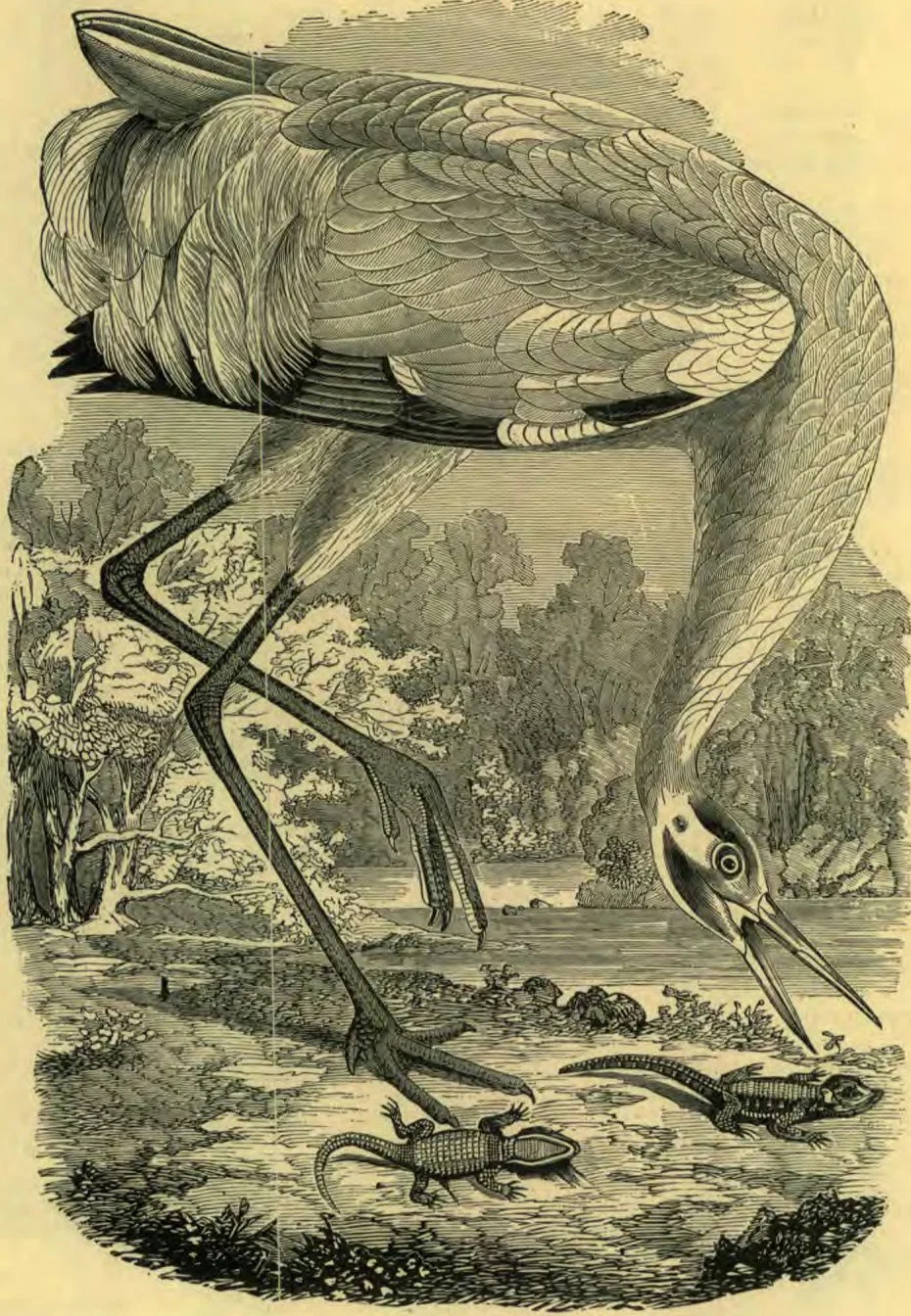
WHAT a long, awkward bird this one in our picture is! He belongs to that great family of water birds known as waders. He lives near rivers and marshy sedges. And when you have learned that, you can see of what use his long, slim legs are to him. He can wade around among the tall reeds and rushes and in the deep mud, hunting for his food, where an ordinary bird could not go at all. In the same way, his long neck, that makes him look so homely, is also useful to him.
There are a good many kinds of cranes, and some of them are very odd, indeed. One of them is called the Demoiselle Crane. “Demoiselle” is the French word for “young lady.” This bird was given this name because it is slow and graceful, and also very dainty. It has a funny way of dancing about on the tips of its toes, and flapping its wings, all the time bowing its head in the most comical fashion. The Crowned Crane, a different looking bird from the Demoiselle, also has these queer ways. How odd these birds must look when dancing!
In the summer season, the cranes fly from South America, often far to the north of us. You cannot see them go, for they fly up high in the air, away out of sight. But you might hear their cry, which is loud and piercing, and sounds like the far-off blast of a trumpet. It is a strange noise. The crane could not make it if it were not for the queer music box in his throat. This music box is his windpipe, which is very long. Instead of going straight to the lungs, it passes into the breast bone, and after several twistings, reaches his lungs.
He is a shy, wary bird, and very hard to shoot. But when he is wounded, he is savage indeed, and can keep away the bravest hunter. He can fight vigorously with his sharp bill and strong wings. The great naturalist, Audubon, was once attacked by a crane that he had shot in the wing. As he came near it, the bird stretched itself up to its full height, and angrily ran toward him, with open beak, till finally Audubon was obliged to run into the river up to his neck, and wait for his boatmen to come up and kill the bird. They laughed heartily at him; yet I do not think one of them would have changed places with him, and faced the savage bird. W. E. L.
OLD WINTER IS COMING.
Old Winter is coming; alack, alack! How icy and cold is he! He’s wrapped to his heels in a snowy-white sack, The trees he has laden till ready to crack; He whistles his trills with a wonderful knack, For he comes from a cold country.
A funny old fellow is Winter, I trow, A merry old fellow for glee; He paints all the noses a beautiful hue, He counts all our fingers, and pinches them too; Our toes he gets hold of through stocking and shoe, For a funny old fellow is he.
Old Winter is blowing his gusts along, And merrily shaking the tree; From morning till night he will sing us his song, Now moaning and short, now boldly and long; His voice it is loud, for his lungs are so strong, And a merry old fellow is he.
Old Winter’s a rough old chap to some, As rough as ever you’ll see. “I wither the flowers whenever I come,” I quiet the brook that went laughing along, I drive all the birds off to find a new home; I’m as rough as rough can be.”
A cunning old fellow is Winter, they say— A cunning old fellow is he; He peeps in the crevices day by day To see how we’re passing our time away, And mark all our doings from sober to gay; I’m afraid he is peeping at me!
—Selected.
THE THREE MESSENGERS.
THERE was a king who wanted to send a message to a country a long way off. It was a message of importance, so he wished to find a trusty servant to carry it.
Now, as the king passed through his palace, he espied Budo, who was known to be the strongest man in his court, lounging listlessly about.
“Take this message for me, and I will give thee a goodly reward,” said the king.
Budo took the message, and started off. But the work was not to his taste; and as he went loitering about, he lost the message, and never delivered it at all.
Then the king went to Nudio, who was known to be the swiftest runner in the country, and he said to him: “Nudio, take this message for me, and I will give thee a reward.”
“With all my heart,” replied Nudio; and thrusting the message into his dress, he set off at a brisk run, taking a stout staff with him. “For,” said he, “it will serve me to lean on when my way lies up hill, or as a weapon of defense should any one molest me.”
He had got a good way on his journey, when he overtook a man who appeared traveling the same way as himself, who suggested that they might as well walk together.
Now, Nudio knew that the king’s business required haste, but his own ease was dearer to him than his monarch’s wishes, so he slackened his pace, and quickly entered into conversation with his fellow-traveler. Alas! the man was a thief; and knowing that Nudio was the bearer of a message from the king, he felt sure that something valuable was in the packet Nudio carried, and determined to get it. But how to do so was the question, for Nudio was strong and brave, and able to run like a hare if need should arise.
The stranger’s eye fell on the staff the messenger carried. “That is a fine stick,” he exclaimed, slyly; “let me feel its weight in my hand.”
And Nudio, all unsuspecting of treachery, gave up the staff. No sooner had the stranger taken it than he fell upon Nudio with all his might, striking him with the weapon so suddenly that he fell senseless on the ground. Then the robber searched for the message; and great was his disappointment when he found it contained no treasure such as he expected, and he angrily cast it to the winds.
So the king once more searched his palace for a messenger, and this time his choice fell on a little lad who all day long had been hovering near, and longing to be useful.
“Take this message for me,” said the monarch, reading in the child’s eye the wistful desire of his heart, “and I will give thee a reward.”
Away dashed little Zedo, as he safely folded the king’s message under his robe; and though the way was long and difficult and lonely, he would not rest until he had safely delivered it.
Dear children, you, too, may be messengers of a king—the King of glory—and the messages he gives to you to carry for him are kind words and loving deeds, and obedient wills to his commands. And he promises great rewards to those who carry his messages faithfully.—Christian at Work.
Letter Budget.
GENIE H. EATON writing from Toland Co., Conn., says: “If you will let my mamma write for me, I will send a letter for the Budget. I can't write very well. We are always glad when our little paper comes; and the first thing I look at is the pictures. The picture in the last paper of an “outdoor school” I looked at a long time. I should like to go to school outdoors, for we have large trees near our school-house; but I should want our teacher, for he is gentle and patient. I know if we had the stern man in the picture, with his rod, I should miss every word, and could not be at the head of my class, as I have been for two weeks. Now that I am seven years old, mamma says the INSTRUCTOR can come in my name next year. It is sent in Freddie's now. He is just as old again as I am, and he is a pretty good skater. I can't skate, but I take my sled on the ice, and we have jolly good times. I bring in the wood, and help Fred with his chores, and we have to hurry so as not to be tardy at school. I want to tell you lots more, but mamma says my letter is getting too long. When I can write, I shall tell you about the brook, and the ducks, and some of the little boys here. I shall not feel bad if you don't print this; for I would rather read some other boy's letter. I wish the editors, and all the little girls and boys a merry Christmas and a happy New Year.”
We cannot wish you a merry Christmas, Genie, for that is in the past; but we wish you a happy New Year,—a year filled up with loving words and kind deeds. How glad we all are that we don't need to go to school in a heathen country, and that God blesses us with kind parents and teachers who lead us gently over the road to knowledge and usefulness. But the picture of the man with his rod may awaken sympathy in our hearts for the heathen boys and girls everywhere, so that we will donate what we can spare to help missionaries in carrying them the light of truth. You have written a very interesting letter, and the little boys and girls will all gladly welcome the “lots more” you have to tell when your mamma thinks best that you shall send it.
IDA BROMLEY writes from Kendall Co., Ill. She says: “I love to read the letters in the Budget, so I thought I would write one too. I am twelve years old. I go to school, but not to Sabbath-school; for it is eighteen miles to the nearest church. My sister and I keep the Sabbath with mother, and learn our lessons at home. My father and one brother and sister do not keep the Sabbath. My oldest sister works in the paper mill. I love to see her stack paper. My cousin Carrie Elliott and her two children, John and Seward, from Battle Creek, are here on a visit. I am trying to be a good girl, so as to meet the INSTRUCTOR family in the new earth. Pray for me.”
Let us all remember Ida, as well as all the others who do not have Sabbath privileges. We are glad the scattered children can have the Sabbath-school lessons and the INSTRUCTOR as helps.
KATY MAY DUNHAM writes a letter from Jackson Co., Mich. She says: “I am nine years old. I have one brother and one sister. My parents keep the Sabbath. I go to Sabbath-school most every time. This is the first time I ever wrote a letter to the Budget; I hope I can write another sometime. I want to be a good girl so I can meet you all in the new earth.”
You can write another letter sometime, Katy; and when you write again, can't you tell us something of your home life?