RATON, N. M., Feb. 4, 1905.
COLO. TRACT SOCIETY, DENVER, COLO.:
I write to you to-day, and enclose a true copy of a letter from Chief Justice Mills, of our territory, to the sheriff of our county, who resides in Raton, the county seat.
In compliance with the request in Judge Mills' letter, Sheriff Littrell called on all of the business men of Raton, January 27, and notified them all to close on Sunday, reading the letter to each one, and of course I did not escape. I had a conference with the sheriff later, and presented my reasons minutely, leaving some reading matter to explain more fully the reasons why I could not comply with the request.
He was very lenient, and listened attentively. I informed him that I had expected this before now, and that when the time came for my arrest, I should not cherish any feelings of contempt against him, or other officers of the law, for fully discharging their duty, and that I would come along with him like a man. I asked for a copy of Judge Mills' letter, and send it herewith.
Your Brother in Christ,
E. K. CASSELL.
Santa Fe, N. M., Jan. 21, 1905.
TO MARION LITTRELL, SHERIFF OF COLFAX,—
Dear Sir: I desire to call your attention to the message of Governor Otero, recently delivered to the Legislature of this territory, and particularly to that part of it which has reference to the enforcement of what is commonly designated the Sunday law.
As peace officer of your county, it is your duty to see that this law, together with all others that are on the statute books, is vigorously enforced, and I call upon you to notify the people of your county, if any, who may be violating its terms, that this law must be obeyed.
It is also your duty to see that evidence is collected against any violators of this law, so that the same may be presented to the next grand jury which meets in your county.
Very respectfully,
WILLIAM J. MILLS,
Chief Justice.
In the County Jail.
Raton, N. M., March 31, 1905.
ELDER H. M. J. RICHARDS, PUEBLO, COLO.—
Dear Brother: The judge sentenced me to fifteen days in the county jail, and costs of court, which are $28, making forty-three days altogether in jail. There were two others fined the same as myself. The sheriff served the warrant on me Thursday at 11 o'clock, with a bond of $500. He said, "Here is what you have been expecting." Then he read the warrant, which charged me with "performing labor on the first day of the week, commonly called Sunday." I asked, "When shall I go?" He said, "If you say you will come, I will go back to the court-house, and you can come this afternoon at 2 o'clock." I went on time, and just about time for court to convene. Mr. Sproull came up and asked me if I was not going to employ a lawyer. I said, "No." Then Mr. Sproull said that he would; so he sent Mr. Studley. He asked me what I was going to do. I said, "I am guilty of the charge, but I want to appeal for extension to the next term of court." There was no time left to do anything before my case was called, so he stepped up, and plead, "Not guilty." Then my case was set for Thursday, at 2 P.M. (March 30).
I made appearance, and plead "guilty." The judge set the case for Saturday. I said that I could not appear on Saturday. Then he studied a moment, and set it for Friday, March 31, at 2 P.M. But he sent the sheriff after me to appear at 9:30 A.M. I went, and the judge asked me what I had to say. I said that I was a Seventh-day Adventist, and had kept the Sabbath; I believed I had a right to work six days, and that God commanded me to observe the seventh day; therefore I was working on Sunday.
The judge said, "You knew it was a violation of the laws of the territory?" I said "Yes." "Then why did you violate it?" he asked. I said, "Because I believed that I had a right to do so. Because it conflicts with the law of God." He then said, "You are like the Mormons, who believe that because God gives them a right to more than one wife, they are at liberty to break the law of the land?" I replied, "Having more than one wife is a civil offense, but performing honest labor is not a civil offense." The judge said, "Then you are like the Jew, who does not believe in God (Christ, I suppose), and keeps Saturday?" I said, "According to the Constitution of the United States, I believe the Jew has as much right as any one." He interrupted me, and said, "This Sunday work must be stopped, and the law enforced. I will sentence you to fifteen days in the county jail, and costs."
The court adjourned until August, 1905. I am exceedingly glad that I am accounted worthy of the "light affliction" now, and to suffer for the blessed cause of the Third Angel's Message. I have already been asked to make a talk to the prisoners to-morrow. They made the request themselves. I had beans, light bread, and apricots for dinner. Pray that the sheriff and his family may receive this truth, as well as the prisoners. Pray that I may speak, with boldness, the truth.
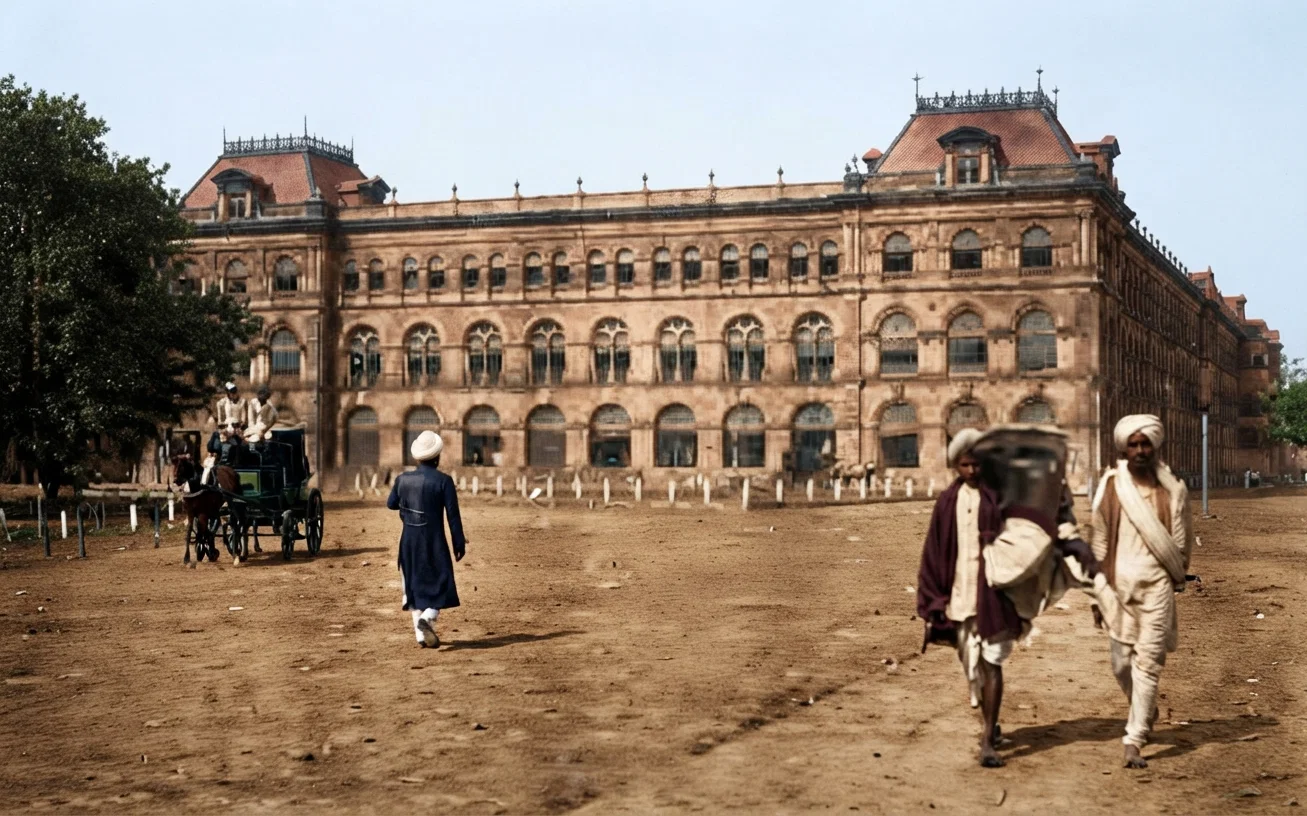
One of the Government Buildings in India.
Your Brother in Christ,
E. K. CASSELL.
THE PROGRESS OF CHURCH AND STATE UNION.
[From our correspondent at Washington, D. C.]
The State as a Teacher of Religion.
WHAT the opponents of the idea of the state's assuming to teach religion have maintained ever since the proposition was suggested, is at last admitted by one of the foremost advocates of such a scheme.
Dr. Wilbur F. Crafts assures the Washington public that "nothing new is proposed" in the movement now on for religious instruction in the public schools, that "teachers are not required to teach Christian morality," that "the present law requires the reading of the Bible in the schools, the repetition of the Lord's Prayer, and the teaching of Christian morality, including 'the laws of God.'" "What is proposed," says Mr. Crafts, "is to require that this teaching shall be mapped out definitely by the board of education, instead of being left, as now, to the discretion or indiscretion of the individual teacher." "Manifestly," he says, "the teachers would be far more likely to work in their personal opinions under the present plan than under the new one proposed, under which the board of education would carefully prescribe just what is to be taught."
Exactly, Mr. Crafts, and you could not have more thoroughly indicted this scheme nor more fully exposed its danger than by the explanation you have so freely proffered to the public. Already religious teaching is required or permitted, but the matter can not be allowed to rest there; the teaching must be "mapped out definitely" by some authority which "must prescribe just what is to be taught." There must be no opportunity left for personal opinion or individual discretion in the religious teaching; it must come from some authority and the teachers must be mere machines in teaching the religion prescribed by that authority.
Mr. Crafts has brought to view a tendency which inevitably begins the moment government touches religion, and which, if it continues to deal with it, must inevitably lead to a governmental bureau of7religion with a Popiedenzeff or a Crafts at its head to prescribe and map out definitely just what shall be taught and believed in religion in the country. It is significant that Mr. Crafts has so plainly brought to view the fact that this movement now on in Washington for the teaching of religion in the public schools is a movement for the elimination of personal opinion in religious teaching and for the substitution, therefore, of official authority to map out definitely and to prescribe just what shall be taught in religion. It is safe to say that no one has done more than Mr. Crafts to show the inherent evil of this church-and-state scheme now on in Washington, which he is actively supporting.
Catholics and the Y. M. C. A.
A recent news item in a Washington paper, announcing that "Catholics and Y. M. C. A. will co-operate in work among the laborers on the isthmus," reads:
Archbishop Ireland had a conference with Secretary Taft yesterday on the subject of the religious welfare of the men employed in the construction of the Panama Canal, especially in connection with the plan for the establishment of branches of the Young Men's Christian Association in the Canal Zone. It was made clear that there is no antagonism between the Catholic Church and the Young Men's Christian Association, and it is said that an effort will be made to have the two bodies co-operate in the work of extending the Christian spirit among the workmen.
One can but wonder what the Secretary of War has to do with such a matter. But, perhaps, looking after "the religious welfare" of the people of the "appurtenant" territories has become one of the functions of the War Department. It would seem so from incidents like the above that transpire from time to time.
Church and State in the Philippines.
On December 15 last, the Secretary of War and the Roman Catholic apostolic delegate to the Philippines, Mgr. Agius, who was on his way from Rome to the Philippines, "were in conference for some time touching Philippine affairs in which the Catholic Church authorities are interested." While "one of the matters related to claims for damages for the occupation of the church lands and church buildings," we were told that "a more important matter to the church authorities was the controversy between the Roman Catholic Church and the Aglipayan Church." It would hardly seem that this other matter came within the proper sphere of the War or Colonial Department, unless, indeed, it has undertaken to look after the religious, as well as the civil, affairs of the people in these possessions. The conference on this occasion between the Secretary of War and the papal delegate "was held at the residence of Secretary Taft, so that it might be informal and the conference be uninterrupted," and on this occasion the Secretary entertained at luncheon besides the "apostolic delegate," "Mgr. Falconio, apostolic delegate to the United States, and former District Attorney Philbin, of New York, a prominent Roman Catholic layman. In the evening of this day "Secretary Taft and Mgr. Agius called at the White House and discussed for some time with the President matters relating to the Philippines." One of the objects of the whole proceeding, we were told, was "to exchange views with reference to the important question of the relations between the Catholic Church and the government in the Philippines." From these incidents and other things that are seen occasionally, it would seem that it is about time there was some exchange of views on the part of the people of this country with reference to the important question of the relations between the Catholic Church and the Government in the United States.
SITUATION IN THE ORIENT.
THE eyes of the world are now turned toward the China Sea, where the fleets of Russia and Japan are in close proximity. The Russian fleet is sailing toward the Island of Formosa, and the Japanese are keeping close watch on its every movement. The Japanese are considerably outnumbered by the Russians, and it is not thought that a general engagement will be hazarded by Admiral Togo until he has weakened the Russian fleet by torpedo-boat attacks at night. News of night attacks of this kind may be expected at any moment. Russia is risking her all, so far as sea-power is concerned, in the desperate endeavor to overwhelm the Japanese fleet and gain the mastery of the oriental waters. The Japanese realize the importance of the outcome, and are taking every precaution to insure victory. With Japan's fleet destroyed or seriously disabled, and her great army still in Manchuria, her plight would be a desperate one, and Russia would have an overwhelming advantage.
It is reported that in case the Russian fleet is unsuccessful, the world may look for a great popular outbreak in Russia. Aggressive forces are concentrating for action. Demands for reform are coming from influential bodies as never before; workmen are more insistent in their demands; and the government feels under the necessity of taking greater precaution for the safety of the established order.
In Manchuria there have been but slight skirmishes between outposts or small detachments, with little or no advantage to either. The Russians are concentrating, but the disposition of the Japanese forces is kept closely veiled.
The lawyers of Russia have organized, and are holding meetings against the orders of the police. They are demanding greater freedom and the participation of the people in the affairs of the government. Every district in Russia save Siberia is represented in the lawyers' organization. In one of their published statements they declare that their country is on the verge of a precipice; that the poverty-stricken populace are driven by the malevolence of the government into agrarian and industrial revolt; that the social and economic questions can not be settled by the bureaucracy; that political reform is imperative; that each minute of delay increases the anarchy and revolt; that the representatives of the people should have the principal influence in the government; and that the bureaucracy should be relegated to a minor role; that all class privileges, political or religious, should be obliterated; that the principle of universal suffrage should be adopted; and that every restriction upon the liberties of the press and speech should be removed.
The discussion of the details of the bill for the separation of church and state in France is giving rise to lively debates in the Chamber of Deputies. The government's supporters firmly uphold the contents of the committee's text, rejecting by large majorities numerous amendments to the first paragraph. The second section, containing the fundamental principles of the bill, "that the republic neither recognizes, provides stipends, nor subsidizes any religion," was adopted on April 13 by a vote of 337 against 233. The French Government in this is taking a stand on straight religious liberty principles. There is a large and growing element in our country that could profitably take lessons from the present action and course of the government of France.
Some of New York's wealthiest men have recently had erected a palace of amusement called the Hippodrome, at the enormous cost of $3,500,000. On the first night of its opening the patronage was so large that it was decided by the backers of the enterprise to erect similar structures in each of the other large cities of the United States. The clamor of the people of this age for amusement, and the willingness of shrewd financiers to invest their wealth in such marvelous structures devoted to pleasure, show that this is an age of pleasure-seeking and wealth-seeking. "Lovers of pleasure more than lovers of God" is a most fitting designation of the mass of the people of this age.
The governor of Wisconsin has signed a bill which outlaws the cigaret in that state. According to this bill, cigarets are not to be manufactured in that state for sale in the state, nor may they be handled by dealers or carried on the person. The penalties for the violation of the law range from $5.00 to $100 and six months in prison. It is to be hoped that the law may result in the eradication of the cigaret evil from that state, and that its influence may be felt in other states. There is no one thing that is doing more to undermine constitutions, and to debase young men's ideas of manhood, than is the cigaret.
The sultan of Morocco continues to disregard the wishes of France and follows the advice of Germany. Germany is now negotiating a treaty with Morocco, without any regard to the claims of France as a directing factor in Moroccan affairs. This treaty embraces all the "most favored nation" features, and upon this treaty Germany will press her resistance to France's efforts to become the dominating power in Morocco.
The great merger of the New York Central, the Union Pacific, and the Chicago and Northwestern Railroads will bring 36,000 miles of track under one management. Bonds to the amount of $790,000,000 will be put on the market at once. There will be above two billion dollars worth of stocks and bonds covering the system, which will be the most extensive and most valuable system in the world.
Venezuela's president has conveyed his reply to the demands of the United States to the State Department at Washington. The language of the reply is said to be very vigorous. Some even regard it as being offensive and somewhat in the nature of an ultimatum.
Another hurricane is reported from the South Sea Islands, and it is reported that much damage has been done.
The body of John Paul Jones has been unearthed in Paris, and will soon be brought to this country for interment.
A SAD TENDENCY.
By H. Hansen
So many of our high schools and low schools, colleges, church seminaries, and state universities are training our boys and girls to ruin! It is all games, sports, baseball, football, golf, basket-ball, punching-bag, prize rings, and athletic clubs; and the results: broken noses, broken limbs, broken ribs; not infrequently death occurs. Dice, cards, saloons, jails, states' prisons, hell. Why not lessons on honest business, and warnings on the pitfalls of Satan that are in their paths? H. Hansen.
SECTARIANISM IN THE PUBLIC SCHOOLS.
By John D. Bradley
THE writer of this has sent two or three communications to the Washington Post with reference to the demand for definite religious teaching in the public schools of the District of Columbia, but, for some reason, none of them have been published. The following is from one of these communications:
It is claimed and argued by these churchmen that there is no sectarianism in this matter; that the religious teaching proposed is not sectarian, because the great majority of the people believe that way.
Do these gentlemen not know that, if every person in this country save one believed alike in religion, and there was but the one person believing differently, in the view of the state, and upon the principle of religious and civil equality which the state must maintain, the religious belief of that overwhelming majority would be just as much sectarianism as the religious belief of the one man?
Do these gentlemen not know that, so long as there is a single dissenter from any religious belief, principle, or teaching, that such belief, principle, or teaching is sectarian? and that there is no religious belief, principle, or teaching so universal that it can be other than sectarian to the American state?
Do these gentlemen imagine that the inculcation in the public schools of the idea that the Ten Commandments are the "divine" and "revealed law of God," received by man directly and miraculously from the hand of the Almighty, is not sectarian teaching? If they do, they would better go to the intellectual centers of their own religious bodies, and find out if this is an idea that is universally accepted there, and from which there is no dissent.
In the present state of opinion on this matter, the assumption that the teaching of the Ten Commandments upon a supernatural basis, and with the idea that they were written or spoken by the Almighty, is not sectarian teaching, is preposterous.
It is not the principle of non-sectarianism upon which these Washington churchmen are proceeding, but the principle that the sectarianism of the majority can properly be taught by the state.
Upon their principles and logic, the most narrow sectarian teaching would be perfectly proper in the public schools, if the people who believe in it were in the majority. If Methodists were in the majority, it would be all right to teach Methodism in the schools; and if Roman Catholics were in the majority, it would be all right to teach Catholicism in the schools. The principle is not whether the religious teaching is sectarian or not, but whether it is accepted and believed by a sufficient number of the people to secure for it the endorsement which it necessarily must have in order to come into the schools of a democratic community. It is a principle that will not do in this country nor in any country, where the principles of modern civilization are dominant. JOHN D. BRADLEY.
GOD MANIFEST IN THE FLESH.
By Ellen G. White
BY MRS. E. G. WHITE.
THIS earth has been honored and blessed with the presence of the Son of God. In the Scriptures we read of His incarnation, His teaching, His miracles, His death, and His resurrection. The effort to understand these wonderful subjects puts to the tax the highest powers of the mind, and then there is an infinity beyond which can not be exhausted. The oftener the mind is called to this study, the stronger and clearer it will become. In the daily life will be revealed the mysteries of godliness, which may be experienced, but can not be explained. Throughout the ceaseless ages of eternity the redeemed will study these subjects, ever gaining from them a deeper and clearer knowledge of God and of Christ.
What opposites meet and are revealed in the person of Christ! The mighty God, yet a helpless child! The Creator of all the world, yet, in a world of His creating, often hungry and weary, and without a place to lay His head! The Son of Man, yet infinitely higher than the angels! Equal with the Father, yet His divinity clothed with humanity, standing at the head of the fallen race, that human beings might be placed on vantage-ground! Possessing eternal riches, yet living the life of a poor man! One with the Father in dignity and power, yet in His humanity tempted in all points like as we are tempted! In the very moment of His dying agony on the cross, a Conqueror, answering the request of the repentant sinner to be remembered by Him when He came into His kingdom, with the words, "Verily I say unto thee to-day, Thou shalt be with Me in Paradise."
Christ was God manifest in the flesh. In Him divinity and humanity were united. In Him dwelt all the fulness of the Godhead bodily. He lived in this world a perfect life, revealing the character to which, through divine grace, man may attain. In His life He left an example that every true Christian must follow. No falsehood ever fell from His lips. Never did He do a dishonest act. He stood forth in unsullied purity and goodness, revealing what man must be before he can enter the holy city.
Christ's life was one of constant self-sacrifice. He came to this world to live, in our behalf, the life of the poorest, to walk and work among the needy and the suffering. Unrecognized and unhonored, He walked in and out among the people for whom He had done so much. On the hillsides of Galilee, in the great thoroughfares of travel, by the seashore, in every place where there were those who needed help, Jesus healed the people, and pointed them to their heavenly Father. His life laid the foundation for a religion in which there is no caste, where Jew and Gentile, free and bond, are linked in a common brotherhood, equal before God.
Christ lived a life of prayer. Daily beset by temptation, constantly opposed by the leaders of the people, He knew that He must strengthen His humanity by prayer. In order to be a blessing to men, He must commune with God, from Him obtaining energy, perseverance, steadfastness.
Christ is our Burden-bearer. He came to bear the trials that we must bear, to resist the temptations that we must resist. He came to show that, by receiving power from on high, man can live an unsullied life. With sympathetic love and tender compassion, without a trace of harshness, He meets us in our necessities. Armed with the weapons of love, He works with gracious helpfulness and unwearying patience. By the gentle touch of grace, He drives from the soul unrest and doubt, changing enmity and unbelief to confidence and faith.
"In the beginning was the Word, and the Word was with God, and the Word was God. . . . And the Word was made flesh, and dwelt among us, . . . full of grace and truth." "We have not an High Priest that can not be touched with the feeling of our infirmities; but was in all points tempted like as we are, yet without sin." "In all things it behooved Him to be made like unto His brethren, that He might be a merciful and faithful High Priest in things pertaining to God, to make reconciliation for the sins of the people."
IS THE BIBLE GOD'S WORD TO US?
By Daniel Nettleton
BY DANIEL NETTLETON.
"All Scripture is given by inspiration of God, and is profitable for doctrine, for reproof, for correction, for instruction in righteousness, that the man of God may be perfect, thoroughly furnished unto all good works." 2 Tim. 3:16, 17.
WE believe that there is one true and living God, and that the holy Bible is a revelation of His character and will to us. If there is one true First Great Cause (and none but the fool has said there is no God), is it not reasonable that He would make a revelation of Himself to His creatures? Will the all-wise Creator, after having made us and placed us in this world, abandon us and never have a thought or care for us further? Would not that be contrary to the law of parentage? Do not the parents love to care for and communicate with their offspring? The apostle Paul, when reasoning with the heathen of Athens, who had erected an image to the
"unknown god," and were ignorantly worshiping it, desired to convince them that God is not an unfeeling being, like a cold piece of gold or marble, but a living, loving, and merciful Father. So he addressed them in these words:
"Ye men of Athens, I perceive that in all things ye are too superstitious. For as I passed by and beheld your devotions [gods that ye worship], I found an altar with this inscription, TO THE UNKNOWN GOD. Whom therefore ye ignorantly worship, Him declare I unto you. God that made the world and all things therein, seeing that He is Lord of heaven and earth, dwelleth not in temples made with hands; neither is worshiped with men's hands, as tho He needed anything, seeing He giveth to all life, and breath, and all things; and hath made of one blood all nations of men for to dwell on all the face of the earth, and hath determined the times before appointed, and the bounds of their habitation; that they should seek the Lord, if haply they might feel after Him, and find Him, tho He be not far from every one of us; for in Him we live, and move, and have our being; as certain also of your own poets have said, For we are also His offspring. Forasmuch then as we are the offspring of God, we ought not to think that the Godhead is like unto gold, or silver, or stone, graven by art and man's device." Acts 17:22-29.
Our all-wise, almighty, loving Father has not left us comfortless. He speaks to us. All nature cries out that He loves us. The flowers; the birds, in their cheerful songs of praise; the grass; the woods that clap their hands with joy; the sparkling fountains and laughing brooks; the deep, broad rivers that flow in silence to the sea; the great mountains; and the mighty ocean; all, all proclaim "the Hand that made us is divine." Vocal speech is not the only language, the encircling of the arm of flesh is not the only embrace; the bright-faced sky, the sweet-scented, and beautiful spring, the golden fields of grain, and rich harvests of autumn, and innumerable anthems and tokens of joy, are all expressions of His power and love.
"For the invisible things of Him from the creation of the world are clearly seen, being understood by the things that are made, even His eternal power and Godhead." Rom. 1:20.
"The heavens declare the glory of God; and the firmament showeth His handiwork. Day unto day uttereth speech, and night unto night showeth knowledge. There is no speech nor language, without these their voice is heard." Ps. 19:1-3, margin.
The open book of nature is not the only book God has written for His children. The Holy Bible is to man a letter of affection from our loving Father. "Whatsoever things were written aforetime were written for our learning, that we through patience and comfort of the Scriptures might have hope." "These things I have spoken unto you, that in Me ye might have peace."
"This Book, this holy Book, on every line
Marked with the seal of high Divinity,
On every leaf bedewed with drops of love
Divine, and with the eternal heraldry
And signature of God Almighty stamped.
From first to last this ray of sacred light,
This lamp, from off the everlasting throne,
Mercy brought down, and in the night of time
Stands, casting on the dark our gracious bow,
And evermore beseeching man with tears
And earnest sighs, to read, believe, and live."
The Bible is a library of books, sixty-six in number. It was written by thirty-two persons at different times, covering a period of sixteen hundred years. It was written by men in every phase of life, from the lowly shepherds to the wisest and greatest monarchs that have ever governed nations. It was written in9lonely deserts, in the shade of a great rock in a weary land, by the mournful waters of the great Euphrates, in great cities, and on rock-bound, storm-beaten Patmos. When the Egyptians were writing riddles upon their monuments to baffle the blind inquirers of succeeding years, Moses, the man of God, was writing the clear, simple story of Creation, the fall of man, and the plan of his redemption from sin.
"And never earth's philosopher
Traced with his golden pen,
On the deathless page words half so sage,
As he wrote down for men."
WE gaze on the work of His fingers,
We quail at the power of His rod,
We hope in the word He has spoken,
And, trembling, rejoice in our God.
His Spirit upholds His creation,
His power it were vain to resist;
Self-existent, unfathomed by reason;
But, O! should He cease to exist!
Then would darkness more than Egyptian
Be felt, till all feeling were past;
While His empire crumbled to nothing,
And being and life breathed their last.
He sits on His throne in the heavens,
Where rises the fountain of light;
The folds of His raiment are sweeping,
Star-lit, through the fields of our night.
The crown on His brow is a rainbow;
From His presence all darkness must fly;
The purple of evening may linger
Till dawn blushes red in the sky.
For in the completeness approaching,
When time has relinquished its flight;
Tho day may be tinted with changes,
We know that there will be no night.
And weeping shall pass like a rain-cloud;
Drops shining with light from the skies;
The hand that hath chastened the mourners
Shall wipe all the tears from their eyes.
Tho their songs should be resting in silence
That stills in their harps every chord,
Yet ceaseless the hearts of the ransomed
Shall thrill with their joy in the Lord.
—James L. Wadsworth.
SEARCH THE SCRIPTURES
JOEL.
By F. D. Starr
BY F. D. STARR.
EIGHT centuries before the birth of our Lord, the prophet Joel uttered his interesting predictions. Tho very short, the book contains some very important prophecies, and very frequent reference is made to the sayings of this prophet. Chapter one brings us to the time when "the day of the Lord is at hand," and the great destruction that shall come upon the land by means of the judgments of the Almighty that fall so grievously upon the transgressors on account of the universal departure from God. The beasts of the field, and the fields themselves, as well as man and the whole creation, are shown to be groaning in pain together, as Paul states in Romans 8, waiting for the day of redemption. This prepares the way for the trumpet blasts of the second chapter to be given, and an alarm to be sounded in the holy mountain of the Lord, or among His people.
The latter rain, as well as the former rain, or the outpouring of the Holy Spirit, is brought to view in the second chapter. This is clearly explained by Peter in Acts 2. We there learn that this rich experience is to be enjoyed by God's people in the last days. It is evident from the apostle's explanation that the former rain was given at the day of Pentecost, while the latter rain is to be experienced just before the second coming of our Lord. The remarkable signs that shall be witnessed just before His second appearing are also given by the prophet Joel. "The sun shall be turned into darkness, and the moon into blood, before the great and the terrible day of the Lord come." It is a matter of most thrilling importance to us, that these wonderful signs have already taken place. The mysterious darkening of the sun, the parallel of which has never been seen, took place May 19, 1780. The following night the darkening of the moon occurred. The "blood, and fire, and pillars of smoke," find their fulfilment in the "fearful sights" and "great signs" that there shall be from heaven, as mentioned by our Lord in Luke 21:11. So the prophet Joel carries our minds down to the time of the coming of the Lord.
Chapter three has a very important bearing upon a very live question at the present time. A question coming prominently to the front is that concerning the peace of the world. Is there to be universal peace? The discussion of this question is taken up in the pulpits of the land, and peace conferences are held by the nations of the earth.
Such predictions as those of Isa. 2:2-4, and Micah 4:1-3 are quoted as proving that all warlike operations are about to cease. But, upon more closely examining these texts, we find that it is not the Lord who has said, "Nation shall not lift up sword against nation, neither shall they learn war any more," but the nations, the people, say this. In this prophecy of Joel we have the matter set before us in its true light, and we see that the Lord's declaration is directly contrary to the declaration of the people. The Lord says: "Proclaim ye this among the Gentiles: Prepare war, wake up the mighty men, let all the men of war draw near; let them come up; beat your plowshares into swords, and your pruning-hooks into spears." So, just before the coming of the Lord, the nations will be in an attitude of war. This is the real condition among the nations at the present time. With one of the fiercest wars in the history of nations now being prosecuted, and the other nations making unparalleled preparations for war, we see the prophecy of Joel now being fulfilled before our eyes.