The Youth’s Instructor, Vol. 37, No. 29.

THE MANUFACTURE OF IRON

The Youth’s Instructor

Jul 17, 1889

S. D. A. Publishing Association · Battle Creek, Mich. · Jul 17, 1889
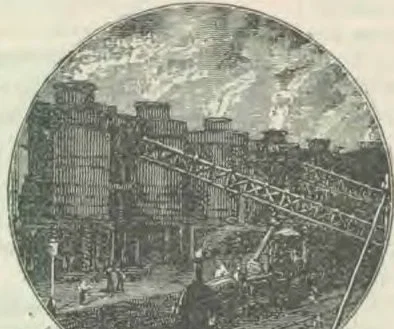
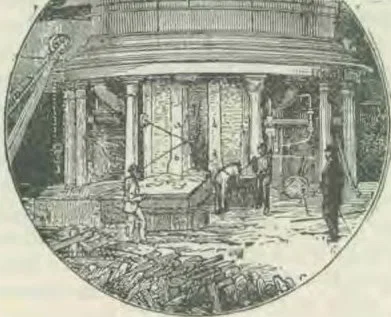
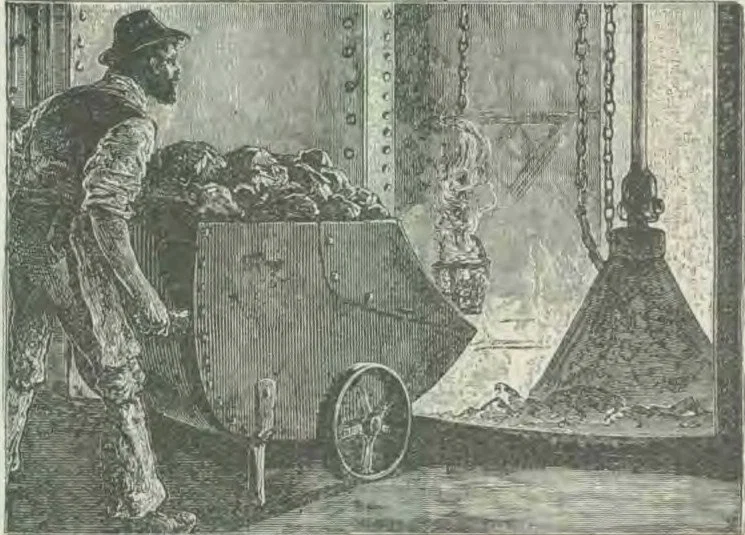
THE MANUFACTURE OF IRON.
Iron is one of the most valuable metals known, because of its adaptability to so many uses. Gold and silver are valuable, but we could manage to live without them. It would be almost impossible, however, to get along without iron and steel. Just think, for a moment, what the world would do without iron, with which to make plows; or shoes for the horses’ feet; or saws, hammers, and chisels for the carpenter; or nails, with which to build houses; or needles, with which to make and mend our clothing. Iron is now used for almost everything. When the writer was in Pittsburg not long ago, he went into one of the many rolling mills of that city, where at one point he saw iron worked into flat plates covering a large surface, while at other places it was being drawn out into large bars and wires of every size. Iron in some form is found almost everywhere. It is hidden in the earth under our feet, in the water we drink, and it enters into the composition of all plants and creatures.
When iron is first taken from the mine, its particles are so mixed with the earth in which it is found that it looks just like pieces of reddish brown dirt. In this condition it is taken to the smelters, or blast furnaces, six of which are shown in the upper part of the picture on this page. In these a hot fire is kept constantly burning, fed by a plentiful supply of coal thrown in at the top, where the fire is seen issuing forth. In the middle of the picture, the top only of a furnace is seen, and the man with the wheelbarrow is represented as just dumping into the fire a load of coal. When the fire is in the proper condition, the iron ore is brought up and tumbled in at the same place. As the iron melts, it separates from the limestone, earth, and other matter with which it is mixed, and runs through the mass to the bottom of the furnace.
When a charge of ore has stewed in this “fiery furnace” for about twelve hours, it is taken out at the bottom of the furnace, which is shown in the lower part of the picture. At this place an opening was left when the furnace was made, which was stopped up during the melting process by a mixture of clay and coal-dust. This must be drilled open, by driving through it a long iron bar. But before this is done, the ground near the furnace must be prepared for the reception of the liquid iron; for there are no pots or pans which could well hold such fiery liquid. The furnace itself is provided with a method by which a current of cold air is constantly circulated round the blast pipes inside, lest they should be melted in the fiery mass.
The preparation required is made by first smoothing over the great layer of damp sand which lies about, and then a small gutter is plowed through it, leading down to numerous little nicely-molded places in the sand, which are connected with one another by small ducts. As the melted iron runs down this first gutter, it finds its way into all these small molds, where it remains until it is cold, when it is taken out in the shape of the pieces seen piled up in the foreground of the lower part of the picture. In this shape it is called “pig-iron.” It is given this name because the group of molds in which it was cast are called “pigs,” while the long duct leading from the furnace to feed them is called the “sow.”
When one row of these pigs is full of the metal, sand is thrown into the duct leading to them, and the liquid is turned toward another row until that is full, and so on till all are filled. When the flowing metal does not move fast enough, it is helped along in its course by drawing before it a long pole, which leaves a slight track behind, drawing the iron after it, much as a little stream of sluggish water can be made to follow one’s finger when it is a little moist. All this must be done quickly; for as soon as the metal commences to flow, it also begins to cool and grow thick. The writer saw this work done once in the northern part of Michigan, and it was to him a grand sight to watch the men at their work, and notice how each one did the right thing just in time, without any one to prompt him.
When the pigs are all full, the hole in the furnace is again quickly plugged up, wet sand is thrown over the glowing iron lying about, and a stream of cold water is turned on, to cool it. This fills the place for a little while with steam, which is soon gone, and then the men with heavy sledges go about and break the pigs of iron apart while the metal is yet soft, when it is ready for the market. Two sets of men are required to attend to these smelting furnaces, because they are in operation day and night. Each set of men, therefore, works twelve hours. It costs so much to start one of these furnaces up, that the fire is never allowed to cease, from one year’s end to another, except for repairs. The men, therefore, who work there must attend to business seven days in the week, without any Sabbath. This seems very hard to us who enjoy our weekly rest, yet there are many thousands in our country and in others also, who, because of the insatiable greed of their employers, are obliged to work every day in the week. J. O. C.

JULY

Yellow grow the grasses, faint and parched with heat; Sharp and shrill the locusts call from out the wheat; O'er the unshaded clover noiseless bees go by; And with heart of scarlet beating in the sky Comes July.
Panting with their motion, birds forget to sing; All the bright-winged insects move on languid wing; In the hot air wilted hollyhocks wrinkled lie; For with heart of scarlet beating in the sky Comes July.
Blood-red flame the mornings as with fire o'er-run; Sultry grow the noontides 'neath the blood-red sun; By the dusty waysides sweet-briers scorching die; For with heart of scarlet beating in the sky Comes July.
Through the brazen twilight comes on cooler air; All the stars look fevered with the light they bear; Falling through the purple night, dew swiftly dry; For with heart of scarlet beating in the sky Comes July.
—C. E. Walton-Stone.

WALTER LYMAN'S LESSON IN POLITENESS.

“Why can't that horrid old woman do her calling in the daytime?” exclaimed Walter Lyman, as he looked up from the interesting story he was reading. “I don't want to go way 'round to Twelfth Street with her.”
Mrs. Lyman stood by her son's chair, and she touched him gently on the shoulder. “My son, would you allow that poor old woman to go home alone to-night? What if it were your mother?”
“I couldn't imagine such a transformation, mother. You'll never be like her. She's as ugly as—as—well so ugly that there is no danger of any one's running off with her between here and Twelfth Street,” and Walter laughed in derision.
“It is very icy, Walter, and just think how terrible it would be for her to slip down and hurt herself; it might be the cause of her death. She was very anxious to see your father, and she cannot see him any time but in the evening, you know.”
Walter was just going to say, “Why doesn't father go home with her?” but he remembered that his father was always quite tired at night; for his work during the day was arduous. Walter got his cap, but he was not in a pleasant mood, and it did not make him feel any pleasanter to hear his younger brother say as he went out of the door, “If it was only a pretty girl, Walt, that you had to go home with, you wouldn't have any objections to make, would you?”
“Now, Walter,” said his mother, as he waited in the hall for Mrs. Hawkins to finish her conversation with his father, “I want you to be very kind to the poor old lady, and give her your arm, so she won't fall. She isn't the most agreeable person, I know; but she has had a great many sorrows. She is all alone in the world. She had a boy like you, but he died, just when he was able to be of some help to her. The Lord took her boy, and now, in her old age, she expects other mothers' boys will care for her.”
Walter was touched by his mother's words; for he was a tender, kind-hearted boy; and he really was very polite and thoughtful on the way home. He listened attentively to all Mrs. Hawkins's grievances, which she poured out in a confidential manner to him. He began to feel a sort of championship to the poor old body.
When they got to the one room in the tenement house that Mrs. Hawkins called her home, she said, “Well, now, you're a good sort of boy to be so kind to an old body like me. Most boys don't want to bother with old folks. Come in and rest you awhile.”
Walter had left his story in a place where his hero was in great danger of being lost at sea; but his heart was so touched by the old lady's evident pleasure at the attention he had shown her that he went in for a few minutes. She showed him all her treasures—the geranium in the window, that had its first blossom just coming out; she unlocked the bureau drawer, and brought out the old daguerreotypes, and told Walter that this one was her husband's picture, and that one her boy's, and although he had been dead over forty years, she dropped a tear on the glass over the picture. Once Walter would have laughed at the quaint manner in which the boy was dressed, but it was too sacred a thing to make fun of.
“I think I must go now,” he said, when the pictures were put away.
“You make me think of my boy,” she said, as she followed him to the door. “Won't you come round sometimes of an evening, and cheer me up a little?”
Walter promised he would, and he did not forget his promise either. It became his particular missionary work to look after poor old Mrs. Hawkins. The school-boys laughed about it, and joked him a good deal, but they soon learned to respect him for the work he had chosen to do. It was old Mrs. Hawkins's last few miles of the journey on earth.
Walter received her dying blessing and her little Bible, soiled and worn with so many years of using. He keeps it as a reminder of his lesson in true Christian politeness, and he says he will always pay his first attentions to the wants of the aged, who have traveled so long on the way, and are worn and feeble from the cares and sorrows they have had.—N. Y. Evangelist.

ABRAHAM LINCOLN.

The fame of Abraham Lincoln is of a kind that is certain to increase as time goes on. He was a man of the people. In a good sense of the word, he was very human. He was both a great man and a man of great simplicity. The world, we may be sure, will never tire of talking and reading about him. His intimate friend of many years, the Hon. Leonard Swett, pronounced him the best listener he ever knew. “He would hear any one on any subject, and generally would say nothing in reply.”
He believed that something was to be learned from everybody, but he was not given to asking advice. He kept his eyes and ears open, and then acted as he himself thought wise and proper. Mr. Swett was with him at the Illinois bar for eleven years, and in all that time never knew him to ask the advice of a friend about anything.
Once, however, just before his famous discussion with Douglas, he sent for half a dozen lawyers.
“Gentlemen,” he said, “I am going to ask Douglas the following questions, and I want you to put yourselves in Douglas’s place, and answer the questions from his standpoint.”
He knew, of course, that a man who would succeed in debate must have anticipated his opponent’s arguments.
He was naturally a philosopher. He made the best of things as they were, instead of allowing them to harass or discourage him. Speaking of their travels together on circuit, Mr. Swett says:—
“Beds were always too short; the coffee was burned or otherwise bad; the food was often indifferent, and the roads were nothing but trails; streams were without bridges, and it was often necessary to swim; sloughs were deep, the wagon had often to be pried out of them with fence-rails; but I never heard Mr. Lincoln complain of anything.”
“He never got the better of his fellow-man in a trade, and never lent money for interest. He never tasted liquor, never chewed tobacco or smoked, but labored diligently in his profession, charging small fees, and was contented with small accumulations.”
Mr. Swett never knew him to borrow money except when he left Springfield, to assume the duties of the Presidency. Then he borrowed enough to pay his expenses until he should draw his first quarter’s salary. “In his life he lived in all circles, moved in every grade of society, and enjoyed all equally well. To his companions in every station he was equally entertaining and equally happy.”
Concerning his inquisitiveness, Mr. Swett says: “Traveling the circuit, he sometimes sat with the driver, and before we got to our journey’s end, he had found out all that the driver knew. If we stopped at a blacksmith’s shop, he took a seat by the forge, and learned how to make nails. If he saw a new agricultural implement standing on the sidewalk in front of a country store, he was sure to stop and learn what it would do, how it would do it, and upon what it was an improvement.
“He was the only man I have ever known who bridged back from middle age to youth, and learned to spell well. His manuscripts were as free from mistakes as any college graduate’s. I have seen him upon the circuit with a geometry, astronomy, or other elementary books, learning in middle life what men ordinarily learn in youth.”
“One day he was sitting on the sidewalk in front of a tavern. He had just got the point of a nice demonstration in geometry; and wishing some one to enjoy it with him, he seized upon a hostler, and explained it to him till the hostler said that he understood it.”
Abraham Lincoln was one of those rare and fortunate souls who knew how to study both books and men. He had an instinct for knowledge, and was always at school. The world itself was his university.—Youth’s Companion.

RUSSIAN TERRITORY AND CLIMATE.

Of whatever the rest of Europe has much, Russia has little; and of whatever the rest of Europe has little, Russia has much. The rest of Europe, with one or two exceptions, has a large amount of sea-coast; Russia has little. While Russia is larger than all the rest of Europe, it possesses only one third as much sea-coast, and of what it has, about one half is upon the Arctic Ocean and the White Sea, and of course is navigable but one third of the year. The rest of Europe has mountains. “Without speaking of the vast central mass of the Alps, there is not one European land which does not possess, either in its length or breadth, a great mountain system forming the scaffolding, or backbone, of the country.”
What mountains Russia has are found in the extremities. In the many thousand miles that I traveled in Russia, I saw no mountains, nor any hill that rose above the surrounding country more than twice the height of Bunker Hill Monument. The country, with occasional depressions so gradual as scarcely to be noticed, is a great plain. Hence there is no obstruction to the fierce winds that sweep down from the Arctic regions, nor is there any modification of the temperature by the influence of the sea. The historian says: “In the steppes of the Kirghiz, in the latitude of the center of France, the mercury is sometimes frozen for whole days; while in the summer the same thermometer, if not carefully watched, bursts in the sun.”
Russia is also one of the driest countries in the world. It contains very little stone, and up to the time of Peter the Great almost all its public buildings were of wood or brick. The most famous ancient palaces and churches were of wood, and to-day almost all the houses of the citizens, and huts of the peasants, are of wood. “It is only since the conquest of the Baltic and the Black Seas, that the Empire has had cities of stone. Peter the Great gave Russia her first stone capital.”
But if Russia has very little sea-coast, and no mountains except upon its boundaries, it has many of the greatest rivers in the world. The Volga is a wonderful river. As I rode upon it, and considered that it was possible to ride by steamer more than twice the distance from St. Louis to New Orleans, I could not but feel that I was in a country whose rivers are worthy to be compared with those of the United States. Nearly all the important rivers, whatever may be their course, rise in the plateau of Valdai. Here rises the Volga, which finds its way into the Caspian; in the same neighborhood is the Dnieper, which flows into the Black Sea, and also the Neva. The network of rivers in Russia is extraordinary, and hardly paralleled.
Says one traveler: “The vast central area of the Russian lowland has almost everywhere the same character, woods and marshes alternating with cultivated land, affording a superfluity of grain, which is sent down by the rivers to the seaports of the Baltic and Black Seas; but along its northern border, next the icy Arctic Sea, lie the moss-covered swamps called the Tundras, the soil of which is never thawed for more than a yard’s depth; all its southern margin towards the Black Sea and the Caspian is a treeless steppe, over which, at some seasons, the grasses shoot up above a man’s height, concealing the pasturing herds. Toward the Caspian, over the area covered by that sea in former times, the steppe has a different aspect, the soil being so filled with salt left by the retiring sea as to support only the prickly saltwort and such saline plants.”
The great forests of the North extend from the marshes on the shore of the Arctic Ocean down to Moscow. These forests show the same general distinctions found in the great northern forests of the globe. The larch and the fir alternating with the birch are in the extreme north, while on the southern boundary of the forest region, the oaks, the maples, the elms, and the limes, with which we are familiar, can be seen. Then comes the immense fertile region known as the Black Land, which consists of “a deep bed of black mold.” “From time immemorial this soil has been the granary of Eastern Europe. It was here Herodotus placed his agricultural Scythians, and hence Athens drew her grain.”
Then come the vast steppes, which, if properly manured, are fertile. Before it was placed under cultivation, this region was similar to our prairies.
Next come the great barren steppes, which remind us of the alkali plains of the far West. Near the mouth of the Dnieper, there are expanses of sand; on the coast of the Caspian, as already remarked, they are saline.
These peculiarities of configuration of soil and climate have been the most potent factors in developing the character and evolving the history of the Russian people. A beautiful passage from Rambaud illustrates this effect:—
“We must recognize that the Russian, almost as much as the Anglo-Saxon, has the instinct which drives men to emigrate and found colonies. The Russians do in the far East of Europe what the Anglo-Saxons do in the far West of America. They belong to one of the great races of pioneers and backwoodsmen. All the history of the Russian people, from the foundation of Moscow, is that of their advance into the forest, into the Black Land, into the prairie. The Russian has his trappers and settlers in the Cossacks of the Dnieper, Don, and Terek; in the tireless fur-hunters of Siberia; in the gold-diggers of the Ural and the Altai; in the adventurous monks who ever lead the way, founding in regions always more distant, a monastery which is to be the center of a town; lastly in the Raskolniki, or Dissenters, Russian Puritans, or Mormons, who are persecuted by laws human and divine, and seek from forest to forest the Jerusalem of their dreams. The level plains of Russia naturally tempt men to migration. The mountain keeps her own, the mountain calls her wanderers to return; while the steppe, stretching away to the dimmest horizon, invites you to advance, to ride at adventure, to ‘go where the eyes glance.’” And wherever they have gone, they have “Russified” the people whom they found.—J. M. Buckley, LL.D.

THE GOLDEN CHANCE.

He who is wise will not sit down With folded hands, and say, Some time, I trust, the golden chance Will come this way.
To such the opportunity They wait for never comes; It does not herald its approach With beat of drums.
It comes with quiet tread and mien; The dreamer does not see That which he's waited for so long,— His opportunity.
And so the chance he seeks goes by To never come again, And all too late he learns the truth, When other men
Who do not fold their hands and wait For great things, win the prize; They seize the chance of every day Before it flies.
And thus they gain what dreamers lose. Each chance that comes may be The Golden Chance, so squander not One opportunity.
—Eben E. Rexford.

A STITCH IN TIME SAVES NINE.

No doubt nearly every child who is old enough to sew at all has heard the old saying, “A stitch in time saves nine.” We will see how true this is. A little girl had been taught to darn her own stockings, and had been furnished with plenty of yarn, and was told to mend them just as soon as a small hole appeared. While her stockings were new, and the holes that came were small, she did very nicely; but after awhile it became a task, and she would let it go day by day, until so many holes came, and they grew larger and larger, that she thought her stockings were worn out, and could not be worn any more. But no, she had to sit down and darn every hole. Her little hands grew very tired, but she could not stop; and when every hole was mended, her stockings did not look well any more, and she felt ashamed to wear them. When she was told again, “A stitch in time saves nine,” she determined to save herself from so much work another time. Don’t you think that is ever so much the better way?

Heaven Helps Those Who Help Themselves
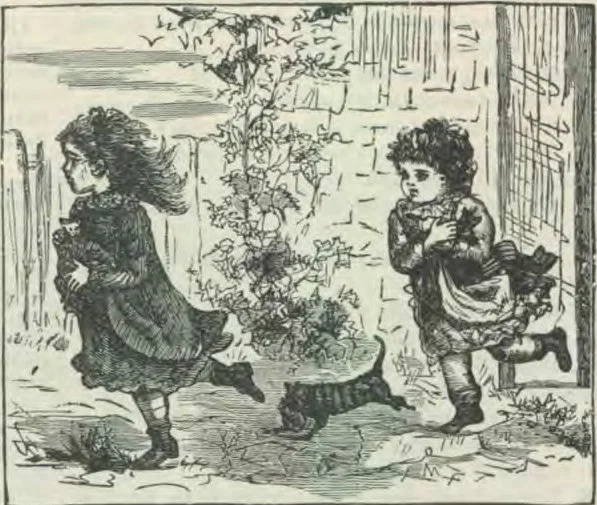
HEAVEN helps those who help themselves.

UNCLE DOC.

There are two little girls, Edna and Milly, nearly the same size; but Edna is a little larger than Milly.
They have an uncle who is a doctor; and they call him Uncle Doc. He lives on a prairie.
Do you know what prairie is? It is country where there are no woods, nor any trees except those that have been planted. But there is a great deal of tall grass there, and some bushes.
One time Edna and Milly went to their uncle's house on the prairie, and stayed several days. There were no children there for them to play with; so they used to ride with the doctor, when he went to see sick people.
At first they thought it would be very nice to ride around all day, and they didn't think they ever could get tired of it, as Uncle Doc said he did; but after a few days they were glad to stay at home with their aunt.
One morning they missed her; and the hired girl said she was “picking the ducks.” That means to pull out all the soft feathers, to make pillows.
Edna and little Milly both wanted to see how she did it, so the hired girl opened the door of the hen-house a little way, and let them go in.
There sat Aunt Cynthia, holding a duck between her knees, while she picked the feathers out of its breast. She told them some more would soon grow, to keep the duck warm the next winter.
When she had picked all the feathers she wanted off of that duck, she put it out through a window. Then she started to catch another; but they flew around as fast as they could, to get away from her, and made a great noise, because they were afraid.
Edna and Milly stood in the middle of the hen-house, and the ducks were whirling around and around them, screaming terribly. That so frightened the little girls, that they began to scream too, and jumped up and down, and cried to their auntie till she stopped chasing the ducks, and tried to quiet the girls. The poor ducks would not hurt them; but they didn't know it, and were so frightened that Aunt Cynthia had to let them out of the hen-house. The hired girl had fastened the door on the outside; so their auntie squeezed them through the little window where she had put the duck out, and let them drop down to the ground.
They were very glad to get out; but afterward they felt ashamed that they had been afraid, and they made up their minds never again to be frightened at anything that would not hurt them.
One day Uncle Doc brought home a chicken which he had killed. Edna asked whose chicken it had been; but he laughed, and said it hadn't been any one's.
She thought it strange that there should be a chicken that didn't belong to any one; but her auntie told her that on the prairie there are birds that people call prairie chickens, that are wild, like robins or sparrows.
After that the doctor took both the girls with him to hunt prairie chickens. He had a big dog, named Zip, that went with them.
Zip was of the kind of dogs called bird dogs, because he would drive the birds up from the bushes and grass, so the hunters could see them, and when a bird was shot, he would run and find it, and bring it to his master.
When the doctor saw a prairie chicken flying along, he would shoot just ahead of it, and by the time the chicken got to that place, the shot would be there too, and kill it.
When Zip brought the first one to them, Uncle Doc said, “You see I shot that on the wing.”
Milly looked at it, then she said, “Why, it looks as though it had been shot in the neck.”
Then he laughed. These two little girls didn't like to have people laugh at them, any better than you do; but their uncle would laugh. He was pretty good to them, though, and explained what he meant when he said the chicken was shot on the wing.
If you will ask your papa, or uncle, or some other gentleman, I think he will tell you how a bird can be shot on the wing, and yet its wing not be shot.
When it came time for the girls to go back to their home, their uncle went with them, and took Zip along.
Soon after they reached home, the girls heard a great barking; and when they ran to see what was the trouble, there was Zip under a tree, and their old cat, Purr, up in the tree, and Zip barking at her.
Edna and Milly were very much afraid the dog was going to hurt their cat; but Uncle Doc asked them if they thought his dog could climb a tree. Milly said Purr might fall down; but the doctor sent the dog away, and caught the cat, and showed the little folks what sharp nails she had to cling with.
Just then Edna remembered their little kittens, that could scarcely walk when the girls went away; and she was sure they could not get away from Zip, if he should chase them. So away the girls ran, to find their kittens and see if they were in a safe place.
They found them in a shed, where the old cat had already gone. There was no door to the shed, and the dog might get in; so Edna caught up two of the kittens, and put them in her apron, while little Milly took one in her arms, and the old cat seized another, as though she understood the danger; and away they all ran.
But where should they go? They feared the dog might see them; and they didn't know what they would do then. They suspected Zip was at the house; but there was no other place where they would be safe, so they hurried in at the back door, and ran, all out of breath, up-stairs, and shut their pets in a room there.
Then the girls had a chance to look at their kittens, and see how they had grown. A few weeks ago, when they first found the tiny things out in the wood-house, on some old sacks, the kittens could not open their eyes, and could only crawl about a very little. Even their cries were very small cries. Milly had not thought they were nice at all. But now they were lively little kittens, and both girls were much pleased with them.
When Edna and Milly went down-stairs, they told Uncle Doc about their pets; and he wanted to see them. The little folks did not dare bring them where the dog could see them, but the doctor promised to make Zip leave them alone, and to try to teach him not to bark at cats. So the kittens were brought, the old cat remaining about as though she thought her family were still in danger.
When uncle asked what she called the kittens, Edna told him they didn't have any names. Then he offered to help think of some for them.
What names do you suppose they gave those kittens? I will tell you; one they called Wink; another Blink; and the one with a white face, which you see peeping out of Edna's apron, was called Bo-peep; while the little black one which the old cat is carrying was named Doc.
Mrs. Ada D. Wellman.

HOW GRANDMA LOST HER SHOES.

Kitty was sniffing behind grandma's closet door, because she could not wear her bronze boots to school. The “committee-man” was coming in, and, oh dear! her old boots had a little hole in one toe—such a very little hole that no one but Kitty, or a microscope, could find it.
“Let me see, what did I use to wear to school?” said grandma, talking to herself loudly enough to be heard above Kitty's sniffs. “Why, come to think it over,” she added, breaking off her story, “I do believe I went barefoot!”
Kitty stopped sniffing.
“Didn't my feet get brown and tough!” continued grandma. “Why, I could run right over a thistle-bed and scarcely feel it, and much as ever a bumblebee could sting through the thick skin on the bottoms of them! But one did sting my great toe one day, and I had to walk on my heel for some time.”
“But you didn't go barefoot in winter?” Kitty managed to ask through the crack of the door.
“No; then I had some stout shoes, sometimes cobbled out of the legs of my father's worn-out boots; but generally father bought a calf-skin at the town where he went to trade once a year, and Peleg Dingley, the neighborhood cobbler, came and made up the family shoes. They didn't look much like your bronze boots,” and grandma laughed at the thought of it; but I thought they were nice.
“I remember when I was a small tot, about six years old, that something dreadful happened to me in the matter of shoes—great to me then.”
Kitty had now crept from behind the door, and was hanging on the back of grandma's chair.
“It was in 1816, I think, the year that there was no summer. There was snow and frost every month in the year, and the boys had to plant corn and potatoes with their mittens on; but there wasn't a kernel of corn raised anywhere in our town, nor scarcely anything else, and it looked as though we would all have to go hungry.”
“Well, I had a nice pair of soft calf-skin shoes that year, and 't was such poor times that for all 't was so cold, I went barefoot.”
“One day, along in June, we had all gone up to Dame Lyddy's school, as usual—there was a great log school-house full of boys and girls, and all barefoot like myself. But it was a bitter day, and all the little girls tucked their brown toes beneath their woollen petticoats to keep them warm.”
“By and by it began to snow—great, whirling, feathery flakes! The air was thick, and it looked more like January than June. The little girls began to whimper, for we didn't know how we could ever get home; but the boys would dash out into the storm and snowball each other for a minute, then dash in and stand about on the great, warm stone hearth.”
“Well, four or five inches of snow fell, and just as school was out at night, in stamped Uncle Tim Flint, with a long tow-and-linen pillow-case slung over his back. We thought he had brought our suppers, but the next minute he turned the pillow-case upside down, and out tumbled a bushel or two of—shoes. He had been all about the neighborhood, and gathered up the children's shoes, and brought them to the school-house. Some had gaping toes, some had no strings, some were down at the heel. But didn't we make a dive into those shoes!”
“I'm sorry to say that there was some quarreling over them, and Dame Lyddy had to take down her rod before peace was restored.
“We all got on a pair somehow, and trudged home at last; but, deary me! mine looked no more alike than a pig and a goat. In the scramble I had got hold of one calf shoe and one cow-skin shoe with a patch on it; one pinched my toes terribly, the other was so large that it kept coming off in the snow, and it hadn't any string, either.
“I shed some tears over the loss of my nice shoes, but the shoes of the whole neighborhood were so hopelessly mixed that father thought it might lead to trouble to try to look mine up. Luckily, there were enough remnants of the calf-skin for Peleg to piece me out a pair of slippers, and with them I got along till father went to town again.”—Youth's Companion.
Continue reading: THE LITTLE MAID'S SERMON