THE Decalogue has almost invariably been considered by all Christian people the holy, the immutable, law of God. Only as respects the Sabbath, has question been raised. That has been the one bone of contention in the great Ten Words. To get rid of that, men have been willing to abolish the Decalogue; but without important exception they have professed to believe that every precept save the fourth has been reenacted.
Such a course should cause the whole Christian world to pause and ask, Why? Why should men endeavor to get rid of the Sabbath? Was it not given of Jehovah in the beginning? Is it not founded in a need of man's nature? Is it not the one day above all others around which cluster the great facts of the creative Godhead? Then why abolish it?—Evidently from the one sole reason that men have found themselves observing a different day and they seek to justify their observance rather than change their course. Not for one moment would we seek to justify such a course as this in the financial world. Just and conscientious persons would not continue to pass a counterfeit note when its genuineness was disproved. Why should men pursue a different course in religious matters, in matters of eternal moment? Why should men relegate to the Jews the day which God gave in the beginning for the race?
Position in the Decalogue.
Note the position of the Sabbath in the Decalogue. Its setting in the great constitution was of God. He Himself wrote the Ten Commandments in the order which has come down to us. If He had placed the Sabbath precept, as has been pointed out, at the very beginning of the law, it might have been argued that it was no part of that document. If it had been found at the close, men might have reasoned that it belonged with other ceremonial precepts. But at neither beginning nor end of the Decalogue do we find it. Rather, right in the heart of the Ten Words is it placed, guarded by the impregnable walls of three immutable precepts in front, and of six at the rear, so that men must tear from the law these precepts before they can lay sacrilegious hands upon the law regarding the Sabbath. Thus God has guarded it behind and before, and showed by its very position that the Sabbath is of the same holy, immutable character as the other nine moral precepts. To this a passage in Nehemiah (9:13, 14) refers:
"Thou camest down also upon Mount Sinai, and spakest with them from heaven, and gavest them right ordinances and true laws, good statutes and commandments, and MADEST KNOWN UNTO THEM THY HOLY SABBATH."
Now it was not at Mount Sinai that the Sabbath, or rest-day first came to Israel. They knew it previous to this when the manna fell. Exodus 16. They were inclined to then regard it as a matter of their convenience; but God "made known" to them in His holy law that the Sabbath was immutable and eternal, resting on the same basis as every other immutable precept of that divine code. Why not so accept it?
Prayer.
The Results.
AND this is the confidence that we have in Him, that, if we ask anything according to His will, He heareth us; and if we know that He hear us, whatsoever we ask, we know that we have the petitions that we desired of Him." "The door of heaven is always open for the prayers of God's people."
We call to mind the prayer of Hezekiah as he spread out the letter of Sennacherib, King of Assyria, before the Lord, and in his utter helplessness, but in all the earnestness of his soul, plead that God would vindicate His cause and put to flight the army of the Assyrians, the leader of which had so boldly and blasphemously defied the God of Israel. The result?—The angel of the Lord "smote in the camp of the Assyrians an hundred fourscore and five thousand."
"Frail art thou, O man, as a babble on the breaker,
Weak, and governed by externals, like a poor
bird caught in the storm;
Yet thy momentary breath can still the raging
waters,
Thy hand can touch a lever that may move the
world.
O Merciful, we strike eternal covenant with Thee,
For man may take for his ally the King that
ruleth kings;
How strong, yet how most weak; in utter poverty,
how most rich,
What possible omnipotence to good is dormant in
a man!
Prayer is a creature's strength, his very breath
and being;
Prayer is the golden key that can open the wicket
of Mercy;
Prayer is the slender nerve that moveth the muscles of Omnipotence."
Away down in idolatrous Babylon, in the king's palace, holding a position of honor and trust in the king's court, we see a man of God, greatly beloved, a man who knew what it meant actually to dwell in the secret place of the Most High.
Hear him, as with fasting and sackcloth and ashes, he confesses his sins and the sins of the people, and pleads with God to forgive and have mercy. Does he receive the assurance? Listen to his own testimony:
"And whiles I was speaking, and praying, and confessing my sin and the sin of my people Israel; . . . yea, whiles I was speaking in prayer, even the man Gabriel . . . touched me, . . . and talked with me, and said, O Daniel, I am now come forth to give thee skill and understanding. At the beginning of thy supplications the commandment came forth, and I am come to show thee; for thou art greatly beloved; therefore understand the matter."
God does not always answer immediately. Other agencies are often at work. "Wait on the Lord; be of good courage, and He shall strengthen thine heart; wait, I say, on the Lord."
Again Daniel prayed. Three long weeks he waited and prayed. Was his faith rewarded? At the end of that season of heart-searching and prayer, a hand touched him and said to him, "O Daniel, a man greatly beloved, . . . fear not, . . . for from the first day that thou didst set thine heart to understand and to chasten thyself before thy God, thy words were heard. . . . But the prince of the kingdom of Persia withstood me one and twenty days; but, lo, Michael . . . came to help me, and I remained there with the kings of Persia. Now I am come to make thee understand." Then "will I return to fight with the prince of Persia."
"Before they call, I will answer; and while they are yet speaking, I will hear."
Time and words fail us to tell of other wonders of prayer recorded in the Old Testament, but we may read them there, how "Abraham's servant prays, Rebekah appears; Jacob wrestles and prays, and prevails with Christ, Esau's mind is wonderfully turned from the revengeful purpose he had harbored for twenty years. Moses prays, Amalek is discomfited; Joshua prays, Achan is overcome; Hannah prays, Samuel is born; David prays, Ahithophel hangs himself; Asa prays, a victory is gained; Jehoshaphat cries to God, God turns away his foes. Mordecai and Esther and the Jews fast and pray, Haman is hanged on his own gallows in three days; Nehemiah darts a prayer, the king's heart is softened in a minute. Elijah prays, a drought of three years succeeds; Elijah prays, rain descends apace; Elisha prays, Jorden is divided; Elisha prays, a child is brought back to life;"—because prayer reaches the heart of the Infinite.
Did the mind of Alfred Tennyson, in times more modern, overstate it when he said:
"More things are wrought by prayer
Than this world dreams of."
As Dr. Daniel March has beautifully said, "We must not think that God was more interested in the world in ancient times when He spoke by miracles and prophets and apostles than He is now when He speaks by His written word and His holy providence. The heart of the Infinite Father never yearned toward His earthly children with a deeper and more tender compassion than now. There never was a time when God was doing more to govern, to instruct, and to save the world, than He is doing now. We need only add the faith of the patriarchs to the science of the philosophers, and we shall find Bethels in the city and in the solitude, Mahanaims in every day's march of the journey of life."
KATHRINA BLOSSOM WILCOX.
The Parable of the Beggar.
In urging the sacredness of the Lord's Day, a Chinese preacher used this story:
"It came to pass that a man went to market, having on his shoulder a string of seven large, copper coins [Chinese coins are strung on strings and carried on the shoulder]. Seeing a beggar crying for alms, he gave the poor creature six of his seven coins. Then the beggar, instead of being grateful, crept up behind the kind man and stole the seventh coin also. What an abominable wretch! Yes; but in saying this you condemn yourselves. You receive from the hand of the gracious God six days, yet you are not content. The seventh you also steal!"
—Exchange.
The Hague Conference---What Is Behind It?
By M. Ellsworth Olsen
By Our Own Correspondent
"REMEMBER this," said the late Marquis of Salisbury at a meeting held in the Mansion House, London, Nov. 10, 1897, "that THE FEDERATION OF EUROPE IS THE EMBRYO OF THE ONLY POSSIBLE STRUCTURE OF EUROPE WHICH CAN SAVE CIVILIZATION FROM THE DESOLATING EFFECTS OF A DISASTROUS WAR."
It must be either the federation of Europe or disastrous war—the veteran statesman could see no third solution. And other statesmen are thinking along somewhat the same lines, else there would be no Hague Conference in this year of our Lord 1907.
But the responsible heads of governments are too heavily weighted down with high duties of State to devote much thought to international pacification. The more one sees of the men who have come here to deliberate concerning the world's peace, the more one is convinced that they are here in obedience to a mandate not their own, nor yet one from their governments as such. There is a movement on foot in many different parts of the world which, whatever may be its future, has certainly gained great momentum in the last few years. Thru a variety of organizations, thru individual effort, thru the columns of the public press, and in many other ways the idea of human solidarity of interests is steadily forging to the front. There is heard on every hand the "Schrei nach Zusammengehoerigkeit" (cry for oneness), as the Germans have so well expressed it; the "Weltruf nach Assoziation" (world cry for association). Internationalism is in the air; it has received the warmest welcome in the circles of art and scholarship, and is subtly pervading the councils of State. What it may come to still remains within the realm of the unknown and the unknowable, but that it is a force to be reckoned with, no one can doubt.
The World's Cry for Solidarity.
The peace conference has been called, we repeat, at the instance of this world cry for solidarity, and the center of the movement, the place where the real peace enthusiasts meet and discuss their far-reaching plans, is at the headquarters of internationalism on Princessegracht, overlooking one of the fine, well-shaded canals that contribute so greatly to the beauty and picturesqueness of Holland's capital. Here, in commodious rooms, one finds something going on daily—lectures, discussions, conferences, social events. Here one may read the reviews and magazines issued in a half-dozen leading languages of the world for the purpose of setting forth the essential oneness of the human race, and the utter foolishness of war between the nations. Here, too, one may meet some of the men and women who are doing most to forward the peace movement. Before the close of the conference probably nearly all of the leading spirits will have come hither; for The Hague is just now an exceedingly interesting place to these messengers of international peace and good-will who see in the present conference the possible realization of their dearest hopes.
Interesting and Significant.
It will not be possible to give the opinions of more than a few of the chief promoters of the peace movement, but I shall try to take some of the most representative ones. Mr. Felix Moscheles, chairman of the International Arbitration and Peace Association, member of the Bureau de Berne, and editor of "Concord," a well-known London magazine, was the first member of the fraternity I had the pleasure of interviewing. Mr. Moscheles resides in London, and is an artist by profession. He has exhibited at a number of the leading galleries, and numbers among his sitters Mazzini, the Italian patriot, our own Grover Cleveland, and many other celebrities. He was on terms of intimate friendship with Du Maurier, the well-known author of "Trilby," and has written a book recounting some of their early experiences together. His engrossing pursuit of art, in which he has won deserved fame, has not, however, hindered him from doing much in the cause of the world's peace, and to-day, at seventy-four, he is as keenly alive to the horrors of what he justly calls the present "international anarchy," and as eager to bring about a better state of things, as when he first began to agitate the matter. Indeed, he belies his years, for he is still possessed of the alertness and vigor of youth, and if nature has given him the silvery crown she has not yet imposed the infirmities of old age. In his bodily presence, as well as in his writings, the genial editor of "Concord" gives one the impression of having plenty of reserve force. We may, therefore, be justified in believing that with a splendid record behind him of endeavor and achievement in the interests of international amity, he also has much ahead.
I caught Mr. Moscheles at his hotel the other morning, and asked him his impressions of the conference thus far.
"I am pleased," he replied, "but to me it is a great achievement that there should be such a conference at all. If it had been told me years ago that practically all the nations of the world would be represented at a conference held in the interests of peace and fraternity, I should have regarded it as hardly less than a miracle."
"You were also here at the first conference in 1899. How does the present meeting compare with that?"
"There was more skepticism among the delegates of the first conference. The nations were feeling their way then. This is still true in a measure. The delegates represent widely separated countries and greatly differing interests. Naturally they are somewhat reserved and a little suspicious of one another."
"Don't you think this feeling of mutual suspicion is in the natural order of things, and would effectually bar the way to universal peace?"
"I do not. When I go to America, as I have done several times, I find the Englishman, the German, the Austrian, the Frenchman, and the Italian all living together in perfect amity with one another and with the native Americans. This demonstrates to my satisfaction that there is nothing inherent in the different nationalities which renders them obnoxious to one another, or makes it necessary for them to indulge in mutual distrust and suspicion.
"It doesn't pay, this building up of walls of separation. Union does pay. We stand for an ideal which is thoroly practical, and as such it makes a strong appeal to sensible men. The future is for cooperation in distinct opposition to competition. Scientific progress points in that direction. No petty limits mark off the field of science, or separate between the scholars of one country and those of another."
"Yes, the commercial development is likewise in the same direction. I am opposed to the trusts because of the way they use their money, and because of various abuses associated with them; but I can not but view the massing together of great commercial interests in one gigantic organization as a thing good in itself. Only, there should be public control, because such large public interests are at stake."
"Then you believe Socialism is a force that makes for peace between nations?"
"I do. Socialism acknowledges the common brotherhood of man, and is working in the main for principles which must commend themselves to mankind.
"When do I look for this fraternization of the nations?—That is more than I know. We must not expect to see results too soon. Nothing happens to-morrow. Nothing, again, happens alone. The reforms which the world needs are like spokes in a wheel, and they must move round together. Social conditions must be changed before some of these international questions can be settled.
"The United States of the World?—It is a conception we may look forward to, but we must not expect it very soon.
"Who would be the head of such a confederacy?—That is beyond us. Circumstances change. Perhaps there would be no head.
"Do I think the occupant of the papal chair would prove an acceptable head?—No, I don't think the present outlook would justify such an expectation.
"How would the decisions of the world-tribunal be enforced?—That would have to be by public opinion. In the last resort we should have to conceive of some kind of international police force. But such speculations are hardly profitable. We have to feel our way in all such matters, and grapple with the difficulties when they present themselves.
"How long have I been engaged in peace propaganda?—Ever since I was fourteen years of age. I was attending a school in Germany. A number of us students from different countries had come together one evening to listen to a paper on patriotism. I said, 'Patriotism is a vice,' and I am still of that opinion. I don't know of a more appropriate term to apply to something that makes a man at the sounding of the war trumpet eager to shoot his fellow man.
"Yes, I have lived to see considerable progress made in the direction of peace, and I certainly think that the present conference, judging from the general spirit shown by the delegates, and the agenda which they have placed before them, looks at least very hopeful."
The View of a Baroness.
I met the Baroness Von Suttner at the close of an excellent address in which she had dealt with the question of the use of air-ships for war purposes. The author of "Lay Down Your Arms" will hardly need any introduction to American readers. I found her a woman of commanding presence and stately dignity with all that generous ardor of temperament which one would expect to find in one who has written with such eloquent sympathy of the horrors of war and the blessings of peace. The recipient last year of the Nobel peace prize, founder and president of the Austrian Peace Society, and vice-president of the International Peace Movement, the Baroness Von Suttner is11in the very forefront of the world's peace workers, and her addresses at the International headquarters have been received with great interest and enthusiasm.
Asked her opinion of the conference, she said:
"It is a step forward."
"Do you think it will accomplish a great deal in the interests of universal peace?"
"That is hard to say at this date."
"Do you think the delegates are inclined to peace?"
"Not all, of course. I fear some of the delegates are very jealous of maintaining all the horrors of war as ever practised, because of some supposed advantages to the country they represent. But there are others who are devoted advocates of peace; a third and perhaps largest contingent are at least favorable to peace, and will give their votes to throwing some needful restrictions about war with a view to limiting its sphere of destruction."
"Do you think there is a good prospect of a permanent court of arbitration being formed to which the nations of the world would refer their disputes?"
"The cause of arbitration has made very great progress in the last few years, and I think we are justified in expecting that this conference will take some important advance steps. The time is ripe for action. Public sentiment calls for something to be done toward bringing the nations closer together."
The Baroness added that in her travels about she had found in many places a general awakening on the subject of international peace, and she hoped that no untoward influences would be brought to bear to hinder The Hague Conference from doing the work it was evidently called to do.
The opinions of W. T. Stead, another enthusiastic worker in behalf of peace between the nations, I gave in my previous article. It remains to give my readers some idea of a phase of the general peace movement which is in some ways more definitely conceived, and at the same time of broader scope, than anything hitherto placed before the public. I refer now to the "Foundation of Internationalism," an enterprise headed by Dr. P. H. Eykman, a well-known Dutch physician and hygienist, and his friend, Mr. Paul Horrix. These gentlemen have been for some years developing a plan for international institutions on a large scale, which they are now bringing before the world. A brief outline is all that can be attempted in this article, but I may have occasion to refer to the matter later. It is generally known that Mr. Andrew Carnegie has given a large sum of money for the erection of a permanent building for The Hague Peace Convention. The Holland Government has accepted the money, and the committee appointed to select a site has suggested a spot within the city limits, bordering on ground not built on at present, but which would be likely to rise in value immediately the building was erected. The plan of Dr. Eykman and Mr. Horrix is to go out to a place northwest of the city, to buy a large piece of ground and sell out portions of it at advanced prices to raise money for the enterprise. The latter plan certainly seems the broader one; but it is doubtful whether it will be carried into execution, as there are powerful interests in favor of the former. Dr. Eykman has in mind no less a place than a world's capital at The Hague. The peace conference building would form the center of a new city, springing up, as it were, on the borders of the old city. It would be laid out with perfect regularity, and the buildings which would be the headquarters of the various international societies could be conveniently disposed about the campus.
Dr. Eykman's first idea, was the founding of an international bureau of hygiene. Then, on examining into the matter further, he began to realize that hygiene was related to paidology and to economics, and that all the arts and sciences were closely bound together, and would be greatly stimulated and encouraged by having permanent headquarters at such a place as The Hague. At the present time, as Dr. Eykman points out, international conferences of a scientific character are held from time to time, but the good they might do remains largely undone because they are hampered in various ways, and especially so in not having a permanent office. The Hague is centrally located, and being the capital of a small country would not be likely to provoke the jealousy of rival powers. Moreover, the land is well suited for the purpose. At the present writing the promoters of this world enterprise are receiving encouragement from a number of prominent men, and even if the site of the proposed palace of peace were to be retained, it would still be possible to carry out the larger plan in all its details, excepting the location of the peace palace.
Among the men who support this movement are such well-known names as Bjornstjerne Bjornsen, the Norwegian poet, Lord Kelvin, Sir William Ramsay, Richard Strauss, George Brandes, John S. Sargent, and a long list of other prominent men representing the leading nations of Europe.
Dr. Eykman and Mr. Horrix are men of great push and boundless enthusiasm. They are on fire with their project, and supporters are rallying round them. There is, indeed, something almost fascinating in the idea. "A city shall arise, the capital of the world, in which will be concentrated the intellect of all nations, there to form in organized and continual cooperation the great focus of universal culture." "The brains of the world," Stead has called it. The idea is striking. Can it be realized? That remains to be seen. Meanwhile the promoters of the scheme are working with admirable enthusiasm, and bid fair to make some adequate impression on the public mind.
These, then, are some of the personalities at work behind the scenes. The discussions at Princessegracht are unofficial, but sooner or later in essentials they come before the delegates in the Ridderzaal. It is these enthusiasts who have done most to bring about the calling of the conference, and they will probably exert some influence on its deliberations.
M. ELLSWORTH OLSEN.
The Hague, June 24.
Japan No Longer a Little Kingdom.
IT is announced that Japan will put forward at The Hague Conference its right as a conqueror to annex outright all the territory that has come under its dominion as a result of its war with Russia. We are accustomed to regard the Sunrise Kingdom as a diminutive empire. As a matter of fact, the outlying peninsulas and islands that have come to Japan as the fruits of victory have transformed that country into a commanding nation.
Including the Pescadores, the Kuris and Formosa, Japan had until recently an area of 162,153 square miles. To that the practical annexation of Korea added 90,000 square miles, and half of Sakhalin 14,500 square miles more, making a total area over which Japan exercises sovereignty of more than 266,-000 square miles.
No nation in Europe, outside of Russia, now has a territory equal to Japan's. That country's ''benevolent assimilation'' of Korea has not awaited the sanction of The Hague. The Hermit Kingdom, which is as large as England and Ireland combined, contributes a population of 10,000,000 to Japan. Altogether Japan now has a greater number of inhabitants to draw upon for either war or industry than the German Empire has.
It is idle longer to regard Japan as a Lilliputian land. And in the path of its destiny lies Manchuria, a fertile and coveted domain with an area of 350,000 square miles. From every point of view Japan occupies a leading place among the fighting powers.
—San Francisco Examiner.
Manners and Customs of the Koreans
By F. W. Field
Korean Articles—Number Three
WHILE the Koreans have been greatly influenced by their neighbors, they nevertheless have many customs and ways of doing things that are quite peculiar to themselves. Some account of these peculiarities may be of interest to the readers of the SIGNS OF THE TIMES.
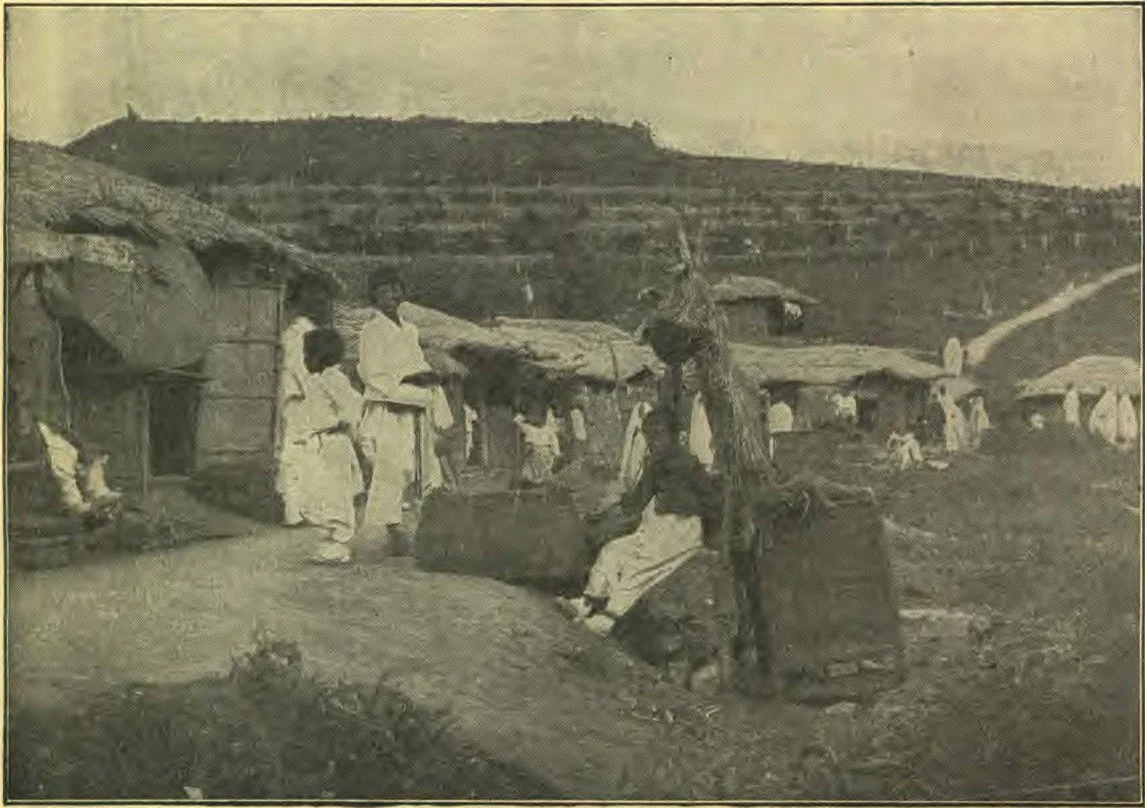
Korean dwellings are not peculiar in that they are almost invariably grouped together in villages, even in the country districts; for this custom prevails thruout the Orient. But Korean houses are peculiar, both in structure and meanness; for it has been said that of all civilized people the Koreans have the poorest dwellings. The walls are made of mud plastered onto a lattice work of small poles, or of stones or tiles laid in mud plaster. The roof is a thatch of straw or reeds over rafters of small, crooked poles. The doors and windows are of latticework, covered with white paper to admit the light. The mud walls dry and crumble, and need frequent repairs.
Queer Houses.
But the most peculiar part of the house is the floor, with its arrangement for heating. The kitchen, usually located in one end of the rectangular structure, has no floor except the solid earth. Here is the fireplace, over which the food is cooked, and which furnishes the heat to warm the other rooms. The floors in the rest of the house are constructed as follows: Parallel walls of stone and mud about a foot high and a foot apart, are first built; then the spaces between these are bridged over with flat stones, and the surface is leveled up with a layer of mud plaster. The resulting flues beneath the floor are connected with the fireplace in the kitchen, so that the hot air and smoke traverse the flues, and warm the floor. This method is said to be a very effective way of heating, but is very expensive; for fuel is scarce and dear. When the mud cracks and lets in the smoke, it must be repaired with fresh mud. In the better class of houses the earthen floor is covered with oiled paper, which is a decided improvement.
Korean Dwellings of the Humblor Sort.
The houses of a country village are crowded close together without any regular arrangement. In place of streets, narrow paths wind here and there, to suit the location of the houses and the lay of the land. In the larger towns there are streets, but these are narrow and crooked. Some of the older and more important cities are enclosed by walls, after the ancient manner. Among these are Pyeng Yang, the old capital, and Seoul, the present seat of government. The walls of Seoul are in a fair state of repair; but those of Pyeng Yang show many marks of wear and war.
Agriculture and Primitive Methods.
Agriculture is the principal occupation of the people, and the methods of labor are very primitive. An outfit for plowing the soil consists of a small wooden plow with a shovel-like iron point, drawn by a small cow.
Another arrangement for turning the soil is an iron shovel with a long handle, and a rope fastened to each of its corners. One man works the handle, while two or more persons pull the blade into the ground by the ropes. It has been pointed out that this shovel is a fair sample of what the Koreans regard as a labor-saving machine; for it saves one man from doing the work that five men can do with much greater ease.
Human Transports.
Wheeled vehicles are practically unknown in Korea. All sorts of commodities are transported upon the backs of men, even for considerable distances. Women carry their burdens upon their heads. Ponies and donkeys are also used to carry burdens; and it is a somewhat ludicrous sight to see a portly Korean riding on a pony or donkey but very little larger than himself. The ordinary roads thru the country are only narrow footpaths, but they are quite in accord with the methods of travel.
Korean Dress.
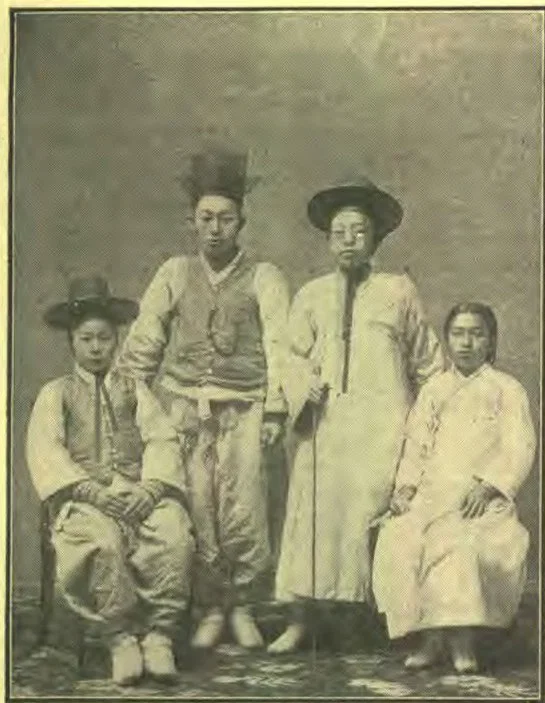
The most striking peculiarity of the Korean costume is that nearly every garment is white. The summer clothes of the common people are of undyed cotton or linen; the winter garments are of the same material, made warm by being quilted with cotton. The wearing of white clothes imposes an arduous task upon the wives and mothers of Korea. As we stood upon the slopes of Nam-San overlooking the city of Seoul, the sound that rose above all others was the whack, whack, of the laundry sticks. The clothes are first boiled in lye, then taken to the nearest well or stream, soaked in the water, and beaten with a club upon a flat stone. When dry they are folded and laid on a smooth, flat stone, and again beaten with light clubs till they take on a polish resembling that of dull satin. The process thruout is quite effective, and one is surprised at the whiteness and glossiness of the well-dressed gentleman's garments; but it requires an immense amount of labor. However, the government has recently taken action, advising the people to wear clothes of darker colors; and a few of them are beginning to act upon the suggestion. This action of the government is interesting as indicating the force of custom in Korea, as well as the peculiar realm of Korean law.
Perhaps nothing better illustrates the force of custom in Korea than the matter of wearing hats. Boys wear their hair in a long braid down their backs, the same as girls. But when the young man marries, his hair is combed up and twisted into a slender coil or "topknot" on the crown of his head. At the same time he assumes the dress of a man, which includes a peculiar head-gear of black horse-hair, and a straight-rimmed, taper-crowned hat. The boy has become a man; but an unmarried man may not dress his hair into a topknot, nor wear any kind of hat or hair head-dress.
There is quite a variety of hats and head-dresses worn; and it would require a lengthy chapter to describe them, and to enumerate all the rules and customs connected with their use,—black hats and white13hats, mourning hats, and mourning caps, servants' hats, and head-dresses for old men, young men, and scholars. But all this might seem trivial and tedious. These old customs seem to be losing their force to some extent, and it is not uncommon to see young men with their hair cut after Western fashion.
Korean Men in Native Dress.
The Custom Concerning Marriage.
In Korea as in other oriental countries, marriage is not the result of mutual love and choice, but is arranged for the young people by their parents. The usual age at which both men and women marry is seventeen or eighteen years; tho it is not at all uncommon for boys not yet in their teens to marry. Marriage in Korea is anything but a love affair. It is proper for a husband to treat his wife with respect; but he would become an object of ridicule were he to show affection for her. Among the higher classes it is "good form" for him, three or four days after the wedding, to leave home for a length of time to show his indifference toward his wife. Conjugal fidelity is a feminine virtue only, and concubinage is not uncommon. A marriage once contracted is not easily broken; for if a man divorces his wife, custom forbids him to marry again.
The Seclusion of the Women.
From the age of seven a Korean girl is carefully secluded in the women's apartments of her father's house; and when she marries, she passes to a similar seclusion in her husband's home. Among the middle and upper classes, this seclusion is as complete as in the zenanas of India. Only servants and the lowest class of women may go abroad by daylight without restraint. Women of the common people are often seen upon the streets; but at such times they wear a long garment thrown over the head, and held closely about the face. The native Christian churches are usually divided into two rooms by a partition or curtain, the women occupying a room by themselves.
This custom of secluding the women evidently must greatly affect the social life of the people. There can be no promiscuous gatherings of men and women. If women make or receive calls, it must be done with the utmost privacy. Men receive and entertain their friends with neither mother, wife, nor sister present, to add charm and grace to the occasion. While on a missionary tour in the country, we were entertained at a certain village by a well-to-do man, who was interested in Christianity. The rooms assigned to us were not connected with any other rooms of the house. Here we ate and slept, received callers, and held our meetings. At meal-time our food, prepared in the kitchen and served upon tiny, tray-like tables, was brought around the corner of the house to our room by some of the men folks. And during our stay of several days, neither woman nor girl was seen, heard, nor even mentioned. This circumstance brought forcibly to our minds the need of women Bible workers and evangelists to carry the Gospel to their secluded Korean sisters.
They Are Hospitable.
While there are many things among this people to call out adverse criticism, it must not be thought that they have no virtues. On the contrary, they are kind and hospitable to guests, providing the best that their humble homes have to offer. The unsalted mixture of rice and beans may be unsavory to our cultured palates, and the thin mattress spread upon the hard floor may supply scant comfort for a night's rest; but the welcome we receive proves that true hospitality is not dependent upon affluence. Such a hospitable people ought to be especially susceptible to that divine truth expressed in the familiar words of the Saviour,—"It is more blessed to give than to receive." In holding up to view some of their faults and deficiencies, I have not meant to excite blame or ridicule, but rather a kindly sympathy that may lead to efforts for their uplifting.