The Youth’s Instructor, Vol. 34, No. 4.

HOW SUCCESS WAS WON

The Youth’s Instructor

Jan 27, 1886

S. D. A. Publishing Association · Battle Creek, Mich. · Jan 27, 1886

HOW SUCCESS WAS WON.
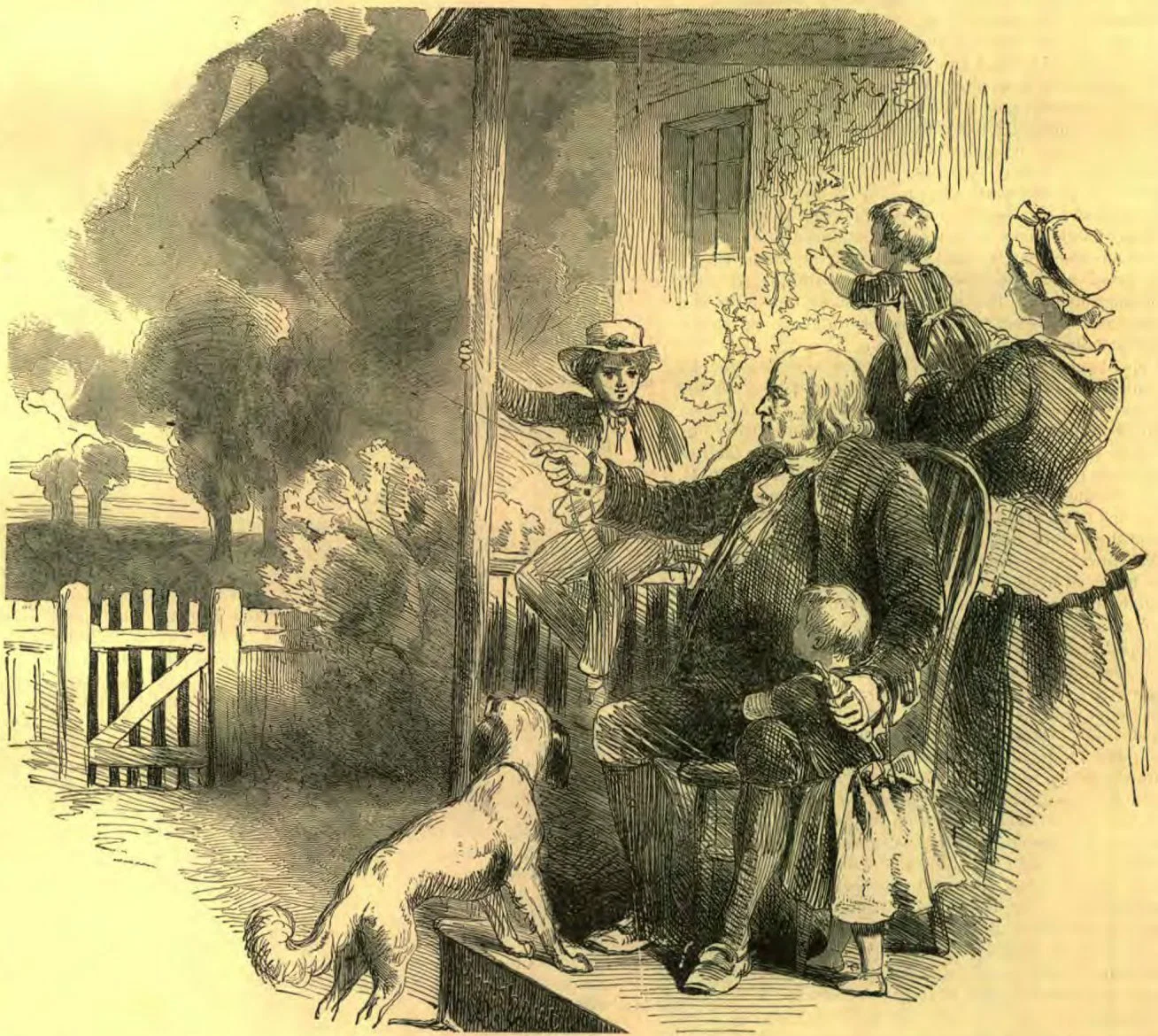
If you had been walking about the narrow, crooked streets of Boston over a hundred and sixty years ago, you might have come across the workshop of a candle and soap maker. And had you peeped within the door of this humble house, you might have seen, dipping the wicks in and out of the tallow, a young lad with a very discontented look on his face. He did not like to do this work; he wanted to go to school. But his father was poor, and had a large family to provide for; so Benjamin, as this lad was called, had to do his share toward earning a living.
Ben had a great many excellent qualities, that in after years he turned to good account in helping his country. But sometimes these same good qualities, when not guided by sound judgment, led him into a vast deal of mischief. In all sports he was the leader among the boys of the town. In the vicinity there was a mill-pond bordered by a salt marsh; and thither the boys resorted to fish for minnows. Constant tramping had rendered the marsh a veritable quagmire, affording insecure footing to the juvenile fishermen. Ben, as usual, set his wits to work to remedy the evil. Seeing at a distance a pile of stones that had just been hauled for a new house, he and his companions set to work after the men had left the place at night, and carried all the stones, big and little, over to the pond to make a pier of. Next morning the workmen came to lay the wall, and found their stones missing. When the mischief-makers were found out, their stern New England fathers severely corrected them, and made them carry the stones back. Ben then learned a lesson which was to last him all through life,—a lesson all boys should early learn,—that wrong means are not justifiable even in a good cause, and that what is not honest cannot be truly useful.
As the days and weeks went by, Ben grew more and more uneasy, and dissatisfied with his work, until his father was seriously afraid he would run away to sea, as one of his brothers had done. Noticing the boy's fondness for books, his father thought the printer's trade would be best suited to his taste; and he accordingly made arrangements with Ben's brother James to take him into his office and teach him the trade. Ben was to work for him nine years, or until he was twenty-one, and during the last year he was to have pay for what he did. He liked the trade, and soon became a good workman. But he found it as hard work as ever to get books to read; for he had no money to buy with. At last he persuaded his brother to give him half the money he paid for his board; and he managed to board himself comfortably on half of what his brother gave him, spending the rest for books. As he says himself: “I had another advantage in it. My brother and the rest going from the printing house to their meals, I remained there alone, and dispatching presently my light repast (which was often no more than a biscuit, or a slice of bread, a handful of raisins or a tart from the pastry cook's, and a glass of water), had the rest of the time, till their return, for study; in which I made greater progress from that greater clearness of head, and quicker apprehension, which generally attend temperance in eating and drinking.”
But Ben had a hard master in his brother, who was a hasty, passionate man, and often beat him soundly when he displeased him. Ben did not receive such treatment very pleasantly. By and by they had an open quarrel; whereupon he left his brother and went to Philadelphia, which was to be his home for the rest of his life. You no doubt remember of reading how, poor, friendless, and homeless, he wandered through the streets of the city, eating a roll that he had just bought at a bakery. He must have presented a ludicrous appearance, with his pockets stuffed out with soiled clothes, and a roll of bread under each arm. But those who were so ready to laugh at him then, were glad to pay him all respect in later years.
Ben, or Franklin as he was now called, soon found a place to work; and by his steady, industrious habits and studious turn of mind, made a good reputation. In about seven years he was able to run a printing house on his own account, and from that time forward his life was one of continued success.
But there is hardly room to tell you of all the honors that he enjoyed in the latter part of his life, and of all the projects he set afoot for the benefit of the people. He was the first to organize a fire company in Philadelphia. He made many experiments in science, and discovered the similarity between lightning and electricity by his famous experiment with the kite in a thunder-storm. The knowledge that he gained through this experiment he turned to practical account in the invention of the lightning-rod.
His wise counsel and sound judgment were much valued, and led the people to elect him a member of the General Assembly. In later years he visited England and France, where he did very effective service for the American colonies.
You may like to know by what means a lad of poor and obscure parentage was enabled to gain such success. Outside of his natural abilities, which were of great advantage to him, I think the key-note may be found in this passage of scripture, which his father so frequently quoted to him when a boy: “Seest thou a man diligent in his calling, he shall stand before kings, he shall not stand before mean men.” “The industry of that Franklin,” said an old townsman, “is superior to anything I ever saw of the kind; I see him still at work when I go home from club, and he is at work again before his neighbors are out of bed.” And Franklin himself says: “I considered industry as a means of obtaining wealth and distinction: though I did not think I should ever literally stand before kings, which, however, has since happened; for I have stood before five, and even had the honor of sitting down with one, the king of Denmark, to dinner.” And again, “I have always thought that one man of tolerable abilities, may work great changes, and accomplish great affairs among mankind, if he first forms a good plan; and cutting off all amusements or other employments that would divert his attention, makes the execution of that same plan his sole study and business.” W. E. L.

COPENHAGEN

The capital and most important city in Denmark is called Copenhagen by English-speaking people; but its name is Köbenhavn. The original name was Hafen, which afterwards was changed to Köbmanshafen, which means “merchants’ harbour.” It is situated on the largest island, Salland, on the east coast, nearly opposite to Malmö in Sweden. It is the largest city in Northern Europe, having nearly three times as many inhabitants as Christiana and 80,000 more than Stockholm. The present number of inhabitants is 320,000; that is about as many as St. Louis has, and more than Chicago had seven years ago. But then, Copenhagen has had a long time to grow in; for it is about seven hundred years old, while Chicago is only a little more than fifty.
The name, Köbenhavn, corresponds well with the origin and site of this city. In the eleventh century it was a well-known trading place, built on some small islands between Salland and Amager (another island). Here the people were partly sheltered from violence, the vessels found an excellent anchoring place, and in Öresundet (the strait connecting Kattegattet and the Baltic Sea) the inhabitants found an abundance of fish; while the town was built right on the highway between the North Sea and the Baltic Sea, and between Roskilde, which was then the capital of Denmark, and Lund, an important city in Sweden. Köbenhavn is still a lively trading place right on the main road to the harbors of Prussia, Sweden, and Russia in the Baltic.
Absalon, a Catholic bishop, who was commander-in-chief of the Danish army and navy, and who was commissioned to subdue the pirates which infested the sea, was the first who fortified this place. He built a castle with forts in the place where the royal palace, Christiansborg, now stands. In the year A. D. 1204 the archbishop, Jens Grand, made it a city; and afterwards it obtained privileges as such. You see by this that the bishops in those days were mighty men in the affairs of state. They claimed Copenhagen as their special property; and in the thirteenth century, King Waldemar III. ceded to them two counties in Salland to obtain the right of governing the city for a time. The bishops, however, tried afterwards in vain to get it back.
In 1441, the royal palace in Roskilde and a large portion of the city burnt down, whereupon the king chose Copenhagen for the royal residence, which it has continued to be ever since.
Copenhagen has often suffered from destruction by fire, mostly in 1728, 1795, and 1807 when it was bombarded by the English. The greater part of the present city is therefore new, and built after modern style. The streets are straight and wide, and the houses generally five stories high besides the basement. When you walk through these streets, it reminds you of the principal streets of Chicago and other American cities. But the central, the old part, still has narrow, irregular streets, and presents the antiquated aspect of past centuries.
There is probably no city in the world that is kept cleaner than Copenhagen, and in proportion to its size has so many public parks, avenues, artificial lakes, and streams. In the summer time the parks are very lovely, and are kept with great care. The attention of the visitor is attracted by numerous swans that sail along proudly on the waters of the lake, or collect by the shore or bridges to gather the bread crumbs thrown to them.
Copenhagen has often been attacked and besieged by enemies. In 1259 it was taken by opposing tribes. In 1306 the Norwegians made an attack upon it, but were repelled.
In 1362 the city was pillaged, and the castle destroyed by an army from Lübeck and Holstein; and six years later, it was again pillaged by the enemies of King Waldemar III.
In 1428 the citizens, directed by Queen Philippa, repelled an attack of an army from the Hanseatic (German) towns. From the 10th of June, 1523, to the 6th of January, 1524, the city, which took sides with the former king, Christian II., was besieged by land and sea. Ten years later it was besieged one year. The inhabitants suffered much from hunger, and surrendered at last July 29, 1536.
Copenhagen was also besieged by the Swedes for nearly two years, from August 11, 1658, to May 27, 1660, when peace was made. The citizens suffered severely from hunger under this siege, but they defended their city with great valor. October 20, 1700, a united English and Dutch fleet began to bombard Copenhagen, but this soon ceased, with the peace of Travendal. April 2, 1801, a great sea-battle was fought outside of the harbor, between the English and Danish fleet. And from the 2d to the 5th of September, 1807, the city was bombarded and to a great extent destroyed by the English fleet. Thus you see that those other powers have revenged themselves fully for the attacks which the Danes had formerly made on them. Stern justice and cruelty are the principal elements in the ruling powers of this world; but we rejoice that a better government soon shall be established, whose king shall sway the blessed scepter of peace and love.
Copenhagen has also suffered considerably from pestilence no less than nineteen times in one hundred and forty-three years, from 1511 to 1654. In the year 1711 as many as 22,500 persons died from pestilence; and in the summer of 1853, no less than 4700 persons were carried off by cholera. This city, having survived so many calamities, is still flourishing, and will probably stand until all the great and proud cities of the earth shall be laid low to give place for the eternal city of God, in the day when the Lord alone shall be exalted.
This city has more than twenty Lutheran churches and chapels, two Roman Catholic, one Greek Catholic, one French Reformed, one English Episcopal, one Methodist, one Baptist, one Irvingian, besides other chapels and halls where meetings are held by Disciples, Swedenborgians, Mormons, German Baptists, Free Lutherans, Brethren, and S. D. Adventists.
In Copenhagen is the harbor for the fleet, numbering some forty smaller and larger war-vessels. Here, also, about one third of the Danish army is stationed. The number of soldiers in the city this summer was not less than eleven thousand.
Here are four royal palaces. One of them, Amalienborg, is the residence of the king. The royal family is somewhat interesting, on account of its connection with so many other royal families. The name of the king is Christian IX. One of his sons is king of Grecia; one daughter is married to the prince of Wales; another to the emperor of Russia; the third to the duke of Cumberland. The king’s oldest son, the crown-prince of Denmark, is married to a Swedish princess; and prince Waldemar has lately married a French princess. Thus they are connected with five royal families. In the Panopticon may be seen life-like wax-figures presenting in one group all these royal persons.
Nine museums are found in this city, among which the sculptures of Thorvaldsen and the collections of antiquities are most renowned. In the zoological museum is found a cetaceum (collection of skeletons of whales) which is the largest in the world. In the botanical garden are plants from all zones—no less than two hundred kinds from America. Here the astronomical observatory is located on a hill. Here is also a statue of Tycho Brahe who died in 1601, and is world-renowned for his astronomical observations. The zoological garden has a rich collection of animals from all parts of the world.
Of libraries, the royal library with 500,000, and the university library with 250,000 volumes deserve to be mentioned. The university has one thousand and five hundred students. Besides this institution of learning, there are several hundred schools which, generally speaking, are well managed. At noon you may meet hundreds of school-children, boys and little girls too, clattering on the stone-paved streets with their wooden shoes, like a division of horsemen. The city has ten or more hospitals, the largest can accommodate eight hundred patients.
There is an abundance of theaters and public resorts of pleasure in the city and its suburbs. Nine lines of street-cars, besides rail-cars, steamers, and steam-street cars, every day carry passengers from seven in the morning till eleven at night. The people are pleasure seekers to a high degree. Last summer, on Sunday more than 60,000 people were conveyed to only one park, six miles from the center of the city. Every Sunday you may see the road crowded with carriages and foot-passengers, besides the thousands who go by steamer and rail. Most of the stores are open on Sunday, and trade briskly in the morning and all the evening till ten or half past ten o’clock. Sunday is looked upon only as a day of recreation.
The Socialistic element is strong in Copenhagen. Their paper has more readers than any other political paper in the city. Most of them are infidels. They number probably more than 20,000.
The people are generally very polite, but true morals are low, and infidelity and pleasure-seeking are the most prominent features of their character. Yet in this modern Sodom there are some honest souls who desire to become acquainted with the holy Scriptures and to fear God and keep his commandments.
JOHN G. MATTESON.
Copenhagen, Denmark.

DIDN’T THINK.

Opening the door of a friend’s house one day, I made my way through the entry to a small back court, where Ned, the only son, was crying bitterly.
“Ah, Ned, what is the matter?”
“Mother won’t let me go fishing. Harry and Tom are going to the harbor, and I want to go.”
Here Ned kicked his toes angrily against the post, to the great danger of his new boots.
“Whose little dog is this?” I asked, as a brown spaniel came bounding up the garden walk.
“It is mine,” cried Ned in an altered tone. “Didn’t you know I had one?”
“No, indeed. What a fine fellow! Where did you get him, Ned?”
“Father bought him for me. He is so knowing, and I teach him many things. See him find my knife;” and Ned, wiping away his tears, threw his knife into the clover.
“There, Wag,” he said; “now go and find my knife.”
Wag plunged into the grass, and after a great deal of smelling and wagging, he came triumphantly forth, and brought the knife to his young master.
“Give it to him,” said Ned, pointing to me; and Wag laid it at my feet.
“This is a knife worth having,” said I; “four blades.”
“’T is a real good one,” said Ned. “Father gave it to me on my birthday; and he gave me a splendid box of tools, too.”
Ned looked up brightly, and forgot his crying.
“Let me think,” said I; “was it with this knife that you hurt your foot so badly?”
“Oh, no,” cried Ned; “that was done with the ax; but I’ve got well now.”
“I was afraid you would be laid up all the spring.”
“Well, ’t was mother’s nursing, the doctor says. Mother and father took great care of me. It was lonely staying in the house so; but mother used to leave her work and read to me, and father often stayed with me.”
“I should think you had very kind parents, Ned.”
The boy looked down on the floor, and a slight pout puckered his lips.
“I suppose there are none who have your interest and happiness so much at heart.”
“But I want to go fishing,” muttered Ned.
“And can’t you trust them, Ned, and willingly agree to their wishes? You may not know the reason why they object to your going; but from all your experience of their kindness and wisdom, are you not sure that they would not cross your wishes without good reason for doing so? And, surrounded as you are by so many proofs of their love, will you sit there and murmur and cry, and fill your heart with angry and stubborn thoughts, because of one little denial of your wants? Is not this a poor and ungrateful return for their kindness? It is little enough that a child can do for a parent, and that little he ought to do most cheerfully. I suppose the best return a child can make to a parent, is cheerful obedience. How small that seems! And would you grudge giving that, Ned?”
Ned looked sober. “Oh, sir,” he said humbly, “I didn’t think of all this—I didn’t think of it.”
“‘Didn’t think’ is at the bottom of a great deal of our ingratitude and murmuring against both our earthly parents, and our Father who is in heaven.—Selected.

KEEP TO THE RIGHT.

“Who is that singing under my window?” called Aunt May as she threw open her blinds one bright morning, and heard two lusty voices below shouting,—
“Keep to the right, boys, Keep to the right.”
“Only Tom and Ned, Auntie; may we come up?” and a moment later the two boys bounded into the room above, where Aunt May sat at her window.
“Isn’t it a fine morning, Auntie?” cried Tom; “and we’re up bright and early. May we stay with you till breakfast-time?”
“Oh, yes, Auntie,” pleaded Ned; “and we’re such good ‘early birds,’ I think we ought to have some sort of a worm as a reward.”
“It better be an angle-worm, Auntie; Ned is always fishing for a story.”
“Very well,” laughed Aunt May, “I will tell you what I thought when I heard you boys singing, ‘Keep to the right.’ I thought of one time—it was just such a bright morning as this—when I did not keep to the right. I had taken a pretty sail the day before up the River Thames from London to Tagg Island; and in the morning we walked over green fields and along a fine, broad road to Hampton Court, one of the famous old palaces of England. Now, in the beautiful grounds that surround this palace there is a curious green labyrinth, or narrow, winding walk, inclosed on either hand by a close hedge. It is called the Maze. In olden times it was counted a pleasant pastime to find one’s way through such labyrinths. Before I entered this Maze, some one whispered in my ear a very simple rule for finding my way among the winding paths to the little circular space in the center. It was this: ‘Keep to the right the first time you have a choice between two ways, and to the left every time after.’ I passed in through the narrow opening in one side of the thick outer circle of hedge, fully expecting soon to penetrate the mysteries of the Maze; but in some way I failed to make that first turning to the right, and so I ran about for some time, shut in on either hand by dense masses of green, finding the way barred once and again by a leafy barricade that caused me to retrace my steps, until at last chancing to strike the right path, I found my way to the middle of the Maze, glad to sit down and rest for a moment on the little wooden bench placed there under a shady tree. I might have been saved all my trouble if I had only started right.
“But the little blunder taught me a useful lesson, or rather, brought an old lesson to mind in a way which I have not forgotten. As you boys grow older, you will find that you are constantly coming to places in life where you have a choice between two ways. There is only one rule that will guide you safely. It is, ‘Keep to the right.’ You may be strongly tempted for many reasons to take the opposite course, to go to the side that you know to be wrong; but you may be sure that it will lead you into confused and tangled ways, and you must, sooner or later, lament the foolish choice. Never mind how irksome it may appear; never mind how much you may be obliged to give up in order to choose the right path; listen to the soft voice that whispers in your ear, and ‘keep to the right.’ Only by so doing can you avoid the tangled maze of sin; only by traveling along the right way can you come out at last at the right ending, the happy resting-place. If Tom will bring my Bible and turn to the thirty-second psalm, we will read together how we are to be helped always to know the right way. See, I have laid a green leaf at the place. I plucked it that morning in the Maze, and have kept it ever since beside the words, ‘I will instruct thee and teach thee in the way which thou shalt go: I will guide thee with mine eye.’” —The Child’s Paper.

The Truth Cannot Be Burned, Beheaded, or Crucified

THE truth cannot be burned, beheaded, or crucified. A lie on the throne is a lie still, and truth in a dungeon is truth still; and the lie on the throne is on the way to defeat, and the truth in the dungeon is on the way to victory.—Wm. McKinley.

Doing Our Duty in Everyday Life

LET us do our duty in our shop or our kitchen, the market, the street, the office, the school, the home, just as faithfully as if we stood in the front of some great battle, and we knew that victory for mankind depended on our bravery, strength, and skill. When we do that, the humblest of us will be serving in that great army which achieves the welfare of the world.—Theodore Parker.

IMPORTANT BIBLE SUBJECTS.

LESSON 6.—THE HEAVENLY SANCTUARY.

[NOTE TO THE STUDENT.—Do not consider the lesson learned until you can give at least the substance of every text, with the correct reference for each. The references in black letters indicate those texts that should be committed to memory. A little diligent application each day will enable you to learn them, although this need not be considered a test of scholarship.]
1. Were sins actually removed by the ceremonies and offerings connected with the earthly sanctuary? Heb. 10:3, 4.
2. What does Paul say of the service of the earthly priests? Heb. 8:5.
3. What does he call the earthly sanctuary? Heb. 9:8, 9.
4. Of what was it a figure, or pattern? Heb. 9:23.
5. Then is there a real sanctuary in heaven? Heb. 8:1, 2.
6. Does the heavenly sanctuary have two holy places? Heb. 9:24.
7. Who is the high priest of this sanctuary? Heb. 4:14.
8. Did he minister there while the first or earthly tabernacle was standing? Heb. 9:8. (See note.)
9. What position did our High Priest take when he left this earth? Heb. 10:12; 8:1.
10. What office does he there fill? Heb. 8:2.
11. In what part of the earthly sanctuary were the altar of incense and the golden candlestick placed?
12. Where was the throne of God seen by John? Rev. 4:5; 8:3.
13. Then in which apartment did our Lord begin his priestly work?
14. What did the second apartment of the earthly sanctuary contain?
15. What did John behold in the heavenly temple? Rev. 11:19.

THREE WAYS OF DOING.

Some teachers stand aloof, and expect their pupils to come to them. In this, they look for an impossibility. One might just as well stand upon the brow of a tall perpendicular rock, and say to a child below, “Come up here, and I will help you.” The teacher’s mind should be much better disciplined than that of his pupils. His mental processes are more direct, concise, and rapid; and when he presents a theme without regard to the mental habits of the learner, he requires him to grapple with a new subject, and a new mode of thought at the same time. Such a teacher has very little power to interest even grown-up people, much less to gain and keep the attention of children.
Another class of teachers come down to their pupils, and stay there. Such teachers are much liked by children, because they amuse and entertain, without requiring any mental effort on the part of their delighted listeners. They seldom lead to higher modes of thought, or to more vigorous and continued action of the mind. The most they attempt is to carry their pupils along, without requiring them to advance mainly by their own efforts. They please children by playing with them, but do not teach them to work. Teaching, with them, is a mere pastime, at least for a season; but unless they change classes, they will at last be put to their wit’s end to invent “new plays,” or methods of amusement. In their extremity they often resort to unhealthful stimulants, and as a result, their pupils become so mentally dyspeptic that it seems impossible for them to do good thinking on any subject.
There are some teachers, however, who come down to their pupils, or so nearly so as to become genial, and easily understood, and then entice and encourage them forward and higher, never wearying them too much, yet seldom giving them a hand. They do not strive to attract others to themselves, but rather to the beauties of the way. The learner pursues the path of knowledge, not simply because that in it he can enjoy the delightful companionship of his teacher, but because he sees it to be a good path,—one that may make him wiser and happier. The healthy exercise of the mind is its own reward, and soon the pupil begins to find pleasure in grasping new thoughts, in combining and comparing them, and thus reaching conclusions and judgments of his own. This kind of mental satisfaction never becomes stale, and will lead to an earnest appreciation of the knowledge gained. One so taught will come to have an inward impulse of his own that will urge him on in search of truth, long after his teacher has ceased to prompt him. —S. S. Worker.

THE MANUFACTURING AND TEMPERING OF STEEL.

STEEL is manufactured from iron, and is, too, a compound of carbon and iron. It may be made directly from the iron ore, from pig iron, or from wrought iron. If made from pig iron, it must have some of the carbon taken out, as pig iron contains more carbon than steel possesses. If it is manufactured from wrought iron, more carbon must be added, for wrought iron has less carbon than steel.
There are different processes for diminishing the amount of carbon in the iron, as there are also different methods for increasing it. The more carbon the steel contains to a certain limit, the closer is the grain of the steel, and the lighter its color, effects which are produced by hardening.
The principal characteristics of steel relate to hardening and tempering. If it is brought to a red heat, and cooled suddenly in water, oil, or some other liquid, it becomes hard in proportion to the amount of carbon it contains, the temperature to which it was raised, and the rate at which it was cooled. After being hardened in this manner, if it is heated again, and allowed to cool slowly in the air, it loses its hardness in proportion to the temperature to which it was reheated. The process by which these changes are made in steel is called tempering. All compounds of iron and carbon can be thus tempered. The temper of steel determines its value.
One’s success in hardening and tempering steel depends upon many conditions; the temper is decided by the color of the oxide which forms on the surface. The workman understands that lancets require a very pale yellow; razors and surgical instruments, a pale straw; penknives, a full yellow; scissors and cold chisels, brown; axes and plane irons, brown, with purple spots; table knives, purple; swords and watch springs, a bright blue; fine saws and augers, full blue; and hand and pit saws, dark blue. These colors are removed by the after grinding and polishing.
But there are a multitude of processes by which the work of tempering is done, and just the nature of the hardening process is not very well understood; so it requires great skill, or very nice discriminating powers, to do the work successfully, as the following extract from the Christian Union will show:
“To be able to properly temper steel springs and implements, may be considered a gift similar to that possessed by the ‘poet born.’ A man whose business in a certain tool shop was to temper springs, worked 22,000 consecutively, and of the whole number only six failed to pass the test; but during this man’s temporary illness, more than half the springs handled by his assistant, who had been under instruction a year, failed. In a large manufactory of sword blades, one man does all the tempering, being called in from other employment at intervals, because, although he has always been willing to instruct others, he has never had a pupil who could equal him in the work. There is a large scythe manufactory in a New England town making 14,000 dozen scythes a year; and the president has, for years, hardened and tempered every scythe that leaves the works, because no other man in the works can do it so well.”

HOW LONG TO LAST?

A SCULPTOR will spend hours in shaping a feature of the face. Like a magician’s wand, his chisel will stroke some bud of snowy marble until he has evoked a marvelous copy of nature. With like patience a painter will labor to give expression to the eye, or form to the hand. Their work is not for a day. It is not to stand as an image or flaunt as a banner in the hasty pageantry of some procession. It will have a history in the long annals of art, and survives to-day. Haydn is said to have spent three years amid the harmonies of “The Creation,” that musical masterpiece. When asked for the reason, he said, “Because I intend it to last a long time.”
You, in your work for others, are shaping substance more imperishable than canvas or marble. As a result it will outlast Haydn’s “Creation.” You work upon the soul that stains the canvas, carves the marble, and gives wings of song to its sweet conceptions. You are striving to educate into all Christ-likeness a human soul whose heritage is immortality. You can afford to be a patient workman, and wait long for results, as you will have eternity in which to watch their development.—S. S. Journal.

SOMETHING FOR SOMEBODY.

SOMETHING for somebody! How or why— It makes no odds how small it may be, The little, sweet kindness just close by, The unprized duty that's next to thee.
Just giving a flower, a book, a tone, A cup of water to weary lip— Or helping the angel roll the stone Out of the path where a foot might slip.
Something for somebody! He prays best Whose deeds with heaven-blest incense come, The breath of love in a human breast Can make the angels feel at home. — Tarpley Star.

SILVERING LOOKING-GLASSES.

As the boys and girls make their toilet sometimes before the mirror, do they not frequently wonder how such a piece of workmanship was wrought? It certainly seems like very particular business to spread evenly over glass anything which has the habit of creeping away so like quicksilver. A writer in Golden Days gives the process as follows:—
“In silvering looking-glasses a large, perfectly flat stone table is provided, upon which a sheet of tin-foil, without crack or flaw, is evenly spread. This is covered uniformly to the depth of one-eighth of an inch with clear mercury. The plate of glass, perfectly cleansed from all grease and impurity, is floated carefully on the mercury, so as to exclude all air-bubbles. It is then pressed down by loading it with weights, in order to squeeze out all the mercury which remains in a fluid state, this surplus being received in a gutter around the stone. After remaining in this position for about twenty-four hours, it is raised gently upon its edge, and in a few weeks is ready to frame. It is said to be desirable to have the lower end of the glass from which the mercury was drained at the bottom of the frame, as the surface is generally roughened a little at that part.”
We may learn something here, perhaps, about mirrors. By its shape, one cannot always tell which end of the frame was designed for the top; but by examining the glass, we may be able to have the most perfect part where it will be most useful. The same writer also tells how to repair the silvering of looking-glasses. The method is this:—
“First uncover and clean the damaged spot by very careful rubbing with fine cotton until there is no trace of grease or dust. Then, with the point of a knife, cut the size of the required piece on the silvering of another glass; drop a small globule of mercury (the size of a pin’s head for a surface the size of a finger nail) upon the cut piece. The mercury penetrates the silvering as far as the cut and allows of the removal of the piece. Transfer this to the spot required to be repaired, and press it on with a piece of soft cotton.”

THE TREASURY WASTE-BASKET.

In almost any Office, until the waste-basket has been searched for a missing article, a faint hope lingers that it may yet be found. Such seems to be the experience at the Treasury Department at Washington; and a number of girls are employed purposely to examine the waste papers which collect each day. A Washington correspondent of the Telegram writes:—
“Down in the basement of the Treasury Department is a room in which about a dozen girls sit and sort over the waste paper which has accumulated from the work of the twenty-five hundred clerks in the room above. All of the waste paper in the Department is transferred to this room by the sweepers at the close of each day. Then the girls go over it carefully, piece by piece, and they often make very valuable discoveries. Not long ago $10,000 worth of bonds were found in a waste-basket in the office of the Comptroller of the Currency, and there was a great howl about it at the time, but in the end nobody was punished for the gross carelessness; but such large sums as this seldom find their way into the sorting-room. The principal discoveries are pen-holders and stationery which have been accidentally dropped into the waste-baskets. Sometimes a valuable document disappears in an unaccountable manner from the files of the Department. The rooms are ransacked, and every one connected in the division becomes well-nigh crazy. As a last resort the waste-paper room is appealed to. In nine chances out of ten, if the paper has been disposed of in that way, the girls will find it. They have become remarkably expert in sorting over this rubbish. A girl will take a mass of it in her hands, and, in less than the time that it takes to tell it, her sharp eyes will have seen all the different pieces, and if there is even a scrap that looks as though it might be valuable, it is carefully laid aside for future examination. Experience has convinced the Treasury officials that these girls annually save many times their salaries to the Government. The sale of the waste paper is one of considerable importance; and the revenue each year is, in the course of business, turned back into the Treasury, where it properly belongs.”

A KAFFIR SERVANT.

The Kaffirs, natives of the eastern part of South Africa, have a singular way of finding food and water. An exchange says they use baboons for that purpose. “They catch them while they are young, and make them so tame that they prefer the hut of their master to the wild homes in the tree-tops. When a Kaffir wishes to obtain a fresh supply of babiana roots, he ties a long rope to a trained baboon, and leads it into the forest. The baboon knows what is wanted, and, as soon as it finds a root, the Kaffir gives a bit of the food to the animal, which is thus encouraged to work further. There is nothing cruel about that; but when the Kaffir wishes to replenish his water-needs, the baboon is first made almost mad with thirst, when he darts from bush to bush, and from hillside to hillside, in search of a pool or stream. By what sign the animal is guided, no one knows; but a baboon can find water where man would perish.”

PUMICE STONE.

Do you know how this peculiar kind of stone came into existence?
Pumice stone, common as it is, is really a remarkable thing. There is, indeed, an awful and mysterious interest about it. Every piece of pumice-stone once existed as lava in the depths of a volcano. But it not alone makes its appearance from the volcano, but also from the bottom of the sea. There are submarine volcanoes venting their fiery anger at such vast depths under the ocean that their effects do not reach the surface. The pumice which they discharge being lighter than water, rises to the surface, and so we obtain it. It has been seen floating over a space of three hundred miles on the sea, at a great distance from land or any known volcano.

ATMOSPHERIC SOUNDING BOXES.

In the Sinaitic range of mountains there is a remarkable cone of sandy rocks called Geble-Nakus. When a traveler attempts in fine weather to scale this miniature peak, he hears a sound like that of distant bells. When there is no wind, and the sand is damp with dew, the sound is not heard. This phenomenon is attributed to the friction of the silicious sand on the declivities of the cone. The atmospheric vibration is supposed to be intensified by cavities which serve as sounding boxes.—Selected.
Continue reading: IT MAKES ALL WRONG