“Please, father, is it all wrong to go pleasuring on the Lord’s day? My teacher says it is.”
“Why, child, perhaps it is not exactly right.”
“Then it is wrong, isn’t it, father?”
“Oh! I don’t quite know that; if it is only once in awhile.”
“Father, you know how fond I am of sums?”
“Yes, John, I’m glad you are; I want you to do them well, and be quick and clever at figures; but why do you talk of sums just now?”
“Because, father, if there is one little figure put wrong, in a sum, it makes it all wrong, however large the amount is.”
“To be sure, child, it does.”
“Then, please, father, don’t you think, if God’s day is put wrong now and then, it makes all wrong?”
“Put wrong, child—how?”
“I mean, father, put to a wrong use.”
“That brings it very close,” said the father, as speaking to himself, and then added: “John, it is wrong to break God’s holy Sabbath. He has forbidden it, and your teacher was quite right.”
“Remember the Sabbath-day to keep it holy.”—Kind Words.
HOW WINTER CAME.
By H. E. R.
WHEN Winter came down in his furry gown
With a border of snow like eider down—
Came down to the earth from his far-off home
Away in the North, whence the fierce winds come,
Where the world is ice, where the frost is made,
Where the light of the sun is but a shade—
He came on the wings of a chilling breeze,
And whipped the last leaves from the trees.
Piled them in hillocks here and there,
And pulled the grasses' long, gray hair.
He caught the rain-drops as they fell
From the dripping eaves; and, strange to tell,
With a crystal fringe was each ledge o'erhung
Like stalactites from some sea-cave swung.
He raved and he scowled, till his terrible look
Chilled the heart of the timid brook,
Then he laughed till the soft flakes shook from his cap,
In a thick, white fleece o'er Nature's lap.
Fold on fold, till the Earth lay deep
Tucked in for the season, fast asleep.
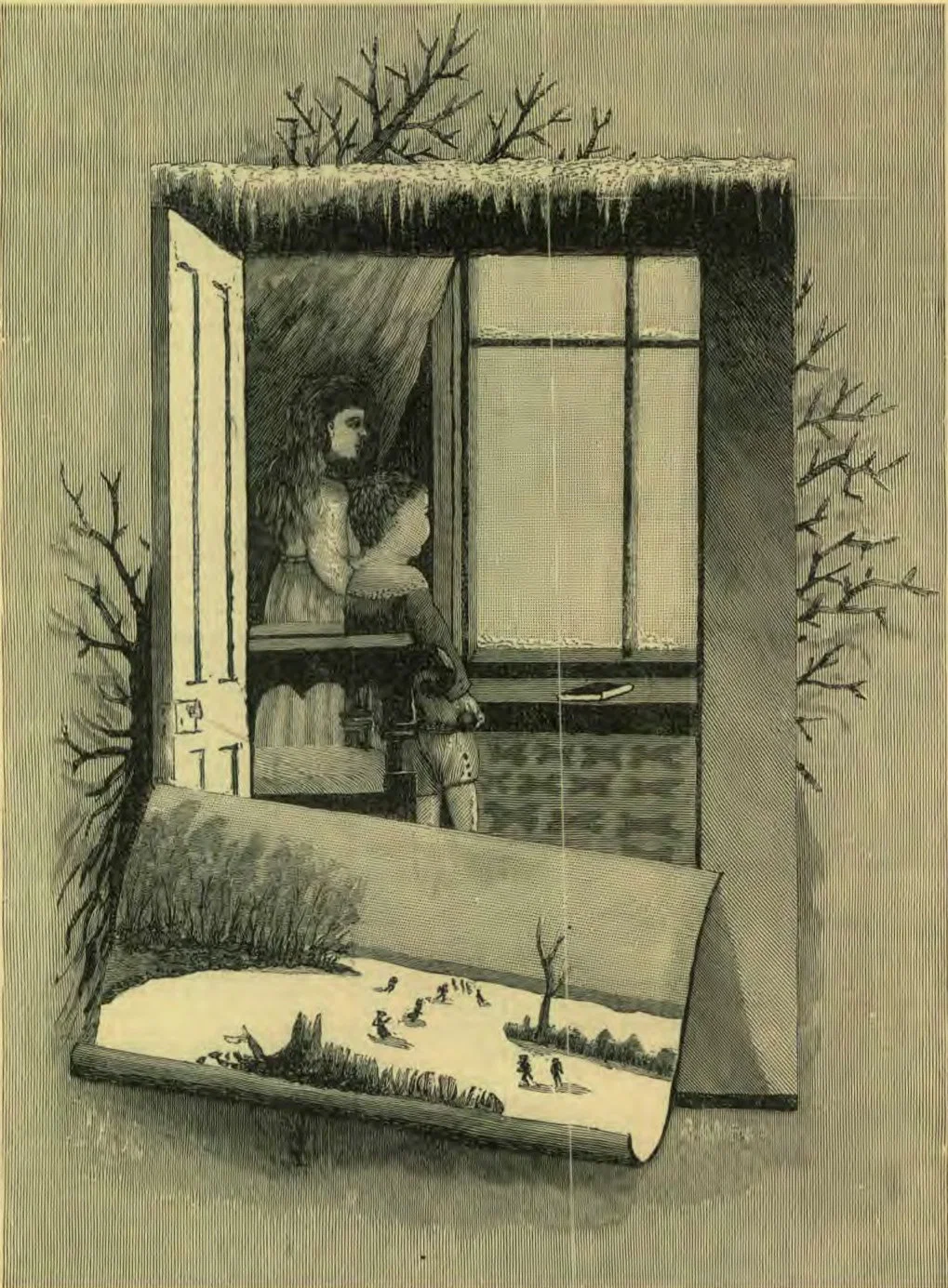
How the children smiled when at early dawn
The curtains were back from the windows drawn.
A patter of feet, a busy hum
And glad, sweet calls, "Oh, the snow has come!"
Soon in the clear and frosty air
They peopled the hillside everywhere.
And to and fro, round curve and crook
The merry skaters skimmed the brook.
The day was fair, all the world seemed glad,
And a right merry welcome Winter had.
H. E. R.
NO "IF."
THERE was a knock at the door of Aunt Fanny’s pleasant kitchen one morning, and on the steps stood a little girl with a basket on her arm.
“Don’t you want to buy something?” she asked, as she came in. “Here are some nice home-knit stockings.”
“Surely you did not knit these yourself, little girl?” said Aunt Fanny.
“No, ma’am; but grandma did. She is lame, and so she sits still and knits the things, and I run about and sell them; that’s the way we get along. She says we are partners, and so I wrote out a sign and put it over the fire-place: ‘Grandma and Maggie.’”
Aunt Fanny laughed, and bought the stockings; and as she counted out the money to pay for them, Maggie said:—
“This will buy the bread and butter for supper.”
“What if you had not sold anything?” asked Aunt Fanny.
But Maggie shook her head.
“You see we prayed, ‘Give us this day our daily bread,’ and God has promised to hear when folks pray; so I guess there wasn’t any ‘if’ about it. When he says things, they’re sure and certain.”
Playing on the Street.
WHEN I was a boy, my father moved to a nice house on the outskirts of the city. The neighbors were good ones, and I had a plenty of playmates.
One evening, just after dark, we were running races, the other boys and I, up and down the sidewalk. After awhile father came to the door, and called: “Come in, my son!”
When I went in, he told me that I must not be out on the street at all after sunset.
I wondered why. I could not see any harm in running races up and down the walk.
But he told me not to do it, and I had to obey.
Now that I am a man, I have looked to see how those other boys turned out. Their fathers let them spend the evening on the street, and nearly all of them became bad boys and brought sorrow to their parents.
Boys, the place for you after sunset is at home.
Letter Budget.
HERE we have two printed letters which read as easily as letters printed from type. The first one is from GERTIE M. HATCH, of Tuscola Co., Mich. She writes: “I am a little girl seven years old. I go to Sabbath-school with papa and mamma, and get lessons in Book No. 1, and get them perfect. Mamma reads the INSTRUCTOR to me, and I like it ever so much. She is teaching me to read and write. I have never been to school. I have sold five ‘Sunshines.’ I pay five cents a month into the missionary cause. I give away INSTRUCTORS and tracts. I love Jesus, and I am trying to be a good girl so I may be saved in the new earth. I send my love to all.”
The second letter is from LESTIE PEARL BUTE, of Page Co., Iowa. She says: “I am almost six years old. I keep the Sabbath with papa and mamma. I like to go to Sabbath-school, but the school is sixteen miles away, so we cannot go very often. We take the INSTRUCTOR, and I like to read the Letter Budget. I have never been to school. My mamma is my teacher. I read in the second reader. I sew and knit some, and do some of the easy work. I help put the room in order, wipe the dishes, and look over beans. My mamma thinks it best for me to work a part of the time. My grandpa gave me a little wagon. Two pigeons have come to stay in our barn. We have some five-toed chickens. I am trying to be a good girl so I can be saved when Jesus comes.”
Those little printed letters read just as good as if they were written. You must print others sometime. We like to hear from little girls who try to learn to work; and who love the missionary cause well enough to work for it, and divide their money with it. Does any one ask what children can do? Many times they can do even more than the ministers. The Lord says, “It is not by might, nor power; but by my Spirit” that my work is done. The Lord loved and blessed the children, and he can trust his Spirit with a humble, devoted child. Do you all try to be that, dear children, and you may be little missionaries that will bring many sheaves in the great harvest day.
OSCAR O. CHRISMAN, of Hill Co., Texas, writes: “I want to thank you for the illustrations in the paper, for they help me to better understand my Sabbath-school lesson. Also, I want to thank you for the good pieces, especially Eld. Canright’s on ‘Little Things.’ Please tell him I will try to keep my coat and shoes where I can find them, and will quit teasing my two little sisters. I go to Sabbath-school regularly, and am nearly through Book No. 1 the second time. I am six years old. I got pa to write this letter for me. I want to be a good boy. I send love to all.”
We will let Eld. Canright read in the INSTRUCTOR what you have to say to him, Oscar. Don’t you suppose he will be glad that so many little boys and girls are trying to be careful in little things, since he has taught them that it is the little foxes that spoil the vine? We hope he will favor us with more talks to the children.
FRANKIE POTTER, writing from East Portland, Oregon, says: “Perhaps the children who read the INSTRUCTOR would like to hear from a little boy who is living in Oregon. I came here with my parents just a year ago the first day of January. I like the country very much. We have a great deal of fruit. We have had no snow yet, but we can see snow on Mt. Hood all the year round. It looks like a white sugar loaf. It is sixty-one miles from here. A great many boats and ships come into Portland. Pa has put a great many papers on board of them. I go with him to the boats sometimes. We have a very interesting Sabbath-school. My class study Book No. 4. I write my lesson off, and it helps me to remember it. I am trying to be a good boy and keep the commandments of God, for I want to be saved when Jesus comes. I wish all the INSTRUCTOR family a happy New Year.”
Frankie went from Battle Creek to Oregon. We welcome his good letter to the Budget. He speaks of their fruit. We would like all our readers to see some Oregon pears that Eld. Boyd brought with him when he came to the General Conference. They reminded one of the bunch of grapes the children of Israel brought from the land of Canaan when they returned from searching it. But if you are faithful, Frankie, some day you may have even nicer fruit than is grown in Oregon.