The Youth’s Instructor, Vol. 37, No. 39.

THE KINGFISHER

The Youth’s Instructor

Sep 25, 1889

S. D. A. Publishing Association · Battle Creek, Mich. · Sep 25, 1889

THE KINGFISHER.

WHEN midsummer sun burns fierce as flame From dawn till eve in the sky, Come down with me to the rocky vale Where the river glides softly by, And under the shade of the willow-tree The fishes in quiet lie.
In the sleepy shadows that fringe the stream, The horehound and woodbine spring, And hid in the herbage green and cool, There nestles a wondrous thing; That darts like a fairy arrow sped On a green and azure wing.
His wing just ruffles the glossy wave, As he skims o'er the placid stream; Behold him, splendid in dazzling blue, Lit up by the noontide beam! If he would but stay! But he vanishes As swift as a passing dream.
—Selected.

THE KINGFISHER.

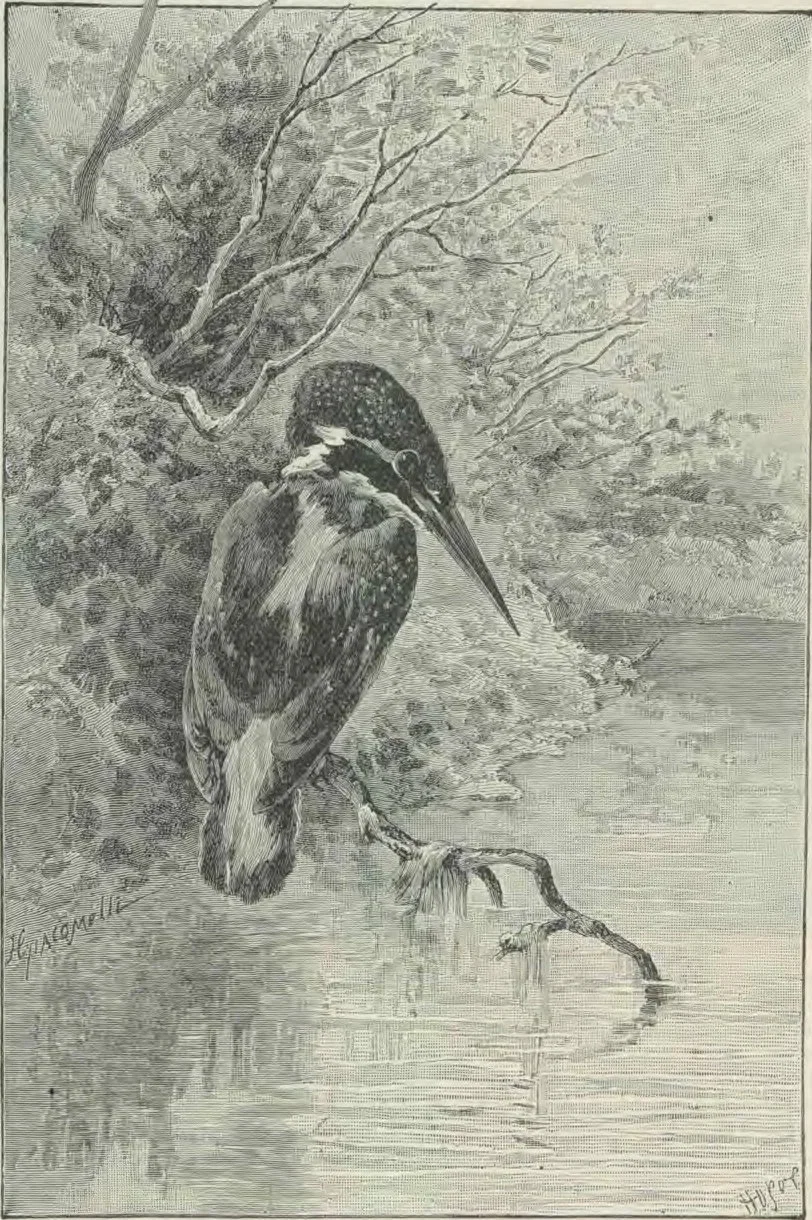
Our cut shows one of a very interesting group of the feathered creation, known as the kingfisher. It is now estimated that there are about a hundred and fifty species of this bird, which are distributed over all the habitable portions of the earth, although much more profusely in some localities than in others. Their chief place of residence is upon some of the East India Islands; and here it is that they are the most attractive in appearance, being dressed in colors that vie with those of other tropical birds.
The distinctive features of the kingfisher are a crested head, a long, pointed bill, which is thickly set upon the head, a short, well-built body, and short, strong legs. In these respects the several species are very similar, although in coloring and in some minor points quite dissimilar.
Notwithstanding the species are so multiplied, except upon the seashore and some of the streams in California there is only one species in the United States, the belted kingfisher. It is thought that formerly there were none in America, but that this species found its way into North America, and from thence southward even to South America.
This bird is a burrower, yet to save labor he will appropriate a rabbit burrow or the abandoned hole of a water rat for his nest. However, he makes thorough repairs, and to avoid damage by water, shapes the hole so that it will have an upward ascent toward the farther end.
He constructs his nest of the fish bones and skins that he ejects from his mouth. Several layers of these are placed one above the other, upon which the eggs are deposited, making a good nest but for the odor arising from the stale fish bones. It is claimed by some authorities that the stench is so great that it clings tenaciously to the bird ever after. If the bird is unmolested in removing the eggs from its nest, it will continue laying throughout the season, after the manner of domestic fowls.
The kingfisher is one of the most gluttonous of birds, often attempting to swallow morsels larger than its body can hold. In several instances one of these birds has been seen with the tail or head of a large fish protruding from its mouth, which it could neither swallow nor eject, and so was a prey to its own greediness.
Some of the species confine themselves less closely to a fish diet than do others, partaking of insects, grubs, caterpillars, and sometimes even snakes and water rats. Chief among this class is the Australian or Giant Kingfisher; named also the “Laughing Jackass,” from its peculiar cry, which is sometimes a perfect imitation of a braying donkey. Of the latter popular species you will read with interest the following quotation from the pen of one who has heard and seen for himself their peculiarities. He says:—
“About an hour before sunrise the bushman is awakened by the most discordant sounds, as if a troop of fiends were shouting, whooping, and laughing around him in one wild chorus. This is the morning song of the ‘laughing jackass,’ warning his feathered mates that daybreak is at hand. At noon the same wild laugh is heard, and, as the sun sinks into the west, it again rings through the forest.”
The regularity of these sounds, at morning, noon, and night, has given this bird the title of bushman’s clock. He further says:—
“I shall never forget the first night I slept in the open bush in this country. It was in the Black Forest. I awoke about daybreak, after a confused sleep, and for some minutes I could not remember where I was, such were the extraordinary sounds that greeted my ears:—the fiendish laugh of the ‘jackass,’ the clear, flute-like note of the magpie, the hoarse cacks of the wattle-birds, the jargon of flocks of leather-heads, and the screaming of thousands of parrots as they dashed through the forest, all joining chorus, formed one of the most extraordinary concerts I have ever heard, and seemed at the moment gotten up for the purpose of welcoming the stranger to this land of wonders on that eventful morning. I have heard it hundreds of times since, but never with the same feelings I listened to it then. . . .
“The ‘laughing jackass’ being of a companionable nature, a constant attendant about the bush-tent, and a destroyer of snakes, is regarded, like the robin at home, as a sacred bird in the Australian forests. It is an uncouth looking bird. It is common in all the forests throughout the year.”
This species seeks the hollow trunk of a tree in which to build its nest.
The true kingfishers, to which the American species belong, “are remarkable for their fish-eating habits. The Old World members of this family are noted for their gorgeous coloration. It is especially the silky azure and bluish-green tints which cause the admiration of all observers, and the common European species forms no exception to the rule.” The North American belted kingfisher is less gorgeously arrayed, but is a stronger, more powerful bird. It adds to its bill of fare, besides fishes and insects, now and then a mouse.
Of the general habits of the fish-eating kingfishers, a celebrated writer remarks:—
“Like most birds of brilliant plumage, the kingfisher prefers a quiet and secluded haunt. It loves the little trout streams, with wooded and precipitous banks, the still ponds and small lakes, ornamental waters in parks, where it is not molested, and the sides of sluggish rivers, drains, and mill-ponds. Here, in such a haunt, the bird often flits past like an indistinct gleam of bluish light. Fortune may sometimes favor the observer, and the bird may alight on some twig over the stream, its weight causing it to swing gently to and fro. It eagerly scans the shoal of young trout sporting in the pool below, when suddenly it will drop down into the water, and almost before the spectator is aware of the fact, is back again to its perch with a struggling fish in its beak. A few blows on the branch, and its prey is ready for the dexterous movement of the bill, which places it in a position for swallowing. Sometimes the captured fish is jerked adroitly into the air, and caught as it falls.”
The superstitious connected many fables with the kingfisher, in the past; but most of them are forgotten.
M. J. C.

Envy Begins at Home

It is a strange thing that envy, like its very opposite, charity, “begins at home.” We are not envious of people far above us in position or talent. Do we hate Patti because she has such a rare voice? or the Prince of Wales because he is to be king of England some day?—No; it is the boy in the next seat at school whom we envy when he gets a higher mark than ours; it is the little sister at home whom every one loves and pets. And the closer it comes, the more constantly the little happenings of every day bring it to mind, the harder it is to fight. Nothing but the grace of God can drive the demon out.

A HORSE WITH SPECTACLES.

“Say, boys,” said Tom Phelps at recess one Friday, “what do you think we’ve got in our barn? You never could guess.”
“Give us ten guesses?” asked one of the boys.
“Yes, a hundred if you like. I know you would never think of it.” Then the guessing began, and a great many queer things were thought of, but none were right, and finally they had to give it up.
“Well,” said Tom, laughing, “of course you couldn’t guess it, because you never heard of such a thing. It’s a horse that wears spectacles.”
“Oh,” said all the boys, who had gathered around Tom, “that’s mean to fool us that way. Didn’t think you were joking;” and they were turning away to their games again, when he called them back.
“But I am not joking. You know our horse Prince?”
“Yes,” came from a dozen boys at once. Didn’t they know him? Hadn’t they ridden behind him, filling Mr. Phelps’s wagon running over full if ever he chanced to drive along just as school was let out, a hundred times? And hadn’t they ridden on his back in the pasture three or four in a row, and tumbled off three or four in a heap, and petted him, and given him apples or sugar whenever they saw him? Every boy in Manlius knew Prince, and to know Prince was to love him; for a more intelligent, kind, and gentle horse never lived.
“What about Prince?” said several in a breath.
“Why, papa thought he was getting blind. He had always acted as if he couldn’t see just right, and so the other day papa took him to a—what do you call it?” said Tom, trying to think of the big word he wanted.
“Was it an oculist?” said a voice.
“Yes, sir,” answered Tom, for it was the teacher, Mr. Bragdon, who spoke. He had joined the group, and was listening with interest to the news about Prince.
“The man looked at Prince’s eyes just the way he would look at anybody’s, and found he was near-sighted, the way some people are. Then he wrote out something to tell how to make spectacles for Prince. Papa had them made and put on a bridle, and Prince wore them yesterday.”
“How did he act, Tom, the first time the spectacles were put on?” asked Mr. Bragdon.
“He acted at first as if he was sort of frightened, but it didn’t take him long to get used to them, and now we think he likes them.”
“Well, that is wonderful!” said Mr. Bragdon, as he turned to go into the school-room; and before recess was over, half the boys in the school had agreed to go to Tom’s the next morning to see how Prince looked in his spectacles. Mr. Bragdon was invited, too; for the boys all liked him, and thought they always had a better time when he was along.
So, bright and early, a troop of jolly boys called for the “teacher,” and were tramping gaily up the carriage-road to the Phelps’s farm-house, when whom should they see but Tom and his father in the big wagon, driving Prince right toward them.
How funny Prince looked with his great goggles, and how the boys laughed! It seemed as if Prince tried to laugh, too; for he shook his mane, and opened his mouth in such a funny way.
“He looks like a professor,” said one.
“Or an owl,” said another.
“Don’t he look awful wise?” said a third.
“Why shouldn’t he? He knows more’n any of us,” retorted one of Prince’s most ardent admirers; and so the talk went on until Mr. Phelps ordered the visitors to “pile in,” and go for a ride. They needed no urging, and their gay laughter, as they went through the quiet town, brought more than one staid body to the window to “see what on airth the racket was.” No doubt more than one turned away with a sigh to say, “It’s only Deacon Phelps and that passel o’ boys he’s so fond of cartin’ round with him;” for there are some people who never can endure noisy boys, and there are some of this kind in Manlius who say Deacon Phelps “might be in better business.” But he only laughs in his quiet way, and keeps the same big warm place in his heart for “the boys.”
When the ride was over, Mr. Phelps said: “Now I’m going to turn Prince out to pasture. Yesterday he acted kind of queer and sorrowful when I took the bridle off. I wish you would watch him to-day, Mr. Bragdon, and see what you think is the matter.”
So they all waited, and watched eagerly to see what Prince would do; and the boys, who were used to his playful ways, were astonished to see him walk slowly part way across the barn, with his head down, and then stand still, like a person who is blindfolded, and does not know where to go next.
“I believe he’s cryin’,” said little Jack White in an awed whisper, and I think the boys would not have been much astonished to see real tears drop from his eyes.
“Go on, Prince,” said Mr. Phelps kindly; but he did not stir until taken by the nose and led out-of-doors. Then he walked slowly down the path toward the meadow, the whole group watching him in silence.
“He seems to miss the spectacles,” said Mr. Bragdon, after a moment.
“Yes,” replied Mr. Phelps, “that’s just the way it seems to me.”
“Look at him now!” cried the boys, “he’s coming back!” and sure enough, Prince had turned, and was on his way back to the barn. Slowly he came, went straight by the boys, never stopping for sugar or caresses, to the barn door, which had been closed, and there he stood, whinnying softly.
“He’s asking for those spectacles, papa,” said Tom, eagerly; “do put them on.”
“Yes,” said Mr. Bragdon, “why not see what he will do?”
So the bridle was put on, bit and all, but Prince did not seem to mind the bit. Just as soon as the spectacles were on and fastened, he rubbed his nose lovingly against Mr. Phelps’s arm, as if to say, “Thank you,” and then kicked up his heels and pranced away down to the pasture in the happiest possible manner.
“Well, I declare!” exclaimed Mr. Bragdon, “that was what he wanted;” and he and Mr. Phelps talked it all over while the boys ran away to the meadow to have a romp with their four-footed friend.
This is a true story. The horse who wears spectacles is now living, and I’m sure you will all join with me in hoping he may live to wear them many years.—Deborah Blossom, in Sunday-School Visitor.

THE AMERICAN INDIAN.

PART V.—CAMP LIFE, TRAVEL, AND TRAILING.

The “tom-tom,” or drum, is the principal musical instrument used among the Indians. Originally it was made of a section cut from the trunk of a hollow tree, over one end of which a raw skin was stretched; but now cheese boxes and various other contrivances are employed. In addition to this, most of the tribes have a kind of flute, or reed instrument. The Pawnees, Cheyennes, and Arapahoes cut off about an inch of the toe of a buffalo’s hoof, which, when dried, is strung on a buckskin string, and twenty or thirty tied to a stick, making a peculiar sounding rattle used by the dancers; but no other instrument is used on religious or ceremonious occasions except the tom-tom.
Col. Dodge says: “Probably from the fact that the music is always to the monotonous beat of the tom-tom, the step of the Indian dance is always very nearly the same, however varied the figures. The feet are kept together, the whole weight of the body resting on the balls, the heels not touching the ground. The dancing effort consists in a little spring on both feet at the same time, so timed that the feet come down exactly on the beat of the tom-tom, sometimes varying the step by a little double spring, such as is often used by little white girls in skipping rope.” In addition, the shoulders rise and fall in unison with the music, communicating a motion to every muscle of the body. When excited, the Indian will frequently spring, or bound, into the air.
The Indians have three kinds of dances,—religious, ceremonial, and social. Men, women, and children take part in the last. The Sioux celebrate “the green-corn dance” in its season, and most Indians have “the scalp dance” after a successful war party. The “sun dance” of the Dakotas is about the same as the Hockeayum of the Cheyennes and Arapahoes. The main object of all these dances is to inspire a nervous intoxication.
“Striking the post” is the preparatory dance before going on the war-path. Each warrior strikes, with his “coup-stick,” a post set up for the purpose, the act being a kind of enlistment pledge, from which sickness or death alone releases him.
Col. Young says: “All Indians use the nose as a musical instrument, especially in the high notes. The lower tones are guttural; and the ‘hu-yah,’ being, as it were, beaten out of their bodies by the coming down of the feet in the dance, is more like a grunt than a musical sound.”
The bow is the natural weapon of the Indian. The boy, as soon as he can run alone, is given one, with a set of blunt-pointed arrows, and he practices incessantly on larks, thrushes, sparrows, etc., which he brings to his mother, as all small game is her perquisite. As he grows older, the iron-point takes the place of the blunt arrows, and he ventures farther from home, in search of larger and dangerous prey.
An Indian, if compelled to fly, will retain his bow and arrows, but throw away his gun, because in the use of the former he is an expert, and certain of his aim. He has not freedom in the use of the gun, since he seldom possesses one until advanced in years; hence he never becomes so familiar and at home with it as with his bow and arrows.
An Indian learns to ride about as soon as he does to walk, and excels even the Arab in horsemanship. While young, he is put in charge of the herd of ponies owned by his father, and spends his days in shooting small game and in racing; but after becoming a warrior, he is drilled in the arts of war.
There is neither rank nor organization in an Indian army, but there are words and signals understood by all, by means of which some wonderful and most intricate maneuvers are executed by even large bodies. The Indian swears never to reveal the meaning of these words and signals, and no amount of persuasion can induce him to do so. He replies always and simply, “I have sworn.” Even the whites, intermarrying with them, can never penetrate this secrecy. Often an entire war party will be directed through the flashes of the sun on a piece of looking-glass held in the hand of the chief, without any other visible communication between them for days at a time.
The Indian never travels by the sun, stars, or compass. He knows nothing of such guides. He trusts entirely to landmarks. In short hunting-trips and in traveling in unknown regions, he is said to be guided by instinct, it being seemingly impossible for even a baby Indian to become lost. In foraging, in thieving expeditions, and on the war-path, the Indian trusts alone to well-remembered landmarks, and it is marvelous how retentive his memory becomes. An Indian will detail, with the most remarkable nicety, peculiar stones, trees, and landscape through a region which he has not passed over, possibly for many years. Ask an Indian for the landmarks for any journey in any possible direction, and they will be given you promptly and minutely.
W. S. C.

TOM'S PRAYER.

It was cold in Tom's room. He undressed rapidly, thinking the while of to-morrow's base-ball. He had stood in the cold, finishing a little story by his bedroom lamp. Now he was thoroughly chilled. Should he get into bed to say his prayer? N-no; that wouldn't be manly or decent after spending so much time to read; so he dropped on to his knees, and this was his prayer:—
“O Lord, take care of us to-night, and fill us with thy light, and cause us to walk in thy way, and fill us with joy and peace, for Christ's sake. Amen.”
While he said these words rapidly, quick thoughts of the just completed story chased themselves through his mind; still he had said the words—mainly extracts from his father's daily morning prayer—and with one bound Tom was in bed. But he had a conscience, and his conscience was not asleep:
“If a fellow came to you with a request like that, what would you say?” asked conscience. “You would tell him to wait till he wanted something before he took up your time. A fellow with a tongue and temper like yours ought to want something.”
“I do,” said Tom. “I'll try again.”
This time he knelt reverently by the bedside, and prayed: “O Lord, I thank thee for having so much patience with me. Please help me to govern my temper, and make me honest in trying to do right, and please help me to serve thee like a man.”
Which prayer do you think was heard?—Selected.

CONFESSION

It was the saintly M’Cheyne who said: “There cannot be a secret Christian. Grace is like ointment hid in the hand: it betrayeth itself. If you truly feel the sweetness of the cross of Christ, you will be constrained to confess him before men.” A man can no more be a secret Christian than a tree or vine can keep the life in it secret by refusing to put forth buds and leaves, blossoms and fruit. If we see a tree or vine without this confession of the life that is in it, especially in the summer time, we say, “That tree or that vine is dead.” So when people say they are Christians, but will not confess him with mouth and by deeds distinctly Christian, we say, “They are dead,” and we say truly.

Four Little Letters: The Power of Love

THOUSANDS of sweet tones have come from eight little notes. This is wonderful; but there is something still more wonderful; millions of good deeds have come from four little letters. What word do they spell? See Romans 13:10.

POP CORN.

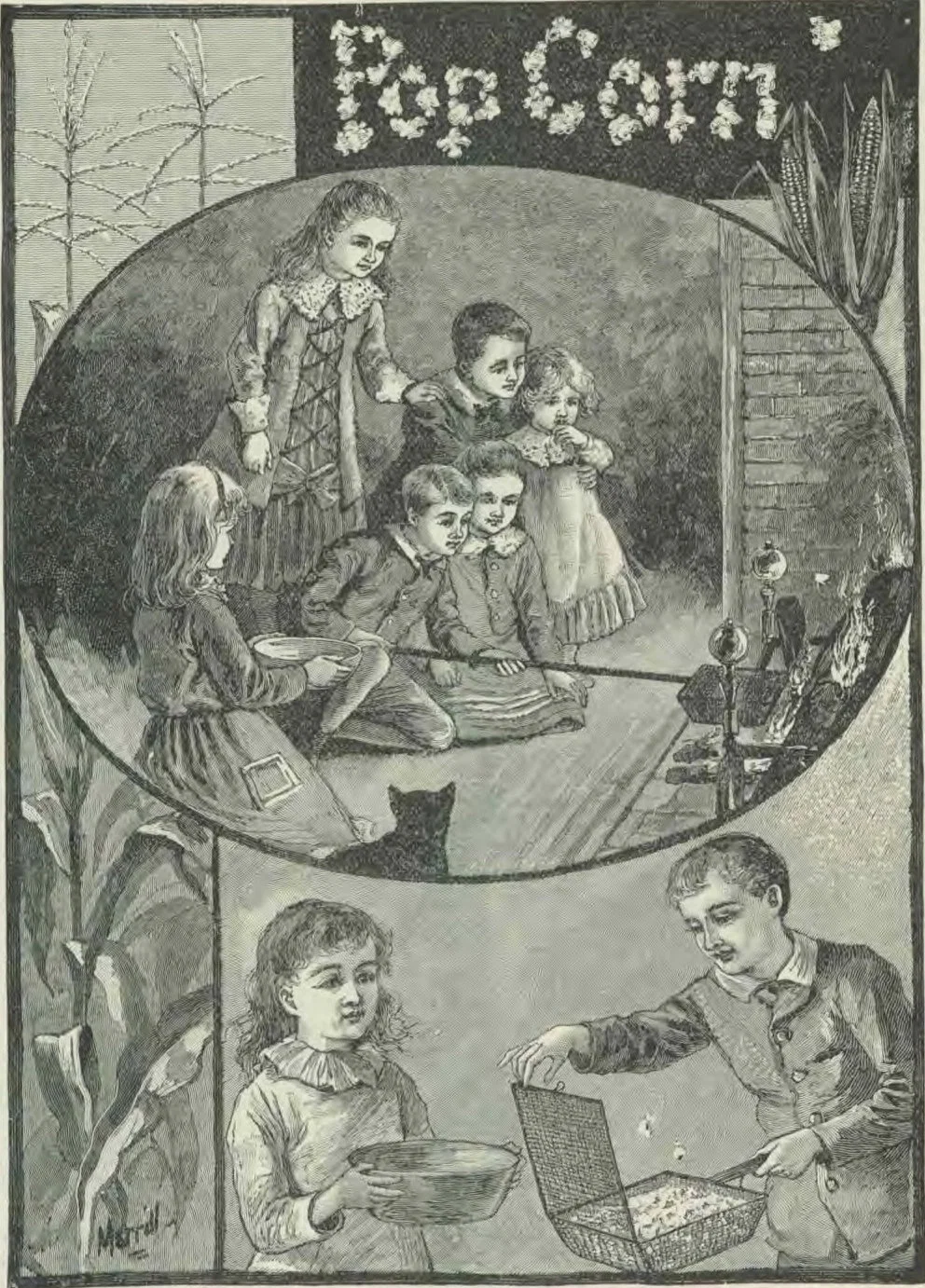
Oh, the sparkling eyes, In a fairy ring! Ruddy glows the fire, And the corn we bring. Tiny lumps of gold One by one we drop; Give the pan a shake,— Pip! Pop! Pop!
Pussy on the mat Wonders at the fun; Merry little feet Round the kitchen run. Smiles and pleasant words, Never, never stop; Lift the cover now,— Pip! Pop! Pop!
What a pretty change! Where’s the yellow gold? Here are snowy lambs Nestling in the fold: Some are wide awake, On the floor they hop; Ring the bell for tea,— Pip! Pop! Pop!
—George Cooper.

HOW THE BANKS WERE FILLED.

FRED BROWN sat on the settee by the old fire-place, with his chin resting on the palms of his hands. He was looking straight at the fire, and doing some hard thinking. Bessie, who was Fred’s other self, and his twin sister, sat curled up on the rug opposite Fred. She was also thinking. What they were both thinking about was this:—
But before I tell you that, I will have to tell you where Fred and Bessie lived. It was in the outskirts of a small town. Their father raised fruit and vegetables, which he sold to the town-dwellers. Besides Fred and Bessie, there were Harry, and Nettie, and Eva, and the baby Midget.
Money was not plenty at the house where the Browns lived. There was plenty to eat always, and usually enough comfortable clothes to wear; but the row of banks that lined the shelf, and belonged, each one to a small Brown, went sometimes for days and weeks without receiving a single penny into their gaping mouths. That was what Fred and Bessie were thinking about as they sat there by the fire.
When they went to church that morning, they were surprised to see a stranger in the pulpit. He talked in easy words to the children, and they understood all he said. He told how we might do things for Christ,—how we could be good and kind, and always ready to mind father and mother; and how we could save up our pennies to send Bibles and teachers to people who do not know so much about God as we do.
Fred grew very much interested; in fact, all the Brown family felt just the same, and they talked the matter over at the dinner-table. That was what set Fred and Bessie thinking, and trying to find ways and means for doing.
“Ta’n't no use,” sighed Fred, “there isn’t a single thing I can think of.”
“Nor I either,” Bessie replied, in a discouraged tone.
“All alone here in the dark?” cried Mother Brown cheerily, coming to the fire and giving the coals a poke that sent the sparks flying up the chimney.
“Jump up and light the lamp, Bessie, and, Fred, you run and get the bag of corn and the popper; this bed of coals is too good to be lost.”
That was a command that Mother Brown never had to give to Fred twice; for he was fond of pop-corn.
“Come on,” cried Fred, bounding into the room where the others were reading, “mother is going to pop corn.”
They all laughed at Fred’s excitement; for they knew he was fond of good things to eat. Soon a merry circle gathered round the fire, watching the heat change the golden kernels into snowy puffs.
“Do you remember the little lame boy we saw selling pop-corn on the cars when we went to grandpa’s?” Harry asked Nettie.
“Oh!” exclaimed Bessie suddenly; “couldn’t we—” looking at Fred.
“I guess—say, mother,” began Fred, and he explained what he and Bessie wanted to do, but couldn’t think of any way for doing until the thought of selling bags of fresh pop-corn came into their heads.
“Well,” said Mother Brown at last, in answer to Fred’s reasoning and Bessie’s coaxing, “I don’t know as I care if you try it. But you must pop the corn all yourselves.”
“Yes’m, I’ll do that,” said Fred, in business tones, “and Bessie can make the bags to put it into. I’d like to begin now.”
But your corn would taste a good deal better if it was fresh than it would to stand over night,” his mother replied. “You might, however, make the bags.”
So Bessie hurried away to make the paste, and fetch some pretty pink and blue and white papers to make the bags of; and by bed-time twelve neatly made sacks stood on the table, waiting to be filled with the snowy kernels.
The twins were at work bright and early. It was their first attempt at popping corn all by themselves. The poppers-full got sadly scorched at first, but experience brought skill, and soon the kernels popped out as snowy white as when mother shook the handle herself.
When Fred had enough to fill the bags, mother poured a little melted sugar on it, which gave the fresh corn a very toothsome crispiness and sweetness.
“Now eat it all up,” shouted Harry, as Fred started toward town.
“I shan’t eat one kernel,” Fred replied, hotly; “this is missionary corn,” and he moved off with an injured air. Harry had teased him on a tender point.
When Fred reached town, he went straight to his Aunt Carrie’s house, and told her what he and Bessie were going to do. She was anxious to help them, and brought out a little table for Fred to put his bags on.
Aunt Carrie’s house stood on the main street. A great many people passed by it every day.
Soon an old lady came along. She gave Fred a surprised look, and then an interested look. “How do you sell your corn?” she asked.
“Three cents a bag,” replied Fred, trying to look as if he had sold pop-corn all his life. “The corn has sugar on it, and the bags are very pretty. My sister made them.”
The old lady smiled. “I think I will take a pink bag,” she said, handing Fred a three-cent piece.
Fred thanked her, as he had seen merchants do, and dropped the money with a jingle into the tin box his aunt had given him. Then he sat down to wait.
By and by a young woman came along, with a baby carriage. She saw Fred and stopped, and soon other pennies went to keep company with the piece in the tin box.
After awhile, he began to get hungry. Pop-corn was good. Fred knew. It was very good with sugar on it. Aunt Carrie was busy in the back part of the house. Anyway, it was his own corn; he could eat a little of it if he wanted to. Two or three kernels disappeared from the nearest bag; then a whole handful; finally the bag was empty. Fred folded it up, with a little guilty feeling, and put it into his pocket.
Some people came along just then, and he sold three more bags. Then there was a long time of waiting. Fred played awhile, and then went back to the corn. By and by another bag had disappeared; it had followed the first one.
Then some boys stopped at the gate, and Fred soon closed out the business, and started for home.
“Oh, bother!” he exclaimed, as he came in sight of the house, “Mother’ll want to count the money. I didn’t think of that.”
Try as hard as he might, Fred could find no way out of the difficulty, and he went very slowly toward the house.
“Is it hard work to be a merchant?” said mamma, taking off his cap and smoothing his hair.
“Pretty hard,” said Fred, wishing she wouldn’t look at him.
“See what a nice lot of bags I have made while you were gone,” exclaimed Bessie. “And we’ll have to buy some more paper to-morrow; for I have used it most all up.”
Fred didn’t show his usual interest in the bags. Mother Brown noticed it.
“Now don’t you think you would better divide the money with Bessie before any of it gets lost?” asked his mother.
Fred’s face grew very red as he answered faintly, “Yes’m,” and began to feel around in all his pockets.
“There were twelve bags, and you sold them for three cents each, I suppose; so how much will you have?” asked his mother. Fred was putting the nickles and pennies one by one into her hand.
“It’s just thirty-six cents,” interrupted Bessie. “That’s eighteen for Fred, and eighteen for me.”
“But here are only thirty,” said Mrs. Brown, looking at Fred.
“Well—I—ate—two—bagsful,” said Fred at length, with his hands in his pockets, and his eyes intently watching two sparrows out of the window.
“Ah!” said Mrs. Brown, with a queer smile. Fred never liked to have his mother smile like that. “How do you mean to divide the money?”
That was also something that Fred had not thought of. Of course Bessie was not to blame for his eating the corn.
“I s’pose Bessie’ll have to have eighteen cents, just the same,” said he, slowly counting out the money, and handing it to Bessie.
“Very well,” said his mother, “I think that would be right.”
“But I don’t want more than Fred has,” said generous-hearted little Bessie, quite distressed at this turn of affairs.
“No,” said Mrs. Brown, who knew how much Fred disliked to have Bessie’s bank account larger than his own, “Fred must do something to help himself remember, and I hope that next time he sells anything for the missionaries, he will give them the whole of it, and not selfishly keep part of it for himself.”
Fred went again a good many times, till people grew quite well acquainted with the little pop-corn peddler. He was often tempted to repeat the first days’ experience, but he didn’t do it; and by the end of two months two of the little iron banks were heavy with pennies and nickles and dimes that were cheerfully sent to the missions. W. E. L.
Continue reading: LETTER TO THE HEBREWS