Your ShelfYour Projects

Review and Herald, Vol. 92, No. 41.

PRAY — GIVE — GO
Earlier text: The Sabbath and the Date Line

Why Have Mothers’ Meetings?

MRS. MARY H. MOORE
In urging upon any class of people a certain course of action, a question naturally rises as to the necessity of that action, and the results to be attained; so when educators, sociologists, philanthropists, and all those interested in social betterment unite in recommending and encouraging mothers’ associations and clubs, there must be an urgent necessity for, and very desirable results to be attained by, such organizations.
Life in general is very complex at the present day, and no man, or woman either, presumes to enter any calling hoping for success without a special preparation.
A generation ago young people obtained the best general education possible, made choice of a vocation or occupation, and entered upon it, expecting to obtain the special training necessary as they went along.
Now things are very different. Specialization is the order of the day. Vocational and prevocational training are required and provided in many places at the public expense as part of the public schools. Thus our artisans, our professional men and women, our artists, bookkeepers, reporters, and stenographers are given a fair start in their various occupations. The more complex and all-inclusive a calling is, the more careful and extensive the training required for success. Also the higher in the scale of ability required a vocation is, the more thorough and careful the training necessary.

Mothercraft Schools

Since nature itself leads to marriage, and motherhood follows by the same law of nature, it has always been taken for granted that the fact and experience of motherhood carried with it all the preparation and fitness needed. That this is a fallacy the experience of generations has proved; and now there is provided in some places training in mothercraft, by which mothers-to-be are fitted for their life task in a thoroughly businesslike way. Such a school not only attacks the problems of ventilation, sanitation, dietetics, etc., but also teaches story-telling, and direction of the occupations and amusements of children. The earnest and faithful young women students of such a school may thus fit themselves thoroughly to fill the office of mother, so far as such a school can fit them. But such schools are not common or easy of access, and many young women cannot avail themselves of their privileges. And what shall we say of the vast army of women who are mothers already, and, in the midst of the conflict, find themselves wholly unprepared to meet the demands made upon them?
There is no more complex or exacting calling than that of motherhood. A successful mother must be a doctor, a nurse, a dietician, a kindergartner, a teacher, a student of psychology, a disciplinarian, an instructor in morals, an administrator of justice, a financier, and a companion and confidential friend to her child,—all this besides the ordinary duties of housekeeper, lady of the house, wife, and sharer with her husband in the social relations of the family. Does she not need more than any other worker, a special training?
There are, according to the census, 700,000 defective in the United States,— imbecile, insane, deaf and dumb, blind, and criminals,—victims of paternal and maternal ignorance. There are but three cities in the United States which have populations exceeding 700,000. Our standing army in time of peace is only about 86,000—these for our protection, and 700,000 for our weakening. These defectives are the result in most cases of failure on the part of the parents; for no man is, by nature, other than his heredity and environment make him. We are not discussing here the part of this burden belonging to the father,—that is another story,—we speak only of the failures of the mothers.
If women fail in other lines, they can harm only themselves or but few others; but an incompetent, inane, ill-trained, or frivolous mother is a curse unto the third and fourth generation of those who love her and fall under her influence. It has been said that woman is but an anex to man’s thought. If this be true, and her sphere be only what it always has been claimed to be,—wife, mother, housekeeper, home maker,—will she not be immeasurably better fitted for these duties if she has the opportunity for personal development which a mothers’ association affords?
The idea that because a woman has borne a child her nature must be motherly, is a fallacy. Think of the weak mother, who yields to the child’s caprice; the vain mother, who overdresses her child; the ambitious mother, who pushes her child unduly; the preoccupied mother, the faultfinding and unsympathetic mother. All these faults may be, and often are, the result of ignorance rather than of intention. Mothers’ meetings help to correct them by giving instruction, and rousing ambition to be and to do better. The study in these meetings leads the mother to look upon her work from the standpoint of a universal work; her problems are the problems of all mothers, her failures and successes set in action lines of influence which reach out to other homes and other lives, and extend on even to eternity. Daniel Webster aptly said, “If we work on marble, it will perish; if we rear temples, they will crumble to dust; if we work on brass, time will affect it; if we work on minds, and imbue them with good principles, we engrave on those tablets something that will brighten for all eternity.”

Casting All Your Care Upon Him

I HEARD the call, “Come unto me and cast them all, These burdens that are crushing you to bear.” I came, and stood before him with my load of care. I stood in wonderment, for I had thought He would reach out and take what I had brought. Had he not promised? Then why did he not? He read my thought and said, “Have you forgot I bade you cast them on me?” Then I knew I must reach out; and so I closer drew And laid them in his loving arms, and looked for peace, For rest, from sense of weariness a glad release. Heartsick, I questioned why. He questioned in reply, “What is it at your feet I saw you lay, When with your load of care you came this way?” “O Lord,” I said, “I was ashamed to bring This other, lest it seem too small a thing; And yet the weight of it to me Is agony.” “Did I not say bring all? You did not hear aright the call.” I stooped and raised it, placed it on his breast, And knew at last the blessedness of rest.
—Anna M. King, in the Sunday School Times.

Sixty Years With the Review

SIXTY years with the REVIEW ought to entitle one to speak in its behalf. The following words come from Brother D. T. Shireman, who has worked faithfully for the cause of present truth all the years he has read the REVIEW: “For almost sixty years the ADVENT REVIEW AND SABBATH HERALD has made its weekly visits to my home. It is ever a welcome visitor, bringing the glad news of the return of our Saviour. The fulfilling signs of these times tell us his coming is near. May we be faithful in giving the glad message to others. I hope that every Seventh-day Adventist family is getting the good REVIEW and reading carefully every week the soul-inspiring articles from the pen of those at the front. Our Saviour will soon lay aside his priestly garments, and come to call his children home and to seal the sinner’s doom. Dear brethren, are we doing all in our power to give the glad news to others as the days are going by, letting the light shine in our daily lives, and spreading the printed page?”

Laundry Secrets

MRS. R. T. MITCHELL
The following laundry secrets I have found very helpful, and I take pleasure in passing them on to others:—
In order to keep the daintily colored summer frocks fresh and attractive, we must have a special “fixative” for every color. Alum used in the rinsing water will prevent green from fading. Ox gall is good to use for gray and brown. A handful of salt thrown into the rinsing water will set blue. Hay water (made by pouring boiling water over hay) is excellent for washing tan or brown linen. A tablespoonful of black pepper stirred into the first suds in which cottons are washed will prevent colors running. Five cents’ worth of sugar of lead crystals, dissolved in a pailful of water, makes a solution which fixes the tone of pinks, blues, and lavenders. The fabrics should remain in the sugar of lead bath an hour or so before going to the suds.
These baths will not prevent a color from fading if the garment is hung in the sun to dry. Delicate colors, in fact all colors, are much less likely to fade if dried in the house.
Vinegar is useful in reviving colors. Add one teaspoonful of common vinegar to each quart of cold rinsing water; thoroughly saturate each article to be rinsed, wring tightly, and dry quickly.
If the color has been taken out of silks by fruit stains, ammonia water will usually restore it.

Our Household Exchange

A BROOM ECONOMY.—The usefulness of a worn broom may be prolonged by cutting the lower row of stitching, and evening off the edge of the broom with the shears. MRS. D. A. F.
DRIED FRUITS.—Raisins, figs, and dates are improved by steaming a few minutes before serving. All dried fruits, whether to be cooked or eaten raw, should be thoroughly washed. MRS. D. A. F.
TO WATERPROOF SHOES.—First have the shoes clean and dry. Then brush thoroughly with warm (not hot) linseed oil. By this method shoes may be made impervious to water for weeks. MRS. J. M. S.
DUSTLESS SWEEPING.—Tear a newspaper into small bits, dampen, and sprinkle over the carpet before sweeping. The paper takes up the dust, and keeps it from being scattered in the air. It is a good plan to wipe a rug or carpet occasionally with a cloth wrung out of a pail of warm water in which a handful of salt has been dissolved. MRS. H. E. S. H.
A SUGGESTION FOR FRUIT-CANNING TIME.—To utilize empty bottles, milk jars, or fruit cans that cannot be supplied with new covers, try this plan for fruit juices, sifted tomatoes, etc.: Thoroughly sterilize the bottles or jars, and with a glass cutter cut pieces of glass to fit the tops. Prepare the fruit juice as usual, and fill the bottle or can. Cover the rim with melted sealing wax, and place over it a piece of the glass, which has been heated. Press this down firmly on the wax. This seals the fruit perfectly. Set aside to cool, shaking the jar lightly once or twice, or turning it upside down. By this method no tin, rubber, or zinc can come in contact with the fruit; there is no top to leak, and no lodging place for germs. Nothing short of freezing or knocking the top off the bottle will spoil the fruit. T. C. H.
(The glass lining from worn-out Mason jar caps might be used in this way without cutting. M. A. B.)
CARE OF THE BREAD TINS.—In bread making much depends on the proper care of the pans. Those made of sheet iron are much better than others, both because of their color and their durability. If tin bread pans are used, it will be found that new ones never give a brown bake; this is because they reflect the heat. It is a good plan to heat new pans until they are well colored before using. Never use bread pans for any other purpose except to bake bread; otherwise the bread will cling to the pans, no matter how carefully they are oiled, or how thoroughly the bread is baked. Very little oil is necessary, but it is essential that every part of the pan be touched. A clothespin or similar stick, with a bit of clean cloth well fastened to one end, makes a good oiler. When the bread is done, it should be removed from the pans, which should be at once rubbed with a clean, dry cloth. Bread pans need no washing (bakers never wash their baking pans); but they must be thoroughly rubbed, and kept in a clean place, free from dust. MRS. D. A. F.

To Can Tomatoes

THE one vegetable that is easy to can is the tomato. The trouble that housewives have in canning tomatoes is entirely needless, as they contain so much acid and so little protein that bacteria have little opportunity to cause trouble if the canner does her part intelligently. The trouble nearly always results because tomatoes beginning to spoil are used, or because an attempt is made to preserve fully ripened tomatoes. If decay has already begun, the bacteria that cause fermentation in the jars are present in large numbers, and some of the spores are almost sure to escape unless heat is applied for a long time. The amount of acid is small in fully ripened tomatoes.
For canning, select sound tomatoes the least bit underripe. Wash them, scald them for an instant, cool them, remove the skins, and pack them whole into the jars. Add a level tablespoonful of salt to each quart, but no water. Steam the jars twenty-five minutes and then seal them.—M. M. Telford.

The Way to Success

“The secret of success,” the stamp said, “is sticking to it.”
“To succeed,” said the knife, “be bright and sharp.”
“Keep up to date,” said the calendar.
“Aspire to greater things,” said the nutmeg.
“Don’t knock; it’s old-fashioned,” said the electric bell.
“Do a driving business,” said the hammer. And the barrel added, “Never lose your head.”
“Make light of everything,” the fire observed cynically.
“But always keep cool,” said the ice.
—Selected.

It Pays to Write for the Press

It was not until the Press Bureau was established by the General Conference, and instructions were given, that I began writing for the press. The results have been very gratifying. Nearly every article that I hand the editors is printed.
As I have lived in Altoona, Pa., most of my life, except the twelve years that I spent in Massachusetts, I naturally have many friends here, many of whom have known me for years. Occasionally I meet them on the street, and in conversation they make mention of reading my articles in the papers. I have had dealings with business men who, when they know who I am, make mention of reading my articles in the papers. Nearly every week I have such experiences, and the comments are favorable, showing conclusively that the articles are being read. Were I living in a strange city, I should not be conscious that so many were reading my articles; but here, knowing so many, I have the privilege of knowing the result.
While holding a series of meetings in Huntingdon, I gave articles to the local daily paper. At times these articles did not appear, but later I learned that they had been set up in type, but when it came to putting them into the forms the space was lacking.
I was told, while in Pittsburgh, that there was no use writing for the large dailies, as they would not accept anything of a religious character unless there was something large behind it; but I have found that they will accept articles there as elsewhere.
It certainly was a step in the right direction when the General Conference established the Press Bureau, and as the result thousands of articles on the message are going to the masses almost daily, especially during the tent season.
During my present tent effort the editors have printed nearly all my articles given them. The paper with the largest circulation has printed them all. It pays to write for the press.
CHAS. F. ULRICH.

The North Texas Camp Meeting

THE North Texas camp meeting this year was held in Dalworth Park, halfway between Dallas and Fort Worth, in a beautiful location furnished us by the Dalworth Company. The attendance was the largest in several years.
Besides the local and union conference workers, we were pleased to have with us Elder F. W. Paap, whose labor and instruction in home missionary work were appreciated. We experienced a genuine revival in the tract work, more than $80 worth of tracts being sold at the close of one service. At another meeting about one thousand copies of “The World’s Crisis” and one hundred and twelve volumes of the “Testimonies for the Church” were sold. Subscriptions were taken for the REVIEW and for Liberty. The secretary of the tract society said that his book sales were much beyond his expectations.
We truly rejoice to see a revival of such work as formerly characterized every Seventh-day Adventist camp meeting, and made us a people known everywhere as having our religion in our hearts and heads, and as able to give a stranger a tract on any subject to help him remember what we said in conversation.
Very few changes were made in the officers of the conference. In all the business sessions the Spirit of the Lord was truly felt. An offering of $2,310 was made for the Twenty-cent-a-week Fund. At the close of the meeting about a dozen were baptized.
H. H. HAMILTON.

Quebec Camp Meeting

The thirty-sixth annual session of the Quebec Conference was held in connection with the camp meeting at South Stukely, June 17-24. This conference is the oldest in Canada. The very large French Catholic population, about seventy-five per cent, has presented many difficult problems. The proportion of French- to English-speaking population is still changing in favor of the French, due largely to the activities of the Catholic Church in buying up land held by Protestants, and settling it with Roman Catholics.
Notwithstanding these difficulties, there were real marks of progress. During the year a church of twenty-two members was raised up in Sherbrooke, the leading Protestant town in the province. Elder Campbell, president of the union conference, is conducting a tent effort in an adjoining town, which it is hoped will result in further strengthening the work in that place. Elder A. V. Olson is conducting a tent effort in the English-speaking portion of Montreal.
There had been a substantial increase in the tithe during the year, and the offerings for missions reached twenty-seven cents a member. Elder Vuilleumier has labored earnestly for the French in Montreal, and the Lord is blessing his labors. They hope to have some of their new converts in the French department of the union school at Oshawa. Funds were raised at the meeting to provide scholarships for this purpose.
South Stukely is a small village, so the attendance from the outside was not large. Our own people sought the Lord earnestly, and consecrated themselves to work more devotedly during the coming year. Fifteen, nearly all of whom were young people, were baptized during the meeting.
Elder Olson has the confidence and support of our people here, and was unanimously reelected president. Brother N. L. Saunders, lately from the Williamsdale Academy, was elected Missionary Volunteer secretary. Only a few changes were made in the executive committee. The laborers present from outside the conference were Elders M. N. Campbell, Professor Rowe, Elder Roth, and the writer. C. M. SORENSON.

The Cumberland Camp Meeting

This meeting was held, according to appointment, in the city of Cleveland, Tenn., July 16-25, and was in many respects the best meeting ever held in this conference. There were more than two hundred encamped on the ground, one fourth of whom were believers who have accepted the present truth within the last three years.
The president’s address was replete with facts and figures showing splendid advancement in all departments of the work the past year. As the result of the evangelistic efforts put forth, one hundred individuals had been baptized and added to the church membership, and the conference had many urgent and growing interests.
The tithe received the past year amounted to $8,144.20. The first six months of 1915 show an increase of one thousand dollars over the corresponding period last year. The offerings for missions in 1914 amounted to $4,833.82. The amount received the first half of 1915 is about seven hundred dollars more than for the same period last year. The book sales in this conference last year amounted to $10,605.44. In comparison, the sales for the first half of this year show an increase, and the bookmen believe that 1915 will show a large gain in this department of the work.
The business of the conference passed off harmoniously. Elder W. H. Branson was unanimously elected to the presidency, with practically the same committee and departmental secretaries as last year.
The laborers from abroad who assisted the local and union conference workers in carrying the responsibility of this meeting were Elders J. O. Corliss and C. B. Haynes, Miss E. M. Graham, and the writer. The instruction during the day was of a practical nature, emphasizing the importance of the home missionary work, and the benefit of getting the rank and file of our membership at work in a definite way for the salvation of souls. This was given a very practical turn for several days, when, after some definite instruction by Sister Graham or Brother Haynes, the camp was divided into companies, with a leader over each. The members of these companies went into the homes of the people of the city of Cleveland, selling books, pamphlets, and magazines, giving away tracts, and personally inviting the people to the services. The result of this work was very gratifying, as the evening attendance was largely increased thereby. In all my camp meeting experience I never saw people more interested in the truths for this time than at this meeting. Elders Locken and Mayoon, with other helpers, remain more fully to develop the interest created. We believe that a harvest of souls will be gathered in this place.
Revival services were held both Sabbaths with gratifying results, and strong public and personal efforts were put forth for the youth and children. Dr. M. M. Martinson looked after the health of the campers, and gave daily instruction in the principles of health, temperance, and hygiene. Altogether, Cumberland had a good meeting, and the laborers start out full of courage and consecration, with their goal set for two hundred baptized believers during the conference year before them.
Personally it was a privilege to renew acquaintance with those I knew when I labored in the Southeastern Union, and to form the acquaintance of the lay members who have accepted the present truth since I left that union. I am sure the workers in this conference desire an interest in the prayers of the REVIEW family, that God will give grace and help in winning souls for the kingdom.
CHAS. THOMPSON.

Colporteur Work in Cuba

THERE is the sound of agoing in the colporteur work in Cuba. At the institute held in January of this year, about twelve young people who had been attending the little training school in Santa Clara during the four months’ term, took instructions and went into the work.
The Cuban committee at that time planned for another term of four months’ school, to begin September 6, and also offered the regular scholarship discount to all those who would pay for their books and turn in an amount sufficient to cover the school expenses for the year.
About half the class who took instruction and went out to earn scholarships were young ladies. Sister Ida F. Carnahan went with this group of girls to Havana, the largest city of Cuba. These workers have placed about $1,300 worth of books in the homes of the people in Havana this year, and two have the money to their credit at the office for their scholarships. Others have nearly enough. The accompanying picture shows six of these lady colporteurs, with Brother and Sister J. E. Anderson in the center, who are now making a home for the workers. Several of the young men also have their scholarships earned. One young man, a Jamaican, has delivered over $1,000 worth of books this year, and another, a Cuban, over $1,200 worth.
As the Israelites who were hidden in the caves and among the rocks came out and joined in the chase when they saw that Jonathan and his armor-bearer had the Philistines in retreat, so young people here in Cuba, when they saw that the colporteurs were winning against the enemy, have joined the ranks, until there are now over twenty names on the list.
During the first half of this year the colporteurs in this island took $12,800 worth of orders, and delivered $7,200 worth of books. When the writer made a plea for a man to lead out in the work in Central America, where there are no colporteurs, the Cuban committee generously offered to give two instead of one, and two who have had the best success this year. When the colporteur work began in Cuba, Mexico gave two of the best men it had. Now Cuba is doing the same for another needy field.
In the beginning of the work here, mostly health books were sold, but the workers are now selling the doctrinal books freely. "The Great Controversy," "The Coming King," and "Thoughts on Daniel and the Revelation" are being sold at present. Not only do the workers find that they can follow the health books with the doctrinal books, but they find that it is possible to follow with good success one doctrinal book with another; and some who are having the best success are going over territory with the same book that had been sold there before. The sales are much better than they were the first time.
These books are creating interests that the few evangelical laborers are unable to follow up. A Presbyterian minister told one of our colporteurs the other day that he had taken four or five members into his church recently from Catholicism, as a result of their having bought the book "The Coming King." How much better it would have been for our work if we had had evangelists to follow up the interest created by these books, so that these people could have been brought into the Seventh-day Adventist Church.
CUBAN COLPORTEURS
CUBAN COLPORTEURS
In view of the many openings for work and the urgent need of more workers, the Cuban committee is asking the Mission Board for two additional ministers and two more Bible workers. There may be those who read these lines who can help the Mission Board in deciding who should respond to this call.
N. Z. Town.

The Colored Work in the Atlantic, Columbia, Southeastern, and Lake Union Conferences

Since my last report I have visited Atlanta, Macon, and Savannah, Ga., and Jacksonville, Fla., all in the Southeastern Union Conference. The work in these churches is making progress. Additional members are being added constantly, and the missionary societies are doing a good work in distributing our truth-filled literature.
Sister Anna Knight has been chosen missionary secretary of the Southeastern Union Mission, and has entered upon her work enthusiastically. She will visit all the churches, organizing them for more thorough and systematic work.
Sabbath, July 10, was spent with the churches in Washington, D. C. I spoke at eleven o'clock at the People's Church. The house was crowded with attentive listeners. The Lord came near and added his blessing. At two o'clock I attended the funeral of one of the members of the Eighth Street church. Tent meetings are being conducted in the city, with very encouraging interest. Sixty members have been added to the church the past year. These have been gathered largely by house-to-house work. A working church is a growing church.
I left Washington on Sunday afternoon, and spent several days in Baltimore. Elder Rodgers is conducting a tent effort there. The tent is filled every night. The outlook is promising for a large number of souls at this place. One hundred is the goal set by the brethren. The church building is being enlarged, in order to accommodate the congregation.
I next visited Philadelphia, spending several days. Although the membership of the church is small, the brethren are of good courage. We hope that a strong tent effort can be conducted there next spring, which will strengthen the church.
I reached New York for Sabbath, July 17. Elder Humphrey called a union meeting of the churches in the city, in the large tent on Sabbath morning. The Lord gave freedom in the presentation of his word. A meeting for the young people was held in the afternoon, when Elder Jayne, president of the conference, gave a very interesting talk. The tent meeting is being conducted in Manhattan. The outlook is encouraging for a large number of conversions this summer.
Several days were spent with the Pittsburgh church. The Lord blessed the message at this place. The work is somewhat retarded because the believers here have no suitable place in which to conduct public services. The land has been secured, however, and money is being contributed to erect a church building. This will greatly strengthen the work. It is quite difficult to build up a church without an appropriate building for service.
I next visited Detroit, Mich. The little company at this place is of good courage, although much in need of a church building. Efforts are being made to secure suitable quarters soon.
Sabbath, the twenty-fourth, was spent in Battle Creek, where I attended the funeral of Sister White. Fourteen years ago, during the General Conference of 1907, held in this place, I had the privilege of hearing the Lord's servant speak for the first time. If I remember correctly, she spoke at the eleven o'clock hour, Sabbath morning, from the text, “Come unto me, all ye that labor and are heavy-laden, and I will give you rest.” The impression made on my mind at that time has followed me ever since. Now she rests from her labors, and her works follow her.
According to appointment, I reached Chicago on Sunday. The work in this large city is making some progress. Additions to the church are being made. Elder Forde is conducting tent meetings.
Sunday night his large tent was filled with earnest listeners. Some have begun to keep the Sabbath, though his effort has but fairly begun.
I spoke Sunday night to the church on Dearborn Street, encouraging missionary activity, showing that service for Christ is fundamental to everlasting life, that only those who have been faithful in service are promised a place in his kingdom, and that service for Christ constitutes a training without which we cannot participate in the joys of heaven. The man with one talent, selfishly hiding it in the earth, was rejected by his Master and cast into outer darkness. He had the ability to serve, but did not do so. This lesson was given for our warning. “To every man his work.” When the Lord comes to earth again, he will reward every one according to his work. No work, therefore, no reward.
The spirit of consecration and seeking God, with a desire to be more active in the service of Christ, is being manifested in all our churches. The Lord's people will be willing in the day of his power.
C. B. Stephenson.

The Central American Camp Meeting

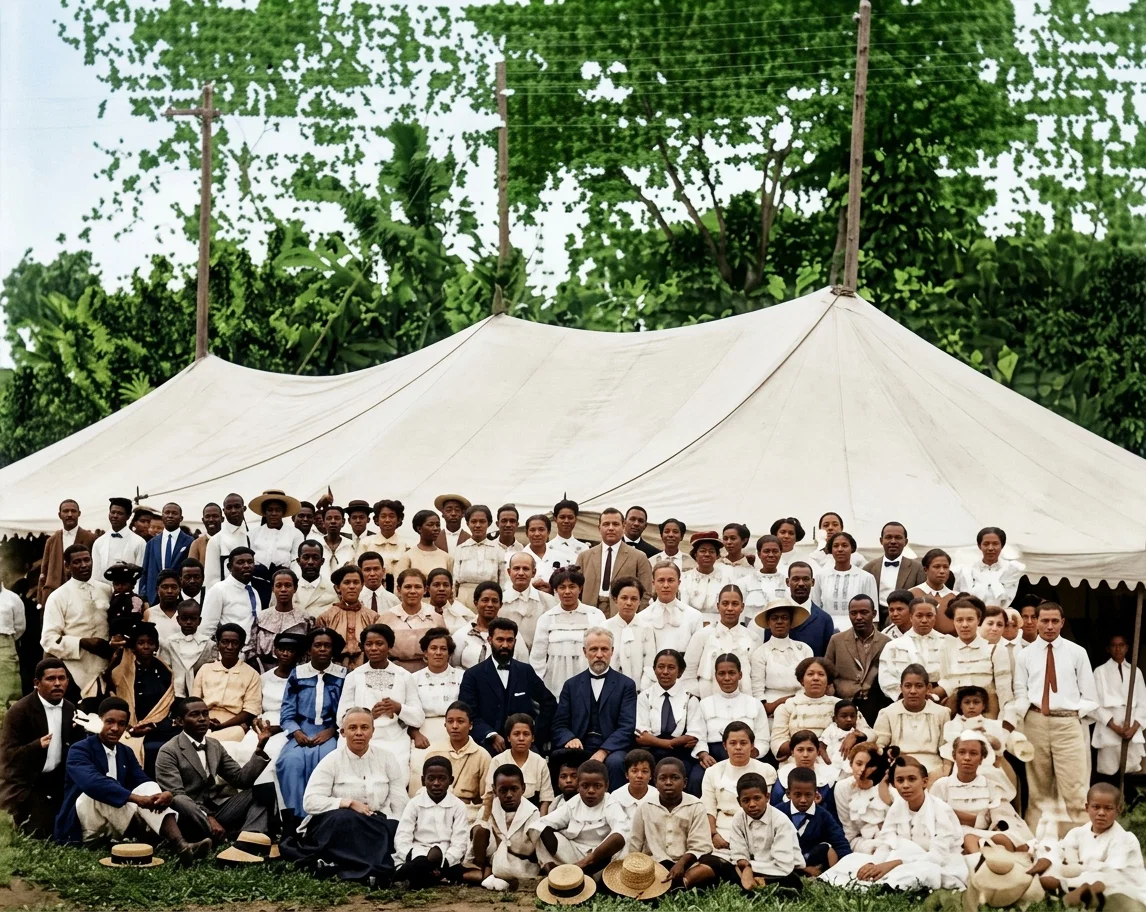
In the year 1892 Elder Frank Hutchins and wife, now Mrs. E. R. Palmer, were sent to pioneer the work in the Bay Islands and along the Central American coast. “In the years that followed they scattered thousands of pages of literature all along the coast from British Honduras to Colon.” Elder Hutchins found fifteen believers in Ruatan, one of the Bay Islands. Soon others accepted the present truth in Utila and Bonacca, other islands of the same group. “The progress of the message was so rapid that a church building, begun as a union church, was finished as a Seventh-day Adventist church, almost all those connected with it having accepted the present truth during its erection.”
The Lord continued to bless the work, and in 1908 this field was organized into a conference. The eighth annual session of this conference was held this year in La Ceiba, Spanish Honduras, May 21-30. About one hundred brethren and sisters were present at this meeting, most of whom were English speaking; but as there is a small company of Spanish-speaking believers in La Ceiba, where the meeting was held, all the conference business was conducted in the two languages. In the evening, preaching services were held at seven o'clock in English and at eight o'clock in Spanish. There was a good attendance from the town, some nights the tent being full.
As the message first gained a foothold among the English-speaking people of the Bay Islands and in Belize, and as the workers who have labored in this field have for the most part spoken only the English language, practically nothing has been done for the Spanish-speaking population of Honduras. But as ninety-six per cent of the whole population in this field is Spanish speaking, the brethren felt that definite plans should be laid at this annual meeting to reach those of this tongue with the present truth. To this end the following recommendations were enthusiastically and very unanimously passed:— “Whereas, Spanish is the language spoken in the greater portion of our field, and,—
“Whereas, This makes it very necessary that the man in charge should be able to speak this language, we therefore—
“Recommend, That the director of our field so arrange the work of the mission that he can devote at least one half of his time to the study of the Spanish language during the next twelve months.
“Whereas, The circulation of our literature is one of the most successful methods of bringing people into the truth, and,—
“Whereas, Very little has yet been done in the colporteur work among the Spanish-speaking population of our field, we therefore—
“Recommend, That at the earliest possible date a good, experienced man who speaks the Spanish be secured to take charge of this branch of the work in our field.”
The present organization of the field has been found unsuitable, on account of the lack of communication, and the following recommendations were adopted in order to remedy the situation:—
“Whereas, The lack of communication and travel between the north and south portions of the Republic of Honduras makes it practically impossible successfully to work the south section from the north, we—
“Recommend, That all that portion of Honduras south of the five northern provinces be separated from the Central American Conference, to form a mission field by itself.
“Whereas, We believe that it would be for the best interests of the work in our field if it were operated as a mission field instead of as a conference, we—
“Recommend, That the Central American Conference be disbanded, and that we ask the General Conference to organize it as a mission field on the same basis as Mexico, Cuba, and Porto Rico.”
These plans appealed to the delegates, and were received with lively interest.
The home missionary and the Missionary Volunteer work were more thoroughly organized. The Sabbath school work received attention, and in all things belonging to this message the members showed their desire to keep pace with the world-wide movement.
The excellent results obtained in offerings to foreign missions are worthy of mention. The amount per capita for the year was $6.32. The average per capita given by the members in the United States during 1913 was $6.95. So the Central American people came behind the general average only sixty-three cents, which, considering the conditions of their field, is a very creditable record.
VIEW TAKEN AT THE CENTRAL AMERICAN CAMP MEETING
The following-named persons were suggested as officers for the Northern Honduran Mission for the coming year: Director, Isaac Baker; advisory committee, Isaac Baker, Dr. A. J. Hetherington, Christopher Jones, S. J. Bennett, H. Moncado; Sabbath school and Missionary Volunteer secretary, Mrs. Alma O. Jones. The General Conference Committee is asked to supply a secretary and treasurer for the mission.
At the close of the meeting three young persons were baptized. The brethren and sisters who attended the meeting received rich blessings, and returned home determined to do more than ever before to help give the message and finish the work.
N. Z. TOWN.
Continue reading: The Work in India