The Youth’s Instructor, Vol. 31, No. 35.

THE KING'S DAUGHTER

The Youth’s Instructor

Aug 29, 1883

S. D. A. Publishing Association · Battle Creek, Mich. · Aug 29, 1883

THE KING'S DAUGHTER.

“BLANCHE, where is the Isle of Wight?” asked Louise. “It is such a bother to look up all the places that one comes to in reading.”
“Why, you dear child,” began Louise’s older sister, “don’t you know that the Isle of Wight is a lovely island in the English Channel? I’d like to be there this cold day, away from the wind, and among the beautiful myrtles, fuchsias, and verbenas.”
Louise liked to hear about flowers, and about pleasant, sunny places, where one need never shiver nor complain of the cold, rough winds of winter. Throwing down her book, she drew her little chair close to the table where her sister was painting—a gentle hint that she would like a story about the Isle of Wight.
But Blanche smiled, and shook her head, and said, “Not just now, dear, for I have my work, and you have yours. If you will take the trouble, though, you can find out a great deal about the Isle of Wight in a book that I will let you take; and to-night I will tell you about some one who used to live there.”
Louise looked at the old clock in the corner, and sighed to think how many hours must pass before “night.” Yet the time seemed to go much faster after she had decided to see what she could find out for herself about the Isle of Wight.
“I suppose, Blanche, that you are going to tell me about Dr. Thomas Arnold, who was born there,” she said. “He did a great deal to improve the public schools in England.”
“Hello, Louise! You don’t mean to say that you have been reading Tom Brown at Rugby?” shouted Dick, running in at that moment.
Louise did not know what Dick was talking about. She was quite sure, however, that he was laughing at her speech about the public schools. She did wish that Dick would keep out of the way sometimes. Blanche made it all right, however.
“True enough,” she said, “Dr. Arnold was born on the Isle of Wight. He did a great work for the schools in England by making his own school at Rugby so good. Some day you and I will read all about it in Tom Brown at Rugby. But just now, Dick, Louise and I are going to talk about some one else who lived on the Isle of Wight. You may stay and listen if you wish.”
“All right,” said Dick. “Was your man a soldier, or anything of that sort?”
“I am going to tell you about a woman,” said Blanche. “Her life has been written, and translated into a great many languages, and read by thousands in almost every part of the world.”
“Let me think,” said Dick. He thought he knew a great deal about history; but he could not remember, just then, about any very remarkable woman who was born on the Isle of Wight. “Was she one of the British queens?” he asked. “No; she lived and died not so very many years ago, though it was before any of us were born. Her grave may be seen now in a pretty church-yard on the isle.”
“Oh!” cried Dick, just the least bit disappointed.
“She was a King’s daughter though,” said Blanche. “One day a minister was sitting at his study-window, when some one knocked at his door, and handed him a letter. It was from the King’s daughter, asking him to come to the funeral of her sister. The minister had never seen the writer, but her letter made him wish to know her. Yet it was not well spelled nor well written.”
Dick and Louise thought this strange, since the writer was, as Blanche said, a King’s daughter.
“When the minister had read the letter carefully, he asked, ‘Who brought this letter?’
“‘He is waiting outside at the gate, sir,’ was the reply.”
Here Blanche began to read from a little book:— “I went out to speak to him, and saw a venerable old man, whose long hoary hair and deeply-wrinkled countenance commanded more than common respect. He was resting his arm upon the gate, and tears were streaming down his cheeks. On my approach, he made a low bow and said,—
“‘Sir, I have brought you a letter from my daughter, but I fear you will think us very bold in asking you to take so much trouble.’
“‘By no means,’ I replied. ‘I shall be glad to oblige you and any of your family in this matter, provided it is quite agreeable to the minister of your parish.’
“‘Sir, he told me yesterday that he should be very glad if I could procure some gentleman to come and bury my child, as he lives five miles off, and has particular business on that day. So, when I told my daughter, she asked me to come to you, sir, and bring that letter, which would explain the matter.’
“I desired him to come into the house, and then said, ‘What is your occupation?’
“‘Sir, I have lived most of my days in a little cottage six miles from here. I have rented a few acres of ground, and kept some cows, which, in addition to my day’s labor, have been the means of supporting and bringing up my family.’
“‘What family have you?’
“‘A wife, now getting very aged and helpless, two sons, and one daughter; for my other poor dear child is just departed out of this wicked world.’
“‘Poor thing! she did not use to take to such good ways as her sister; but I do believe that her sister’s manner of talking with her before she died was the means of saving her soul. What a mercy it is to have such a child as mine is! I never thought about my own soul seriously till she, poor girl! begged and prayed me to flee from the wrath to come.’”
“‘How old are you?’
“‘Near seventy, and my wife is older; we are getting old and past our labor, but our daughter has left a good place, where she lived in service, on purpose to come home and take care of us and our little dairy. And a dear, dutiful, affectionate girl she is.’”
“‘Was she always so?’
“‘No, sir. When she was very young, she was all for the world and pleasure and dress and company. Indeed, we were all very ignorant, and thought if we took care for this life and wronged nobody, we should be sure to go to heaven at last. My daughters were both willful, and, like ourselves, strangers to the ways of God and the word of his grace. But the eldest of them went out to service; and some years ago she heard a sermon preached by a gentleman who was going out as chaplain, and from that time she seemed quite another creature. She began to read the Bible, and became sober and steady. The first time she returned home afterward to see us, she brought us a guinea [five dollars], which she had saved from her wages. She said, as we were getting old, she was sure we should want help; adding that she did not wish to spend it in fine clothes, as she used to do, only to feed pride and vanity. She said she would rather show gratitude to her dear father and mother, because Christ had shown such mercy to her.’”
“He was a reverend old man; his furrowed cheeks, white locks, weeping eyes, bent shoulders, and feeble gait, were characteristic of the aged pilgrim. As he slowly walked onward, supported by a stick which seemed to have been the companion of many a long year, tears of sympathy came to my eyes.”
Dick and Louise wondered more than ever. Blanche had said that the writer of the letter was a King’s daughter, and yet the minister spoke of her father as a dairyman!
“The story,” said Blanche, “goes on to tell how the minister visited the young woman, first in a family where she was staying for a time, then in her own home. Here are a few of his words about her home: ‘As I approached the village where the good old dairyman dwelt, I observed him in a little field driving his cows before him toward a yard and a hovel which adjoined his cottage. I advanced very near him without his observing me, for his sight was dim. On my calling out to him, he started at the sound of my voice, but with much gladness of heart welcomed me, saying, “Bless your heart, sir; I am very glad you are come; we have looked for you every day this week.” The cottage-door opened, and the daughter came out, followed by her aged and infirm mother. I dismounted, and was conducted through a neat little garden, part of which was shaded by two large, overspreading elm trees, to the house. Decency and order were manifest within and without. No excuse was made here on the score of poverty for confusion and uncleanness. Everything wore the aspect of neatness and propriety. On each side of the fireplace stood an old oaken arm-chair, where the venerable parents rested their weary limbs after the day’s labor was over. On a shelf in one corner lay two Bibles, with a few religious books and tracts. The little room had two windows: a lovely prospect of hills, woods, and fields appeared through one; the other was more than half obscured by the branches of a vine which was trained across it; between its leaves the sun shone, and cast a cheerful light over the whole place. This, thought I, is a fit residence for piety, peace, and contentment. May I learn a fresh lesson for advancement in each, through the blessing of God, on this visit!’”
“What do you mean, Blanche?” asked the children. “Just now you said that she was the daughter of a King, and now you call her ‘the dairyman’s daughter.’ How can both be true?”
“Her earthly father was indeed a poor dairyman, Dick, just as you read in the story. But do you not know that all who love Christ are the children of the heavenly King? I want you to read every word of the pretty book called The Dairyman’s Daughter,—all the beautiful letters she wrote to her minister, and how her wise words and holy life helped him to be a better minister; how her example was a blessing to all who knew her; and how her story, as written in that book by Mr. Leigh Richmond, has led many others to love Jesus.”—S. S. Visitor.

THE LORD WILL PROVIDE.

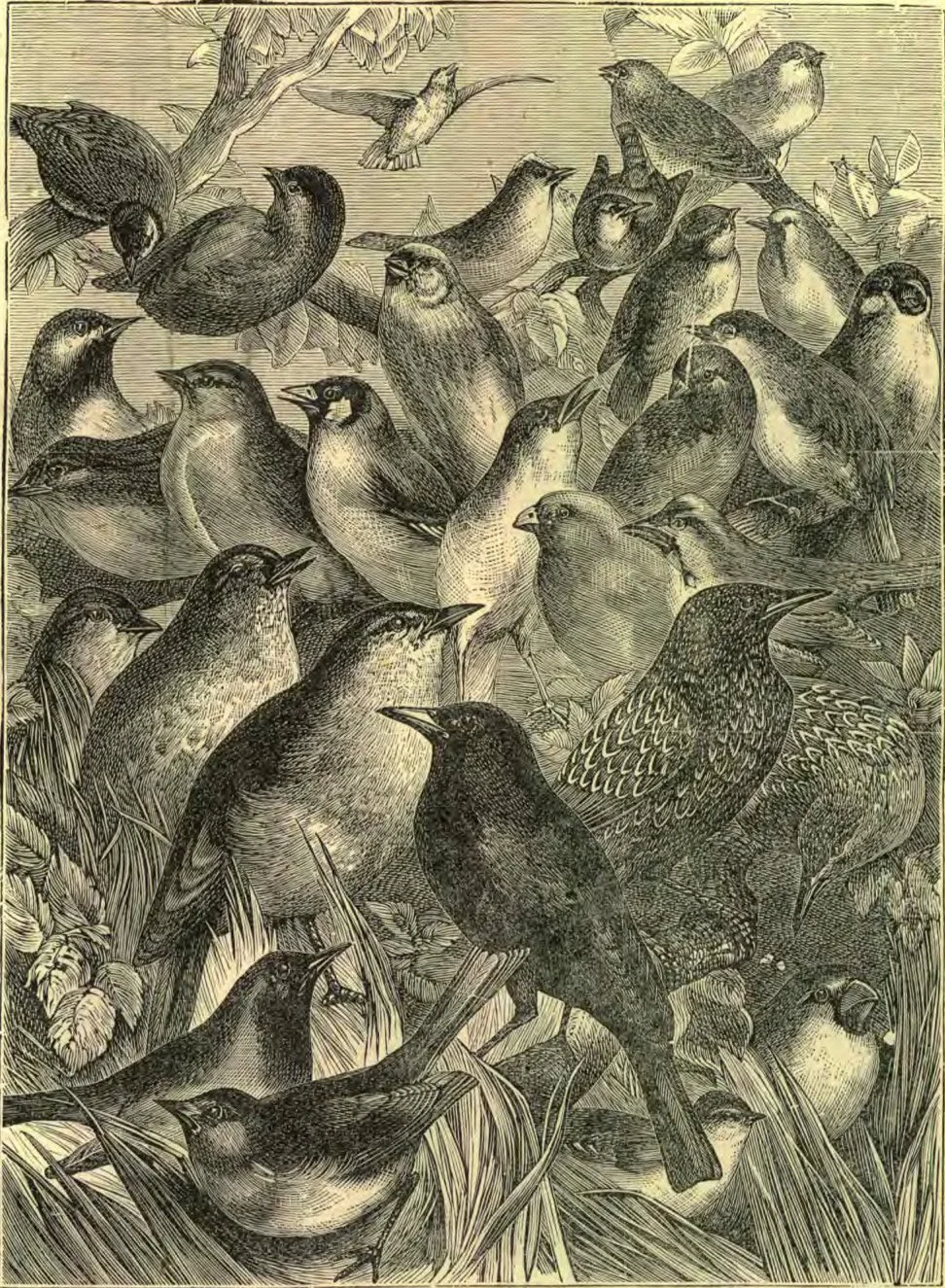
Lo! the lilies of the field, How their leaves instruction yield; Hark to Nature’s lesson given By the blessed birds of heaven! Every bush and tufted tree Warbles sweet philosophy: “Mortal, fly from doubt and sorrow; God provideth for the morrow!
“Say with richer crimson glows The kingly mantle than the rose? Say, have kings more wholesome fare Than we poor citizens of air? Barns nor hoarded grain have we, Yet we carol merrily, Mortal, fly from doubt and sorrow; God provideth for the morrow!
“One there lives whose guardian eye Guides our humble destiny; One there lives who, Lord of all, Keeps our feathers lest they fall; Pass we blithely then the time, Fearless of the snare and lime, Free from doubt and faithless sorrow; God provideth for the morrow!”
— Bishop Heber.

A BRAVE BOY.

SPAIN is a Roman Catholic country, where the priests have great influence, and Protestant missionaries of the gospel experience untold hindrances and opposition in the prosecution of their work. The following anecdote is related by a Protestant hearer:—
“Coming on to the plaza facing the church, we saw a group of boys coming out of the neighboring school. They were teasing one of their number in a most unfair and cruel manner, shouting out at the top of their voices, ‘Protestant! Protestant!’ The poor boy did not run nor fight, but stood up calmly, and laying his hand upon his heart, he exclaimed, ‘Yes, I am a Protestant, and I esteem it an honor to be one!’” Ah, thought this Christian spectator, if all who profess to be on the side of the pure gospel were as brave in witnessing for it as this boy, what a power might be exerted for the truth!—Youth’s World.

FLYING-FISH

In the sea there are three flyers that really, from the extent of their flights, deserve the name. Those of our readers who have been at sea, especially in the south, may have seen the common flying-fish, with its brilliant blue and silver body, and lace-like, sheeny wings. From the crest of a blue wave they dart, singly or in flocks, fluttering along, rising and falling, turning in curves, and returning to the water with a splash—perhaps to fall victims to some watchful bonito, or dolphin, that has been closely following them beneath the water. These privateers of the sea are their greatest enemies, following them under water, and emerging as they rise in the air just in time to catch the luckless flyers as they descend. The dolphins will take great leaps of twenty or thirty feet in following the poor flying-fish, which, notwithstanding their long wings and wonderful powers, often fall victims to their tireless pursuers. They frequently fly aboard vessels at night, perhaps attracted by the light, or, it may be, caught up by the wind from the crest of some curling wave, and carried high in air against the sails.
The gurnard, though it has also long, wing-like fins, presents otherwise a totally different appearance. Its head is enclosed in a bony armor, from which project two sharp spines. Some of these fish are of a rich pink color, while others are mottled with red, yellow, and blue, and as they fly along over the water, and the sunlight falls upon their glittering scales, they seem to glow with a golden lustre. With such hard heads, it will not be surprising information that they are disagreeable fellows to come in contact with; at least, so thought a sailor who was standing at dusk upon the quarter-deck of a vessel near one of the West India Islands. Suddenly he found himself lying upon his back, knocked over by a monster gurnard, that, with a score of others, had darted from the water, this one striking the man fairly in the forehead. The gurnards are also chased by dolphins, and they are frequently seen to rise in schools, to escape from the larger fish; while hovering above them are watchful gulls and man-of-war birds, ready to steal them from the jaws of their enemies of the sea.
In company with these flying-fish, may often be seen curious white bodies, with long arms and black eyes. They are flying squids, members of the cuttle-fish family, and the famous bait of the Newfoundland cod-fishermen. On the banks they are often seen in vast shoals; and during storms, tons of them are thrown upon the shore. When darting from wave to wave, they resemble silvery arrows, often rising and boarding ships in their headlong flight. So valuable are they for bait, that four or five hundred vessels at St. Pierre are engaged in catching them by means of jiggers, or small tackle.
Many of the squid family leave the water when pursued. Even the largest of them, often forty or fifty feet long, have been seen to rise ten or fifteen feet in the air, and sail away as if propelled by some mysterious force, their hideous arms dripping and glistening. They are certainly the largest and strangest of the flyers without wings.—St. Nicholas.

Rejoicing in Another's Prosperity and Sharing Sorrow

To rejoice in another's prosperity is to give content to your own lot; to lessen another's grief is to alleviate or dispel your own.

LESSON 150.—THE GOSPEL PREACHED AT THESSALONICA, BEREA, AND ATHENS.

The next day the magistrates sent word by their sergeants, or lictors, to have Paul and Silas released from prison. But Paul refused to go, saying, “They have beaten us openly uncondemned, being Romans, and have cast us into prison; and now do they thrust us out privily? nay, verily; but let them come themselves and fetch us out.” On learning that Paul and Silas were Romans, the magistrates were much alarmed, fearing that they would be called to account for imprisoning Roman citizens without giving them a proper opportunity for defense. So they came to the prison themselves, and talked with Paul and Silas; and after bringing them forth, requested them to leave the city. They first went to the house of Lydia; and when they had seen the brethren and comforted them, they departed, passing through Amphipolis and Apollonia, and coming to Thessalonica, where the Jews had a synagogue. Here, as his manner was, Paul went into the synagogue on the Sabbath-day, and reasoned from the Scriptures with the Jews, showing that in order to fulfill the prophecies, it was necessary that Christ should suffer death, and be raised again; and that Jesus of Nazareth, whom he preached unto them, was Christ indeed.
Some of the Jews were convinced by Paul’s preaching, and believed that Jesus was the Saviour of the world. Of the devout Greeks a great multitude believed, as did also many of the chief women.
But the unbelieving Jews were filled with envy and hatred, and gathering a company of lewd fellows of the baser sort, set all the city in uproar. Supposing the apostles to be in the house of one Jason, they assaulted it, purposing to bring them out to the people. Not finding them there, they dragged Jason and certain other brethren before the rulers of the city, crying, “These that have turned the world upside down are come hither also; whom Jason hath received: and these all do contrary to the decrees of Caesar, saying that there is another king, one Jesus.”
On hearing these things, the people, and the rulers of the city were troubled; but not knowing what more to do, they made Jason and his companions give security for good behavior, and then let them go.
Immediately after this, the brethren sent Paul and Silas away by night unto Berea. Here the apostles went into the synagogue of the Jews, where they found a company of men more noble than those in Thessalonica; for they received the word with all readiness of mind, and searched the Scriptures daily to learn whether those things were so. As a consequence, many of the Jews believed, as did also many Greeks of honorable estate, both men and women. As soon as the hostile Jews of Thessalonica knew that Paul was preaching in Berea, they came on, and stirred up the people against him. But immediately the brethren sent him away toward the sea, while Silas and Timothy remained in the city. Paul’s friends conducted him to Athens, and then returned, bearing a message to Silas and Timothy to come to him with all speed.
While Paul was waiting at Athens, his spirit was stirred at seeing the whole city given up to idolatry. So he went into the synagogue, where he reasoned with the Jews and other devout persons who assembled there, as he did also with all who met him daily in the market-place. Here he encountered certain philosophers of the Epicureans and the Stoics; and some said, “What will this babbler say?” while others, on hearing him preach Jesus and the resurrection, said, “He seemeth to be a setter forth of strange gods.” Finally they took him, and brought him unto Areopagus, or the hill of Mars, saying, “May we know what this new doctrine whereof thou speakest is? For thou bringest certain strange things to our ears: we would know therefore what these things mean.”

QUESTIONS.

  1. At what place were Paul and Silas imprisoned?
  2. What happened as they were praying, and singing praises to God?
  3. Describe the conversion of the jailer and his family.
  4. What word did the magistrates send the next morning? Acts 16:35, 36.
  5. How did Paul receive this message?
  6. How did he reply to it?
  7. How did the magistrates feel, on learning that Paul and Silas were Romans?
  8. What did they fear?
  9. What course did they immediately take?
  10. Where did the apostles first go, on leaving prison?
  11. What did they do there, before leaving the city?
  12. To what place did they go when they left Philippi?
  13. What places did they pass through on their way?
  14. How did Paul begin his work at Thessalonica?
  15. What did he show from the Scriptures?
  16. How did his preaching affect the Jews?
  17. What other good results followed his labors?
  18. What bad spirit was shown by the unbelieving Jews?
  19. What course did they take?
  20. Why did they assault the house of Jason?
  21. When they could not find the apostles there, what did they do?
  22. What did they say about Paul and Silas?
  23. What accusation did they bring against Jason?
  24. On what ground did they claim that it was a crime for him to entertain the apostles?
  25. How were the people and the rulers affected on hearing these things?
  26. What did they do with Jason and his companions?
  27. How did the apostles escape the persecution that awaited them?
  28. What was the character of the Jews at Berea?
  29. How did they show themselves to be more honorable than those of Thessalonica?
  30. What good results followed?
  31. How were Paul and Silas compelled to discontinue their work at this place?
  32. To what place was Paul taken by his friends?
  33. What word did he send back to Silas and Timothy?
  34. How was Paul stirred up while waiting for them to come to him?
  35. What formidable opponents did he encounter?
  36. How did some show contempt for him?
  37. What did others say, as they heard him preach Jesus and the resurrection?
  38. Where did they finally take him?
  39. What request did they make?

NOTES.

Acts 16:35. The Sergeants. Literally, those having rods; the lictors. These were public officers, who went before magistrates with the emblems of authority. In Rome they bore before the senators the fasces; that is, a bundle of rods with an ax in its center, as a symbol of office. They performed somewhat the same office as a beadle in England, or as a constable in our courts.—Barnes. In the colonies they carried staves, not fasces as at Rome.—Hackett.
Chap. 17:1. Amphipolis. This city was at this time the capital of the eastern province of Macedonia. It was originally a colony of the Athenians; but under the Romans it was made the capital of that part of Macedonia. It was near to Thrace, and was situated, not far from the mouth of the river Strymon, which flowed around the city, and thus occasioned its name, around the city. In the middle ages it was called Chrysopolis. The village which now stands upon the site of the ancient city, is called Empoli or Yamboli, a corruption of Amphipolis. And Apollonia. This city was situated between Amphipolis and Thessalonica, and was formerly much celebrated for its trade.—Barnes. Thessalonica was a rich commercial city near the mouth of the Echedorus, on the Thermaic Gulf, about twenty-eight miles nearly west of Apollonia. It is now called Salonica, having a population of seventy thousand, of whom thirty thousand are Jews.—Hackett.
Ver. 10. Berea. A city of no great fame in history, sixty miles southwest of Thessalonica. Its modern name is Verria, or Kara-Verria, a corruption of the old appellation, and contains about 18,000 inhabitants.—Rev. Com.
Ver. 11. These were more noble. This literally means more noble by birth; descended from more illustrious ancestors. But here the word is used to denote a quality of mind and heart; they were more generous, liberal, and noble in their feelings; more disposed to inquire candidly into the truth of the doctrines advanced by Paul and Silas.—Barnes.
Ver. 15. Athens was the most celebrated city of Greece, and was distinguished for the military talents, learning, eloquence, and politeness of its inhabitants. It is supposed to have been founded some 1500 years before the Christian era. It was called Athens in honor of Minerva, who was chiefly worshiped there, and to whom the city was dedicated. The city at first was built on a rock in the midst of a spacious plain, but in process of time the whole plain was covered with buildings which were called the lower city. No city of Greece, or of the ancient world, was so much distinguished for philosophy, learning, and the arts. The most celebrated warriors, poets, statesmen, and philosophers were either born or flourished there. The most celebrated models of architecture and statuary were there; and for ages it held its pre-eminence in civilization, arts, and arms. The city still exists, though it has been often subject to the calamities of war, to a change of masters, and to the moldering hand of time.—Ibid.
Ver. 19. The Areopagus. This was the name of a hill in Athens, as well as of a judicial court which held its sittings there. The hill was famous as the spot where, according to tradition, Ares, or Mars, the god of war, was brought to trial by the gods for murder. A temple of the god was built on the brow of the hill, and an additional solemnity was given to the place as the site of the sanctuary of the Furies, in a broken cleft of the rock immediately below the judge’s seat.—Conybeare and Howson. Sixteen stone steps, cut in the rock at the southeast angle, led up to the hill of the Areopagus from the valley of the Agora or market-place, where Paul had been disputing. Ver. 17. Immediately above these steps is a bench of stone, excavated in the limestone rock, forming three sides of a quadrangle. There the Areopagites sat.—Wordsworth.

A SINGULAR TOMB.

THERE is said to be a tree in the island of Madagascar that eats people up, and this is the way it does it: The trunk is very thick and scaly, looking something like a very high pineapple. At the top there are leaves six feet long, which hang down almost to the ground. Above the leaves are long white tendrils, which wave about in the air. They surround a white plate, or dish, slightly hollowed out, and filled with a thick, sweet fluid, somewhat resembling honey.
Now, when anybody wants to steal this honey, he climbs the tree, which he can easily do, as the scales serve as steps, and gets into the white plate, which is said to be large enough to hold several persons. But the tree takes good care of its honey. As soon as a foot touches the dish, the white fibers, which are eight feet long, begin to wave about and twist themselves around the intruder, till they strangle him; and then the great leaves rise slowly up into the air, and shut together, till the poor victim is not only killed, but buried, without a funeral, in a thick, green sepulcher.
In this way, some of the wonderful sea-urchins, medusæ, etc., absorb the fish that venture within reach of their innocent-looking tentacles, which are nothing more nor less than arms to clasp around them, and draw them into their mouths.
And now we wonder if some bright young reader may not think of some other enticing-looking place, that, when tempted to go too near to indulge in its imaginary sweets, proves to have just such treacherous arms to draw one closer and closer, until the poor victim is absorbed in clutches that will not yield their hold.—Little Sower.

CHIPPIT AND PIPPIT.

CHIPPIT and Pippit went out to play In the three-tree meadow one summer day, And pussy went too.
Said Chippit to Pippit, “I know the road, Let us go the way that the dun cow go'ed, Where the grass is new.”
Now puss was cunning and old and wise, And much had seen through the slits of her eyes,— The sly old cat.
And this very morning she wanted a treat, And she knew little chickies were good to eat, And best when fat.
So she trimmed her whiskers and stretched her back, And then set out on the chickies’ track With a noiseless tread.
She had happy thoughts as she stole along, And she gave one purr by way of a song, But no more she said.
Now Chippit was chasing a bumble-bee, And Pippit a grasshopper under a tree, When puss drew near;
Puss raised her head when she saw the twain; But none saw Chippit and Pippit again, Which is very queer;
For Chippit and Pippit had meant to roam In the meadow awhile, and then go home When they felt inclined.
But this I know, that pussy cat lay And basked in the sun the rest of the day, And pussy had dined!
Let all little chicks when they go to play, Be sure to keep out of the tempter’s way— It is safest so.
Of evil company let them beware; There is danger, danger everywhere Where the wicked go.
—Child’s Companion.

THE CHILDREN'S HOUR.

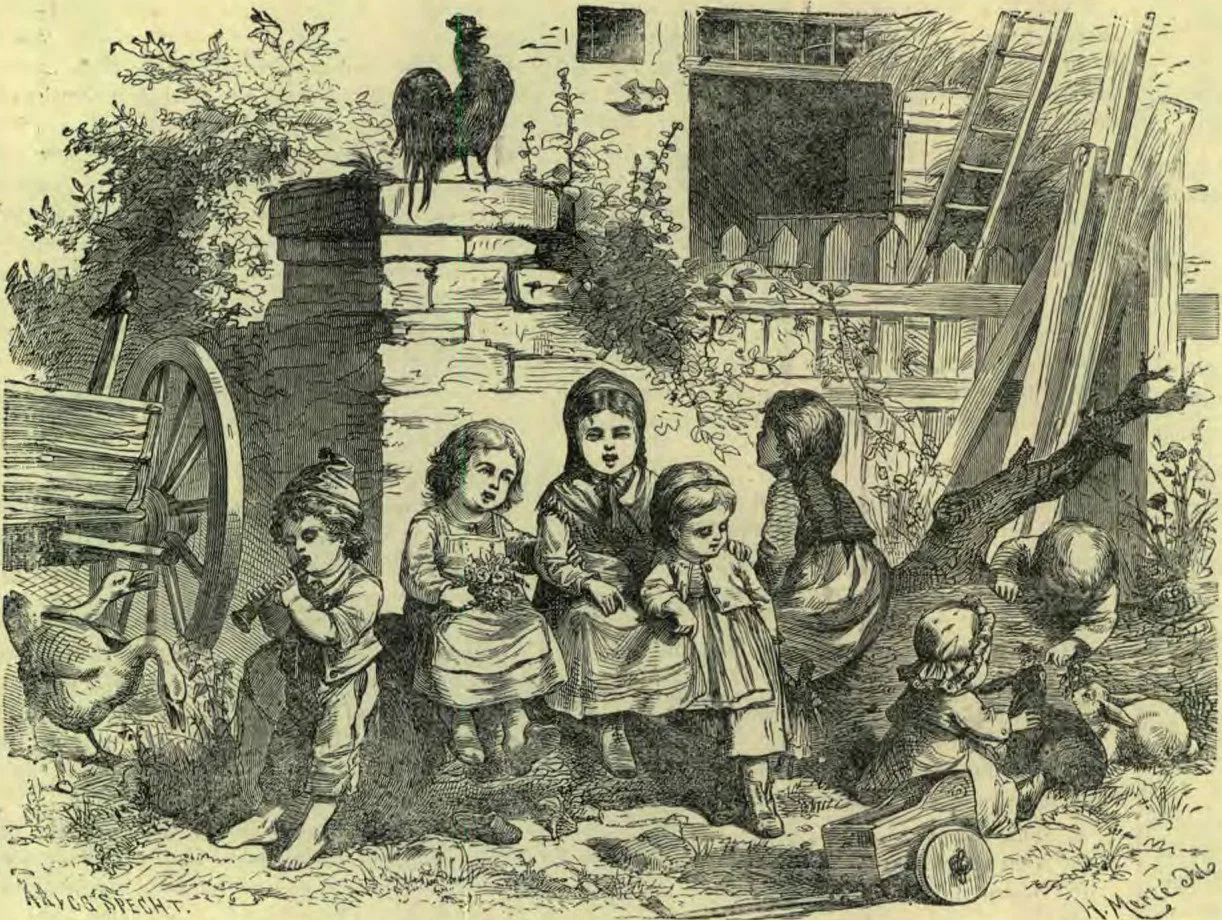
Gertrude and Amy had come from town to stay a few weeks with their cousins at the old farmhouse. They had fine times chasing one another through the tall grass in the orchard, or wading knee-deep in the brook that ran through the meadow. When they were tired of running, they liked best to have grandma come out under the maple trees in the front yard, and tell them stories. This morning grandma could not come; so they went down by the barn to see the chickens and geese and rabbits. After they had fed them, they sat down on an old log. Harry was tooting away on a fife that belonged to Brother George, and the girls sang the tune through with him. The rooster flew up on the fence, and tried to help in the music, and so did the geese. When they had finished, Amy said, “Cousin Mary, tell us some of the stories grandma has told you; we have never heard them, and they will be all new to us.”
“Tell that story about the war,” said Harry.
So Mary began: “Once, a great many, many years ago, there lived across the ocean a people who tried to serve the Lord. Sometimes the wicked people around them came out to fight them, but the Lord almost always helped his people to get the victory.
“One time their enemies came up, and carried off most all their wheat and corn. Then the Lord sent an angel to tell a man named Gideon to take an army, and go and fight these wicked people. Gideon was a good man, and believed the Lord; but he wanted to be sure that the Lord would help him save his people, so he asked him to give him a sign.
“Gideon said, ‘I will put a fleece of wool on the floor, and if the dew falls on the fleece, and the floor stays dry, then I shall know that I ought to go and fight.’ In the morning he looked, and saw the floor dry, and the fleece wet; but he didn’t feel sure about it then. So he asked the Lord to let the fleece be dry the next night, and the ground wet. And when he got up in the morning, it was so.
“Then Gideon took a great army, and went up to battle; but the Lord told him he had too many men, and that he must send a part of them back. He told him to take the soldiers down to a brook, and to go to battle only with those men who lapped up water like a dog. When the men got through drinking, there were just three hundred who were to go with Gideon.
“This captain sent the rest of the soldiers home, and went to fight with the three hundred. He felt a little afraid to go with so few men; so the Lord told him to go down to the camp of his enemies after dark, and hear what they were talking about, and then he would not be afraid. “When he got there, he heard one man telling another about a strange dream that he had had. He said he dreamed that a barley cake tumbled into the camp, and hit a tent, and that tent fell down, and hit another tent, and so they kept doing until all the tents were overturned. Then the other man said, ‘This is nothing but the sword of Gideon.’
“Gideon went back to his own army, and gave each man a trumpet, and a pitcher with a lamp in it; and told them to follow him, and do just as he did. He told one hundred of them to go on one side of the camp, and a hundred on each of the other two sides. In the middle of the night, Gideon blew on his trumpet, and broke the pitcher that held his lamp; and all his soldiers blew their trumpets, and broke their pitchers, and cried, ‘The sword of the Lord and of Gideon.’
“Then their enemies were so frightened that they ran every way, and killed each other with their swords.
“So the Lord helped Gideon beat his enemies, and they didn’t trouble him nor his people any more for forty years.”
Just then the dinner bell rang, and Mary didn’t have time to tell any more stories. Gertrude said she thought it was the best story she had ever heard, and that she hoped grandma would tell them some every day while she was there.
W. K. L.

Correction to Instructor Page Number Figure

In the INSTRUCTOR of August 8, No. 32, first page, second prose article, read eight hundred and fifty-nine, instead of seven hundred and fifty-nine.

MIND

MIND your tongue! Dont let it speak hasty, cruel, unkind, or wicked words.
Mind your eyes! Don’t permit them to look on wicked books, pictures, or objects.
Mind your ears! Don’t suffer them to listen to wicked speeches, songs, or words.
Mind your lips! Don’t let tobacco foul them. Don’t let strong drink pass them. Don’t let the food of the glutton enter between them.

MUSIC BOOKS.

Pearly Portals for the Sabbath-school. By D. S. Hakes. The music in this work is new. The words from the best authors. 160 pp. Boards, 35 cents per copy. Cloth, .50
Song Anchor for the Sabbath-school, praise-service and fireside. 164 pp. Boards, 35 cents. Cloth, .50
Temperance and Gospel Songs. For the use of Temperance Clubs and Gospel Temperance Meetings. Price, .30
Better than Pearls. A new collection of the best Gospel Songs, Hymns, and Tunes for use in Tent and Camp-Meetings, as well as in Revivals, Social and Praise Service. Cloth, 40 cents. Board, .30
Songs for Class and School. For Singing-School, Day-School, Convention and Fireside. 160 pp. $.35
Hymn Book. “Hymns and Tunes for those who keep the Commandments of God and the Faith of Jesus.” It has 337 hymns, and 147 tunes, 416 pages. Muslin Bound, $1.00. Morocco, gilt edges, $1.50
All of the above works will be sent by mail, post-paid, on receipt of prices named. Address,
REVIEW & HERALD, Battle Creek, Mich.

You have reached the end of this edition.

The Youth’s Instructor · Aug 29, 1883