The Youth’s Instructor, Vol. 38, No. 17.

CHAPEL OF HENRY VII

The Youth’s Instructor

Apr 23, 1890

S. D. A. Publishing Association · Battle Creek, Mich. · Apr 23, 1890

CHAPEL OF HENRY VII.
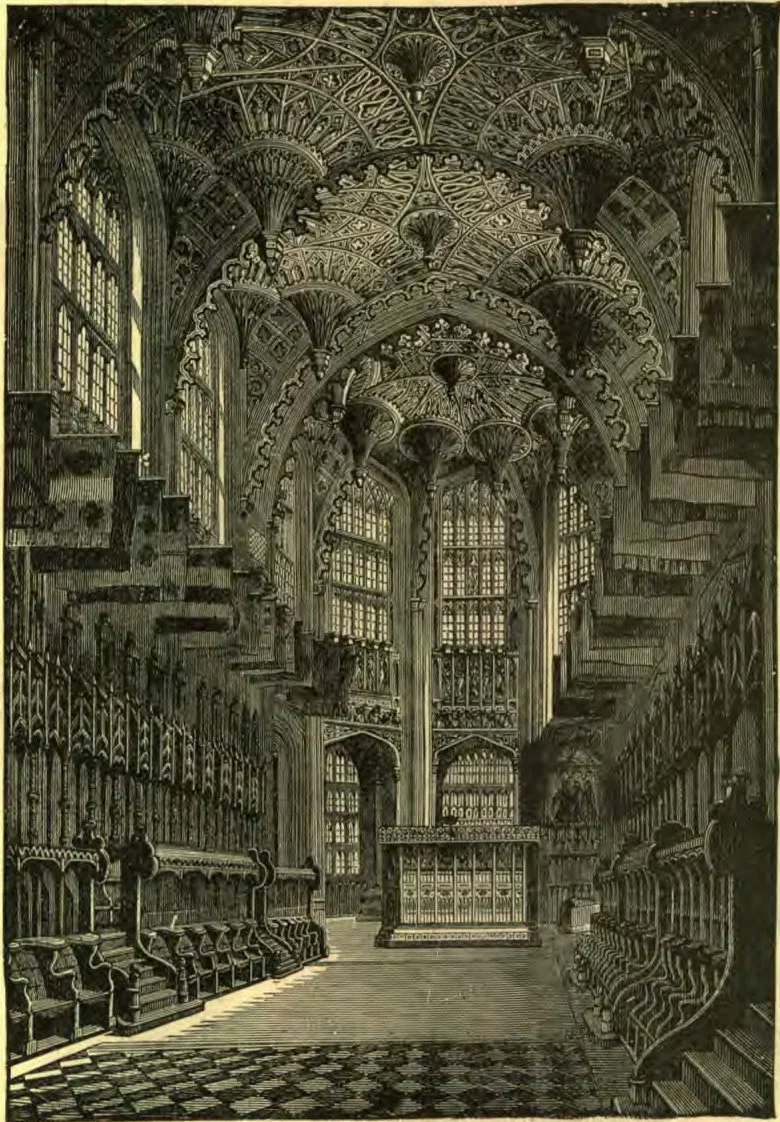
The beautiful chapel, or hall, shown in our engraving, was erected by Henry the Seventh, a sovereign of England, in 1503, and is a part of the noble old pile of buildings known as Westminster Abbey, in London. Henry VII. was one of the most wicked kings that ever swayed a royal scepter. His throne was established in blood, and his power was maintained at the sacrifice of many a noble life.
Entering the abbey from the west, we pace the long nave, with its vaulted passages, somber and still in their ancient splendor, past the tombs of England’s most honored sons, till at last we reach the eastern end, and stand before the entrance to the magnificent chapel of Henry the Seventh. “A flight of steps leads up to it, through a deep and gloomy, but magnificent, arch. Great gates of brass, richly and delicately wrought, turn heavily upon their hinges, as if proudly reluctant to admit the feet of common mortals into this most gorgeous of sepulchers.”
“On entering, the eye is astonished by the pomp of architecture, and the elaborate beauty of sculptured detail. The very walls are wrought into universal ornament, incrusted with tracery, and scooped into niches, crowded with the statues of saints and martyrs. Stone seems, by the cunning labor of the chisel, to have been robbed of its weight and density, suspended aloft, as if by magic, and the fretted roof achieved with the wonderful minuteness and airy security of a cobweb.
“Along the sides of the chapel are the lofty stalls of the Knights of the Bath, richly carved of oak, though with the grotesque decorations of Gothic architecture. On the pinnacles of the stalls are affixed the helmets and crests of the knights, with their scarfs and swords; and above them are suspended their banners, emblazoned with their armorial bearings, and contrasting the splendor of gold and purple and crimson, with the cold gray fret-work of the roof. In the midst of this grand mausoleum stands the sepulcher of its founder,—his effigy, with that of his queen, extended on a sumptuous tomb, and the whole surrounded by a superbly wrought brazen railing.”
Irving continues: “There is a sad dreariness in this magnificence; this strange mixture of tombs and trophies; these emblems of living and aspiring ambition, close beside mementoes which show the dust and oblivion in which all must sooner or later terminate. Nothing impresses the mind with a deeper feeling of loneliness than to tread the silent and deserted scene of former throng and pageant. On looking round on the vacant stalls of the knights and their esquires, and on the rows of dusty but gorgeous banners that were once borne before them, my imagination conjured up the scene when this hall was bright with the valor and beauty of the land, glittering with the splendor of jeweled rank and military array, alive with the tread of many feet and the hum of an admiring multitude. All had passed away; the silence of death had settled again upon the place, interrupted only by the casual chirping of birds which had found their way into the chapel and built their nests among its friezes and pendants,—sure signs of solitariness and desertion. When I read the names inscribed on the banners, they were those of men scattered far and wide about the world, some tossing upon distant seas, some under arms in distant lands, some mingling in the busy intrigues of courts and cabinets,—all seeking to deserve one more distinction in this mansion of shadowy honors, the melancholy reward of a monument.”
Thus the world’s great men strive to make themselves a name that they may not be forgotten by those who shall live after them. Perishable honors! Monuments to fame oft crumble to dust, and the hardest stone is ground to powder by the wear of ages.
There are beautiful buildings in this world, erected by proud and powerful monarchs; but did you never think how much more beautiful will be the dwellings in the city of God? The beauty of earth we can know, for we have words by which to describe all the loveliness ever seen by man; but the golden city is beyond description. The heart of man cannot conceive the beauty of that place. We may lay the precious stones side by side, and reflect them in a golden mirror, but the life, the soul, of the picture is not there. “The glory of God did lighten it, and the Lamb is the light thereof.”
This is the home for which we are looking, and it is almost here. The years of waiting are nearly run, and the great, glad eternity is soon to burst upon us. Are we ready to change our earthly home, however beautiful, for the glorious one prepared for us in heaven?
MARY STEWARD.

A STRIKE.

"I'm going to strike, mother," said Tom.
"And I," said Ned.
"Strike what?" asked mother.
"Why, strike—strike work, you know. Strikes are all the fashion now. Ned and I have been holding a caucus about it, and we have made up our minds to try one. The White boys struck, and had a splendid time of it. They didn't do a thing for a week, and then their mother made proposals for them to go on. She offered them a rise on their pocket money. That's the way strikes always end."
"Not always," said mother, looking rather amused. "Now, mother," said Tom, impressively, "you're to remember that if you want us to do anything specially for you, we're ready to do it. This strike doesn't apply to anything of that sort."
"You are very kind, I am sure," said mother.
"But," said Ned, "if Bridget wants any wood brought, or any kindlings cut, she's got to make special terms. And if father wants the garden worked, he must make special terms."
"I understand," said mother. "I dare say a strike is a very good thing sometimes, and serves a very useful purpose in showing how much people depend on one another. When does the strike begin?"
"This morning."
"Well, you must notify Bridget of what is going on."
The boys skipped off to the kitchen, and informed the maid-of-all-work that they had "struck," and then rushed off to school full of joy over the new state of things. An hour later, mother received a note from father stating that he had been suddenly called out of town, and might not be able to return for two or three days.
"Ah," she said, smiling, "this will help out the strike very well."
She had a little talk with Bridget in the kitchen, and then went to make a few calls among her friends.
"Hurrah!" shouted Tom, as he rushed into the house on his return from school at noon. "I'm as hungry as a bear, mother!"
No answer came to his calls.
"What's to pay?" said Ned, who had come in more slowly. "Bridget! Where in the world is she?"
But silence seemed to reign where the clatter of pans and dishes usually made music in the ears of the hungry boys.
"Well, well!" exclaimed Tom, as he flung open the kitchen door.
The shades were drawn down, the stove cold, the table bare and clean, and everything in apple-pie order.
"Doesn't look much like dinner," said Tom, fretfully.
"Looks like the fairy story where everything went to sleep for a hundred years," said Ned. "I wish Bridget would come and wake things up. Where can she be?"
"Or mother?"
"Or father?"
But as the noon hour wore away, and neither mother, father, nor Bridget appeared, the boys hunted about for what they could get to eat, and, feeling much abused at the cold, comfortless lunch, went back to school.
Mother sat in the window when they returned home in the afternoon.
"Mother, here are Phil and Harry Graham," said Tom, ushering the two boys into the room. Mother gave them a cordial greeting, after which Tom took them out to see the rabbits, while Ned lingered to talk a little.
"They're jolly nice boys that have just moved here," he explained, "and they're going to stay for tea. But, mother, where's Bridget? There wasn't a soul here when we came home at noon," he added, waxing a little indignant at the remembrance of the injuries put upon them.
"Oh, when I told Bridget you were going to strike, she said she thought it would be a good time for her to strike, too; so she's gone."
"H'm," said Ned, discontentedly, "I don't see why women want to strike."
He went out to see his friends, and the four had a merry time at play.
"Seems to me it ought to be supper-time," said Tom, as the darkness began to close in. "Come in, boys, the tea-bell will ring in a minute, I know."
But the bell did not ring, and before long, Tom made his way to the kitchen. Darkness and quiet still reigned there.
"Dear me! I forgot all about the strike!" he said, looking about him in great dismay.
He went to his mother's room, to find that she had again gone out. Greatly mortified at the inhospitable state of things, Tom and Ned did their best to find something fit to set before their visitors. But it was easy to see that no one had thought of setting a lunch, and when the Graham boys at length said "Good-by," our strikers felt that the visit had been a sad failure. They groped around for a lamp, and went to their room.
"Look at the bed!" exclaimed Ned.
"Look at the whole room!" said Tom.
It was indeed in pitiful contrast to its usual neatness.
Pillows and sheets lay exactly as the two had left them after the morning frolic which usually accompanied their toilet.
"There's not a drop of water in the pitcher!"
"And I can't find my night-shirt. Oh, there it is in the corner, where I flung it this morning."
"I wonder where mother is?" grumbled Ned, as he lay down on the unmade bed.
Mother came in a little later, smiled as she kissed the sleeping boys, patting their heads, as she said, "Poor, silly little men!"
"Is mother on a strike, too, I'd like to know?" said Tom, the next morning.
A heavy frown settled on his face as, going to her room, he saw that she had been there during the night, but had now gone out again. No bell had aroused them, and they had slept late. No pleasant warmth and stir in the kitchen gave promise of a comfortable breakfast. Bread and butter and cold meat seemed most unappetizing in the chill of the spring morning.
"I say, Ned," said Tom, with energy, "don't let's allow ourselves to be beaten out so. Let's cook breakfast ourselves, and have something comfortable. Let's make an omelet. They're splendid, and nothing at all to make."
"How do you do it?"
"I know how. I saw Bridget doing it once, and it was just as easy. You take eggs and milk and flour. You make the fire while I get the things."
The fire-making was a brilliant success.
"I'd like to see if we can't look out for ourselves," said Tom, his spirits rising at the sound of the cheerful crackle.
He began to separate the yolks from the whites of the eggs, finding it a more difficult performance than it had appeared under Bridget's skillful fingers.
"I don't see what makes this flour so lumpy," said Tom, as he stirred it into the eggs. "But I guess it'll all come right in the cooking. Now, Ned, bring the spider."
The two watched eagerly as the omelet began to cook. But the lumpy mixture failed woefully in taking on the puffy appearance always assumed by Bridget's omelets.
"It's time to turn it," said Ned.
"It won't turn," said Tom, trying his best with knife and spoon. "It's all stuck to the pan. Oh—I forgot to put any butter in it!"
"Take it off, and we'll eat it without turning. It'll taste good anyway, if it doesn't look right."
"Bah!" exclaimed Ned in great disgust, as he took a liberal mouthful. "It's all burnt, and there's something else the matter with it."
"I guess I forgot the salt," said Tom meekly, as he went out-of-doors to relieve himself of the first taste of the omelet.
"Look here!" said Ned, when Tom came back. "I'm getting tired of strikes. I move we have another caucus, and let the strike go. I wish mother was here, so we could tell her."
Tom felt like holding out a little longer, but when at noon he stood again by the kitchen table, he agreed that he had had enough of it.
"There's mother!" said Ned, joyfully, as he heard an approaching step.
Mother came in and looked about the kitchen with a smile, as if things were going on in the most agreeable manner possible.
"Where have you been all these days, mother?" asked Ned.
"Why, on the day your strike began, I chanced to call on Mrs. Alton, and learned that her little Agnes was very ill with whooping-cough and other troubles. Mrs. Alton herself is not well; so she thought it very neighborly when I told her I would take care of Agnes. As you were on a strike, and father away, I knew I should not be needed at home."
"Not, eh?" grumbled Tom. "Well, mother, the strike's over. So I hope little Agnes is better."
"She is," said mother, "but that need not interfere with your strike. I want you fully to realize how important your work is here. I don't want you to do anything but what you think you get fair pay for."
"Important—ho! ho!" laughed Ned. "Mother, if you'll get things running again just as they used to, I'll put my work into the business, and never say strike again. No breakfast, no dinner, no supper, but what you have to scratch for; everything mean and miserable and hateful."
"Then you are sure that things go a little better when each member of a family does his best to co-operate willingly and cheerfully in the work in which all share the benefit?"
"Yes, I'm sure," said Tom. "If only you'll come back, and get Bridget back, I'll never grumble about chores again."
Bridget was there at tea-time, the kitchen was clean, a good supper cooking, and everything running smoothly in the old groove.
"I guess," said Tom to Ned, as the one sawed and the other split wood in the shed, "the less we say about what we amount to on this place, the better. It could run itself without us a great deal better than we could run ourselves without it."
Mother chanced to be within hearing, and she smiled lovingly into the bright boy faces as she said:—
"That is just as it should be, my dears. It is father's and mother's place to 'run,' as you call it, a home principally for the benefit of the younger ones. But these younger ones have their own duties as well, and in performing them faithfully are fitting themselves for the graver duties which will one day come to them."—Congregationalist.

SLEEP

While children sleep, They know not that their father toils; They know not that their mother prays, Bending in blessing o'er their beds, Imploring grace for after days.
While children sleep, They never dream that others work That they may have their daily bread; When morning comes, they rise and eat, And never ask how they are fed.
While children sleep, They do not see the shining sun, They do not know the gracious dew, In daily miracle of love, Is ever making all things new.
Do we not sleep? And know not that our Father works With watchful care about our way? He bends in blessing from above— His love broods o'er us day by day.
Do we not sleep? And never dream that others work, Reaping the sheaves that might be ours? We see not how the shadows fall That mark the swift-departing hours.
Ah, still we sleep! Our drowsy eyes see not the light, See not the hands stretched out to bless, See not that waiting for us stands God's kingdom and his righteousness.
—Good Words.

Making the Most of Our Opportunities

It is not so much the length or the variety of our opportunities as the way in which we use them that will decide how much they will benefit us.

The Value of Cheerfulness Toward Others

You find yourself refreshed by the presence of cheerful people. Why not make earnest effort to confer that pleasure on others?

STEPS ON THE WAY OF LIFE.

JUST as I am, by sin defiled, I come to Thee, a weary child, With beauty lost, with duty marred, With God-given image sadly scarred; Lost and undone, to Thee alone Who only can for me atone, I come, I come, dear Jesus.
Earnestly, Lord, I do repent, And all my wanderings lament With godly sorrow, grieving still That I've rebelled against thy will. That I have caused thee grief unknown, To thee who only can atone, I come, I come, dear Jesus.
Such as I have to restore again, I'll render to my fellow-men; With humble, broken heart will go, And seek to make wrongs right below. I lift my heart to thee alone, Who only can for me atone; Oh, plead for me, dear Jesus!
Utterly helpless, to thy breast I come, O Christ, for promised rest. Though scarlet sin has stained, I know That thou can'st make me white as snow; My helpless soul trusts thee alone, Trusts thee for all my sin to atone. I come to thee, dear Jesus!
Saved through thy blood by faith in thee, Thy Spirit works thy will in me; My sin-stained robes I've cast aside, And in thy robes of light I hide; Clothed with thy righteousness alone, So shall I stand before the throne, Complete in thee, my Saviour.
Peace, perfect peace, with God on high, We Father, Abba Father, cry; In Christ, the Son, the Father sees us, And we're accepted now in Jesus. Faith brings the vital power in, And we're no more the slaves of sin; The righteous law is our delight, We'll walk, and keep our garments white. Through Christ, our Lord and Saviour.
FANNIE BOLTON.

MENDING HIS NETS.

Many centuries ago an old man and his sons sat mending their nets in a boat upon a little inland sea in Asia. Their boat was anchored near the shore; other boats were near them, their crews hauling in fish. The old man, it is likely, was in haste to mend the nets, and go on with the day's work.
A Man came down the beach. He called to them, and bade them lay down their nets, give up their fishing, and follow him. When they heard him, something told them in their hearts that this call meant that they should forsake the life to which they had always been used,—fishing, eating, sleeping, surrounded by neighbors and friends,—and that they should begin a different work for the people who were strangers to them.
Here were their nets, their own boats, the blue waters filled with fish, the peaceful hills along the coast, the calm little valleys between; here were home, and comfort, and security.
Yonder was the Man on the shore, calling to them to follow him—it might be to hunger, to pain, possibly to death.
But each man heard God speaking in his soul in that voice.
The fisherman's sons arose, and followed Him who had called. But their father sat still, and mended his nets.
These two young men, during the rest of their lives, wandered homeless; they suffered persecution, privation, and pain, and one, at least, perished as a martyr to his faith. But they have helped to bring truth into the world; they have lifted millions of souls out of barbarism up to light and freedom and love.
Of their father we do not even know that he mended his fishing-nets securely.
Possibly to the reader of this article has come, or some day will come, the same Voice, saying, “Follow me.”
You will know that it means, Do not any longer give up your life to the work of fishing or trading or earning money in any way merely to buy necessaries and luxuries. Follow Me. Help your fellow-men to come nearer to God. Do it in your business, in your daily life. Bring truth and order and love into the world. Be ready to sacrifice yourself. It may cost you comfort, it may cost you friends, possibly life itself. Do it.
Have you heard the Voice?—Youth's Companion.

BEAUTIFUL

Beautiful feet are those that go On loving ministries to and fro.
Beautiful arms are those that bear Burdens for those who are pressed with care.
Beautiful hands are those that give Blessings to those who in poverty live.
Beautiful lips are those that speak Words to comfort the sad and weak.
Beautiful brows are those that wear Virtue’s signet engraven there.
Beautiful deeds are those that tell That the spirit of Christ in the heart doth dwell.
“BEAUTIFUL FEET ARE THOSE THAT GO ON LOVING MINISTRIES TO AND FRO.”
Beautiful lives are those that shine With love for the holy, the pure, divine.
Beautiful angels such beauties see, And chant them over the jasper sea.
Beautiful mansions the Lord will give To those who beautiful lives will live.
J. M. HOPKINS.

THE “COMMODORE.”

“MAMMA TERRY, I've 'most smashed my thumb! Oh! oh, dear!” cried Winfred, bursting into the sitting-room like a small tornado.
“Oh, hush, Win! If you haven't been blown to pieces by a dynamite bomb, run over by an engine, or fallen out of a seventh-story window, there is no reason for howling so,” said Thad, his big brother, looking up from his Greek.
“Do be quiet, Winny,” said sister Ruth, “or you'll have a policeman and all the neighbors in here to know who is being killed.”
“But it hurts awfully!” cried Winfred. “I guess you'd cry!”
At that moment the bewitching strains of a hand-organ were heard in the street. Winfred ran to the window, and was perfectly quiet until the monkey and organ moved on; then he took up his doleful crying where he left off.
“Winfred,” said his mother, trying very hard to speak patiently, “what is the trouble now?”
“I hurt my finger,” said the little boy.
“Come here and let me see it.”
Winfred held up his fat little fingers, and looked at them with a puzzled expression on his face.
“I s'pose it was this finger—or else, may be, it was my thumb. I've most forgot which,” he said, looking somewhat ashamed.
“The injury must have been very slight, Winfred,” said Mrs. Terry, “or you would not have forgotten so soon. You have a very bad habit of crying over every trifle, and it makes it very unpleasant for all of us. Besides, dear, habits, like threads, can be easily broken when they are little, but they grow stronger year by year, until they are like huge cables. How sad it would be, when you are a man, if you should cry every time you stubbed your toe, or got a sliver in your finger.”
Winfred's face grew very hot with shame.
“'Course I sha'n't cry when I'm a man,” he said.
“I fear you will, unless you break yourself of the habit now,” said his mother. “You used to be a brave little boy, but for the last year you have grown more and more babyish. I really feel ashamed of you, Winfred.”
“May be I sha'n't cry any more,” said the little boy, with his arms round his mother's neck.
Nevertheless, he had three more “crying spells” before bed-time.
The next day there was great rejoicing in the house, for Uncle Chester came home.
Uncle Chester was a sailor, and had been away on a long voyage. Every one liked the kind, jolly sailor, but Winfred thought him the greatest hero in the world.
Uncle Chester brought them all presents from distant lands—shells and rare curiosities, but to Winfred he brought a beautiful green parrot, with brilliant red feathers around his neck.
Winfred was so delighted that he was nearly wild with joy.
“You are the dearest, jolliest uncle in the world!” cried Winfred, hugging him till he cried for mercy. “How could you know just what I wanted most?”
“I thought you would like it,” said Uncle Chester. “It is a fine bird and quite young, so it cannot talk very well yet; but you can teach him, if you are patient. This species is very teachable. There is one thing, perhaps, which I ought to mention. The Commodore dislikes very much to hear any one cry.”
Winfred's face grew red as he saw Ruth and Thad smiling. He would not have had Uncle Chester know he cried, for a bank full of money; and in all the fortnight he stayed, Winfred did not once cry.
But the door had no sooner closed after Uncle Chester than he cried harder than ever.
The parrot was his constant companion, and rode on his shoulder or followed him from room to room.
He would say “Commodore” quite plainly when asked his name, and when the others were laughing, he joined with a gruff “Ha! ha!” but the moment Winfred began to cry, the bird cried out: “What a baby! Ha! ha! What a baby! What a baby! Ha! ha! What a baby!” Winfred stopped instantly, so surprised that it almost took his breath away, and it was several days before he cried again. But whenever the boy began to cry, the parrot screamed, in a mocking tone, “What a baby! Ha! ha!” and very soon Winfred did not dare to cry any more.
“That parrot is worth his weight in gold,” said Thad one day. “Win has not had a good cry for weeks, but what bothers me is to know who taught the Commodore that phrase that has such a wonderful effect.”
“It is my opinion,” said Ruth, “that mamma and Uncle Chester know more about it than they are willing to tell.”
What do you think?—Youth's Companion.
Continue reading: THE ROYAL CHILDREN OF GERMANY