The Youth’s Instructor, Vol. 49, No. 39.

THE ROSE-BREASTED GROSBEAK

The Youth’s Instructor

Oct 3, 1901

Review and Herald Publishing Company · Battle Creek, Mich. · Oct 3, 1901

THE ROSE-BREASTED GROSBEAK

When I was just beginning the study of birds, and for the first time caught sight of the Rose-breasted Grosbeak, I felt that I had made a wonderful discovery. Certainly it must be a very rare bird; for I did not remember ever having seen it before in my life. But this was but another example of the fact that often we do not see what we might easily see if our eyes were open to discover. The Rose-breasted Grosbeak loves the shelter of trees and shrubbery, and for this reason I had more than once, I have no doubt, passed it by unnoticed.
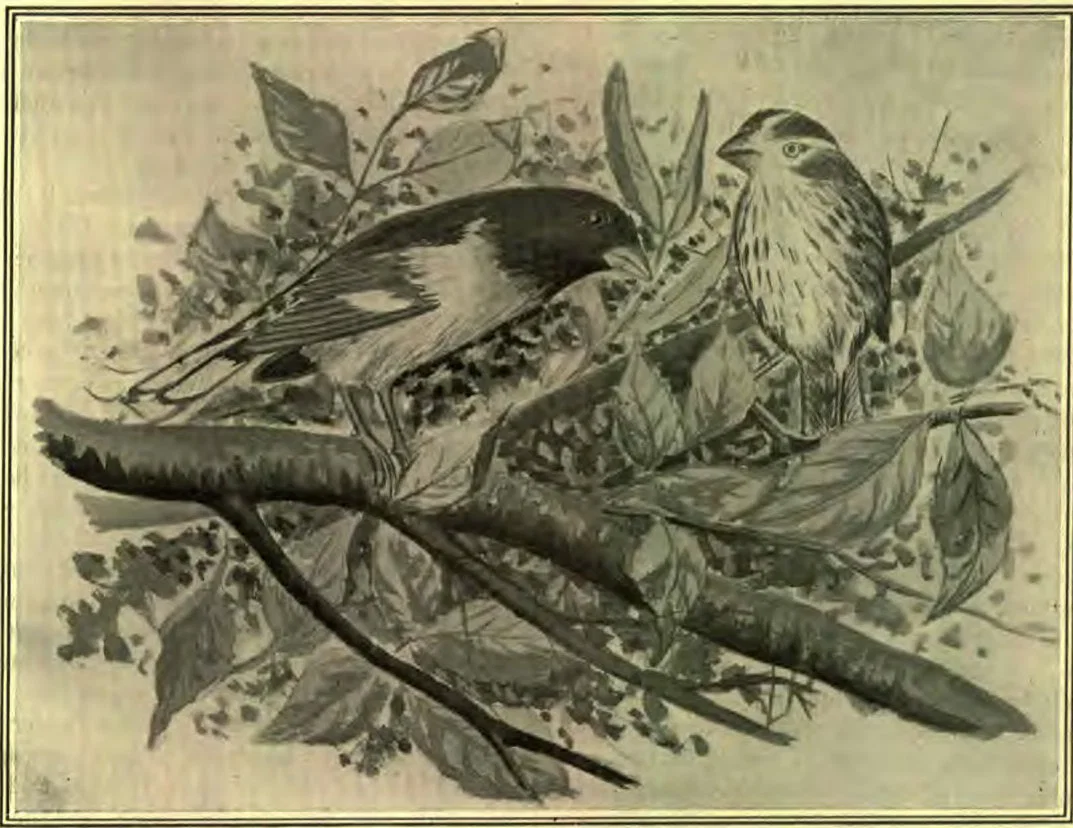
The Grosbeak is a bird worth seeing. He is dressed in black, white, and rose-color, and in the early spring has a song that is worth hearing. In intonation it is much like that of the robin, but this similarity exists only in the form; for as Professor Chapman says, “there is no more resemblance in their voices than there is between the birds themselves.” The song of the robin is often delicate and sweet, but too frequently exceedingly monotonous. Not so the song of the Grosbeak. I have listened, time and time again, for long periods to its pure, glad carols, thanking God for the melody of spring. Florence Merriam calls the jubilee of the Grosbeak a “rich, round pendulum-song.” The figure is an apt one, as those who are acquainted with the song will testify. The bird has a great habit of getting well into the top of a tree, and often, perched in its dense green top, will sing its rapturous melody while the westering sun sinks slowly toward the horizon. If you do not identify the bird by its song, his call note is fully as characteristic, being a distinct but not loud sort of questioning note,—a steely ick, eek, or peek!
The black head, singularly large beak, and the rose-colored patch on the breast are enough to identify the male. The female is more difficult to determine; but her being in company with the male, her sparrow-like coloring, but in size too large for a sparrow, the white line over her eye, and her large or “gross” beak will enable you to be sure of her identity. It is the large beak which gives the bird its name. It is somewhat like that of the sparrows and finches in outline, but is an exaggeration, being built on a large scale. The bill is for crushing the potato-beetle and other insects which largely compose its diet. It also eats a few peas, but its value in destroying “potato-bugs” more than compensates for any damage it may do in this way.
Professor Beal tells of two Grosbeaks which had their nest hidden by a potato patch that was so infested with potato-beetles that the vines were completely riddled. The Grosbeaks visited the fields every day; and when their young were old enough to travel, the whole family appeared on the scene. The young birds stood in an expectant row on the topmost rail of the fence, and their parents flew briskly back and forth, bringing them beetles. A few days later not a beetle was to be found, either old or young; the birds had swept them from the field, and saved the potatoes.
ROSE-BREASTED GROSBEAK
“One of the pleasantest nesting episodes I have ever known,” writes Florence Merriam, “was that of a Grosbeak family. The pretty, pale-blue eggs were laid in a nest of twigs in a pear-tree, close beside a carriage drive, and the trustful birds seemed to realize that they were among friends. The father was most devoted, brooding the nest and feeding the young. All his thoughts seemed to center about the pear-tree; the little home there was clearly the point around which everything in the world revolved. When he came to his nest, it was with a low, sweet greeting; when he left, it was with a soft farewell; if danger threatened, he was on the spot, and his anxious cries filled the air; when all was quiet again, and he had flown away, his cheering song came back to his mate in the nest, as if to assure her that he was near. The rich music that was always ringing about the home, the tender watchfulness and affection of the old birds, and the quiet happiness of the mother of the family on her nest under the green leaves, all seemed suited to the cheery orchard with its mellow sunshine and its ripening fruit.”
The male Grosbeak is not only an ardent lover, but assists in brooding by relieving the mother; and at such times, it is said, often sings while sitting on the nest. L. A. REED.

SWALLOWS

SWALLOWS are among the birds that are universally known. They constitute a family by themselves, and are so different from other birds (swifts alone excepted) in their appearance and manner of life that nobody, though he never has looked into a “bird book,” need be in doubt what to call them. Once, to be sure, in the North Carolina mountains, I talked with a man who did not know what I meant by the word “swallow” as applied to a bird. He had never heard it, he said. But even in his case the ignorance was, no doubt, a mere matter of terms. If I had said “martin,” he would have understood me well enough.
The family is, comparatively, a small one. Only about eighty kinds are known the whole world over. In eastern North America there are but six, and, happily, these are so different from one another in plumage and nesting habits that no one who cares to know them apart need have any great difficulty in so doing.
Of the six species, two nest commonly in boxes or houses which men put up for their accommodation; two in and about barns and other such buildings; and two in sand-banks, natural openings in limestone cliffs, and the like.
The two house-dwellers are the purple martin, called also the black martin, and the tree-swallow, or white-breasted martin.
Purple martins are the largest of North American swallows. Their color is not at all what is ordinarily understood by the word “purple.” To see the male in the air, you would call him black, while the female looks like a black bird with a white belly. They are more common in the South than in the North (every colored man’s cabin has its pole and calabash for their accommodation,—they keep hawks away from his chickens), but are known to occur far up in British America. They make much cheerful noise, and in all respects are neighbors worth encouraging. In Jacksonville, Fla., some years ago, I noticed that they had taken possession of the big, flaring caps of the arc lights along the streets, and since then the same thing has been observed in Massachusetts. Swallows, of all birds, are quick to appreciate modern improvements. Indeed, all but one of our species (the sand-martin) have materially altered their nesting-habits since the country was settled by white men. Some of our swallows have probably made more improvement in house-building during the last three hundred years than some savage tribes have made in ten times that period.
The white-breasted swallow, or tree-swallow, is a most lovely creature, lustrous blue, or blue-green, above, and snow-white underneath. He also, as I have said, likes a bird-house, though in common with the purple martin he formerly lived in hollow trees (whence his second name), and will do so even yet if nothing more convenient offers itself. In summer—to a man who lives in Massachusetts, at all events—he seems to be almost a rarity; but if one goes to the seacoast at the right moment in autumn, one finds tree-swallows there by the million. They have assembled for their long southward journey.
The barn-swallow is to be known by his deeply forked, scissors-shaped tail, and by his chestnut-colored throat and breast. In these days he lives by preference in barns. All farmers’ boys should be acquainted with him, and with his happy, twittering song. Some people say that he is the fastest flier of the family. Perhaps he is, but the slowest of them can fly fast enough to make a human being envious.
The cliff-swallow, known also as the eaves-swallow (one name referring to his old habit of nesting on the face of cliffs, the other to his modern practice of nesting under the eaves of barns and sheds), is a peculiarly social bird. Many pairs usually live together; and a busy and pleasing sight it is to see them (and hear them) at their work, whether gathering mud, plastering their nests under the eaves, or feeding their little ones. They may be told on the wing by their rufous or salmon-colored rumps, their whitish foreheads, and the square cut of their tails.
The sand-martin, or bank-swallow, is smaller than his relatives, and inhabits sand-banks, into which he burrows. Naturally, he is not to be found in all places. His back is dull of color, and his lower parts are whitish, with a narrow, dark band across the breast. You may know him—the adult male, that is—by this mark, as well as by his peculiar rough—finely rough—voice. If you examine a bank full of his holes, you will perhaps find a much larger one among them. That will most likely be the door of a kingfisher’s nest.
Much like the sand-martin in color, but a little larger, and lacking the dark breast-band, is the rough-winged swallow. He is less generally known than the others, partly because he is less widely and generally distributed. Very few New England people ever see him. He nests not only in sand-banks and limestone cliffs, as before said (in the walls of the Natural Bridge in Virginia, for example), but in the stone abutments of bridges. His name comes from a peculiarity of the feathers of his wings, which can not be made out except with the bird in the hand.
These six, as I have said, are all the swallows to be found in eastern North America. The “chimney-swallow,” so called, is not a swallow, but a swift.—Bradford Torrey, in S. S. Times.

CHAPTER V

Our Earth before the Flood

§ 43. The climatic conditions of our earth prior to the flood must have been vastly different than they are now. The simple statement that “the Lord God had not caused it to rain upon the earth; . . . but there went up a mist from the earth, and watered the whole face of the ground” (Gen. 2:5, 6) speaks volumes concerning man’s abode before the flood. Before that event no clouds ever darkened the sunlit skies, and no storms ever beat upon the smiling face of the yet unbroken surface of the earth. The rolling thunders were not then heard, the lightnings did not leap from cloud to cloud, nor the pitiless hail destroy the vegetation as now; neither were the snow, the sleet, the storm, and the rain known.
§ 44. After the flood, when the face of nature was all changed and broken, the Lord said to Noah (Gen. 9:13, 14): “I do set my bow in the cloud, and it shall be for a token of a covenant between me and the earth. And it shall come to pass, when I bring a cloud over the earth, that the bow shall be seen in the cloud.” This bow is the token of God’s promised care for us; it is like the bow that spans the throne of God in heaven. The rainbow is caused by the sun’s rays being prismatically divided in passing through the falling drops of water, and reflected to us from some dark cloud that forms the background. So in heaven the bright beams from the Sun of Righteousness shining forth through the showers of divine blessing are reflected to us from the dark cloud of confessed sins that God has cast behind his back. See Rev. 4:3; Eze. 1:28; Ps. 97:2; and Isa. 38:17.
§ 45. If there were no rainbow before the flood,—if “the Lord God had not caused it to rain; upon the earth,”—then there could have been no clouds to obstruct the perpetual sunshine. Had there been clouds, there would have been rain; had there been rain, there would, of necessity, have been a rainbow; but there was neither. No rain, no snow, no hail nor sleet to disturb the gayeties of that pleasure-seeking race; for these phenomena all depend upon an atmosphere heavily laden with moisture in the form of clouds, which becomes precipitated by being chilled with cooler strata of air. If there were no clouds and no rain, then there must have been no portions of atmosphere surcharged with electricity to be manifest in the form of lightning and thunder.
§ 46. The atmospheric pressure upon the earth’s surface must then have been much lighter than now; for remove from our present atmosphere the millions of tons of water that, in the form of clouds, now float over our heads, and the present pressure of nearly fifteen pounds to the square inch at sea-level would be greatly reduced.
§ 47. After the flood, the Lord promised Noah that “while the earth remaineth, seedtime and harvest, and cold and heat, and summer and winter, and day and night shall not cease,” showing that these existed previously to the flood; but we can not refrain from asking the question, Did these extremes of heat and cold always exist? Before the curse of Adam’s sin rested here,—before this earth became the seat of Satan’s rebellion,—was our earth’s equator like the torrid blast from a heated furnace? and were our poles buried beneath eternal ice and snow?—We most certainly think not. When Captain Nares of the British exploring expedition returned from his arctic trip, he reported the finding of large coal deposits and other evidences of a former existence of evergreen forests in Lat. 82° 44′, which is far beyond the present line of vegetable growth of any considerable size. How much farther north these evidences extend we do not know; but we do know that the remains of the mammoth and other immense herbivorous mammalia, are found so far beyond the present line of possible existence of any such animals as to show conclusively that there must have been a time when our present snow-bound polar regions were the homes of luxuriant forest growths, through which roamed animals of proportions unknown to us now, save by their frozen and fossil remains.
§ 48. We firmly believe that before the fall the climatic conditions of our earth were even much more pleasant and agreeable than those which existed from the time of the fall to the flood. How long this earth was robed in Edenic beauty, and man was permitted to remain in his first home, we know not. From “Patriarchs and Prophets,” pages 67 and 68, we quote the following:—
“In humility and unutterable sadness they [Adam and Eve] bade farewell to their beautiful home, and went forth to dwell upon the earth, where rested the curse of sin. The atmosphere, once so mild and uniform in temperature, was now subject to marked changes, and the Lord mercifully provided them with a garment of skins as a protection from the extremes of heat and cold. As they witnessed in drooping flower and falling leaf the first signs of decay, Adam and his companion mourned more deeply than men now mourn over their dead. The death of the frail, delicate flowers was indeed a cause of sorrow; but when the goodly trees cast off their leaves, the scene brought vividly to mind the stern fact that death is the portion of every living thing.”
If, then, our seasons, with their extremes of heat and cold, began at the time of the fall of man, if they are a part of the curse to which we were then subjected, we shall study with renewed interest the cause of our earth’s seasons, as compared with the seasons upon our sister planets.
§ 49. When we look at our earth, and consider what is said in Isa. 45:18,—that the Lord created it not in vain, but formed it to be inhabited,—and yet see, besides the desert wastes of the equator, and the frozen fields of our poles, that fully three fourths of its surface is covered with water, again we ask, “Was it always so?” The change in the climate at the time of the fall caused no change in the distribution of the water on its surface; but it is no doubt true that great changes were made at the time of the flood.
In 2 Esdras 6:42, 44, we read: “Upon the third day thou didst command that the waters should be gathered in the seventh part of the earth: six parts hast thou dried up, and kept them to the intent that of these some being planted of God, and tilled, might serve thee. For immediately there were great and innumerable fruits, and many and diverse pleasures for the taste, and flowers of unchangeable color, and odors of wonderful smell, and this was done on the third day.” As to the inspiration of the foregoing we of course can not say.

QUESTIONS

How was this earth watered before the flood? Explain how the rainbow is produced. How do you know there was then no rain? clouds? snow? hail? thunder? Explain how there might have been dew, fog, frost, and ice. Give evidences that the atmosphere was not as dense as now. Of what is the bow an emblem? When did our seasons evidently begin? Give proofs that our poles were not always covered with ice and snow. For what purpose did the Lord make this earth? In what respects is it now fitted for man’s abode?
DR. O. C. GODSMARK.

A STORY FOR GIRLS

THERE is a picture stamped upon my memory, which it always gives me sorrow to look upon. Gladly would I erase it, but it is painted in unfading colors, which the passing years can not dim, nor time tarnish. Only an earnest wish that some girl or boy may be benefited, prompts the writing of this sad experience.
My parents moved to Michigan from a pleasant home in Ohio soon after I had passed my thirteenth birthday. In that early day, we met with many privations. Being the eldest of several children, my services were in constant demand, and were usually cheerfully given; for I dearly loved my feeble mother. At times I would weep when I thought of the probability of being motherless; but as girls, and boys too, of fourteen, are apt to be careless and thoughtless, I was often forgetful of her wishes, and sometimes failed to render cheerful obedience to her requests.
In those days the amusements and pleasures of the young were few and very simple, and the reader may fail to realize with what pleasure I had been looking forward to an all-day’s visit with a young friend who lived a mile or more from my home. At last the day set for my visit arrived. I was up early. It had rained in the night, but the sun rose clear and bright. I was in my pleasantest mood until mother said, “Ettie, I can not spare you until this afternoon. We shall have to wash first, now we have some rain-water.” The weather had been quite dry for several weeks, and our rain-trough was empty. We had no cistern, a big basswood log, scooped out, which stood at the back of the log house, serving as our rain-water-reservoir. Being so small, it was, of course, often empty. My face was instantly tangled into a frown, and my lips pouted. Mother continued, “I am sorry to disappoint you, dear, but we shall finish by noon; then you may go, and have a pleasant visit.”
Very sullenly I donned my old wash-dress. Soon the suds began to fly, in my eagerness to get through. We had none of the easy washing machines now so common, and I worked with all my might until I supposed the washing was finished, when mother pleasantly asked me to wash a few extra pieces, so as to utilize every pail of water. Being in haste to get away, I sharply told her I would not,—if she wanted any more washing done, to do it herself. I have never forgotten the sad look she gave me as she said, in a low, gentle voice, “My daughter may be sorry some day for her unkind words to her mother.”
Oh, how her words went to my heart! I longed to put my arms around her neck, tell her then and there that I was sorry already, and ask her to forgive me; but my stubborn will held me back, and Satan whispered evil thoughts into my mind, telling me to wait,—that some other time would do as well. So, proud and defiant, I turned away, dressed, and went to spend the afternoon with my young friend. But somehow I did not enjoy my visit as I had expected. The pale, sad face of my mother would come before me, and her gentle words echoed in my ears, giving me mental pain.
In the evening I went home feeling dissatisfied, but I was too proud to go and tell her how sorry I was. I fully intended to do so, but kept putting it off until it was too late. Not long after this my mother was taken suddenly ill on a Sabbath evening. In a short time she became delirious, and the next Tuesday afternoon she fell asleep in Jesus.
O young people! as I bent over her cold form, my sorrow was increased tenfold. As her words came to my mind, my proud heart was crushed. I was ready now to cry, “Mother, forgive your naughty girl; she is sorry, oh, so sorry!” But it was too late. Her ears did not hear my pleading. What would I not have given, had I, since that dark afternoon, asked her forgiveness; but I did not, and the sad picture still hangs on memory’s wall, to remain as long as the mind shall retain a thought of the past.
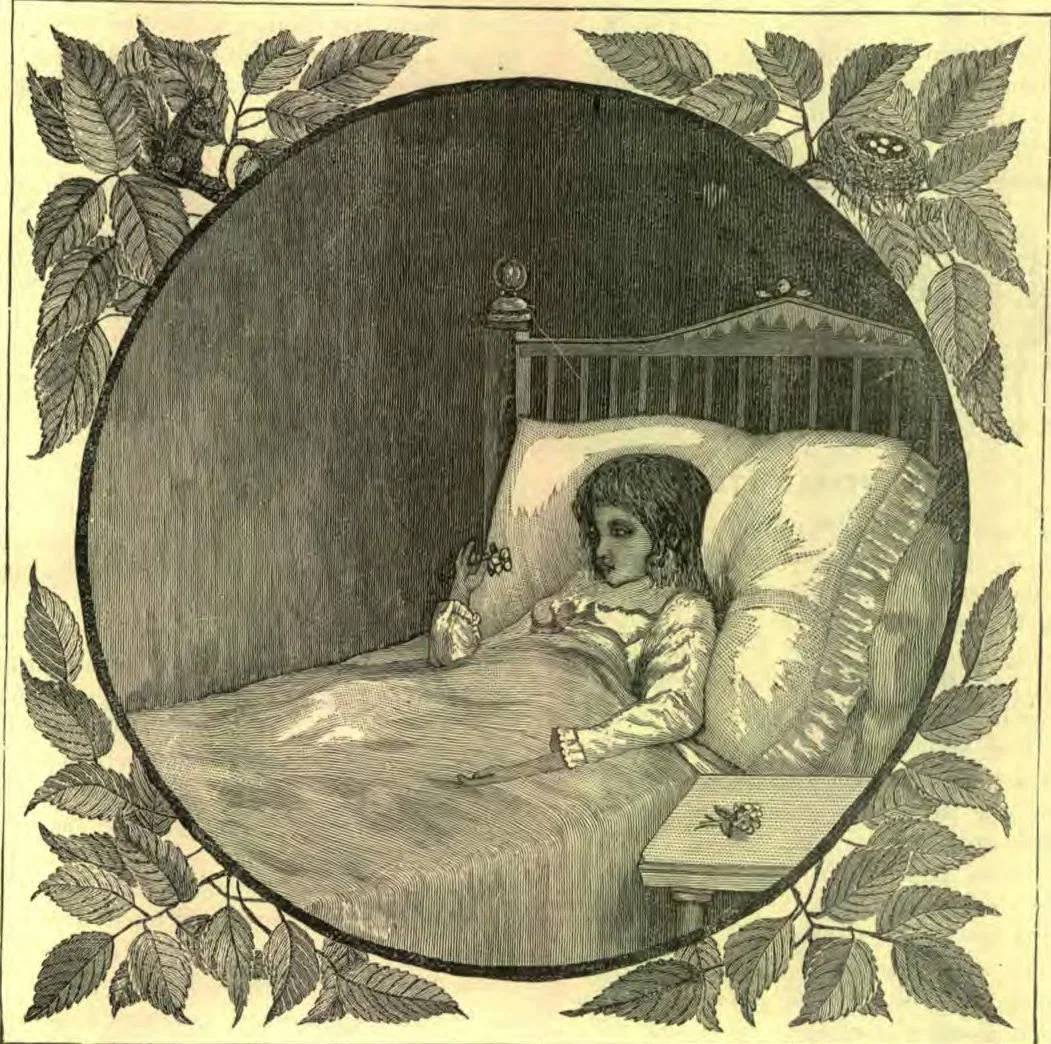
“A BUNCH OF WILD FLOWERS TO A SICK GIRL BROUGHT”
It ever gives me sorrow to hear young folks saying unkind words to their parents, because I know they are painting a picture that they will shudder to look upon in after-years. Dear boys and girls, be careful of father and mother, and do all you can to help them gently down the decline of life. They tenderly cared for you in your years of helplessness; now you should do all you can to cheer and comfort them. Age has trials the young know nothing of. Let no word, no act, of yours add aught to the weight of responsibility and care upon their shoulders. Be tender and thoughtful of your parents while you have them, lightening their daily burdens with prompt obedience, willing service, and tender, loving words.
MRS. M. C. DU BOIS.

MY PHOSPHORESCENT CLOCK

We have made a recent purchase in our house, and it is proving very useful. It is a phosphorescent clock. It looks like any ordinary clock, save that the figures on the face are perhaps unusually distinct; but when it is taken into a dark room, its face seems suddenly to have acquired transparency, as if there were a strong light inside, and on this glowing face the figures stand out plainly, so that no one need light the gas to learn the time of night.
How does it do it?—No one knows. There is a coating of phosphorus over the face of the clock, and in some mysterious way that wonderful substance “absorbs” the light during the daytime, and gives it out again during the darkness. “Phosphorus” comes from two Greek words that mean “light-bearer,” and well does it deserve its name. Other substances are light-bearers also, but not so gloriously phosphorus.
Ingenious men of science have found a way to measure the light-carrying powers of different substances. The diamond, for instance, is strongly phosphorescent; other gems are less so. Wise men mount on a wheel the material to be examined. The wheel is set revolving in a dark room, and the investigator looks at it through a slit. Through another slit a certain space away from the investigator a ray of light is thrown upon the phosphorescent substance, and the wheel is revolved faster and faster till the substance becomes visible to the eye of the scientist waiting for it in the dark. When that moment arrives, the speed of the wheel is noted, and it is known for how long a time that particular substance will carry light. It may be a very small part of a second, or it may be several minutes; no matter, it can be measured.
Now, wouldn’t it be well if we should set on foot some such experiment with ourselves? It isn’t on the sunny days that we most need our good cheer, our gratitude, and our trust, but it is when the sky lowers, when the darkness gathers, when the shadow of misfortune or of death draws nigh. If we will, we may be laying up for ourselves under smiling skies a reservoir of trust and happiness which we can carry over into the gloom. I know just such people, don’t you? Good cheer has become a habit with them, as with my phosphorescent clock; and when you look at them in the dark, ah, how their faces shine!—Christian Endeavor World.

A BUNCH OF WILD FLOWERS

'Tis strange what power in seeming trifles lies! A bunch of wild flowers to a sick girl brought,— A little thing it seemed; yet all day long They made a sort of glory in the room, And turned a weary soul to songs of praise.
Ah, well she knew the bank from which they came, The velvet bank with play of sheen and shade Made by the sunbeams sifting through the trees. And as she looked at them, they spoke to her The sweet familiar language of the woods. She felt the cooling breezes fan her cheek, She heard the brooklet laughing on its way, The songs of birds among the tree-tops hid, And all the soft hand-clapping of the leaves. The fragrance of the blossoms brought to her The thousand indescribable sweet scents That linger in the dewy depths of woods. Their upward turned corollas seemed to her Like well-remembered faces that we love.
They cooled the fever in her leaping pulse, And calmed her with their messages of peace. They made a sort of glory in the room, And turned a weary soul to songs of praise.
VIOLA E. SMITH.

OUR WEEKLY STUDY

At the Council following the General Conference last spring it was planned to have the topic for consideration in the Young People’s meetings week by week the same as that of the weekly Reading Circle study when it should be taken up in the fall. For the interval between, the series of studies in “Steps to Christ” was provided. These have now been finished, and the regular winter’s work was entered upon with the missionary study given last week, corresponding to the monthly Field study.
As an introduction to the Reading Circle studies on Health Principles, a series of Good Samaritan studies has been provided, and it has been advised that short lessons and supplementary helps on these subjects be given in this department to assist in conducting the regular meetings of the young people’s companies. In this way the same subjects that are studied during the week in the home will receive further consideration at the meetings of the young people; and it is hoped that a deep and practical interest will thus be awakened in the hearts of old and young alike in these important truths.
Good Samaritan work must of necessity include a work for others — a work of ministry, either physical or spiritual, or both. As an introduction to the subject, the topics, Who Is My Neighbor? and, Thy Neighbor as Thyself, will be taken up. These will be followed, in order, by the following: Hospitality; The True Motive in Service; Acceptable Service Illustrated; Feeding the Hungry; God-given Opportunities; Bear Ye One Another’s Burdens — How? and Rewards of Service. For the second Sabbath of each month, of course, the study will be on missionary subjects, to correspond with the regular Field study, which occupies the second week each month in the Reading Circle course.
We hope that our young people everywhere will make the most of these lessons, utilizing the matter that will be found from week to week in the Review and Herald. In this connection we would also urge that as far as they can do so, they supply themselves with our missionary journal, the Missionary Magazine, upon which one study each month will be based.
There are great opportunities before the young people. Oh, that all may walk in the counsel of the Lord, and improve every opportunity for ministry that comes to them!

ABRAHAM AND HIS SEED, MISSIONARIES

(October 6-12)
I. FROM what religious surroundings did the Lord call Abraham? Joshua 24:2; Gen. 31:30; note 1.
2. What did he require him to do? Gen. 12:1.
3. What promise did the Lord make to Abraham concerning his relation to the families of the earth? Gen. 12:3.
4. When given a family and new associations, how did Abraham become a blessing? Gen. 18:18, 19; note 2.
5. What is God trying to do for parents and children now, just before the great and dreadful day of the Lord? Mal. 4:5, 6.
6. Were the heathen blessed in their associations with Abraham and his family? Note 3.
7. How far was the blessing of Abraham and his seed to extend? Gal. 3:8.
8. What relation do Christians to-day sustain to this work of becoming a blessing to the heathen? Gal. 3:29; note 4.

NOTES

1. “Abraham had grown up in the midst of superstition and heathenism. Even his father's household, by whom the knowledge of God had been preserved, were yielding to the seductive influences surrounding them, and they ‘served other gods’ than Jehovah.”—“Patriarchs and Prophets,” page 125.
2. “In early times the father was the ruler and priest of his own family, and he exercised authority over his children, even after they had families of their own. His descendants were taught to look up to him as their head, in both religious and secular matters. This patriarchal system of government Abraham endeavored to perpetuate, as it tended to preserve the knowledge of God. It was necessary to bind the members of the household together, in order to build up a barrier against the idolatry that had become so widespread and so deep seated. . . . The greatest care was exercised to shut out every form of false religion, and to impress the mind with the majesty and glory of the living God as the true object of worship.”—Id., page 141.
3. “During their stay in Haran, both Abraham and Sarah had led others to the worship and service of the true God. These attached themselves to the Patriarch’s household, and accompanied him to the land of promise.” “Abraham’s household comprised more than a thousand souls. Those who were led by his teachings to worship the one God, found a home in his encampment; and here, as in a school, they received such instruction as would prepare them to be representatives of the true faith. Thus a great responsibility rested upon him. He was training heads of families, and his methods of government would be carried out in the households over which they should preside.”—Id., pages 127, 141.
4. “Many are still tested as was Abraham. . . . God has a work for them to do; but a life of ease and the influence of friends and kindred would hinder the development of the very traits essential for its accomplishment. . . . Who is ready at the call of Providence to renounce cherished plans and familiar associations? Who will accept new duties and enter untried fields, doing God's work with firm and willing heart, for Christ’s sake counting his losses gain? He who will do this has the faith of Abraham, and will share with him that ‘far more exceeding and eternal weight of glory,’ with which ‘the sufferings of this present time are not worthy to be compared.’”—Id., pages 126, 127.

THINGS TO KEEP

“Keep your grip.” A nerveless, uncertain hand, always ready to let go the helm, accomplishes nothing.
“Keep your head.” Train your thoughts, as soldiers are trained, not to fly into a panic nor to scatter helplessly in the hour of peril and difficulty, but to be firm, collected, alert, ready to fight a way through.
“Keep clean.” Let no seeming obstacle persuade you that your path must diverge, even for a few steps into the mire. There is a clean way to everything really worth having.
“Keep going.” There are no more cowardly words heard on any right road than those two little words, “give up.”
“Keep faith.” Above and beyond all else, keep faith,—faith in the fatherhood of God, in the loving, tender presence of Christ, in the overruling of the Almighty, and in the final triumph of right.— Selected.

SUGGESTIVE PROGRAM FOR THE YOUNG PEOPLE'S MEETING

OPENING EXERCISES. Ten minutes.
Bible Study — Abraham and His Seed, Missionaries. Twenty minutes.
Field Study —
The Jesuits in Paraguay; their work among the Paraguayans, and its influence upon this people to-day. Three minutes.
The early history of Fiji; their traditions and customs; evidences that they once believed in the true God. Three minutes.
The Maoris of New Zealand, noting especially the belief which they held that makes Seventh-day Adventist missionaries welcome. Three minutes.
A summary of all the items of progress and interest mentioned in the October Missionary Magazine. Three minutes.
A summary of all the appeals for help, with suggestions as to how we may answer them, noting the article by J. L. Shaw on “Not Numbers, but Co-operation.” Three minutes.
Season of prayer, remembering especially fields that have been studied to-day, and the appeals for help. Ten minutes.
NOTE.— Material for the field study will be found in the October number of the Missionary Magazine. It is based upon the Missionary Reading Circle study for the second week in October. Where possible, it would be well to have different individuals present the different topics suggested, urging that a large number take part in the short prayer season.

LET HIM LEAD

No human plans should enter into the work. No human policy should seek to direct. No scheming should be given standing-room. Scheming in Christian work?—Yes, it has been in the past, and only the grace of God can prevent it from coming in again. When it seems to you that everything is going wrong, pray, pray! When you raise your voice to give admonition, or to speak of that which you think should be corrected, be sure the Lord is directing what you say.
Do not try to have everything go your way. Let the Lord do the molding and shaping. Remember that the Lord is leading others as well as yourself. If you can not see how success can come through the efforts that are put forth, pray again. If you think a crisis is coming, and that God's work is going to ruin, “stand still, and see the salvation of God.” But above all else, keep human inventions and selfish purposes out of the work. Laura L. Fisk.

Christ's Tender Call to Wandering Youth

Jesus calls to every wanderer, “My son, give me thine heart;” “Return, ye backsliding children, and I will heal your backslidings.” The youth can not be happy without the love of Jesus. He is waiting with pitying tenderness to hear the confessions of the wayward, and to accept their penitence. He watches for some return of gratitude from us, as the mother watches for the smile of recognition from her beloved child. . . . He would have us understand how earnestly and tenderly his heart yearns over us, in all our trials and temptations. “Like as a father pitieth his children, so the Lord pitieth them that fear him.”—Mrs. E. G. White.

NATURE'S FACE-WASHING

The Earth had been so long at play She was all soiled with dust; Her nice green gown was sad and gray. Her tresses badly mussed.
Quoth Nature: “To be so defiled Will bring us sore disgrace. I'll bring a big wet cloud, my child, And wash your dusty face.”
It rained and rained, all night and day, And rinsed the hills and creeks; And yet it was but Nature's way To wash her daughter's cheeks.
The Earth began to squirm, and tried, At first, to dodge the water; But Nature held her fast, and cried, “Now, don't be naughty, daughter!”
So was the Earth made fresh and neat, The dust all washed away. “I feel,” she said, “so clean and sweet! May I go out and play?”
Her frock of green was new and clean, She romped with careless grace, And merry birds sang welcome words,— Because she washed her face!
— S. S. Times.
Continue reading: SOLILOQUY OF A SLING