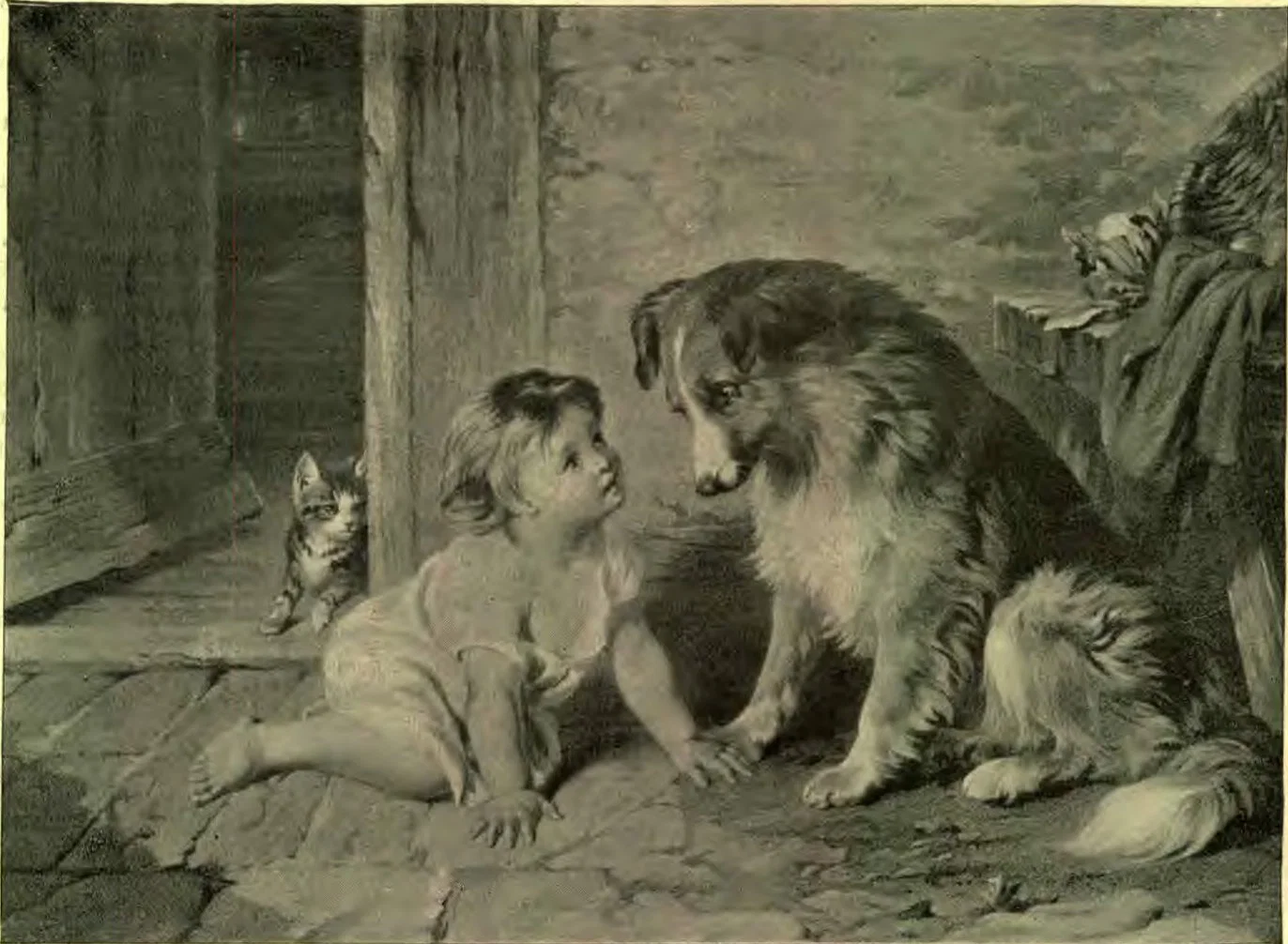
THERE! I do believe he has lost me, and I'm glad of it! I was so ashamed of living with that boy; but I couldn't get away from him, however hard I might try. But the grass is so deep here where he dropped me that I don't believe he will ever find me again.
I wouldn't have minded living with him if he had been the right sort of fellow, but —
He could shoot pretty straight with me, and I'd have been proud of it, if he had shot at the right kind of things. But he shot pretty little birds, and happy, innocent squirrels, and harmless old toads.
There was a boy once who shot a wicked giant with a stone from a sling like me. Now if the boy I belonged to had only done that way —
He had giants enough in his way, too, if he had only had a mind to fight them. And when he met them, I was always along, too. Giant Carelessness sometimes went with us; then we were very apt to break some one's windows, or make ugly scars on the painted walls of the houses. Often, when the boy was at work in the garden, or on his way to school, Giant Laziness would meet us, and coax us off into the woods and fields. There we would find Giant Cruelty, and spend the morning slinging stones at birds and squirrels. I was ashamed enough of that; but when he went home with Giants Cowardice and Deceit, and told his gentle mother that he had been at work, or at school,—why, then I was so ashamed that I hid deep down in his pocket.
But he dropped me here in the tall grass this morning, and I hope he may never find me again.
AUNT BETTY.
WHEN GRANDMA WAS A SCHOOLGIRL
“No, going to school nowadays isn’t what it was when I was a girl,” Grandma Gaines remarked as she rolled up the golf stocking she was knitting for Fred, and glanced across the table, where Ethel sat with her books spread out before her, and two little wrinkles of perplexity between her brows.
“School is school!” Ethel exclaimed, fretfully, “and I guess it’s tiresome enough any way you take it.”
“Well, it didn’t seem so to us,” grandma replied, tucking her glasses into the basket under the knitting.
Ethel made a mental note of this; for she was called on many times during the day to hunt grandma’s glasses.
“You see, we didn’t have so many other places to go, and so many other things to amuse us,” grandma continued. “We lived in the country, where it was a long distance to the nearest neighbors, and the only time we had children of our own age to associate with was during the six months of school, and that was like one long picnic to us.”
“But didn’t you have to study?” Fred asked, pricking up his ears at the suggestion of a six-months’ picnic.
“Yes, but somehow we didn’t seem to find it as hard as you do. It wasn’t because we were any smarter, I’m sure, and the people who made our books did not take the trouble to explain and simplify things that they have with yours.”
“What did you study? Tell us about it,” Fred said, shoving back his books, and planting both elbows on the table in a comfortable, listening attitude.
“What did we study?” Grandma’s eyes twinkled, and the wrinkles at the corners of her mouth deepened in a smile. “Well, mostly the blue-backed speller when we were your age.”
“Oh, but not all the time?”
“Yes,” nodding her head until the little white curls bobbed about her ears. “At least, most of the time, and I seem to have forgotten the other things, if there were any.”
“Just as I’ll forget the things in that old Number Book!” Fred said, giving it a poke with his elbow.
FAST FRIENDS
“We didn’t go to school at nine o’clock in the morning, and get out at two, as you do,” grandma continued, ignoring Fred’s interruption. “It was a mile from our house to the crossroads school, and many of the children lived even farther away. We took our dinners in buckets or home-made willow baskets, and the teacher called ‘Books!’ promptly at eight o’clock. Our schoolhouse was not furnished with comfortable desks and pretty pictures, like yours. There were blackboards set into the walls on both sides, and the only ornament was a map of the United States, which hung behind the teacher’s desk. Only the big boys and girls had desks, and we youngsters sat in rows on benches.”
“I should think you would have got tired of that!” Fred exclaimed.
“We did. I can remember very distinctly how heavy those books grew before the recess hour310arrived. The principal event of the day was the spelling class, when we were all called up in line, and ‘toed the mark’ while the teacher gave out the words. We had ‘turning down’ and head marks, and the proudest boy or girl in that school was the one who captured the prize at the last day for the most head marks. It seemed a long time from eight o’clock until twelve. We girls always took our baskets into the grove back of the schoolhouse, and I don’t think I have ever tasted anything quite so good as those lunches—home-made cookies and bread and butter, with an apple or some other dainty to ‘top off’ with.”
“And the boys?” Fred reminded her.
“O, the boys! Well, I’m sure they had their share out of the dinner-baskets, though when they ate it, I don’t know. They never seemed to stop long enough, and they had a good time, if one may judge by the noise they made. The big girls spent the hour walking around with the teacher.”
“The hardest part of the day was the time from one o’clock until four. There was very little for us youngsters to do, and the only break in the monotony was the study hour, when all the school studied the spelling lesson for the next day, and studied aloud.”
“Studied aloud?” Ethel exclaimed, in surprise.
“Yes, studied aloud.” And grandma’s eyes twinkled, and her curls bobbed again. “You can’t think what fun it was. Everybody, big and little, boys and girls, opened their books at the same place, and began to spell together in a sing-song tone: ‘B-a ba, k-e-r, baker; s-h-a sha, d-y dy, shady; l-a la, d-y.’ My! I can hear it now!” And grandma clapped both her hands over her ears. “The voices grew louder and louder, the rows of feet swung regularly back and forth, and the shoulders swayed to and fro in time to the chant. There never has been anything like that spelling hour in the old school! The birds in the grove outside hushed their songs to listen, and the ground-squirrels scurrying along the rail fence thrust inquisitive heads from behind the rails, and waved their bushy tails in astonishment.”
“Whee! but wouldn’t I like to have been there!” Fred exclaimed.
“Yes, but it didn’t last long. The teacher soon called, ‘Order!’ the spelling stopped, and the older girls went up to recite their history lesson. How the hours dragged through those long afternoons! All the sweet sounds of the fields and woodlands came droningly in through the windows, the spellers grew heavier and heavier, the board backs of the benches were just high enough to support tired little heads, the rough walls of the schoolhouse grew farther and farther away, the sounds without and the sounds within mingled in a soothing lullaby, and—well, when school was dismissed, it usually found some of us where Ethel is now.”
“Catch ’em sleepin’ in our school!” Fred exclaimed as he gathered up his books, and stooped to kiss grandma good-night.—Selected.
THE STURDY SOLDIER
By Frank Walcott Hutt
A battle is on each day,—
A battle for honor and right, my boy;
And who shall be captain, and who shall give way,
Is seen at the close of the fight, my boy.
Don't give up the field too soon;
Don't hurry away from the foe, my boy.
Be dauntless and fearless, night, morning, and noon,
And keep in the conflict aglow, my boy.
The soldier who keeps his post,
With valor and courage to win, my boy,
Not only may share the applause of a host,
But peace and contentment within, my boy.
FRANK WALCOTT HUTT.
THE TRUE SHEPHERD
By Ellen G. White
“My sheep hear my voice, and I know them, and they follow me: and I give unto them eternal life; and they shall never perish, neither shall any man pluck them out of my hand. My Father, which gave them me, is greater than all; and no man is able to pluck them out of my Father's hand.”
Christ is the Good Shepherd. He leads the way, calling upon his sheep to follow him. Those who hear and obey his voice will follow his example in all things. Becoming acquainted with him, they will grow daily more and more like him. They will be meek and lowly, free from jealousy and envy.
Do we hear Christ’s voice? Are we following him? It is of great importance that we know whether we are following the True Shepherd. In order to know this, we must search his word; for it is his voice speaking to us. “What saith the Scriptures?” is to be our watchword at every step. In God’s word we may find an answer to every question. From it light shines upon our pathway, revealing the Good Shepherd as he goes before us.
Christ knew that man could not in his own strength overcome the enemy; so, laying aside his royal robe and kingly crown, he came to this earth to overcome in our behalf. He was tempted in all points like as we are, that he might know how to succor them that are tempted. He met and overcame Satan on every point. He has left us an example of perfect obedience. In his strength we can be more than conquerors. He is able to save to the uttermost all who come to God by him.
Christ is a conqueror, and those who follow him will be on the conquering side. There are precious victories before the Christian. He may be weak, but the Redeemer knows his need, and is able to strengthen him. Jesus knows that Satan is trying to get control of men and women, and he stands ready to help all who come to him for help. He is not willing that any should perish. He has made it possible for every tempted son and daughter of Adam, in every time of temptation, to gain a glorious victory. He has placed the power of heaven within the reach of his children.
God has done for us all that infinite love could suggest, and all he asks of us in return is obedience—conformity to his will. He has placed before us a standard of righteousness, which he desires us to reach. He calls upon us to return to our loyalty to him, that we may be admitted into the Eden-home from which Adam was banished by his disobedience. A young man came to Christ, asking him what he should do to inherit eternal life. The Saviour answered, “If thou wilt enter into life, keep the commandments.” This is his answer to his followers for all time. Our duty is outlined in the commandments; and if we obey them, we shall gain eternal life. If we desire heaven and its joy, we must cease from transgression; for the law of God is the rule by which character is measured.
Satan works zealously to prevent us from forming characters which will meet God’s approval. But they that are with us are more than all they that are against us. God sends heavenly angels to the side of his children to keep them from evil. If we have placed ourselves in his care, we may rest securely; for he has promised that no man shall pluck us out of his hand.
In the past many have suffered for the truth’s sake. To them truth was dearer than all else, and they willingly gave up this present life for the life eternal. We shall be called upon to sacrifice for the truth’s sake. Those who share in Christ’s glory must share also in his suffering. But let us remember that in the home which the Saviour is preparing for us, there is no sorrow nor suffering. Of those who overcome it is written: “Therefore are they before the throne of God, and serve him day and night in his temple. . . . They shall hunger no more, neither thirst any more; neither shall the sun light on them, nor any heat. For the Lamb which is in the midst of the throne shall feed them, and shall lead them unto living fountains of waters: and God shall wipe away all tears from their eyes.”
The royal command has gone forth, “Come out from among them, and be ye separate, . . . and touch not the unclean thing; and I will receive you, and will be a Father unto you, and ye shall be my sons and daughters.” What greater honor could be conferred on mortal man? When men are going to appear before an earthly monarch, how carefully they prepare to meet him! How carefully, then, should we prepare,—we who expect to meet the King of kings? If our preparation meets his approval, we shall dwell with him forever, clothed in the spotless robe of Christ’s righteousness. Surely this is worth striving for. The free gift of eternal life is ours on one condition: “Blessed are they that do his commandments, that they may have right to the tree of life, and may enter in through the gates into the city.” May God help you to live so that you may enter the holy city, is my prayer.
MRS. E. G. WHITE.
The Yoke of Christ as Mercy
Did you ever stop to ask what a yoke is really for? Is it to be a burden to the animal that wears it?— It is just the opposite. It is to make its burden light. Attached to the oxen in any other way than by a yoke, the plow would be intolerable. Worked by means of a yoke, it is light. A yoke is not an instrument of torture; it is an instrument of mercy. It is not a malicious contrivance for making hard work; it is a gentle device to make hard labor light. It is not meant to give pain, but to save pain. And yet men speak of the yoke of Christ as if it were a slavery, and look upon311those who wear it as objects of compassion. . . . Christ’s yoke is simply his secret for the alleviation of human life, his prescription for the best and happiest method of living.— Drummond.
STEPS TO RUIN
By Elizabeth Rosser
One drink,—
Just one,—
He took
“For fun.”
And then he took
Drink number two,
“’Cause other boys
And men all do.”
The third and fourth he took
To gain a “manly” look,
Five, six,— a thirst was born,
Unquenched at night or morn.
Seven, eight, nine,— each called for more,
Till they were numbered by the score.
Lost — honor, riches, home, and hearth,—
All that he held most dear on earth.
For lack of bread his little children cried,
His wife, heart-broken, sickened soon, and died.
He, once a man, but now a hopeless slave,
Rum-sodden, dropped into a pauper’s grave.
ELIZABETH ROSSER.
BALKY PEOPLE
By James I. Vance
STANDING one day near a railroad crossing, the signal sounded for an approaching train, and the gates began to descend. A wagon was midway the tracks when the alarm was given, and the gates began to fall. Just then, at the place of greatest peril, the horse hitched to the wagon nullified, and refused to go forward or backward. He had balked when he needed to make the best time. He refused to pull at all when he ought to have pulled his best.
I have thought that some people are like the old horse. They balk on the track of danger. They nullify when they need to strike the swiftest gait. They are weaklings in the hour that calls for strength, and cowards in the battle that needs braves.—James I. Vance.
COME HOME
By B. F. M. Sours
Come back! come home! why longer wait
While Love, with bleeding heart,
Pursues thy wanderings up and down;
And grieves for what thou art?
Thy feet have wandered far away
Upon the hills of sin;
Thy heart is lone, thy heart is sad,
Thou hast so weary been.
Deep in thy life's remotest depths
Love's voice is calling still;
In day's bright glow, in darkest night,
Thou feelest the heavenly thrill.
Life can not yield to thee its best
Until thy loyal heart
Has made its hand-clasp with the skies,
Choosing the better part.
B. F. M. SOURS.
CLEANSING THE LEPER
By W. S. Sadler
(Concluded)
Put Forth His Hand and Touched Him.— In answer to the leper’s petition, Jesus put forth his hand, touched him, and said, “I will,” thus indicating his supreme authority and unlimited power. His whole being was drawn out in sympathy toward this loathsome but believing leper; his heart was touched. He reached forth his hand and touched him. The great need that touched the Master’s heart moved the mighty hand to touch the need. The same suffering that moved the Saviour’s heart to compassion moved his hand to cleanse the leper.
Christ touched the leper. This teaches us that we must reach people where they are. We must be in touch with them, upon a level with them, showing sympathy, not pity, for the erring. We must touch God with one hand, and humanity with the other. He cleanses us by giving us new life. He does not put new wine into old bottles. He gives us new wine and a new character in which to hold it. He creates a new man, a new disposition, a new heart.
Say Nothing to Any Man; Show Thyself to the Priest.— This is another instance where the Saviour straitly charged the one upon whom he performed the miracle to say nothing to any one; only, in this case, he added, “Go thy way, show thyself to the priest.” See Lev. 14:1–7. Here is another instance showing that Christ came not to destroy even the law of Moses, much less the law of God; but rather to fulfill, thus bringing the former to an end at his death, and by the same act forever establishing the latter. Christ instructed the cleansed leper to show himself to the priest. Moses had enjoined upon the priests the work of looking after lepers, attending to the quarantine, etc. Christ does not set the example at this time of ignoring what he had instructed Moses to enjoin upon the people hundreds of years before. He told the leper to offer the customary sacrifice for his cleansing. Had not Christ cleansed him from his leprosy? Was he not every whit whole?—Yes; but this did not relieve him from attending to those things which divine law had prescribed, any more than being miraculously healed would exempt us from the necessity of taking a bath, or partaking of physical nourishment. Our working and praying must co-operate. Both must have for their object the removal of the cause of disease, and be followed by conscientious compliance with every divine requirement.
Could No More Openly Enter the City.— The leper “began to publish it much, and to blaze abroad the matter.” In this he disobeyed Christ’s instructions, and so seriously interfered with the Master’s work that he could enter no more openly into the cities, but taught the people in desert places, and yet they came to him from every quarter. This miracle teaches us that obedience is better than zeal. The cleansed leper failed to obey. It is not always best to encourage young converts to tell, at first, all the story of what the Lord has done for them; a difference must be made. This is indicated by the fact that Christ sometimes told those who had been healed to tell of the miracles which had been performed in their experience, and at other times he forbade them, undoubtedly in each case owing to the safety or danger to the spiritual experience of the individual, as well as the effect of such publicity upon his work.
15. Can we be sowers too? How shall we get good seed to sow? 2 Cor. 9:10.
16. What will this seed do for us? 1 Peter 1:23; note 2.
17. In the parable what did the sower do in order to sow? Will you do the same?
NOTES
1. Jesus had just been preaching in every city glad tidings of the kingdom of God. At the beginning of his ministry his message had been, “The kingdom of God is at hand,” and it was ever in the minds of the people “when the kingdom of God should come.” They were looking, however, for an earthly king, one who would free them from the power of the Romans; and soon after this they really tried to make Jesus their king. See if you can find in what Gospel this is recorded.
2. “The sower sowed his seed;” we sow ours. But the good seed is ours to sow only when we receive what is being ministered. This seed is God’s incorruptible word which abides forever. By it we are born again, and our whole life is renewed. Then it will be seen that we sow our seed as the Master Sower sows his. This same thought is set forth in Isa. 53:10: “When thou shalt make his [Christ’s] soul an offering for sin, he shall see his seed.”
ILLUSTRATIVE
WHILE walking down the street one day, I passed a store where the proprietor was washing the large plate-glass window. There was one soiled spot which defied all efforts to remove it. After rubbing hard at it, using much soap and water, and failing to remove it, he found out the trouble. “It’s on the inside,” he called out to some one in the store.
Many are striving to cleanse the soul from its stains. They wash it with the tears of sorrow; they scrub it with the soap of good resolves; they rub it with the chamois of morality; but still the consciousness of it is not removed. The trouble is that “it’s on the inside.” It is the heart that is bad. If the fountain is bitter, the stream will not be sweet.
Nothing but the blood of Jesus applied by the mighty hand of the Holy Spirit can cleanse the inside, nothing but God’s Spirit alone can reach the inside.—Epworth Herald.
GRAND TRUNK R'Y. SYSTEM.
By W. C. Cunliffe
Taking Effect June 2, 1901.
Trains leave Battle Creek.
WEST-BOUND.
No. 2, Mail and Express, to Chicago 12.15 P. M.
No. 7, Limited Express, to Chicago 7.00 A. M.
No. 1, Chicago Express, to Chicago 9.23 A. M.
No. 3, Lehigh Valley Express, to Chicago 3.50 P. M.
No. 5, International Express 2.17 A. M.
No. 75, Mixed, to South Bend 7.30 A. M.
Nos. 9 and 75, daily, except Sunday.
Nos. 1, 3, 5, and 7, daily.
EAST-BOUND.
No. 10, Mail and Express, East and Detroit 3.45 P. M.
No. 8, Limited Express, East and Detroit 4.50 P. M.
No. 4, Lehigh Express, East and Canada 8.22 P. M.
No. 6, Atlantic Express, East and Detroit 2.10 A. M.
No. 2, Express, East and Detroit 7.00 A. M.
No. 74, Mixed (starts from Nichols yard) 7.15 A. M.
Nos. 10 and 74, daily, except Sunday.
Nos. 4, 6, 8, and 2, daily.
W. C. CUNLIFFE, Agent,
BATTLE CREEK.
Good Deeds and Sacrifice Are Never Wasted
By Frederic W. Farrar
No good deed, no genuine sacrifice, is ever wasted. If there be good in it, God will use it for his own holy purposes; and whatever of ignorance, or weakness, or mistake was mingled with it will drop away, as the withered sepals drop away when the full flower has blown.—Frederic W. Farrar.
A Baby's First Wardrobe
By Mrs. F. M. Kellogg
Is the most trying proposition a young mother can meet. Often everything she makes is wrong. For 30 cents in stamps you can get twenty-two guaranteed patterns drawn on anatomical and hygienic lines, with full instructions for making. Also an illustrated booklet on care of the body—free. All in plain envelope. Everything essential to know. For information on garments for other ages, send stamp.
MRS. F. M. KELLOGG,
207 Hubbard St., - - Battle Creek, Mich.
SENT FREE
By E. J. Worst
Read Special Offer Below.
THE CO-RO-NA MEDICATOR.
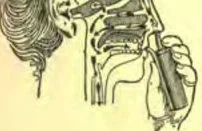
A natural evolution from E. J. Worst’s famous Catarrh Inhaler that has won a world-wide reputation. It is made of Nickel, and will last a lifetime; is so compact it may easily be carried in a vest pocket or reticule.
CATARRH.
Don’t take medicine into the stomach to kill germs of Catarrh in the head. If you will only stop and think for a moment, you will certainly realize that the germs of disease were carried into your head by air, and that air is the only agency that will carry a medication to the diseased passages capable of destroying such germs. Catarrh, Colds, Pains and Hoarseness in the Head, Bronchitis, Sore Throat, Headache, Partial Deafness, La Grippe, and all diseases of the air passages yield as if by magic to treatment with the Co-ro-na Medicator. Science and common sense can offer no improvement upon this little pocket physician. It is simple in construction, and may be used anywhere and at any time. It is the only positive cure for the diseases named. I make it easy to prove this beyond all question by the following remarkable
SPECIAL OFFER.
For a short time, I will mail free to any reader naming this paper one of my new Scientific Co-ro-na Medicator, complete, with medicine for one year. If it gives satisfaction, send me $1.00; if not, return it after three days’ trial. Could any proposition be fairer?
E. J. WORST, 112 Elmore Block, Ashland, O.
NOT SOLD BY DRUGGISTS. AGENTS WANTED.
NOTES AND COMMENTS
A Silent Alarm-Clock.— People who depend on alarm-clocks to waken them in the morning may be glad to know of a suggestion recently made for a silent alarm. This is to be given by an electric light so focused that at the desired time the current will be turned on, and the light flashed upon the head of the sleeper. It is claimed that the flash of light will always rouse one who is asleep.
Where Gardening Is Taught.— Gardening as a science is taught in the public schools of Sweden as well as in the teachers’ normal schools. Every country schoolhouse has its garden spot, where the children receive practical lessons in the raising of fruit, vegetables, flowers, the care of house plants, hotbeds, etc. Every year the children receive a tree or shrub or plant for their own home yard.
An Ancient Bell.— In the tower of a schoolhouse in East Haddam, Conn., hangs a bell that has an interesting history. It was cast in Santiago, Spain, in the year 815, and is consequently more than a thousand years old. It was taken to Mexico, where, during the Mexican War, it was captured by United States soldiers, and brought to East Haddam. Here it was hung in a church tower, where it did service till last year, when it was removed to its present position.
New Use for Rattlesnakes.— A physician of Brazil has brought forward the curious claim that rattlesnake poison is a specific for leprosy. The natives’ belief that a survivor of rattlesnake bite is proof against the disease, led to experiments by the doctor, with results that encourage him to claim genuine cures for the perfected remedy. A German pharmacist, commenting on this, reminds the public that rattlesnake poison in quantities will kill lepers as soon as other persons.
A Thirty-Ton Bomb.— In May of 1900, during an explosion in Mt. Vesuvius, the largest bomb ever observed was thrown up to a distance of a third of a mile, and fell back upon the mountain. Its height exceeds that of a man, and its weight is estimated to be more than thirty tons. To give an idea of the immense force exerted to raise this mass to this elevation,—and as easily, apparently, as a child would toss a rubber ball into the air,—one who has made a careful study of the subject declares that “the explosion of steam must have equaled about six hundred thousand horse-power.” These bombs are formed of partially cooled lava.
Broom-Corn Millet as Food.— It is announced that the Department of Agriculture contemplates the introduction of a new cereal food into this country—not a manufactured food, but a natural product. This is the broom-corn millet, so called because of its resemblance, when growing, to broom-corn. It is also known as “proco,” by the peasants of Russia, who use it largely for food, about seventy million bushels being produced yearly for that purpose. A special study has recently been made of the plant by a representative sent by Secretary Wilson to study the agriculture of Russia, and he declares that it could easily be raised on the plains of the Northwest,—Minnesota, the Dakotas, and Nebraska. As under favorable conditions, it yields an abundant crop, it is hoped that its culture may become a source of profit to the farmer.
An Imitation Imitated.— Celluloid has long been used as an imitation for tortoise-shell and other high-priced bone, and now an imitation celluloid is produced. The new material is prepared of glacial acetic acid, nitrocellulose, gelatine, and alcohol, and is said to be valuable as a backing for photographic films, as it will not curl up in water.
Foiling the White Ants.— In South Africa the white ants do their destructive work on every particle of wood that is not living. It was in an attempt to resist their ravages that the company now constructing a telegraph line from Cairo to the Cape hit upon the plan of using living trees for telegraph poles. These are set out in lines, their branches trimmed off, and the wires fastened to them by means of tarred hempen cords. These trees, however, are only a temporary arrangement, as they require continual attention. Iron poles have been substituted for a part of the distance, and will eventually be used altogether.
Platform of Submerged Land.— On the coast of Africa, opposite the mouth of the River Congo, says the Youth’s Companion, and continuous with the course of that river, lies a submerged valley, the existence and shape of which have been ascertained by means of soundings made by the British Admiralty. This valley, through which the Congo probably flowed at a time when the western coast of Africa was more elevated than it is at present, is one hundred and twenty-two miles in length, extending to the edge of the platform of submerged land which borders the continent. Its sides are steep, precipitous, and well-defined, indicating that they are formed of solid rocks. Other submerged river valleys are found on the western coast of Europe, and similar phenomena exist in various parts of the world where the edges of continents have sunk.
Where Defects Are of Value.— An expert in precious stones declares that the best test for rubies and emeralds is an examination by microscope, a magnifying power of one hundred diameters being sufficient to show the defects. All emeralds and many rubies have many characteristic defects, which can not be imitated in artificial stones. For diamonds the best test yet discovered is their hardness. A genuine diamond can not be scratched with either a file or quartz. A ruby will also stand this test, but an emerald cracks easily, being little harder than quartz. Speaking of diamonds, there is now on exhibition at the Pan-American Exposition what is claimed to be the largest diamond ever brought to this country. It is “canary yellow in color, about as large as a bantam’s egg, absolutely flawless, and of a brilliant luster.” This precious gem was found in the famous Kimberley mines in South Africa, and taken to Amsterdam, where it was cut into the form of a brilliant of sixty-four facets. Its commercial value has not been made public.
The Flying-Fox Nuisance.— To fruit-growers on the Pacific Coast the flying-fox, or “fruit-eating fox,” as it is often called, has proved so great a pest that the United States government has declared war upon it. For some time the owners of fruit farms have been doing their best to exterminate the animals, but without much success, as they are so quick in movement that it is difficult to catch them, and they soon learn to avoid traps. When they enter an orchard, they make short work of it, spoiling all the fruit they do not eat. Peaches, figs, plums, and other soft fruits are their favorites. This species of flying-fox, which measures nearly six feet from tip to tip of the wings, was first brought to this country in a fruit-steamer from Australia, where, in some sections, it has become a serious menace to the fruit industry. It was at first regarded as a curiosity; and when its destructive character was learned, the people of California found they could not get rid of the pest. A systematic search is now carried forward in all steamers entering San Francisco harbor, to make sure that no more of these unwelcome visitors are allowed to land.