—The prospects for war between Russia and China are still threatening.
—All Jews of foreign birth have been ordered to leave St. Petersburg immediately.
—Ten Nihilists have recently been arrested in Russia, four of whom are women.
—Last year the native Baptists of Burmah raised $31,000 for the endowment of a college.
—Upwards of 7,000 ironworkers are on a strike in the north of England.
—Jersey City will be within six minutes of New York when the Hudson River Tunnel is completed.
—There is a lack of rain in Western and South-western Kansas, which may foreshadow short crops.
—On the 6th inst. a part of the roof of the St. Gothard tunnel fell, killing three workmen.
—The Belgian Minister of Justice refuses to harbor the Jesuits, if they are expelled from France.
—Germany is indignant over an attempt on the part of Prince Bismarck to oppress the free city of Hamburg.
—The disposition of unauthorized religious orders still occupies the attention of France.
—The prospects are that the tobacco-crop of Virginia will be exceedingly poor this year. There is no crop that could be better spared.
—At Holyoke, Mass., paper is made from wood. A poplar log is put in at one end of the machine, and comes out paper at the other.
—During the month of April, 46,148 immigrants landed at New York. This is the largest number of arrivals in any single month.
—France is just now troubled with strikes. More than 20,000 operatives in the silk and cotton factories are idle; in one town, 80 factories are closed.
—The Italian Chamber of Deputies has been dissolved. The elections will take place May 16, and the new Chamber will meet May 28.
—On a recent Sunday, Lord Cecil, a son of the late Marquis of Exeter, and brother of the present Marquis, conducted a religious service in New York City.
—Parnell’s scheme of land reform by forcing the landholders to sell, is, it is said, denounced, even in Ireland, as wild, and not to be accomplished without a revolution.
—The Turkish government will continue to employ the English officers now in its service, if they will consent to a reduction of 45 per cent in their salaries.
—Five Chinamen in New York City, all of whom are professing Christians, and who wish to claim the protection of our laws, have just taken out their first naturalization papers.
—Mr. Elliot Stock has issued a pocket English Testament, with copious notes, references, and introductions, three maps, and 24 illustrations, for one penny.
—An American engineer, in the employ of the Japanese government, has been making extensive purchases at Philadelphia of machinery and tools for public works in Japan.
—President Hayes and Secretary Evarts have received from the Japanese Minister to this country ten large boxes of Japanese forest trees, to beautify their homes in Ohio and Vermont.
—On the 22d of April, the descendants of Thomas Jefferson presented to the government the small mahogany writing-desk on which that statesman wrote the Declaration of Independence.
—The interoceanic project is by no means new. The archives at Madrid are said to contain details of a scheme put forward some 300 years ago, to join the Rio Grande and the Chagres rivers by means of a canal.
—The Mexican volcano of Colima is now in active eruption. The scene is full of splendor, the flames at night illuminating the darkness for miles around. The inhabitants of the villages and towns in the vicinity of the mountain are wild with terror.
—England is indignant over a difference of from £3,000,000 to £5,000,000 between the actual financial results in India, and the government’s report to Parliament. The cost of the Afghan war has been understated, and the resources of the Indian government overstated.
—A dispatch from Bradford, Pa., dated May 7, gives the details of a destructive fire which was still raging in the oil regions in that vicinity. Rew City, a village of a hundred houses, has been entirely destroyed, not one house remaining. The fires extend over an area of 12 miles.
—A dispatch from Constantinople says that the Levant Herald has been suspended for hinting that the government would do well to commence reforming before the English Cabinet recognizes the necessity of executing the “bag-and-baggage” policy.
—A few weeks ago, about 200 men, who were engaged in seal-hunting along the eastern shores of Newfoundland, were carried out to sea by the sudden breaking away of the ice. Many died, and the sufferings of some who escaped death were terrible. It is not unusual for seals to visit this locality.
—Five prominent citizens of Pennsylvania have been convicted of attempting by bribery to pass a bill through the Legislature, of which two of them were members. They were sentenced to imprisonment for one year, and to pay a fine of $1,000 each. They have been pardoned out of the penitentiary, but will be compelled to pay their fines, and are by law disqualified from holding office in future.
—Mr. Redpath, who was sent to Ireland by the editor of the New York Tribune, Mr. Whitelaw Reid, with instructions to “find the facts and report them,” says that there are 350,000 people in the west of Ireland who will die of starvation if the contributions for their support should fall off. Mr. R. says that he “grew sick, and wept like a child,” at the scenes of distress which he witnessed.
—An association called the “Toledo Sabbath Union” has been organized in Toledo, Ohio. The following are the objects of the association as embodied in their Constitution: 1. To secure the better observance of Sunday; 2. To ascertain the names of persons engaged in work on Sunday, and report them to the Union; 3. To examine the Sunday laws on the statute books of Ohio, and enforce them if need be; 4. To induce by persuasion, if possible, all railroads and places of business to cease work on Sunday; and, 5. To assist the International Union in inducing Congress and the State Legislature to pass more stringent Sunday laws.
—A dispatch from Constantinople to the London Times says: “According to trustworthy intelligence received from Cettinje, the Prince of Montenegro declares that he has no intention of fighting with the bands which have taken possession of the evacuated territories, and that if war unfortunately be necessary, it will be declared against the Turkish government, which is the real author of resistance to the execution of the convention. This accusation of complicity on the part of the Turkish authorities with the leaders of the Albanian agitation is fully confirmed by intelligence from Scutari. It is there an open secret that resistance to the advance of the Montenegrin troops was organized by Hodji Osman Pasha and Hodo Bey, both officers of the Turkish service, and in intimate relations with Izzet Pasha, Governor General of the Province.”
Obituary Notices.
“Blessed are the dead which die in the Lord from henceforth.” Rev. 14:13.
PATCH.—Died suddenly of disease of the heart, April 14, 1880, in Eden, Vt., Bro. Hiram Patch, aged 75 years. He embraced present truth about twenty-five years ago, and has tried to live and practice Bible religion. His example, prayers, and testimonies have told on the side of truth. He loved the assembly of God’s people, and in his death the church has lost a worthy member. A wife, three children, and several grandchildren are left to mourn. We trust he will have part in the first resurrection. Funeral discourse by the writer, from Deut. 32:9. ALBERT STONE.
GIBBS.—Died in Windsor, Eaton Co., Mich., April 30, 1880, at the home of her son, Sister Betsey Gibbs, aged 78 years, 10 months, and 20 days. She was in usual health until forty-eight hours before she died, when she was stricken by paralysis. In early life she became a Christian, and for five years past she has kept the Sabbath and been a member of the Dimondale church. She died in the faith, and her friends sorrow not as those without hope. The crowded house and the earnest attention at her funeral showed how she was respected. Sermon by the writer, from James 4:14. T. M. STEWARD.
Faith for Trials Yet to Come
—How great seems the weight of difficulties that are to be met; and how insignificant appears the whole sum of them when they have been overcome, and have become nothing more than a memory! When we are perplexed, and give way to anxiety and worriment concerning troublesome questions as yet unsolved, we are ready to say, as the quaint old prayer says of the weight of our sins, “The burden of them is intolerable.” But when sober thought has succeeded worry and irresolution, and prayer and courage have conquered the impending difficulties, we no longer magnify trifling circumstances until they seem unsurmountable, but clearly see them in their real significance. It is then that we feel and express real gratitude to God for his aid. But are not faith and courage beforehand quite as much a duty as thankfulness and security afterward? Almost anybody can be grateful,—even animals can feel a keen sense of enjoyment when comforts have been received; but to trust God for aid in troubles and trials yet to come is not so easy. And yet confidence for the future is a far better test of faith than the most sincere thankfulness for the past. If you are not as willing to believe that which will be, as to perceive that which has been, then, in effect, you regard God as a ruler of yesterday, but not of to-morrow.—S. S. Times.
STRAINING AT A GNAT, AND SWALLOWING A CAMEL.
By William Covert
BY ELD. WM COVERT.
We frequently meet with persons who are having a very unpleasant time over an imaginary wrong in some one else. They are continually picking at the dust in somebody’s eye, while their own eyes are full of beams. The following is a truthful illustration of this point: A brother in one of our churches came to me a few days ago, and asked if I was in Battle Creek last Christmas. When I informed him that I was, he remarked that I must have seen the “Christmas tree.” He then began straining at the supposed gnat. He was quite certain that the Adventists were backsliding, or they never would have resorted to such a mode of raising money. He spoke as though he was sighing over the departed innocence of our people.
When I had explained to him the nature of the meetings and “trees” referred to, I began to inquire how he had learned of the Christmas tree, when he told me that he read of it in the REVIEW. I learned, however, that he borrowed the paper that contained the report. He had stopped taking the paper, because the subscription price is too high. He is not too poor to take it, but the publishers are speculating out of the brethren, and he is too conscientious to uphold them in it. I did not hear of his grumbling about the price of tobacco, though he uses it freely. Upon further inquiry, I learned that he had not paid a cent on the Tabernacle expenses; that he had ceased to pay S. B.; and that he was not doing anything in the tract and missionary work. He was not spending a penny to in any way help forward the cause of the Lord, yet he was making suggestions about the way the work should be done. I think this man has swallowed the “camel,” and is now afraid of choking on the “gnat.”
I wish to ask if this is a fair sample of our grumbling friends. If so, may Heaven pity them.
Forgiving the Particular Enemy: A Christlike Duty
—It is one thing to forgive our enemies as a general class, but it is a very different thing to forgive a particular enemy. No such spiritual strength is needed to make us say that we forgive all “Jews, Turks, infidels, and heretics,” as is demanded for our genuine forgiveness of the John Doe who poisoned our dog, or the Richard Roe who told lying stories about us behind our backs. Yet it is the individual who has injured us, whom, after Christ’s example, we are bidden to forgive. The historian Prescott knew and kindly treated, during years and years of suffering, the person whose careless toss of a bread-crust, in the college dining-room, made him virtually blind for the rest of his life. And that godly English-woman known as Sister Dora, who is now winning posthumous honor from all who read the story of her noble life, was privileged to be able to devote the tenderest care in her hospital ward, to a rascal who had stoned her in the open streets of Walsall, and who, when he confessed his fault in penitence and tears, was told by the gentle spirit that she had known his face from the moment he threw the stone that cruelly cut her forehead. Not all of us are called upon to forgive those who have destroyed our eyes, or stoned us in the streets; but do we not know some one who has wronged us? and have we willingly and fully forgiven him?—S. S. Times.
A PROSPEROUS RAILROAD.
THE NEW YORK Herald has been looking over the business that is annually transacted by the CHICAGO & NORTH-WESTERN RAILWAY COMPANY, and the more the writer considers it the more he wonders at the immense magnitude of its transactions, the great length of its lines, the incomparable wealth, fertility, and expansiveness of the sections that it penetrates, and the brilliant future which this gigantic corporation has before it. In collecting the data for its article, the Herald finds that the NORTH-WESTERN operates 2,100 miles of road, and reaches almost every important point in Northern Illinois, Wisconsin, in Northern Michigan, in Iowa, in Minnesota, and runs many miles in Dakota. If its lines were laid eastward from New York they would extend more than two-thirds of the way across the Atlantic, or they would reach from the pine-clad hills of Maine to the sunny shores of the Gulf of Mexico. The Herald continues:—
“Take down your map and trace its routes. Fix your eye on Chicago as a starting point. Westward in nearly an air line you will trace its California line until you reach the Missouri River at Council Bluffs, opposite Omaha—here is a single run of nearly 500 miles. Back to Chicago again you look north-west and follow another of its routes through Madison, the Capital of Wisconsin, into Minnesota, and on to St. Paul and Minneapolis—this is 400 miles more. Again, looking from Chicago you can trace a line through Sparta, Wis., La Crosse, in the same State; Winona, Owatonna, and New Ulm, in Minnesota, and north-westward far into Dakota, here we have 625 miles more of road. Again, coming to Chicago, we see two lines running northwardly—one along the lake shore to Milwaukee, and thence to Fond du Lac, and the other running more inland, through Janesville, Watertown, etc., also to Fond du Lac; thence north, through Oshkosh, De Pere, Green Bay and Escanaba, Negaunee, Ishpeming, and Marquette—here is another 440 miles of road. Then we have a line from Chicago to Elgin, Rockford, and Freeport; another from Clinton, Iowa, to Anamosa, in the same State; another from Kenosha, on Lake Michigan, to Rockford, in Northern Illinois; and, after all longer lines, we have many short spans to traverse before we have found out all of the CHICAGO & NORTH-WESTERN RAILWAY.
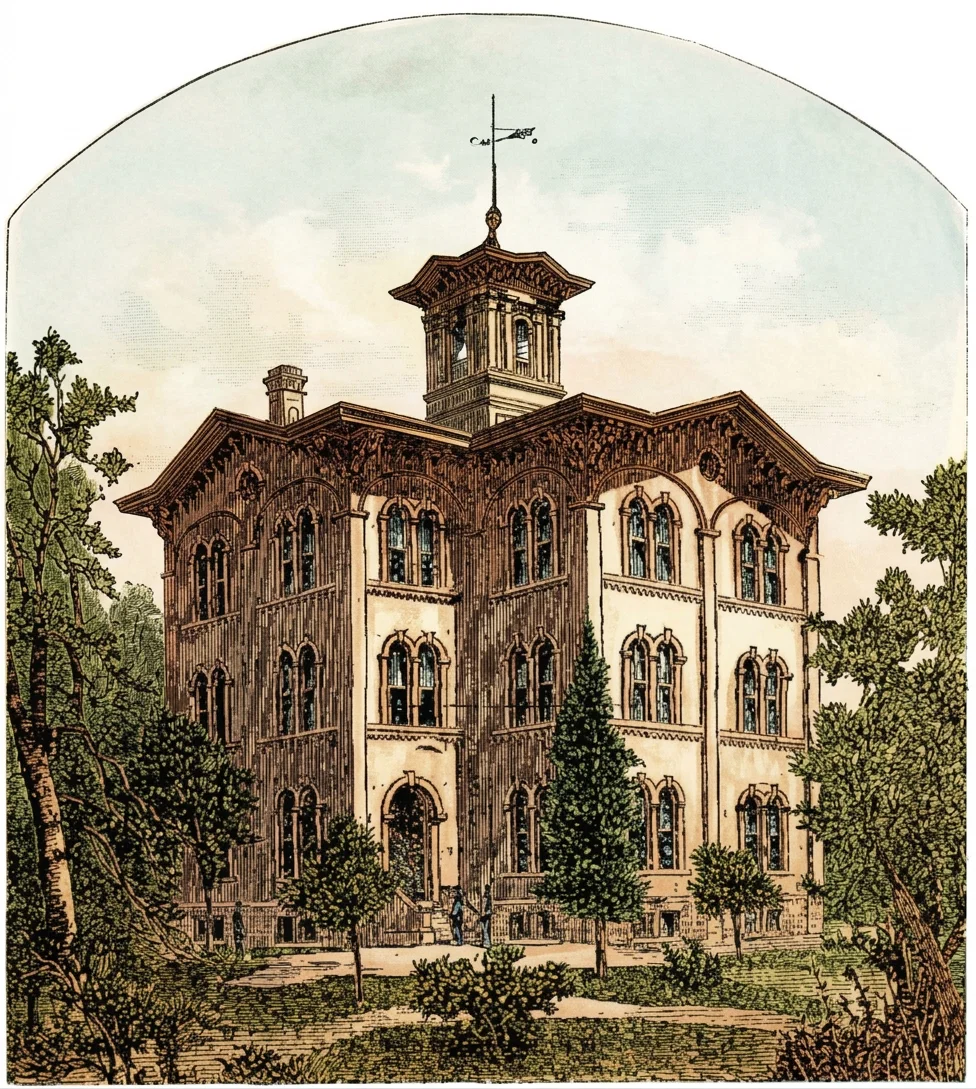
BATTLE CREEK COLLEGE.
A MODEL EDUCATIONAL INSTITUTION, COMPRISING FIVE DEPARTMENTS.
Nearly 500 Students Enrolled Annually, Coming from 32 States and Territories.
DEPARTMENTS.
I. DEPARTMENT OF THE ARTS AND SCIENCES.
This includes a Classical Course of FOUR YEARS and an English Course of three years, each with its Preparatory Course of two years.
II. NORMAL DEPARTMENT.
This includes a Teachers’ Course of FOUR YEARS, and a Model School. The course in this department includes all the branches required for a first-class certificate in any State. Professional instruction in Didactics is also given to those in this department who are expecting to teach.
III. COMMERCIAL DEPARTMENT.
This includes instruction in the following topics: Bookkeeping, Business Correspondence, Business Forms, Business Penmanship, Commercial Law, Banking, and Telegraphy. The common branches are also pursued in connection with the topics given above; also, French and German.
There are two sessions daily—afternoon and evening.
The courses in this department are of varying length, and the tuition ranges from $5.00 to $30.00.
Superior advantages for those desiring to prepare themselves for Tract and Missionary Secretaries and Librarians. (Send for special circular.)
IV. DEPARTMENT OF THEOLOGY.
This department has a course of three years, which includes, besides the usual common branches, Geology and Greek.
V. DEPARTMENT OF HYGIENE.
This department has a course of one year. It is designed for those who desire to obtain accurate and scientific information on all subjects pertaining to the preservation of health, together with a fundamental knowledge of anatomy and physiology, and a practical acquaintance with the nature and ordinary treatment of common diseases.
THE FACULTY
numbers fourteen members. They are all men and women of experience and critical scholarship.
The majority of the students are young men and women of true moral worth. Their influence over the unstable is highly restrictive and salutary, making it comparatively easy to maintain the most rigid discipline.
EXPENSES.
Probably there is no other College in the United States where a thorough education can be obtained at so small an expense. A system of clubbing, which has become very popular among students, enables them to secure excellent board at $1.10 a week, exclusive of lodging, which costs 50 cents to $1.00 more. The annual expenses of each student, including all but traveling expenses and clothing, need not exceed $113.00. A full descriptive Catalogue will be sent free, upon application.
Address BATTLE CREEK COLLEGE, Battle Creek, Mich.
MEDICAL AND SURGICAL SANITARIUM,
By John Harvey Kellogg
Battle Creek, Michigan.
This institution, beautifully located in one of the most healthful cities of Michigan, is everywhere recognized as the
GREAT SANITARIUM OF THE WEST.
More than 4,000 patients successfully treated. The erection of new buildings and the addition of all the most approved remedial appliances known to the profession, have made it The Most Complete Institution of the Kind in America. All modern hotel conveniences furnished. Terms very reasonable.
J. H. KELLOGG, M. D., Medical Superintendent.
Address,_SANITARIUM, Battle Creek, Mich._
REVIEW AND HERALD PUBLISHING HOUSE.
BOOK AND JOB PRINTING, BOOK BINDING,
Electrotyping, Stereotyping, Paper Ruling, Blank Book Manufacturing, Etc.
The largest and best equipped printing office in the State.
Orders by mail promptly attended to.
Address REVIEW AND HERALD, Battle Creek, Mich.
GOOD HEALTH.
By Editor
J. H. KELLOGG, M. D., EDITOR.
This popular health journal enters upon its fifteenth volume with the most flattering prospects for a continuation of the prosperity that has attended its publication in the past. It has for several years enjoyed the
LARGEST CIRCULATION OF ANY HEALTH JOURNAL IN AMERICA,
and its publishers are determined, not only to maintain the high position already attained, but to greatly increase its circulation the coming year, and thus enlarge its field of usefulness.
During the year each number will contain a large amount of valuable and interesting matter on the subjects of Health, Temperance, Popular Science, General Literature, and other topics of interest. The practical information in its pages on Sanitary Science, Public and Domestic Hygiene, and topics of kindred nature, gives it a scope and field of usefulness peculiar to itself, and unoccupied by any other journal.
AN ILLUSTRATED ARTICLE
on practical hygiene, or some other topic of general interest, will appear in each number, as a new and permanent feature of the journal in the future. In addition to this the Department of Questions and Answers, which has contributed so much to the success of the journal in the past, will be revived in a practically useful form, and made more valuable than ever before.
SUBSCRIPTION PRICE, $1.00 A YEAR.
PREMIUM FOR NEW SUBSCRIPTIONS.—The “Household Manual,” a work of great value as a book of ready reference, packed full of practical information, and sold at retail for 75 cents, is offered to new subscribers with GOOD HEALTH for one year, for $1.25. We regard this as the best premium offer ever made, as the book alone is well worth the subscription price of the journal, and 25 cents extra secures both.
Specimen copies of the journal will be sent free to any address on application.
Address GOOD HEALTH, Battle Creek, Mich.
THE SIGNS OF THE TIMES.
By Editor
A RELIGIOUS PROPHETIC JOURNAL.
This is the pioneer sheet of eight pages (the size of the REVIEW page), circulated everywhere by our Tract and Missionary workers, at the low price of one dollar a year to the T. and M. societies only.
The conductors of the SIGNS have laid their plans to make this pioneer sheet for 1880 a power in the land. Live writers are engaged for the work. Elder Smith will give a series of articles under the significant heading, Synopsis of Present Truth. Elder White will occupy several pages of each number with sermons on Redemption through Christ, and other subjects of like importance. And besides her regular articles on Old Testament history, Mrs. White will furnish other matter in her usual forcible style.
There will be a special edition of the SIGNS of twelve pages, for old subscribers, who are generally members of our churches on the Pacific coast. This will contain the eight pages of the pioneer sheet with four pages of church matters, reports and appointments inserted, making twelve pages, which will contain nearly three hundred square inches more than the old size of eight pages. Price, invariably, $2.00 a year.
Address SIGNS OF THE TIMES, Oakland, California.
STANDARD BOOKS
Issued by the S. D. A. Publishing Association and for Sale at this Office.
History of the Sabbath and First Day of the Week for the period of 6,000 years. By Eld. J. N. Andrews. 528 pp. $1.00
The Sanctuary and the 2300 Days of Dan. 8:14. By Elder U. Smith. This work explains the past Advent movement, and makes plain the present position of those who wait for the Lord. 352 pp. $1.00
Thoughts on Daniel, critical and practical. By Elder U. Smith. An exposition of the book of Daniel, verse by verse. 384 pp. $1.00
Thoughts on Revelation. By Elder U. Smith. This work presents every verse in the book of Revelation with such remarks as serve to illustrate or explain the meaning of the text. 352 pp. $1.00
Life of Wm. Miller, with portrait. This book gives interesting sketches of the Christian life and public labors of this pioneer in the Advent movement in this country. 416 pp. $1.00
Life of Elder Joseph Bates, relating his experience of twenty-five years on ship-board, with incidents of his rise from cabin-boy up to master and owner. The closing chapters relate to his labors in the ministry and in the cause of temperance and other moral reforms. Fine tint paper, 352 pp. $1.00
Life Sketches of Elder James and Mrs. E. G. White. The early lives and Christian experiences of both are given in this volume. Their subsequent history is so connected with the cause, that this book gives an outline of the rise and progress of our people and our cause. $1.00 With fine steel portraits of both. $1.25
Thrilling Incidents in the political Life of Francesco Urgos, while a soldier with Garibaldi, including his perilous escape from the tyrants of Rome, and his subsequent travels in Africa and Syria. 328 pp. $1.00
The Biblical Institute. This work contains a synopsis of the lectures given at the Battle Creek College by Elder U. Smith, and at Biblical Institutes. 352 pp. $1.00
The Nature and Destiny of Man. By Elder U. Smith. This work treats on the great questions of the condition of man in death, and his destiny beyond the resurrection. 356 pp. $1.00
The Spirit of Prophecy: or, the Great Controversy between Christ and his angels, and Satan and his angels, in four volumes. By Mrs. E. G. White. These volumes cover the time from the fall of Satan to the destruction of sin and sinners at the close of the one thousand years of Rev. 20. Each, 400 pp.
Vol. I. Old Testament Facts to Christ. $1.00
Vol. II. Life and Ministry of Christ. $1.00
Vol. III. The Death, Resurrection and Ascension of Christ, with the Lives of his Apostles. $1.00
Vol. IV. (In preparation.) $1.00
The Constitutional Amendment: A discussion between Elder W. H. Littlejohn and the editor of the Christian Statesman, on the Sabbath. 384 pp. $1.00
Spiritual Songs. A book of hymns and tunes. 537 hymns, 147 tunes, 416 pp. $1.00 Morocco, gilt. $1.50
The Song Anchor. A popular collection of songs for the Sabbath-school and praise service. 164 pp. 35 cts. Bound in muslin. 50 cts.
The Bible from Heaven. By Elder D. M. Canright. An argument to show that the Bible is not the work of men, but is in deed and in truth the work of God. 300 pp. 80 cts.
The Soul and the Resurrection, showing the Harmony of Science and the Bible on the Nature of the Soul and the Doctrine of the Resurrection. By J. H. Kellogg, M. D. 75 cts.
The United States in the Light of Prophecy: or, an exposition of Rev. 13:11-17. By Elder U. Smith. Dealing with our own land and applying to our time. Of surpassing interest to every American reader. 200 pp. 40 cts.
Thoughts on Baptism. By Elder J. H. Waggoner. The subject viewed in the light of the Bible and History. 186 pp. Bound in flexible cloth. 35 cts. Paper covers. 25 cts.
A Word for the Sabbath; or false theories exposed. A poem, by Elder U. Smith. 60 pp. 30 cts. Glazed paper covers. 15 cts.
Bible Lessons for Little Ones, No. 2. Flexible cloth. 15 cts.
Bound Volumes of Review and Herald. Each $3.00.
The Youth’s Instructor for 1879. Firmly bound. $1.00.
Bible Lessons for Little Ones. A Sabbath-school book designed for the use of beginners, and prepared with special regard for the wants of very young children. In flexible cloth, 84 pp. 15 cts. In paper covers, 84 pp. 10 cts.
Gems of Song. A vest-pocket song book containing hymns only. A choice collection. 96 pp., 119 hymns, bound in flexible cloth. 15 cts. In paper covers. 10 cts.
BOOKS IN PAPER COVERS.
Constitutional Amendment. Condensed, 336 pp. 40 cts.
Sanctuary and 2300 Days. Condensed, 224 pp. 30 cts.
Facts for the Times. A collection of valuable extracts from eminent authors. 224 pp. 25 cts.
Eleven Sermons on the Sabbath and Law. By Elder J. N. Andrews. 226 pp. 25 cts.
United States in Prophecy. 200 pp. 20 cts.
The Nature and Tendency of Modern Spiritualism. By Elder J. H. Waggoner. 184 pp. 20 cts.
The Atonement. By Elder J. H. Waggoner. An examination of a remedial system in the light of Nature and Revelation. 168 pp. 20 cts.
The Ministration of Angels, and the Origin, History, and Destiny of Satan. By Elder D. M. Canright. 144 pp. 20 cts.
Our Faith and Hope. Sermons on the coming and kingdom of Christ. By Elder James White. 182 pp. 20 cts.