Pacific Press Publishing Company · New York · Sep 10, 1896
ROME DEFENDS THE INQUISITION.
By Editor
On another page we reprint from the Catholic Mirror an article which deserves more than passing notice, not alone because of what it contains, but because of the prominence of the Roman Catholic layman who writes it, and for the reason that it is published with evident approbation in the Mirror, the official organ of Cardinal Gibbons, Archbishop of Baltimore.
“The Church” Ruled the World.
In the very outset it will be observed that in the times of which Mr. Conway writes, “the Church of Christ,” by which he means the Roman Catholic Church, “ruled with the scepter of faith the civilized world.” The same fact, namely, the universality of Rome’s political domination at the era of the Inquisition, is emphasized all through the first part of Mr. Conway’s article. This fact itself, insisted upon by Mr. Conway, is sufficient to show that Rome and Rome alone was responsible, not only for the Inquisition, but for the untold horrors which everywhere attended its operations not only in Spain, but also in France, Italy, and the Netherlands, and, indeed, wherever it was established.
Denials Not Proof.
It is true that later in his article Mr. Conway attempts to explain away some of the most damaging facts relating to the operations of the Inquisition, and that he even denies that the number of its victims were as great as is generally stated; but denials are not proof, and the facts of history concerning the work of both the Spanish and the Roman Inquisitions are too well authenticated to be successfully disputed at this late day.
Racked Only Once!
To plead that “the Inquisition was a very merciful tribunal,” indeed “almost a compassionate tribunal,” as Mr. Conway does, because “a man was only allowed to be racked once,” is puerile. One racking was sufficient to dislocate many of the joints and to leave the victim a physical wreck, and yet we are assured in the closing decade of the nineteenth century that the tribunal which habitually inflicted this fiendish torture was almost compassionate!
Ironic Defense of the Inquisition's Leniency
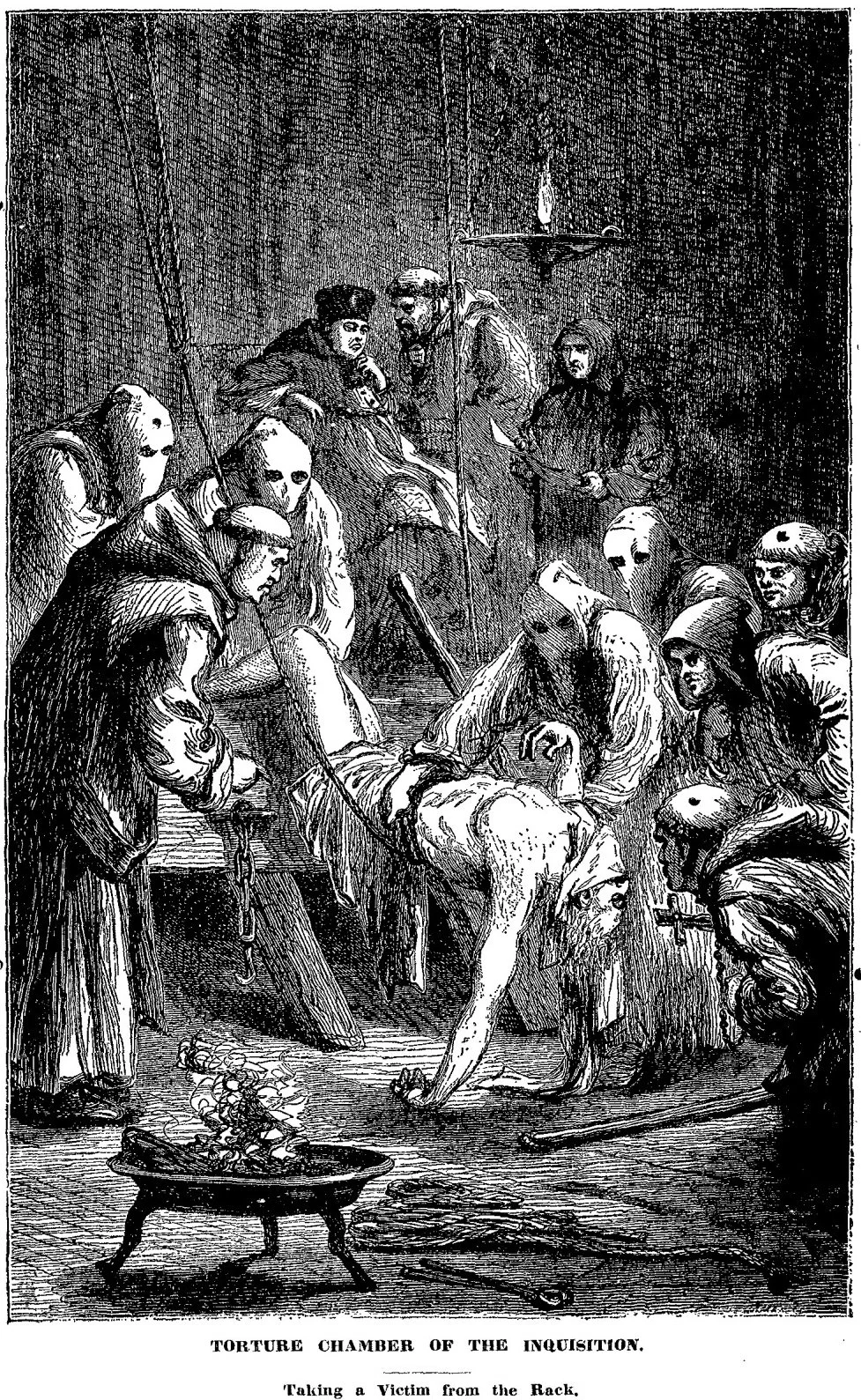
TORTURE CHAMBER OF THE INQUISITION.
Taking a Victim from the Rack.
“The Inquisition was a very merciful tribunal; I repeat it, almost a compassionate tribunal. . . A man was only allowed to be racked once, which no one can deny was a most wonderful leniency in those times.” See Mirror article on page 285.
If Right Why Deny the Facts?
But why, believing as he does that the Inquisition was right, Mr. Conway cares to enter even a partial denial of the charges against it is more than we can see. If, as he insists, “the church” was justified in punishing heretics even to the death, then the exact number so punished can make no material difference. If, as Mr. Conway also insists, it was the bounden duty of the church to root out heresy, she certainly could not be blamed for using whatever means seemed most likely to accomplish that result in the shortest time; and certainly nothing could have been more effective than the utter extinction of the incorrigible.
The Church Claims Infallibility.
It must be remembered that the Catholic Church claims infallibility through its head, the Pope. If this claim were true, the state of society and the customs of the times could make no difference with the acts of the church; they must be right. It is true that this infallibility is claimed only in “matters of faith and morals,” but certainly the right of the church to persecute dissenters, even to the death, is a question both “of faith and morals.” Members of that church evidently realize this, and practically admit it when they attempt to justify the action of the church in establishing and maintaining the Inquisition. Were it simply a question of expediency, of church discipline, or of anything outside of that for which they claim infallibility, they would certainly not stultify themselves by making any defense. Then might they well afford to say: “The church has never claimed infallibility in discipline; and in establishing and maintaining the Inquisition she erred.” But as the dogma that the church has a right to coerce the conscience, to compel obedience, is a matter of “faith,” and as torturing and killing men is a question of morals, they dare not say that the church erred in these things.
Two Inquisitions.
“History,” says Mr. Conway, “divides the Inquisition into two distinct tribunals; the Roman Inquisition and the Inquisition of the Spanish Government. Great care,” he adds, “must be taken not to confound the two. One is purely ecclesiastical, the other strictly secular.” In the light of this full and candid admission that the Roman Inquisition belonged wholly to the church, it is needless to dwell upon that phase of the subject. We shall examine briefly, therefore, his statement that “the other,” namely, the Spanish Inquisition, was “strictly secular.” And in so doing we shall find that “great care” is indeed required not to confound the two, so much are they alike, in origin, purpose and operation.
Defends the Spanish Inquisition.
In the first part of the latter half of his article Mr. Conway discusses the Spanish Inquisition at considerable length and gives quite an account of its origin, which he endeavors to show was purely political. He ascribes it altogether to the desire of the king to establish such a tribunal for political reasons, but in doing this he himself very clearly shows that this desire sprang, primarily, from intense religious feeling; and, as in his defense of the Roman Inquisition, he appeals in its justification to the customs of the people who lived at that time.
To Detect Jewish Hypocrites.
The claim made by Mr. Conway is that the Spanish Inquisition was directed particularly against the Jews, many of whom, “thirsting for wealth, while secretly remaining Jews, pretended to profess the Catholic faith, were baptized, pushed themselves into the courts and kingly palaces, became holders of large estates, and even were found among the priests and prelates of the Church of God. In this hidden, underhanded manner, they were seeking to overturn the institutions, not only of the Catholic Church, but also of the Spanish nation.”
Why Such Hypocrisy?
A pertinent question would be, Why did the Jews thus profess a faith which they did not believe? Was it not because of the corrupt union of Church and State which placed a premium upon hypocrisy, and upon moral and political corruption? and is it not evident from this that the logic of any union of Church and State is unbounded corruption in both? or an inquisition? because where it is made a matter of financial or political profit for men to profess a certain faith, many will be found to do so, and when they have so professed they will use their influence and positions for their own aggrandizement. To discover the secret thoughts of the hearts of such men the methods of the Inquisition must be used. Therefore Mr. Conway’s statement of facts constitutes a powerful argument against all union of Church and State, because such union must, in the first place, beget and foster hypocrisy; and hypocrisy can be completely discovered only by wringing from men the secrets of their hearts; and this can be done only by torture.
Was It Political?
But let us examine the political element which Mr. Conway insists entered into this matter. He says that these Jews in “this hidden, underhanded manner” “were seeking to overturn the institutions, not only of the Catholic Church, but also of the Spanish nation.” The last accusation, namely, that they were seeking to overturn the Spanish nation, must be understood in the light of other utterances by the same writer, who, in his attempted justification of the persecution of “the heretic,” styles him “a foe to civilization.” Roman Catholics believe that the Roman Catholic Church is the only efficient promoter of civilization, consequently anything that is opposed to the Catholic faith is, as they view it, opposed to civilization. In like manner they believe that the Catholic Church is the only adequate conservator of stable, civil government, therefore that which is opposed to the Catholic Church is opposed to civil government; thus runs their theory. So that in its last analysis that which is here assumed and asserted to be political was in fact religious; and to reach this and stamp it out the Spanish Inquisition, equally with the Roman Inquisition, was established.
The Consent of the Pope Necessary.
Again, Mr. Conway gives his whole case away when, in attempting to show that the Spanish Inquisition was “secular,” he admits the fact that before it could be established the consent of the Pope was necessary; and seeing himself the incongruity of having to receive the consent of the church for the establishment of something “strictly secular,” he asks: “What need was there of the permission of the popes? If the Inquisition was purely secular what had the Pope or the church to do with its actions?” And answering his own question he says: “The permission of Rome was necessary for many reasons, but chiefly for two, first, because the men who were appointed as inquisitors by the Court of Spain were priests and prelates and theologians of the church, and were for that reason under the jurisdiction of the popes; and secondly, and most especially, because the Inquisition was instituted to try people on matters of faith.”
Managed by Priests, Prelates and Theologians.
These facts thus clearly stated by a prominent Roman Catholic writer in a prominent Roman Catholic paper ought certainly to satisfy any candid mind as to the nature of the Spanish Inquisition. It existed by permission of the church, was administered by priests, prelates and theologians of the church, and existed for the purpose of trying people in matters of faith, and the punishments inflicted were for departures from the faith of the church.
Two Vital Questions.
But perhaps too much space has already been devoted to the discussion of this phase of the question. Two vital points yet remain to be examined. First, the confession of adulterous union of the Church with the State; and second, the parallel afforded by his article between justification of intolerance in the Dark Ages and justification of intolerance in our own day.
Confession of Adulterous Union.
Speaking of the relation which existed between the Church and the State in the days of the Inquisition, Mr. Conway says: “To put it briefly, in those Middle Ages there was the greatest union of Church and State. This union was the natural outcome of the beautiful marriage of civil and religious institutions. The State, then, as it should now, protected and defended her [his] holy bride from danger and persecution.” It is true that in the 21st chapter of Revelation the City of God is called “the bride, the Lamb’s wife.” But all through the Scriptures marriage is used to illustrate the relation which exists between Christ and his Church, and the Catholic Church holds and teaches that the church is the bride of Christ. But here we have it declared by a prominent Catholic writer, in an official organ of the church, that the union which existed between the Catholic Church and the State in the Middle Ages “was the natural outcome of the beautiful marriage of civil and religious institutions;” and that this was nothing less than the marriage of the State and the Church is shown by the words, “The State, then, as it should now, protected and defended her [his] holy bride [the church] from danger and persecution.” This is a confession of all that Protestants have ever charged against the Church of Rome, namely, that she is the lewd woman described in the 17th chapter of Revelation, “with whom the kings of the earth have committed fornication.”
The church being first married to Christ, and subsequently joined to the State, is by the Scriptures declared to be guilty of spiritual adultery. “For the woman which hath a husband is bound by the law to her husband so long as he liveth; but if the husband be dead, she is loosed from the law of her husband. So then if, while her husband liveth, she be married to another man, she shall be called an adulteress.”
What a warning is there in this against that for which the National Reformers are laboring, and upon which they insist, namely, a union of the State with religion, not, they say, with any particular church, but simply with Christianity. That is exactly what they283had in Rome, and that which followed was only the logical and inevitable outcome.
A Perfect Parallel.
One important point remains to be noticed, namely, the parallel between the “justification” of intolerance in the era of the Inquisition and the “justification” of intolerance now. We shall show this parallel by placing side by side a portion of two paragraphs from Mr. Conway’s article and a short extract from Judge Hammond’s dictum given August 1, 1891, at Memphis, Tenn., in the case of R. M. King, a Seventh-day Adventist, tried, convicted, and imprisoned for practical dissent from the religious faith of his neighbors as to the particular day to be observed as the Sabbath:—
Conway’s Defense of the Roman Inquisition.
“This was done when all the world embraced and the teachings of the Catholic Church. King and subject, prince and peasant, rich and poor, all believed her doctrines not only to be true, but to be incapable of being false. Schools and churches, assemblies and meeting-houses, echoed and re-echoed with her tenets and dogmas. And so, quite naturally, it seemed to all who lived in such surroundings, and rightly too, that any one who sought to destroy the faith of the nation, which is at all times its most priceless treasure, was as great an enemy to the State as one who contrived to undermine its civil institutions.”
“Moreover, since all statesmen and public officers were at the same time Catholics, it is most easy to understand that they enacted laws and punishment in keeping with their religious convictions. . . . All the laws had a tinge of Catholicity, and they were carried out in a manner savoring of the principles of that universal religion. Consequently, it is evident, that one who was a heretic then, was, by the very fact in opposition to the spirit of the laws and customs of his country—in other words, a disturber of the public peace, and an underminer of civil society.”
The Hammond’s Defense of the Tennessee Inquisition.
By a sort of factitious advantage, the observers of Sunday have secured the aid of the civil law, and adhere to that advantage with great tenacity, in spite of the clamor for religious freedom, and the progress that has been made in the absolute separation of Church and State. The courts cannot change that which has been done, however done, by the civil law in favor of the Sunday observers. The religion of Jesus Christ is so interwoven with the texture of our civilization and every one of its institutions, that it is impossible for any man or set of men to live among us and find exemption from its influences and restraints. Sunday observance is so essentially a part of that religion that it is impossible to rid our laws of it. . . . It is idle to expect in government perfect action or harmony of essential principles, and whoever administers, whoever makes, and whoever executes the laws, must take into account the imperfections, the passions, the prejudices, religious or other, and the errings of men because of these. . . . If one ostentatiously labors for the purpose of emphasizing his distaste for, or disbelief in, the custom [of keeping Sunday], he may be made to suffer for his defiance by persecutions, if you call them so, on the part of the great majority, who will compel him to rest when they rest.”
The parallel is complete, and he who assents to Judge Hammond’s reasoning in defense of the Tennessee Inquisition, cannot consistently dissent from Mr. Conway’s, in justification of the Roman Catholic Inquisition of the Middle Ages, as it existed in France, Spain, Holland and other countries. There can be no compromise on this question. It is “impossible for a magistrate [civil authority] to adjudge the right of preference among the various sects which profess the Christian faith, without creating a claim to infallibility, which would lead us back to the church of Rome.”
A ROMAN CATHOLIC PLAN FOR CHURCH REUNION.
By S.
Says the New York Sun, of September 1:—
The movement for the reconciliation of the Anglican Communion to the Papal See has Catholic as well as Protestant supporters; for instance, the Abbe Portal, an eminent Catholic theologian, concurs with Lord Halifax in believing that the fusion should be and could be effected. The plan which he favors was defined in a recent speech. He concurs with Lord Halifax in deeming the true unifying process to be not the conversion of individuals, to which the Catholic propaganda in England has been hitherto restricted, but corporate union, by which he means an agreement for consolidation between the leaders and authorities of the Church of England on the one part and of the church of Rome upon the other. This mode of consolidation, he says, would save the individual from the torture of doubt and other risks incurred by a personal investigation of the faith, and, above all, it would avoid the danger of shaking the whole roots of his spiritual life by forcing him to break violently with his religious past.
The Sun proceeds to state that this plan for reunion of the Anglican and Catholic communions has received condemnation from a source supposed to be the pen of Cardinal Vaughan, the English primate; and which would not be surprising, considering its impolitic nature in this enlightened day. Nevertheless the plan is essentially papal, and by it vast numbers of the heathen were, back in the early years of the great apostasy, received into the papal fold.
It was this wholesale “conversion” and reception of heathenism into the church that made the Papacy essentially what it is to-day in respect to religious belief and ceremonies. The conversion of individuals from heathenism to Christianity was altogether too slow a process to suit the purposes of the church in those days when she was struggling to rise to a place of preëminence from amidst the tumult of hostile forces around her. Conversions were by tribes and nations, through their “representatives,” and officials of the church were not always particular whether these “conversions” were made with the consent of the “converted.” Not infrequently the latter were given their choice between “conversion” and death. Of course this was because the “mystery of iniquity,” of which the Apostle Paul warned the church in his day, was working in the church and had perverted the latter from the way of righteousness and truth.
If the Abbe Portal were a resident in the United States, however, we would not feel certain that his plan had not been suggested by some events of our own times, and which also represent the action of “Protestants.” There is the movement which recently came before Congress, and will come before that body again, to make this nation “Christian” by amending its Constitution. This done, the people of the nation could be counted as as Christians, without “the torture of doubt and other risks incurred by a personal investigation of the faith.” This project has the approval and support of leading “Protestant” bodies in this country. As the reader may remember, also, it was not very long since that some prominent American Protestants counted all the Roman Catholics as supporters of a project for a national Sunday “law,” because the project had the approval of Cardinal Gibbons. That it is right for “the leaders and authorities” in the Church to think for the masses in the Church, and for the latter to do as their superiors bid them, is a principle always upheld by the papal church, and justified by Protestants on that occasion.
In rejecting the Abbe’s plan of “corporate reunion,” the papal authorities simply set the principle aside as inapplicable to the occasion of Anglican reunion with Rome at this time. The day of wholesale “conversions” to the “faith” seems to be past, and Rome prospers now by other methods. It is doubtless with surprise that Rome sees this principle taken up and indorsed in the name of Protestantism. Her surprise must be exceeded only by her exultation as she sees “Protestantism” opening the way for her to work with all the power and success of pre-Reformation times, for the spiritual enslavement of mankind.
S.
THE BUSINESS OF PREACHERS.
By S.
The business of preachers is to preach the gospel. Probably all preachers are agreed upon this point, but the world suffers by reason of the wide disagreement among them concerning what the gospel includes.
The gospel is the word of God. It is the business of preachers, as such, to preach that word, and no other. No preacher has any business to present, as gospel truth, that which is merely his own conclusions, however sure he may be that those conclusions are correct.
We have reached a time when the relation of the preacher to politics has become a theme of widespread discussion. There seems to be some doubt in the public mind as to the propriety of political discourses from the pulpit. In theory at least, the general sentiment in this country is opposed to a union of Church and State—a combination of religion with politics; and when the two are spoken of and treated as belonging to the same sphere of action, the average mind instinctively hesitates to give its sanction. But many voices are now heard explaining away this apparent distinction of nature and purpose, and showing how a clergyman can properly engage as a gospel minister in the discussion of politics. For instance, we quote the following from the Herald and Presbyter (Cincinnati), of September 2:—
There is a false sentiment in some localities that the ministry should confine themselves to religion and the church, and have nothing to do with politics. There is no class or profession that has more to do with making good citizens. They gather the people284from all classes and conditions of society; they bring them under the influence of gospel teaching; they instruct them in their duty to God and man, and build up the highest type of citizenship. Shall the man who teaches duty to God be forbidden to teach duty to society and the State? A minister is a citizen, and when he took the vows that set him apart to the sacred office, he became no less a citizen. There was nothing in his obligation which bound him to give up his civil rights. He does not cease to pay taxes, nor is he released from military service or jury duty. When the community is aroused over the discussion of questions that involve public morals, he as a public educator may have a duty to perform. Certainly he has a right to be heard when his home and friends are affected. . . . We see no reason why any man should be denied a voice in any public matter affecting the weal of the State. On the contrary every man has a duty to the State which he should intelligently and faithfully perform.
This certainly sounds very plausible, and is objectionable only in so far as it tends to break down the distinction which should be clear in every mind between the spheres of civil things and things religious. In civil things the majority must rule, and their rule must be by force. In religious things each individual must decide for himself, and his decision must be voluntary, not forced. When religion and politics are mixed, force is brought into the domain of voluntary action, and votes are made to do the work of faith.
Of course a clergyman has, like any other person, a civil right to express his mind upon secular questions which concern the welfare of individuals and of society. He may even do this from the pulpit, so far as civil rights are concerned; though the pulpit is certainly not the most appropriate place for secular themes. But let him present these as his own ideas and conclusions, and not as the word of God. This is the important point in the whole subject. The minister of the gospel is not sent to preach his own word, but God’s word. Why? Because there is no gospel in anything but the word of God. The gospel is “the power of God unto salvation to every one that believeth.” Rom. 1:16. What power is that? It is the power of God’s word? And what is that power? “By the word of the Lord were the heavens made, and all the host of them by the breath of his mouth.” Psalm 33:6. It is creative power. God’s word created all things in the beginning; it creates a new man now when received in faith; and that is how a sinner is saved from sin. He is “born again”—created new in Jesus Christ. This is the mystery of God in the gospel.
Then what business has the gospel minister to put his own word in the place of the word of God? Is man’s word a foundation for Christian faith? Is there any power in it to save the soul? Can it create a new and perfect man, as God’s word can? The great trouble with most of the preaching of this day touches this very point. It substitutes man’s word for God’s. The “sermon” presents the ideas, observations and conclusions of the preacher, in the place of the divine truths stated in the Scriptures. This is the reason there is so little power in it against the wickedness which is so dominant in society. And this is why it is deemed necessary for the preacher to appeal to the civil power and seek for a combination of politics with religion.
When the Saviour was on trial before Pilate, the latter asked him, “What is truth?” The Saviour had answered this question a short time before, in these words of his prayer for his disciples: “Sanctify them through thy truth; thy word is truth.” John 17:17. Would that preachers would always keep this text in mind! “Thy word”—not man’s word—“is truth.” It is the preacher’s business to preach truth. He may feel very sure that his own conclusions are truth, but that is not to the point. No man is infallible. Of no man can it be said, Thy word is truth. This is not impeaching any man’s honesty. It is but one way of stating the truth that all men are finite, and that “to err is human.” No man’s word can constitute the “sure foundation” which the Christian must have to stand upon in the contest with sin.
Several prominent preachers have of late been preaching strong “sermons” against “free silver,” denouncing as robbery the plan of one of the political parties to bring about “free coinage.” This affords an illustration of the point under consideration. These men are of course very sure that they are right, and it may be that they are. But again, it may be that they are not right. Multitudes of intelligent people believe that they are not. There is no certainty about it. What they state is merely their own conclusions, which no one is under obligation to receive as truth. So likewise the preacher may “preach” upon “any public matter affecting the weal of the State,” or of the community where he resides, if he chooses to do so; but unless he can read what he would present from the word of God, he will present merely his own opinions—nothing more. If anyone wishes to “preach” in this way, of course it is his privilege to do so.
But the preacher is not willing that his political sermon should be viewed in this light. He wants it to be received as gospel truth. He wants the same obligation to attach to it which pertains to the word of God. He wants to be able to speak upon secular matters of public interest, with the accredited authority of a prophet of God. He is not willing to present his political views as merely his own opinions, to be taken for what they are worth. The distinction between man’s word and God’s word having been largely obliterated in the public mind by the preaching of human tradition, speculation and fancy, in the place of Scripture, it is now sought to break down the distinction between the sphere of religion, in which God’s word rules, and the sphere of civil things, in which man’s word must prevail, as expressed by the majority of the people. And never in the history of this nation was sentiment in favor of this intermixture of politics and religion being formed more rapidly than is the case at the present time. And the meaning of it is that Church and State are rapidly seeking to occupy the same spheres of human thought and life, which can be done only by a union of these two powers, contrary to the foundation principles of our American Government.
S.
THE SULTAN'S MISTAKE.
By S.
THE following, which is taken from some statements made by the Rev. Mr. MacQueen, of Boston, just returned to this country from Turkey, affords a pretty good index to the amount of good done by the harangues of the clergy in favor of war upon the Turk. The Sultan, upon the arrival of Miss Clara Barton and her company, to engage in Armenian relief work, provided them with escorts. Mr. MacQueen tells us:—
When they first started, orders for the escorts were countermanded. This was because a bundle of American papers had arrived containing Talmage's sermon in which he fiercely denounced the Sultan. Seven days after, when the Turkish authorities learned who Talmage was and that his speech was not equivalent to a declaration of war, the order was reissued.
Considering all the facts in the case, not omitting to take account of the nature of Mr. Talmage's oratory, it would seem hardly more than to be expected that the Sultan should get from his “sermon” the impression he did. It is a rather peculiar state of things, from a Christian point of view, when what purports to be the preaching of the gospel of peace, by American clergymen, sounds to foreign rulers like an American declaration of war. S.
ARE THESE THINGS SO?
[Special Cable Dispatch to the Sun.]
LONDON, Sept. 5.—Turkey, it should be said, is not the only country where barbarities, without a shadow of excuse, are being committed. A terrible indictment has been made against the British forces engaged in suppressing the rebellion in Matabeleland. Several private letters from Buluwayo this week describe with an air of verity atrocities which amount to wholesale legalized murder. Nothing worse in general character is reported from Constantinople than this, from Englishmen engaged with the British detachment in pursuit of natives:—
“When out on patrol a week ago we suddenly surprised five Kaffirs sitting down watching some goats. They simply jumped up, threw down their shields and assegais, and covered their faces with their hands. One short command was given, and the five men were shot dead. We rode on as if nothing had happened.
“Another case is that of a young green doctor sent fresh from home by the Red Cross Society. He was tying up a wounded Matabele when a sergeant came by.
‘Hullo, doctor,’ says he, ‘what are you up to?’
‘Attending this wounded native,’ replies medico.
‘Nonsense,’ says the officer. ‘Leave the nigger and come and look after some of my men.’
‘No,’ says the doctor, ‘I must attend to this native first.’
‘Oh, you must, eh? All right. Bandage away.’ And he drew his revolver and blew half the Kaffir’s head off.”
THE CHURCH OF ENGLAND IN PARLIAMENT.
By S.
In England, as probably all readers of the SENTINEL know, there is a State Church—the “Church of England.” Other church members are “nonconformists.” The latter probably outnumber the adherents of the State Church, but receive no governmental recognition. The State Church receives the attention of Parliament, and being composed of two divisions—“High Church” and “Low Church”—sometimes gives that body no small amount of work in the settlement of church differences. This is especially noticeable the the present year. Not since the disestablishment of the Church in Ireland in 1868, we are told, has there been a session in which the concerns of the Church were more before Parliament than was the case during the summer just past.
In England, the State Church system is seen at its best; for the prevailing sentiment of the people is enlightened and liberal. But seen at its best, it presents no features that are not antichristian. The Outlook, of Aug. 29, gives us the following view of its practical workings, as now observed:—
The majority of English church livings—rectories, vicarages, and perpetual curacies—are private property, and oftentimes go with the landed estates out of which the ecclesiastical parishes are formed. Some English landlords have as many as nine or ten of these livings in their gift. What is meant by “in their gift” is that, when a living becomes vacant, the lord of the manor has the nomination in his hands. He presents to a living, and the new incumbent, having proved himself satisfactory to the bishop of the diocese, is formally admitted. Once admitted, he is in possession for life; and the lord of the manor, or whoever the patron may be, has nothing more to do with the living until the next vacancy occurs. When ecclesiastical patronage is attached to estates in the possession of Roman Catholics, the owners lose their rights to presentation. It is invested for the time being in one or other of the universities of Oxford and Cambridge.
The great landowners, as a rule, exercise these peculiar rights in connection with the Established Church with care and discretion, and usually with satisfaction to the bishops. There is seldom a scandal in connection with these presentations. Scandal arises in connection with livings in the gift of needy people, who, when a living seems likely to become vacant, turn the right to the next presentation into cash. In connection with livings in such hands there has long existed a regular trade. There are numerous agencies in London which make a specialty of advowsons, and when these agencies have a living on hand they advertise it, in just the same way as estate agents advertise houses and lands. These advertisements can be seen any day in the columns of the Times or the Standard.
The expert advertisement-writers of New York could not produce more attractive advertisements than some of those emanating from the brokers in church285livings. The advertisements usually make a central point of the advanced age of the present incumbent. This, of course, is a most important fact for a purchaser; for no one desires to invest money in a living when he may have to wait twenty years before he can present to it. A living is not a marketable property unless the incumbent is advanced in life, and the vacancy may be expected at an early date. The advertisements also describe the character of the Church service, whether it is High or Low.
High Church livings are in greatest demand, and it is always important for a prospective rector or vicar to know the character in this respect of the parish to which he is going. If the incumbent he is to replace has been a Low Churchman, the church wardens will be Low Churchmen too. They stay on after the old incumbent is gone, and may give trouble to a new incumbent of High Church tendencies. The age of the incumbent and the character of the service having been stated, there usually comes in these advertisements of advowsons for sale a glowing description of the parish and the surrounding country. The society of the neighborhood comes in for some notice, and oftentimes stress is laid on the fact that the fishing in the neighborhood is good, and that a pack of hounds meets a few miles away. Occasionally emphasis is laid on the fact that there are no dissenters in the parish—no Wesleyans, Congregationalists or Baptists; and that there is no school board.
For years past, sincere and earnest Churchmen have been shocked at the open manner in which the brokerage and auctioneering of church livings have been carried on. The Cranborne Bill is one of several efforts which have been made to regulate and check the sales.
It is only the spirit of the Reformation, which obtained such a strong hold upon the liberty-loving Anglo-Saxons, that has prevented England from reaping the more baleful fruits of this essentially papal system.